An Agency of Record, and What Appointing One Commits You To
Appointing one agency to lead your marketing settles who decides, who answers, and how long you are tied in. Read the terms before the pitch.


/ On this page9 sections
An agency of record (AOR) is the one agency a company has put under contract to lead a named part of its marketing.
The designation settles who is authorized to commit your spend, who answers when a campaign underperforms, and how long you are tied in.
Almost everything else said about the arrangement follows from those three.
You will meet the phrase in contracts, board minutes and trade stories more often than in conversation. The parts of it that cause trouble later are all decided before anyone starts work.
An Agency of Record, in Plain Terms
An agency of record is defined by its contract, not by its size, its services or how much of your work it happens to get.
Without that contract you have a favorite supplier. It carries none of the same obligations in either direction.
The words "of record" are not decoration. They mean the relationship is on the record: written down, dated, scoped, and known to the vendors and media owners the agency will be dealing with in your name.
You will also see "agency on record" written for the same thing. Nothing turns on the preposition.
The Other Agency of Record
In insurance the same phrase means something unrelated, and people land on it by accident.
There, an agency of record holds a book of policies for an insurer, and moving that book takes a signed release rather than a new pitch.
HealthPartners' own transfer of agency of record agreement has the existing agency give up all ownership and control rights over the groups and contracts it describes or attaches, to the receiving agency.
The two arrangements share the words and nothing else.
What the Designation Changes
Signing the contract changes three things, and they are the whole reason the arrangement exists.
- Authority. Inside its scope the agency can act in your name: negotiate rates, place orders, deal with vendors, commit money. That is the operative sense in media buying.
- Accountability. There is one number to call, and no argument about whose fault it was. Split the same work across four specialist suppliers and the gaps between them belong to nobody.
- Continuity. The agency accumulates your context and keeps it. A serious appointment at least puts it on the page: Visit The Woodlands' 2026 request for proposals states a preference for one consistent account team throughout the contract term, including at presentations.
Those three come with the structure. You get them by signing, whoever wins.
Being cheaper does not, though it is usually sold alongside them. Cheaper is a claim about one agency's fee against whatever you were spending in pieces, and it is true or false one arrangement at a time.
The Scope Is Written Into the Name
An agency of record appointment is always scoped, and the scope is normally written into the name of the appointment. Read the title of a real one and you already know most of what it covers.
Two public searches show how wide the range is:
- Calgary Economic Development's 2024 search is for a media agency of record, scoped to media strategy, media planning and media buying, over what the request for proposals calls a partnership for the next three years.
- Visit The Woodlands' 2026 search is for an integrated creative and media agency of record, which adds the making of the work to the buying of it.
So one phrase describes two different jobs. A media agency of record buys. An integrated one buys and makes.
Public relations, digital and creative appointments run on the same pattern.
Because each one is scoped, a company can hold several at the same time, and plenty do. One agency of record for media, another for public relations, a third for a product line in a market where the first has a conflict.
Settle the scope first. The term and the fee are easier to argue about, and neither will rescue an appointment scoped wrongly.
Scope is where these relationships go wrong: work one side assumed was included and neither side wrote down.
What an Agency of Record Does in a Normal Month
An agency of record does whatever its scope of work lists, and a published scope of work is unusually specific about it. The duties in Visit The Woodlands' 2026 request for proposals are a fair picture of an integrated appointment.
- Planning and buying the media. Not only placement: the scope names negotiation of competitive media pricing, added-value opportunities and bonus placements, which is where a buyer earns the fee.
- Watching the campaign and changing it. Continuous monitoring and optimization against performance, rather than a plan set in January and reported on in December.
- Running the account. Weekly status meetings, vendor and partner coordination, insertion orders, and then vendor payments, invoice reconciliation, auditing and billing.
- Reporting on a cycle. Monthly, quarterly and annual reports, with budget pacing, in the formats the client asks for.
- Making the work. Creative strategy, concepting, design and production, plus adapting and resizing creative assets for the formats they will run in.
Look at how much of that is administration.
Reconciliation, insertion orders, invoices and pacing are unglamorous, and they are a large share of what the fee buys.
That is not a criticism of the model. It is the clearest signal of who the model suits, which is a company whose marketing runs every week rather than twice a year.
How the Money Works
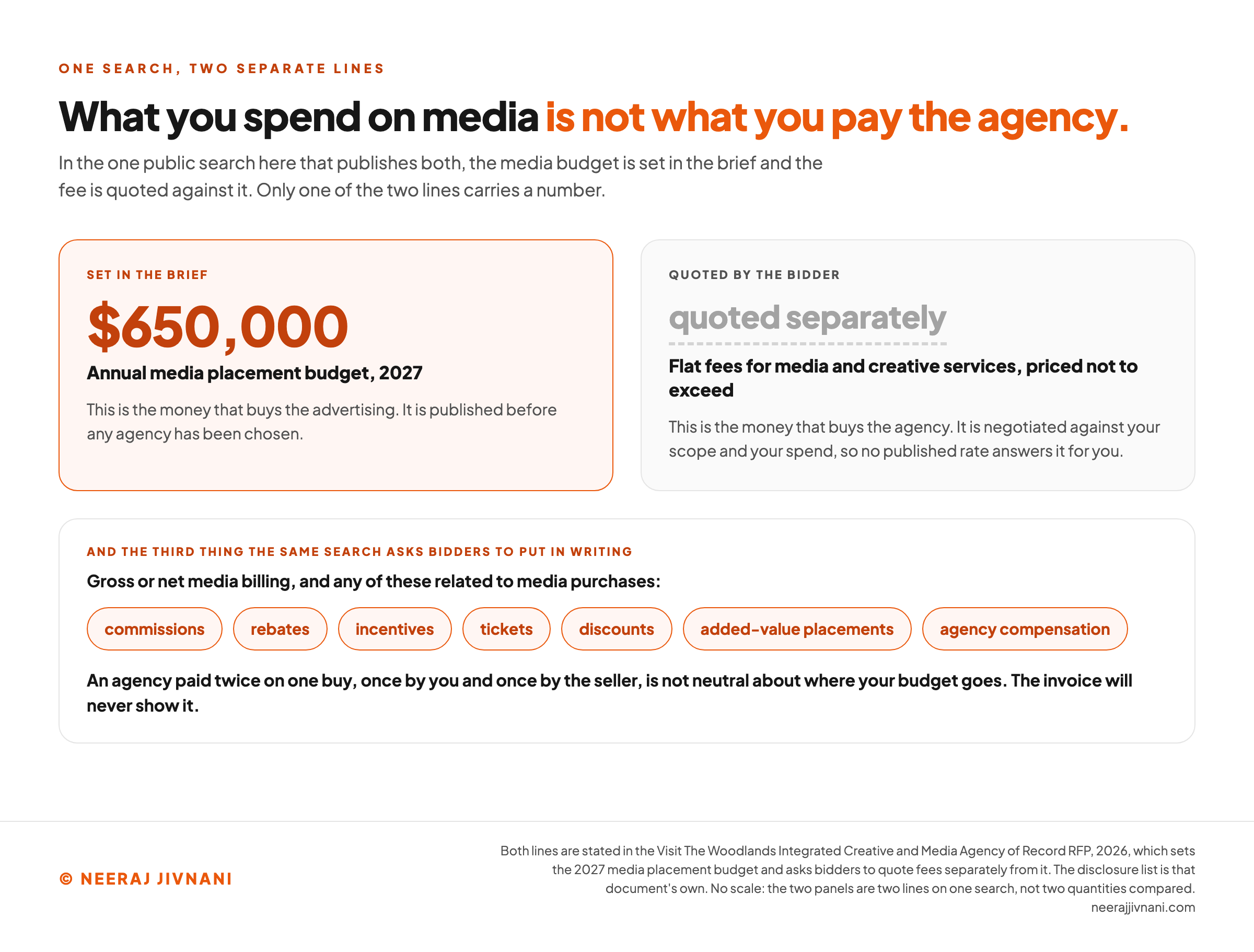
The money you spend on media is not the money you pay the agency. Some fee models put both on one line, which is the reason to insist on the split.
A search that publishes both lines shows the split on the page. Visit The Woodlands' 2026 request for proposals sets the 2027 annual media placement budget at $650,000, then asks agencies to quote flat fees for media and creative services separately from it, with not-to-exceed pricing.
Separating the two is the honest answer to what an agency of record costs, because the split is the part that does not move.
The fee itself is negotiated against your scope and your spend, and any number quoted to you as a market rate was set by somebody else's scope.
The Part to Ask About Before the Fee
How the agency is paid matters more than what it is paid.
A monthly retainer, a percentage of media spend, project fees and a mix of all three pull in different directions. A percentage of spend rewards spending more.
Which is why the disclosure questions a public search asks are worth copying into a private one. Visit The Woodlands asks bidders to disclose gross or net media billing and any commissions, rebates, incentives, tickets, discounts, added-value placements or agency compensation related to media purchases.
Ask for that same list before you sign.
An agency paid twice on one buy, once by you and once by the seller, is not neutral about where your budget goes. The invoice will never show it.
Use this chart — embed code and citation
<a href="https://neerajjivnani.com/blog/agency-of-record/"><img src="https://neerajjivnani.com/infographics/agency-of-record/two-lines-not-one.png" alt="Two panels for one search. The left panel, headed as set in the brief, carries $650,000, the annual media placement budget for 2027, described as the money that buys the advertising and published before any agency has been chosen. The right panel, headed as quoted by the bidder, carries no number at all and reads quoted separately over a dashed line, for flat fees for media and creative services priced not to exceed, described as the money that buys the agency and negotiated against your own scope and spend. A band below lists what the same search asks bidders to put in writing: gross or net media billing, and any commissions, rebates, incentives, tickets, discounts, added-value placements or agency compensation related to media purchases. It closes on the line that an agency paid twice on one buy, once by you and once by the seller, is not neutral about where your budget goes, and the invoice will never show it." width="1200"></a>
<p>Chart: <a href="https://neerajjivnani.com/blog/agency-of-record/">Neeraj Jivnani</a></p>Neeraj Jivnani, "An Agency of Record, and What Appointing One Commits You To", neerajjivnani.com, https://neerajjivnani.com/blog/agency-of-record/Free to republish with a link back to this page.
The Length of the Commitment
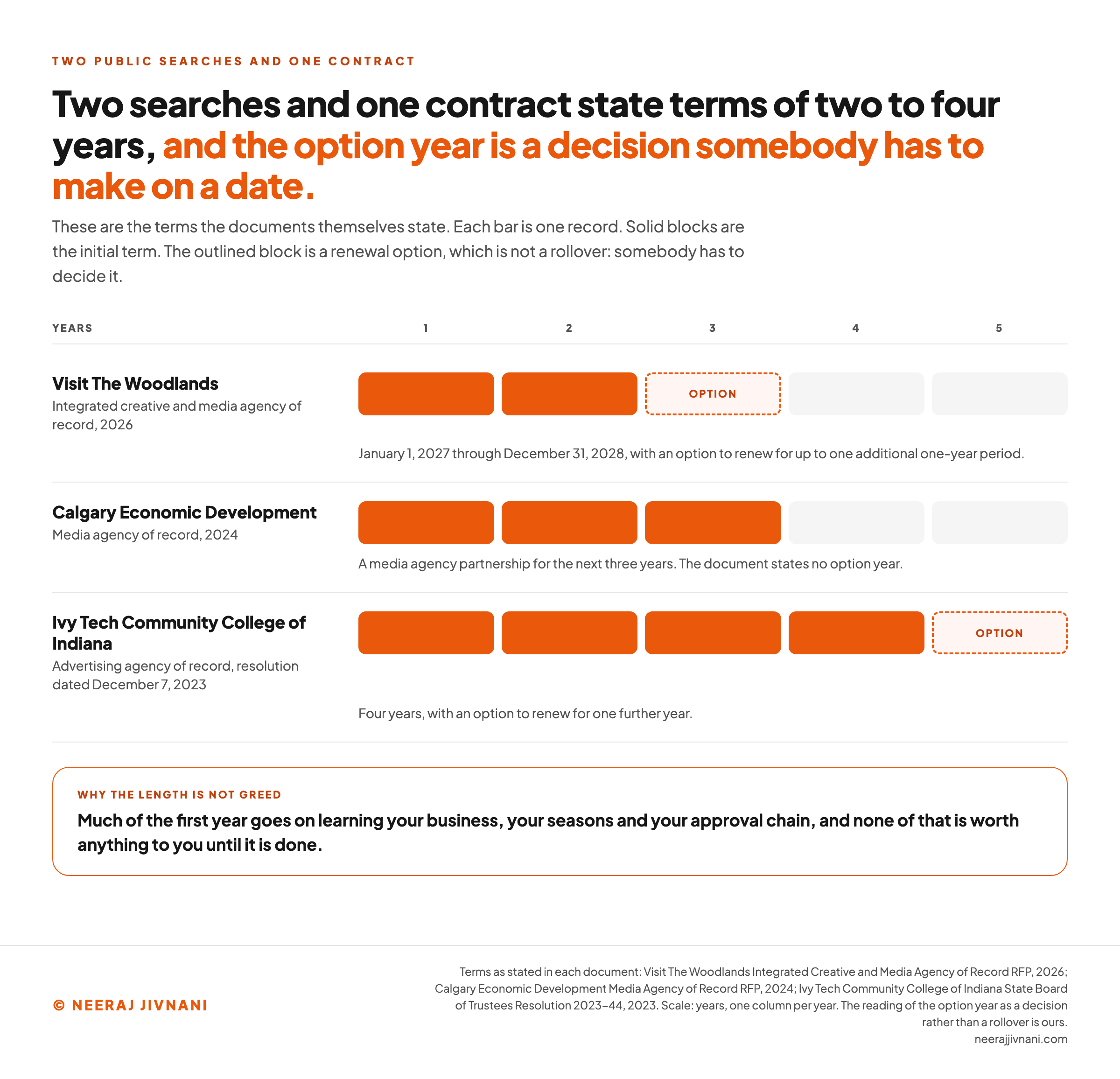
Initial terms run between two and four years in these public records, and they renew rather than roll.
- Visit The Woodlands, 2026. An initial term anticipated to run from January 1, 2027 through December 31, 2028, with an option to renew for up to one additional one-year period, contingent on performance, funding availability and mutual agreement.
- Calgary Economic Development, 2024. A media agency partnership for the next three years.
- Ivy Tech Community College of Indiana. Williams Randall was contracted as the college's advertising agency of record in June 2021, on a term of four years with an option to renew for one further year. The state board of trustees resolution recording that is dated December 7, 2023.
The length is not greed. Much of the first year goes on learning your business, your seasons and your approval chain, and none of that is worth anything to you until it is done.
The renewal option is the clause to read twice. It turns a rolling relationship into a decision somebody has to make on a date, which is the opposite of how most agency relationships end.
A poor fit shows long before a term like that runs out. Put a mid-term review in the contract so the first honest conversation about it is not the renewal negotiation.
Use this chart — embed code and citation
<a href="https://neerajjivnani.com/blog/agency-of-record/"><img src="https://neerajjivnani.com/infographics/agency-of-record/terms-run-in-years.png" alt="Three horizontal bars on a scale of five years, one bar for each public record. Visit The Woodlands, an integrated creative and media agency of record in 2026, shows two solid years for an initial term running January 1, 2027 through December 31, 2028, followed by a dashed block marked option for up to one additional one-year period. Calgary Economic Development, a media agency of record in 2024, shows three solid years for a media agency partnership for the next three years, with no option year stated in the document. Ivy Tech Community College of Indiana, an advertising agency of record whose resolution is dated December 7, 2023, shows four solid years followed by a dashed option block for one further year. A band across the foot says much of the first year goes on learning your business, your seasons and your approval chain, and none of that is worth anything to you until it is done." width="1200"></a>
<p>Chart: <a href="https://neerajjivnani.com/blog/agency-of-record/">Neeraj Jivnani</a></p>Neeraj Jivnani, "An Agency of Record, and What Appointing One Commits You To", neerajjivnani.com, https://neerajjivnani.com/blog/agency-of-record/Free to republish with a link back to this page.
How a Brand Picks One
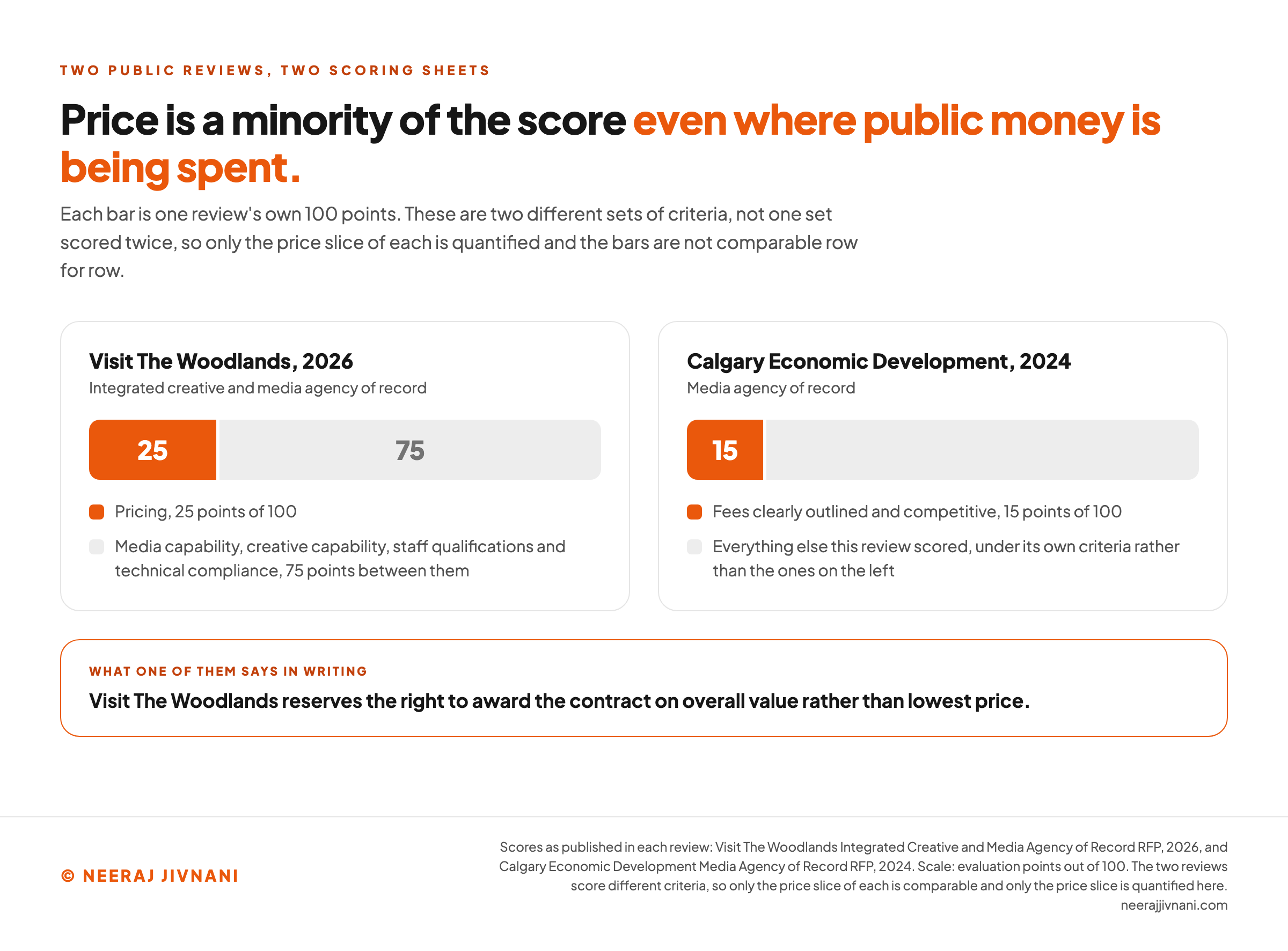
A scored review picks the agency, and in the searches on public record price is a minority of that score.
Visit The Woodlands' 2026 evaluation gives pricing 25 points out of 100, with the remaining 75 split between media capability, creative capability, staff qualifications and technical compliance. Calgary Economic Development's 2024 evaluation gives 15 points out of 100 to whether fees are clearly outlined and competitive.
Both are public bodies spending public money, which is the case where you would most expect the lowest bid to win.
The lowest bid does not have to win. Visit The Woodlands' 2026 search reserves the right to award the contract on overall value rather than lowest price.
Weight your own review the same way. The difference between a good agency and a cheap one will cost you more than the fee gap inside a single quarter.
Both reviews also demand something a private appointment can easily leave out. Calgary Economic Development requires bidders to disclose in writing any possible conflict of interest, or anything that could be perceived as one, and reserves the right to reject a proposal on that basis.
Visit The Woodlands requires bidders to disclose current or anticipated engagements with competing destination marketing organizations, convention and visitors bureaus, municipalities and hospitality clients. Ask the same of your own shortlist, and ask it early rather than after you have picked a favorite.
Finding Out Who Holds a Brand's Account
Agency of record appointments tend to surface. The winning agency announces it, the client confirms it, the trade press tracks the reviews, and in the public sector it lands in the minutes.
Ivy Tech's appointment of Williams Randall can be read in a numbered board resolution by anyone who wants to.
That resolution records a dated fact, not a live roster, and the distinction matters: that term has since run out. No holder is named here as current for any brand, because accounts move, reviews run every few years, and a name presented as current turns false on its own.
Use this chart — embed code and citation
<a href="https://neerajjivnani.com/blog/agency-of-record/"><img src="https://neerajjivnani.com/infographics/agency-of-record/price-is-a-minority.png" alt="Two scoring sheets side by side, each drawn as its own bar of 100 evaluation points. Visit The Woodlands in 2026, searching for an integrated creative and media agency of record, gives pricing 25 points of 100, with media capability, creative capability, staff qualifications and technical compliance sharing the other 75 between them. Calgary Economic Development in 2024, searching for a media agency of record, gives 15 points of 100 to whether fees are clearly outlined and competitive, and the rest of its bar is left unquantified because that review scores its own criteria rather than the ones beside it. A note says the two bars are not comparable row for row. A band across the foot says Visit The Woodlands reserves the right to award the contract on overall value rather than lowest price." width="1200"></a>
<p>Chart: <a href="https://neerajjivnani.com/blog/agency-of-record/">Neeraj Jivnani</a></p>Neeraj Jivnani, "An Agency of Record, and What Appointing One Commits You To", neerajjivnani.com, https://neerajjivnani.com/blog/agency-of-record/Free to republish with a link back to this page.
The Test Is Weeks a Year, Not Budget
You need an agency of record when your marketing runs continuously. You do not when it runs in bursts.
The model buys accumulated context, and context is only worth paying for while somebody is using it.
So the unit is weeks a year: how many of them you need a team thinking about your marketing.
Say you run two campaigns a year around a trade show. A retainer funds the whole calendar to hold a team you use for two stretches of it.
Whatever the team learned in the spring has gone stale by the autumn.
Weeks a year is the first test and it is not the only one. A single channel done properly wants a specialist even when the work never stops, and a generalist appointed over it will subcontract that specialist anyway, at a margin.
The other case is a team that already knows what it wants made. If your people set the direction and need execution, the appointment adds a layer of account management whose job is to receive instructions.
Weeks a year, not budget
Mark the weeks your marketing actually needs a team thinking about it. Click a week, or hold and drag across a run of them. Nothing here is scored and nothing is kept.
One year, 52 weeks
You need an agency of record when your marketing runs continuously. You do not when it runs in bursts. Mark your own year above and the difference stops being a description.
The Exclusivity Runs Both Ways
Exclusivity is the last thing to weigh, and it is a cost as much as a benefit.
The conflict rules in these appointments are strict. Calgary Economic Development can reject a bidder over a conflict that is merely perceived, and Visit The Woodlands wants competing destination marketing organizations and hospitality clients disclosed up front.
Read that from your own side of the table. The agency turns away your competitors, which is worth real money to you, and in exchange you give up the ability to bring in a better team for one job without reopening the contract.
The strongest argument the other way deserves taking seriously.
Every new supplier has to be told everything from the start, and nobody invoices you for the hours you spend explaining your business for the fifth time.
That cost is real and it is invisible, which is why consolidating can feel like a saving even when the fee goes up.
Be honest about which of the two you are buying.
Ending One Cleanly
Write the ending before you sign the beginning. The clause that matters is not the notice period, it is what has to be handed back.
A well-drafted appointment makes the handover a contractual duty rather than a courtesy. Visit The Woodlands' 2026 request for proposals states that the selected agency will participate in onboarding and transition activities, including transfer of campaign assets, reporting and account access.
Account access is the item that hurts.
Ad accounts, analytics properties, tag containers, pixel installs, domain records and creative source files all tend to accumulate in whichever agency set them up.
If those sit in the agency's name and the relationship ends badly, you are rebuilding rather than transferring, and you are doing it while your campaigns are dark.
So the clause to write is dull and specific. Name the accounts that stay in your ownership from day one, name the file formats you get back, and set a date by which the handover has to be finished.
An agency of record is a designation, not a service tier. It does not make an agency better and it will not make your marketing work.
What it settles is who decides, who answers, and for how long. That is worth settling when the work is continuous, and worth avoiding when it is not.