B-Roll, and the Shots Worth Writing Down
B-roll is the footage that shows what the talking describes, and most of what you need to shoot is already named in your own script.

/ On this page12 sections
B-roll is the footage your edit cuts to while the main audio keeps running. Someone is talking, the picture moves to the thing they are talking about, and their voice never stops.
Which clips you will use, where to get them and how long to hold each one are the three questions worth settling before a camera comes out.
All three are settled by one list, and most of that list is already written down in your script.
B-Roll Is the Footage the Picture Cuts To
B-roll is supporting footage laid over or between your main footage. The main footage carries the message; the B-roll carries what the message is about.
On a timeline it is whatever sits above the take that is doing the talking. The audio underneath belongs to that take, so the cut is visible and never audible.
Say a bakery films its owner explaining a new sourdough. The B-roll is the oven, the dough being folded, the loaves coming out, the queue outside before opening.
That is the working sense, and it covers more than people expect. A close-up of hands is B-roll, and so is a wide shot of the street outside.
So is a screen recording of the software, a clip from last year's event, and a shot of the same speaker walking into the room.
The phrase has loosened outside edit suites. In social video it now gets used for any scene-setting footage at all, including clips that carry a whole video with nothing playing under them.
That looser use is common enough to be worth knowing, and it is not what an editor means.
A-Roll Says It, B-Roll Shows It
A-roll says it. B-roll shows it.
A-roll is the take that carries the sentence, and B-roll is what the picture goes to while that sentence finishes. The distinction turns on the job a clip is doing.
An expensive drone shot is B-roll if the video would still make sense without it. A phone clip of a delivery van is A-roll if it is the only thing saying what happened.
The test is whether you could listen with your eyes shut and still follow the video. Everything you would still hear is A-roll.
The term A-roll has mostly fallen out of everyday use, which is why people who say "B-roll" daily rarely say its opposite.
It is worth keeping anyway. The pairing is what stops the word meaning "any nice-looking clip we shot".
Why the Name Is a Letter
The letters come from cutting film, and the mechanism still describes what the footage does.
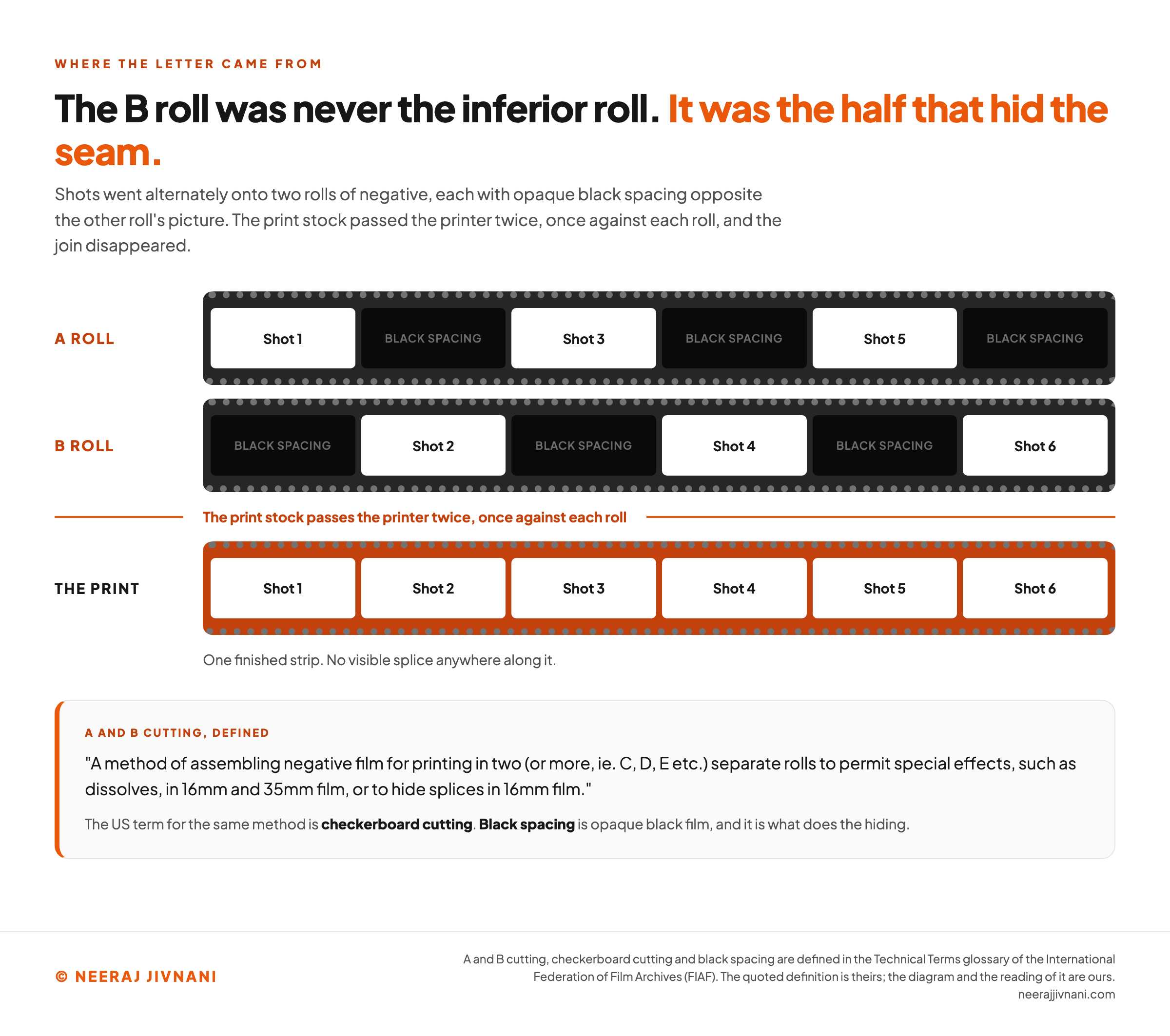
Shots went alternately onto two rolls of negative, each with black spacing, an opaque length of film, opposite the other roll's picture. The print stock passed the printer twice, and the join disappeared.
Two things were being solved that way: effects like dissolves, and joins that would otherwise show.
The International Federation of Film Archives defines A and B cutting as "A method of assembling negative film for printing in two (or more, ie. C, D, E etc.) separate rolls to permit special effects, such as dissolves, in 16mm and 35mm film, or to hide splices in 16mm film".
The US term for the same method is checkerboard cutting.
So the B roll was never the inferior roll. It was the second half of a pair, and the half that kept the seam from showing.
That is still the job.
Use this chart — embed code and citation
<a href="https://neerajjivnani.com/blog/b-roll/"><img src="https://neerajjivnani.com/infographics/b-roll/why-the-name.png" alt="A diagram of A and B roll checkerboard cutting. Two parallel filmstrips run left to right. The A roll carries the odd-numbered shots with opaque black spacing opposite every even shot; the B roll carries the even-numbered shots with black spacing opposite every odd shot. An arrow underneath shows the print stock passing the printer twice, once against each roll, producing one finished strip with no visible splice. A caption states that the International Federation of Film Archives defines A and B cutting as a method of assembling negative film into separate rolls, one purpose of which is to hide splices in 16mm film, and that the US term for it is checkerboard cutting." width="1200"></a>
<p>Chart: <a href="https://neerajjivnani.com/blog/b-roll/">Neeraj Jivnani</a></p>Neeraj Jivnani, "B-Roll, and the Shots Worth Writing Down", neerajjivnani.com, https://neerajjivnani.com/blog/b-roll/Free to republish with a link back to this page.
What Counts as B-Roll
What counts as B-roll is almost anything, so the useful question is which kind of shot you are short of.
These are the categories that come up in real edits:
- Establishing shots. The building, the street, the room from the door. They tell a viewer where they are, and one of them usually opens the video.
- Detail shots. A hand on a control, a label, a screen. These do the most work per second and are the easiest to forget on the day.
- Process shots. Each step of the job being done, filmed step by step. If your video explains a method, these are not decoration, they are the explanation.
- Reaction shots. Someone listening, nodding, laughing. In a two-person interview they are the cleanest way out of a jump cut.
- Cutaways. A short move away from the main scene and back. The general case that the four above are all versions of.
- Screen recordings. For anything software-shaped this is the B-roll, and it is the one people forget to capture until the edit.
- Archive. Footage you already own from an event or a site visit. Free, on brand, and sitting in a folder nobody has opened.
Stock footage and generated footage count too. Getting hold of them is a different problem from shooting them, and it has its own section.
What the Footage Does That the Talking Cannot
B-roll is hired for four jobs. Naming the job before you shoot is what stops a folder of pretty clips that never get used.
It shows the thing. A product, a process or a place is faster to understand seen than described, and a viewer who has seen it stops picturing something else.
It hides the join. Cut two sentences out of an interview and the head jumps. A cutaway over the join makes that invisible, which is the oldest reason B-roll exists.
It gives the eye somewhere to go. A face talking for six minutes is hard to stay with, whatever the face is saying.
It sets the place. One wide shot at the top saves a sentence of explanation.
Those four cover documentary, news, interviews, tutorials, social clips and corporate video alike.
The format changes the length and the framing. It does not change what the footage is for.
Write the Shot List From the Nouns in Your Script
Your shot list is already written, and it is sitting in your script.
Read the script or the interview questions and mark every concrete thing they name. The product. The workshop. The delivery van. The form somebody fills in.
Say a script reads: we bring the parts in from several suppliers, and we test every unit before it ships. That is two shots, the loading bay and the test bench, and the edit will want both at a known second.
Each marked noun is a shot the edit will reach for, because the audio names it out loud.
Do that and the usual habit of filming plenty of spare footage stops being necessary. Spare footage is insurance against not having decided, and it costs an afternoon of filming plus an evening of watching it back.
Your shot list is already written
It is the things your script names out loud. Put the script in, tap every concrete thing it names, and the list assembles as you go.
Nothing to hand? This is the line the post works through.
A few things belong on the list that no script names.
One wide establishing shot of wherever you are. One shot of the speaker doing something other than speaking.
And a slow pass over whatever is on the desk, because detail shots rescue more edits than anything else on the list.
A Published Package, Shot by Shot
What a company hands over in practice is a plain list, and it is worth copying.
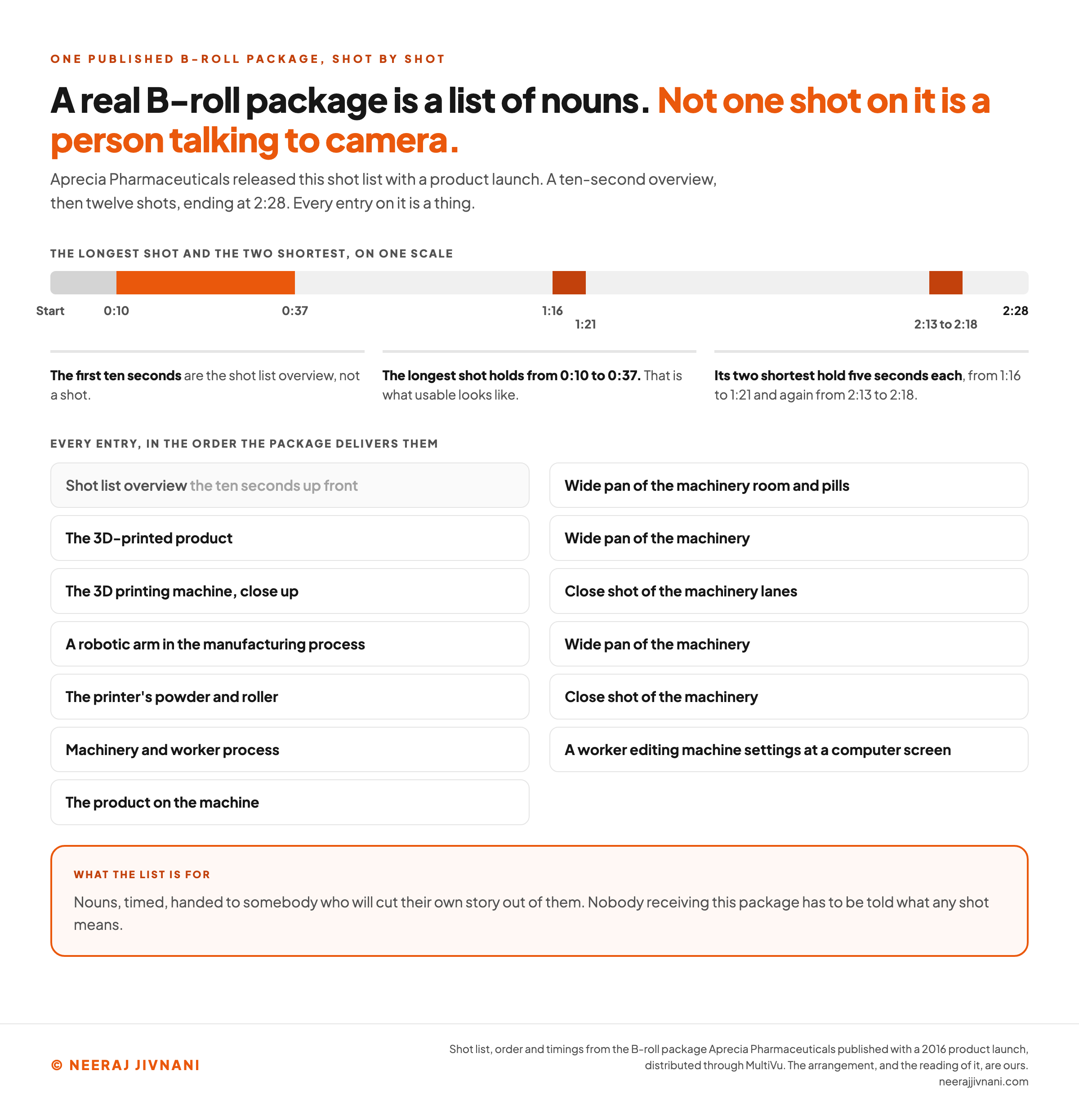
Aprecia Pharmaceuticals published a B-roll shot list with a 2016 product launch, distributed through MultiVu. After a ten-second overview it runs twelve shots and ends at 2:28.
The shots are the 3D-printed product, the printing machine in close up, a robotic arm in the manufacturing process, and the printer's powder and roller.
Then machines and worker process, the product on the machine, a wide pan of the machinery room and pills, two more wide pans of the machinery, close shots of the lanes and of the machinery, and a worker editing machine settings at a computer screen.
Every entry is a thing. Not one of them is a person talking to camera.
That is what a B-roll package is. A list of nouns, timed, handed to somebody who will cut their own story out of it.
Use this chart — embed code and citation
<a href="https://neerajjivnani.com/blog/b-roll/"><img src="https://neerajjivnani.com/infographics/b-roll/published-package.png" alt="A timeline of a real published B-roll package. Aprecia Pharmaceuticals' B-roll shot list, published with a 2016 product launch and distributed through MultiVu, runs from 0:00 to 2:28: a ten-second shot list overview, then the 3D-printed product, the 3D printing machine in close up, a robotic arm in the manufacturing process, the printer powder and roller, additional machines and worker process, the 3D-printed product on the machine, a wide pan of the machinery room and pills, a wide pan of machinery, a close shot of machinery lanes, a further wide pan of machinery, a close shot of machinery, and a worker editing machine settings at a computer screen. Every one of the twelve shots names a thing rather than a person speaking." width="1200"></a>
<p>Chart: <a href="https://neerajjivnani.com/blog/b-roll/">Neeraj Jivnani</a></p>Neeraj Jivnani, "B-Roll, and the Shots Worth Writing Down", neerajjivnani.com, https://neerajjivnani.com/blog/b-roll/Free to republish with a link back to this page.
Where a Clip Comes From When You Did Not Get It on the Day
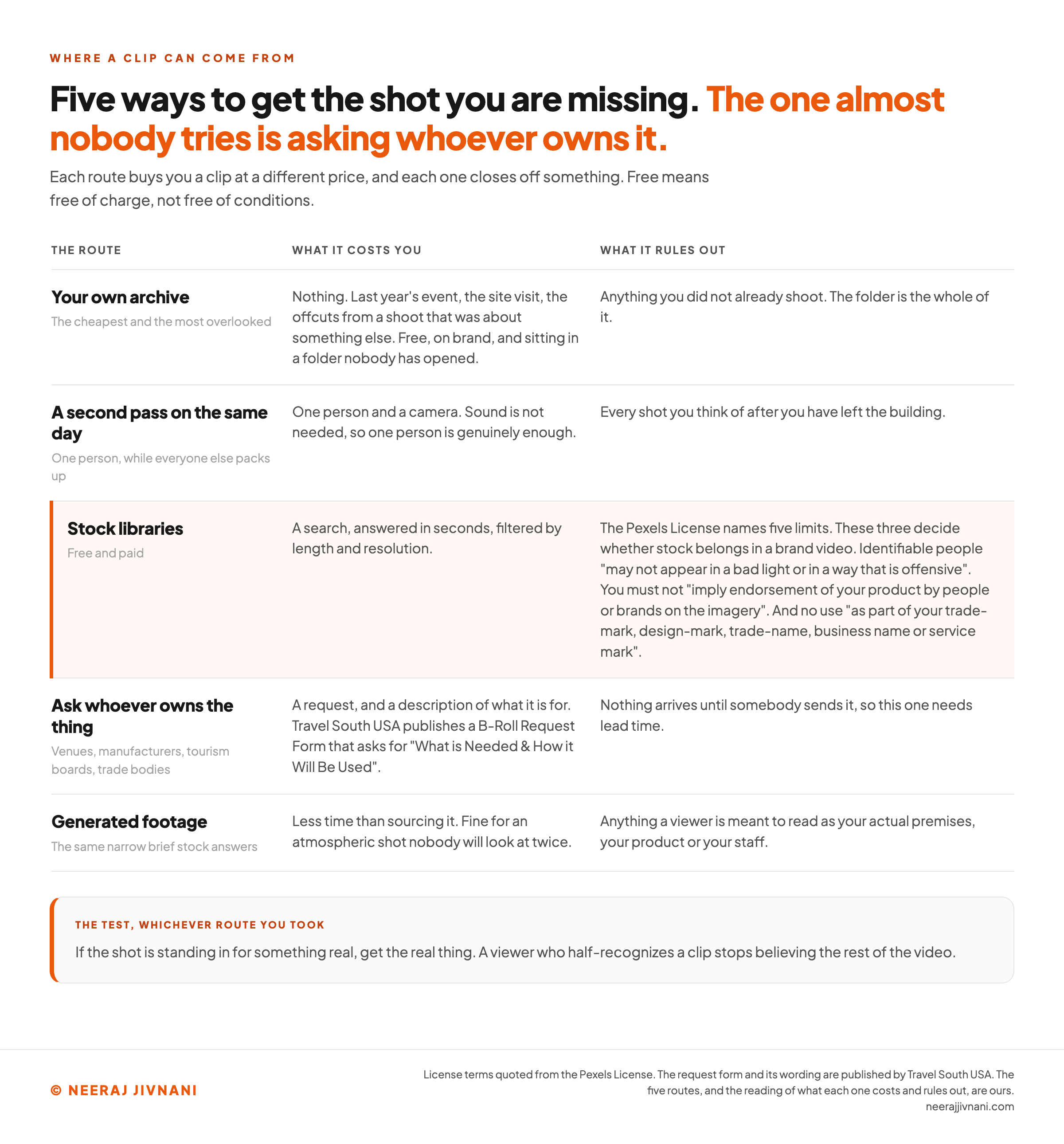
Five routes lead to a clip you do not already have, and only one of them means picking up a camera again. The rest exist because the thing you need is often somewhere you are not.
Your own archive is the cheapest and the most overlooked. Last year's event, the site visit, the offcuts from a shoot that was about something else.
A second pass on the same day. Send one person back with the camera while everyone else packs up. Sound is not needed, so one person is genuinely enough.
Stock libraries, free and paid, answer a search in seconds and let you filter by length and resolution.
Ask whoever owns the thing. This is the route almost nobody tries, and organizations publish forms for it.
Travel South USA, a regional tourism marketing body, publishes a B-Roll Request Form. It asks a requester to describe "What is Needed & How it Will Be Used" before it sends any footage over.
Venues, manufacturers, tourism boards and trade bodies often hold usable footage of their own place or product.
Generated footage, which answers the same brief as stock and answers it faster.
What a Free Stock License Does Not Cover
Free means free of charge, not free of conditions, and the conditions bite hardest in exactly the video you are making.
The Pexels license permits modification and does not require attribution. It then sets five limits on what may be done with a clip, and three of them decide whether stock belongs in a brand video.
Identifiable people "may not appear in a bad light or in a way that is offensive".
You must not "imply endorsement of your product by people or brands on the imagery".
And you must not use the footage "as part of your trade-mark, design-mark, trade-name, business name or service mark".
Read the second one twice.
Cutting a smiling stranger into a video about your product, over a voiceover about happy customers, is a fair description of implying endorsement.
Our position on stock is narrower than the libraries would like. It works for weather, traffic, wide country and generic city motion, where nobody is claiming the shot is yours.
It reads as stock the moment it is meant to be your office, your team or your customers. A viewer who half-recognizes a clip stops believing the rest of the video.
Generated Footage
Generated clips answer the same narrow brief that stock does, and they answer it faster.
They are fine for an atmospheric shot nobody will look at twice. They are the wrong tool for anything a viewer is meant to read as your actual premises, your product or your staff, and that is a trust judgment rather than a technical one.
The test is the same either way. If the shot is standing in for something real, get the real thing.
Use this chart — embed code and citation
<a href="https://neerajjivnani.com/blog/b-roll/"><img src="https://neerajjivnani.com/infographics/b-roll/five-routes.png" alt="A five-row comparison of where a B-roll clip can come from. Your own archive: costs nothing, is already on brand, and is limited to what you happened to shoot. A second pass on the same day: one person and no sound recording needed, but only available while you are still on site. Stock libraries: fast and searchable, and carrying license conditions, with the Pexels license forbidding footage that implies endorsement of your product by people or brands, that shows identifiable people in a bad light, or that is used as part of a trade mark or business name. Asking whoever owns the place or product: free and specific, and it needs lead time, with Travel South USA publishing a B-Roll Request Form that asks what is needed and how it will be used. Generated footage: less time than sourcing it, and unusable where the shot is standing in for your real premises, product or staff." width="1200"></a>
<p>Chart: <a href="https://neerajjivnani.com/blog/b-roll/">Neeraj Jivnani</a></p>Neeraj Jivnani, "B-Roll, and the Shots Worth Writing Down", neerajjivnani.com, https://neerajjivnani.com/blog/b-roll/Free to republish with a link back to this page.
How Much You Need, and How Long Each Shot Runs
Count the places your edit will want a picture change, and shoot one usable clip for each. That is the quantity, and you can work it out before you leave the office.
Two things push it up. Any join you plan to hide needs its own cutaway, and a clip only counts once, because using the same shot twice in one video is the most visible sign of a thin shoot.
Length is the part people get wrong on the day.
A shot has to be held far longer than it feels while you are filming, because the edit needs room either side of the moment it uses.
In Aprecia's package the two shortest shots hold five seconds each, from 1:16 to 1:21 and from 2:13 to 2:18, and the longest holds twenty-seven seconds, from 0:10 to 0:37.
Five seconds is the floor there.
Hold longer than you think and the decision stays yours in the edit.
The other half of the answer is about the cut rather than the clip. A cutaway that sits on screen after it has made its point starts drawing attention to itself, and the viewer begins wondering why they are still looking at a doorway.
Cutting It In
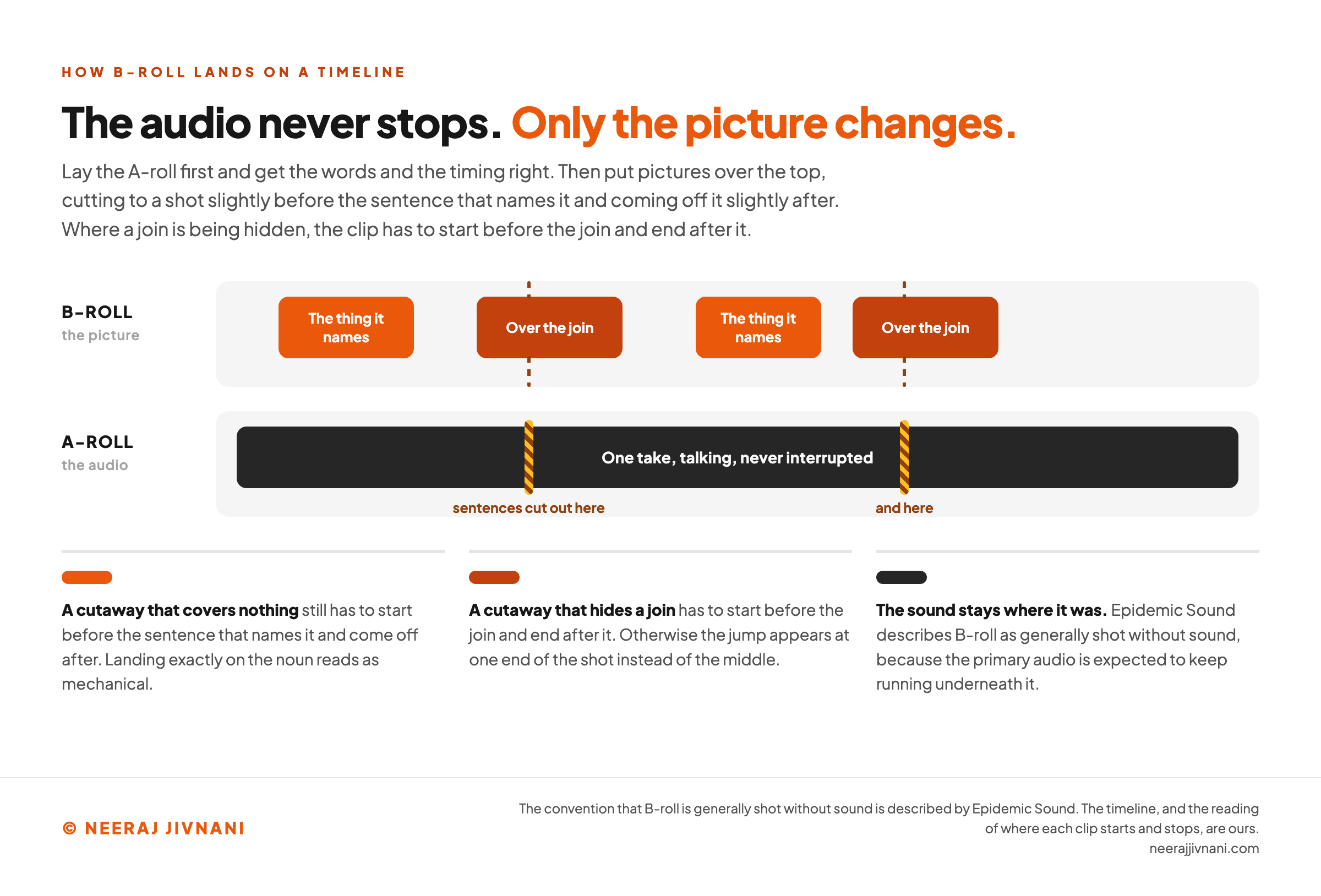
Cutting B-roll in starts with the audio. Lay the A-roll first, get the words and the timing right, and only then put pictures over the top.
Cut to the shot slightly before the sentence that names it, and come off it slightly after. Landing exactly on the noun is technically correct and reads as mechanical.
Where you are hiding a join, the cutaway has to start before the join and end after it. Otherwise the jump appears at one end of the shot instead of the middle.
The last check is the cheapest one available.
Watch the sequence through once with the picture only, no sound, and see whether it still describes what happens. A sequence that makes no sense silent is usually a sequence of decoration.
Use this chart — embed code and citation
<a href="https://neerajjivnani.com/blog/b-roll/"><img src="https://neerajjivnani.com/infographics/b-roll/two-tracks.png" alt="A two-track timeline diagram. The lower track is the A-roll: one continuous interview take, unbroken audio, with two shaded gaps marking places where sentences were cut out. The upper track is the B-roll: four separate picture clips laid over the A-roll, each one starting shortly before the moment its sentence names and ending shortly after, and two of them positioned so they span the shaded joins in the track below. A note states that the audio never stops, only the picture changes, which is why Epidemic Sound describes B-roll as generally shot without sound." width="1200"></a>
<p>Chart: <a href="https://neerajjivnani.com/blog/b-roll/">Neeraj Jivnani</a></p>Neeraj Jivnani, "B-Roll, and the Shots Worth Writing Down", neerajjivnani.com, https://neerajjivnani.com/blog/b-roll/Free to republish with a link back to this page.
Does B-Roll Have Sound?
Usually not, and the reason is structural rather than stylistic: the primary audio keeps running underneath, so the clip is generally shot without sound, as Epidemic Sound describes it.
That does not mean switching the microphone off.
Record whatever ambience the location gives you, then decide in the edit whether a little of it under the cut helps. A machine running, a door closing, a room full of people: those are worth capturing and mixing low.
What almost never works is cutting to a clip and letting its own audio take over. The moment the voice stops, the viewer notices the edit, which is the one thing the cutaway was there to prevent.
Where a Cutaway Makes It Worse
Four times a cutaway makes a video worse rather than better, and the shot list is shorter for knowing them.
When the shot adds nothing the sentence did not. Cutting to a laptop while somebody says "we sent an email" tells a viewer nothing.
When the speaker is the point. A founder explaining a decision, an apology, a piece of bad news: covering their face with scenery reads as evasion.
When it is a screen share with a voice over it. The screen is already the picture, and cutting away from it loses the only thing anybody is watching.
When you cannot shoot the real thing. A stand-in for your own premises does more damage than the gap it fills.
The Cheapest Hour on the Whole Shoot
Everything above collapses into one hour at a desk with the script in front of you.
Mark the things it names. Add an establishing shot, a shot of the speaker not speaking, and a slow pass over the details.
Then decide which of them you can film, which you already own, and which you will have to ask for or buy.
That list is the shoot. It tells you how long the day needs to be, what to hold each shot for, and when to stop filming and go home.
A shoot without it produces footage. A shoot with it produces the specific clips your edit is going to reach for, in the order it will reach for them.