What AI Slop Is, Why There Is So Much of It, and How to Tell
You keep meeting the word. Here is what makes something slop, why there is so much of it, and the three questions that tell you fast.

/ On this page8 sections
AI slop is content generated by AI, published without anyone reviewing it, and pushed at people who did not ask for it. The word names a failure of care, not a technology.
You have met it: the recipe page that circles the question before it reaches the ingredients, the video of an animal that does not obey physics.
One distinction decides everything else here. Slop is not a fact about how a thing was made, it is a fact about how little was decided before it was published.
What AI Slop Means
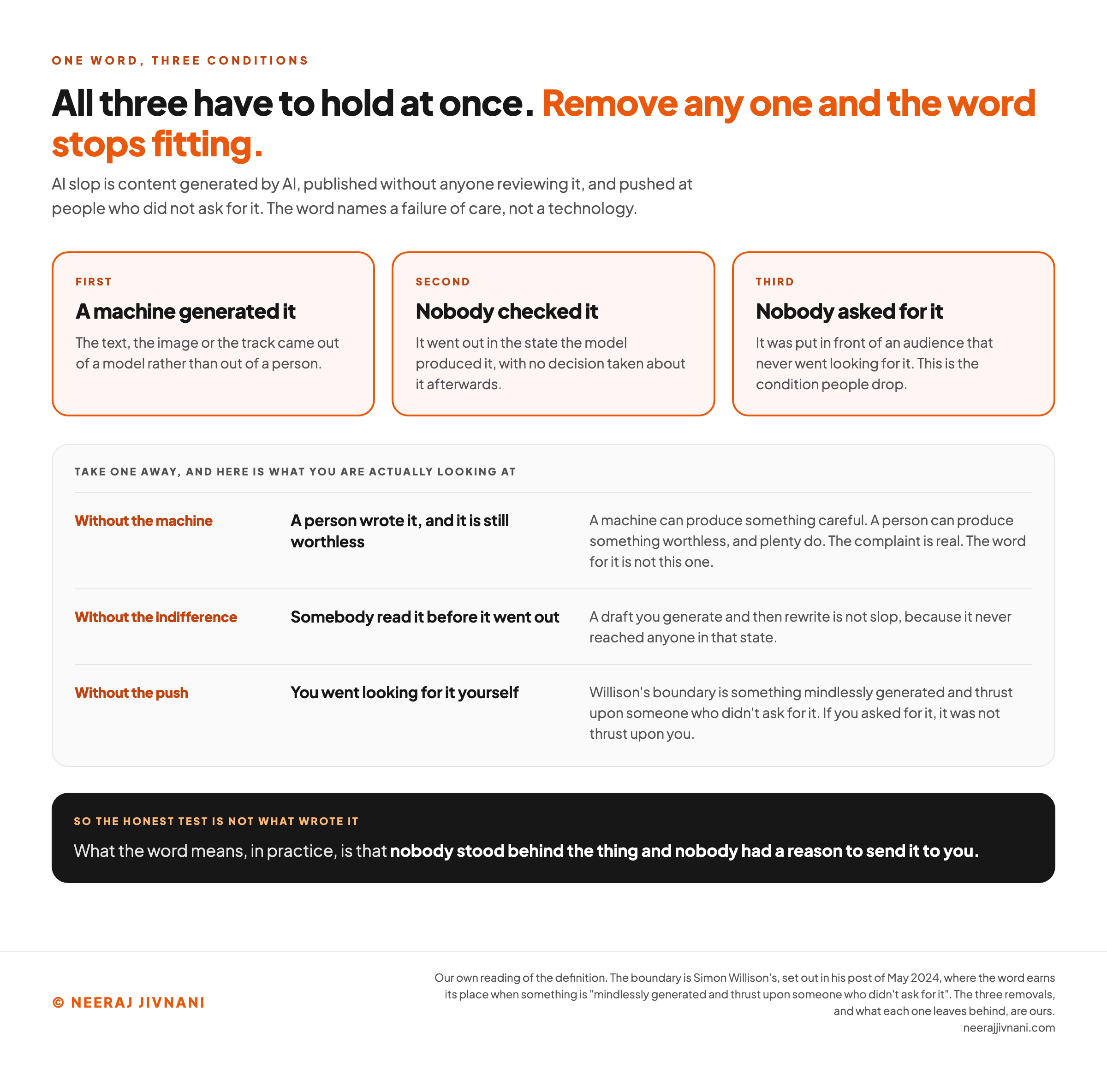
Three conditions have to hold at once for the word to mean anything, and removing any one of them makes it stop fitting.
The one people drop is the last of the three. Something has to have been pushed at an audience that never went looking for it.
A draft you generate and then rewrite is not slop, because nobody was ever handed it in that state.
Writing in May 2024, the programmer Simon Willison set the boundary plainly.
His post argues that "not all AI-generated content is slop". The word earns its place, he wrote, when something is "mindlessly generated and thrust upon someone who didn't ask for it".
The comparison that stuck was spam, and it holds up.
Spam was never a claim about email as a technology. It was a claim about volume, indifference, and being sent something you did not want.
The Part People Get Wrong
The common mistake is to hear "AI slop" and understand it as "AI content". Those are different claims, and treating them as one makes the word useless.
A machine can produce something careful. A person can produce something worthless, and plenty do.
What the word means, in practice, is that nobody stood behind the thing and nobody had a reason to send it to you.
Use this chart — embed code and citation
<a href="https://neerajjivnani.com/blog/ai-slop/"><img src="https://neerajjivnani.com/infographics/ai-slop/all-three-or-the-word-does-not-fit.png" alt="Diagram of the three conditions that all have to hold at once for the word slop to fit, shown as three cards: a machine generated it, nobody checked it before it went out, and it was put in front of an audience that never asked for it; below them, three rows show what is left when each condition is removed, a person writing something worthless, somebody reading the draft before it went out, and a reader who went looking for it themselves, each with the reason the word stops fitting; a closing band states that the honest test is not what wrote it, and that what the word means in practice is that nobody stood behind the thing and nobody had a reason to send it to you." width="1200"></a>
<p>Chart: <a href="https://neerajjivnani.com/blog/ai-slop/">Neeraj Jivnani</a></p>Neeraj Jivnani, "What AI Slop Is, Why There Is So Much of It, and How to Tell", neerajjivnani.com, https://neerajjivnani.com/blog/ai-slop/Free to republish with a link back to this page.
Where the Word Came From
Slop is a borrowed word. The AI sense of it arrived in 2024, the word did not, and where it came from is the argument.
It already meant kitchen waste and pig feed: a mixture nobody assembled on purpose, served to something that would eat anything put in front of it.
The transfer is doing real work. The complaint is not that the food is poisonous, it is that nobody thought about who was going to eat it.
The word spread much faster than the definition did.
That is why you now see it aimed at any machine output at all, including work that is careful and useful. It is also why the arguments about it get so heated: two people using the word can be making completely different accusations.
The looser use is worth resisting, and not out of pedantry. A label that means "a machine was involved" tells you nothing about whether a thing is worth your time.
Say a chart answers your question exactly, and you then find out a model drew it. Calling it slop at that point tells a reader nothing about whether the numbers are right.
Used that way the word burns itself on a distinction that does not predict anything.
Where You Meet It
Slop is not one format. It shows up wherever publishing is cheap and distribution is automatic, which by now is most places.
These are the six a reader runs into without going looking for them.
- Social feeds. The largest volume by far, because the feed is the only place where content with no audience can still find one. Engagement bait, invented personal stories, fake historical photographs.
- Video. The most visible, because a generated scene fails in ways the eye catches immediately. Extra fingers, objects that pass through each other, a voice with no breath in it.
- Search results and article farms. Pages built to match a query rather than to answer it. They are the reason so many searches now end in a page that restates your question at length.
- Music. Streaming catalogs carry uploaded generated tracks in volume, often under invented artist names, because a stream pays whether or not anyone chose it.
- Storefronts and game listings. Generated cover art, generated descriptions, sometimes generated products that do not exist.
- Books. Print-on-demand titles assembled in hours, including field guides and health advice, which is where the harm stops being aesthetic.
The pattern across all six is the same.
Most of it is not built to fool a careful reader. It is built to be present in a place where a small share of attention has a price.
Why There Is So Much of It
There is so much of it because the economics reward volume and nothing else.
Generating text at scale now costs a fraction of commissioning it, and the systems that carry content mostly pay by the impression rather than by the merit.
When the cost of making something falls to nearly zero and the payoff per unit stays positive, volume is the rational strategy. That is true whether the thing being made is good or not.
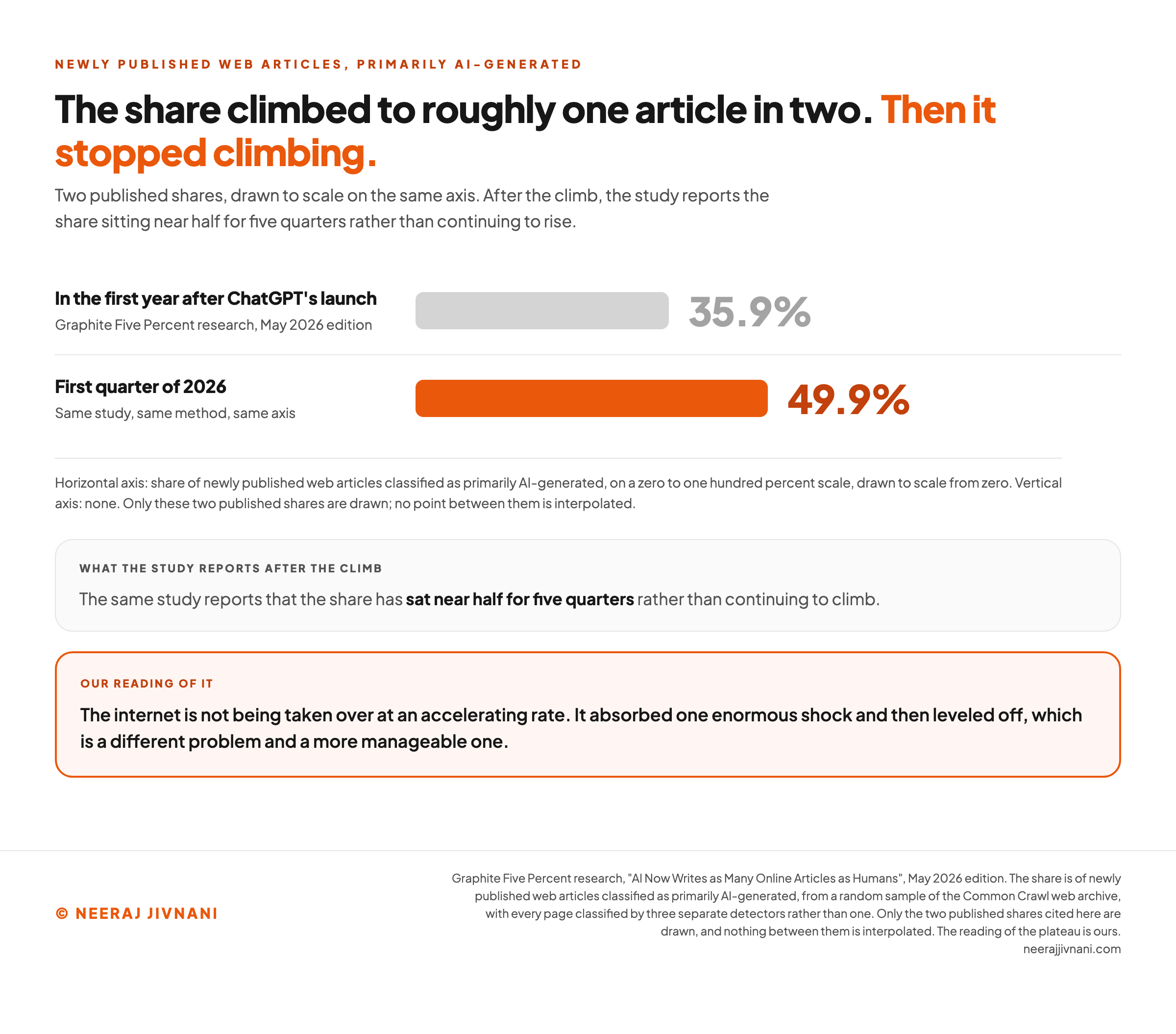
Roughly one newly published web article in two is now primarily AI-generated: 49.9% in the first quarter of 2026, on Graphite's Five Percent research, May 2026 edition.
The trend is the more interesting part. The same study reports that the share has sat near half for five quarters rather than continuing to climb, after rising from 35.9% in the first year following ChatGPT's launch.
Both shares come from a random sample of the Common Crawl web archive, with every page classified by three separate detectors rather than one.
So the internet is not being taken over at an accelerating rate. It absorbed one enormous shock and then leveled off, which is a different problem and a more manageable one.
Use this chart — embed code and citation
<a href="https://neerajjivnani.com/blog/ai-slop/"><img src="https://neerajjivnani.com/infographics/ai-slop/it-stopped-climbing.png" alt="Two horizontal bars comparing the share of newly published web articles that are primarily AI-generated, 35.9% in the first year after ChatGPT's launch and 49.9% in the first quarter of 2026, drawn to scale from zero on a zero to one hundred percent axis, with the axis note recording that only these two published shares are drawn and that no point between them is interpolated; a panel beneath them states that the same study reports the share sitting near half for five quarters rather than continuing to climb, and a closing panel carries our own reading, that the internet is not being taken over at an accelerating rate but absorbed one enormous shock and then leveled off." width="1200"></a>
<p>Chart: <a href="https://neerajjivnani.com/blog/ai-slop/">Neeraj Jivnani</a></p>Neeraj Jivnani, "What AI Slop Is, Why There Is So Much of It, and How to Tell", neerajjivnani.com, https://neerajjivnani.com/blog/ai-slop/Free to republish with a link back to this page.
How to Tell
What works is a ten second read on substance, built from three questions. They take longer to describe than to run.
There is no single reliable signal to look for, and no detector settles it for you. Whether a machine was involved is usually not knowable, and it is not what the read is for.
The Ten Second Read
Take whatever page you have open and ask these, in this order.
- Did it answer the question in the first screen? Slop defers. It restates the question, sets context, promises to get there.
- Is there anything in here that only this writer would know? A number, a date, a specific consequence, an opinion someone could disagree with. Generated filler is confident and non-committal at the same time.
- Would removing half the words lose anything? If the answer is no, that is your answer.
The list leaves out punctuation and sentence rhythm, and it never asks what produced the page.
Those omissions are the point. Most of what predicts the judgment is not something software measures reliably yet, and the habits people watch for are the easiest thing in a text to change.
Run the page you have open through it
Three conditions have to hold at once for the word to mean anything. Remove any one of them and it stops fitting, whatever a machine had to do with it.
1. A machine generated it.
The text, the image or the track came out of a model rather than out of a person.
2. Nobody checked it before it went out.
It reached you in the state the model produced it, with no decision taken about it afterward.
3. It was put in front of you when you did not ask for it.
This is the third condition, and it is the one people drop.
Answer all three and the label comes out. It is the less useful half of this.
And now the part that does not depend on the label
Three questions do most of the work on a page in front of you, and none of them requires you to guess what wrote it.
Did it answer the question in the first screen?
Slop defers. It restates the question, sets context, promises to get there.
Is there anything in here that only this writer would know?
A number, a date, a specific consequence, an opinion someone could disagree with. Generated filler is confident and non-committal at the same time.
Would removing half the words lose anything?
If the answer is no, that is your answer.
The strongest predictors of the judgment are relevance, information density and tone. None of them is a formatting habit, which is why nothing above asks you about punctuation.
The Surface Tells Are Weaker Than You Think
You have seen the lists. Heavy em dashes, three-beat sentences, the "it's not X, it's Y" construction, bulleted lists with emoji, phrases bolded for no reason a reader can work out.
These are real patterns and they are worth noticing. They are also weak evidence on their own.
Two things break them. Human writers use every one of these habits, some of them heavily, and models can be told to avoid them, which takes about one sentence of instruction.
Treat a surface tell as a prompt to read more carefully. Treat it as proof and you will be wrong in both directions, which is worse than having no test at all.
What Predicts the Judgment
The three strongest predictors of a slop judgment are relevance, information density and tone, and none of them is a formatting habit. That ranking is from "Measuring AI 'Slop' in Text", a Northeastern, Stony Brook and Meta AI preprint in its January 2026 revision.
Relevance is whether the text answers the thing you came for. Density is how much it says per hundred words.
Tone is whether it sounds like a person with a position, or like a voice trying not to commit to one.
Two of the three are about substance and the third is about whether anyone committed to anything. That is why the ten second read asks about what a page tells you rather than about how it sounds.
Those three did not come out of a style guide. The researchers asked 19 experts across writing, journalism, linguistics, natural language processing and philosophy what makes text slop, and turned the answers into a fixed set of codes.
Professional copy editors then marked 150 news articles and 100 answers to real search queries against those codes, line by line.
The result corrects the instinct that slop is a style. Polish is not the opposite of slop, and a generated page can be well turned and still be empty of the thing you came for.
A plain, ugly paragraph that answers the question is not slop.
Whether a Detector Can Do It for You
Not yet, and the same paper is where to look.
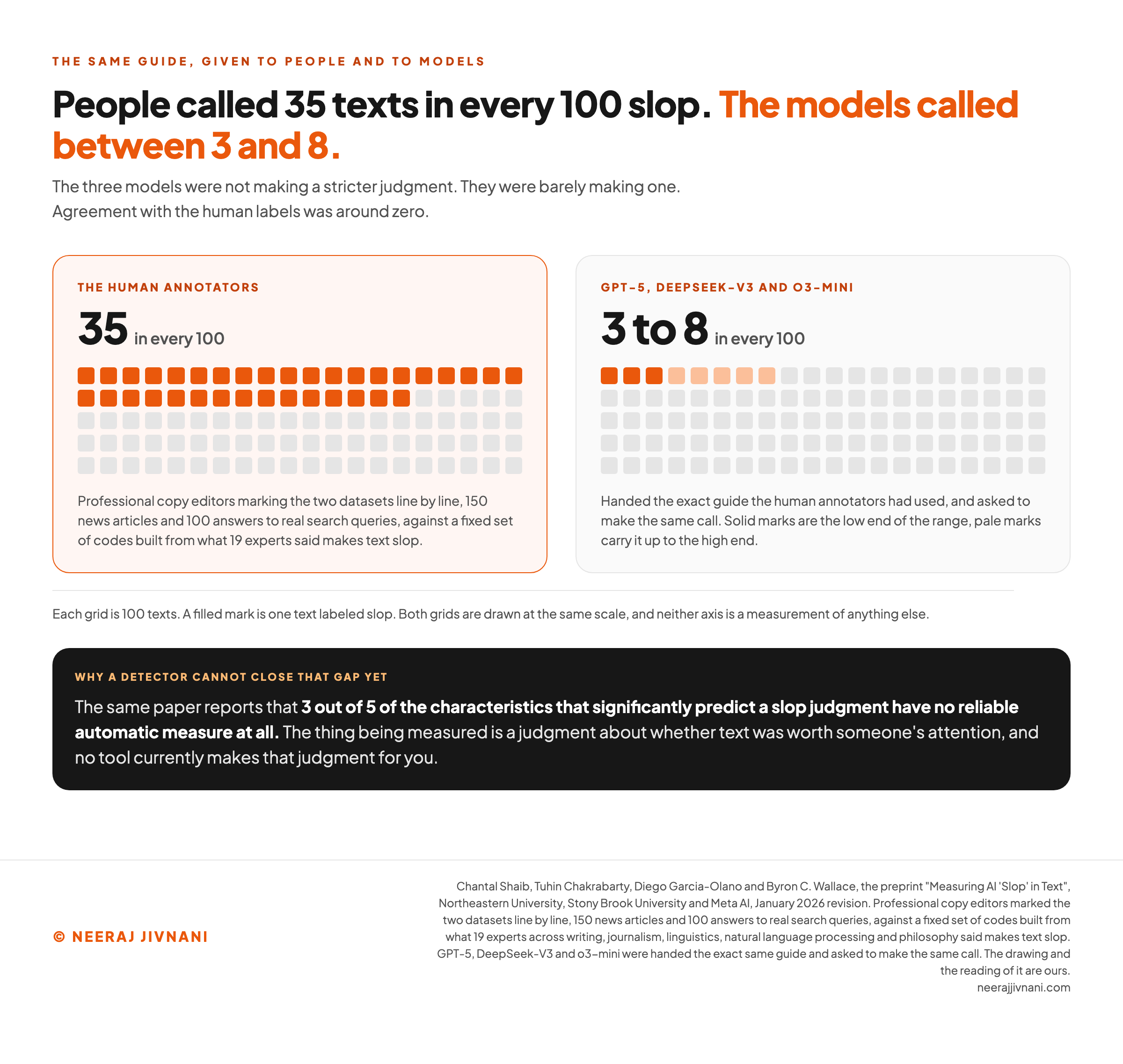
The researchers handed GPT-5, DeepSeek-V3 and o3-mini the exact guide the human annotators had used, and asked them to make the same call.
Agreement with the human labels was around zero.
The human annotators marked 35 texts in every 100 as slop. The three models marked between 3 and 8.
They were not making a stricter judgment. They were barely making one.
They also report that 3 out of 5 of the characteristics that significantly predict a slop judgment have no reliable automatic measure at all.
That is the part to hold onto. The thing being measured is a judgment about whether text was worth someone's attention, and no tool currently makes that judgment for you.
Use this chart — embed code and citation
<a href="https://neerajjivnani.com/blog/ai-slop/"><img src="https://neerajjivnani.com/infographics/ai-slop/the-models-barely-made-the-call.png" alt="Two grids of one hundred squares each, comparing how often people and models labeled a text slop when both were given the same guide: on the left, the human annotators marked 35 squares in every 100, and on the right GPT-5, DeepSeek-V3 and o3-mini marked between 3 and 8, drawn as three solid marks with five paler ones carrying the range up to its high end; a note records that professional copy editors marked the two datasets line by line, 150 news articles and 100 answers to real search queries, against a fixed set of codes built from what 19 experts said makes text slop, and a closing band states that 3 out of 5 of the characteristics that significantly predict a slop judgment have no reliable automatic measure at all, and that no tool currently makes that judgment for you." width="1200"></a>
<p>Chart: <a href="https://neerajjivnani.com/blog/ai-slop/">Neeraj Jivnani</a></p>Neeraj Jivnani, "What AI Slop Is, Why There Is So Much of It, and How to Tell", neerajjivnani.com, https://neerajjivnani.com/blog/ai-slop/Free to republish with a link back to this page.
What It Costs, and to Whom
The honest answer is that most of it costs you almost nothing, one piece at a time. A bad recipe page wastes a minute.
That is annoying rather than serious, and treating every instance as a crisis is its own kind of overreaction.
Two things change that answer. The first is scale, because a minute repeated is a habit. The second is who is standing where the cost lands.
The Costs That Accumulate
The costs that matter are the ones nobody notices individually.
Search and feeds get worse when the ratio of effort to volume collapses, because both systems assume that publishing something has a cost. Attention is a fixed budget, and every minute spent on filler is taken from something a person made on purpose.
Then there is the category where it does real harm.
Consider, for example, a print-on-demand foraging guide generated in an afternoon and sold beside the real ones. It gives a confident wrong answer about which of two similar mushrooms is edible.
Generated health advice, invented travel information and fabricated images circulating during a disaster sit in the same bracket.
Who Actually Pays
The distribution of that cost is the uncomfortable part, and it is not even.
For a reader it is spread thin, a minute here and a minute there, which is why nobody organizes against it. The individual harm never gets large enough to act on.
For anyone whose work depends on being believed, it lands in one place. A researcher, a small publisher, somebody writing from real experience now pays a tax they did not incur, in the extra effort it takes to be read as genuine at all.
Suspicion is the default now. Careful work gets accused of being generated, sometimes on the strength of a punctuation mark.
That asymmetry is the other reason the argument about slop runs hotter than the individual harm seems to justify. The people complaining loudest are usually carrying the concentrated end of it.
Worth worrying about, then, but in proportion.
The plateau matters here. This is a problem to manage rather than a wave to brace against.
What To Do About It
Two different jobs, and two different answers.
If you are reading, the work is choosing where your attention starts. If you are publishing, the work is keeping the decisions that cost something.
One larger point sits underneath both, and it is worth saying plainly. The lever that would change the volume sits at the platform level, not with any reader.
What such a lever has to do is easy to describe and hard to build. It has to make presence cost something again.
That is what happened to spam. Sending mail at volume stopped being free, in effort if not in money, and the flood became a nuisance rather than a crisis.
Nothing an individual does moves that. What it moves is where their own hours go, which is the part they control.
If You Are Reading
There are three moves, and all of them are about where your attention starts rather than about detection.
Go directly to the handful of sources that have survived your own attention over the last year, rather than meeting them through a feed.
Reward specificity when you find it, by finishing the piece and coming back.
And when something reads like it was assembled rather than written, close it. The time you spend deciding is itself the cost.
If You Are Publishing
The answer is not to avoid AI content creation. It is to keep the parts of publishing that cost something.
Deciding what is true is one.
Deciding what to leave out is another, and it is the one that gets skipped first, because generating more is easier than choosing less.
Being willing to be wrong in public, under your own name, is the third.
We use these tools, and we think the line sits where Willison put it in 2024. He wrote that he attaches his name and stakes his credibility on the things he publishes.
That is a standard about accountability rather than about authorship, and it is the only one that has held up.
So the test is whether a real decision was made anywhere in the thing before it went out.
Not whether a machine was involved, which is not an interesting question. Whether somebody chose the angle, cut the weak part, and checked the claim that would embarrass them if it turned out to be wrong.
The Short Version
Slop is what you get when publishing costs nothing and nobody decides anything, which is why the word is about care rather than about machines. The machine is what made it cheap; the missing decision is what makes it slop.
That is also why the fix is not a detector and not a ban. It is the same thing it has always been: someone reading the thing before it goes out, and being willing to answer for it afterwards.
Judge what is in front of you on whether it told you something. That test worked before any of this, and it is the only one that still works now.