What Copywriting Is, How to Write It, and What It Pays
Your page has one job: get one person to do one thing. See what that takes, in the order the decisions happen, and what the work is worth.


/ On this page8 sections
Copywriting is writing with one job: getting one particular person to take one particular action. Everything below follows from that sentence.
Which means the work is less about words than people expect. It is about deciding what a page has to say, and to whom, before a line of it exists.
Here is what that takes, in the order the decisions happen, and what the job is worth if you are weighing it as a career.
What Copywriting Is
Copywriting is the writing that asks. A product page, an email, an advertisement, a signup screen: each one exists to move a reader one step, and each one is judged on whether they took it.
Persuasion is the mechanism. The action is the point.
Keeping those apart matters more than it sounds, because it is how people end up admiring copy that sells nothing. A line can be clever, quotable, on brand, and still leave the reader with nothing to do.
The word "copy" means the text itself, as distinct from the picture, the layout or the code around it. A copywriter produces that text for a commercial purpose.
Three things separate copy from the other writing a business produces:
- It has an audience of one. Not a segment or a persona deck. One person with a problem they could describe out loud.
- It has a single action. Read the next line, reply, book, buy, cancel before the trial renews. One.
- It gets marked. Somebody either did the thing or did not, in a way an essay is never marked.
That third one is why copy improves faster than most writing. The feedback is rude and it arrives quickly.
Copywriting and Content Writing Are Not the Same Job
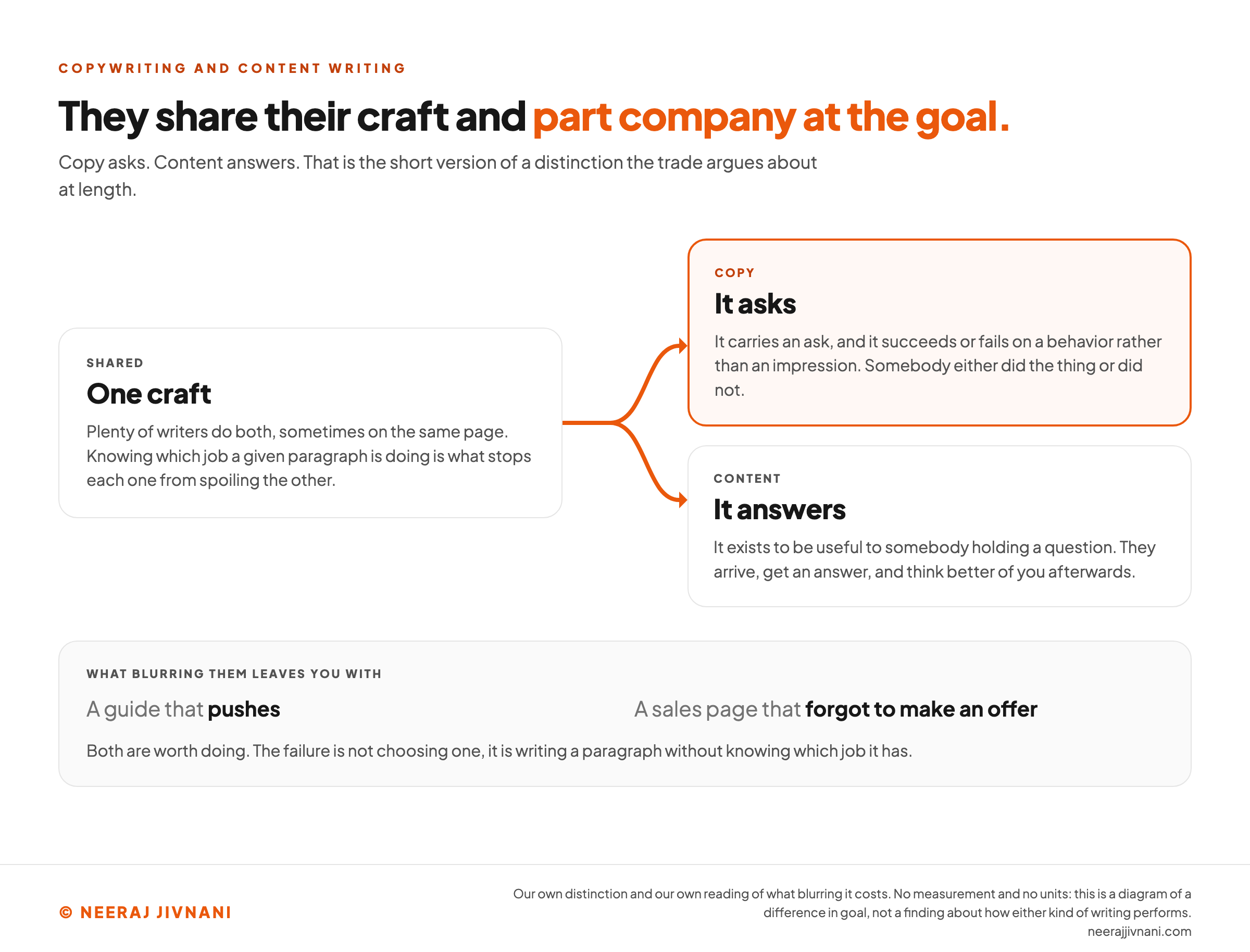
Copy asks. Content answers. That is the short version of a distinction the trade argues about at length.
Content writing exists to be useful to somebody holding a question. A guide, an explainer, a comparison. They arrive, get an answer, and think better of you afterwards.
Copy exists to be acted on. It carries an ask, and it succeeds or fails on a behavior rather than an impression.
The two share their craft and part company at the goal.
Plenty of writers do both, sometimes on the same page. Knowing which job a given paragraph is doing is what stops each one from spoiling the other.
Use this chart — embed code and citation
<a href="https://neerajjivnani.com/blog/copywriting/"><img src="https://neerajjivnani.com/infographics/copywriting/where-copy-and-content-part.png" alt="A fork diagram of copywriting against content writing, with one shared craft node on the left branching into two arms: copy, which carries an ask and succeeds or fails on a behavior rather than an impression, and content, which exists to be useful to somebody holding a question and leaves them thinking better of you afterwards, with a panel underneath naming what blurring the two leaves you with, a guide that pushes and a sales page that forgot to make an offer." width="1200"></a>
<p>Chart: <a href="https://neerajjivnani.com/blog/copywriting/">Neeraj Jivnani</a></p>Neeraj Jivnani, "What Copywriting Is, How to Write It, and What It Pays", neerajjivnani.com, https://neerajjivnani.com/blog/copywriting/Free to republish with a link back to this page.
What a Copywriter Does All Day
A copywriter works out what a page has to say, to whom, and then says it in the fewest words that keep it true.
Most of that is not writing. The hours go on deciding what has to be said.
The work runs in a stable order:
- Find out who buys and why. Interviews, support tickets, reviews, recorded sales calls, and above all the words people use when they complain.
- Settle the one action the piece is asking for, and get it agreed before drafting starts.
- Work out the offer. What the reader gets, what it costs them in effort, what it replaces.
- Assemble the proof. Numbers, demonstrations, guarantees, other people's words.
- Write it, usually more than once, in more than one direction.
- Cut it. This is where most of the improvement happens and where the least time gets booked.
- Hand it over in the shape it will be used. A layout, a sequence, an ad set, with each format's limits respected.
The official description is narrower than the job.
Copywriters "prepare advertisements to promote the sale of a good or service", says the US Bureau of Labor Statistics in its Occupational Outlook Handbook, which lists writing advertising copy for newspapers, magazines, broadcasts and the internet among the duties of the occupation.
That covers the output. The research, the arguing about the offer and the cutting are the parts that decide whether the output works.
Who Hires Copy, and Why
Three kinds of employer, and the work feels different in each.
- Companies with something to sell keep writers in house, close to the product, the support queue and the numbers. Depth is the advantage; sameness is the risk.
- Agencies put writers on several accounts at once. Range is the advantage, and the distance from the customer is the cost.
- Everybody else buys it by the project, from freelancers and small studios, usually for a launch, a rebuild or a campaign nobody internally has time for.
Charities, universities and trade bodies buy it for the same reason as businesses. Somebody has to ask for the donation, the application, the renewal.
Copy gets commissioned wherever an organization has decided a specific number should move and words are the lever available.
Where Copy Shows Up, and What Each Surface Has to Do
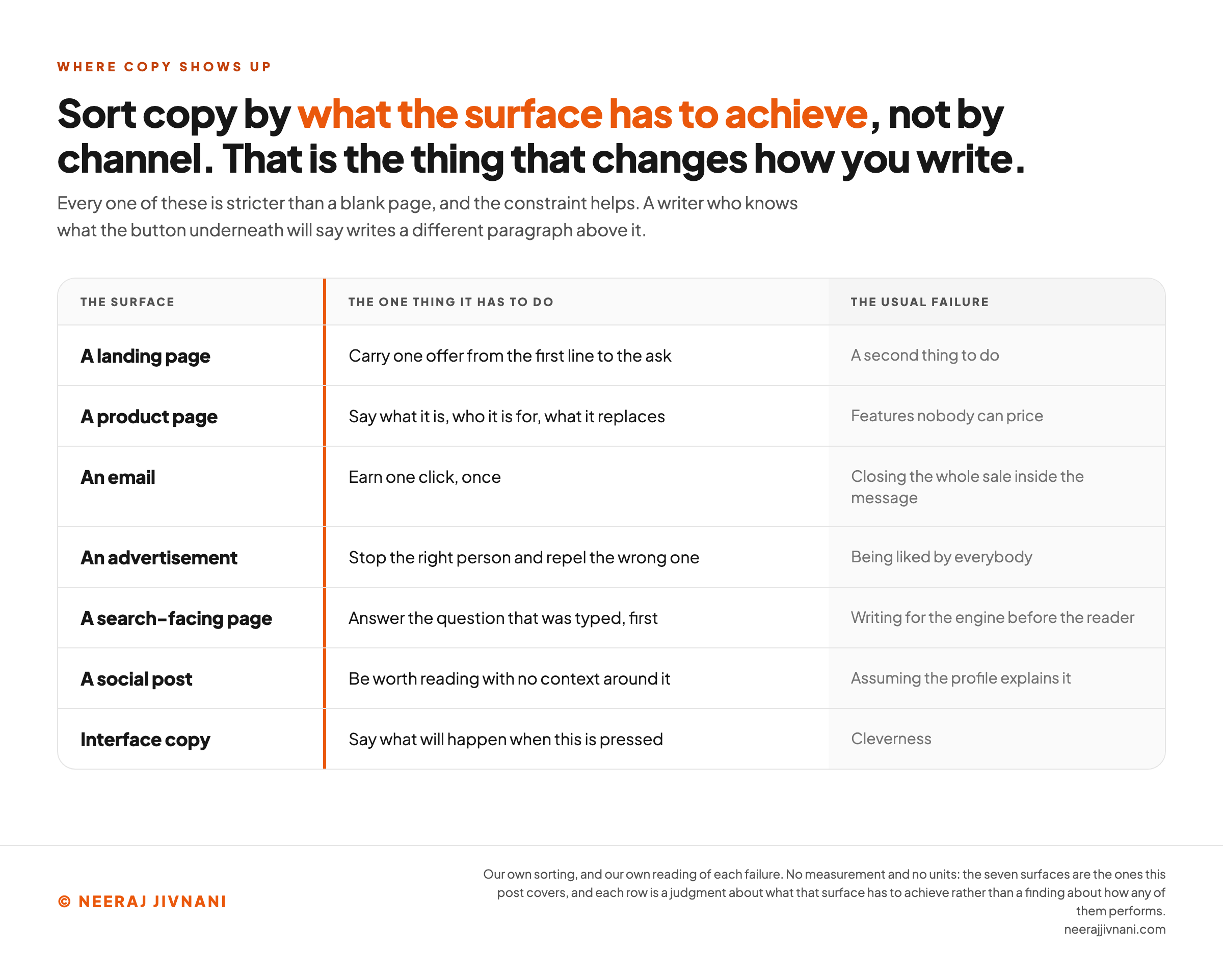
Copy is normally taught as a list of channels. Sorting it by what the surface has to achieve is more useful, because that is the thing that changes how you write.
| the surface | the one thing it has to do | the usual failure |
|---|---|---|
| A landing page | Carry one offer from the first line to the ask | A second thing to do |
| A product page | Say what it is, who it is for, what it replaces | Features nobody can price |
| An email | Earn one click, once | Closing the whole sale inside the message |
| An advertisement | Stop the right person and repel the wrong one | Being liked by everybody |
| A search-facing page | Answer the question that was typed, first | Writing for the engine before the reader |
| A social post | Be worth reading with no context around it | Assuming the profile explains it |
| Interface copy | Say what will happen when this is pressed | Cleverness |
Search copy and email copy have each grown into trades with their own rules, deliverability and ranking among them, and both reward specializing. The writing underneath is the same discipline pointed at a different surface.
Every one of those surfaces is stricter than a blank page, and the constraint helps. A writer who knows what the button underneath will say writes a different paragraph above it.
Use this chart — embed code and citation
<a href="https://neerajjivnani.com/blog/copywriting/"><img src="https://neerajjivnani.com/infographics/copywriting/sorted-by-the-job-not-the-channel.png" alt="Seven copy surfaces sorted by what each one has to achieve rather than by channel, in three columns: a landing page, a product page, an email, an advertisement, a search-facing page, a social post and interface copy, each with the one thing it has to do beside it and the usual failure of that surface in a muted third column, running from a second thing to do on a landing page to cleverness in interface copy." width="1200"></a>
<p>Chart: <a href="https://neerajjivnani.com/blog/copywriting/">Neeraj Jivnani</a></p>Neeraj Jivnani, "What Copywriting Is, How to Write It, and What It Pays", neerajjivnani.com, https://neerajjivnani.com/blog/copywriting/Free to republish with a link back to this page.
How to Write Copy That Gets the Action
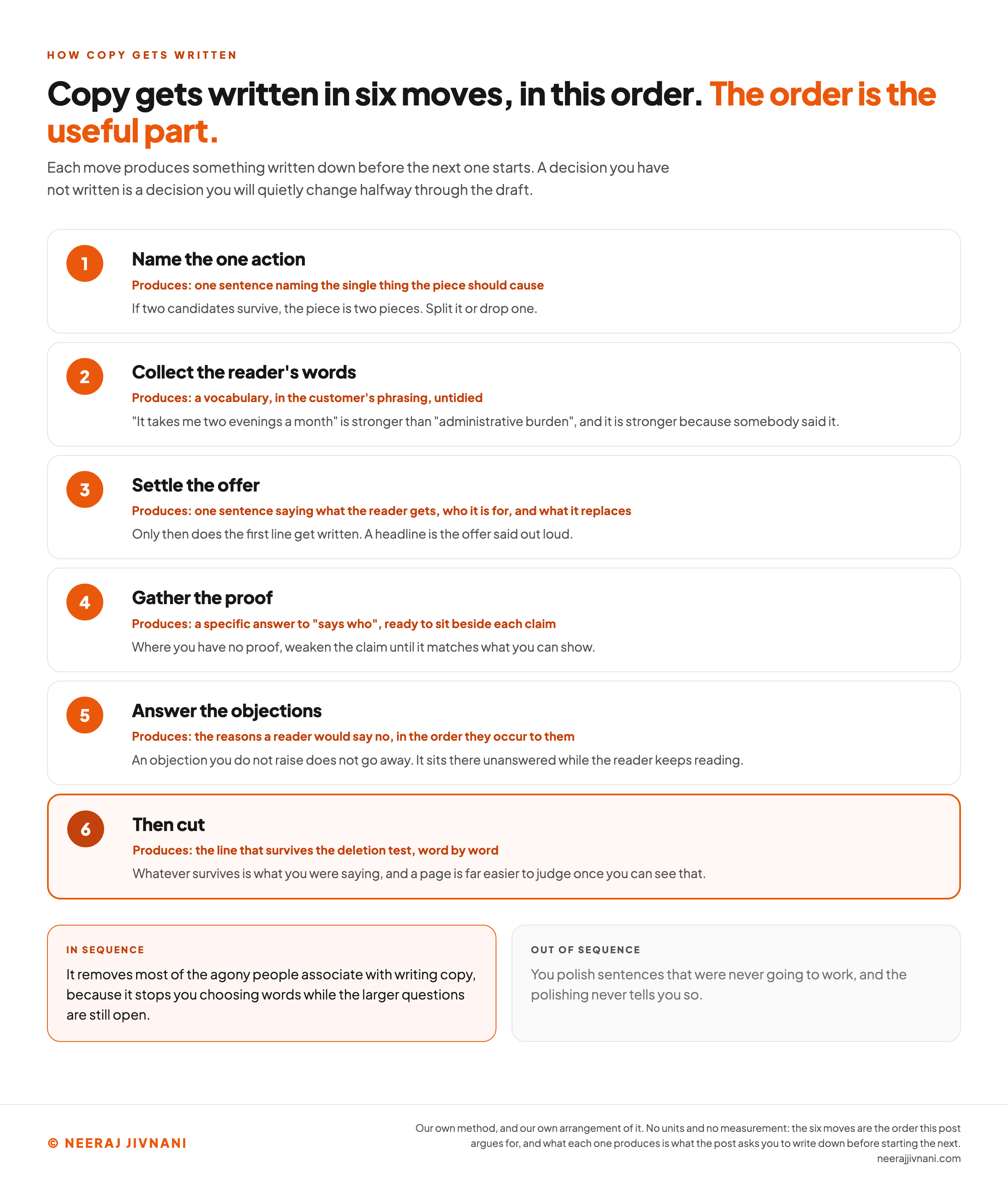
Copy gets written in six moves, in this order: name the action, collect the reader's words, settle the offer, gather the proof, answer the objections, then cut.
The order is the useful part.
Done in sequence, it removes most of the agony people associate with writing copy, because it stops you choosing words while the larger questions are still open.
Done out of sequence, you polish sentences that were never going to work, and the polishing never tells you so.
Each move below produces something written down before the next one starts. That is deliberate.
A decision you have not written is a decision you will quietly change halfway through the draft.
Name the One Action
Write down the single thing you want the piece to cause, in a sentence, in the reader's terms, before anything else.
If two candidates survive, the piece is two pieces. Split it or drop one.
This is where most weak copy is lost. A page asked to build awareness, explain the product, handle pricing and capture an email will do four things at half strength, and no rewriting fixes it later.
Collect the Reader's Own Words
You are not looking for a clever angle. You are looking for the words your customer uses when nobody from your company is listening.
Three places to find them:
- Read your own support inbox and your reviews.
- Read the reviews of the thing people buy instead of you.
- Sit in on two sales calls and write down the nouns.
What you collect is a vocabulary, and copy written in that vocabulary needs less persuading, because the reader recognizes the problem before they meet the pitch.
The temptation is to tidy it up. Resist that. "It takes me two evenings a month" is stronger than "administrative burden", and it is stronger because somebody said it.
Write the Offer, Then the Line That Carries It
Write the offer before you write the headline, or the headline is decoration.
The offer is one sentence: what the reader gets, who it is for, and what it replaces or removes. If you cannot write it plainly, the problem is not your writing.
Only then does the first line get written. A headline is the offer said out loud, in the fewest words that keep it true, aimed at the person the offer is for.
Say you sell scheduling software to independent physiotherapists. "Powerful practice management" says nothing. "Stop losing Friday evenings to next week's diary" says the same offer to one named person.
Write six of them. The one you keep is rarely the first, and the exercise is quick once the offer sentence exists.
Put the Proof Next to the Claim
Every claim raises a silent question, and the question is always the same one. Says who?
Answer it where the claim is made, not in a testimonials block further down. A number, a demonstration, a specific detail, a named customer, a guarantee that costs you something.
Small and checkable beats large and unverifiable. A modest claim a reader can test for themselves will outlast a grand one that collapses the moment somebody looks into it.
Where you have no proof, weaken the claim until it matches what you can show. That is not caution, it is the only version that keeps working after the reader looks into it.
Answer the Objection Where It Lands
List the reasons a reader would say no, in the order they occur to them. Price, switching cost, timing, trust, whether it works for a business like theirs.
Then put each answer at the point in the page where the objection arrives, rather than saving them for the end.
An objection you do not raise does not go away. It sits there unanswered while the reader keeps reading, and it is doing more damage silently than it would in the open.
Some objections are correct and cannot be answered. Say who the thing is not for. That sentence loses you the wrong reader and it earns you the right one.
Then Cut
Cut on a second day if you can, and cut hard. Most first drafts carry more words than the argument needs.
Read it aloud. Every stumble is a real problem, and every sentence you cannot say in one breath is one the reader will not finish either.
Then run the deletion test, word by word, on the lines that matter most.
The deletion test, word by word
Put in one line of your own copy, then strike out every word you could remove without changing what a stranger would understand. What is left is what you were saying.
No line of your own to hand? These two say the same offer, and only one of them says it to somebody.
Nothing to cut yet
The test runs on one line at a time, which is why it is worth doing on the lines that matter most rather than on a whole page. Read the line aloud first. Every stumble is a real problem.
The point of the test is not brevity for its own sake. It is that whatever survives is what you were saying, and it is a great deal easier to judge a page once you can see that.
Use this chart — embed code and citation
<a href="https://neerajjivnani.com/blog/copywriting/"><img src="https://neerajjivnani.com/infographics/copywriting/the-order-is-the-useful-part.png" alt="The six moves copy gets written in, numbered in order down the page, each with what it produces in writing before the next one starts: name the one action, which produces one sentence naming the single thing the piece should cause; collect the reader's words, which produces a vocabulary in the customer's phrasing, untidied; settle the offer, which produces one sentence saying what the reader gets, who it is for and what it replaces; gather the proof, which produces a specific answer to says who, ready to sit beside each claim; answer the objections, which produces the reasons a reader would say no in the order they occur to them; and then cut, which produces the line that survives the deletion test, word by word; and two panels underneath contrasting what happens in sequence, where the order removes most of the agony people associate with writing copy, against what happens out of sequence, where you polish sentences that were never going to work and the polishing never tells you so." width="1200"></a>
<p>Chart: <a href="https://neerajjivnani.com/blog/copywriting/">Neeraj Jivnani</a></p>Neeraj Jivnani, "What Copywriting Is, How to Write It, and What It Pays", neerajjivnani.com, https://neerajjivnani.com/blog/copywriting/Free to republish with a link back to this page.
What Goes Wrong Most
Copy fails in a handful of repeating ways, and not one of them is a failure of talent.
Read your own page against this list before you rewrite a word of it.
- It talks about you. Count the sentences whose subject is your company. If they outnumber the ones about the reader, the page has the wrong subject.
- It asks for two things. See the first step of the method. It is the most expensive mistake on this list.
- It describes instead of asking. A page can be accurate, complete, well organized and never once tell somebody what to do.
- Its claims float free. Adjectives where evidence should be. Powerful, effortless, innovative: words a competitor could print without changing a comma.
- It is written for a committee. Copy approved by six people tends to offend none of them and move nobody.
- It hides the price or the ask. Whatever the reader has to give up, saying it late does not soften it. It removes their reason to trust the rest.
- It is aimed at everybody. Copy that repels nobody attracts nobody, because the reader cannot tell whether it was written for them.
What the 80/20 Rule Means in Copywriting
Ask what the 80/20 rule means in copywriting and you get at least three different answers, none of them a measured finding.
The most common one is about effort: give most of your time to the headline and the opening.
The second is about subject. A page should be mostly about the reader and only a little about you.
The third is ordinary Pareto, that a small share of your pages produces most of your results.
Treat the first of the three as a working habit and it is a good one: your first line earns the second, and no amount of quality further down rescues an opening nobody stayed for.
Is Copywriting a Job Worth Doing
Yes, with the honest caveats attached, and the caveats are worth reading before you enroll in anything.
It is a real trade with a wide pay range and a low barrier that cuts both ways. Nobody needs your permission to call themselves a copywriter, which means the label proves nothing and the work has to.
What It Pays
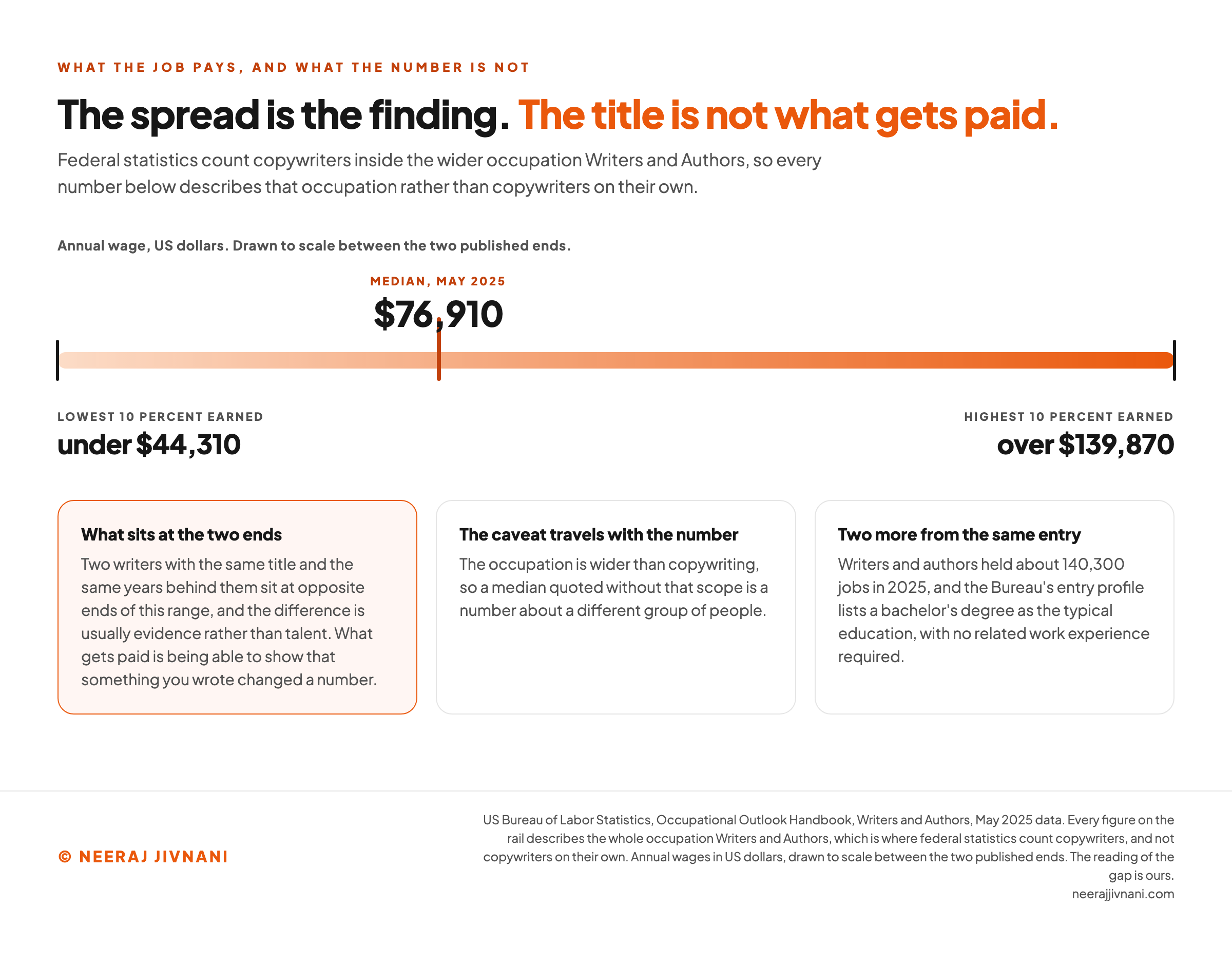
The median is $76,910 a year for writers and authors, the wider occupation that copywriters are counted inside, in the US Bureau of Labor Statistics' May 2025 wage data.
The lowest 10 percent earned under $44,310 and the highest 10 percent earned over $139,870.
Our reading of that gap: the title is not what gets paid.
What gets paid is being able to show that something you wrote changed a number. Two writers with the same title and the same years behind them sit at opposite ends of that range, and the difference is usually evidence rather than talent.
Which makes keeping records of your own results career advice rather than admin.
Two other things from the same entry set expectations. Writers and authors held about 140,300 jobs in 2025, and the Bureau's entry profile lists a bachelor's degree as the typical education, with no related work experience required.
Copywriter, Advertising Copywriter, Freelance Copywriter and Search Engine Optimization Copywriter all sit under one occupation code, 27-3043, in the sample of reported job titles published by O*NET, the US Department of Labor's occupational database, in an entry updated in 2026.
The specialty is in the title, not in the classification.
Starting With No Experience
You can, and the route is not mysterious. Nobody is checking credentials, and every hiring conversation ends up at the same request: show me something you wrote.
Four things, roughly in this order:
- Learn the structure, not the tricks. Take pages that sell, retype them, and mark where each one names the reader, makes the offer, proves it and asks.
- Write real pieces for imaginary briefs. Rewrite a page you use and did not like. Put your version and the reason for each change side by side.
- Do the first few jobs small and cheap in effort, not free. A local business, a charity, a friend's product page, or a job board listing you can answer with work instead of a pitch. Ask what happened afterwards.
- Keep the results. Not screenshots of praise. What the page was for, what you changed, and what moved.
A portfolio of five pieces with the reasoning attached beats a certificate. The reasoning is the thing being hired.
What AI Changed, and What It Did Not
Generated drafts are now free and instant, which has taken the value out of producing competent, generic text. That was already the least valuable part of the job.
What it did not touch is the part that was always the work: knowing which customer you are writing to, what the offer genuinely is, and which claim you can prove.
A model can write ten headlines in a second. It cannot sit in on the sales call, decide the page is asking for two things, or tell you that your proof will not survive a skeptic.
The federal projection is duller than either story.
The Bureau of Labor Statistics expects employment of writers and authors to show little or no change from 2025 to 2035, on about 11,900 openings a year across the decade.
So: not a gold rush, and not a graveyard. A normal skilled trade, in which the people who get hired are the ones who can show what their words did.
Use this chart — embed code and citation
<a href="https://neerajjivnani.com/blog/copywriting/"><img src="https://neerajjivnani.com/infographics/copywriting/the-spread-not-the-median.png" alt="A pay rail for the occupation Writers and Authors, which is where federal statistics count copywriters, drawn to scale between the lowest 10 percent earning under $44,310 a year and the highest 10 percent earning over $139,870, with the May 2025 median of $76,910 marked at its true position about a third of the way along, and three cards reading the gap: that two writers with the same title sit at opposite ends of it and the difference is usually evidence rather than talent, that the occupation is wider than copywriting so a median quoted without that scope describes a different group of people, and that writers and authors held about 140,300 jobs in 2025, with the Bureau's entry profile listing a bachelor's degree as the typical education and no related work experience required." width="1200"></a>
<p>Chart: <a href="https://neerajjivnani.com/blog/copywriting/">Neeraj Jivnani</a></p>Neeraj Jivnani, "What Copywriting Is, How to Write It, and What It Pays", neerajjivnani.com, https://neerajjivnani.com/blog/copywriting/Free to republish with a link back to this page.
What to Do First
Write two sentences before you touch a word of the page you are least happy with. Neither of them is a rewrite.
First, the one action that page exists to cause.
Second, the offer that makes taking it worth their while.
If the page and those two sentences disagree, you have found the problem, and it was never the writing.