How to Write a Creative Brief, and Which Parts Change the Work
Five fields on a creative brief decide what comes back. The rest only record a decision you already took. Here is what belongs in each of the five.

/ On this page11 sections
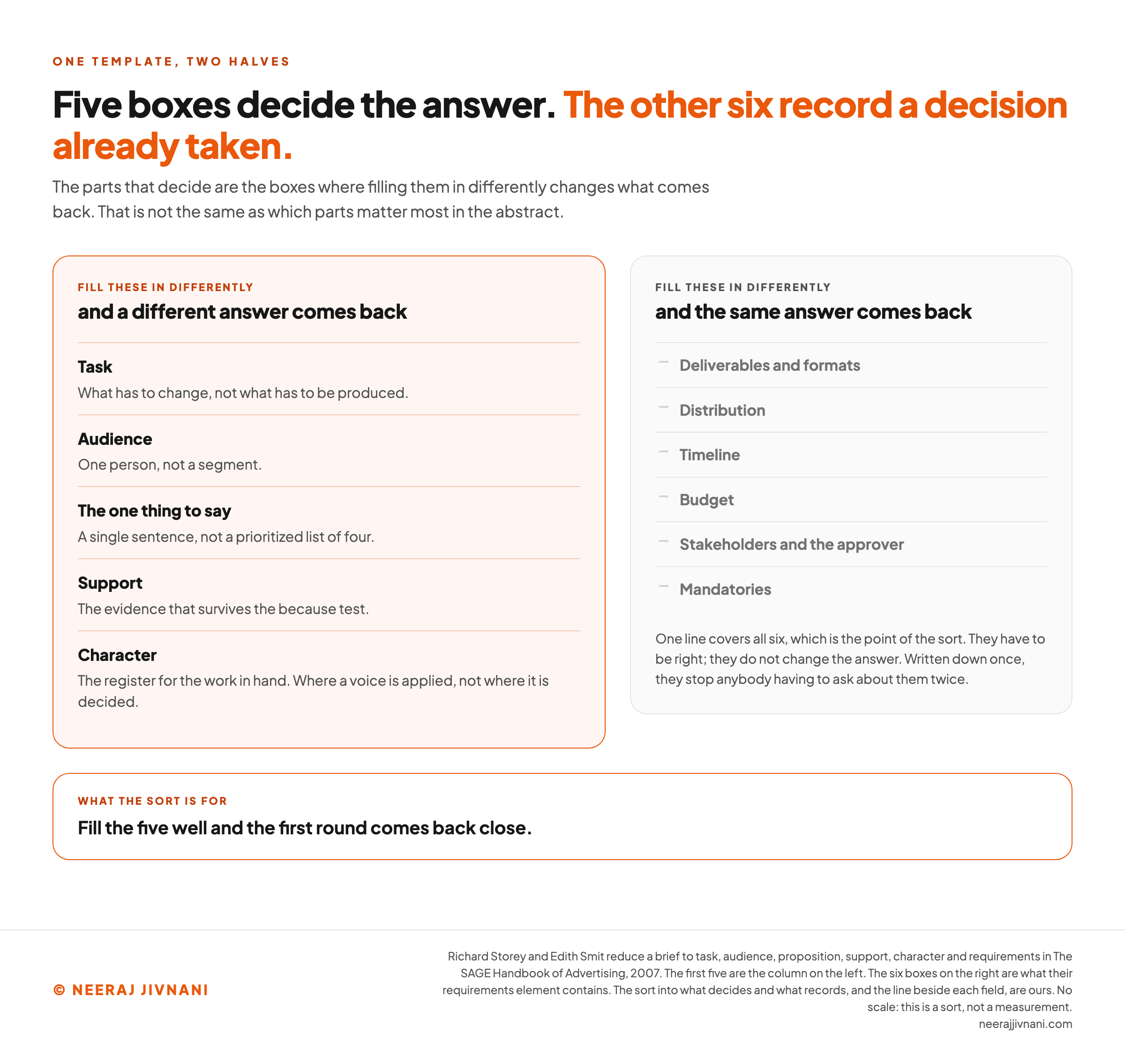
Most of the boxes on a creative brief template record a decision somebody already took. The deadline, the budget, the file sizes, the name of the approver: not one of them decides what the work has to say.
Five fields do.
Fill those five well and the first round comes back close. Here is the split, and what belongs in the half that matters.
What a Creative Brief Is, and What It Is For
A creative brief is a short document telling whoever is making something what the work has to achieve, who it is for, and what it has to say.
It sits between the strategy and the work.
The marketing plan says what the business is doing this year. The brief turns one slice of that into an instruction somebody can act on this week.
The brand strategy is too abstract to build a campaign from.
In practice one page is doing three jobs at once. It settles what everybody agreed to, it gives you a fixed thing to judge the work against later, and it is meant to start the thinking.
The first two get all the attention, because they are the two that protect people in a meeting.
The third is why the document exists at all.
When a Brief Is Worth Writing, and When It Is Not
Write one whenever more than one person has to agree on what the work should do, or whenever the person making it is not the person who wants it.
Skip it when you are making the thing yourself, this afternoon, on a decision only you have to live with. A brief written to yourself is a to-do list in costume.
One boundary is worth holding. A brief is not a scope of work and it is not a project plan.
If the argument in the room is about money or dates, that argument is not a briefing problem, and moving it into the brief will not settle it.
Who Writes It, and Who Has to Read It
Whoever holds the commercial answer writes it. Depending on how the team is arranged, that is the marketer, the account manager, the project lead or the founder.
The readership is wider than the designer. Everyone who will make something works from the same page: writers, photographers, editors, developers, whoever cuts the video.
What matters more than the job title is the signature.
One named person owns the brief, because a document assembled from four opinions with nobody's name on it cannot be questioned, defended or changed.
When a brief arrives from a client or another team and you cannot use it, the move is not to complain and not to start work anyway.
Rewrite it in your own words, as a draft of what you understood, with the gaps marked as questions. Send that back and ask them to confirm it.
That takes 20 minutes, and it converts a vague brief into a specific disagreement. A specific disagreement is a much easier thing to resolve.
The Parts That Decide What Gets Made
The parts that decide are the boxes where filling them in differently changes what comes back. That is not the same as which parts matter most in the abstract.
Six things belong on the page, whatever a template calls them and in whatever order it sets them out: task, audience, proposition, support, character and requirements. That six-element core is Richard Storey and Edith Smit's, in the SAGE Handbook of Advertising, 2007.
Five of those decide. The sixth, requirements, is the record.
The Task
The task says what has to change, not what has to be produced.
The common mistake is to write it as a communications variable. "Boost awareness of the new sauce variant," "announce the launch," "communicate the change in policy."
Those are the wrong things to aim at. Advertising can lift awareness fast, and awareness by itself is rarely worth much commercially.
Rewritten as a task, the same job reads: corrupt people's comfortable sauce-buying habits and dare them to try the new spicy variant. That rewrite is Storey and Smit's, and it is an entirely different instruction for the same product.
The question that gets you there is what is holding people back.
Take the 1998 British government campaign to get parents reading to young children, which is the case Storey and Smit set out. Parents already knew they should, so the obstacle was not information.
It was the book at bedtime, at the end of a long day, when reading a story is the last thing anybody has energy for.
So the task became encouraging parents to take the opportunities that come up through the day instead.
Attach a number while you are there.
Dutch research on cases nominated and not nominated for the Effie awards, the advertising industry's effectiveness prize, found a strong correlation between proven effectiveness and clear, numerically stated performance objectives set up front.
Storey and Smit report it, and add that in most cases the objectives were not stated up front.
The Audience
Write a person, not a segment.
A line describing men aged 25 to 45 who are frequent visitors to do-it-yourself sheds is a media buying instruction. Nobody can write or design for it, because two people who would respond to opposite work both fit it.
One is a self-described craftsman with grime under his fingernails, the next best thing to a tradesman, who runs a thumb down a cupboard door and says "lovely bit of dovetailing that."
The other is a keeping-up-with-the-Joneses type who believes his ordinary semi could one day make it into House Beautiful, and hosts dinner parties to show off the latest project.
Same demographic. Different advertising, every time. Both descriptions are Storey and Smit's.
So the test on your own description is simple. Read it back and ask whether the other man in that shed would also fit it.
If he would, you have written the segment again.
The One Thing to Say
The proposition is the single message the work has to land. Agencies call it single-minded, meaning one thing rather than a prioritized list of four.
The word has softened over the decades, and that changes what belongs in the box.
It began as the unique selling proposition in Rosser Reeves' sense, where every advertisement said to the reader: buy this product and you will get this specific benefit.
By the 2000s it more commonly meant a short, sharp expression that summarizes the message and gives the communication a focus.
Either is fine. Two of them is not.
Creative teams put more effort into this line than into anything else on the page, and it shows in two opposite habits.
Some write it in large letters and stick it on the wall. Others read it once and then deliberately go away from it.
Both habits treat that one sentence as the whole brief. Whichever way your team works, it is the line they will carry out of the room, so keep rewriting it until it survives on its own.
The Support
Support is what makes the proposition believable. It is usually one true thing about the product, and the useful ones are specific enough that somebody could check them.
The most common abuse of the field is that it becomes the place everything homeless ends up: features nobody could place, messages from a different campaign, the thing the product director wanted mentioned somewhere.
There is a test for this, the because test, and it is hard to argue with. Reverse the proposition and the support into one sentence beginning with "because."
Two examples, and both of them fail, which is the point.
"Because it is easier to swallow, brand x is more effective at fighting migraines." "Because it comes in a range of engine sizes from 1.4 to 3.2 litres, it is the most reliable car ever."
Read aloud, a support that does not support is audible immediately. The test and both examples are Storey and Smit's.
The Character
The character field is where a brand's voice gets applied. It is not where that voice gets decided, and a brief will not settle a question the company has never answered.
If a written voice already exists, this box points at it and names the register for this particular piece.
If none exists, four adjectives in a box will not create one. Pretending otherwise is how a design gets approved and then re-argued a week later.
Most character sections have little character in them. "Bold, confident, uncomplicated, modern" is the usual shape, and a novelist evoking a character does not rely on adjectives alone.
The alternative is better, and it is easy to copy.
One car commercial was briefed as evoking the same effect and feeling as the slow, purposeful opening and closing of an expensive compact disc player.
A Kellogg's briefing, by legend, consisted of an old-fashioned wind-up alarm clock placed in a brightly striped cereal bowl. Both briefs are Storey and Smit's.
An object, a piece of music or a paragraph somebody else wrote will move a designer further than four adjectives will.
Use this chart — embed code and citation
<a href="https://neerajjivnani.com/blog/creative-brief/"><img src="https://neerajjivnani.com/infographics/creative-brief/five-decide-six-record.png" alt="A creative brief template sorted into two halves. The left half, headed as fill these in differently and a different answer comes back, lists five fields: the task, which says what has to change rather than what has to be produced; the audience, which is one person rather than a segment; the one thing to say, which is a single sentence rather than a prioritized list of four; the support, which is the evidence that survives the because test; and the character, which is the register for the work in hand, where a voice is applied rather than decided. The right half, drawn plain and unemphasized, lists deliverables and formats, distribution, timeline, budget, stakeholders and the approver, and mandatories, with a single line covering all six: they have to be right, they do not change the answer, and written down once they stop anybody having to ask about them twice. A band across the foot says that filling the five well is what brings the first round back close." width="1200"></a>
<p>Chart: <a href="https://neerajjivnani.com/blog/creative-brief/">Neeraj Jivnani</a></p>Neeraj Jivnani, "How to Write a Creative Brief, and Which Parts Change the Work", neerajjivnani.com, https://neerajjivnani.com/blog/creative-brief/Free to republish with a link back to this page.
The Parts That Only Record a Decision
Every field below records a decision somebody already took, which is why the whole block is minutes of work rather than an afternoon.
They still have to be right. Written down once, they stop anybody having to ask about them twice.
- Deliverables and formats. What is being made, how many, at what sizes and durations.
- Distribution. Where it runs, and anything about the placement that constrains the work.
- Timeline. Dates for the review and the internal approval, not only for delivery, since those are the ones that slip.
- Budget. The production budget, and whether it includes talent, licensing and media.
- Stakeholders and the approver. Who contributes, and the one name with the final say.
- Mandatories. Legal lines, logo rules, claims that must appear, claims that must not.
Being thin here is expensive, even though the section is unglamorous.
Too little specific guidance in this section is one of the principal causes of wasted time and effort in creative development, a point Storey and Smit take from the Institute of Practitioners in Advertising's 2003 study of client briefs.
Be specific where the requirement is genuinely fixed, and invite thinking about the format where it is not.
If the work has to be black and white, or a particular size, or carry legal small print, the briefing is when to say so. Not weeks later, once large-scale color ideas have been developed.
How Long a Creative Brief Should Be
One page. Briefs are called briefs because they are supposed to be short, and that constraint is doing real work.
It is easy to agree to and hard to hold to.
A page forces the choice you are trying to avoid.
Two pages lets you keep both propositions, both audiences and every mandatory anybody asked for, then hand the resulting fog to somebody else to resolve.
Attachments are fine. The research, the previous campaign and the product specification belong there.
The page is the part that gets agreed.
Writing One, in Order
The order matters, and the first move happens before the document exists.
The brief is the output of a conversation with whoever wants the work, not a replacement for having it. Ask them what will be different if this succeeds, and what they will look at to decide.
Then write, in this order:
- The task. What has to change, and what is currently stopping it.
- The audience. One described person, in language somebody could write dialogue from.
- The one thing. A single sentence. Write three versions and delete two.
- The support. Run the because test on it before you keep it.
- The character, then the record. Formats, dates, budget, approver, mandatories.
Then get one name on it and circulate it before anyone starts.
Working top to bottom through a template instead is how you end up with a brief whose audience contradicts its task, because each box was answered alone and nobody read the page as one argument.
The page as one argument
Five boxes, joined into the sentence they were always meant to be. Nothing here is scored and nothing is kept. Each box answered alone is how an audience ends up contradicting its task.
Your page, read as one argument
You want one described person to what has to change. You will say the one thing, because the evidence. Said in the register of the register.
Five boxes decide what comes back. Until they are answered there is no argument on the page, only a form.
Not asked for here
They have to be right; they do not change the answer.
Telling a Brief That Will Work From One That Will Not
The task line tells you what you will get back, before a single idea exists.
The Ladder From an Instruction to a Challenge
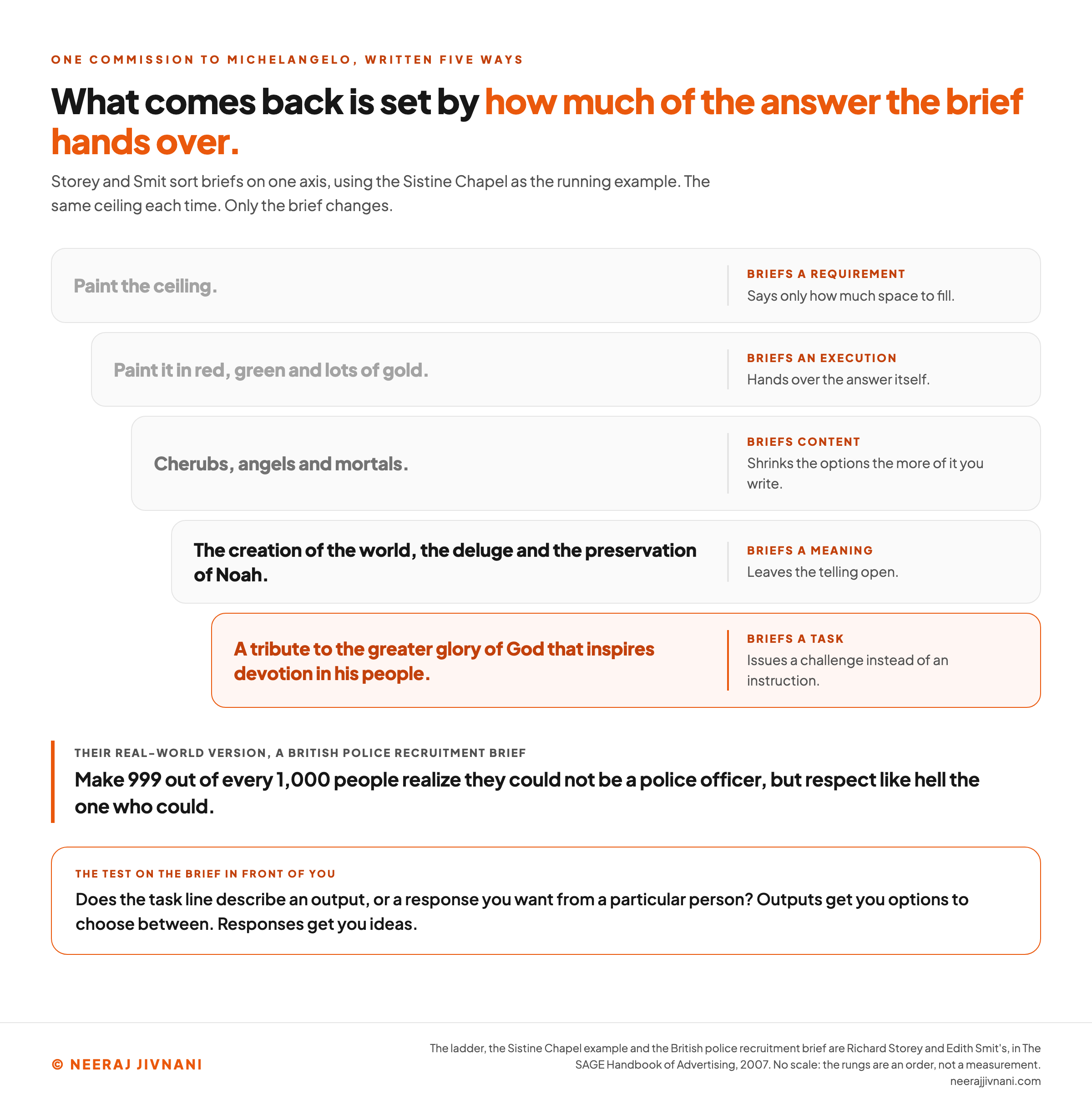
What separates the rungs is how much of the answer the brief hands over. Storey and Smit sort briefs that way, using the Sistine Chapel as the running example.
Pope Julius could have told Michelangelo to paint the ceiling. That is a requirement, and it says only how much space to fill.
He could have said to paint it in red, green and lots of gold, which briefs an execution.
He could have specified cherubs, angels and mortals, which briefs content and shrinks the options the more of it you write.
He could have described the creation of the world, the deluge and the preservation of Noah. That briefs a meaning and leaves the telling open.
Or he could have asked for a tribute to the greater glory of God that inspires devotion in his people, which briefs a task and issues a challenge instead of an instruction.
A British police recruitment brief did exactly that. It asked the advertising to make 999 out of every 1,000 people realize they could not be a police officer, but respect like hell the one who could.
So the test on the brief in front of you is short. Does the task line describe an output, or a response you want from a particular person?
Outputs get you options to choose between. Responses get you ideas.
Read It Back Before Anyone Starts
There is a measured reason not to trust your own read of your own brief.
80% of marketers think they write good briefs. 10% of creative agencies agree, in BetterBriefs' 2021 survey of more than 1,700 marketers and agency staff across more than 70 countries.
On whether briefs give clear strategic direction, the split was 78% against 5%.
Both figures are perceptions, and neither side is a neutral judge of the other.
What the gap says is that a brief's writer and its readers do not agree about it, and you cannot tell from inside which of you is right. So read it back, out loud, to the people who will use it, before any work starts.
Use this chart — embed code and citation
<a href="https://neerajjivnani.com/blog/creative-brief/"><img src="https://neerajjivnani.com/infographics/creative-brief/from-an-instruction-to-a-challenge.png" alt="A five-rung ladder showing one commission to Michelangelo written five ways, each rung stepped further to the right than the one above it. Paint the ceiling briefs a requirement, and says only how much space to fill. Paint it in red, green and lots of gold briefs an execution, and hands over the answer itself. Cherubs, angels and mortals briefs content, and shrinks the options the more of it you write. The creation of the world, the deluge and the preservation of Noah briefs a meaning, and leaves the telling open. A tribute to the greater glory of God that inspires devotion in his people briefs a task, and issues a challenge instead of an instruction. Below the ladder sits the real-world version, a British police recruitment brief asking the advertising to make 999 out of every 1,000 people realize they could not be a police officer, but respect like hell the one who could. A band across the foot asks whether the task line describes an output or a response you want from a particular person, and says that outputs get you options to choose between while responses get you ideas." width="1200"></a>
<p>Chart: <a href="https://neerajjivnani.com/blog/creative-brief/">Neeraj Jivnani</a></p>Neeraj Jivnani, "How to Write a Creative Brief, and Which Parts Change the Work", neerajjivnani.com, https://neerajjivnani.com/blog/creative-brief/Free to republish with a link back to this page.
What a Brief Cannot Fix
Some of what gets blamed on a brief was never a briefing problem in the first place.
It cannot settle an argument the business has not had. When two executives want different things, a careful brief records the disagreement in diplomatic language, and the work is where it finally surfaces.
It cannot make a weak proposition strong. If there is genuinely nothing to say, a well-written page describes that clearly and the work will still be thin.
The Brief Will Change During the Work
The brief itself will move, and that is what people plan around least.
No brief can be completely right and wholly inspiring at the outset of creative development, and none is likely to stay unchanged in substance and meaning through the development that follows. Storey and Smit put that as directly as it can be put.
Their study of the Account Planning Group's award case histories found that cases running strategy, briefing and creative development as a clean linear sequence were in the minority.
From those papers, they read it as commonplace in many agencies, if not most, for strategic and creative development to run at least partly in tandem.
That is worth designing for rather than resisting.
Put a version number and a date on the brief, agree who is allowed to change it, and re-circulate it when it changes. Then "the brief has moved" stops being an accusation and becomes a status.
A brief with every box full of generic answers is worse than a short one, because it looks finished and nobody reopens it.
Creative Brief, Design Brief, Marketing Brief
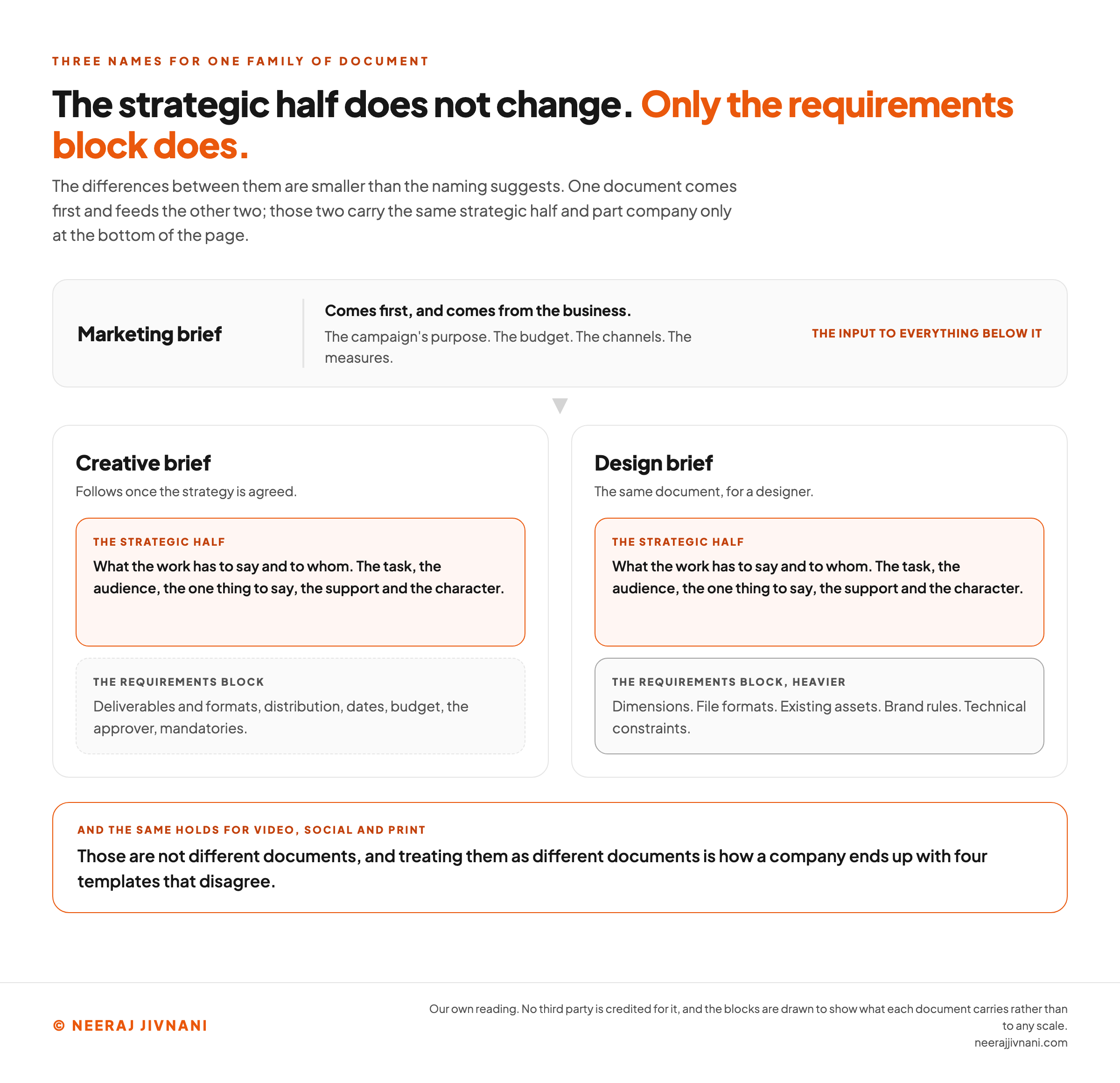
Three names for one family of document, and the differences between them are smaller than the naming suggests.
The marketing brief comes first and comes from the business. It carries the campaign's purpose, the budget, the channels and the measures, and it is the input to everything below it.
The creative brief follows once the strategy is agreed. It carries what the work has to say and to whom, which is the five fields above.
The design brief is the same strategic half with a heavier specification block: dimensions, file formats, existing assets, brand rules, technical constraints.
Some templates carry five boxes, some eleven. Adding boxes does not make a brief more rigorous.
What moves with the count is how much recording the template asks for, not how much deciding.
A creative brief in graphic design is this same document, where the requirements section carries the specification a designer needs and the strategic half is unchanged.
The same holds for video, social and print. Those are not different documents, and treating them as different documents is how a company ends up with four templates that disagree.
Only the requirements block changes.
Use this chart — embed code and citation
<a href="https://neerajjivnani.com/blog/creative-brief/"><img src="https://neerajjivnani.com/infographics/creative-brief/only-the-requirements-block-changes.png" alt="Three documents drawn in sequence. At the top, the marketing brief, which comes first and comes from the business, carrying the campaign purpose, the budget, the channels and the measures, and labeled as the input to everything below it. An arrow points down to two panels side by side. The creative brief, which follows once the strategy is agreed, and the design brief, which is the same document for a designer. Both carry an identically drawn strategic half: what the work has to say and to whom, being the task, the audience, the one thing to say, the support and the character. Only their lower blocks differ. The creative brief carries a requirements block of deliverables and formats, distribution, dates, budget, the approver and mandatories, and the design brief carries a heavier one of dimensions, file formats, existing assets, brand rules and technical constraints. A band across the foot says the same holds for video, social and print, that those are not different documents, and that treating them as different documents is how a company ends up with four templates that disagree." width="1200"></a>
<p>Chart: <a href="https://neerajjivnani.com/blog/creative-brief/">Neeraj Jivnani</a></p>Neeraj Jivnani, "How to Write a Creative Brief, and Which Parts Change the Work", neerajjivnani.com, https://neerajjivnani.com/blog/creative-brief/Free to republish with a link back to this page.
A Brief, Filled In
The Structure
Here is the whole document on one page, described by what each field has to contain rather than by what it is called.
| Field | What it has to contain |
|---|---|
| Task | The behavior that has to change, what is stopping it, and the number you will read afterwards |
| Audience | One person, described closely enough to write dialogue for |
| The one thing | A single sentence, no conjunction |
| Support | The evidence that survives the because test |
| Character | The register for the work in hand, pointing at the voice document if one exists |
| Deliverables | What is made, how many, at what sizes and durations |
| Distribution | Where it runs, and what that constrains |
| Dates | Review, internal approval, delivery |
| Budget | The production budget, and what it includes |
| Approver | One name |
| Mandatories | Legal lines, brand rules, claims that must and must not appear |
For a design brief, only the last six rows change: the requirements block carries dimensions, file formats, existing assets, brand rules and technical constraints, and the five above it are unchanged.
The Same Structure With a Project in It
Say a bakery chain sells well at weekends and poorly on weekdays, and wants that to change. This example is illustrative, not a client.
Task. Get existing weekend customers to buy bread on a weekday. What stops them is not price or preference: a weekday loaf means a second stop on a commute with no slack in it. Measured on weekday loaf sales against the same eight weeks last year, read in January.
Audience. Somebody who likes this bakery enough to queue on a Saturday, and who buys supermarket bread on a Tuesday without ever deciding to.
The one thing. Good bread is a weekday thing.
Support. The shops open before the commute and hold bread back for the evening, so there is a loaf at both ends of a working day.
Character. Warm, unhurried, never precious about baking. Points at the existing voice document.
The record. Six-sheet posters and in-store cards, a print run and dates, one approver, and the allergen line that has to appear on anything naming a specific product.
Six blocks, and every line in them is either a decision or a fact. That is the whole document.
Knowing When the Brief Is Finished
A brief is finished when the person who has to make something can say what has to change, who has to change it, and the one thing that might move them.
If you have an hour, spend fifty minutes on the five that decide and ten on the rest.
That is not a shortcut, and not a way of skipping the boring half. It is where the difference is.