What Brand Voice Is, and How to Write One Your Team Can Use
Place your voice on four scales, name what it is not, and write it down so anyone on your team can publish without checking with you first.

/ On this page8 sections
Your brand voice is the personality that stays the same across everything you publish. Tone is the part that moves.
Place it on four named scales, decide what it is not, and write the result down. Do that and anyone on your team can publish without checking with you first.
What Brand Voice Is
Brand voice is a decision somebody wrote down, not a mood that emerged.
The test is not whether the words sound nice.
It is whether somebody who did not write them can tell they came from you.
A voice has to do three things at once. It has to be distinctive, practical enough for the people who will use it to write, and consistent without being rigid.
Of the three, being practical is what decides whether the other two ever reach a page.
It is also what separates a voice from a mission statement. A voice only its author can apply has failed at the job it exists to do.
Tone is where the voice reaches a reader, which is why word choice is only half of it.
Brand Voice and Brand Tone, and Why the Difference Is Load-Bearing
Voice is what stays the same. Tone is what moves.
The two words get used interchangeably, and pulling them apart is what makes everything below usable.
A voice needs two elements, a constant and a variable. That framing is Lippincott's, from its 2020 paper on finding a brand voice.
The constant is character, "a clear, inhabitable persona, inspired by a real person, that is consistent across the entire organization regardless of subject, touchpoint or audience".
The variable is intent, "what your character intends to achieve in a given moment".
That split tells you which half is allowed to change.
If your character shifts between a product page and a service outage, you do not have a voice. If your intent does not shift between them, you have a voice nobody can stand.
The same three words that carry a launch announcement are wrong on a billing error. Character is not the thing that gives.
"BrandVoice" As One Word Is a Different Thing
Written as one word, BrandVoice is Forbes' sponsored content program rather than anything to do with your own writing. Forbes labels those pages "BrandVoice | Paid Program" on the page itself.
So a search that returns Forbes BrandVoice articles has returned advertising, not editorial.
The two terms are unrelated apart from the spelling.
Why Brand Voice Matters
The honest answer is that the internal case is strong and the external one is thin.
Two claims get made for brand voice most often. One you can test yourself this week. The other rests on a vendor's own survey, and it is worth knowing where that came from before you repeat it.
The Internal Case Is the One You Can Check Yourself
A voice earns its keep inside the company first, and that claim needs no survey behind it. Several people publishing without one will not sound like one organization.
The cost is a reader who cannot tell what the brand is.
CUSTOMatrix ran into it: its own published guidelines describe a previous voice that was "at times firm, tight and professional, while at others conversational and highly-peppered with colloquialisms", and put the result as confusion in brand perception.
You can test for that cost in an afternoon without commissioning anything.
Put last month's output in front of somebody who did not write it, and ask how many people they think produced it.
The 33% Number, and Where It Comes From
The vendor claim is that consistent branding can raise revenue by 33%. It comes from a December 2019 Lucidpress press release, reporting the brand templating company's own survey of over 200 organizations.
The same claim also circulates at 23%, credited to Marq, the company Lucidpress became. Both numbers are the same vendor's own research rather than two independent results.
A second number in the same release is more useful and gets quoted far less. It reports that 81% of companies still deal with off-brand content, which describes the problem rather than promising a return for solving it.
The Four Dimensions a Voice Sits On
The four dimensions are formal against casual, serious against funny, respectful against irreverent, and matter-of-fact against enthusiastic. Nielsen Norman Group published them in July 2016 and last reviewed the article in 2023.
Each one is a spectrum rather than a switch, and a piece of copy can fall anywhere along it.
That is the difference between a scale and an adjective, and it is why the frame survives contact with real writing.
Here is what each dimension is asking.
| Dimension | The question it asks |
|---|---|
| Formal against casual | Is the writing formal, informal or casual? |
| Serious against funny | Is the writer attempting humor, or approaching the subject seriously? |
| Respectful against irreverent | Does the writer approach the subject respectfully, or irreverently? |
| Matter-of-fact against enthusiastic | Is the message delivered plainly, or with energy behind it? |
One caution on the humor dimension, which matters when you apply it. The study measured only the attempt at humor, and explicitly did not evaluate whether the writers landed their jokes.
Irreverence carries its own caution. An irreverent tone is usually aimed at the subject, and not usually meant to offend the reader.
What the Study Behind Them Found
The evidence under these four dimensions is one small study, and it is worth knowing its size before you lean on it.
It was an online survey of 50 American respondents, who rated paired writing samples on 5-point Likert scales. The differences within each pair were statistically significant at p < 0.05, and they ran in the direction the tone profiles predicted.
So readers do notice tone shifts. The effect is real.
The size of that effect matters more than its statistical significance. Nielsen Norman Group is explicit that the differences it measured were small in absolute terms, at around 0.5 to 1 point on a 5-point scale.
Hold onto that for two reasons.
It means tone genuinely registers with a reader, and it means a single tone change is a nudge rather than a transformation. The returns come from doing it consistently rather than dramatically.
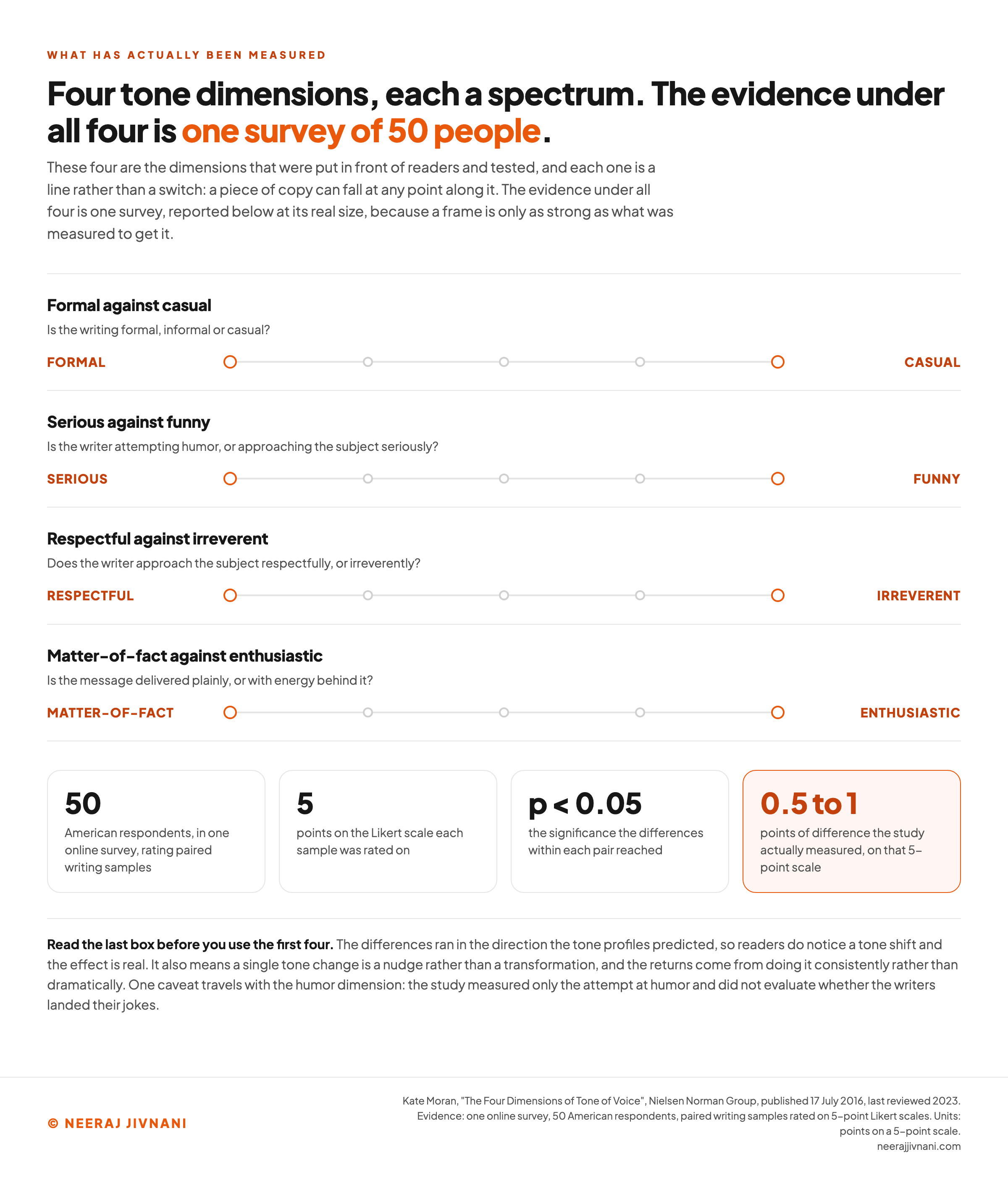
Use this chart — embed code and citation
<a href="https://neerajjivnani.com/blog/brand-voice/"><img src="https://neerajjivnani.com/infographics/brand-voice/four-dimensions.png" alt="Four horizontal five-point spectra, one for each measured tone dimension, labeled formal against casual, serious against funny, respectful against irreverent and matter-of-fact against enthusiastic, with the question each one asks printed beneath its name, above four boxes carrying the study behind them: 50 American respondents, a 5-point Likert scale, significance at p below 0.05, and a measured difference of only 0.5 to 1 point." width="1200"></a>
<p>Chart: <a href="https://neerajjivnani.com/blog/brand-voice/">Neeraj Jivnani</a></p>Neeraj Jivnani, "What Brand Voice Is, and How to Write One Your Team Can Use", neerajjivnani.com, https://neerajjivnani.com/blog/brand-voice/Free to republish with a link back to this page.
How to Find Your Brand Voice
To identify your brand voice, start from what you have already published rather than from a blank page, and decide by reacting to real writing rather than to adjectives. The steps below move from evidence you already own to a document somebody else can use.
Five steps, in the order that works:
- Read what you have already written, because you have a voice whether or not you chose it.
- Write one real passage three ways, so the team argues about sentences instead of adjectives.
- Name the traits, and name what you are not, since the negative half is what makes the list usable.
- Check it against your readers and your competitors, to catch a voice nobody wants or everybody already has.
- Use the mission where it helps, and stop where it stops helping.
Start From What You Have Already Published
Audit before you invent.
Any company with published output already sounds like something, so the first job is to describe it, not to choose it.
Pull your best-performing pages, your last ten customer emails and your last month of social posts. Read them for what they have in common, not for quality.
The question is not whether you like the writing. It is whether a stranger reading all of it would describe the writer the same way twice.
You know the voice is right when a sample needs only light edits for voice and style. That is a completion test you can run without an opinion in the room.
Write the Same Passage Three Ways
Writing the same passage three ways is what makes the adjective exercise honest. Instead of asking a team which words describe the brand, you show them three versions of one article and ask which sounds like the company.
Prosper Strategies sets out the three versions precisely in its 2018 worksheets. Each is one to three paragraphs of a real article, adapted rather than invented.
- A formal version, discussing the topic at the highest level and using two or three cited sources or statistics.
- A neutral version, a bit more conversational than the first, carrying one cited source or statistic.
- A casual version, the most conversational of the three, with one or two jokes or witticisms appropriate to the organization.
The team then reads all three and answers four questions: what they like, what they dislike, which of the three is closest to the voice they want, and how elements of each might be combined.
This works because people are unreliable about labels and reliable about reactions.
Everybody agrees they want to sound "approachable", and then disagrees violently about a specific sentence. That disagreement is the one you need to have.
Name the Traits, Then Name What You Are Not
Pick three to five characteristics, and pair each one with what it does not mean.
The negative half is the half that gets used.
Say your brand is "funny" but not "blue", which is how Amazon Ads sets the pair out.
A trait on its own is not actionable, because everybody thinks they are already doing it.
A trait with a boundary is a decision somebody can apply at eleven at night without asking you.
If you want a starting vocabulary to argue with, there are five brand personality traits worth borrowing: sincerity, excitement, competence, ruggedness and sophistication.
Jennifer Aaker set them out in 1997, and a 2021 brand consistency study in Transactions on the Web still builds on all five.
Those five are broader than a voice guide needs, and that is the point of using them early. They give you a coarse position to argue with before you get precise.
Check It Against Your Readers and Against Your Competitors
A voice you chose alone is a preference. Two checks turn it into a decision.
Ask your own audience what the brand would sound like if it were a person.
That question gets a usable answer from people who would struggle to describe a tone in the abstract.
The second check is competitive.
Do a competitive analysis on the four or five companies your buyers also read, placing them on the four dimensions before you place yourself.
The purpose is not to be different for its own sake. It is to notice when the traits you picked are the traits everybody in your category has already picked, which is how three companies end up sounding identical while each believes it is distinctive.
Where the Mission Helps, and Where It Stops Helping
Your mission and values can tell you what to care about. They cannot tell you how to sound.
The limit is easy to see once you look for it. Ask ten companies to derive a voice from their values and most will arrive at some arrangement of authentic, innovative, human and trusted, because those are the values almost everybody holds.
Values narrow the field. The three-versions exercise and the negative traits are what pick a point inside it.
Use the mission for the question it answers well, which is what you refuse to say. A company whose values genuinely rule out hype has learned something an adjective list would not have given it.
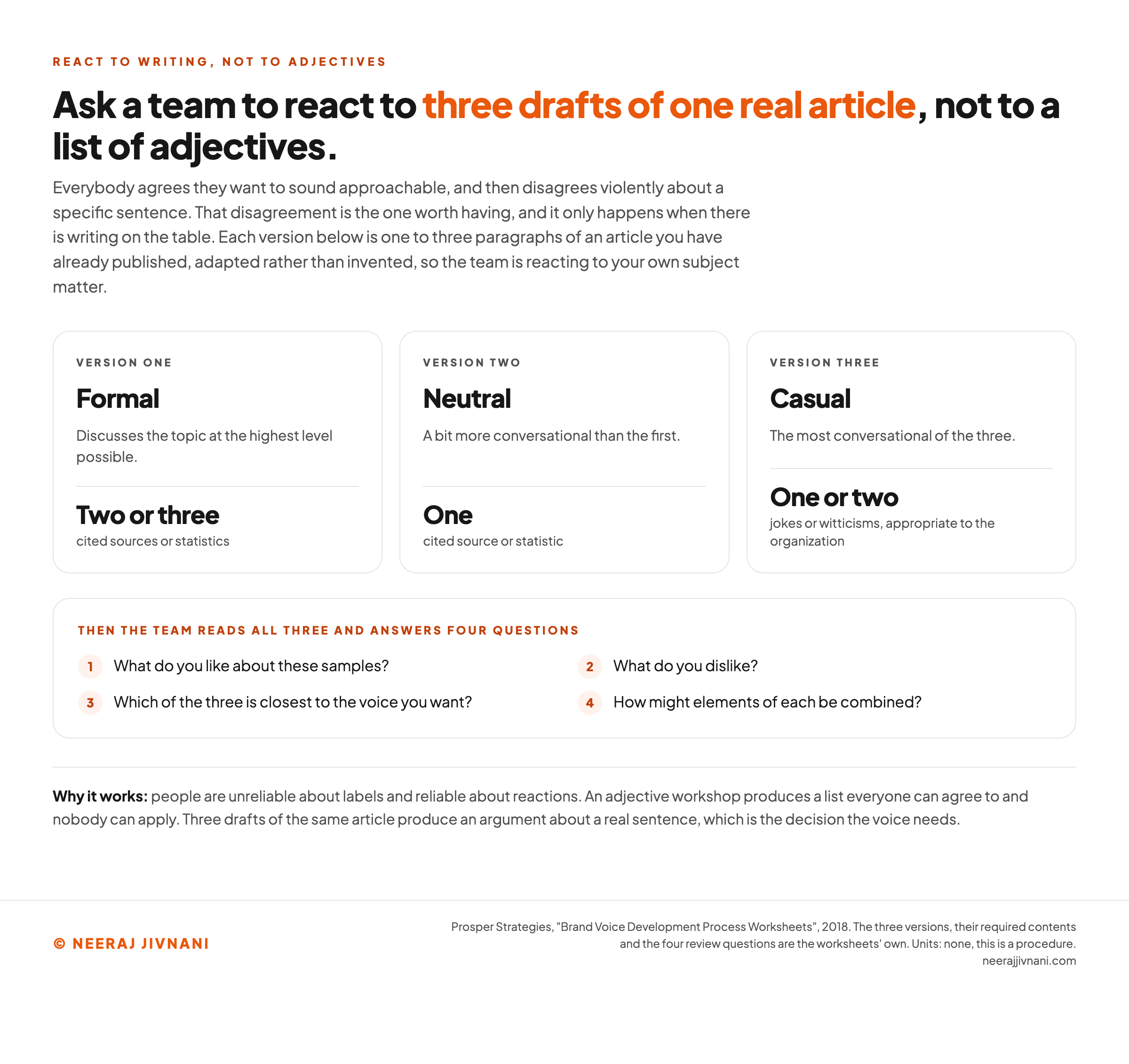
Use this chart — embed code and citation
<a href="https://neerajjivnani.com/blog/brand-voice/"><img src="https://neerajjivnani.com/infographics/brand-voice/three-versions.png" alt="Three cards side by side setting out the formal, neutral and casual versions of one real article, each naming what it has to contain, two or three cited sources for the formal version, one for the neutral and one or two jokes for the casual, above the four questions the team answers once it has read all three." width="1200"></a>
<p>Chart: <a href="https://neerajjivnani.com/blog/brand-voice/">Neeraj Jivnani</a></p>Neeraj Jivnani, "What Brand Voice Is, and How to Write One Your Team Can Use", neerajjivnani.com, https://neerajjivnani.com/blog/brand-voice/Free to republish with a link back to this page.
What a Brand Voice Guide Actually Contains
A usable guide is mostly not adjectives. CUSTOMatrix publishes its own in full, and the order in a real document is the instructive part.
It runs through brand personality, then per-trait guidance on conveying each one, then a voice map, then worked rewrites, then a list of alternate adjectives.
The adjectives arrive last, after the guidance that makes them mean something.
Written guidance moved from useful to load-bearing when teams started drafting with AI. Clear guidelines give you a benchmark to check a generated post against, so anything off-brand is caught before it goes live.
There is a reader-side reason too. Consumers who spot AI-generated content are four times more likely to trust a brand less, in a Klaviyo and Datalily survey cited by Hootsuite. Generated copy has no personality of its own.
Whichever reason moves you, a drafted sentence has to be measured against something, and one person's instinct does not survive that person going on holiday.
The Voice Map, and Why Both Poles Have to Be Real
The voice map is worth copying. Four named scales, five positions each, with one position marked and the reasoning written underneath it.
These are not the four tone dimensions Nielsen Norman Group tested. They are one company's own scales, which is allowed, because what has to be true is that each end is a real word.
| Scale | The five positions | Where CUSTOMatrix marked itself |
|---|---|---|
| Volume | Whispered, Softly Spoken, Conversational, Loud, In Ya Face! | Conversational |
| Energy | Chilled, Relaxed & Easy Going, Switched-On, Effervescent, Manic | Relaxed & Easy Going |
| Sociability | 1 on 1, Inclusive Club, Colleagues & Friends, Community, Universal | Colleagues & Friends |
| Attitude | Safe, Conventional, Politely Opinionated, Provocative, Polarizing | Provocative |
The document explains each mark rather than asserting it. Its attitude is provocative, it says, because that follows from courage as a personality trait, while its energy stays relaxed, so the combination reads as friendly with an edge rather than as aggressive.
"In Ya Face!" and "Whispered" are positions a writer can miss by, which is more than "confident" offers.
Can a writer miss by it?
Type a word you want your writing to be. It will sit there as a label until you write the far end of it, because a word with one end is not something anybody can overshoot. Write the opposite and the same word becomes five positions you can mark.
Start from a published set, or from nothing
The map is empty. Add a word, or load one of the two published sets above and move the marks to where you actually sit.
The Rewrites Are What a New Writer Uses
The guidance under each trait is written as instructions with an avoid attached. Under intelligence, for example, the document tells writers to explain industry terms where relevant, and to avoid a tone that is condescending, elitist or assuming.
Then it demonstrates.
It takes three real page types, a team biography, a services overview and a company history page, and prints a before and an after for each.
A guide that says "be conversational" and a guide that shows one of your own paragraphs rewritten are not the same document. The second answers the question a new writer has, which is what the instruction looks like applied to work like theirs.
The closing section is a list of alternate adjectives, grouped under the ideas they serve. That is what makes the document usable at speed, because most writing decisions are a search for a better word rather than a question of principle.
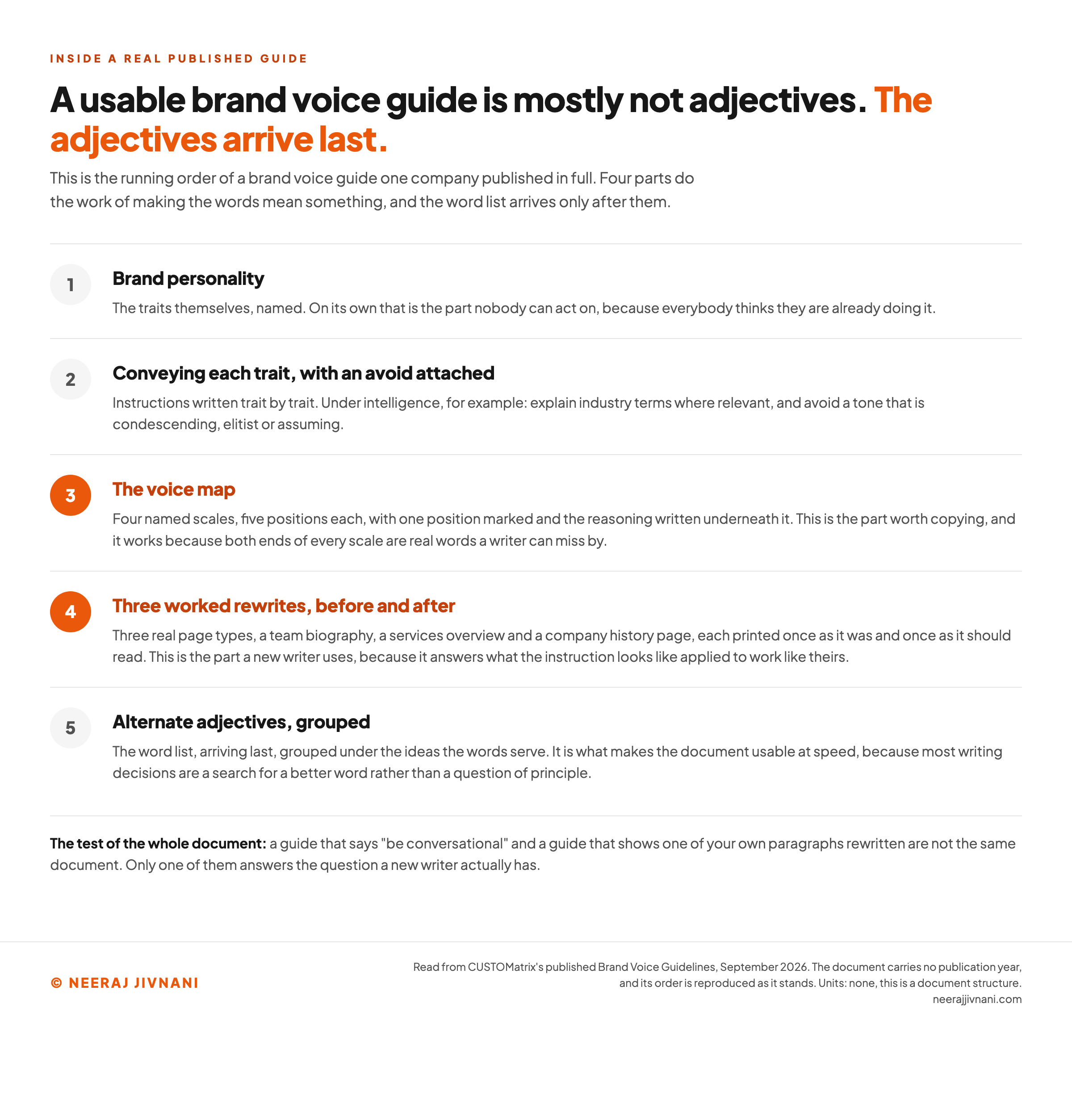
Use this chart — embed code and citation
<a href="https://neerajjivnani.com/blog/brand-voice/"><img src="https://neerajjivnani.com/infographics/brand-voice/guide-anatomy.png" alt="A numbered running order of the five parts of a real published brand voice guide, moving from brand personality through per-trait guidance with an avoid attached, the voice map and three before-and-after rewrites, with the alternate adjectives list arriving fifth and last, and the voice map and the rewrites marked in orange." width="1200"></a>
<p>Chart: <a href="https://neerajjivnani.com/blog/brand-voice/">Neeraj Jivnani</a></p>Neeraj Jivnani, "What Brand Voice Is, and How to Write One Your Team Can Use", neerajjivnani.com, https://neerajjivnani.com/blog/brand-voice/Free to republish with a link back to this page.
Tone Moves With the Reader's Situation, Not the Channel
Move your tone with the state the reader is in, not with the channel they are reading on. Channel is the easiest variable to write a rule about, and it is the wrong one.
The personality stays put; only the register moves.
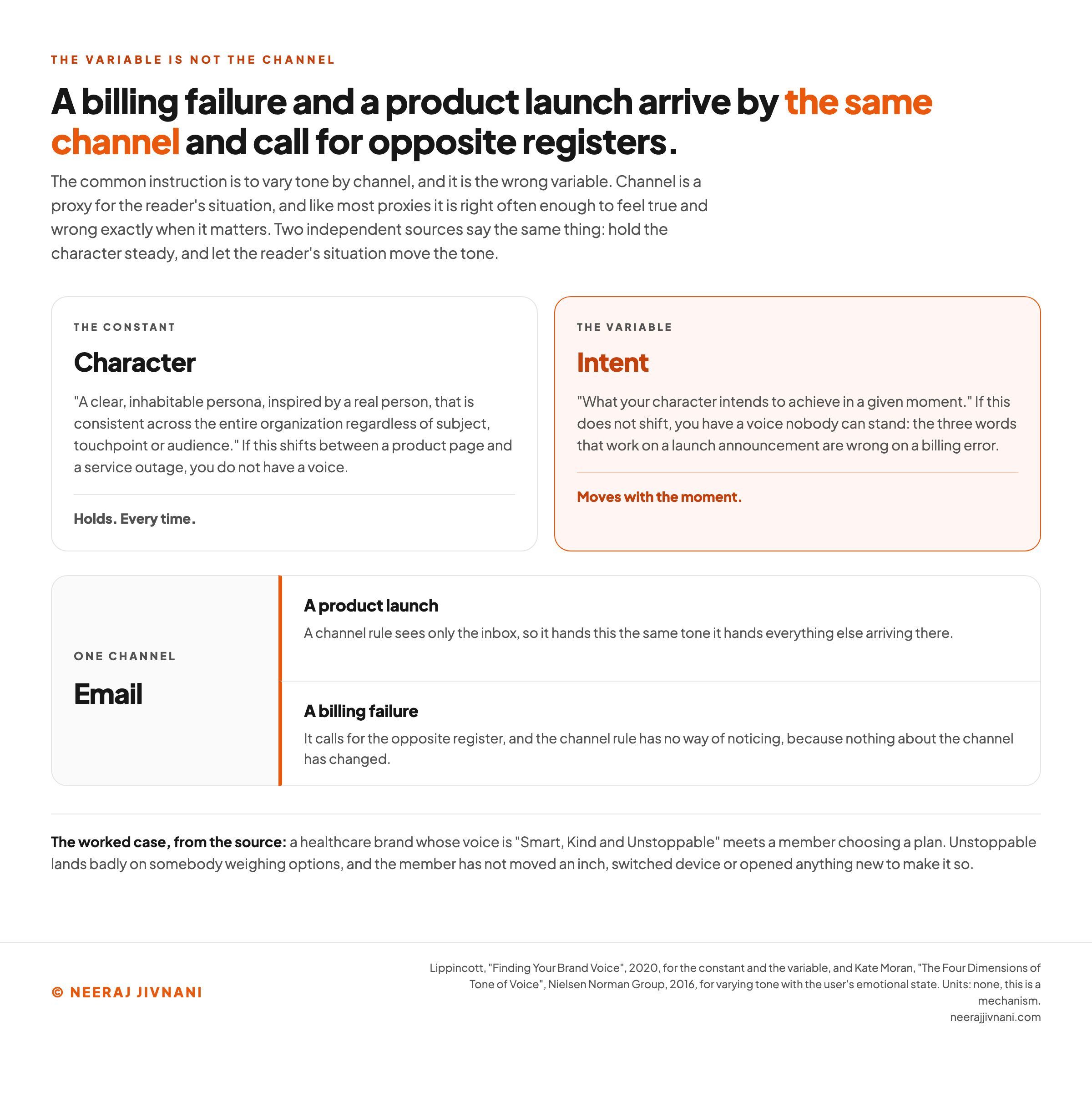
Lippincott's worked example is a healthcare brand whose voice is "Smart, Kind and Unstoppable" meeting a member who is choosing a plan.
Unstoppable is the wrong note in that moment, and no channel rule would have caught it.
The member is on the same website, reading the same brand, in a situation that calls for something else entirely.
Channel-based rules fail for a simple reason. A billing failure and a product launch can both arrive by email, and they call for opposite registers.
Channel is a proxy for situation, and like most proxies it is right often enough to feel true and wrong exactly when it matters.
Use this chart — embed code and citation
<a href="https://neerajjivnani.com/blog/brand-voice/"><img src="https://neerajjivnani.com/infographics/brand-voice/situation-not-channel.png" alt="A two-column diagram setting the constant against the variable, character on the left holding across every subject and touchpoint and intent on the right moving with the moment, above a single email channel splitting into a product launch and a billing failure that call for opposite registers, showing why a channel rule cannot tell the two apart." width="1200"></a>
<p>Chart: <a href="https://neerajjivnani.com/blog/brand-voice/">Neeraj Jivnani</a></p>Neeraj Jivnani, "What Brand Voice Is, and How to Write One Your Team Can Use", neerajjivnani.com, https://neerajjivnani.com/blog/brand-voice/Free to republish with a link back to this page.
Brand Voice Examples, and What Each One Is Evidence Of
Wendy's is a brand voice example because it sits at a recognizable extreme of one dimension, humor, and everyone can hear it.
That is what a brand voice example is: a company far enough along one scale that the position is audible in a single sentence.
Organizing examples by dimension is what makes them useful, because it tells you which scale each brand is an example of.
The table below is Brandwatch's, which places well-known brands at both ends of the four and credits Nielsen Norman Group for the framework.
| Dimension | The two ends | At the first end | At the second |
|---|---|---|---|
| Humor | Funny to serious | Old Spice, Wendy's | IBM, McKinsey |
| Formality | Casual to formal | Mailchimp, Innocent Drinks | Goldman Sachs, The Economist |
| Respect | Irreverent to respectful | Dollar Shave Club, Oatly | Patagonia, UNICEF |
| Enthusiasm | Matter-of-fact to enthusiastic | Stripe, Basecamp | Apple, Nike |
That answers the common question about Wendy's directly. Its voice is an extreme position on the humor dimension, alongside Old Spice, and nothing more mysterious than that.
What the Examples Prove, and What They Do Not
Every brand in that table is a placement, not an outcome.
None of them is evidence that the placement caused anything, and a voice copied from a company with a different business will not carry the results that company gets.
The famous examples are consumer brands with room to be strange. Your company probably does not have that room.
Slack is the reference worth having for a business audience: recognizably itself, and never strange for the sake of it.
The pairing worth studying is one that holds the category constant. Whole Foods and Trader Joe's are two grocers with the same friendly energy, expressed in different ways.
Read that pair for the mechanics, not for inspiration. Sentence length, whether contractions appear, whether questions are asked, and whether the brand ever admits to a limitation will tell you more than any adjective used to summarize them.
Keeping the Voice Once It Is Written Down
A voice guide decays unless somebody reads the output against it. Put the review on a schedule rather than leaving it to whoever notices.
The measurement question has a real answer, and it is the same instrument the original study used.
Ask your own readers to place your content on one or more of the four dimensions, on a 3-point or 5-point Likert scale with an extreme at each end.
That gives you a number for the gap between where you meant to sit and where readers place you. Run it twice a year on the same dimensions and the movement is the finding.
When that number is bigger than you want, do not start by editing the adjectives.
Go to the guidance you wrote under the trait behind the dimension that moved, and to the worked rewrites. Adjectives help a writer pick a word; the guidance and the rewrites are what set the position a reading measures.
Who Decides, and What Still Has to Be Done by Hand
Every voice project eventually hits the same question, which is who decides.
Give the final say to whoever already signs off on marketing and communications content. Naming that person in advance is what stops a voice guide dissolving into a committee.
The honest state of the art is that this is still manual work.
A 2021 study in Transactions on the Web, drawing on web content from around 650 companies, says that monitoring large-scale content authoring for brand consistency "is presently checked manually with the brand style guide of a company".
That study exists because the manual checking does not scale.
Manual checking is also why the written guide carries so much weight. Nobody has replaced the document, so the document has to be good enough for a person to apply quickly.
Two questions settle whether your guide is finished.
Hand it to somebody who has never met you, and see whether the paragraph they write sounds like your company. Then ask whether you would have noticed if it did not.