AI Content Creation: Which Jobs to Hand Over, and Which to Keep
Some of this work a model does reliably in seconds. The rest quietly costs you more than it saves. Learn to tell them apart before you start.

/ On this page9 sections
A model does some of this work reliably, and in seconds. The rest costs you more in checking than you ever saved in typing, and nothing warns you which one you are about to do.
One question sorts them, and you can ask it in about five seconds: how would you find out this output was wrong?
That is the whole method, and the answer tells you what the checking will cost.
What the Term Covers Now
AI content creation covers four kinds of output now: text, images, video and audio. It stopped meaning blog drafts some time ago.
Here is what sits under each.
Text. Posts, ad copy, product descriptions, email, captions, scripts, outlines. The oldest use, and the one the phrase still calls to mind first.
Images. Product shots placed in new settings, social graphics, thumbnails, seasonal variants of an asset you already own. If you sell physical things, this is the one we would put first.
Video. Cutting long footage into short vertical clips, adding captions and burned-in text, generating simple motion from a still.
Audio. Voiceover, narration, cleaning up a recording someone made on a phone.
The common thread is speed, and speed is the only thing anybody can promise you honestly. Everything else depends on what you put in and what you do afterwards.
What Actually Got Cheaper
Producing a first version stopped being the expensive part of publishing. That is a real change and it is narrower than it sounds.
What did not get cheaper is being sure the version is right.
On some jobs that second cost is trivial, because the output is wrong in ways you can see. On others it is the entire cost of the job, and it arrives after you have already congratulated yourself on the time saved.
The One Question Worth Asking First
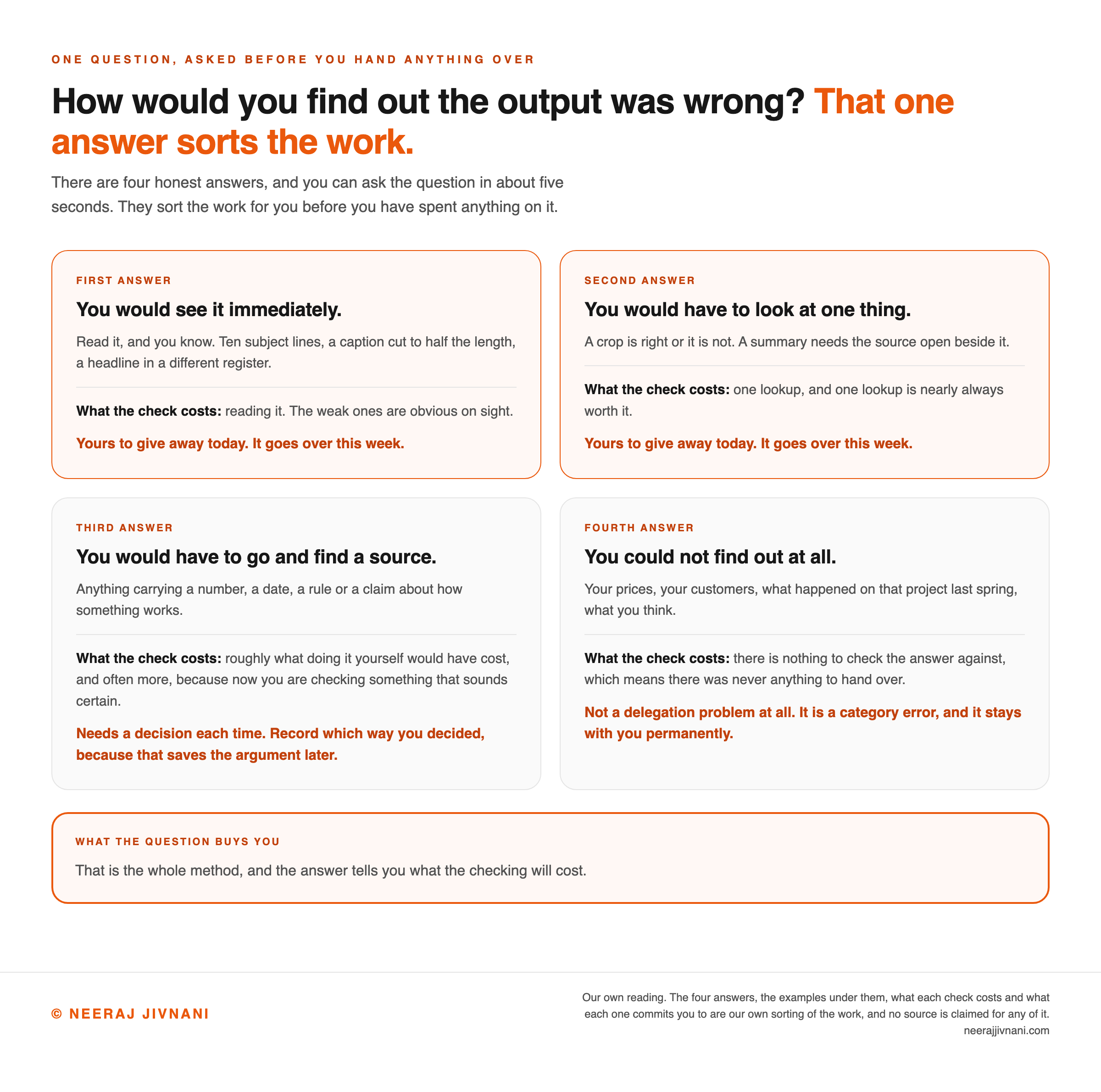
Ask how you would find out the output was wrong. There are four honest answers to that, and they sort the work for you before you have spent anything on it.
You would see it immediately. Read it, and you know. Ten subject lines, a caption cut to half the length, a headline in a different register.
You would have to look at one thing. A crop is right or it is not. A summary needs the source open beside it. One lookup, and one lookup is nearly always worth it.
You would have to go and find a source. Anything carrying a number, a date, a rule or a claim about how something works. Checking costs roughly what doing it yourself would have cost, and often more, because now you are checking something that sounds certain.
You could not find out at all. Your prices, your customers, what happened on that project last spring, what you think. There is nothing to check the answer against, which means there was never anything to hand over.
The first two are yours to give away today. The third needs a decision each time.
The fourth is not a delegation problem at all. It is a category error.
Use this chart — embed code and citation
<a href="https://neerajjivnani.com/blog/ai-content-creation/"><img src="https://neerajjivnani.com/infographics/ai-content-creation/how-fast-could-you-tell.png" alt="Four panels setting out the four honest answers to the question of how you would find out a model's output was wrong, each with the examples that belong to it, what the check costs and what it commits you to: you would see it immediately, whose check is reading it and which goes over this week; you would have to look at one thing, whose check is one lookup and which also goes over this week; you would have to go and find a source, which covers anything carrying a number, a date or a rule, whose check costs roughly what doing the job yourself would have cost and often more, and which needs a decision each time; and you could not find out at all, which covers your prices, your customers and what you think, where there is nothing to check the answer against and the work stays with you permanently. A closing band says the answer tells you what the checking will cost." width="1200"></a>
<p>Chart: <a href="https://neerajjivnani.com/blog/ai-content-creation/">Neeraj Jivnani</a></p>Neeraj Jivnani, "AI Content Creation: Which Jobs to Hand Over, and Which to Keep", neerajjivnani.com, https://neerajjivnani.com/blog/ai-content-creation/Free to republish with a link back to this page.
The Jobs Worth Handing Over
The jobs worth handing over are the ones whose output announces its own mistakes. Six of them cover most of a content week.
Variations on something that already works. You have a subject line, a headline, an opening paragraph. You want ten more in the same register.
Reading ten lines takes a minute, and the weak ones are obvious on sight.
Reformatting one piece for another channel. A long post into a thread, a webinar into captions, a case study into ad copy. The source sits in front of you, so anything invented shows up as something you never said.
Cleanup. Transcripts, meeting notes, a recording made on a phone. Punctuation, filler removal, speaker labels.
This is the least glamorous use and the one that pays back most reliably.
Alt text and meta descriptions, written from the page itself. Hand it the page, take the first pass, fix the two that miss. It cannot know which detail in an image is load-bearing, and you will see that in a second.
A first-pass translation. Good for scale, never good unsupervised. You still need somebody who speaks the language to read it, and that person now edits instead of writing from nothing.
Structure from material you supply. Give it your notes, your research, your transcript, and ask for an order. It is arranging your material rather than inventing any.
The Thread Running Through All Six
In every one of them you supplied the substance and the model supplied the shaping.
That is the pattern to look for. When the substance is already yours, the worst outcome is a bad arrangement of true things, and you can see a bad arrangement.
The Jobs That Cost More Than They Save
The expensive jobs are the ones where being wrong stays invisible until somebody else finds it. Four of them account for nearly all the damage.
Anything with a number, a date or a rule in it. A model will produce a plausible figure, credited to a plausible source, that does not exist.
Verifying one properly means finding the original document and reading the sentence around the number. That costs more than looking it up yourself would have.
Anything about your own business. Your prices, your process, your results, what a client asked for last month. There is no source to check it against, because the source is you.
Your position. The recommendation, the thing you would say if somebody asked you across a table, the call you would defend when somebody pushed back on it.
There is nothing external to check that against. The only reference is what you believe, and you are the only person holding it.
The first idea. One step earlier, same problem. A generated list of angles is a decent map of what your reader has met before, which makes it better for elimination than for selection.
None of this is a limitation you can prompt your way out of, and a longer brief does not fix it. It is a statement about what the tool is for.
What a Real Check Looks Like
Finding a page that repeats a figure is not a check. It is how a plausible number becomes a published one.
A real check has four parts and costs about five minutes.
Find the primary document, not a page citing it. A trade article quoting a survey is not the survey, and the number often changes on the way across.
Find the sentence, then read the paragraph around it. Scope lives in the sentences on either side. A figure lifted out of a qualifying clause is a different claim from the one the source made.
Check the edition and the date. Sources get revised, and this year's version usually sits at the same address as last year's.
Decide whether your sentence claims what their sentence supports. Not something adjacent to it, and not the stronger version you would prefer.
Five minutes is the honest price. A piece carrying eight sourced claims owes forty minutes you did not need before, and that is the bill the speed was borrowed against.
Your own week, sorted with the one question
For each job below, answer one thing: how would you find out the output was wrong? Nothing here is scored and no answer is corrected. The sort is yours, and what it prints is what each answer commits you to.
The four honest answers
You would see it immediately.
Read it, and you know. Ten subject lines, a caption cut to half the length, a headline in a different register.
You would have to look at one thing.
A crop is right or it is not. A summary needs the source open beside it. One lookup, and one lookup is nearly always worth it.
You would have to go and find a source.
Checking costs roughly what doing it yourself would have cost, and often more, because now you are checking something that sounds certain.
You could not find out at all.
There is nothing to check the answer against, which means there was never anything to hand over.
The jobs
Ten more of something that already works
A subject line, a headline, an opening paragraph, in the same register. Reading ten lines takes a minute, and the weak ones are obvious on sight.
One piece reformatted for another channel
A long post into a thread, a webinar into captions, a case study into ad copy.
Cleanup on a transcript or a recording
Punctuation, filler removal, speaker labels. The least glamorous use and the one that pays back most reliably.
Alt text and meta descriptions, written from the page itself
Hand it the page, take the first pass, fix the two that miss. It cannot know which detail in an image is load-bearing.
A first-pass translation
Good for scale, never good unsupervised. Somebody who speaks the language still reads it, and now edits instead of writing from nothing.
An order for notes, research or a transcript you supply
You give it your material and ask for an order. It is arranging your material rather than inventing any.
Anything with a number, a date or a rule in it
A model will produce a plausible figure, credited to a plausible source, that does not exist.
Anything about your own business
Your prices, your process, your results, what a client asked for last month. There is no source to check it against, because the source is you.
Your position on something
The recommendation, the thing you would say if somebody asked you across a table, the call you would defend when somebody pushed back on it.
The first idea, or a list of angles
A decent map of what your reader has met before, which makes it better for elimination than for selection.
The question that decides whether the sort applies at all
For the jobs you put in the first two answers, is the material in front of you?
Where your week landed
Answer the question on one job above and the board starts filling. On paper this takes about twenty minutes and you only do it once.
What You Have to Give It
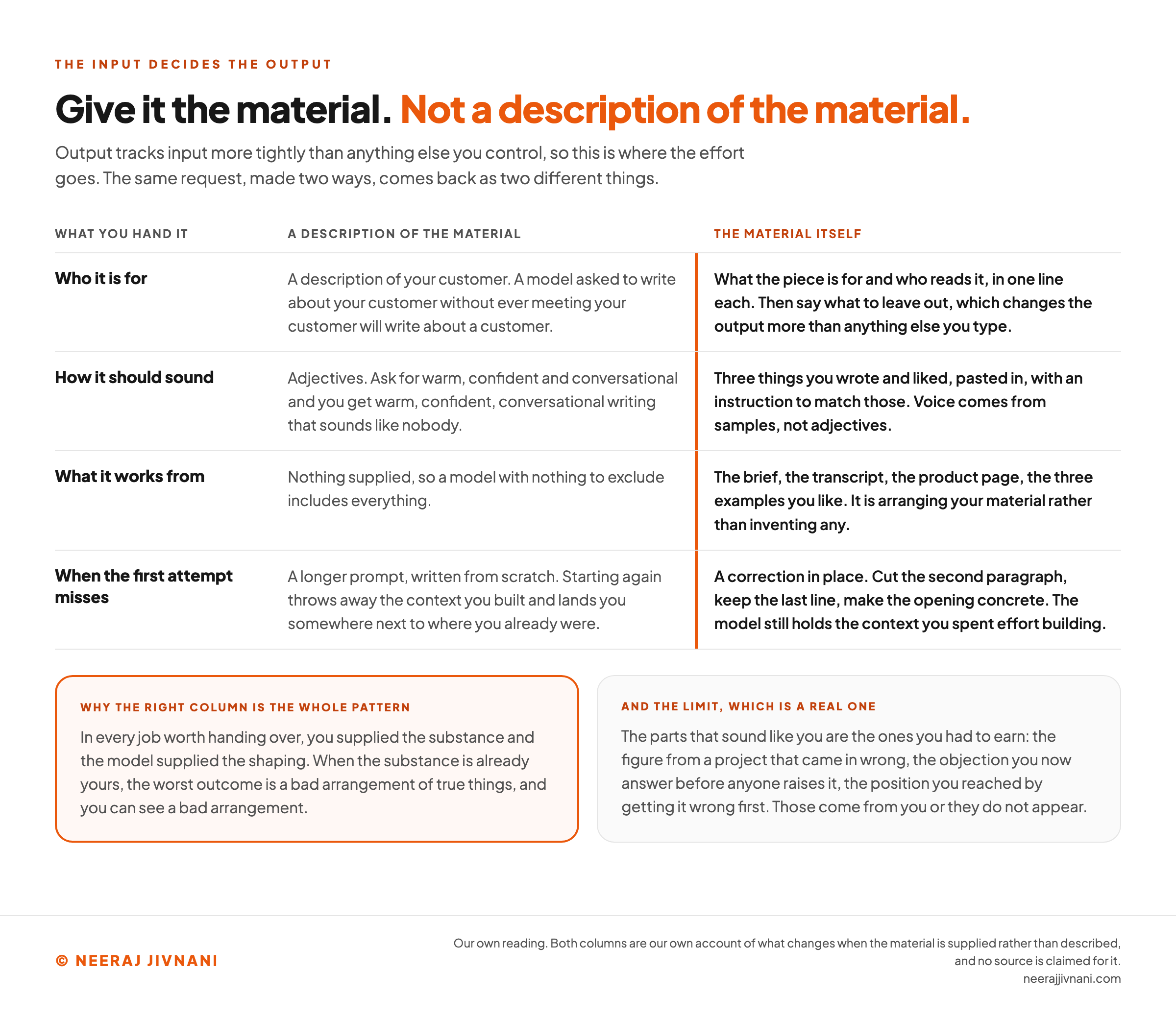
Output tracks input more tightly than anything else you control, so this is where the effort goes.
Give it the material, not a description of the material. The brief, the transcript, the product page, the three examples you like.
A model asked to write about your customer without ever meeting your customer will write about a customer.
Say what the piece is for and who reads it, in one line each. Then say what to leave out.
Saying what to leave out changes the output more than anything else you type, because a model handed no exclusions includes everything it can justify.
Making It Sound Like You
Voice comes from samples, not adjectives. Ask for warm, confident and conversational and you get warm, confident, conversational writing that sounds like nobody.
Paste three things you wrote and liked. Say to match those.
Then accept the limit, because it is a real one.
The parts that sound like you are the ones you had to earn: the figure from a project that came in wrong, the objection you now answer before anyone raises it, the position you reached by getting it wrong first.
Those come from you or they do not appear. Styling is not a substitute for having something to say.
Correcting It Beats Starting Again
When the first attempt misses, correct it in place. Do not clear the box and write a longer prompt.
"Cut the second paragraph, keep the last line, make the opening concrete" gets you further than any rewritten instruction, because the model still holds the context you spent effort building.
Starting again throws that away and lands you somewhere next to where you already were.
Use this chart — embed code and citation
<a href="https://neerajjivnani.com/blog/ai-content-creation/"><img src="https://neerajjivnani.com/infographics/ai-content-creation/material-not-a-description.png" alt="A four-row table comparing what comes back when a model is handed a description of the material against what comes back when it is handed the material itself. On who it is for, a description of your customer produces writing about a customer, while the material column asks for one line each on what the piece is for and who reads it, and then for what to leave out, which changes the output more than anything else you type. On how it should sound, adjectives produce warm, confident, conversational writing that sounds like nobody, while three things you wrote and liked give it something to match. On what it works from, nothing supplied means a model with nothing to exclude includes everything, while the brief, the transcript and the product page leave it arranging your material rather than inventing any. On a first attempt that misses, a longer prompt written from scratch throws away the context, while a correction in place keeps it. Two panels beneath state the pattern, that you supplied the substance and the model supplied the shaping, and the limit, that the parts sounding like you are the ones you had to earn and come from you or do not appear." width="1200"></a>
<p>Chart: <a href="https://neerajjivnani.com/blog/ai-content-creation/">Neeraj Jivnani</a></p>Neeraj Jivnani, "AI Content Creation: Which Jobs to Hand Over, and Which to Keep", neerajjivnani.com, https://neerajjivnani.com/blog/ai-content-creation/Free to republish with a link back to this page.
Where the Time Goes Instead
The hours you stop spending on producing turn up again in specifying and checking.
Miss that, and two things go wrong. The first is planning as though the saving were real across the board.
Say a team of three publishes eight pieces a week and moves to twenty-four. Nobody added a fourth reviewer, so the queue of unchecked work becomes the bottleneck, and it does not take long.
The second is quieter, and it catches good editors out.
Reviewing generated work is a different job from editing a colleague's draft. A colleague's mistakes cluster where they were unsure, so you learn where to look.
A model's mistakes do not cluster anywhere useful, and they are written with the same confidence as the rest. There is nowhere to look, so you read all of it.
The trade is good on the jobs that announce their own mistakes and bad on the ones where being wrong stays invisible, and that is the whole argument.
Who Owns What It Makes
What a model makes for you is not automatically yours, and the published analysis is clear enough to plan around.
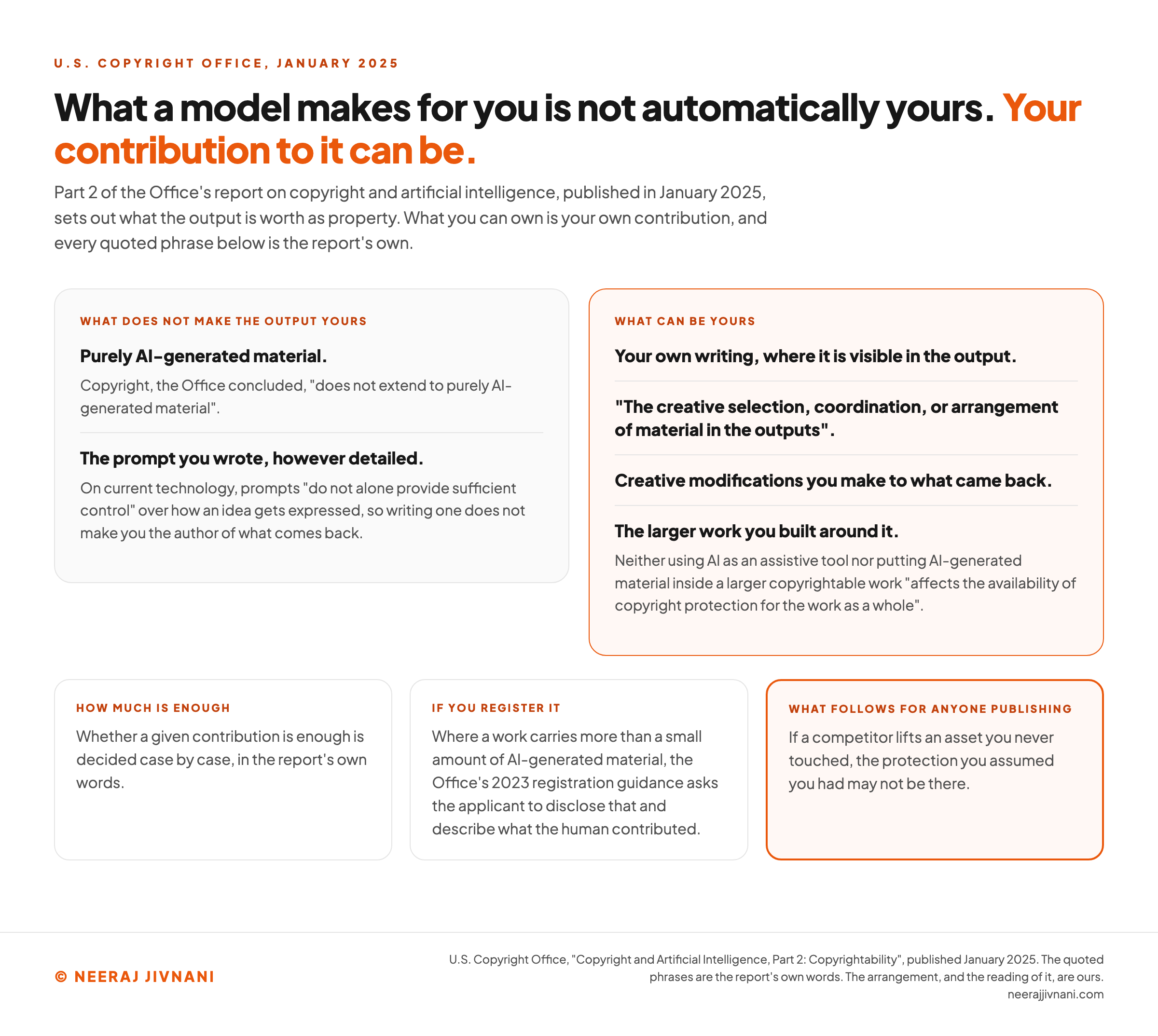
The U.S. Copyright Office set out its analysis in Part 2 of its report on copyright and artificial intelligence, published in January 2025. Copyright, it concluded, "does not extend to purely AI-generated material".
Prompting does not change that, on the technology as it stands.
The Office found that "based on the functioning of current generally available technology", prompts "do not alone provide sufficient control" over how an idea gets expressed. Writing one does not make you the author of what comes back.
What you can own is your own contribution. Your writing where it is visible in the output, "the creative selection, coordination, or arrangement of material in the outputs", and creative modifications you make to it.
Whether a given contribution is enough is decided case by case, in that report's own words.
The Half That Works in Your Favor
The Office was explicit that neither using AI as an assistive tool nor putting AI-generated material inside a larger copyrightable work "affects the availability of copyright protection for the work as a whole".
So a campaign you conceived, structured, wrote around and edited keeps its protection as a whole. A generated image you dropped in untouched is a different question, and the answer is narrower.
Two things follow for anyone publishing commercially. If a competitor lifts an asset you never touched, the protection you assumed you had may not be there.
And when a work carrying more than a small amount of AI-generated material is registered, the Office's 2023 registration guidance, restated in that report, asks the applicant to disclose that and describe what the human contributed.
Use this chart — embed code and citation
<a href="https://neerajjivnani.com/blog/ai-content-creation/"><img src="https://neerajjivnani.com/infographics/ai-content-creation/what-the-copyright-office-protected.png" alt="Two columns comparing what the U.S. Copyright Office concluded in January 2025 does not make a model's output yours and what can be yours in it. What does not make it yours: purely AI-generated material, which copyright does not extend to, and the prompt you wrote however detailed, because on current technology prompts do not alone provide sufficient control over how an idea gets expressed. What can be yours: your own writing where it is visible in the output, the creative selection, coordination or arrangement of material in the outputs, creative modifications you make to what came back, and the larger work you built around it, because neither using AI as an assistive tool nor putting AI-generated material into a larger copyrightable work affects protection for the work as a whole. Three notes beneath record that whether a contribution is enough is decided case by case, that the Office's 2023 registration guidance asks an applicant registering a work with more than a small amount of AI-generated material to disclose it and describe the human contribution, and that an asset you never touched may not carry the protection you assumed." width="1200"></a>
<p>Chart: <a href="https://neerajjivnani.com/blog/ai-content-creation/">Neeraj Jivnani</a></p>Neeraj Jivnani, "AI Content Creation: Which Jobs to Hand Over, and Which to Keep", neerajjivnani.com, https://neerajjivnani.com/blog/ai-content-creation/Free to republish with a link back to this page.
What Changes From Here
Three changes from here are worth planning against, because they are visible now rather than forecast. The timing of everything else is a guess.
The formats keep merging. One brief can produce the script, the visuals and the voiceover, where that used to be three separate jobs done by three people.
That changes who does the work more than it changes the work.
The output keeps getting more fluent and no better informed. It sounds more right than it is, and it still has no way of knowing what happened in your business last quarter.
And the checking does not automate itself. A tool can tell you that a sentence exists somewhere.
Deciding whether it is true still means opening the source document and reading the paragraph around the sentence.
A quotation can be word for word accurate and still misrepresent what its source was doing. No tool sees that.
As for whether it replaces the people doing this work, headcount is the wrong measure.
The number of pieces one person can produce went up. The number one person can check did not. That gap is the constraint.
Where to Start
Start by writing down everything you make in a week, then sort that list with the one question. On paper, once, and it takes about twenty minutes.
Where a job lands is the decision, and the four answers are the only options.
Everything in the first two answers goes over this week. Everything in the fourth stays with you permanently.
The third gets decided piece by piece, and recording which way you decided saves the argument later.
Then protect the checking time you have created. The trade only holds while the third answer still gets its five minutes, and the moment those minutes quietly go somewhere else the arithmetic runs backwards.