Co-Branding: Two Names on One Product, and Who Answers for It
Co-branding puts two names on one product, so one of you made it and the other lent its name. See what that loan obliges you to do, and what it costs.

/ On this page8 sections
Co-branding puts two names on one product. One of you made it, and the other lent its name to something it did not make.
That loan is the decision. What you agreed the other side may do with your name, and for how long, decides everything that comes after it.
What Co-Branding Is
Co-branding is an arrangement where two or more brands appear together on a single product or service, and both names stay on the finished item.
Each company stays separate. Neither is acquired, neither is merged, and both go on selling everything else they sold before.
The product persists, which is what makes the decision permanent. A campaign stops when you stop paying for it. A product sits in a warehouse, on a shelf, in somebody's cupboard and in a search index, carrying your name, whatever either of you does next.
Plenty of arrangements get called co-branding and are not. A joint webinar is not one. A feature that lets one company's app talk to another's is not one either.
The test is whether a customer can buy a single thing and get both brands.
Who Made the Thing
Co-branding and co-marketing get used interchangeably, and one question separates them: who made the item, and whose name is on it.
In a joint promotion, both companies still sell their own products. You point at each other, share an audience, and the arrangement ends when the promotion does.
In a co-brand, there is a third thing that is neither of yours alone. Somebody manufactured it, somebody else lent a name to it, and somebody has to answer for it when a customer is unhappy.
That last part is why the two are not the same thing to agree. Two sellers pointing at each other have to settle a schedule.
Putting your mark on something another company manufactures means settling what the thing may be, and keeping a say in it after everyone has signed.
The Four Kinds, Sorted by What You Are Lending
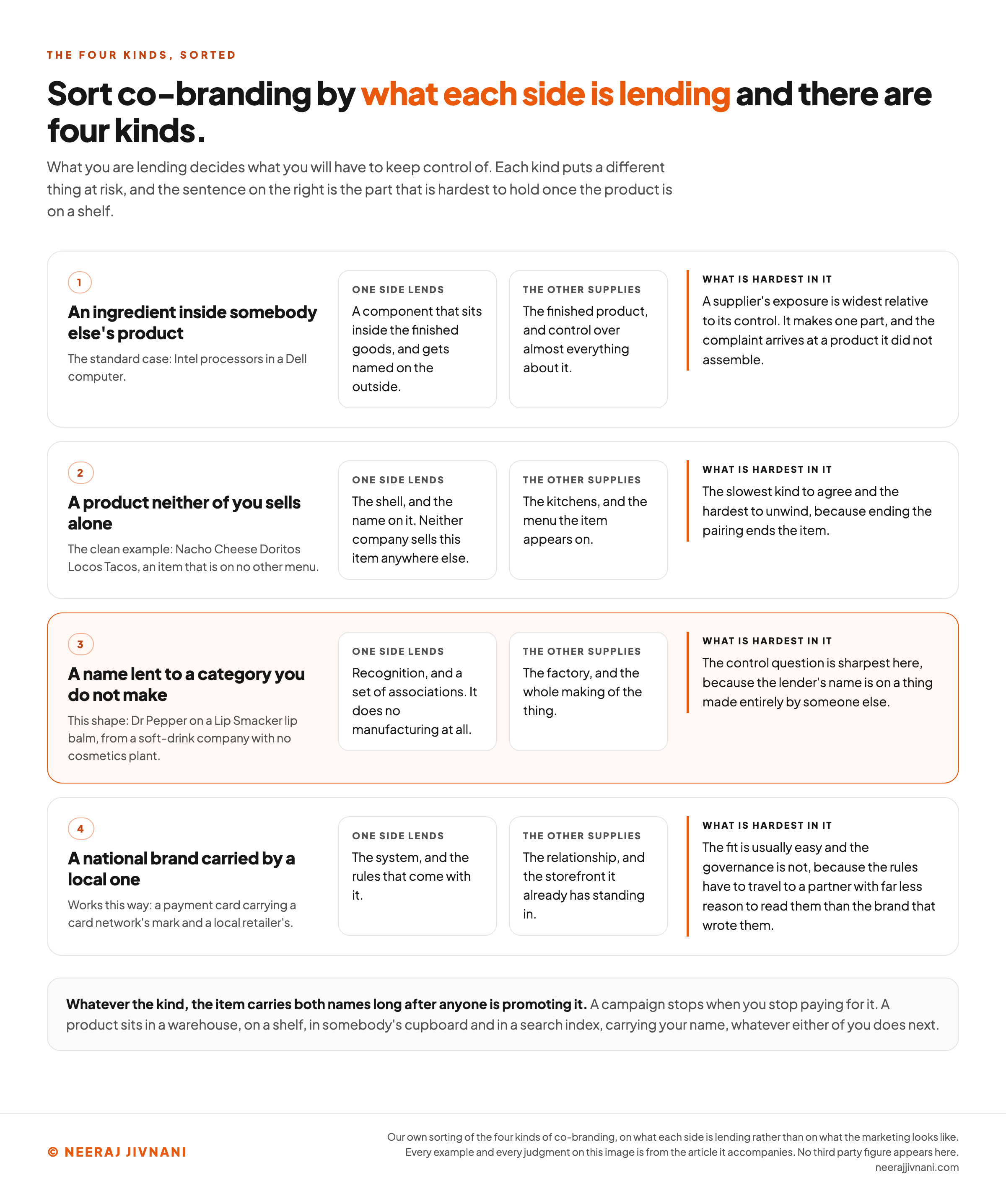
Sort the kinds by what each side is lending and there are four of them.
The four differ in who makes the thing and how much control the other side keeps over it.
What you are lending decides what you will have to keep control of.
An Ingredient Inside Somebody Else's Product
One company's component sits inside another company's finished goods, and gets named on the outside. Intel processors in a Dell computer are the standard case.
The maker of the finished product controls almost everything about it. The ingredient brand controls the one thing it supplies and the right to have that thing named.
This is the kind where a supplier's exposure is widest relative to its control.
It makes one part, and the complaint arrives at a product it did not assemble.
A Product Neither of You Sells Alone
Two companies put both marks on one item, and neither of them sells that item anywhere else. Nacho Cheese Doritos Locos Tacos are the clean example: Taco Bell does not sell Doritos, Frito-Lay does not sell tacos, and the item is on no other menu.
An ingredient deal is different, and the difference shows when one side leaves. A computer ships with a different processor if the chipmaker walks away, but end this pairing and the item stops existing, which makes it the slowest kind to agree and the hardest to unwind.
A Name Lent to a Category You Do Not Make
A brand licenses its name into a product class it has no factory for. Dr Pepper on a Lip Smacker lip balm is the shape: a soft-drink company with no cosmetics plant, and a flavor on a balm it did not make.
The lender does no manufacturing at all. What it contributes is recognition and a set of associations, and what it gets back is a presence in an aisle it does not stock.
It is also the kind where the control question is sharpest, because the lender's name is on a thing made entirely by someone else.
A National Brand Carried by a Local One
A large brand reaches a market through a small operator who already has standing there, and both names appear. A payment card carrying a card network's mark and a local retailer's works this way.
The national brand supplies the system, the rules and usually the product itself. The local one supplies the relationship and the storefront.
The fit is usually easy and the governance is not, because the rules have to travel to a partner with far less reason to read them than the brand that wrote them.
Use this chart — embed code and citation
<a href="https://neerajjivnani.com/blog/co-branding/"><img src="https://neerajjivnani.com/infographics/co-branding/what-each-side-is-lending.png" alt="Four stacked rows, one for each kind of co-branding, sorted on what each side is lending, under a line saying that what you are lending decides what you will have to keep control of. Row one is an ingredient inside somebody else's product, the standard case being Intel processors in a Dell computer: one side lends a component that sits inside the finished goods and gets named on the outside, the other supplies the finished product and control over almost everything about it, and what is hardest in it is that a supplier's exposure is widest relative to its control, because it makes one part and the complaint arrives at a product it did not assemble. Row two is a product neither of you sells alone, the clean example being Nacho Cheese Doritos Locos Tacos, an item that is on no other menu: one side lends the shell and the name on it, and neither company sells this item anywhere else, the other supplies the kitchens and the menu the item appears on, and it is the slowest kind to agree and the hardest to unwind because ending the pairing ends the item. Row three, drawn in orange, is a name lent to a category you do not make, with Dr Pepper on a Lip Smacker lip balm, from a soft-drink company with no cosmetics plant: one side lends recognition and a set of associations and does no manufacturing at all, the other supplies the factory and the whole making of the thing, and the control question is sharpest here because the lender's name is on a thing made entirely by someone else. Row four is a national brand carried by a local one, a payment card carrying a card network's mark and a local retailer's: one side lends the system and the rules, the other supplies the relationship and the storefront it already has standing in, and the fit is usually easy while the governance is not, because the rules have to travel to a partner with far less reason to read them than the brand that wrote them. A band across the foot says that whatever the kind, the item carries both names long after anyone is promoting it, that a campaign stops when you stop paying for it, and that a product sits in a warehouse, on a shelf, in somebody's cupboard and in a search index, carrying your name, whatever either of you does next." width="1200"></a>
<p>Chart: <a href="https://neerajjivnani.com/blog/co-branding/">Neeraj Jivnani</a></p>Neeraj Jivnani, "Co-Branding: Two Names on One Product, and Who Answers for It", neerajjivnani.com, https://neerajjivnani.com/blog/co-branding/Free to republish with a link back to this page.
What You Get Back
You are buying two things you cannot buy directly: somebody else's credibility, and somebody else's shelf.
Credibility is the one that moves fastest. A newer brand standing next to an established one borrows a judgment the customer has already made, and does it in the time it takes to read a package.
The shelf is slower and more concrete. A product in a partner's distribution is in front of people who were never going to visit your site.
The third thing is not a return at all in the quarter it happens. Your team spends months working beside somebody else's on a real deliverable, and some of how that team works comes back with yours.
That borrowed practice is rated above the reach, which is the opposite of how these arrangements are usually sold.
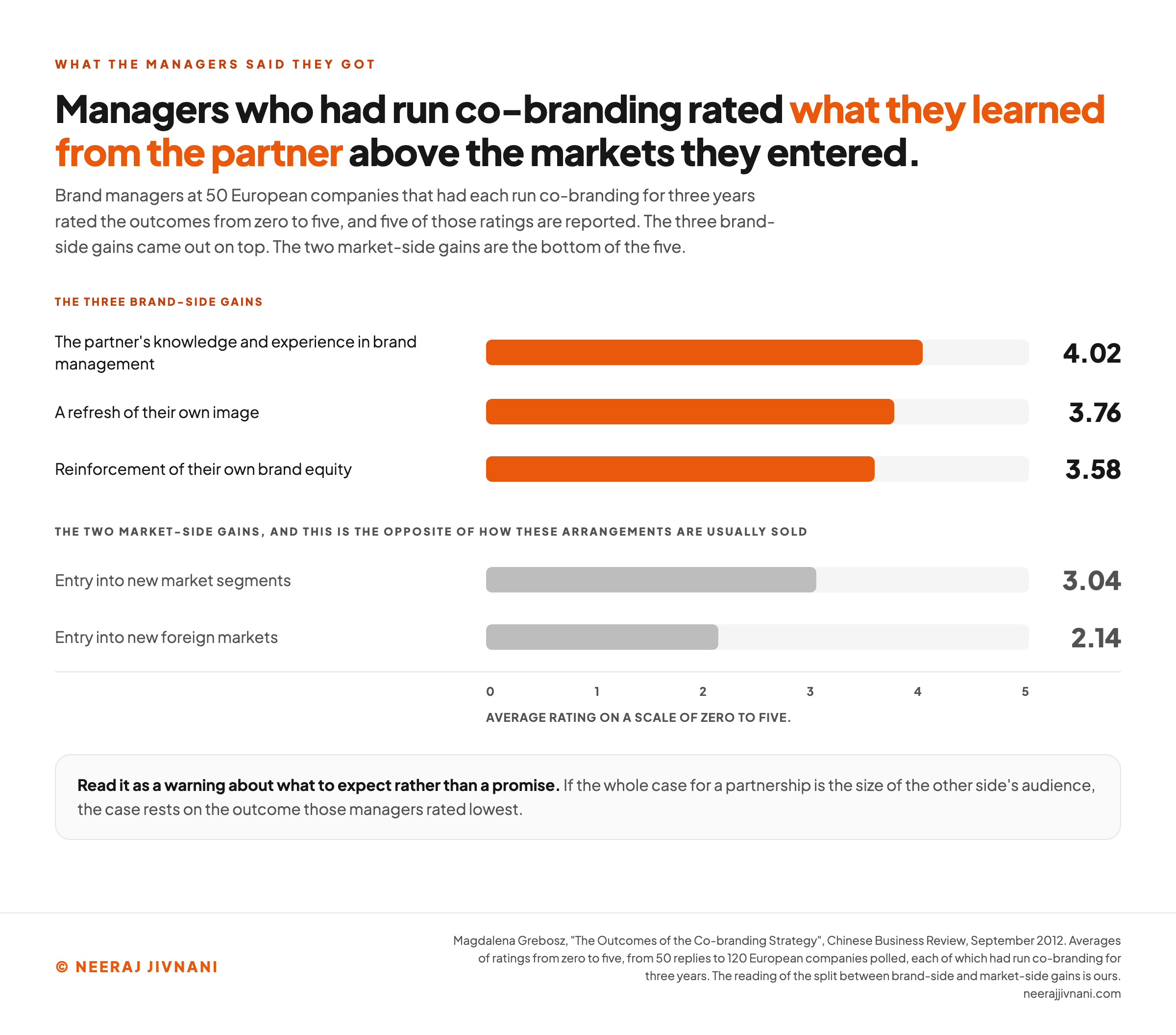
There is survey evidence for that, and it points the same way. Brand managers at 50 European companies that had each run co-branding for three years rated the outcomes from zero to five, and five of those ratings are reported.
The three brand-side gains came out on top: the partner's knowledge and experience in brand management at 4.02, a refresh of their own image at 3.76, and reinforcement of their own brand equity at 3.58.
The two market-side gains are the bottom of the five. Entry into new market segments scored 3.04, and entry into new foreign markets 2.14. Magdalena Grebosz published those averages in the Chinese Business Review in 2012, from 50 replies to 120 companies polled.
Read it as a warning about what to expect rather than a promise. If the whole case for a partnership is the size of the other side's audience, the case rests on the outcome those managers rated lowest.
Where the Money and the Hours Go
A co-brand has no media budget, because it is not a media buy. It brings a thing into existence, and a thing carries costs an advertisement never does.
Price the making, the approving and the tie. Only the first of the three arrives as an invoice.
- Making it. A joint product carries tooling, packaging, minimum order quantities and stock that somebody has to own. This is the part people price, and on a physical product it is usually the largest number.
- Approving it. Every artwork and every claim on the pack goes through two reviews, and the second reviewer is usually a lawyer rather than a marketer. A claim printed on a package is a claim about a product, which is a different order of risk from a claim in an advertisement.
- Being tied in. A license runs for a term. For as long as it runs, you are carrying a product you cannot unilaterally change, and you are associated with a company whose next decision is not yours.
Say you make a hot sauce and a snack company wants the flavor in a limited edition. The recipe is the easy part.
The run size, who carries the unsold stock, and who signs off the packaging are the parts that take months.
Use this chart — embed code and citation
<a href="https://neerajjivnani.com/blog/co-branding/"><img src="https://neerajjivnani.com/infographics/co-branding/what-the-managers-rated.png" alt="A horizontal bar chart of five outcomes rated from zero to five, split into two groups by a heading. The three brand-side gains are drawn in orange at the top: the partner's knowledge and experience in brand management at 4.02, a refresh of their own image at 3.76, and reinforcement of their own brand equity at 3.58. Below them, under a heading saying that this is the opposite of how these arrangements are usually sold, the two market-side gains are drawn in grey: entry into new market segments at 3.04 and entry into new foreign markets at 2.14. A scale runs from zero to five under the bars, labeled as an average rating on a scale of zero to five. The standfirst says brand managers at 50 European companies that had each run co-branding for three years rated the outcomes from zero to five and that five of those ratings are reported, that the three brand-side gains came out on top, and that the two market-side gains are the bottom of the five. A band across the foot says to read it as a warning about what to expect rather than a promise, because if the whole case for a partnership is the size of the other side's audience, the case rests on the outcome those managers rated lowest." width="1200"></a>
<p>Chart: <a href="https://neerajjivnani.com/blog/co-branding/">Neeraj Jivnani</a></p>Neeraj Jivnani, "Co-Branding: Two Names on One Product, and Who Answers for It", neerajjivnani.com, https://neerajjivnani.com/blog/co-branding/Free to republish with a link back to this page.
The Permission You Are Giving
What you are giving a co-branding partner is the right to put your mark on something that comes out of their factory. That is a trademark license wearing a marketing name.
The distinction is not a technicality. A promotion obliges you to send an email; a license obliges you to keep watching what somebody else produces.
So the obligation that matters most is not approval but control, and it does not end at launch.
Controlling Something You Did Not Make
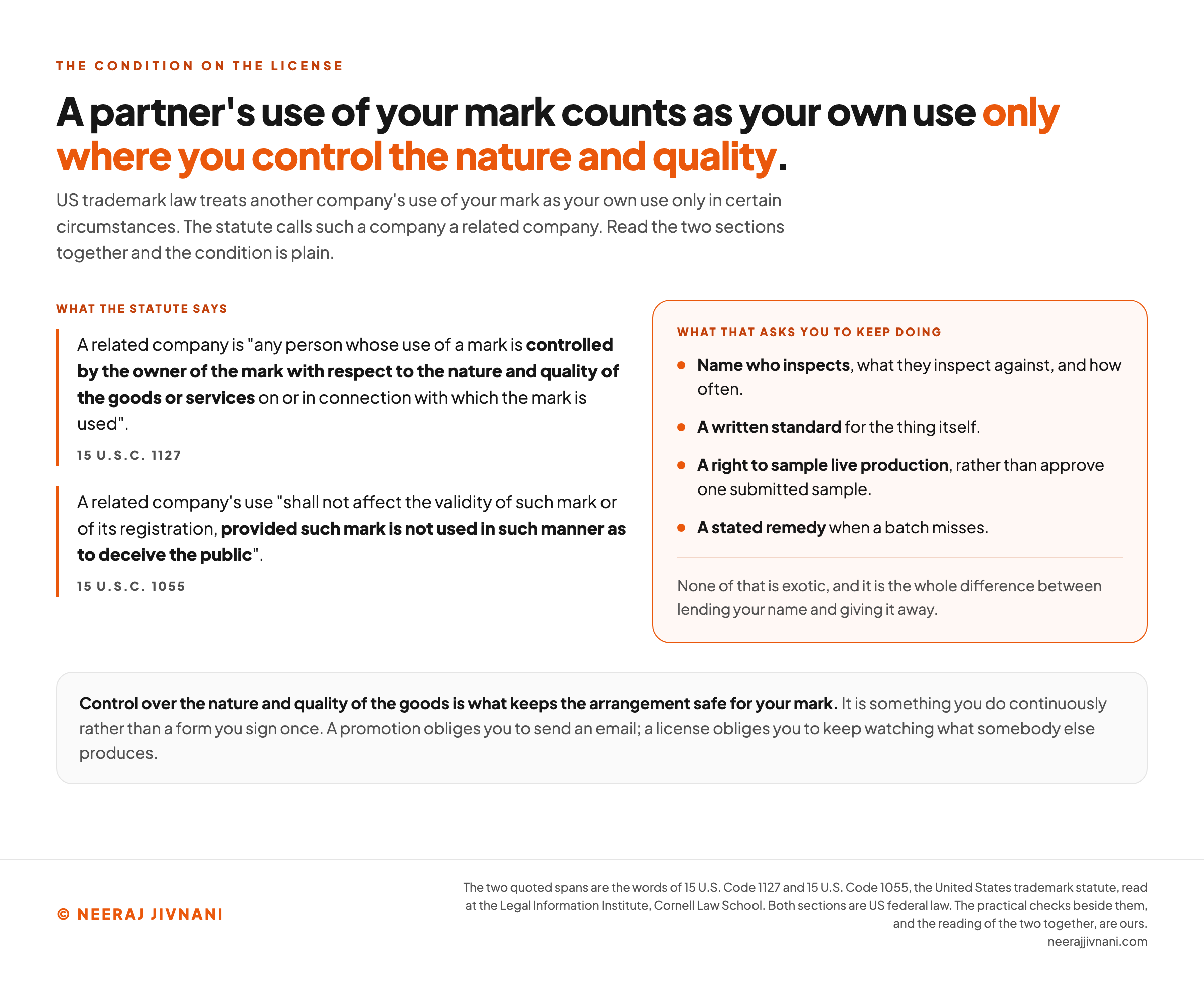
US trademark law treats another company's use of your mark as your own use only in certain circumstances. The statute calls such a company a related company.
It defines one as "any person whose use of a mark is controlled by the owner of the mark with respect to the nature and quality of the goods or services on or in connection with which the mark is used", at 15 U.S.C. 1127.
The companion section adds that a related company's use "shall not affect the validity of such mark or of its registration, provided such mark is not used in such manner as to deceive the public", at 15 U.S.C. 1055.
Read those two together and the condition is plain.
Control over the nature and quality of the goods is what keeps the arrangement safe for your mark, and it is something you do continuously rather than a form you sign once.
In practice that means naming who inspects, what they inspect against, and how often. You want a written standard for the thing itself, a right to sample live production rather than approve one submitted sample, and a stated remedy when a batch misses.
None of that is exotic, and it is the whole difference between lending your name and giving it away.
Saying How It Ends Before It Starts
The ending is the part nobody negotiates, because nobody wants to be the side that raised it.
Four questions settle it, and all four are cheap to answer in advance and expensive to answer afterwards.
- How long does the license run, and what renews it? A term that rolls over automatically is a term nobody reviews.
- Who owns the artwork and the tooling? The co-branded design is usually new work, and new work has an owner whether or not anyone named one.
- What happens to unsold stock? A sell-off window with an end date, or a buy-back at an agreed price. Without it, your name stays on a shelf you no longer approve of.
- How much notice does either side have to give? Notice is what turns an ending into a plan instead of an announcement.
The four start answered, and not by you
Take back the ones your own agreement actually answers. Whatever is left is still answered, by the sentence beside it. All four are cheap to answer in advance and expensive to answer afterwards.
How long does the license run, and what renews it?
Who owns the artwork and the tooling?
What happens to unsold stock?
How much notice does either side have to give?
Answered without you
All four are still being answered for you
The ending is the part nobody negotiates, because nobody wants to be the side that raised it.
How long does the license run, and what renews it?
A term that rolls over automatically is a term nobody reviews. A license runs for a term, and for as long as it runs you are carrying a product you cannot unilaterally change.
Who owns the artwork and the tooling?
The co-branded design is usually new work, and new work has an owner whether or not anyone named one.
What happens to unsold stock?
Without it, your name stays on a shelf you no longer approve of.
How much notice does either side have to give?
Notice is what turns an ending into a plan instead of an announcement.
So our position is plain. Do not sign a co-branding deal you could not end, because an arrangement that is easy to start and impossible to stop is the one that costs you your name.
Use this chart — embed code and citation
<a href="https://neerajjivnani.com/blog/co-branding/"><img src="https://neerajjivnani.com/infographics/co-branding/the-condition-on-the-license.png" alt="Two panels under a title saying a partner's use of your mark counts as your own use only where you control the nature and quality. The left panel carries what the statute says, in two quoted blocks with their citations. The first defines a related company as any person whose use of a mark is controlled by the owner of the mark with respect to the nature and quality of the goods or services on or in connection with which the mark is used, cited to 15 U.S.C. 1127. The second says a related company's use shall not affect the validity of such mark or of its registration, provided such mark is not used in such manner as to deceive the public, cited to 15 U.S.C. 1055. The right panel, boxed in orange, carries what that asks you to keep doing: name who inspects, what they inspect against and how often; a written standard for the thing itself; a right to sample live production rather than approve one submitted sample; and a stated remedy when a batch misses. Under that list it notes that none of it is exotic, and that it is the whole difference between lending your name and giving it away. A band across the foot says control over the nature and quality of the goods is what keeps the arrangement safe for your mark, that it is something you do continuously rather than a form you sign once, and that a promotion obliges you to send an email while a license obliges you to keep watching what somebody else produces." width="1200"></a>
<p>Chart: <a href="https://neerajjivnani.com/blog/co-branding/">Neeraj Jivnani</a></p>Neeraj Jivnani, "Co-Branding: Two Names on One Product, and Who Answers for It", neerajjivnani.com, https://neerajjivnani.com/blog/co-branding/Free to republish with a link back to this page.
What Breaks a Co-Brand
What breaks a co-branding arrangement is one of four things, and not one of them is the product.
The audiences do not read the pairing the same way. A premium brand next to a mass-market one can make the first look cheaper rather than the second look better, and the customer decides that, not the brief. The check is to describe the finished product to ten of your own customers before anything is made, and listen for confusion rather than enthusiasm.
The partner's conduct arrives on your product. A co-brand is not an endorsement a customer can forget about. It is an object they own, with your name on it, so a safety failure or a scandal at the other company reaches you through the thing in their cupboard rather than through a press cycle. The check is the ending, and how fast you can be out of it.
The quality drifts and nobody is watching. A first run gets everyone's attention and the fourth run gets none. This is exactly what the control obligation exists to prevent, and it is also the obligation people quietly stop performing once the launch is over.
The people who agreed it move on. A co-brand is signed by two enthusiasts and inherited by whoever holds the account next year. The item stays on sale; the relationship that made it does not. The check is whether anything in the arrangement still works once both signatories have left.
Reading the Result
Units sold is the easy number, because a co-branded product is its own line on the sales report. It is also the least interesting of the three you need.
Two other readings matter more, and both need a measurement taken before launch.
The first is whether the joint product took its sales from your own. Compare your standard line's volume in the launch quarter against the two quarters before it. If it fell by roughly what the joint product sold, revenue moved rather than grew.
The second is what happened to how people rate your brand. A refresh of your own image came second in those Grebosz averages, and it is invisible unless somebody wrote down the starting point.
Neither needs a research budget. A baseline on your own product's volume, and one brand-perception question asked of your own list before and after, will answer both.
What you cannot do is reconstruct either of them afterwards.
Meaning, Examples, Cost, and the Co-Marketing Line
The same four questions about co-branding keep arriving, and each has a short answer.
What is the meaning of co-branding? Two or more brands appearing together on one product or service, with both names staying on the finished item and both companies remaining separate.
Which is an example of co-branding? A Dell computer carrying an Intel processor, a Doritos Locos Taco, a Dr Pepper flavored lip balm, or a payment card issued in both a card network's name and a retailer's. Each is a different one of the four kinds.
How much does co-branding cost? There is no standard price. The three real outlays are manufacture or inventory, the approval time two companies spend on one artwork, and the length of the commitment. On a physical product the first is usually the largest, and the commitment is the one people underestimate.
What is the difference between co-marketing and co-branding? Co-marketing is two companies promoting to each other's audiences while each still sells its own product. In co-branding there is one item carrying both names, manufactured by one of them and licensed by the other.
Before You Lend the Name
Settle what you will put your mark on before you settle who you will put it with. The name, on what goods, for how long, under whose control.
That is the question a co-branding deal turns on, and it is not the one most conversations start with.
Answer it first and the deal has a shape before the partner does. The kind, the control you keep, and the way out are all decided by that one answer.
Answer it last, and you find out in the week a batch goes wrong, on a product you cannot recall and a contract you cannot end.