Brand Naming: How to Choose a Name Before You Fall for One
Most of what you like is already registered somewhere. Here is the order that stops you losing a week to a shortlist you can never use.


/ On this page9 sections
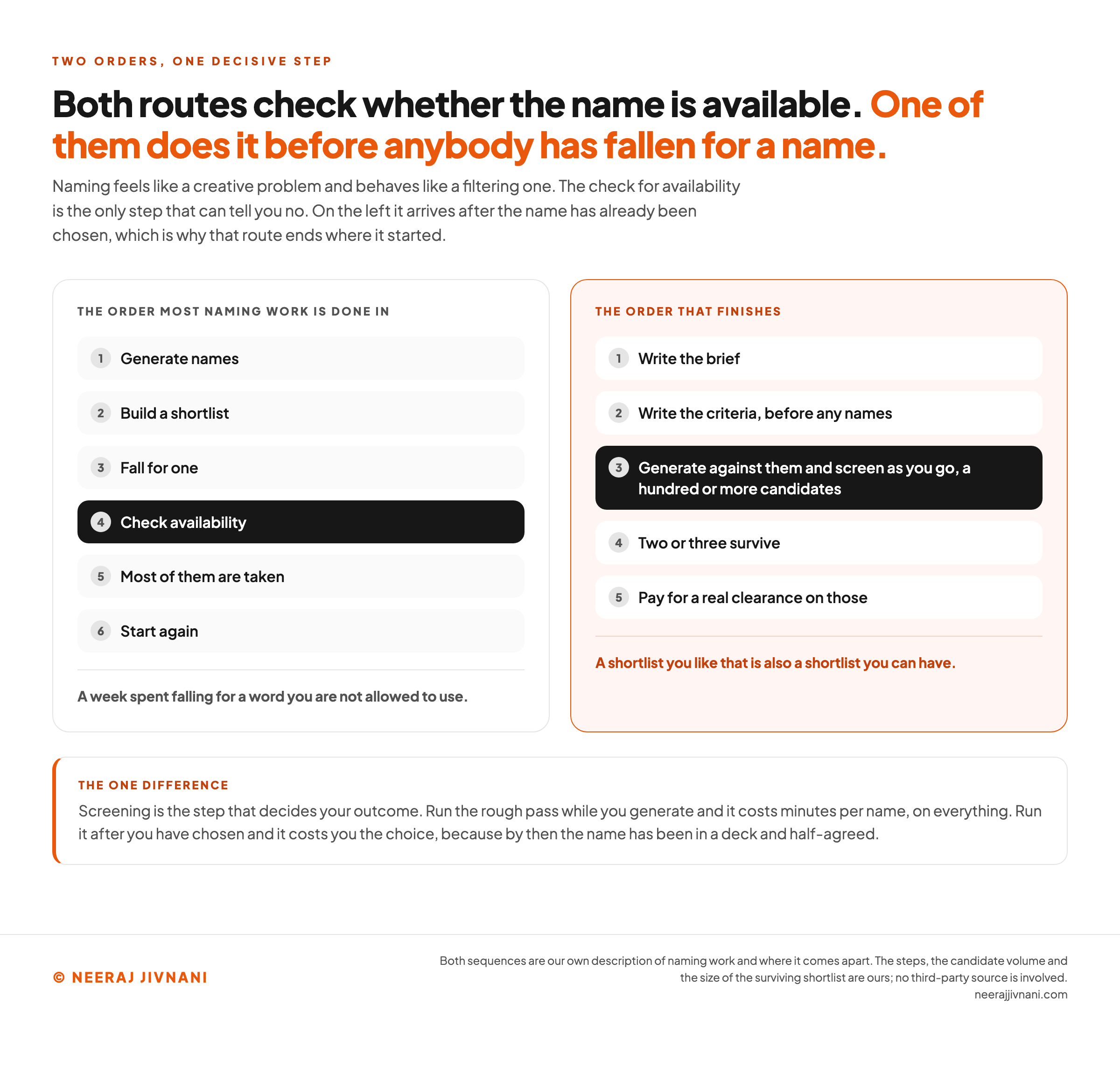
The hard part of naming is not thinking of names. It is that most of the names you think of are already spoken for, and you find that out after you have decided you want one.
So the order matters more than the ideas do. Set the constraints first, generate against them, and screen as you go.
Do it the other way around and you spend a week falling for a word you are not allowed to use.
The Job a Brand Name Has to Do
Brand naming is the work of choosing what a company, product or service will be called, and confirming you are allowed to use it.
Both halves are the job.
The second one is where most naming projects come apart, because it is the only step that can tell you no.
A name has a narrow role, and holding it to a narrow role is what makes the work finishable. It has to be sayable, spellable and ownable.
None of those is about meaning.
A name does not have to explain what you do. It cannot carry your positioning, and it will not rescue a product nobody wants.
What it does is give people a handle to say your business with. Nothing in the word Amazon tells you what is sold there, and nothing in Verizon explains a phone network.
Everything those two names mean now was attached afterwards, by what the companies shipped and how often people met them.
A Company Name and a Product Name Are Different Problems
A company name has to cover things you do not sell yet.
That is the whole difference, and it decides how literal you can afford to be. If the name describes your first product, it fits your business for as long as that product is the business.
A product or service name is allowed to be far more literal, because it sits underneath a company name that is doing the abstract work.
So the rule of thumb is simple. Be broad at the top, specific underneath, and never let a first product name the company.
What Separates a Good Name From a Bad One
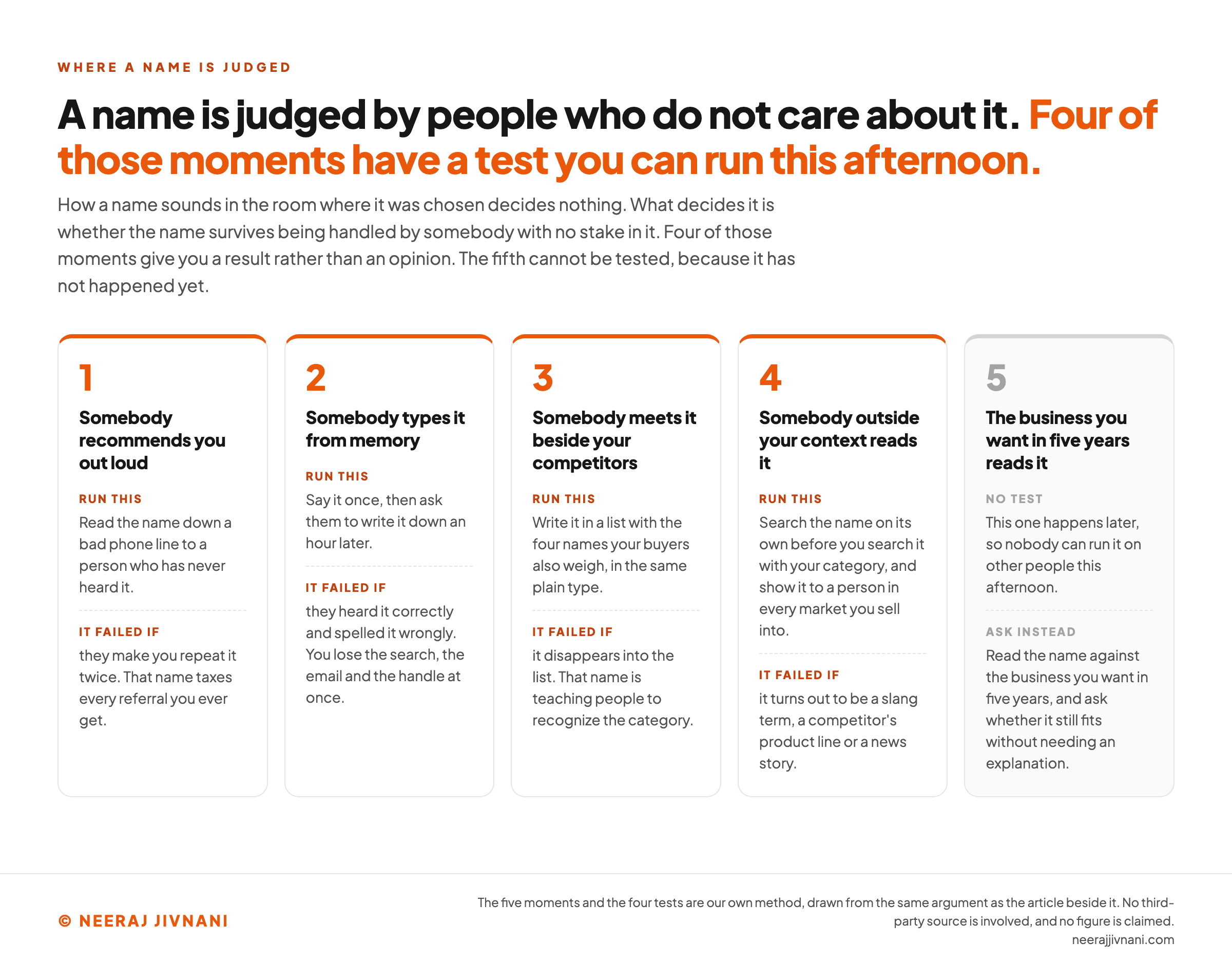
What separates a good name from a bad one is never how it sounds in the room where it was chosen. It is whether the name survives the moments when somebody who does not care about it has to handle it.
There are five of those moments. Four have a test you can run this afternoon, on other people, and the answer is a result rather than an opinion.
Somebody recommends you out loud. Read the name down a bad phone line to a person who has never heard it. If they make you repeat it twice, the name taxes every referral you ever get.
Somebody types it from memory. Say it once, then ask them to write it down an hour later. A name heard correctly and spelled wrongly loses you the search, the email and the handle at once.
Somebody meets it beside your competitors. Write it in a list with the four names your buyers also weigh, in the same plain type. A name that disappears into that list is teaching people to recognize the category.
Somebody outside your context reads it. Search the name on its own before you search it with your category, and show it to a person in every market you sell into.
That fourth one catches the expensive mistakes. A name is fine until it turns out to be a slang term, a competitor's product line or a news story.
The fifth is not a moment anyone else can hand you, and it has no test, because it happens later. Read the name against the business you want in five years, and ask whether it still fits without needing an explanation.
There is one more question and it is not an afternoon's work: whether you are allowed to use the name at all. That one gets answered differently, and it comes further down.
The Bar Is Lower Than You Think
Naming feels hard partly because people expect the wrong thing from it.
The expectation is that the right name will communicate the business, sound modern, feel ownable and be available. Almost nothing meets all four, so the search never ends.
Drop the first one and the work becomes finishable.
A name that means nothing on day one means something specific by year three, because you will have spent three years attaching meaning to it.
That is the trade every strong name has made. It gave up explaining itself in exchange for being able to grow.
Use this chart — embed code and citation
<a href="https://neerajjivnani.com/blog/brand-naming/"><img src="https://neerajjivnani.com/infographics/brand-naming/four-of-five-have-a-test.png" alt="Five cards, one for each moment a name has to survive being handled by somebody with no stake in it, four of them outlined in orange with a test attached and the fifth greyed out with no test. Card one, somebody recommends you out loud: read the name down a bad phone line to a person who has never heard it, and it failed if they make you repeat it twice, because that name taxes every referral you ever get. Card two, somebody types it from memory: say it once, then ask them to write it down an hour later, and it failed if they heard it correctly and spelled it wrongly, which loses you the search, the email and the handle at once. Card three, somebody meets it beside your competitors: write it in a list with the four names your buyers also weigh, in the same plain type, and it failed if it disappears into the list, because that name is teaching people to recognize the category. Card four, somebody outside your context reads it: search the name on its own before you search it with your category, and show it to a person in every market you sell into, and it failed if it turns out to be a slang term, a competitor's product line or a news story. Card five, greyed out, the business you want in five years reads it: no test, because this one happens later, so instead read the name against the business you want in five years and ask whether it still fits without needing an explanation." width="1200"></a>
<p>Chart: <a href="https://neerajjivnani.com/blog/brand-naming/">Neeraj Jivnani</a></p>Neeraj Jivnani, "Brand Naming: How to Choose a Name Before You Fall for One", neerajjivnani.com, https://neerajjivnani.com/blog/brand-naming/Free to republish with a link back to this page.
The Kinds of Name, and What Each One Costs You
Sort names by what they cost you rather than by what they are called. The cost is the thing you are choosing between.
| Kind | Examples | What it buys | What it costs |
|---|---|---|---|
| Descriptive | Hotels.com, Bank of America, The Weather Channel | Instant clarity, and search traffic for the category | Hard to own, hard to defend, and it boxes in what you can sell later |
| Suggestive | Amazon, Nike, Patagonia | Room to grow, and a mood you can build on | You have to teach people what it is before it means anything |
| Coined | Kodak, Xerox, Verizon | Distinctive, defensible, and easier to clear than a real word | You are buying an empty word, and filling it takes years of repetition |
| Compound | Facebook, Netflix, FedEx | Readable, memorable, and easier to clear than a single word | The two halves date together, and one of them usually ages first |
| Founder | Ford, Ralph Lauren, Ben & Jerry's | Immediate credibility if the founder is known | The business is tied to a person, including when that person changes |
| Place | American Airlines, Fiji Water | Borrowed associations, at no cost | It caps where you can plausibly operate later |
| Initials | IBM, BMW, HSBC | Short, and it survives a long formal name | Initials mean nothing until the company is famous, so this is a destination rather than a starting point |
Those are trades, and each row charges you for what it buys. None of them is free.
The rows are also not equally common. Founder names and place names are usually inherited, because the founder or the place was already there before anybody sat down to name anything.
Initials belong at the end of a life, not the start of one. A company earns the right to be called by its letters after enough people know the words behind them.
Which Trade to Make
For a new business, the middle of the table holds most of the good answers.
A suggestive or compound name is distinctive enough to own, concrete enough to remember, and open enough to still fit when the business changes. Netflix and Patagonia both sit there.
Which trade to make depends on what you already have, and three situations decide it more often than taste does.
If a founder already has an audience, a founder name spends that audience immediately and ties the business to a person for as long as it exists.
If every name in your category is descriptive, another descriptive name is the one choice guaranteed to be invisible.
And if the first product will not be the whole business in three years, anything literal is a decision you will pay to reverse.
Write the Brief Before You Write Any Names
Before anyone generates a word, four things go on one page.
- Who this is for, in specific enough terms that you would recognize them in a room.
- What you want it to sound like, and what you refuse to sound like. Ruling sounds out is the part anybody can act on. "Warm and modern" describes nine names in ten.
- How long it can be, and how it has to be typed. A name that lives in an email address has different limits from one that lives on a shelf.
- Every language it has to survive, with a named person against each one who has agreed to read it for you.
Then write the criteria you will judge names against, before you have seen any names.
This sounds procedural and it is the step that decides whether the rest of the work holds.
Criteria written after a name is on the table are not criteria. They are an argument for the name somebody already likes, and everyone in the room can feel it happening.
Which one moved, the name or the criteria
Write the criteria you will judge names against, before you have seen any names. Then bring in the name you already like, and watch what happens to them.
The name field
Once a name is on the table, the criteria bend to fit it. So this opens afterwards, and not before.
Add at least two, so there is something for a name to be judged against.
Generating Candidates Worth Screening
Candidates worth screening come from angles, never from a blank page. A blank page produces the same ten obvious words every time, and you have already thought of them.
Useful angles, and they are worth working through one at a time:
- What the customer ends up with, in their words rather than yours.
- The mechanism: what the thing does, or what it is made of.
- A metaphor from an unrelated field, which is where most distinctive names come from.
- Sounds you want, chosen before meanings. Short, hard consonants read differently from soft, open ones.
- Words in another language, checked with someone who speaks it.
Volume matters, and not for the reason people assume.
You need a hundred or more candidates because you are about to lose most of them at the screen, not because a hundred is a magic number.
Treat the first twenty as warm-up. They are the obvious ones, and the obvious ones are gone.
What a Name Generator Is Good For
An artificial-intelligence name generator is a raw-material machine, and it is worth using as one.
It will hand you fifty plausible coinages in a minute, which is genuinely useful, and it saves the part of the work that is drudgery rather than thinking.
What it cannot do is know anything that decides the outcome. It does not know what is registered in your class, what your buyers already associate with a sound, or which of its suggestions is a competitor's product.
So the output is not a shortlist. It is more candidates to screen, and screening is still the work.
The same holds for doing this yourself against hiring a naming firm. A firm buys you experience of the screen and of the argument, not better ideas, and that is worth different amounts to different people.
Screening: What Is Left to Take
Screening is the step that decides your outcome, so run it while you generate rather than afterwards. That single change in order saves more time than anything else here.
The sequence has two stages, and one of them costs many times what the other does.
The rough knock-out, which you run on everything, in minutes per name. Search the name alone and with your category, this time reading the results for who is already using the word, not for what it means. Check the trademark register for your country. Check the domain and the handles.
The real clearance, which you run on two or three names only. That is a search done properly, and for anything you plan to build a business on it is worth paying a trademark attorney for.
Doing the rough pass first is what makes the second one affordable. You are not paying anyone to tell you that the obvious word is taken.
How Crowded the Register Is
The sense that everything is taken is not a mood. It has been measured.
About three of every four words we use in ordinary language have already been claimed as a trademark.
Barton Beebe and Jeanne Fromer put it precisely in the Harvard Law Review in 2018: "when we use our language, about three-fourths of the time we are using a word that someone has claimed as a trademark."
The count comes from every trademark application filed at the United States Patent and Trademark Office from 1985 through 2016, 6.7 million of them.
Sharper still: of the top 1,000 most frequently used English words, only three are not used in active registered trademarks. That figure is from the same 2018 study, reported by New York University School of Law.
Depletion falls hardest on the sets a new business reaches for first, at standard English words, common American surnames and short pronounceable coinages. Beebe and Fromer find all three substantially depleted in the register itself, and near-totally depleted among registered .com domains.
The study measures the first two as a level, the share of words and surnames already registered, and coinages as a trend, a supply that is declining.
That difference is why a coined name is still worth the years of repetition it costs.
That is the register a new shortlist walks into. It is also worth hearing before you start: if every short English word you like is taken, that is the market, not your imagination.
What a Registered Mark Does Not Block
A trademark hit is not automatically a stop, and an empty search is not a clearance.
Marks are registered against classes of goods and services.
Two companies can hold the same word as long as the two uses would not confuse a customer about who made the thing, which is why Beebe and Fromer's 2018 study uses Delta for faucets and Delta for airlines as its example.
So the question is never whether the word is registered. It is whether anyone is using something close to it, for something close to what you sell.
That question has a right answer and you are not qualified to give it, and neither are we. What the rough pass buys you is a shortlist worth paying someone to rule on.
The Domain Is No Longer the Test It Was
The exact dot-com stopped being the bar some years ago, and holding out for one is now the most common way a good name gets rejected.
Workable alternatives are ordinary: a short modifier in front of the name, the word "get" or "try", a category word appended, or one of the newer top-level domains.
What does still matter is consistency. Whatever you land on, the same string should work as the domain and as the handle on every platform you intend to publish on.
Check the handles at the same time as the domain. A name that is free on one and gone on the other creates a small tax on every mention you ever get.
Use this chart — embed code and citation
<a href="https://neerajjivnani.com/blog/brand-naming/"><img src="https://neerajjivnani.com/infographics/brand-naming/the-order-decides-it.png" alt="Two routes through a naming project drawn side by side as numbered step lists, with the decisive step picked out in black in each one, the availability check on the left and the generate-and-screen step on the right. The left route, labeled the order most naming work is done in, runs six steps: generate names, build a shortlist, fall for one, check availability, most of them are taken, start again, and ends on a week spent falling for a word you are not allowed to use. The right route, outlined in orange and labeled the order that finishes, runs five steps: write the brief, write the criteria before any names, generate against them and screen as you go with a hundred or more candidates, two or three survive, pay for a real clearance on those, and ends on a shortlist you like that is also a shortlist you can have. A band across the foot says screening is the step that decides your outcome, that running the rough pass while you generate costs minutes per name on everything, and that running it after you have chosen costs you the choice." width="1200"></a>
<p>Chart: <a href="https://neerajjivnani.com/blog/brand-naming/">Neeraj Jivnani</a></p>Neeraj Jivnani, "Brand Naming: How to Choose a Name Before You Fall for One", neerajjivnani.com, https://neerajjivnani.com/blog/brand-naming/Free to republish with a link back to this page.
Choosing Between the Last Few
Present the finalists one to a page, in plain type, with no logo and no mockup.
A name shown inside a designed lockup is not being judged.
The design is doing the persuading, and you will pick the best mockup rather than the best name.
Then judge each one against the criteria from the brief, out loud, one criterion at a time.
Do not vote. A vote produces the least objectionable name in the room, which is a different thing from the strongest one.
Two things are worth doing at this stage that you could not do earlier. Write each finalist into a real sentence you would publish, and read it there.
Then leave the shortlist alone for a week and come back to it. A name you still reach for after seven days is a different signal from a name that won a meeting.
One test is not worth the time, and it is the one people run first: asking whether anyone likes it. New names sound wrong, including the excellent ones.
Say a shortlist of three has survived all of that, which is the usual number.
If two are still level, pick the one with more room in it and move on. The gap between a good name and a slightly better one closes the first time you use either of them in public.
Where Brand Naming Goes Wrong
Five failures cover almost all of it, and none of them is a failure of creativity.
The committee. Everyone gets a veto and nobody owns the decision, so every distinctive option is vetoed by someone and the safe one wins by exhaustion.
Falling in love before screening. By the time the name is checked it has been in a deck, said aloud in meetings and half-agreed. Then it is taken, and the project restarts from a worse mood.
Over-describing. The name explains the business perfectly and can never be owned, defended, or grown past.
Chasing whatever the category is doing. Names that look current look dated on the same schedule as everything else that looked current.
Expecting the name to do the brand's job. No name fixes an unclear offer. It is a handle, and if what it is attached to is confusing, a better handle changes nothing.
The Constraints Are the Work
Naming feels like a creative problem and behaves like a filtering one. The ideas are cheap, and the constraints are what decide the outcome.
Get those written down while your judgment is still free, and everything after them has something to stand on.
Then choose, and stop looking.
A name is only a word until it has been used a thousand times, and the thousand times are the part that matters.