The Five Brand Architecture Models, From One Name to None
Work out which structure you are already running, what each one costs to keep, and how to decide the name your next launch should carry.


/ On this page11 sections
You are already running one. Every product, service and division you own carries some amount of your main name, and the pattern those choices make is your brand architecture.
Nobody sat down and chose it; it accumulated one launch and one acquisition at a time.
The five models are easy to tell apart once you know what to look at, and each costs something different to keep. Underneath them sits one repeated decision: how much of your name the next thing you launch should carry.
What Brand Architecture Is
Brand architecture is the pattern of which things you sell carry your main name, which carry a name of their own, and which carry both.
That is all it is. It is a set of naming relationships, written down so the next decision is not made from scratch.
The relationships run in two directions. Downward, a parent name lends credibility to something new. Upward, a strong product name feeds recognition back to the parent.
When the pattern is clear, a customer can work out what belongs to what without being told. When it is not, they assume two of your products are competitors.
What It Does Not Cover
Brand architecture covers things a customer can buy. It does not cover your internal structure.
Brand Amplitude's 2019 architecture toolkit draws the line explicitly, scoping the work to named marketing offerings and excluding business units, patents, ad campaigns, logos and internal processes.
That exclusion carries weight. Mirror the org chart and the structure describes something your customers cannot see.
Your customers do not know you have three divisions. They know there are four boxes on the shelf with four different names on them.
What It Is Actually For
Four things, and you can check each one against your own business this afternoon.
What a stranger can work out unaided. Somebody meets one of your products for the first time. Can they tell it is yours, and can they tell what else of yours exists?
What a new launch inherits. A product under your main name arrives with whatever trust that name has. A product under a new name arrives with none.
What one bad month contaminates. A recall, a security incident, a public argument. The architecture decides how far it travels.
What the marketing budget has to cover. One name means one audience to reach, one story, one set of guidelines. Four names means four of everything.
Those four pull against each other, which is why there is no correct answer. Shared names buy efficiency and spread risk. Separate names contain risk and cost money.
The Five Models, Told Apart by What Is Printed
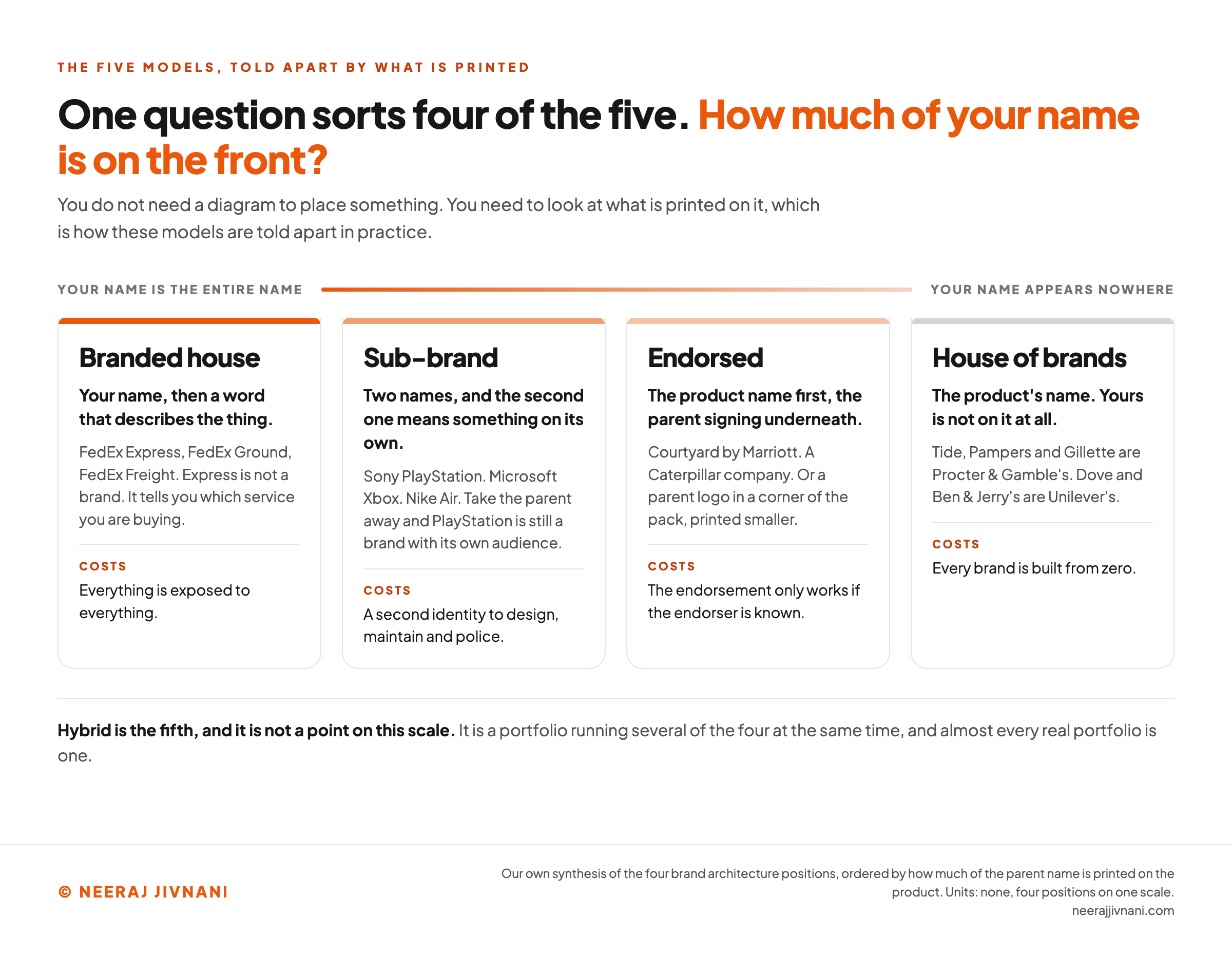
Four of the five sit on a single scale, running from your name being the entire name to your name appearing nowhere. The fifth describes what happens when you run more than one at once.
You do not need a diagram to place something. You need to look at what is printed on it, which is how these models are told apart in practice.
Branded House: the Parent Name Is the Whole Name
In a branded house the parent name does all the work, and the second word is a description rather than a brand.
FedEx Express, FedEx Ground and FedEx Freight are the standard example. Express is not a brand. It tells you which service you are buying.
Google runs the same way across Maps, Drive and Photos. So does Tesla, whose products are called Model S and Model 3.
Read the second word on its own. If it is a description rather than a brand, you are in a branded house, and "Express" on its own describes a service.
What it buys. One name to build, one budget, one reputation. A new product launches into existing trust instead of building its own.
What it costs. Everything is exposed to everything. And the name eventually caps how far you can stretch, because a name that means too many things stops meaning anything.
Sub-Brand: Two Names, Both Doing Work
A sub-brand is two names where the second one means something on its own.
Sony PlayStation. Microsoft Xbox. Nike Air. Take the parent away and PlayStation is still a brand with its own audience, its own look and its own reason to exist.
A branded house and a sub-brand both read as "Parent Thing" on the box. The second word is where they part company.
What it buys. Room to speak to a different buyer without leaving the family. The parent still gets the credit.
What it costs. A second identity to design, maintain and police. Sub-brands multiply quietly, and a portfolio of forty of them is unmanageable in a way that four is not.
Endorsed: the Child Leads and the Parent Signs
In an endorsed structure the product name comes first and the parent signs underneath.
You recognize it by the connective word. "Courtyard by Marriott". "A Caterpillar company".
Or by a parent logo in a corner of the pack, printed smaller than the brand it is vouching for.
What it buys. The product can be its own thing, with its own positioning and price, while still borrowing enough credibility to get a first purchase.
What it costs. The endorsement only works if the endorser is known. A signature from a name nobody recognizes adds a line of type and nothing else.
Endorsement also runs invisibly, with the parent named nowhere. A shadow endorsement gives you some of the reassurance without the visible link, and it only reaches the buyers who already know the connection is there.
House of Brands: Nothing on the Package Tells You
In a house of brands, the product carries no sign of who owns it.
Tide, Pampers and Gillette are Procter & Gamble's. Dove and Ben & Jerry's are Unilever's.
A shopper choosing between two of them on one shelf gets no signal from the packaging that they share anything. The parent name here is for investors, suppliers and staff.
What it buys. Total freedom. Each brand gets its own audience, its own price, its own voice, and a failure at one does not touch the others.
What it costs. Every brand is built from zero. There is no equity to borrow and almost no cross-selling, so the budget scales with the number of names.
Hybrid: More Than One of These at Once
A hybrid is a portfolio running several of the four at the same time.
Alphabet holds Google, which is itself a branded house across search, maps and mail, alongside separate ventures that carry no Google name at all. Amazon puts its name on Prime and keeps it off Twitch and Whole Foods.
It is not a fifth point on the scale. It is the shape a portfolio takes when different things were decided differently, and almost every real portfolio is one.
The Two Ends, and Why the Names Confuse Everybody
The difference between a branded house and a house of brands is which name a customer sees at the moment of purchase.
Branded house: they see yours. House of brands: they see the product's, and yours is either on the back in small type or absent.
The terms are almost identical words in a different order, which is a design flaw in the vocabulary rather than a failure of attention on your part.
If it helps, read "branded house" as one house with your name over the door, and "house of brands" as a landlord nobody meets.
Use this chart — embed code and citation
<a href="https://neerajjivnani.com/blog/brand-architecture/"><img src="https://neerajjivnani.com/infographics/brand-architecture/one-scale-four-stops.png" alt="Four columns set under a scale that runs from your name being the entire name on the left to your name appearing nowhere on the right. Each column names a position, says what is printed on the product, gives a worked example and states what that position costs to keep: branded house with FedEx Express, sub-brand with Sony PlayStation, endorsed with Courtyard by Marriott, and house of brands with Tide and Pampers. A line underneath says hybrid is the fifth and is not a point on this scale." width="1200"></a>
<p>Chart: <a href="https://neerajjivnani.com/blog/brand-architecture/">Neeraj Jivnani</a></p>Neeraj Jivnani, "The Five Brand Architecture Models, From One Name to None", neerajjivnani.com, https://neerajjivnani.com/blog/brand-architecture/Free to republish with a link back to this page.
Why Almost Every Real Portfolio Is Mixed
If you have been reading the five and finding that none of them fits, that is the correct reaction.
Pure models are teaching devices. Real portfolios are mixed, because they were assembled over time by different people solving different problems.
A company that describes itself as a branded house usually has one acquired brand it never absorbed. A company that calls itself a house of brands usually has two products with the parent name on them for historical reasons nobody remembers.
You are not one of the five. You are several of them at once, and what matters is which one each individual offering should be, and whether the answers you have given so far are defensible.
That reframing is the useful part. "Are we a branded house?" has no action attached to it. "Should this new product carry our name?" has exactly one.
The Architecture You Have Was Probably Not Chosen
The structure in front of you is mostly a record of old decisions rather than a strategy, and that changes what you should expect from this work.
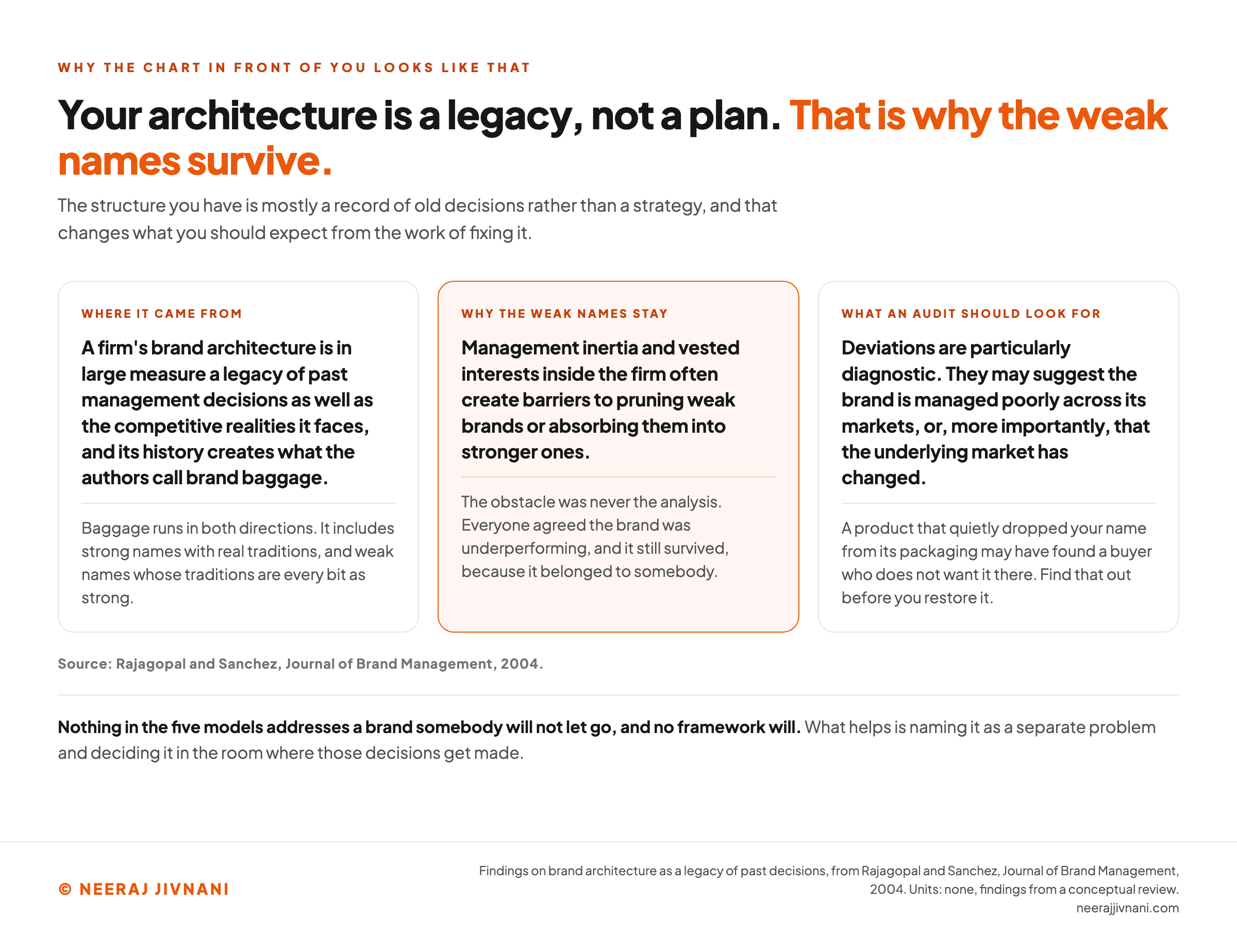
A firm's architecture is in large measure a legacy of past management decisions as well as the competitive realities it faces. Its history creates what Rajagopal and Sanchez call brand baggage, in their 2004 review in the Journal of Brand Management.
Baggage runs in both directions. It includes strong names with real traditions, and it includes weak names whose traditions are every bit as strong.
The same paper names the reason the weak ones survive: management inertia and vested interests inside the firm often create barriers to pruning weak brands or absorbing them into stronger ones.
Read that again if you have ever tried to retire a brand.
The obstacle was never the analysis. Everyone agreed the brand was underperforming, and it still survived, because it belonged to somebody.
This is why architecture projects stall in a way that pricing projects do not. A name carries the memory of the person who chose it and the team that built it, so proposing to retire one is heard as a verdict on them.
Nothing in the five models addresses that, and no framework will. What helps is naming it as a separate problem, deciding it in the room where those decisions get made, and not pretending that a cleaner chart will settle it.
Use this chart — embed code and citation
<a href="https://neerajjivnani.com/blog/brand-architecture/"><img src="https://neerajjivnani.com/infographics/brand-architecture/a-legacy-not-a-plan.png" alt="Three panels carrying the findings of a 2004 review of brand architecture. The first says a firm's architecture is in large measure a legacy of past management decisions as well as the competitive realities it faces, and that its history creates brand baggage. The second, highlighted, says management inertia and vested interests often create barriers to pruning weak brands or absorbing them into stronger ones. The third says deviations are particularly diagnostic and may suggest either poor management of the brand across its markets or, more importantly, a change in the underlying market. The source line reads Rajagopal and Sanchez, Journal of Brand Management, 2004." width="1200"></a>
<p>Chart: <a href="https://neerajjivnani.com/blog/brand-architecture/">Neeraj Jivnani</a></p>Neeraj Jivnani, "The Five Brand Architecture Models, From One Name to None", neerajjivnani.com, https://neerajjivnani.com/blog/brand-architecture/Free to republish with a link back to this page.
Mapping What You Have Now
Mapping what you have takes an afternoon, a spreadsheet and three columns.
Start with a walk around your own shelf, your own app store listing, your own price list.
Column one: every name a customer can encounter. Products, services, apps, programs, sub-lines, loyalty schemes. Anything that has its own name and can be bought, joined or downloaded.
Column two: which of the four positions it currently occupies. Use the printing test, not the intention. What is on the pack, the landing page and the invoice.
Column three: which position it should occupy. Answer it last, not now.
The value is not in the finished chart. It is in the rows where columns two and three disagree, and in the rows where nobody can say what column two is.
Staff who cannot place a name leave customers no chance of placing it.
You can read a model off a package
Look at what is printed on the front, what is printed on the back, and whether the second word means anything on its own. Use the printing test, not the intention.
The scale is how much of your main name the thing carries.
Every name a customer can encounter
Products, services, apps, programs, sub-lines, loyalty schemes. Anything that has its own name and can be bought, joined or downloaded.
What these rows say
Nothing is placed yet. Write the line that is printed on one thing you sell, then answer the two questions underneath it.
This is column two. Column three, which position each should occupy, is the one you answer last.
Read the Drift Before You Correct It
When you find a brand that has wandered away from where it was supposed to sit, do not correct it on sight.
Rajagopal and Sanchez call deviations particularly diagnostic in their 2004 framework, and read them two ways: they may suggest the brand is being managed poorly across its markets, or, they add, more importantly, that the underlying market has changed.
A product that quietly dropped your name from its packaging may have found a buyer who does not want it there. Find that out before you restore it.
So treat drift as a question. Ask the team that made the change what they learned, then decide whether the map is wrong or the product is.
Which Model the Next Thing You Launch Should Take
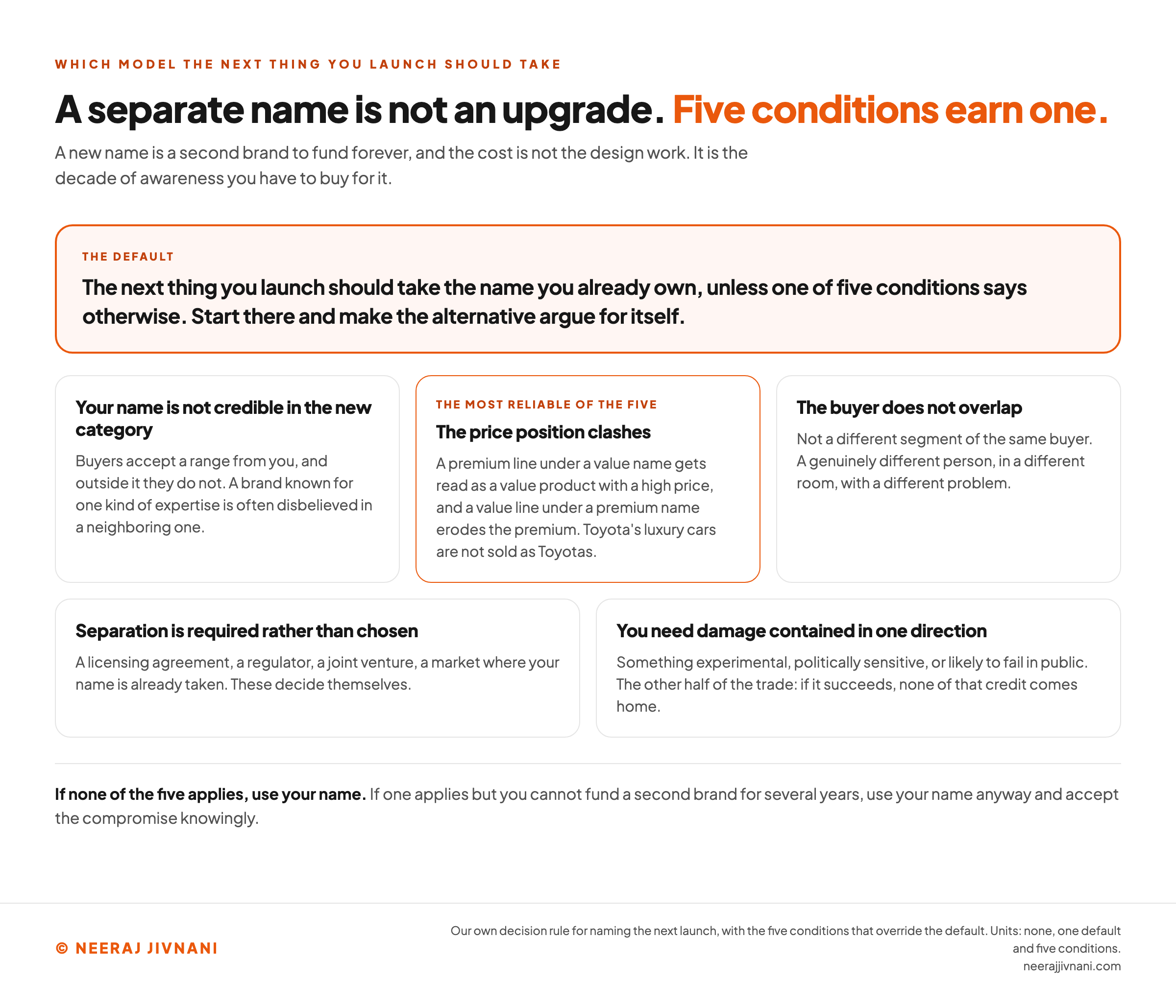
The next thing you launch should take the name you already own, unless one of five conditions says otherwise.
That is the default. Start there and make the alternative argue for itself.
This is not modesty.
A new name is a second brand to fund forever, and the cost is not the design work. It is the decade of awareness you have to buy for it.
Asking whether something deserves its own brand gets you nowhere. Ask which specific condition makes your existing name unusable here, and whether you can afford the replacement.
The Five Conditions That Earn a New Name
Any one of these is a real argument. Anything else is enthusiasm.
Your name is not credible in the new category. Buyers accept a range from you, and outside it they do not. A brand known for one kind of expertise is often disbelieved in a neighboring one, however competent the product is.
The price position clashes. Of the five, this is the one we would trust furthest. A premium line under a value name gets read as a value product with a high price, and a value line under a premium name erodes the premium. Toyota's luxury cars are not sold as Toyotas.
The buyer does not overlap. Not a different segment of the same buyer. A genuinely different person, in a different room, with a different problem.
Separation is required rather than chosen. A licensing agreement, a regulator, a joint venture, a market where your name is already taken. These decide themselves.
You need damage contained in one direction. Something is experimental, politically sensitive, or likely to fail in public. Keeping it at arm's length is a real reason, as long as you accept the other half of the trade: if it succeeds, none of that credit comes home.
If none of the five applies, use your name. If one applies but you cannot fund a second brand for several years, use your name anyway and accept the compromise knowingly.
Use this chart — embed code and citation
<a href="https://neerajjivnani.com/blog/brand-architecture/"><img src="https://neerajjivnani.com/infographics/brand-architecture/the-default-and-the-five.png" alt="A wide highlighted band states the default, that the next thing you launch should take the name you already own unless one of five conditions says otherwise. Five cards underneath carry the conditions: your name is not credible in the new category, the price position clashes, the buyer does not overlap, separation is required rather than chosen, and you need damage contained in one direction. The price card is marked as the most reliable of the five. A line underneath says that if none of the five applies, use your name." width="1200"></a>
<p>Chart: <a href="https://neerajjivnani.com/blog/brand-architecture/">Neeraj Jivnani</a></p>Neeraj Jivnani, "The Five Brand Architecture Models, From One Name to None", neerajjivnani.com, https://neerajjivnani.com/blog/brand-architecture/Free to republish with a link back to this page.
The Four Ways This Breaks
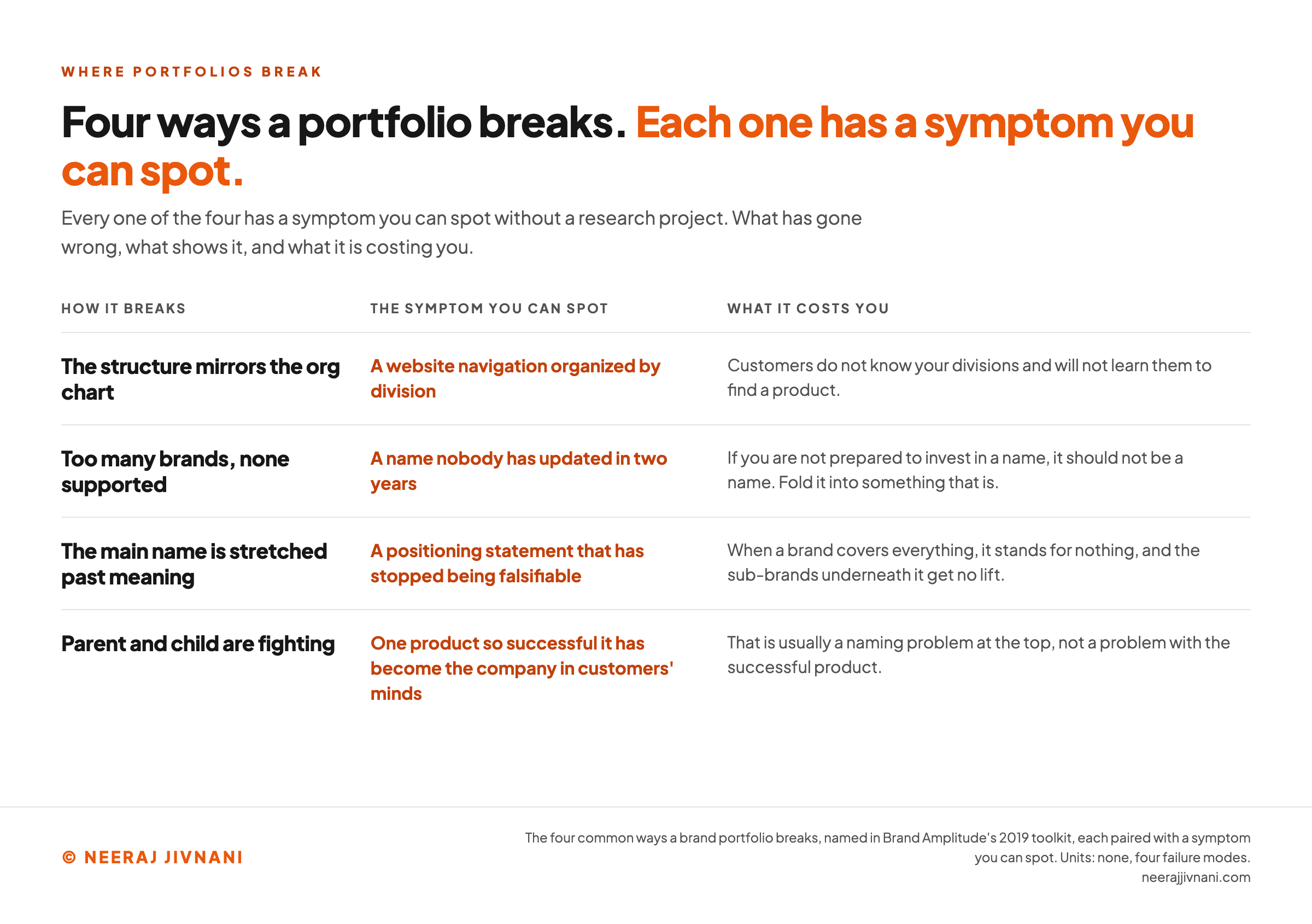
There are four common ways a portfolio breaks, and each one has a symptom you can spot without a research project. The four are named in Brand Amplitude's 2019 toolkit.
The structure mirrors the org chart. The symptom is a website navigation organized by division. Customers do not know your divisions and will not learn them to find a product.
Too many brands, none supported. The symptom is a name nobody has updated in two years. If you are not prepared to invest in a name, it should not be a name. Fold it into something that is.
The main name is stretched past meaning. The symptom is that your positioning statement has stopped being falsifiable. When a brand covers everything, it stands for nothing, and the sub-brands underneath it get no lift.
Parent and child are fighting. The symptom is one product so successful it has become the company in customers' minds, blocking everything else. That is usually a naming problem at the top, not a problem with the successful product.
Use this chart — embed code and citation
<a href="https://neerajjivnani.com/blog/brand-architecture/"><img src="https://neerajjivnani.com/infographics/brand-architecture/four-ways-and-the-symptom.png" alt="A table of four rows, one per failure mode, with three columns: how it breaks, the symptom you can spot, and what it costs you. The rows are the structure mirroring the org chart, shown by a website navigation organized by division; too many brands with none supported, shown by a name nobody has updated in two years; the main name stretched past meaning, shown by a positioning statement that has stopped being falsifiable; and parent and child fighting, shown by one product that has become the company in customers' minds." width="1200"></a>
<p>Chart: <a href="https://neerajjivnani.com/blog/brand-architecture/">Neeraj Jivnani</a></p>Neeraj Jivnani, "The Five Brand Architecture Models, From One Name to None", neerajjivnani.com, https://neerajjivnani.com/blog/brand-architecture/Free to republish with a link back to this page.
Writing the Rule Down, and Who Holds It
Write the rule down in one paragraph and give it to a named person who holds it. A chart on its own will be ignored inside a year.
It is short: the default, the conditions that override it, and who decides when somebody claims one applies.
Put the naming conventions beside it. How a sub-brand is written, where an endorsement appears, what a descriptor is allowed to be, which abbreviations are permitted.
A rule with no owner is a suggestion, and the first product manager with a strong opinion will overrule it.
The person holding it does not need to be senior. They need to be the one who sees every launch early enough to ask the question before a logo exists.
The Other Branding Questions That Land Here
People searching for brand architecture often arrive carrying three other frameworks. They are different tools and none of them replaces this one.
The five C's of branding is a general checklist, and several incompatible versions circulate under the name. It covers the brand as a whole rather than the relationships between brands, so it does not settle what your next product is called.
The twelve brand archetypes decide how a brand sounds and behaves. Architecture decides which things share a name. A portfolio can run one archetype across every brand or a different one for each.
The seven pillars of branding is another broad checklist with no settled membership. Architecture sits inside it as one pillar rather than competing with it.
All three sit alongside architecture rather than replacing it. What to call the next product is a question only this one answers.
One Decision, Made Over and Over
You will not become a branded house. You will decide, forty times over ten years, how much of your name each new thing carries, and the label arrives afterwards.
That is the whole of it.
The five models are a vocabulary for those decisions rather than a menu of destinations, which is why the useful question is never which one you are. It is what the next thing gets called.
What you can control is that the forty decisions get made the same way.
A stated default, five conditions that override it, a rule somebody owns, and the honesty to say when the real obstacle is that a brand belongs to someone who will not let it go.