The Availability Heuristic: Where It Fools You, and the Counter That Works
Judging how often something happens by how easily you picture it? See where that misleads you, and the fix that is not trying harder.

/ On this page7 sections
You work out how often something happens by checking how easily you can picture it. Ask whether car break-ins are common on your street and you do not consult a crime table, you see whether an example arrives.
That substitution is the availability heuristic, and it is running on almost every estimate you make in a day. Most of the time it is close enough to be worth the speed.
This covers where it goes wrong, how to tell it from the shortcut it gets confused with, and what to do when you catch it, which is not what you would expect.
The Swap Your Mind Makes
The availability heuristic is the substitution of an easy question for a hard one. The hard question is how frequent or how likely something is. The easy question is how readily an instance comes to mind.
Amos Tversky and Daniel Kahneman named it in 1973. The next year they set it out in Science alongside representativeness and anchoring, as one of three shortcuts people use to judge under uncertainty.
Their description there is still the clearest one going: people assess frequency or probability "by the ease with which instances or occurrences can be brought to mind."
You will also see it called availability bias. The first name describes the shortcut and the second describes what happens when it misfires, and the two are used interchangeably.
The swap is not a design flaw.
Common things are easier to recall than rare ones, so ease is a genuine clue to frequency most of the time.
Tversky and Kahneman said so in the same paper: these shortcuts are "highly economical and usually effective, but they lead to systematic and predictable errors."
Read the second half of that without the first and you get the wrong idea. If the heuristic were usually wrong you would have noticed it years ago and stopped using it.
It survives because it is usually right. That is exactly what makes the exceptions expensive.
The Input Is Effort, Not Evidence
What the shortcut reads is effort, not evidence: how hard the search felt, rather than how many examples it turned up.
Those two things normally point the same way. Plentiful things are easy to retrieve, so the number you find and the ease of finding it rise together.
That is why you cannot tell from the inside which of the two you are using.
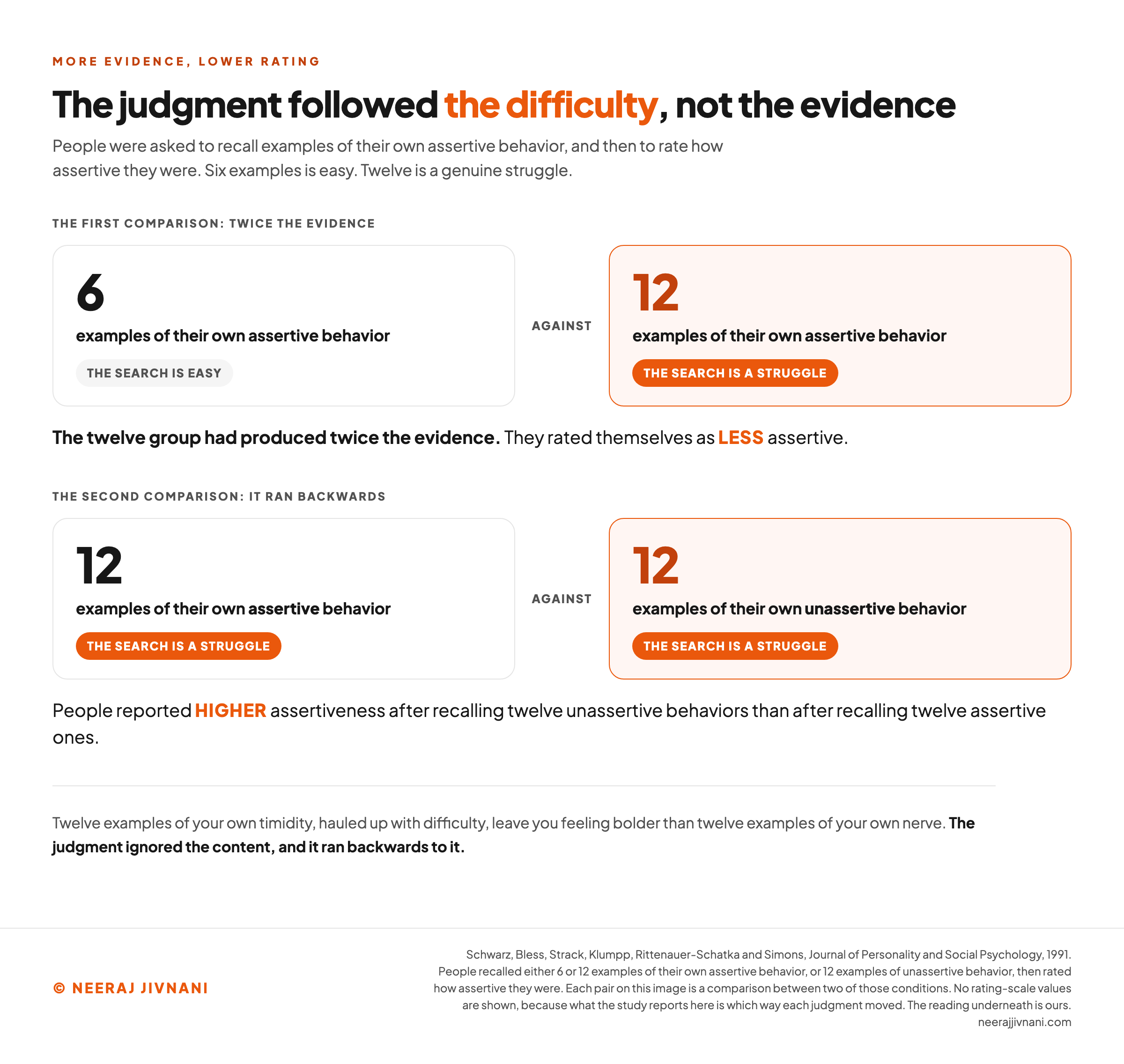
A 1991 experiment by Norbert Schwarz and colleagues pulled them apart. People were asked to recall either six examples of their own assertive behavior, which is easy, or twelve, which is a genuine struggle. Then they rated how assertive they were.
The twelve group had produced twice the evidence. They rated themselves as less assertive.
The result runs further than that. In the same study, people reported higher assertiveness after recalling twelve unassertive behaviors than after recalling twelve assertive ones.
Twelve examples of your own timidity, hauled up with difficulty, leave you feeling bolder than twelve examples of your own nerve.
The judgment followed the difficulty. It ignored the content, and it ran backwards to it.
One caution, since this is a fifty-year-old idea with a large literature behind it.
The ease-of-retrieval effect is a medium-sized one rather than an overwhelming one, and the feeling of ease accounts for part of it rather than all of it. That is what Weingarten and Hutchinson's 2018 meta-analysis of the research found.
Treat it as a reliable tendency, not a law.
Use this chart — embed code and citation
<a href="https://neerajjivnani.com/blog/availability-heuristic/"><img src="https://neerajjivnani.com/infographics/availability-heuristic/six-against-twelve.png" alt="Two paired comparisons drawn as cards, from a 1991 experiment in which people recalled examples of their own behavior and then rated how assertive they were. The first pair sets six examples of their own assertive behavior, marked as an easy search, against twelve of the same, marked in orange as a struggle. The line beneath reads that the twelve group had produced twice the evidence and rated themselves less assertive. The second pair sets twelve examples of assertive behavior against twelve examples of unassertive behavior, both marked as a struggle, and the line beneath reads that people reported higher assertiveness after recalling twelve unassertive behaviors than after recalling twelve assertive ones. No rating scale values appear anywhere on the image, because what is being shown is which way each judgment moved. A closing line says that twelve examples of your own timidity, hauled up with difficulty, leave you feeling bolder than twelve examples of your own nerve, and that the judgment ignored the content and ran backwards to it." width="1200"></a>
<p>Chart: <a href="https://neerajjivnani.com/blog/availability-heuristic/">Neeraj Jivnani</a></p>Neeraj Jivnani, "The Availability Heuristic: Where It Fools You, and the Counter That Works", neerajjivnani.com, https://neerajjivnani.com/blog/availability-heuristic/Free to republish with a link back to this page.
Where the Availability Heuristic Misleads You
The shortcut breaks in one specific way: whenever something other than frequency made the example easy to reach.
Five of those reasons come up often enough to be worth knowing by name.
Flying and Driving
People are warier of flying than driving, and some will take a long drive to avoid a short flight.
A crash makes the news everywhere at once, with photographs. Road deaths are distributed across thousands of ordinary days and reported locally or not at all.
Ease of recall diverges sharply from frequency, and the fear follows the ease.
Tversky and Kahneman used a quieter version of the same point in 1974. Seeing a house burning, they wrote, probably lifts your sense of how likely house fires are more than reading about one in the local paper does. Nothing changed except how vividly it arrived.
Insurance After the Flood
Flood insurance take-up spikes the year after a flood and then declines steadily back to where it started, which is what Justin Gallagher found across a national panel of floods and policies in 2014.
Nobody in those towns is being stupid. They are answering "could this happen to me?" with "can I picture it?", and in the year after a flood they can picture it in detail.
Later, the picture has faded and the same question gets a quieter answer. Same house, same river, same odds, two different judgments.
The Letter Puzzle
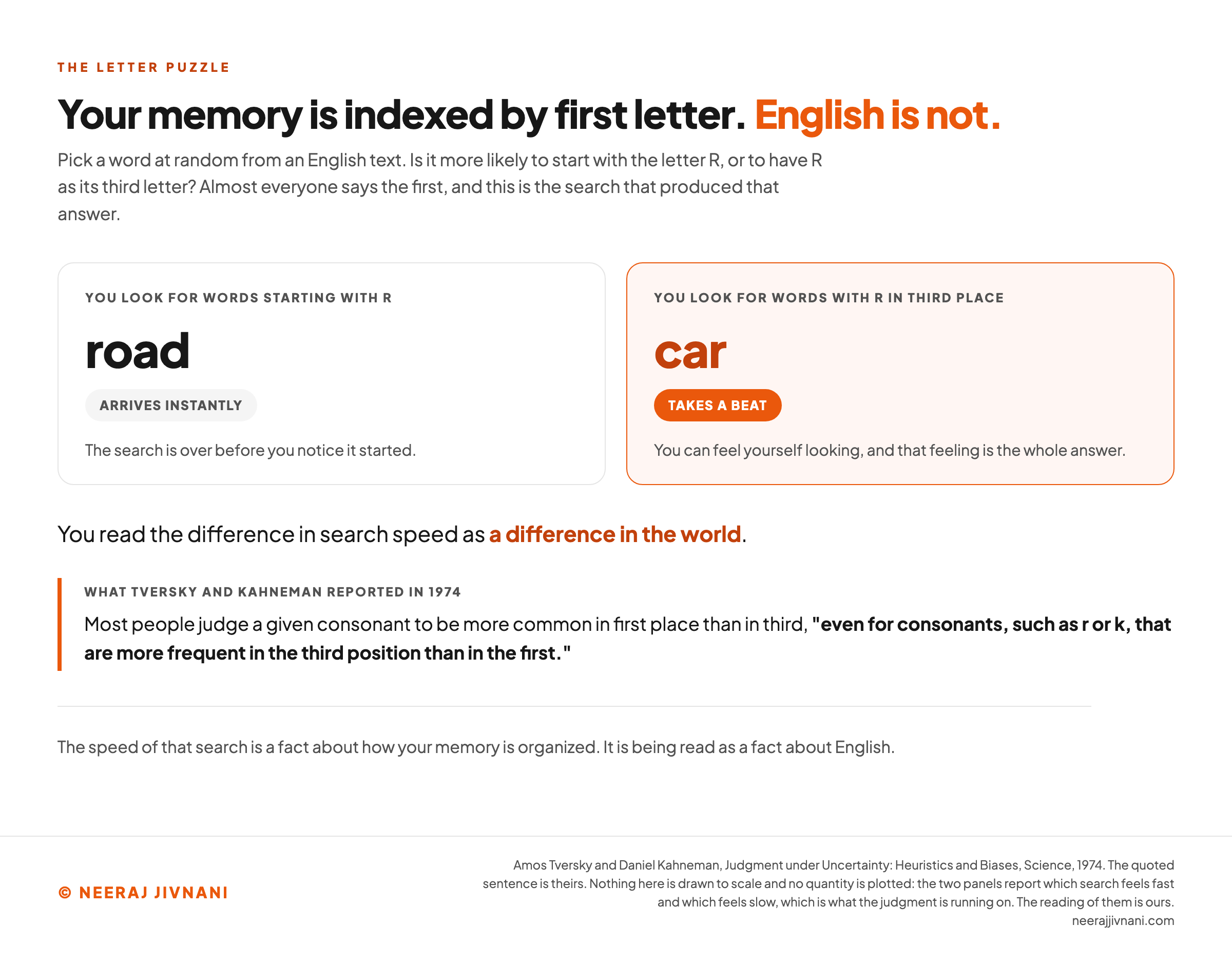
Pick a word at random from an English text. Is it more likely to start with the letter R, or to have R as its third letter?
Almost everyone says the first.
You go looking: road comes instantly, car takes a beat, and you read the difference in search speed as a difference in the world. That is Tversky and Kahneman's explanation.
It is not a difference in the world.
They reported in 1974 that most people judge a given consonant to be more common in first place than in third, "even for consonants, such as r or k, that are more frequent in the third position than in the first."
Your memory is indexed by first letter. English is not.
Who Gets Promoted
Two candidates, similar records, both with a mistake in their past. One of those mistakes happened on a project you ran.
You will weigh that one more heavily, and it will feel like judgment rather than recall. What is doing the work is that you were in the room.
There is a measured version of that gap. Communities that were not flooded, but shared a television media market with those that were, increased their flood insurance take-up at one-third the rate of the flooded communities, in Justin Gallagher's 2014 study.
Both groups saw the same flood. Only one of them stood in it.
Personal exposure is the hardest of these to catch, because your own memories do not arrive labeled as a biased sample.
Advertising, and What Comes to Mind First
Marketers have used this for a long time, usually without naming it. The aim of being known for one thing, repeated until it is dull, is to be the instance that arrives first when somebody thinks about the category.
That is availability bought rather than earned.
Worth knowing in both directions. When a brand is the first thing you can picture, that is a fact about its media spend before it is a fact about the market.
Use this chart — embed code and citation
<a href="https://neerajjivnani.com/blog/availability-heuristic/"><img src="https://neerajjivnani.com/infographics/availability-heuristic/indexed-by-first-letter.png" alt="Two panels side by side showing the same reader running two searches of their own memory. The left panel, asking for words starting with the letter R, returns the word road and is tagged as arriving instantly, with a note that the search is over before you notice it started. The right panel, in orange, asks for words with R in third place, returns the word car and is tagged as taking a beat, with a note that you can feel yourself looking and that the feeling is the whole answer. Nothing is plotted or drawn to scale. A line between them says you read the difference in search speed as a difference in the world. A quoted block gives what Tversky and Kahneman reported in 1974, that most people judge a given consonant to be more common in first place than in third, even for consonants, such as r or k, that are more frequent in the third position than in the first. The closing line says the speed of that search is a fact about how your memory is organized and is being read as a fact about English." width="1200"></a>
<p>Chart: <a href="https://neerajjivnani.com/blog/availability-heuristic/">Neeraj Jivnani</a></p>Neeraj Jivnani, "The Availability Heuristic: Where It Fools You, and the Counter That Works", neerajjivnani.com, https://neerajjivnani.com/blog/availability-heuristic/Free to republish with a link back to this page.
Availability or Representativeness?
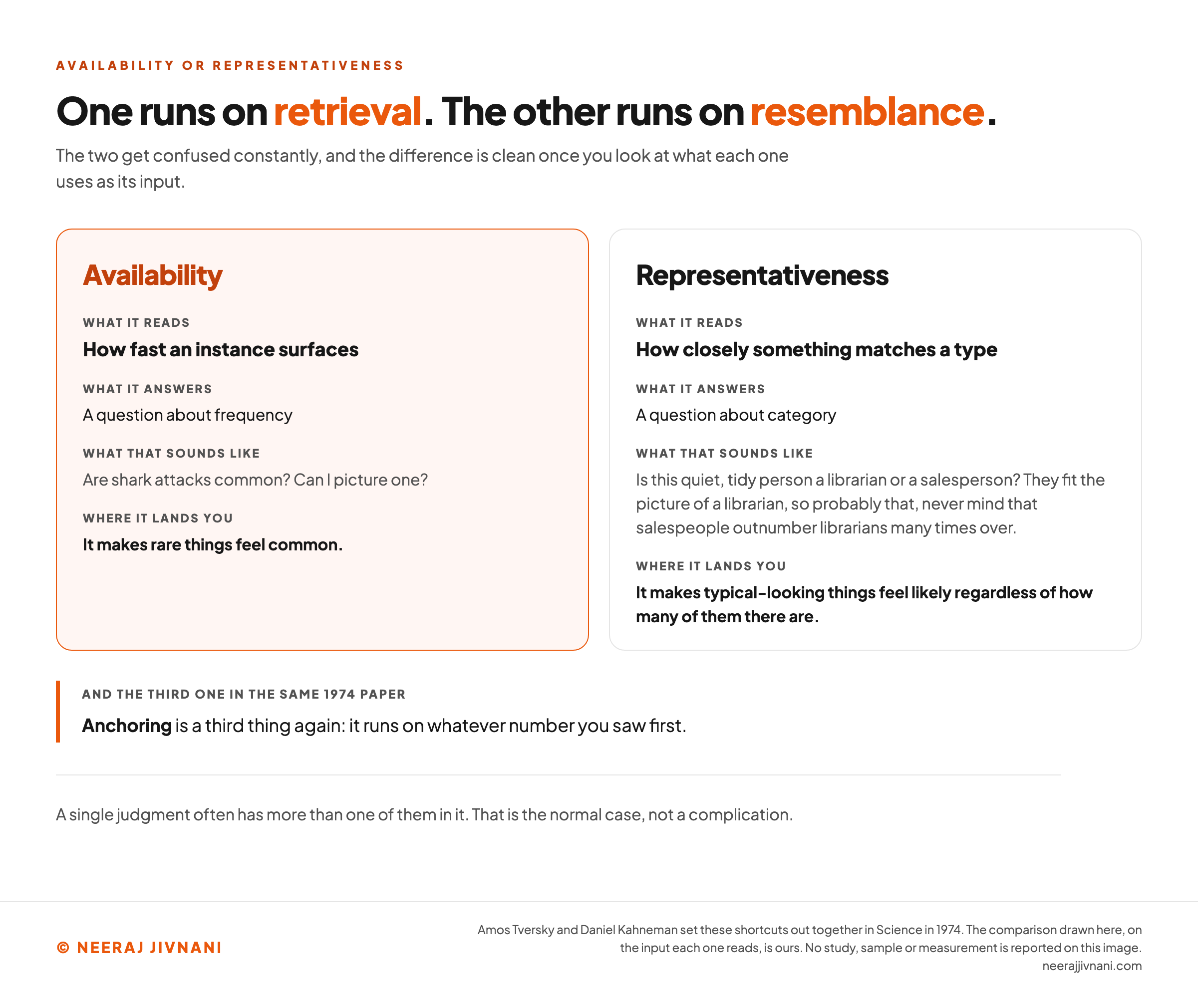
The two get confused constantly, and the difference is clean once you look at what each one uses as its input.
Availability asks how fast an instance surfaces, and answers a question about frequency. Are shark attacks common? Can I picture one?
Representativeness asks how closely something matches a type, and answers a question about category. Is this quiet, tidy person a librarian or a salesperson? They fit the picture of a librarian, so probably that, never mind that salespeople outnumber librarians many times over.
One runs on retrieval, the other on resemblance.
Availability makes rare things feel common. Representativeness makes typical-looking things feel likely regardless of how many of them there are.
Anchoring, the third shortcut in the same 1974 paper, is a third thing again: it runs on whatever number you saw first.
A single judgment often has more than one of them in it. That is the normal case, not a complication.
Use this chart — embed code and citation
<a href="https://neerajjivnani.com/blog/availability-heuristic/"><img src="https://neerajjivnani.com/infographics/availability-heuristic/retrieval-or-resemblance.png" alt="Two columns comparing the availability heuristic and the representativeness heuristic on four rows: what each one reads, what it answers, what it sounds like in practice, and where it lands you. The availability column, in orange, reads how fast an instance surfaces, answers a question about frequency, sounds like asking whether shark attacks are common and whether you can picture one, and makes rare things feel common. The representativeness column reads how closely something matches a type, answers a question about category, sounds like asking whether a quiet, tidy person is a librarian or a salesperson and deciding on the picture rather than on the fact that salespeople outnumber librarians many times over, and makes typical looking things feel likely regardless of how many of them there are. A block beneath names anchoring as the third shortcut in the same 1974 paper and says it runs on whatever number you saw first. A closing line says a single judgment often has more than one of them in it, and that this is the normal case rather than a complication." width="1200"></a>
<p>Chart: <a href="https://neerajjivnani.com/blog/availability-heuristic/">Neeraj Jivnani</a></p>Neeraj Jivnani, "The Availability Heuristic: Where It Fools You, and the Counter That Works", neerajjivnani.com, https://neerajjivnani.com/blog/availability-heuristic/Free to republish with a link back to this page.
How to Catch It in Yourself
The counter starts with one question, asked before you act on the estimate. What else would make this easy or hard to bring to mind, apart from how often it happens?
It is a small question, and being small is what makes it usable in the moment.
Why Awareness and Effort Both Fail
Knowing about the bias gives you nothing to act on. You cannot inspect the feeling of ease from the inside, and it does not announce itself as a feeling.
The instinctive fix is worse than nothing. If the input is how hard the search felt, then deliberately searching harder feeds the machine the exact signal that misleads it.
Dragging up a tenth example takes effort, and that effort registers as proof the thing must be rare.
So the counter cannot be more effort. It has to change what the effort means.
One search, and the two readings of it
Pick something you could list examples of. Anything will do. Then add them one at a time, in whatever order they arrive, and keep going past the point where they stop arriving on their own.
The clock starts when you press it, and runs between one example and the next.
Name the Other Reason
There is one move with evidence behind it, and it comes from the same 1991 study. Schwarz and colleagues found the effect disappeared when participants were given another explanation for why recall felt difficult.
Once the difficulty was accounted for by something else, it stopped being treated as information.
In the study that explanation was handed to people. You supply it yourself, in about ten seconds, and five questions do it:
- Did it happen to you?
- Was it recent?
- Was it dramatic, or photographed, or on every feed you read?
- Did somebody pay to put it there?
- Was it easier to search for it that way?
If you can name the other reason, the feeling stops counting as evidence. You are not suppressing the bias, which nobody can do. You are removing its input.
Then Change the Question
Instead of "how common is this?", ask "out of how many?"
Break-ins on your street, per hundred houses, per year. Candidates who made that mistake, out of everyone who has ever held the job.
A reference class turns a recall task into a counting task, and counting is not something ease can distort.
Two practical notes:
- Do this on the judgments worth ten seconds, because you cannot run it on all of them and the shortcut is right most of the time anyway.
- If a decision matters, get a second estimate from somebody whose recent experience differs from yours. What is available to them is not what is available to you.
Where People Get This Muddled
The question about the difference causes people the most trouble, because the two heuristics are almost always taught in the same breath.
What is the difference between the availability and representativeness heuristics? Availability runs on retrieval, and answers questions about how often. Representativeness runs on resemblance, and answers questions about what category something belongs to.
What is the availability heuristic, with an example? It is judging how likely or frequent something is by how easily an example comes to mind. Watch a week of news about a rare crime and you will rate it as more common than it is, without the rate having changed.
How do you combat the availability heuristic? Name the reason the example is easy to recall, apart from frequency: recency, drama, or that it happened to you. Then restate the question as a proportion, so the answer requires counting rather than recalling.
Can you give an example of a heuristic that is not this one? "I before E except after C" is a good one. It is fast, it is free, it is right far more often than not, and it is wrong for eight, protein and glacier. That is the shape of every heuristic: cheap, usually correct, and wrong in a predictable set of cases.
What This Changes
Nothing here changes the shortcut itself. It is the pricing mechanism your mind uses to answer questions it has no data for, and on most of them it buys a serviceable answer for almost nothing.
What changes is the handful of judgments where you let it run unchecked and should not have.
Those judgments have a tell, and the tell is a vivid example that arrived without being asked for.
When one arrives, ask why that one. If the answer is anything other than "because it happens a lot", you have found the reason your estimate is off, and you have found it before you acted on it.