Buyer's Remorse, and How to Decide Whether to Keep It
Regret is information, not a verdict. Before you send it back, work out which of three things actually went wrong, and what your refund rights are.


/ On this page8 sections
Regret after a purchase is information. It is not a verdict on the purchase, and reading it as one is how people send back things they would have been glad to own.
The useful question is which of three things went wrong. A return fixes one of them and leaves the other two exactly where they were.
Your right to send something back comes from the shop's own policy far more often than from any law.
What Counts as Buyer's Remorse
Buyer's remorse is the regret, guilt or anxiety that turns up after a purchase rather than before it. The money has moved, the decision is made, and the feeling arrives anyway.
Being disappointed by a product is a different thing. Disappointment is about the item; remorse is about the decision.
That boundary decides what will help you, so it is worth drawing before you do anything else.
A faulty or misdescribed item is not remorse. If the thing is broken or is not what the seller said it was, you have a warranty or a misrepresentation problem. That is a different route with stronger rights attached.
Ordinary buyer's remorse is about a purchase that works fine. The coat fits. The laptop runs. You wish you had not bought it.
It shows up most on purchases that were expensive, hard to undo, or made under pressure.
It also shows up on small, cheap purchases, so the size of the number is a poor guide to how bad it will feel.
One more thing gets called buyer's remorse and is not. Spotting the same jacket cheaper elsewhere two days later is annoyance, and it passes on its own.
Why It Happens
Buyer's remorse happens because choosing has a cost. Every purchase closes off the alternatives, and the mind keeps working on the ones you shut down.
Three forces do most of that work, and each one points at a different fix.
Not one of the three is a character flaw, and feeling worse repairs none of them.
Dissonance, in Plain Terms
You hold two ideas at once: you are careful with money, and the thing on the table cost more than you meant to spend. They will not sit together comfortably, and the discomfort is the remorse.
The mind resolves it in one of two directions. It revises the story about the purchase, or it revises the story about you.
So the same person can defend a purchase loudly on Monday and quietly resent it by Friday.
Neither reaction is about the item.
Talking yourself into liking it works when the purchase was reasonable and fails when it was not, which is the case you needed help with.
The More It Cost, the Worse It Sits
How much of yourself went into the decision decides how loudly it comes back. Money is only part of that, alongside the research, the waiting and the arguing you did to get there.
A purchase you agonized over for three weeks has more to answer for than one you made in a minute.
That runs against the intuition that careless buying causes the most regret. An impulse buy never built an expectation for the thing to fall short of.
The practical reading is unwelcome. The purchases most likely to haunt you are the ones you were most careful about, so care is not the protection you take it for.
Too Many Options Spoil the One You Chose
When you have compared eleven models, you know exactly what the other ten were good at. Each of those strengths is now something your purchase does not have.
Choosing from three options leaves you with two ghosts. Choosing from thirty leaves you with twenty-nine.
That is why the categories with endless choice are the ones that produce it, and why more research creates the ghosts rather than clearing them.
Does It Go Away, and How Long That Takes
Buyer's remorse does go away, and the sharp phase is short. What tends to remain is a quieter judgment about the money rather than the raw sting.
How long it takes has never been measured for purchase regret specifically, so any number in weeks is a guess.
Early Regret Is Mostly About What You Did
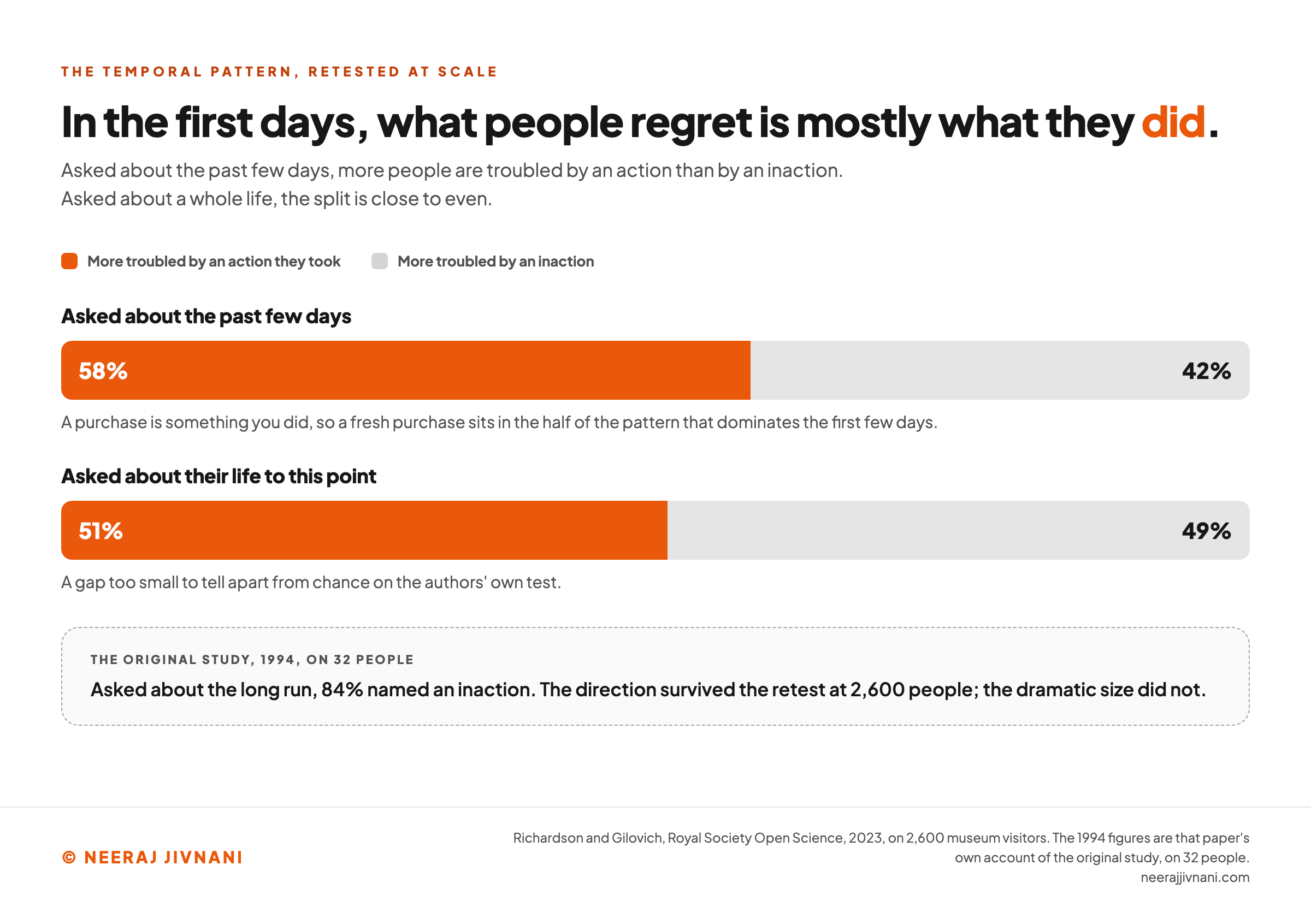
In the short run, what troubles people is mostly what they did rather than what they failed to do, and a purchase is something you did. So a fresh purchase sits in the half of the pattern that dominates the first few days.
That split has been counted. Richardson and Gilovich ran it past 2,600 museum visitors, in Royal Society Open Science in 2023.
Asked about the past few days, 58% were more troubled by something they had done than by something they had not, against 42% the other way.
The long-run half is where the popular version of the idea overreaches. Asked about their life to that point, 51% named an action and 49% named an inaction, a gap too small to tell apart from chance on the authors' own test.
The original 1994 study, on 32 people, had found 84% naming an inaction in the long run. The direction survived the retest at 2,600 people; the dramatic size did not.
What That Means for the Receipt in Your Hand
Two things follow, and they point opposite ways.
The sting you feel now is almost certainly the loudest this will get, and it is loud partly because it is recent rather than because the purchase was bad. Waiting a day costs you nothing and turns the volume down.
But the reassurance people offer, that one day you will regret only the things you did not buy, is much weaker than it sounds once somebody counts it.
Do not keep an expensive mistake on the strength of it.
Use this chart — embed code and citation
<a href="https://neerajjivnani.com/blog/buyers-remorse/"><img src="https://neerajjivnani.com/infographics/buyers-remorse/loudest-early.png" alt="Two horizontal bars showing how the balance between regretting an action and regretting an inaction changes with the time span people are asked about. Asked about the past few days, 58% were more troubled by an action they took and 42% by an inaction, and a note beside it says a purchase is something you did, so a fresh purchase sits in the half of the pattern that dominates the first few days. Asked about their life to this point, the split is 51% action and 49% inaction, a gap too small to tell apart from chance on the authors' own test. Set apart in a dashed box below, the original 1994 study on 32 people found 84% naming an inaction in the long run, and a note saying the direction survived the retest at 2,600 people while the dramatic size did not." width="1200"></a>
<p>Chart: <a href="https://neerajjivnani.com/blog/buyers-remorse/">Neeraj Jivnani</a></p>Neeraj Jivnani, "Buyer's Remorse, and How to Decide Whether to Keep It", neerajjivnani.com, https://neerajjivnani.com/blog/buyers-remorse/Free to republish with a link back to this page.
Deciding Whether to Keep It
Keep it or send it back, and the answer turns on what kind of regret you have rather than on how strongly you feel it.
Deciding is the cure. Not the feeling passing, and not talking yourself round.
The usual alternative is to wait for the discomfort to fade. Waiting long enough works, and it spends the return window on the occasions when a return was the right answer.
So take the decision while you still have both options.
Sort the Regret Into Three Kinds
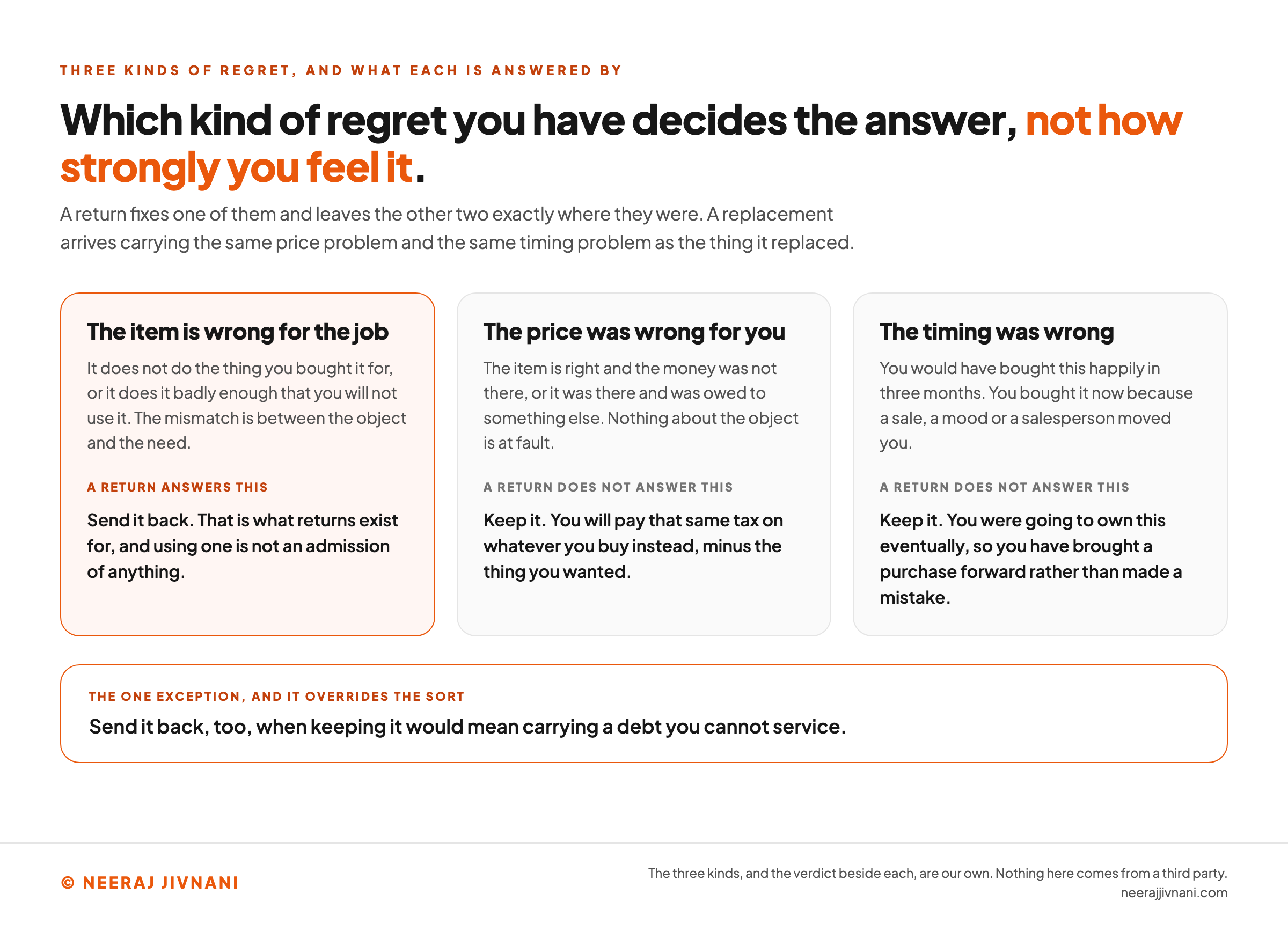
Before you decide anything, name which of these you have. Say it out loud if it helps, because the answer is usually obvious once the question is put properly.
- The item is wrong for the job. It does not do the thing you bought it for, or it does it badly enough that you will not use it. The mismatch is between the object and the need.
- The price was wrong for you. The item is right and the money was not there, or it was there and was owed to something else. Nothing about the object is at fault.
- The timing was wrong. You would have bought this happily in three months. You bought it now because a sale, a mood or a salesperson moved you.
A return answers the first kind. A replacement arrives carrying the same price problem and the same timing problem as the thing it replaced.
That sorting disposes of most cases in under a minute.
When Sending It Back Is Right
Send it back when the item is wrong for the job. That is what returns exist for, and using one is not an admission of anything.
Send it back, too, when keeping it would mean carrying a debt you cannot service. That is a price problem severe enough to override the sorting above, and it is worth making an exception for.
Then move quickly, because policy windows are short and the clock started at purchase rather than at the moment you made up your mind.
Take the item back in the state it arrived in, with whatever the shop asks for. A return refused on a technicality is the worst of both outcomes.
When Keeping It Is the Right Call
Keep it when the object is right and the price stung. You will pay that same tax on whatever you buy instead, minus the thing you wanted.
Keep it when the item is right and the timing was wrong. You were going to own this eventually, so you have brought a purchase forward rather than made a mistake.
Keep it, above all, when a second run at the decision would end the same way.
One version of keeping it is avoidance wearing a disguise. Leaving the box unopened for six weeks so you never have to choose is how a returnable purchase quietly becomes a permanent one.
Check first whether opening it costs you the return. Then open it, try it, and decide inside the window.
Whichever You Choose, Write Down the Cause
The regret is worth one sentence in a note before it fades. Which of the three kinds it was, and what set it off.
Three or four of those sentences will show you a pattern in your own buying that no general advice can, because it will be about you.
Use this chart — embed code and citation
<a href="https://neerajjivnani.com/blog/buyers-remorse/"><img src="https://neerajjivnani.com/infographics/buyers-remorse/three-kinds-one-return.png" alt="Three cards sorting purchase regret into three kinds, under the heading that which kind you have decides the answer rather than how strongly you feel it. A return fixes one of them and leaves the other two exactly where they were. The item is wrong for the job, meaning it does not do the thing you bought it for, or does it badly enough that you will not use it, and the mismatch is between the object and the need. A return answers that one, and sending it back is what returns exist for. The price was wrong for you, meaning the item is right and the money was not there or was owed to something else, with nothing about the object at fault. A return does not answer that one, and keeping it costs the same tax you would pay on whatever you buy instead, minus the thing you wanted. The timing was wrong, meaning you would have bought this happily in three months and bought it now because a sale, a mood or a salesperson moved you. A return does not answer that one either, because you were going to own it eventually. A band across the foot carries the single exception, which is to send it back when keeping it would mean carrying a debt you cannot service." width="1200"></a>
<p>Chart: <a href="https://neerajjivnani.com/blog/buyers-remorse/">Neeraj Jivnani</a></p>Neeraj Jivnani, "Buyer's Remorse, and How to Decide Whether to Keep It", neerajjivnani.com, https://neerajjivnani.com/blog/buyers-remorse/Free to republish with a link back to this page.
Whether You Can Send It Back at All
Yes, you can nearly always send it back. That is the shop's own choice, though, not something a law made it offer.
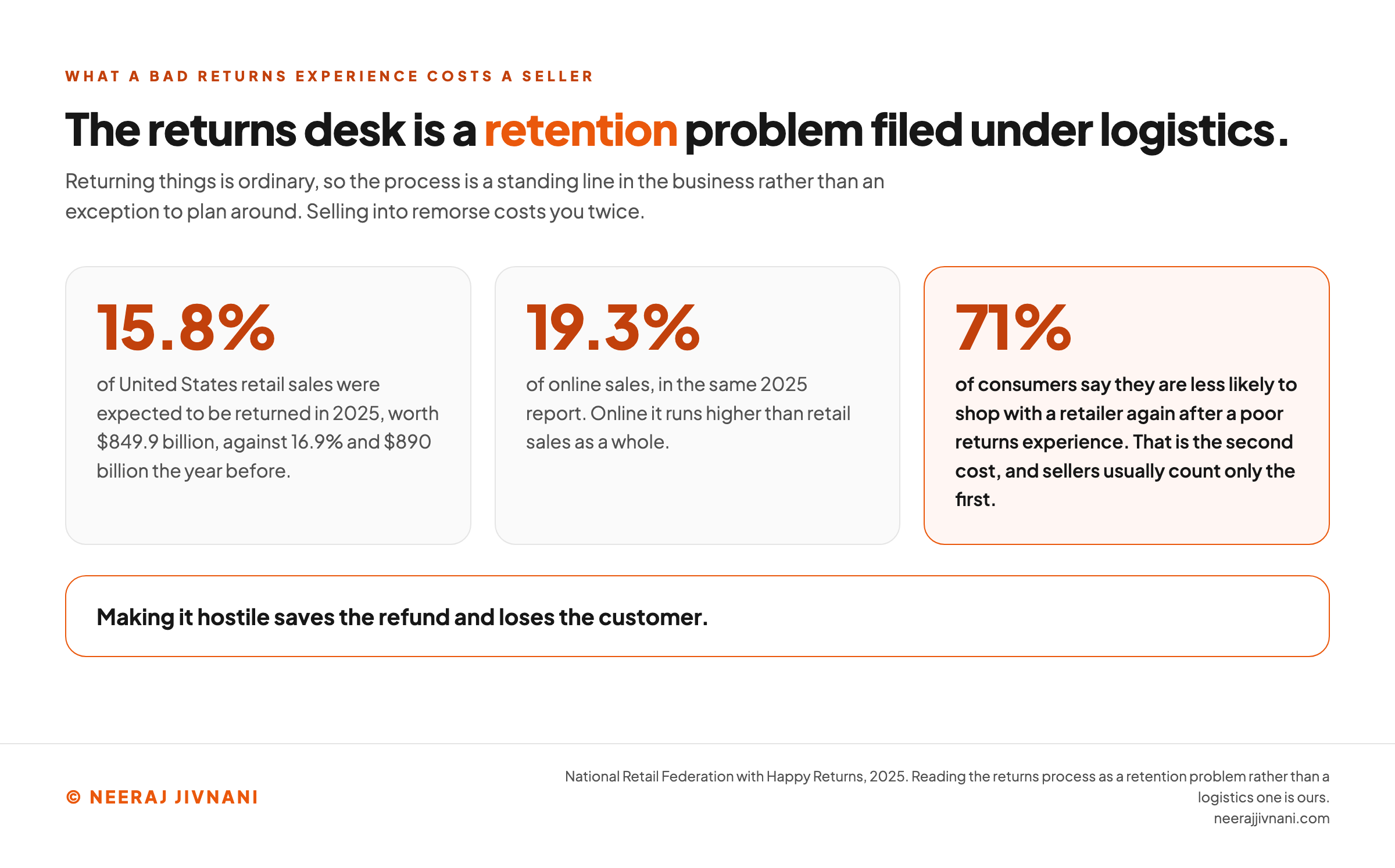
Returning is ordinary rather than exceptional. The National Retail Federation, with Happy Returns, estimated returns at 15.8% of United States retail sales in 2025, worth $849.9 billion, against 16.9% and $890 billion the year before.
Online it runs higher, at 19.3% in the same 2025 report.
You are not doing anything unusual, and the shop has a process for it.
The Shop's Policy Is the Real Rule
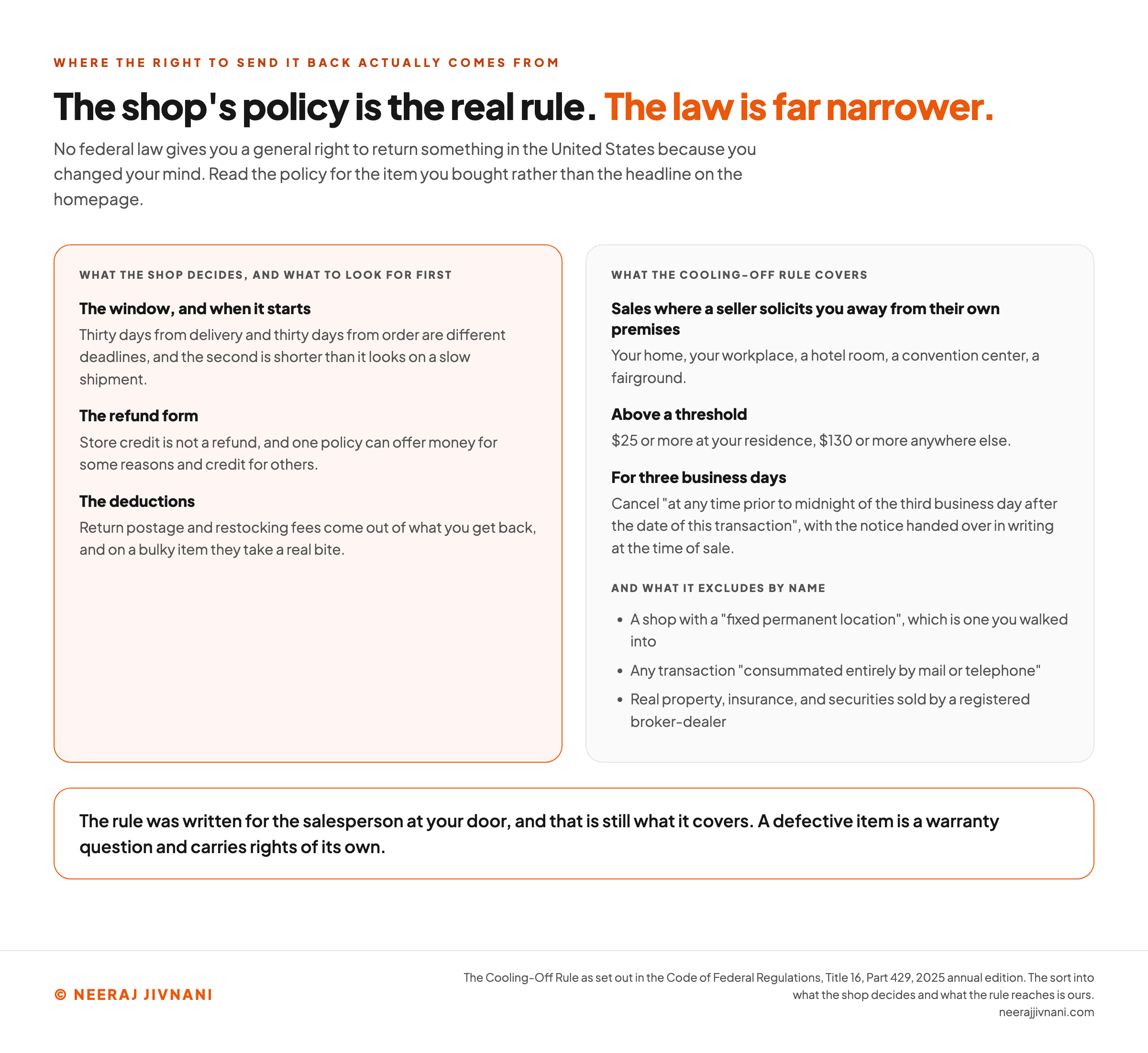
The return window, the condition required, who pays the postage and whether you get money or credit are all set by the seller. They vary enormously between shops, and sometimes between categories inside one shop.
So read the policy for the item you bought rather than the headline on the homepage. Opened electronics, sale items, underwear and made-to-order goods carry their own rules almost everywhere.
Three details are where a return quietly stops being worth making, so look for them first.
- The window, and when it starts. Thirty days from delivery and thirty days from order are different deadlines, and the second is shorter than it looks on a slow shipment.
- The refund form. Store credit is not a refund, and one policy can offer money for some reasons and credit for others.
- The deductions. Return postage and restocking fees come out of what you get back, and on a bulky item they take a real bite.
Free returns are common because shoppers demand them. That same 2025 report found 82% of consumers naming free returns as a major consideration when they buy, which is why so many sellers absorb the cost.
The generosity has a limit and it is being tested. The report also put 9% of returns down as fraudulent, with 45% of shoppers saying that bending the truth on a return is acceptable.
Policies tighten in response, so read the version on the site today instead of the one you remember.
When the window shuts
The clock started at purchase, not at the moment you made up your mind. Give it the two dates on your receipt and see how much room is actually left. Nothing here is kept.
Thirty is only an example. Read the number off the policy for the item you bought, rather than the headline on the homepage, and read the version on the site today instead of the one you remember.
Put in the date you ordered it, the date it arrived, and the number of days the policy gives you. Until all three are in there is nothing on the page to subtract.
The two details no date can settle
- The refund form
- Store credit is not a refund, and one policy can offer money for some reasons and credit for others.
- The deductions
- Return postage and restocking fees come out of what you get back, and on a bulky item they take a real bite.
The Narrow Case Where the Law Steps In
No federal law gives you a general right to return something in the United States because you changed your mind. That surprises people, and it should redirect where you look first.
The rule half-remembered here is the Federal Trade Commission's Cooling-Off Rule, set out in the Code of Federal Regulations at Title 16, Part 429.
It gives a buyer the right to cancel "at any time prior to midnight of the third business day after the date of this transaction", and the seller has to hand over that notice in writing at the time of sale.
The definition is where it narrows.
It covers sales where a seller solicits you away from their own premises: your home, your workplace, a hotel room, a convention center, a fairground. The thresholds are $25 or more at your residence and $130 or more anywhere else.
Personal solicitation is the hinge. A shop you walked into has a "fixed permanent location" and is excluded by name, and a website checkout has nobody soliciting you at all.
The rule also excludes any transaction "consummated entirely by mail or telephone", and, among other things, sales of real property and insurance.
So the ordinary regretted purchase, made in a shop or on a website, sits outside it. The rule was written for the salesperson at your door, and that is still what it covers.
State law adds specific rights in specific places, usually for particular contracts such as timeshares, health clubs or door-to-door sales, rather than a general change-of-mind right. On a large purchase, your own state's consumer protection office is the place to check.
And if the item is defective rather than merely regretted, none of this reaches you. That is a warranty question, and it carries rights that sit entirely outside the Cooling-Off Rule.
Use this chart — embed code and citation
<a href="https://neerajjivnani.com/blog/buyers-remorse/"><img src="https://neerajjivnani.com/infographics/buyers-remorse/the-policy-is-the-rule.png" alt="Two panels contrasting the shop's return policy with the reach of the federal Cooling-Off Rule. The left panel, headed as what the shop decides, lists the three details worth finding first: the window and when it starts, since thirty days from delivery and thirty days from order are different deadlines and the second is shorter than it looks on a slow shipment; the refund form, since store credit is not a refund; and the deductions, since return postage and restocking fees come out of what you get back. The right panel sets out what the Cooling-Off Rule covers, which is a sale where a seller solicits you away from their own premises, at your home, your workplace, a hotel room, a convention center or a fairground, at $25 or more at your residence and $130 or more anywhere else, cancellable at any time prior to midnight of the third business day after the date of the transaction. Below it, what the rule excludes by name: a shop with a fixed permanent location, a transaction consummated entirely by mail or telephone, and real property, insurance, and securities sold by a registered broker-dealer. A band across the foot says the rule was written for the salesperson at your door and that is still what it covers, and that a defective item is a warranty question carrying rights of its own." width="1200"></a>
<p>Chart: <a href="https://neerajjivnani.com/blog/buyers-remorse/">Neeraj Jivnani</a></p>Neeraj Jivnani, "Buyer's Remorse, and How to Decide Whether to Keep It", neerajjivnani.com, https://neerajjivnani.com/blog/buyers-remorse/Free to republish with a link back to this page.
Not Doing It Again
Preventing it again follows straight from the causes, and it is dull work.
Cut the number of options before you compare, not after. Pick three candidates on a rule you set in advance, then compare only those. Fewer options means fewer ghosts afterwards, which attacks the cause rather than the feeling.
Put time between the wanting and the paying. A day for anything ordinary, a week for anything large. Most of what triggers a regretted purchase does not survive the wait.
Write down the job before you shop. One sentence saying what the thing has to do. It makes the first kind of regret nearly impossible, because you cannot buy the wrong item for a job you have already specified.
Check the return policy before you buy. Two minutes at the point of purchase decides whether a mistake is reversible, and it is the cheapest insurance on any purchase.
Treat pressure as information about the seller. A deadline that exists to stop you thinking is a reason to think. Nothing you genuinely need requires a decision inside ten minutes.
None of this makes you immune, and a system that promises it is selling something.
Regret is the price of choosing under uncertainty, and you will pay it occasionally no matter how well you buy.
What Remorse Costs a Seller
Selling into remorse costs you twice, and sellers usually count only the first cost.
The first is the return, and it is measurable. With returns at 15.8% of retail sales in 2025 on the National Retail Federation's numbers, and 19.3% online, it is a standing line in the business rather than an exception to plan around.
The second cost is the customer. That same 2025 report found 71% of consumers saying they are less likely to shop with a retailer again after a poor returns experience.
So the returns process is a retention problem filed under logistics. Making it hostile saves the refund and loses the customer.
Remorse You Caused, and Remorse They Brought
Remorse you caused and remorse the buyer brought with them have different causes and different fixes. Treating them as one problem produces advice that helps with neither.
Remorse you caused comes from a gap between what the customer expected and what arrived. Overstated copy, a photograph flattering the product, shipping costs revealed at the last step, a salesperson closing hard on somebody who was not ready.
It costs you the return and the customer, because the disappointment attaches to you rather than to the purchase.
It is also entirely inside your control.
The fix is unglamorous. Say what the thing does not do, put the total price on the screen where the buyer commits, and stop rewarding a close the customer had to be talked into.
Remorse they brought comes from the buyer's own budget, mood or circumstances, and it would have followed them into any shop. You cannot prevent it and should not try.
You can still make the return easy and the tone neutral, so the person keeps their good opinion of you along with their refund.
The Follow-Up Nobody Sends
The gap between purchase and first use is where remorse grows, and it is usually left empty.
A short message helping the customer get value out of what they bought does real work in that gap. Not a request for a review, and not another offer.
It settles what the buyer is quietly wondering, which is whether they chose well.
Getting the thing into use beats any amount of reassurance about the decision.
Use this chart — embed code and citation
<a href="https://neerajjivnani.com/blog/buyers-remorse/"><img src="https://neerajjivnani.com/infographics/buyers-remorse/the-refund-is-not-the-cost.png" alt="Three figures showing why a returns process is a retention problem rather than a logistics one. 15.8% of United States retail sales were expected to be returned in 2025, worth $849.9 billion, against 16.9% and $890 billion the year before. 19.3% of online sales in the same 2025 report, which runs higher than retail sales as a whole. And 71% of consumers say they are less likely to shop with a retailer again after a poor returns experience, which is the second cost, the one sellers usually leave uncounted. A band across the foot says that making it hostile saves the refund and loses the customer." width="1200"></a>
<p>Chart: <a href="https://neerajjivnani.com/blog/buyers-remorse/">Neeraj Jivnani</a></p>Neeraj Jivnani, "Buyer's Remorse, and How to Decide Whether to Keep It", neerajjivnani.com, https://neerajjivnani.com/blog/buyers-remorse/Free to republish with a link back to this page.
The Decision, in Order
Buyer's remorse is a normal cost of choosing, and it is loudest in the hours right after the purchase, which is the worst available moment to act on it.
So the order is short. Name which of the three regrets you have, read the shop's policy rather than assuming a law will help, and move inside the window if the item is wrong for the job.
If the object is right and the price hurt, keeping it is almost always the better call. The replacement carries the same price with less of what you wanted.
Then write down what set it off.
The discomfort fades on its own. The note is still there the next time you are standing in the same shop, which is when you need it.