Co-Marketing: What Each Side Puts In, and How to Tell Who Got What
Before you agree to a joint campaign, settle what each side hands over, who owns the names it collects, and how you tell whose result it was.


/ On this page12 sections
Co-marketing is a joint campaign that two or more companies run to their own audiences, with each one still selling its own thing.
Before you agree to one, three things need settling: what each side hands over, who owns the names the campaign collects, and how you tell afterwards whose result it was.
Those three are the negotiation. The rest is scheduling.
What Co-Marketing Is
Co-marketing is a joint promotion between two or more companies that reach similar people for different reasons. You make something together, or you promote something together, and each of you puts it in front of your own audience.
Both brands stay separate throughout, and both go back to normal afterwards.
The currency is audience. You are not buying an audience, you are paying in one: access to the people you have already gathered, in exchange for access to theirs.
That is why the deal is hard to value.
Ad inventory has a published price. Nobody has a rate card for the goodwill of a list that took years to build, and both sides tend to feel they are bringing more to the table.
The same trade explains why a partner with a small, engaged list can be worth more than one with a large, indifferent one, and why the deal falls apart when one side has nothing the other needs.
Co-Marketing and Co-Branding Are Different Deals
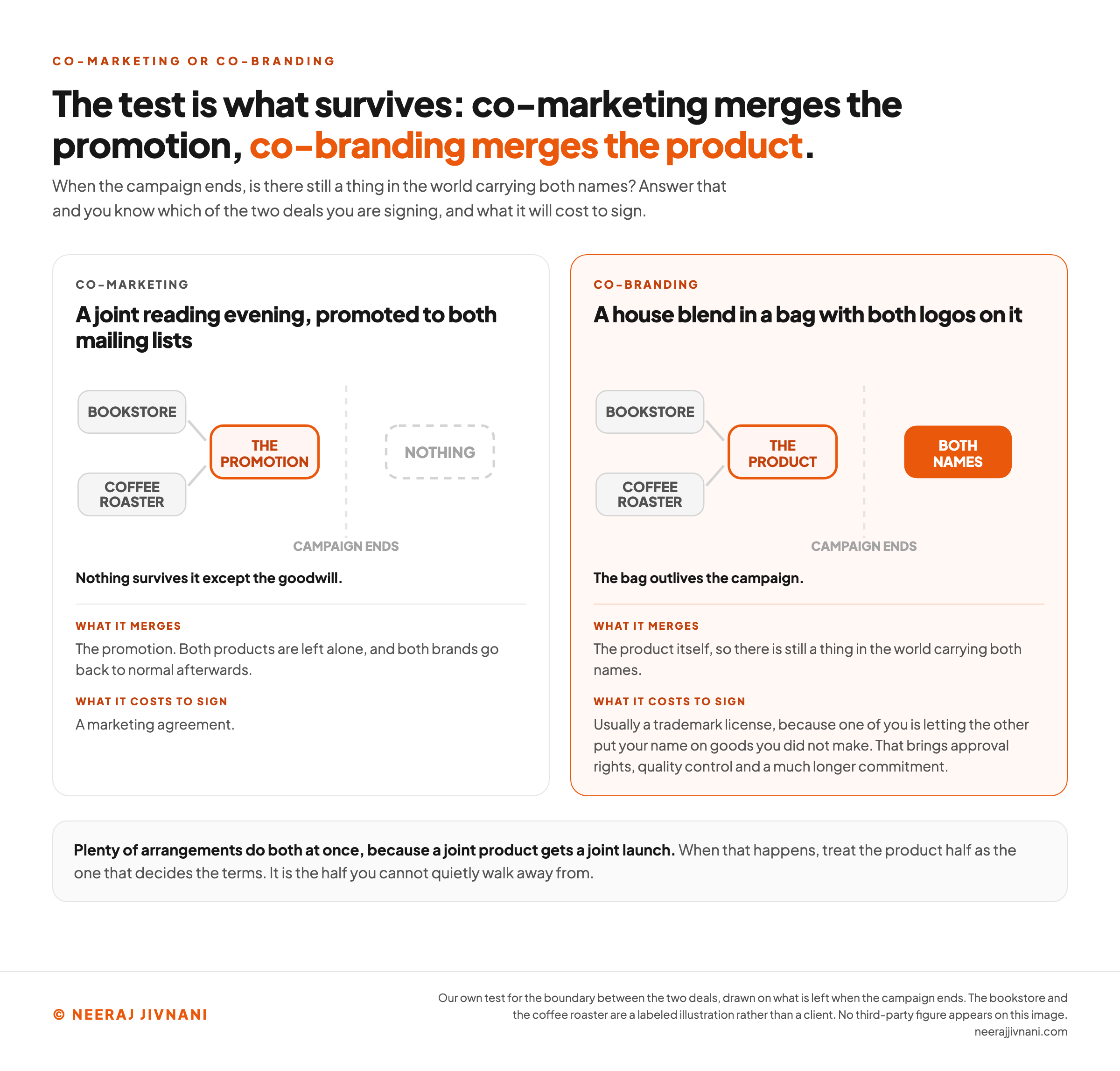
Co-marketing merges the promotion. Co-branding merges the product.
The test is what survives. When the campaign ends, is there still a thing in the world carrying both names?
If a bookstore and a coffee roaster run a joint reading evening, promote it to both mailing lists and then pack up, that is co-marketing. Nothing survives it except the goodwill.
If the same two put out a house blend in a bag with both logos on it, that is co-branding. The bag outlives the campaign.
The difference is not academic, because the two deals cost different things to sign.
A shared promotion is a marketing agreement.
A shared product usually needs a trademark license, because one of you is letting the other put your name on goods you did not make. That brings approval rights, quality control and a much longer commitment.
Plenty of arrangements do both at once, because a joint product gets a joint launch.
When that happens, treat the product half as the one that decides the terms. It is the half you cannot quietly walk away from.
Where Co-Selling and Partner Marketing Sit
Two labels sit next to co-marketing and cause most of the confusion in software.
Co-selling is the sales version: two companies working the same deal, in the same meetings, in front of the same buyer. It happens after the marketing, and it is a different team's job.
Partner marketing is usually a synonym for co-marketing, and sometimes a broader umbrella covering affiliates and resellers too. If somebody uses it at you, ask which they mean before you agree to anything.
Use this chart — embed code and citation
<a href="https://neerajjivnani.com/blog/co-marketing/"><img src="https://neerajjivnani.com/infographics/co-marketing/what-survives-the-campaign.png" alt="Two panels set against each other, headed with the test that co-marketing merges the promotion while co-branding merges the product. The left panel takes a joint reading evening promoted to both mailing lists: a bookstore and a coffee roaster both feed one box marked the promotion, a dashed line marks where the campaign ends, and on the far side of that line the box is empty and reads nothing. Under it, the caption says nothing survives it except the goodwill, that what it merges is the promotion while both products are left alone and both brands go back to normal, and that what it costs to sign is a marketing agreement. The right panel, drawn in orange, takes a house blend in a bag with both logos on it: the same two businesses feed a box marked the product, and on the far side of the campaign ends line a solid orange box remains, reading both names. Under it, the caption says the bag outlives the campaign, that what it merges is the product itself so there is still a thing in the world carrying both names, and that what it costs to sign is usually a trademark license, because one of you is letting the other put your name on goods you did not make, which brings approval rights, quality control and a much longer commitment. A band across the foot says plenty of arrangements do both at once, because a joint product gets a joint launch, and that when it happens the product half is the one that decides the terms, being the half you cannot quietly walk away from." width="1200"></a>
<p>Chart: <a href="https://neerajjivnani.com/blog/co-marketing/">Neeraj Jivnani</a></p>Neeraj Jivnani, "Co-Marketing: What Each Side Puts In, and How to Tell Who Got What", neerajjivnani.com, https://neerajjivnani.com/blog/co-marketing/Free to republish with a link back to this page.
What a Co-Marketing Campaign Looks Like
Almost every co-marketing campaign is one of six shapes, and they sort by what is being shared.
Know which shape you are proposing before you approach anybody. It decides how much work the thing takes, and how evenly that work can be split.
- Joint content. A guide, a report, a template or a webinar with both names on it. Produced once, promoted twice.
- Guest slots. You write, speak or appear on their channel and they do the same on yours. The cheapest shape, because nothing has to be co-produced.
- A shared offer. A bundle, a discount that only works with both of you, or a code one side distributes and the other honors.
- An event. Co-hosted, co-sponsored, or one of you sponsoring the other's. The most expensive shape and the one that builds the most trust.
- A giveaway. Entries arrive from both audiences at once, which makes it the fastest way to grow two lists and the easiest way to attract people who want the prize and nothing else.
- Cross-promotion in owned channels. A slot in each other's newsletter, a takeover on social, a card in the packing slip.
The Same Trade at Three Sizes
The same exchange runs at a trade show, inside a corporate partner program, and between two businesses on one street.
Data Center World ran an Exhibitor Co-Marketing Program for its April 20-23, 2026 event in Washington. Exhibitors got promotional graphics and a unique promo code giving their customers $325 off a conference pass.
An exhibitor promotes the show to its own list. The show fills its hall, and the exhibitor gets its own customers standing in front of its booth.
Both sides pay in audience.
IBM runs the funded version. Its Co-Marketing Guide, effective November 5, 2024, gives Business Partners marketing money to "help offset the costs as you drive demand for you and IBM", across digital campaigns, seminars, trade shows and advertising.
The partner runs the campaign to its own market. IBM covers part of the bill and gets promoted inside it.
Now the small version, and it works the same way.
Say a wedding photographer and a florist in the same city. They serve one customer at one moment for two different reasons, they compete for nothing, and each has a list the other cannot buy.
A shared planning checklist, sent by both, is a co-marketing campaign. There is nothing more to it than that.
What Each Side Puts In
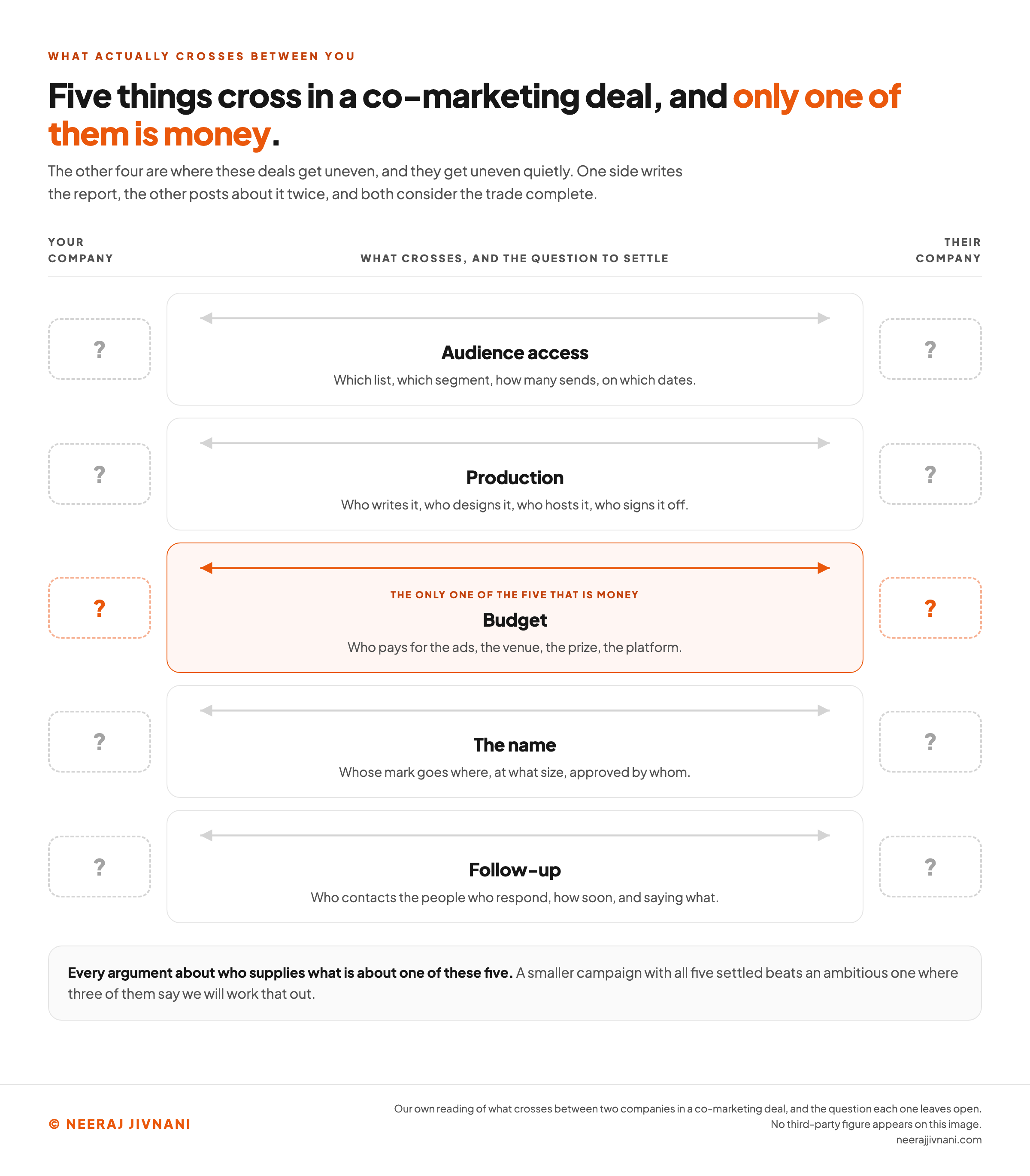
Five things can cross between two companies in a co-marketing deal. Every argument about who supplies what is about one of them.
Put each of them in writing before anybody opens a design file.
| what crosses | the question to settle |
|---|---|
| Audience access | Which list, which segment, how many sends, on which dates |
| Production | Who writes it, who designs it, who hosts it, who signs it off |
| Budget | Who pays for the ads, the venue, the prize, the platform |
| The name | Whose mark goes where, at what size, approved by whom |
| Follow-up | Who contacts the people who respond, how soon, and saying what |
Notice that only one of those five is money.
The other four are where these deals get uneven, and they get uneven quietly.
One side writes the report, the other posts about it twice. Both consider the trade complete.
A smaller campaign with all five settled beats an ambitious one where three of them say "we will work that out".
Say who supplies each of the five
Answer for the deal you are actually being offered. What comes back is not the plan. It is the rows nobody has claimed yet, and every argument about who supplies what is about one of these five.
Audience access
Which list, which segment, how many sends, on which dates
Production
Who writes it, who designs it, who hosts it, who signs it off
Budget
Who pays for the ads, the venue, the prize, the platform
The name
Whose mark goes where, at what size, approved by whom
Follow-up
Who contacts the people who respond, how soon, and saying what
Claim one of the five and the reading appears here.
And What Each Side Gets Back
Three things come back, and only the first tends to reach the campaign report.
The first is exposure you did not buy, in front of an audience that was assembled by somebody else and would have cost you months to build.
The second is the arrangement itself. The expensive part of a partnership is the first campaign, and once it has run, the working process and the mutual trust both exist.
A second campaign with the same partner takes a fraction of the effort.
There is a third return that neither side plans for.
You get to watch how a different audience reacts to your material. That is a read you cannot buy, and it is the reason to compare the two response rates afterwards instead of adding them together.
None of the three is pipeline. What a campaign returns is decided by the shape you picked, so say what you need before you agree to one.
A giveaway and a joint technical guide do not attract the same person.
Use this chart — embed code and citation
<a href="https://neerajjivnani.com/blog/co-marketing/"><img src="https://neerajjivnani.com/infographics/co-marketing/only-one-is-money.png" alt="A five row exchange laid out between two columns headed your company and their company. Each row is one of the five things that can cross, with a double headed arrow running between the two sides and a dashed box carrying a question mark under each company, standing for a supplier nobody has named yet. The rows are audience access, asking which list, which segment, how many sends and on which dates; production, asking who writes it, who designs it, who hosts it and who signs it off; budget, drawn in orange and tagged as the only one of the five that is money, asking who pays for the ads, the venue, the prize and the platform; the name, asking whose mark goes where, at what size and approved by whom; and follow-up, asking who contacts the people who respond, how soon and saying what. The title states that five things cross in a co-marketing deal and only one of them is money, and the standfirst adds that the other four are where these deals get uneven and that they get uneven quietly, with one side writing the report while the other posts about it twice and both considering the trade complete. A band across the foot says every argument about who supplies what is about one of these five, and that a smaller campaign with all five settled beats an ambitious one where three of them say we will work that out." width="1200"></a>
<p>Chart: <a href="https://neerajjivnani.com/blog/co-marketing/">Neeraj Jivnani</a></p>Neeraj Jivnani, "Co-Marketing: What Each Side Puts In, and How to Tell Who Got What", neerajjivnani.com, https://neerajjivnani.com/blog/co-marketing/Free to republish with a link back to this page.
Finding a Partner Worth the Trade
The right partner sells something different, to the same person, at roughly your size, with an audience that responds.
Those four conditions do more work than any list of outreach tactics.
The first three you can check from the outside. The fourth you cannot, and that is the reason a first campaign should be small.
A mismatch in any of the first three does not improve after contact, so check them before you write the first email.
The Overlap Is a Need, Not a Demographic
Matching demographics is the tempting test and the wrong one.
Two brands can share an age band, a city and an income bracket and have nothing to offer each other, because their customers are not thinking about the same problem at the same time.
The better question is when. At what moment does your customer need what your partner sells?
If the answer is a specific moment, you have a campaign. If the answer is "eventually, maybe", you have a demographic and no reason.
That is also the cleanest way to check you are not partnering with a competitor. Same customer, different need, no overlap in what you charge for.
When the Sizes Do Not Match
Audience sizes are never equal, and a gap does not have to sink the deal.
What sinks it is a gap nobody named. The smaller side quietly expects to be carried, the larger side quietly expects to be thanked, and neither says so.
Name the gap out loud and rebalance somewhere else. The smaller partner takes on more of the production, or supplies the expertise, or pays a larger share of the ad budget.
There is a floor, though. If your list is small enough that the larger partner would not notice its absence, you are asking for a favor rather than proposing a trade, and it is better to know that before you pitch.
What to Settle Before Anything Is Published
Write down five things before anyone starts building: what each side is counting, the dates, who approves the work, what proof each side will show, and what happens if one side goes quiet.
The last of those gets skipped almost every time. It is also the one you will reach for in a bad week.
Goals come first because they are usually different. One side wants sign-ups, the other wants to be seen next to you.
Both are legitimate. Neither survives being assumed.
Dates come second, and they are more specific than a launch day. Who publishes when, who sends on which morning, and how long each side keeps promoting it after the launch week.
Then the evidence. Agree what each side will show the other as proof that a promised send happened.
That sounds distrustful, and it is standard practice wherever somebody else is paying.
IBM's Co-Marketing Guide requires Proof of Performance for every tactic a partner claims. An itemized third-party invoice, plus a sample from each channel, specified down to a "screenshot of one email" and a "full-page screenshot of one landing page".
Nobody is paying you, so you do not need invoices. You do want the screenshots, because they are the only record either of you will have of what was promoted and when.
Whose Name Goes Where
Your name is the asset you are lending, and it gets treated more casually than any of the other four.
Settle where each mark appears, at what size, in what color, and who has to approve the artwork before it goes out. Then settle who is allowed to say the partnership exists, and in what words.
The side lending its name sets the terms for how it gets used, whoever is paying.
IBM makes the partner responsible for complying with its marketing guidelines and using the marks correctly, and materials that fail them may not be reimbursed.
It goes further with its own money: an activity promoting both IBM and a competitor's products, without prior written approval, is not reimbursed either.
Exclusivity belongs in the same conversation, and the version worth asking for is narrow: this campaign, this category, this window.
A partner who wants your whole business off the table for a year is asking for something much larger than a joint promotion, and should be paying for it.
What Counts As Done, and What Happens If One Side Stops
Define finished before you start, or the campaign will trail off instead of ending.
Finished is a date, a set of deliverables, and a final report each side has agreed to send. Without it, the promotion quietly stops when both sides get busy and nobody ever decides whether it worked.
The other ending is the one nobody writes down. Name who on each side says so when a deliverable is missed, by when they say it, and what either of you may do with the shared material if the other stops.
None of that has to be a contract clause. It is the answer to a question you would otherwise be asking for the first time in the week it matters.
Who Gets the List
In most co-marketing campaigns both sides get every name collected. That is usually the point, and it is the part most likely to be agreed by nodding.
The sign-up form decides what either of you may do afterwards. Whatever it says at the moment somebody types their email is the whole of what you have.
Widening it later means going back and asking them again, which is a different campaign.
So write that sentence first, then build the form around it. It has to name both companies, plainly, where the person filling it in will see it.
Say the photographer and the florist put their checklist on one page: both logos, one form, and one line under the button saying the details go to both businesses.
That line would be the whole permission, and it would have to be written before the page existed.
Then settle three more things while you are there.
- How long each side may contact these people.
- Whether either of you may pass them on again.
- What happens to the list if the partnership ends.
Have whoever handles your privacy notice read the form before it goes live. This is the one part of a co-marketing campaign that is difficult to unwind afterwards.
Telling Whose Result It Was
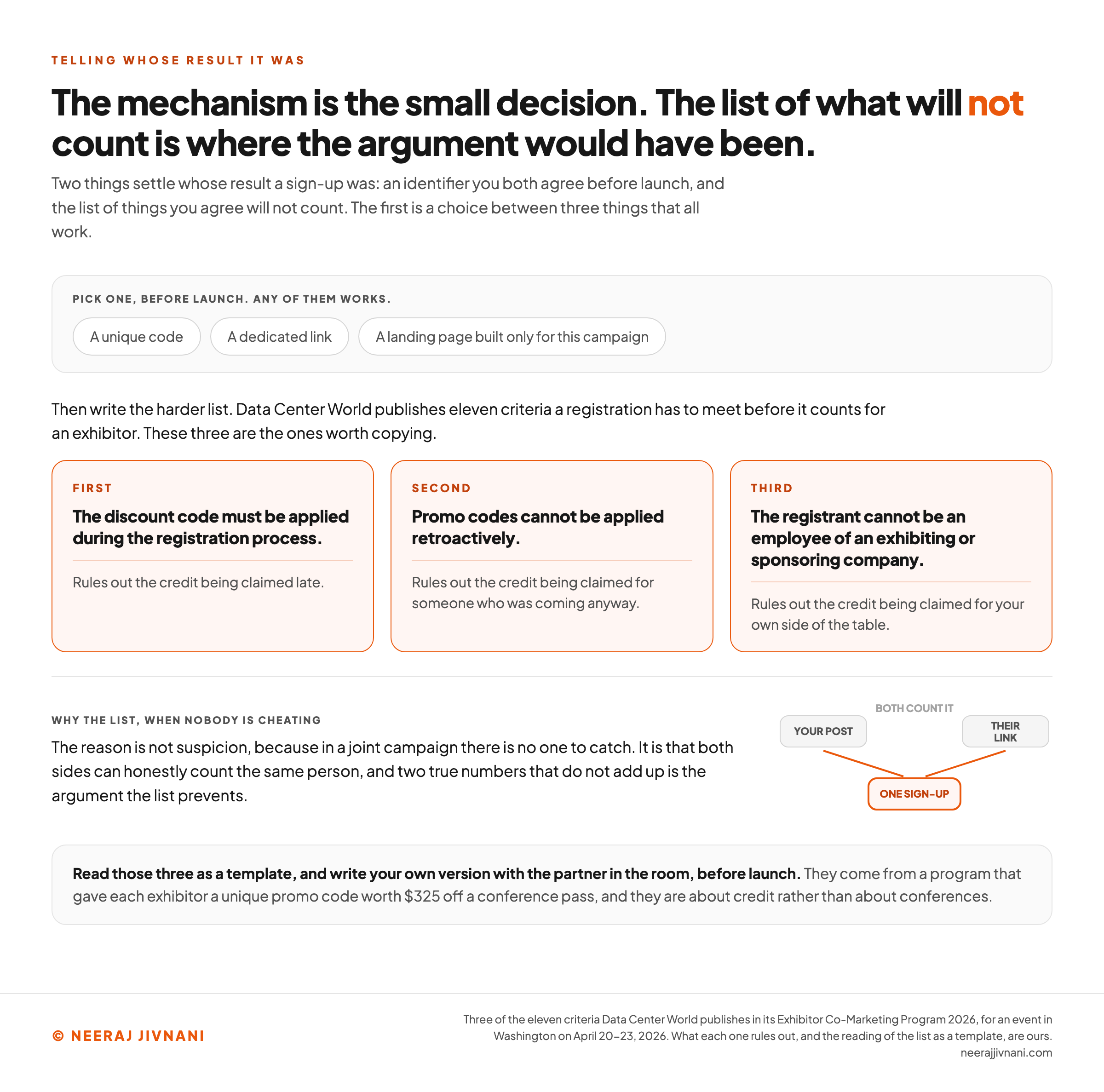
Two things settle whose result a sign-up was: an identifier you both agree before launch, and the list of things you agree will not count.
A unique code, a dedicated link, or a landing page built only for this campaign. Any of them works. The mechanism is the small decision.
The disqualifications are where the argument would have been.
Data Center World publishes eleven criteria a registration has to meet before it counts for an exhibitor.
Three of them are the ones worth copying. A discount code must be applied during the registration process, codes cannot be applied retroactively, and the registrant cannot be an employee of an exhibiting or sponsoring company.
Read those three as a template. They rule out the credit being claimed late, the credit being claimed for someone who was coming anyway, and the credit being claimed for your own side of the table.
Write your own version of that list with the partner in the room, before launch.
The reason is not suspicion, because in a joint campaign there is no one to catch. It is that both sides can honestly count the same person: they read your post, clicked your partner's link, and signed up.
Two true numbers that do not add up is the argument the list prevents.
Then agree what each side reports, and when. One shared document, two columns, sent on an agreed date.
Use this chart — embed code and citation
<a href="https://neerajjivnani.com/blog/co-marketing/"><img src="https://neerajjivnani.com/infographics/co-marketing/what-will-not-count.png" alt="Titled to say the mechanism is the small decision and that the list of what will not count is where the argument would have been. A grey strip at the top offers the three mechanisms as chips, a unique code, a dedicated link and a landing page built only for this campaign, under a line saying to pick one before launch because any of them works. Below it, a line says Data Center World publishes eleven criteria a registration has to meet before it counts for an exhibitor, and that these three are the ones worth copying. Three orange cards labeled first, second and third carry them and what each one rules out: the discount code must be applied during the registration process, which rules out the credit being claimed late; promo codes cannot be applied retroactively, which rules out the credit being claimed for someone who was coming anyway; and the registrant cannot be an employee of an exhibiting or sponsoring company, which rules out the credit being claimed for your own side of the table. Underneath, a short diagram shows one sign-up claimed by two arrows at once, one from your post and one from their link, above the note that both count it, beside text saying the reason is not suspicion because in a joint campaign there is no one to catch, and that two true numbers that do not add up is the argument the list prevents. A band across the foot says to read those three as a template and write your own version with the partner in the room before launch, and notes that they come from a program that gave each exhibitor a unique promo code worth $325 off a conference pass." width="1200"></a>
<p>Chart: <a href="https://neerajjivnani.com/blog/co-marketing/">Neeraj Jivnani</a></p>Neeraj Jivnani, "Co-Marketing: What Each Side Puts In, and How to Tell Who Got What", neerajjivnani.com, https://neerajjivnani.com/blog/co-marketing/Free to republish with a link back to this page.
What One Costs You
There is no price to quote, because most of what a co-marketing campaign costs you is not money.
Three things come out of you. The production hours, the audience you spend, and the coordination.
Production is the visible one and usually the smallest. Audience is the real cost: every send you give a joint campaign is a send you did not use on your own, and a list has a tolerance.
Coordination is the cost nobody budgets. Two calendars, two approval chains and two sets of priorities stretch a short piece of work well past the date either side had in mind.
Co-branding costs more, and the gap is not the design fee. A joint product carries production or inventory, and an exit that has to be negotiated rather than allowed to lapse.
So the range is wide. The cheapest version, a guest post traded both ways, costs an afternoon each.
The most expensive version is a shared product, and it has stopped being a campaign by then.
Where These Come Apart
Partnerships come apart for four reasons, and the idea is almost never one of them.
Uneven effort. One side ships and the other drifts. This is the common one, and settling who supplies each of the five prevents it where goodwill does not.
Two definitions of success. Both sides call it a success and mean different things, so nobody can say whether to do it again.
Nobody owned the calendar. Two companies each assume the other is driving, the launch slips twice, and the enthusiasm goes with it. One named owner on each side fixes it.
The partner's reputation. You are lending your audience your judgment about somebody else. If they mishandle a customer, publish something careless or run into trouble, some of that lands on you, and no clause takes it back off you.
When Not To Run One
Not every gap in your reach is a partnership problem. Four situations mean the answer is no, and all four are visible before you pitch anybody.
You have no audience of your own yet. Co-marketing trades reach for reach, and if you have nothing to trade you are asking for a donation. Build a list first, however small.
You have nothing distinct to offer. If your partner could produce the whole campaign alone, they eventually will.
Your only realistic candidates are competitors. Co-marketing assumes you sell different things to the same person, and that assumption fails the moment you do not.
The campaign is one you could run alone. If a partner adds nothing but a second logo, the coordination cost buys you nothing, and you would ship faster by yourself.
What to Decide First
Co-marketing works when the trade is even and both sides can see that it is.
So the first thing to decide is what you have that is worth trading: which segment of your audience, which piece of production you could carry, which name you are willing to lend.
Once you can answer that plainly, the partner conversation gets short. You know what you are offering, you know what you want back, and you can tell inside one conversation whether the other side has it.
The rest is the paperwork that keeps an even trade from going uneven. Settle who supplies each of the five, write the form's sentence before you build the form, and agree the disqualifications while both of you still expect it to go well.