What Affiliate Marketing Is, and What It Actually Pays You
Thinking about starting? See what your category really pays, how a click turns into commission, and whether the numbers work before you commit.


/ On this page13 sections
Affiliate marketing pays you a commission when somebody you sent to a merchant buys something, or does whatever else that program pays for.
The mechanism is simple. Two numbers decide whether it is worth your time: the rate your merchant publishes for the category you sell in, and what one referral is worth once it lands.
Both are knowable before you start, and both are usually smaller than the pitch suggests.
The Money Path, From Click to Payment
A click starts the arrangement and a completed action ends it. Everything in between is bookkeeping, and every rule that decides whether you get paid lives in that gap.
One referral runs through four steps, and each one can fail on its own.
- You publish a link that carries your identifier. The identifier is what makes the click yours rather than anybody else's.
- Somebody clicks it and lands on the merchant. The click starts a tracking window that has an expiry.
- They buy, and the merchant reports the sale. What counts as a qualifying purchase is defined in the program terms, not by you.
- Whoever runs the program credits your account and pays out later. Payment waits on a minimum balance and a clearing period.
Your buyer is looking at the same click from the other side. "Someone's getting paid", "You're getting tracked", "But is the ad truthful?" Those three lines come from the consumer guidance the Federal Trade Commission (FTC) publishes on clicking an online ad.
That is the frame your reader is standing in.
It is why disclosure and plain honesty are not decoration on this business, and why the version of this work that lasts reads nothing like an advert.
Who Gets Paid, and For What
The merchant, the buyer and you are in every arrangement. The network is the party that comes and goes.
| Party | Also called | What they do | What they take |
|---|---|---|---|
| Merchant | advertiser, brand, retailer | Owns the product, sets the rate, decides what qualifies | Keeps the sale |
| Affiliate network | platform, aggregator | Tracks the click, holds the offers, handles payouts. Absent when you go direct with the merchant | A cut of the commission |
| Affiliate | publisher, partner, creator | Publishes the link and produces whatever surrounds it | The commission |
| Buyer | consumer, customer | Clicks, buys, pays the same price either way | The product |
Affiliate and publisher are one party under two names. Networks tend to say publisher and blogs tend to say affiliate. You will see both words used for you, sometimes in the same paragraph.
The buyer is the party easiest to forget. They pay no more for arriving through your link, and unless you tell them, nothing on the page marks that link as different from any other.
The Pricing Models, and Which One a Program Runs On
The pricing model decides which event triggers your payment. Five of them turn up on program terms pages.
- Pay per sale. You are paid a percentage of a completed purchase. Amazon's program works this way, and so does most retail.
- Pay per lead. You are paid for a form, a trial signup or a qualified inquiry, whether or not money changes hands afterward.
- Pay per click. You are paid for the traffic itself. Rare now, and mostly confined to display arrangements.
- Pay per install. You are paid when an app or a piece of software is installed. Common in mobile.
- Revenue share. You are paid a percentage of what the customer spends for as long as they stay. Common in software and hosting.
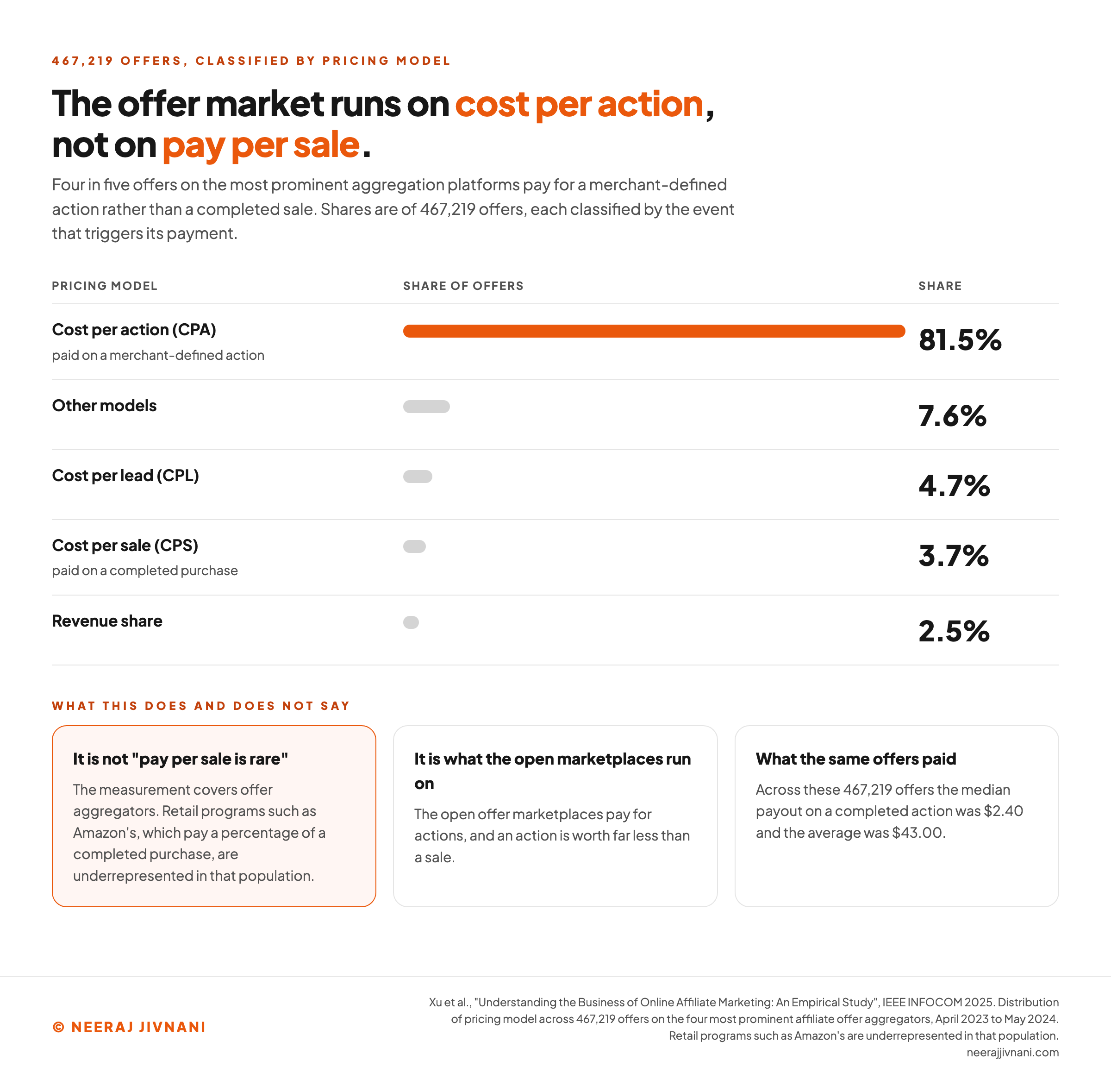
Pay per sale is how retail programs work, Amazon's included. On the open offer marketplaces, the action is what pays, not the sale.
Cost per action pays on whatever the merchant defines as the action, and it covered 81.5% of 467,219 live offers measured by Xu and colleagues for IEEE INFOCOM 2025. Cost per lead took 4.7%, cost per sale 3.7% and revenue share 2.5%.
That measurement covers offer aggregators rather than the whole market, so it does not mean pay per sale is rare.
What it means for you is simpler. An action is easier to produce than a sale, and it is worth a great deal less, which is the trade hiding inside a signup form that looks generous.
Use this chart — embed code and citation
<a href="https://neerajjivnani.com/blog/affiliate-marketing/"><img src="https://neerajjivnani.com/infographics/affiliate-marketing/pricing-models.png" alt="A bar chart of how 467,219 affiliate offers split by pricing model, showing cost per action at 81.5 percent, cost per lead at 4.7 percent, cost per sale at 3.7 percent, revenue share at 2.5 percent and other models at 7.6 percent, a caution that this measurement covers the four most prominent offer aggregators rather than retail programs, and the median payout of 2.40 dollars and average of 43.00 dollars across the same offers." width="1200"></a>
<p>Chart: <a href="https://neerajjivnani.com/blog/affiliate-marketing/">Neeraj Jivnani</a></p>Neeraj Jivnani, "What Affiliate Marketing Is, and What It Actually Pays You", neerajjivnani.com, https://neerajjivnani.com/blog/affiliate-marketing/Free to republish with a link back to this page.
The Tracking Window Decides Whether You Get Paid
A tracking window is the period after a click during which a purchase still counts as yours. Miss it and the sale still happens. The buyer is still happy, the merchant is paid, and you earn nothing at all.
Every program sets its own window, and it is written in the terms rather than in the marketing. It is the most consequential number in the arrangement.
Amazon's Twenty-Four Hours, Word for Word
Amazon states the rule plainly, and the exact wording matters, because two clauses in it decide whether a sale is yours.
The first sets the clock. "You earn commission income on any qualifying items placed in a customer's Shopping Cart within 24 hours of their arrival at Amazon.com via your Associates link."
The second clause is the one that catches people. That window "closes once the customer submits his order or reenters Amazon.com through another Associate's link", and once it has closed you earn nothing on anything bought afterwards.
So the window is not a guaranteed day. It ends at whichever comes first: the clock, the order, or somebody else's link.
Two rules run the other way, in your favor. The window reopens if the customer comes back through one of your links, and Amazon says that "this opens a new 24-hour window".
The cart is the other one. If the item entered it inside the window, Amazon says "you will still earn a referral commission if the order is placed before the Shopping Cart expires (usually after 90 days)".
So a cart abandoned in March can pay you in May.
A program's stated window and what it credits in practice are two different things. Read the terms, then watch what lands in your reports.
Why an Affiliate Link Bounces Through Two Redirects
An affiliate link almost never goes straight to the product page. The detour is deliberate, and you can watch it happen in your own address bar.
Affiliate links "undergo an average of 2 redirections before reaching the landing page, whereas most non-affiliate links exhibit zero redirections", measured by Xu and colleagues for IEEE INFOCOM 2025.
There are two reasons for it, and the first is tracking. The chain is how the network learns which link brought the visitor and what they did next.
The second is defensive. Redirects are used "to obscure the actual affiliate links", which stops a visitor reading the destination and going straight there.
The redirect chain is also where tracking quietly breaks. A blocked hop, a stripped parameter or an in-app browser that refuses to follow costs you the credit. Nothing on your side of the screen tells you it happened.
What the Rate Cards Actually Say
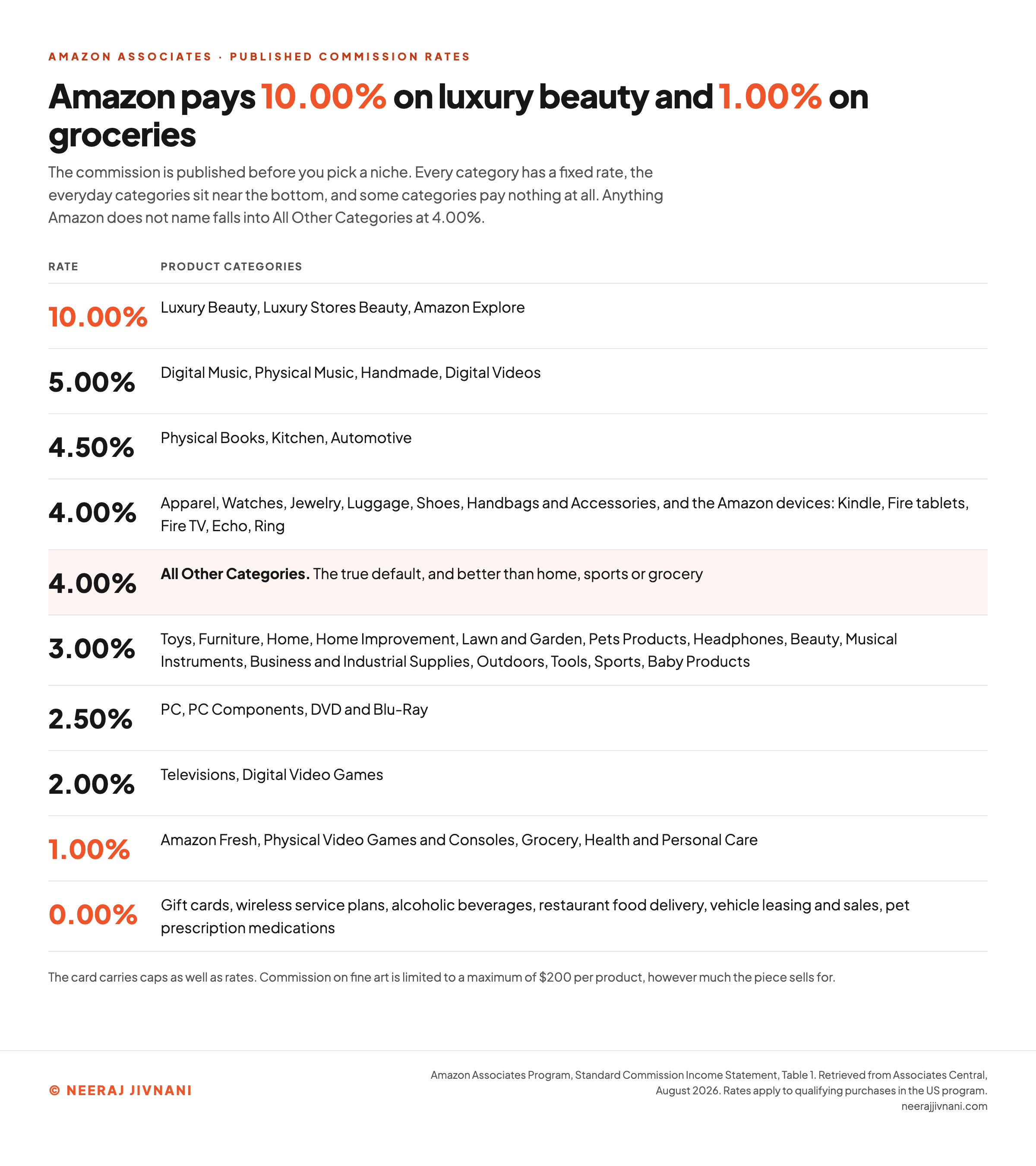
Your commission rate is set by the product category, not by how well you sell. Amazon publishes a fixed rate for each one, and these are its own figures.
| Product category | Fixed commission rate |
|---|---|
| Luxury Beauty, Luxury Stores Beauty, Amazon Explore | 10.00% |
| Digital Music, Physical Music, Handmade, Digital Videos | 5.00% |
| Physical Books, Kitchen, Automotive | 4.50% |
| Amazon device categories, Luxury Stores Fashion, Apparel, Watches, Jewelry, Luggage, Shoes, Handbags and Accessories | 4.00% |
| All Other Categories | 4.00% |
| Toys, Furniture, Home, Home Improvement, Lawn and Garden, Pets Products, Headphones, Beauty, Musical Instruments, Business and Industrial Supplies, Outdoors, Tools, Sports, Baby Products, Amazon Coins | 3.00% |
| PC, PC Components, DVD and Blu-Ray | 2.50% |
| Televisions, Digital Video Games | 2.00% |
| Amazon Fresh, Physical Video Games and Video Game Consoles, Grocery, Health and Personal Care | 1.00% |
| Gift Cards, Wireless Service Plans, Alcoholic Beverages, Kindle subscription products, Vehicles, Pet Prescription Medications, restaurant food delivery, Amazon Appstore, Prime Now, Amazon Pay Places | 0.00% |
Read the bottom row before the top one. Recommend gift cards, wireless plans or restaurant delivery and you earn nothing on Amazon at all.
Review groceries and you earn 1.00%.
Two limits sit underneath the same card, and both are Amazon's own. Commission on fine art is capped at $200 per product, however expensive the piece. The second is stranger, and it catches book sites.
A site that mainly promotes free Kindle books can lose a whole month of commission income. The rule bites when 20,000 or more free titles are downloaded through its links and at least 80% of the Kindle books ordered through them are free.
Amazon is the obvious first program, and being the obvious one is not the same as being the best rate.
Among the affiliate links matched to a live offer, Amazon accounted for 33.9%, AliExpress 28.9%, Shopee 11.8%, Flipkart 6.6% and Sephora 2.2%, measured by Xu and colleagues for IEEE INFOCOM 2025. Those five hold 83.4% of the links between them.
Go direct where you can.
A brand running its own program will often pay better on the same product than a marketplace does, and that is the first place to look once you know what you are selling.
140 rangefinders sold through Amazon paid $1,377.15 in commission in one month, and 53 of the same product sold through the brand's own program paid $1,687.83, figures Location Rebel published in 2024.
There is a caveat on the same page and it cuts the other way: the Amazon figure leaves out the commission on whatever else those buyers put in the basket at the same time.
Fewer sales at a better rate can beat more sales at Amazon's, and that is worth measuring on your own audience rather than assuming either way.
Where the "Up to 10 Percent" Number Comes From
You will see Amazon Associates described as paying up to 10 percent commission. That is true, and it is close to useless as a planning number.
The 10.00% rate applies to three categories: Luxury Beauty, Luxury Stores Beauty and Amazon Explore. Nothing else on the card reaches it.
Say you write about home espresso machines. Kitchen pays 4.50% and the accessories that sell alongside them sit in Home at 3.00%.
The honest headline for that site is 3.00% to 4.50%, not ten.
Check the category before you choose a subject. The gap between the 1.00% row and the 4.50% row is the gap between a hobby and a business.
Use this chart — embed code and citation
<a href="https://neerajjivnani.com/blog/affiliate-marketing/"><img src="https://neerajjivnani.com/infographics/affiliate-marketing/rate-card.png" alt="A table of Amazon's published fixed commission rates by product category, running from 10.00 percent on Luxury Beauty, Luxury Stores Beauty and Amazon Explore down through 4.50 percent on physical books, kitchen and automotive, 3.00 percent on home, toys, beauty, sports, tools and pets products, 2.50 percent on PCs and components, 1.00 percent on grocery and health, and 0.00 percent on gift cards, wireless plans, alcoholic beverages and restaurant food delivery, with a note that the highest rate covers three categories and that All Other Categories pays 4.00 percent." width="1200"></a>
<p>Chart: <a href="https://neerajjivnani.com/blog/affiliate-marketing/">Neeraj Jivnani</a></p>Neeraj Jivnani, "What Affiliate Marketing Is, and What It Actually Pays You", neerajjivnani.com, https://neerajjivnani.com/blog/affiliate-marketing/Free to republish with a link back to this page.
What One Completed Referral Is Worth
Expect small change per referral unless you are selling something expensive, and plan on that basis rather than on the exceptions.
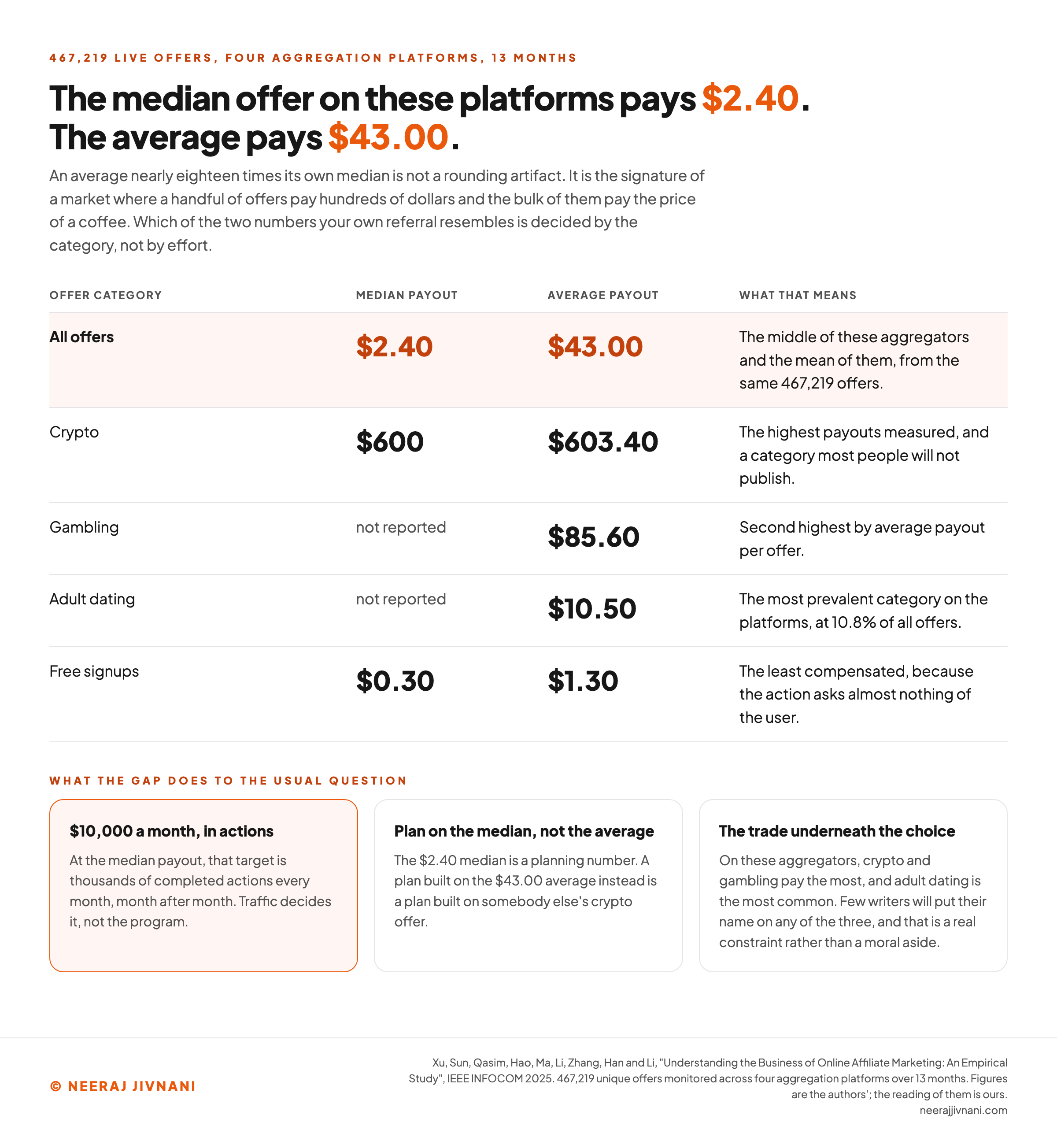
The median affiliate offer pays $2.40 for a completed action and the average pays $43.00, from 467,219 offers monitored across the four most prominent offer aggregators for 13 months by Xu and colleagues for IEEE INFOCOM 2025.
An average nearly eighteen times its own median is not a rounding artifact. It is the signature of a market where a handful of offers pay hundreds and the bulk of them pay the price of a coffee.
Can you make $10,000 a month? Yes, and the arithmetic tells you what it would take. At the median payout, that is thousands of completed actions every month, month after month, without a quiet week.
The program you join is not what decides whether you can produce them. Traffic decides it. So the useful question is not what affiliate marketing pays.
It is how many people you can reach who are ready to act.
Put your own category rate and your own basket size in below, and you will see what one referral of yours is worth.
One referral, against the two numbers that exist
Pick the Amazon category you would sell in and a basket size you think is typical for it. The answer is what one completed referral pays you, set beside the measured median of $2.40 and the measured average of $43.00.
Amazon’s published rate for your category
What one buyer typically spends in that basket
One completed referral at 3.00% on a $100 basket pays you $3.00.
That is 1.3 times the $2.40 median, and it would take a basket of $1,433.33 at this rate to reach the $43.00 average.
What one referral pays at every rate Amazon publishes, on a $100 basket
- 10.00%$10.00
- 5.00%$5.00
- 4.50%$4.50
- 4.00%$4.00
- 3.00%$3.00
- 2.50%$2.50
- 2.00%$2.00
- 1.00%$1.00
- 0.00%$0.00
Read the other way round: at 3.00%, a basket of $80.00 is what it takes for one referral to be worth the $2.40 median, and 3,333 referrals of this size to reach $10,000 in commission.
Rates are Amazon’s published Standard Commission Income table. The median and average are Xu and colleagues, IEEE INFOCOM 2025, across 467,219 offers over 13 months. Everything else here is arithmetic on the rate and the basket you picked.
Our position on the median is not that it is discouraging. It is that it is a planning number. A plan built on the $43.00 average instead is a plan built on somebody else's crypto offer.
Why the Salary Surveys Do Not Answer This
Search for what affiliate marketers earn and you will mostly find salary data. Set it aside, because it measures a different job.
ZipRecruiter puts the average affiliate marketing salary at $82,015, Payscale at $56,141 and Glassdoor at $58,656, three figures Coursera reported as of May 2025.
Those surveys price a salaried post at a company that runs an affiliate program, held by an employee with a manager and a payroll number. That is a career, and a good one.
It is not commission income to a self-employed affiliate, which is what you are asking about.
A salary has a floor. Commission income does not, and no employer sets its ceiling. Traffic does.
Use this chart — embed code and citation
<a href="https://neerajjivnani.com/blog/affiliate-marketing/"><img src="https://neerajjivnani.com/infographics/affiliate-marketing/payout-distribution.png" alt="A comparison of the median and average payout across 467,219 affiliate offers on four aggregation platforms, showing a median of 2.40 dollars against an average of 43.00 dollars, alongside the per-category payouts that produce that gap: crypto at a 600 dollar median and a 603.40 dollar mean, gambling averaging 85.60 dollars, adult dating averaging 10.50 dollars, and free sign-up offers at a 0.30 dollar median and a 1.30 dollar average, with a note that the average sits nearly eighteen times above the median because a small number of offers pay hundreds while most pay small change." width="1200"></a>
<p>Chart: <a href="https://neerajjivnani.com/blog/affiliate-marketing/">Neeraj Jivnani</a></p>Neeraj Jivnani, "What Affiliate Marketing Is, and What It Actually Pays You", neerajjivnani.com, https://neerajjivnani.com/blog/affiliate-marketing/Free to republish with a link back to this page.
The Categories That Pay, and the Ones You Would Have to Live With
The categories that pay best are ones you would probably not want your name on. That trade is the real content of "choose a niche", and it is quantifiable rather than a matter of taste.
Look at where the offers are. The five largest categories were adult dating, sweepstakes, health, finance and insurance, and shopping, together holding 38.2% of all offers, measured by Xu and colleagues for IEEE INFOCOM 2025.
Adult dating alone held 10.8%.
Payouts run the other way. Gambling and crypto are smaller categories in the same work by Xu and colleagues, at 4.5% and 4.2% of offers.
Crypto offers carried a $600 median and a $603.40 mean, gambling averaged $85.60 per offer, adult dating averaged $10.50, and free signup offers came in at a $0.30 median and a $1.30 average.
The best-paying categories are crypto and gambling. The most prevalent is adult dating.
Rule those out and you are choosing from what remains, and what remains pays much closer to the median than to the mean.
Pick on the product and the merchant's own rate, not on what an offer category averages. A subject you can hold for two years, sold through a merchant whose rate you have read, beats a high-payout category you would be embarrassed to publish under your own name.
Where Affiliate Links Actually Get Published
Publish where people already listen to you about this subject, not where a platform ranking says to.
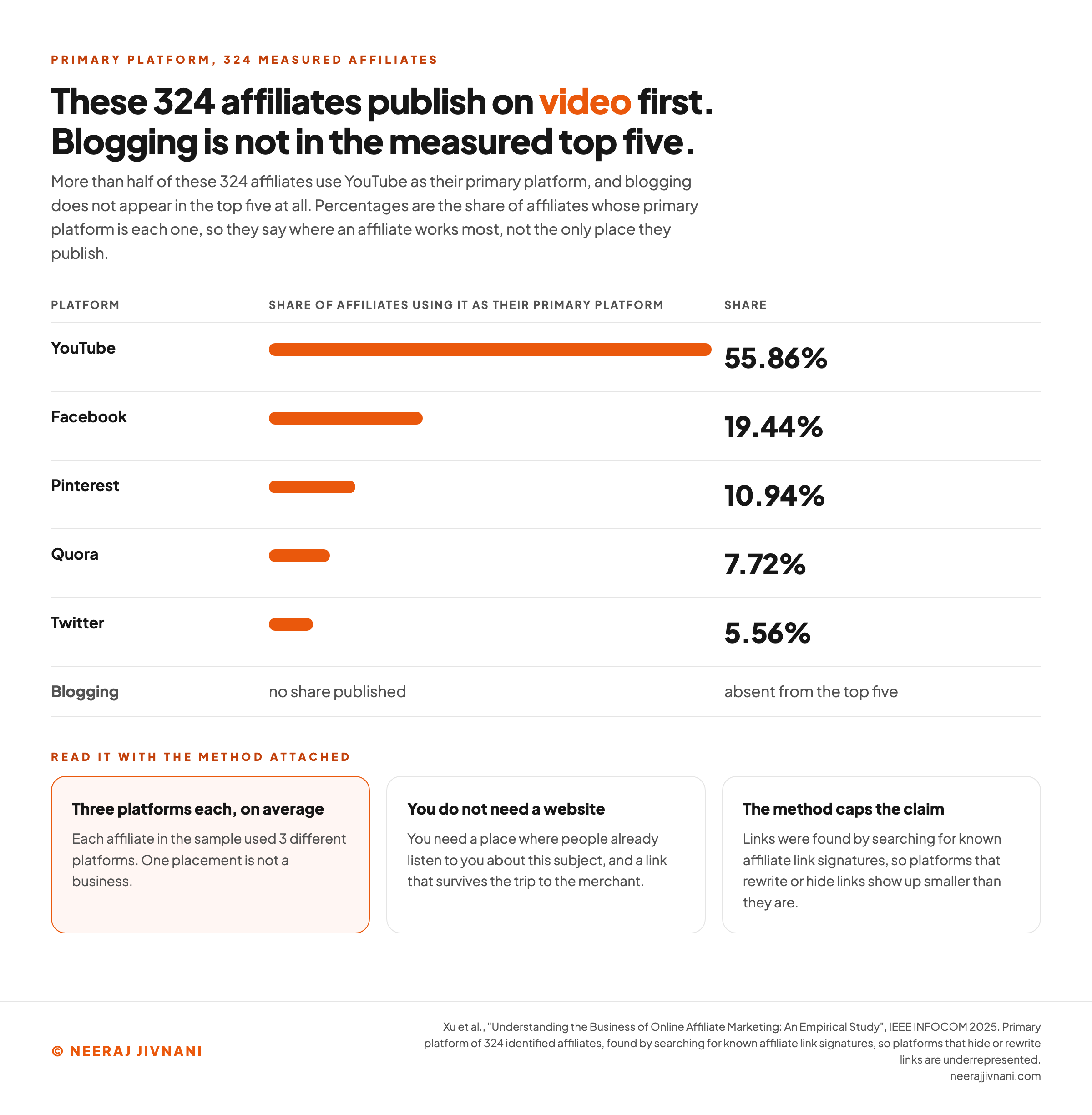
Among 324 traced affiliates, "55.86% utilize YouTube as their primary platform, followed by 19.44% who choose Facebook, 10.94% who prefer Pinterest, 7.72% who select Quora, and 5.56% who opt for Twitter", measured by Xu and colleagues for IEEE INFOCOM 2025. They used three different platforms each, on average.
Blogging is absent from that top five because the list ranks named platforms, and an independent blog on its own domain has nothing to place under. The same paper calls a blogger an affiliate in its opening line.
Those links were found by searching for known affiliate signatures, so platforms that rewrite or hide them are undercounted.
One placement is not a business. The people doing this at any scale are not choosing between video and social.
You do not need a website before you have an audience. You need somewhere your recommendation already carries, and a link that survives the trip from there to the merchant.
Check email first. A program's terms decide whether a link may sit in a message at all. Where they say no, an email newsletter sends readers to a page you control and the link lives there.
The Five Formats That Carry a Link Without Wrecking the Page
A workable format carries the link without turning the page into an advertisement. These five keep working after the novelty wears off.
- The review. One product, used, with the failures named. The failures are the part worth reading.
- The tutorial. You show somebody how to do a thing, and the tools appear because the job needs them. The link is incidental to the instruction, which is exactly why it converts.
- The comparison. Two or three options against criteria you state before you rank them. The value is the criteria, not the verdict.
- The resource page. A standing list of what you use, kept current. Low traffic, high intent, and it earns for years with almost no maintenance.
- The email sequence. A series that teaches something across several messages, with the recommendation arriving after the teaching rather than instead of it.
Finding a Program, and Getting Approved
Programs are reached three ways, and the route decides what you are agreeing to.
Direct with the merchant. You apply on the brand's own site and the rate is whatever that brand publishes. This is where the better rates usually sit.
Through a network. One account, many merchants, one payment and a single set of terms. The convenience is real, and the rates are typically lower than going direct.
Through a marketplace. An aggregator lists offers from many networks at once. It is the fastest way to see what a category pays, and the worst place to judge a merchant.
Approval is not automatic on any of the three. A program will usually want to see where the link is going before it says yes, which is why the place you publish comes before the application.
A microsite is worth naming separately: a small site built around a single category, whose only job is to hold reviews and links.
It concentrates intent. It is also the shape most likely to be refused by a program that wants an established audience.
Use this chart — embed code and citation
<a href="https://neerajjivnani.com/blog/affiliate-marketing/"><img src="https://neerajjivnani.com/infographics/affiliate-marketing/where-links-live.png" alt="A ranked bar chart of the primary platform used by 324 measured affiliates, showing YouTube at 55.86 percent, Facebook at 19.44 percent, Pinterest at 10.94 percent, Quora at 7.72 percent and Twitter at 5.56 percent, with blogging absent from the top five, a note that each affiliate uses three different platforms on average, and a method line explaining that the links were found by searching for known affiliate link signatures so platforms that rewrite or hide links are underrepresented." width="1200"></a>
<p>Chart: <a href="https://neerajjivnani.com/blog/affiliate-marketing/">Neeraj Jivnani</a></p>Neeraj Jivnani, "What Affiliate Marketing Is, and What It Actually Pays You", neerajjivnani.com, https://neerajjivnani.com/blog/affiliate-marketing/Free to republish with a link back to this page.
The Two Disclosure Rules That Bind an Affiliate
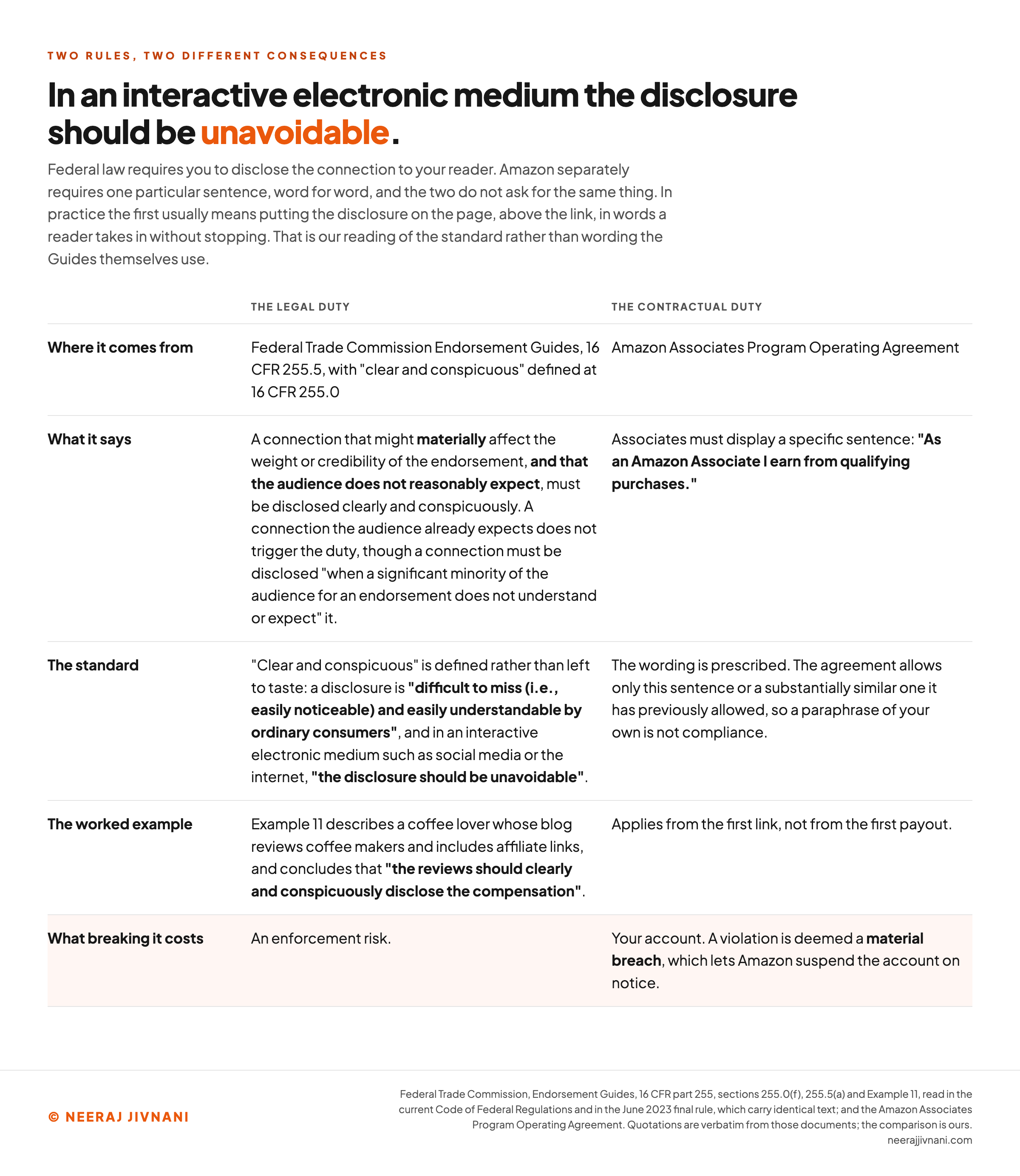
Federal law requires you to disclose the connection to your reader. Amazon separately requires one particular sentence, word for word.
They do not ask for the same thing, which is why doing one does not cover the other.
The federal duty attaches to every affiliate link you publish, whoever the merchant is. Amazon's attaches wherever you display its program content.
What Federal Law Requires
You have to disclose the connection wherever it might materially affect the weight or credibility your audience gives your recommendation, and where they would not already expect it.
That duty is set out in the FTC's Endorsement Guides at 16 CFR 255.5, published in the Code of Federal Regulations (CFR).
The Guides are the Commission's reading of section 5 of the FTC Act, which is where the enforcement power sits.
Expectation is judged generously, not by what most readers would guess. The Guides say a connection has to be disclosed "when a significant minority of the audience for an endorsement does not understand or expect the connection".
It is not a grey area for affiliates. The Commission's own Example 11 describes a coffee lover whose blog reviews coffee makers and carries affiliate links, and concludes that "the reviews should clearly and conspicuously disclose the compensation".
Clear and conspicuous is defined rather than left to taste. At 16 CFR 255.0, the Guides say a disclosure has to be "difficult to miss (i.e., easily noticeable) and easily understandable by ordinary consumers".
Online the standard is stricter still. In an interactive electronic medium such as social media or the internet, the Guides say, "the disclosure should be unavoidable". In practice that usually means on the page, above the link, in words a reader takes in without stopping.
The Sentence Amazon Requires
Amazon's operating agreement requires Associates to display a specific sentence: "As an Amazon Associate I earn from qualifying purchases."
Breaking the legal rule is an enforcement risk. Breaking the contractual one is faster. Amazon's agreement deems a violation of that requirement a material breach, which lets it suspend the account on notice.
This is the unglamorous part and we will not dress it up. Put the disclosure on the page from the first link, in the words the program asks for, and then stop thinking about it.
Use this chart — embed code and citation
<a href="https://neerajjivnani.com/blog/affiliate-marketing/"><img src="https://neerajjivnani.com/infographics/affiliate-marketing/disclosure-duty.png" alt="A two-column comparison of the legal and contractual duties that bind an affiliate, setting the Federal Trade Commission Endorsement Guides at 16 CFR 255.5 and 255.0 against the Amazon Associates operating agreement: the legal side states that a connection which might materially affect the weight or credibility of the endorsement, and which the audience does not reasonably expect, must be disclosed clearly and conspicuously, that a connection the audience already expects does not trigger the duty although one must be disclosed when a significant minority of the audience does not expect it, and quotes the standard that such a disclosure must be difficult to miss and easily understandable by ordinary consumers and should be unavoidable in an interactive electronic medium such as social media or the internet, with Example 11 describing a coffee blogger with affiliate links, while the contractual side quotes the exact sentence Amazon requires its Associates to display, and a footer row explains that breaking the first is an enforcement risk while a violation of the second is deemed a material breach that lets Amazon suspend the account on notice." width="1200"></a>
<p>Chart: <a href="https://neerajjivnani.com/blog/affiliate-marketing/">Neeraj Jivnani</a></p>Neeraj Jivnani, "What Affiliate Marketing Is, and What It Actually Pays You", neerajjivnani.com, https://neerajjivnani.com/blog/affiliate-marketing/Free to republish with a link back to this page.
Running the Other Side of the Deal
The other side of the deal is a sales channel you pay for only after it produces. That is the whole appeal, and it is where the thinking usually stops.
Four decisions set up a program, and getting them wrong is expensive to reverse.
- The rate and what qualifies. A percentage of what, minus returns, minus shipping, minus tax. Amazon's card is the clearest published model of how specific this gets.
- The window. How long after the click a purchase still counts, and what closes the window early.
- Approval. Whether anyone can join or you review applications. Open programs grow faster and attract the traffic you least want.
- Payout terms. The minimum balance, the delay before a commission clears, and the method. This decides whether serious partners stay.
Then comes the choice between running it in house and joining a network.
A network brings partners and tracking you do not have to build, and takes a cut of every commission plus a platform fee. In house keeps the margin and the relationship, and hands you recruitment, fraud checks and payouts as ongoing work.
The honest test is whether you have somebody whose job this is.
The Fraud a Program Owner Pays For
If you run a program, budget for fraud. Two kinds catch new programs first.
Trademark bidding is a partner buying your brand name in paid search, intercepting a customer who was already coming to you, and billing you a commission for the interception.
Cookie stuffing is a page dropping a tracking cookie on a visitor who never clicked anything, so that a later purchase looks like a referral.
Behind those sit typosquatting, adware, browser extensions that rewrite links, and search and email spam.
Write the answer into the terms before the first partner joins. A rule written after the first incident cannot be applied to it.
AI, and the Two Places It Touches This Channel
AI touches this channel in two places, and only one of them is settled.
The settled one is disclosure. An AI-written review carrying affiliate links is still an endorsement, and the duty travels with the content rather than with the author.
An endorsement does not need a person behind it.
The Guides define an endorser as a party who "could be or appear to be an individual, group, or institution".
The unsettled one is competition.
Nobody can yet say how much of the review and comparison traffic affiliate sites live on survives an AI Overview answering the question inside the results page.
What has not changed is the part you control. Neither the published rate nor the tracking window is decided by who writes the words, or by where the reader found you.
What Usually Goes Wrong
Most of what goes wrong here has nothing to do with traffic. Each failure has a fix that costs nothing except doing it first.
- The category pays almost nothing. Gift cards, alcohol, grocery and restaurant delivery sit on Amazon's card at 1.00% or 0.00%. Read the row before you write the article.
- The window closed. The buyer clicked, browsed, came back three days later through somebody else's link, and bought. Nothing tells you this happened.
- The tracking broke. This is the one you can rule out before you publish: click your own link from a phone, from inside a social app's browser and from a desktop, and check that each arrives with the tracking intact.
- The balance never cleared. Programs hold commissions until a minimum is reached, and at small volumes on a low rate that threshold can sit months away.
None of these is a content problem, which is why writing more does not fix any of them.
Settle each one before you publish. Read the terms, and read the rate card row for the thing you are about to write about.
Week One, Month Three, Year One
Week one is not the week you join a program.
Start with the thing people already ask you about. Publish until something ranks or gets watched, and apply to a program only once you have somewhere to put the link. That order is the whole method.
The link is the last decision, not the first one.
What you do not need at the start is a company, a course, a tool subscription or a second niche.
The one thing you cannot skip is the disclosure. It applies from the first link, not from the first payout.
Week One
Week one is one decision and one page. Pick the subject you can hold for two years, and check what its category pays on the merchant's own rate card. Then publish one piece that answers a question people ask, wherever your audience already is.
No program, no links, no disclosure page yet.
Month Three
Month three is where the audience question gets answered honestly. If nothing you have published has been found by anybody, adding affiliate links changes nothing. A commission is a percentage of a number that is currently zero.
The fix at this point is distribution rather than monetization, and we would spend the whole of month four there before shopping for a program.
Year One
Year one is when the arithmetic becomes visible. You know your traffic, you know your category rate, and you know roughly how many readers act on a recommendation.
Those three numbers tell you whether the subject can support this. They are also the first honest evidence you have had. That is why the year matters more than the plan did.
The Honest Version of the Affiliate Marketing Pitch
The honest version of the pitch is that affiliate marketing pays, and that it pays slowly.
The mechanism is plain, the rates are published and the tracking rules are written down, which makes it one of the more transparent ways to earn online. What it is not is separable from the audience.
The rate card sets the size of one sale. It has nothing to say about how many there are, and that is the half you have to build.
Two numbers settle most of it. The first is the category rate your merchant publishes, which tells you what one sale is worth to you. The second is the $2.40 median on the open offer marketplaces, which tells you what that side of the market pays when nobody is picking the flattering example.
Our verdict is that this is a good business to add to an audience and a poor one to build an audience for.
Get the readers or the viewers first, on a subject you would still be interested in two years from now. The commission arrangement is then a twenty-minute decision at the end.
Put your own numbers against both figures before you spend three months on a subject. If the arithmetic works at the rate the merchant publishes, the work is worth doing.
If it only works at a rate no merchant offers, the subject was the problem.