Influencer Marketing, and What a Sponsored Post Really Costs
There is no going rate for a sponsored post. See what the prices actually are, what your money returns, how to vet a creator, and what the law now bans.


/ On this page15 sections
Influencer marketing is paying somebody with an audience to post about you, and the first question a buyer asks is what one post costs.
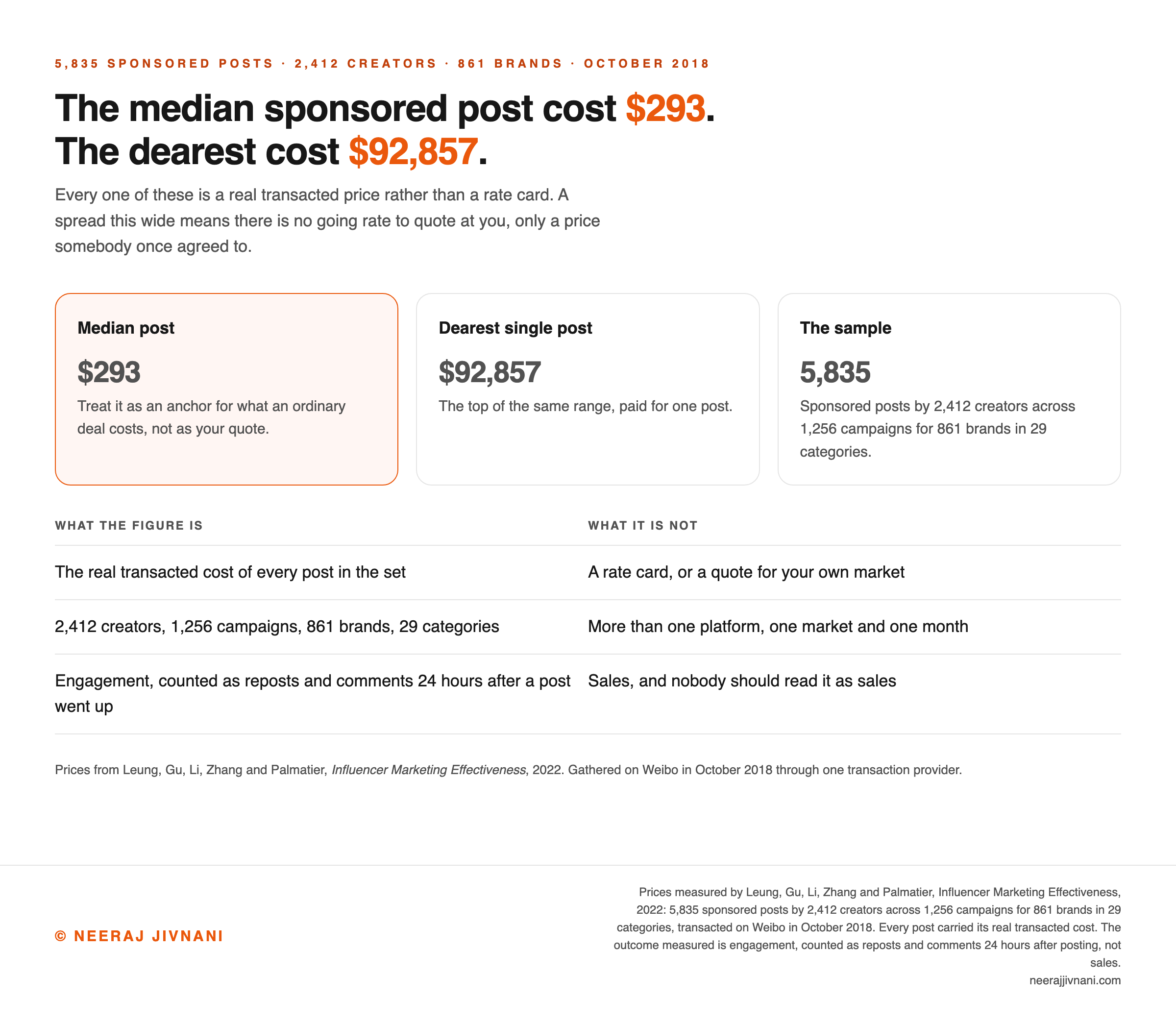
There is no going rate. Real transacted prices ran from $293 at the median to $92,857 for the dearest single post, in a 2022 study by Leung and colleagues.
Spending well inside that spread comes down to three things: what the money returns, who you hand it to, and what the law now says about buying followers.
The Deal Underneath the Word
Underneath the word is a plain transaction: a fee, in exchange for a post to somebody else's audience.
What that fee rents is reach plus borrowed credibility, and the second half is what separates it from an ad.
Three parties sit in every deal. The brand, the creator, and the creator's followers, who never agreed to anything and can leave at any time.
Say a kitchenware brand pays a home cook to film one recipe using its pan. The brand buys the audience, and it buys the trust those people already place in the cook on the subject of pans.
That is why it works when it works.
A recommendation lands from an account somebody chose to follow, rather than from a slot the brand rented next to something else.
The reputation is the asset and the risk together, which is what makes the vetting and the paperwork later on worth the trouble.
The boundary between a sponsored post and an affiliate deal is worth settling early, because the two get confused constantly.
An affiliate arrangement pays a commission on a tracked sale, so the creator carries the risk.
A sponsored post is the other shape. You pay for the post, and you pay whether or not a single person buys.
Some deals mix the two, with a fee plus a discount code that earns on top.
Either way, the fee is the number to settle first.
What a Sponsored Post Costs
The median sponsored post cost $293 in Leung and colleagues' 2022 study. The most expensive single post in that same data cost $92,857.
A spread this wide means there is no going rate to quote at you, only a price somebody once agreed to.
The sample behind those two numbers is 5,835 sponsored posts by 2,412 creators, across 1,256 campaigns for 861 brands in 29 categories. Every one carried the fee that changed hands.
The Numbers, and What They Do Not Cover
The data was gathered on Weibo in October 2018, through one transaction provider, in one market. Prices move, platforms differ, and China is not the United States.
The outcome measured is engagement, counted as reposts and comments captured 24 hours after a post went up.
It is not sales, and nobody should read it as sales.
So treat the $293 as an anchor rather than as your quote. It tells you the order of magnitude an ordinary deal lands at, which is what a budget line needs.
Any rate card you are handed is worth one question: what sample is it built on, and when.
Price the deal from what you can check instead. Ask the creator what a normal post of theirs reaches, what they charged their last partners, and then let your own first deal set the number for the second.
Use this chart — embed code and citation
<a href="https://neerajjivnani.com/blog/influencer-marketing/"><img src="https://neerajjivnani.com/infographics/influencer-marketing/what-a-post-costs.png" alt="A chart of what a sponsored post actually cost in the study by Leung, Gu, Li, Zhang and Palmatier of 5,835 sponsored posts by 2,412 creators for 861 brands transacted in October 2018, showing a median of 293 dollars against a maximum of 92,857 dollars for a single post, with a table separating what the figure is, a real transacted price across 29 categories, from what it is not, a rate card for another market, since the data covers one platform in one market in one month and measures engagement as reposts and comments at 24 hours rather than sales." width="1200"></a>
<p>Chart: <a href="https://neerajjivnani.com/blog/influencer-marketing/">Neeraj Jivnani</a></p>Neeraj Jivnani, "Influencer Marketing, and What a Sponsored Post Really Costs", neerajjivnani.com, https://neerajjivnani.com/blog/influencer-marketing/Free to republish with a link back to this page.
What the Money Actually Returns
What the money returns is engagement, and each extra dollar returns less of it than the one before. In the same dataset, a 1% increase in spend produced a .457% increase in engagement, at t = 16.96 and p < .001.
One caveat has to travel with it. What was measured is engagement, not revenue, so whether a deal pays in money is a question your own marketing analytics has to answer.
The figure that circulates instead is $5.78 earned for every dollar spent.
Mailchimp publishes it, and credits it to the Influencer Marketing Hub, a company that sells software and services into this category.
A vendor's return figure is not a measurement. Trace any number like it back to who produced it before you put it in a plan.
Underneath all of it is social proof, which is why a fee buys anything at all. People take a recommendation from somebody they already chose to listen to more seriously than the same claim in an advertisement.
The Same Budget, Split Differently
Allocation matters more than budget size, and that is the stronger result in the same study. Reallocating the same money by how responsive each creator is would have raised engagement by 16.6% on average across the brands measured.
The rule the authors derive is short.
A creator's share of the budget should be their responsiveness multiplied by their ordinary engagement, divided by that same product added up across everyone you are paying.
Responsiveness here is elasticity: the percentage change in engagement you get from a 1% change in what you spend with that creator. You can only estimate it before a first campaign, and you can measure it after one.
The study prints its own worked case.
A hair styling brand spent $264, sending $234 (89%) to one creator and $30 (11%) to another.
Their measured responsiveness ran .16 and .57, and their ordinary engagement 19 and 15 reposts. Multiplying the two gives weights of 3.04 and 8.55, so the money should have gone 26.2% to the first creator and 73.8% to the second.
Had the brand split it that way, engagement would have risen 42.0%, from 389 reposts to 552.
The budget never changed, only its shape.
Where should the same budget go?
Put in what you are about to spend, how you were going to split it, and the two facts the study says decide the answer. The split comes back the way the study allocates it: in proportion to responsiveness multiplied by ordinary engagement.
$2,000
70%
Creator A
0.20
40
You are paying $1,400
The rule says $941
Creator B
0.50
18
You are paying $600
The rule says $1,059
Where the money should have gone
47.1% / 52.9%
Orange is creator A. Weights are 8.00 and 9.00.
$459 of this budget is in the wrong place. You are overpaying creator A and underpaying creator B, and the correction costs nothing.
Across every brand in the study, reallocating the same budget this way would have raised engagement by 16.6% on average. Its published case is a hair styling brand that spent $264 on an 89 and 11 split, with responsiveness of .16 and .57 and ordinary engagement of 19 and 15 reposts. That gives weights of 3.04 and 8.55, a 26.2 and 73.8 split, and 42.0% more engagement for the same money.
Method, so you can check it. The share each creator should get is their responsiveness multiplied by their ordinary engagement, divided by the same product summed across both. Responsiveness is the percent change in engagement from a one percent change in spend, which you can only estimate before a first campaign and can measure after one. This prints a division of money and never a forecast of engagement, because the model behind the study's 42.0% is not reproduced here.
Nano to Mega, and What Each Band Buys
Four bands are the shared vocabulary here, and the lines fall in the same place almost everywhere.
The bands describe audience size, which is only one of the things you are buying.
| Band | Followers | What the money mostly buys |
|---|---|---|
| Nano | 1,000 to 10,000 | A close audience and a low price. Good for local trade and for testing whether creators work for you at all |
| Micro | 10,000 to 100,000 | Niche authority. The band where a category specialist is easiest to find, and the usual place to start |
| Macro | 100,000 to 1 million | Established reach inside a subject. Production quality rises, and so does the fee |
| Mega | Over 1 million | Broad exposure and name recognition, with the broadest and least targeted audience of the four |
The drift is towards smaller accounts. The share of brands preferring to partner with nano influencers went from 39% in 2023 to 44% in 2024, on Influencer Marketing Hub data reported by Sprout Social.
Engagement Rate Against Follower Count
The usual advice is to prioritize engagement rate over follower count. The measurement points the other way.
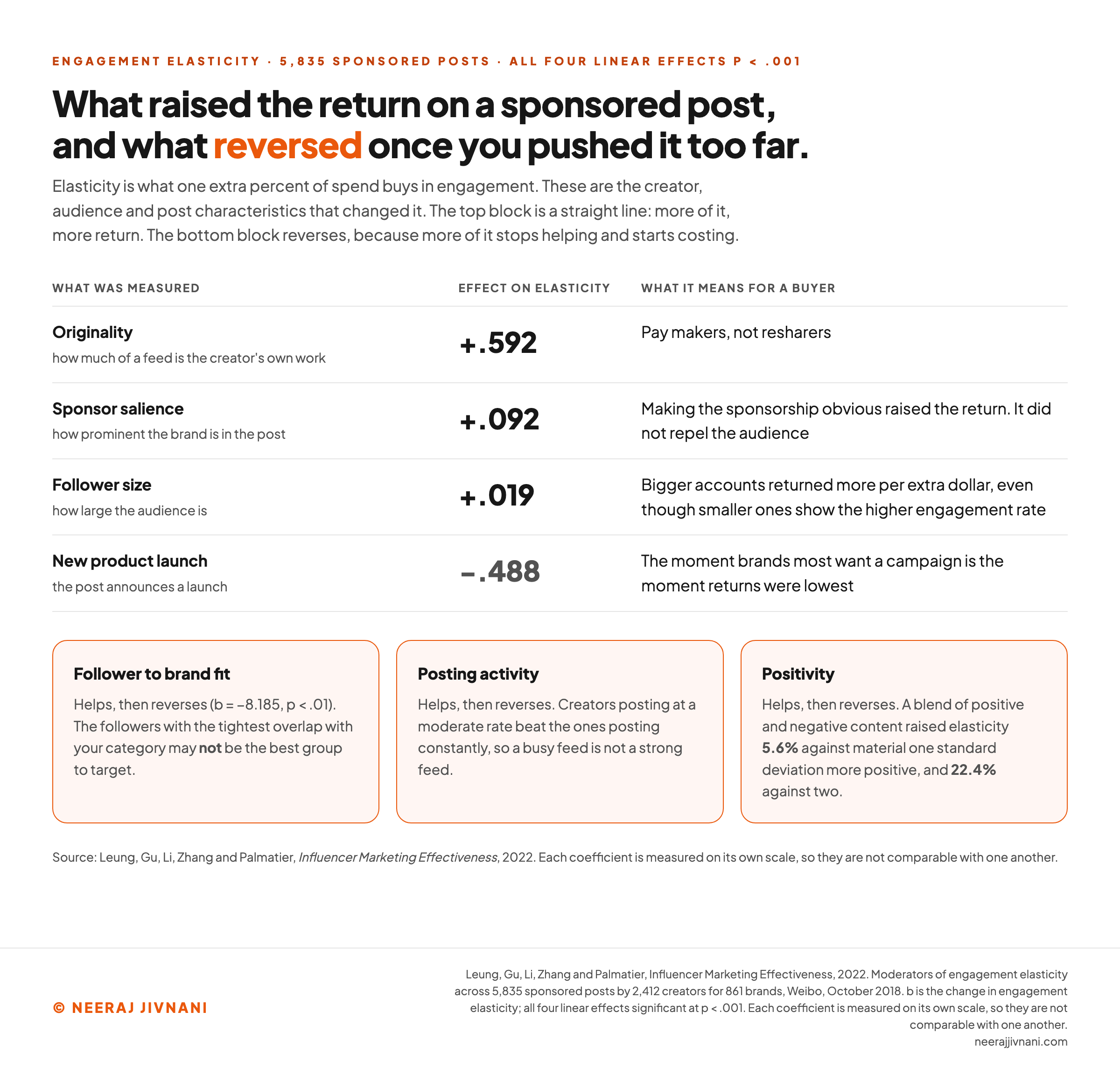
In Leung and colleagues' data, engagement elasticity rose significantly with larger follower size (b = .019, t = 5.92, p < .001), so a bigger account returned more for each extra dollar of spend.
Both things can hold at once, and it is worth being precise about why.
A small account usually has the higher engagement rate, while a larger one had the higher return on the marginal dollar.
The rate tells you how a creator's own audience behaves. The elasticity tells you what happens when you spend more with them, which is the question a budget asks.
None of that means buy the biggest account you can reach.
Elasticity says where an extra dollar goes furthest with a creator already working for you. It does not say where to start, and a small first deal answers that more cheaply.
Originality moved the return as well. Creators who post their own material rather than resharing other people's showed a significant effect (b = .592, t = 5.18, p < .001).
Do not rank these against each other. Each coefficient is measured on its own scale, so they say whether an effect is real, not which one is biggest.
Use this chart — embed code and citation
<a href="https://neerajjivnani.com/blog/influencer-marketing/"><img src="https://neerajjivnani.com/infographics/influencer-marketing/what-moved-the-return.png" alt="A chart of the seven creator, audience and post characteristics that changed the return on influencer marketing spend in a study of 5,835 sponsored posts by Leung, Gu, Li, Zhang and Palmatier in 2022, showing that originality raised engagement elasticity at b equals .592, sponsor salience at .092 and follower size at .019, while posts announcing a new product launch lowered it at b equals minus .488, noting that each coefficient is measured on its own scale and so they are not comparable with one another, and that creator posting activity, follower to brand fit and post positivity each help up to a point and then reverse." width="1200"></a>
<p>Chart: <a href="https://neerajjivnani.com/blog/influencer-marketing/">Neeraj Jivnani</a></p>Neeraj Jivnani, "Influencer Marketing, and What a Sponsored Post Really Costs", neerajjivnani.com, https://neerajjivnani.com/blog/influencer-marketing/Free to republish with a link back to this page.
Choosing a Creator, and the Trap of the Perfect Fit
Start by finding creators your buyers already follow, then judge them on their last two months of posts. Read the comments, not the counts.
The instinct is to chase the tightest possible fit between a creator's audience and your brand.
Fit helps, and then a point comes where more of it helps less.
Follower-brand fit had an inverted U-shaped effect on effectiveness in Leung and colleagues' data (b = -8.185, t = -3.09, p < .01), and the followers with the tightest overlap may not be the best group to target.
The reading the authors give is clutter and satiation. An audience already saturated in your category has heard the pitch, and one more version of it lands on people who are hard to move further.
Creator posting frequency behaved the same way.
Accounts posting at a moderate rate outperformed the ones posting constantly, so a busy feed is not a strong feed.
Say you sell running shoes. The account that posts nothing but shoe reviews is the obvious pick and is probably not the best one, and a running club account with a wider feed may sit closer to the optimum.
Shortlist on three things you can check: whose audience overlaps yours, who makes their own work, and who posts often enough to be seen without being background noise.
Checking an Audience Before You Pay for It
Audience quality is checkable, and it is the one piece of due diligence that pays for itself. Authenticity is not a feeling about a creator's tone; it is whether the followers are real people.
Four checks catch most of it, and none needs a tool:
- The growth curve. Ask for a screenshot of follower growth over the past year. Real accounts grow in steps around posts that did well, and bought ones grow in vertical lines.
- The comments. Read a screenful of them and look for the signature of a purchased audience, such as generic praise and unrelated emoji from accounts with no posts of their own.
- The reach-to-follower ratio. Ask what a normal post reaches. A large following whose posts reach a small fraction of it has either bought followers or lost the ranking system.
- Previous partners. Ask who they worked with last year, then look at whether those brands came back. Nobody repeats a deal that did nothing.
How Common Fake Audiences Are
Bought audiences are common enough to plan around. Across almost 700,000 posts from the first half of 2018, 12% of UK influencers had bought fake followers, in a study recorded in Wikipedia's entry on this subject.
A second study in the same entry found 24% of influencers showing abnormal growth patterns, which is the signature of bought likes or followers.
The money involved is larger still. Influencer fraud ran to as much as $1.3 billion, about 15% of global influencer marketing spend, in 2019 research on the calculable cost of fake followers alone, which the same Wikipedia entry cites.
The underlying work is several years old now. Treat these as evidence that the problem is large rather than as a current rate.
Buying Followers Is Now Prohibited Conduct
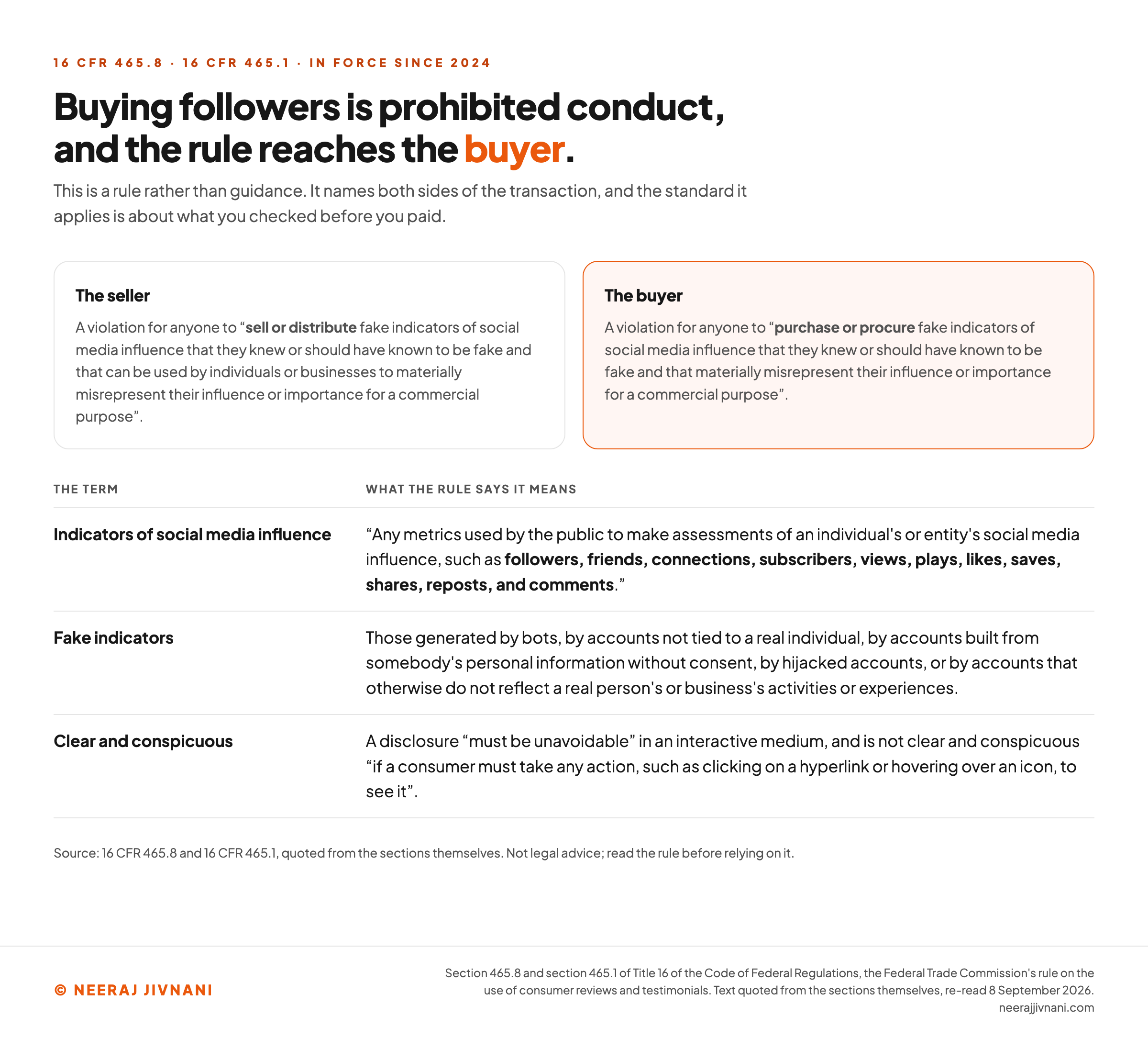
Buying followers stopped being merely a bad idea in 2024. A federal rule made it prohibited conduct, and the prohibition reaches the purchaser rather than the seller alone.
The instrument is section 465.8 of Title 16 of the Code of Federal Regulations (CFR), part of the rule on consumer reviews and testimonials.
Buying followers is an unfair or deceptive act and a violation of the rule.
The prohibited conduct is to "purchase or procure fake indicators of social media influence that they knew or should have known to be fake and that materially misrepresent their influence or importance for a commercial purpose".
The same section covers the other side of the transaction, making it a violation to "sell or distribute" them.
16 CFR Part 255 sits next to Part 465, under the title Guides Concerning Use of Endorsements and Testimonials in Advertising.
Those are guides. Part 465 is a rule, and that is the difference worth knowing.
What Counts as an Indicator
The definitions carry as much weight as the prohibition. Under 16 CFR 465.1, indicators of social media influence are "any metrics used by the public to make assessments of an individual's or entity's social media influence".
The same section gives examples: "followers, friends, connections, subscribers, views, plays, likes, saves, shares, reposts, and comments".
Engagement, in other words, and not only the follower count.
Fake ones are those generated by bots, by accounts not tied to a real individual, by accounts built from somebody's personal information without consent, by hijacked accounts, or by accounts that otherwise do not reflect a real person's or business's activities or experiences.
Read together, that is why vetting an audience is a legal exercise and not only a commercial one. "Knew or should have known" is a standard about what you checked.
A brand that never looked at a creator's growth curve has a thin answer to it.
The Disclosure Requirement, at One Line
Put the disclosure where a viewer will see it without having to do anything.
The rule sets that standard for the disclosures it requires. Under 16 CFR 465.1 a disclosure is "clear and conspicuous" only if it "must be unavoidable" in an interactive medium.
The same definition adds that a disclosure is not clear and conspicuous "if a consumer must take any action, such as clicking on a hyperlink or hovering over an icon, to see it".
For a paid creator post the duty itself sits in the Part 255 endorsement guides, which ask for the same thing in the language of guidance rather than of a rule.
A label hidden behind a "more" link does not count as one.
Use this chart — embed code and citation
<a href="https://neerajjivnani.com/blog/influencer-marketing/"><img src="https://neerajjivnani.com/infographics/influencer-marketing/who-the-rule-reaches.png" alt="A two-sided diagram of section 465.8 of Title 16 of the Code of Federal Regulations showing that the prohibition covers both selling or distributing fake indicators of social media influence and purchasing or procuring them, under the same standard of having known or having reason to know they were fake and that they materially misrepresent influence or importance for a commercial purpose, with the definition from section 465.1 listing the metrics it gives as examples of indicators, such as followers, friends, connections, subscribers, views, plays, likes, saves, shares, reposts and comments." width="1200"></a>
<p>Chart: <a href="https://neerajjivnani.com/blog/influencer-marketing/">Neeraj Jivnani</a></p>Neeraj Jivnani, "Influencer Marketing, and What a Sponsored Post Really Costs", neerajjivnani.com, https://neerajjivnani.com/blog/influencer-marketing/Free to republish with a link back to this page.
What Goes In the Agreement
The agreement is written before any money moves, and it is where most of the arguments that ruin these deals get avoided. A creator brief describes the work; the agreement describes what each side owes.
Verbal deals fail on the same three points every time: what was promised, who owns the material afterwards, and whether the creator may take a competitor's money next month.
The Terms That Decide the Money
Six terms carry the commercial substance, and each one changes the price:
- Deliverables. How many posts, in which formats, on which accounts, and by when. "A post" is not a specification.
- The fee and its form. Cash, product, a discount code that earns, or a mix. Free product alone is not payment for anybody with a real audience.
- Usage rights. Whether you may reuse the creator's material in your own ads, on which channels, and for how long. This is the term most often left out and the one most often needed later.
- Exclusivity. Whether they may work with a competitor, in which category, and for what period. Exclusivity costs money and should be priced rather than assumed.
- Approval rights. Whether you see the material before it posts, and how long you have to respond.
- The term. When the arrangement starts, when it ends, and what happens to material already published when it does.
Three more terms are worth adding when the deal is large: content copyright, a cancellation clause and a morality clause.
One-off or Long-term
A single post is a test, and a standing arrangement across several months is a different purchase.
A repeat deal buys familiarity, and familiarity is what makes an audience believe the creator uses the thing. Run one post first, then extend the ones that worked.
Do not restrict creative control to the point where the post stops sounding like the creator.
The audience can hear the difference between a creator's own words and a script they were handed.
Running It Without Wasting the Money
Running a campaign without wasting the money comes down to the brief, and a poor one is the most expensive mistake here.
A brief that works states the audience, the point you want made, the things that are not true about your product, and the deadline.
It does not state the words.
One finding here goes against the common instinct. Engagement elasticity rose when the sponsoring brand was more prominent in the post, at b = .092 and p < .001 in Leung and colleagues' data, so making the sponsorship obvious did not repel that audience.
The authors read it as information value. A post that names the brand clearly tells the reader something, while a post pretending not to be sponsored tells them nothing and risks the disclosure rules besides.
New product launches ran the other way.
Posts announcing one had a lower return (b = -.488, t = -6.96, p < .001), which the authors put down to the risk and clutter around new products.
Tone had a limit too. A blend of positive and negative content raised engagement elasticity by 5.6% against material one standard deviation more positive, and by 22.4% against material two.
So brief for candour rather than for enthusiasm, and let the creator say what the product does not do. Set the timing, the approval window and the disclosure requirement in the same document, and stop there.
The Numbers That Tell You It Worked
Pick the numbers that tell you it worked before the campaign runs, and keep the list short. A campaign measured against everything is a campaign nobody can call.
Three tracking methods cover most cases:
- A unique discount code per creator. The cleanest attribution available, because the code cannot be shared with another creator's audience without you seeing it.
- A tagged link per creator. Works where a code does not fit, and survives into your analytics.
- Reach and engagement on the post itself. Ask for the creator's own analytics screenshot, since the public numbers understate what a post delivered.
Match the measure to the job.
A post bought for awareness is answered by reach and by branded search afterwards, and holding it to same-week revenue is how a working campaign gets killed.
Watch the window. Leung and colleagues counted engagement 24 hours after posting, which is where their own data provider found activity largely halts, and a report pulled a month later mixes in everything else you did.
Follower growth on your own account is pleasant and tells you almost nothing about whether the fee was worth paying.
The number that decides the next deal is the return per dollar with that creator, not the total.
That is what elasticity measures, and it is what tells you where the next payment should go.
Where the Deals Get Made
Deals get made in four places, and they differ in what they charge you for. Going direct is free and slow, and everything above it is paying somebody to make it faster, such as a marketplace, a software platform or an agency.
The platforms' own marketplaces sit closest to the creators.
TikTok One, which replaced TikTok's Creator Marketplace, and Instagram's creator marketplace both let a brand search, contact and brief without an intermediary.
Software platforms are the next layer, and Upfluence, Klear, Aspire and Modash are among the names you will meet. What they sell is discovery, outreach at volume, and a record of what each deal produced.
Agencies are the layer above that.
They bring relationships and take the work off you, and they charge a fee or a margin on the creator's rate for it.
Directories are the free end.
The Influencer Marketing Hub runs lists of agencies and platforms plus earnings calculators, and it makes its money from the category rather than from you.
Choose by the scale you are running. One or two deals a quarter do not need software; twenty creators a month cannot be run out of an inbox.
Virtual Creators and the AI Question
Virtual creators are computer-generated characters run as accounts, and they are no longer unusual. The first were built by 3D artists, and later ones with artificial intelligence.
Lil Miquela, dated to 2016 in Wikipedia's entry, was an early case, and she prompted real speculation about whether she was a person until it emerged that advertisers had made her.
A brand hiring one is buying attention rather than credibility.
There is no experience behind the endorsement, and experience is what every other deal in this channel is buying.
Artificial intelligence is arriving on the buying side too, and the claims made for it deserve care.
Discovery and vetting are where the plausible uses sit, because both are pattern-matching over accounts at a scale a person cannot read. Treat any tool that promises to predict a campaign's return as unproven until it shows you its method.
An audience of generated accounts is a different matter from a generated creator with a real one. An account not tied to a real individual is exactly what 16 CFR 465.1 defines as producing fake indicators.
What Creators Are Actually Paid
What creators are paid has no official measurement.
The income figures in circulation come from opt-in surveys instead, so check who ran one before quoting it.
What can be stated is the shape of the money. In the measured dataset, the median sponsored post paid $293 while the most expensive paid $92,857.
That is a long tail, and it is the shape that makes the headline numbers so misleading. A handful of creators earn a great deal, most earn modest amounts per post, and an average across both describes neither group.
For a creator reading this, the useful conclusion is about the middle rather than the top.
Rates rise with audience size and with how much of your own work you make, and the second is the part you control.
Six-figure earnings from posts alone are rare and concentrated at the top of the distribution. The creators who earn steadily do it across several arrangements rather than one, which is a different business from a big fee.
Where This Stops Working
Influencer marketing stops working in ways worth naming before you commit.
Four things go wrong often enough to plan around: reputation, authenticity, measurement, and how little control you have over the wording.
That last one is concrete: a creator can word a claim about your product in a way you would never have signed off.
Underneath them is a structural fact: you are relying on somebody you do not employ.
Reputation is the risk with the longest tail. You are attaching your brand to a person, and people do things, which is why larger deals carry a morality clause.
The diminishing return is the other limit, and it is the measured one. Since each extra dollar buys less engagement than the last, a channel that worked at a small budget does not scale in a straight line.
When to Skip the Channel Altogether
Three situations make this the wrong purchase, whatever the budget:
- The purchase is decided on price or urgency. A recommendation moves a considered choice. It does not move somebody comparing two identical products on delivery time.
- The category has no credible creators. If nobody with an audience uses what you sell, paying somebody to say they do is the arrangement at its worst.
- You cannot vet, or cannot pay twice. One post is a test that usually tells you little, and a business that can only afford one deal is buying a coin toss.
There is also the case where a creator is right and the timing is not. A launch is the moment brands most want a campaign, and it is the moment the data says returns are lowest.
Two Numbers Before You Sign Anything
Two numbers settle most of the decision before you sign anything.
The first is the price: a measured median of $293 for a sponsored post, against a maximum of $92,857.
That gap is the useful part, because it says an ordinary deal costs far less than the ceiling suggests. The second number is 16.6%, the average engagement gain those brands left on the table by splitting one budget badly.
Put together, they point at one discipline. The money question is not whether you can afford a creator, it is whether this is the creator your next dollar should go to, and the answer comes from what the last dollar did.
Ask a creator for their real reach and their growth curve before agreeing a fee. Then spend the second payment where the first one worked, rather than where it was easiest to arrange.