The Decisions Behind a Brand, in the Order They Have to Be Made
Decide who your brand is for before anything gets designed. See which of the six decisions can wait, which cannot, and how to read whether it worked.

/ On this page7 sections
Brand building is six decisions about what your company claims and how it says it, and most of them are settled before anything gets designed.
The work itself is short to state. Decide what you are claiming and for whom, choose a small set of signals that carry it, then repeat those signals until people learn them.
Below is the order the decisions go in, which ones can wait, and what to read afterwards to tell whether it worked.
What Brand Building Is
Brand building is the work of changing what your name means to people who are not thinking about you.
It has three parts, and they are always the same three.
- You decide what you want the name to stand for and to whom.
- You choose the signals that will carry it.
- Then you repeat those signals long enough for somebody to learn them without trying.
The six decisions below sit inside those three parts, and everything else is detail attached to one of them. A color palette is part of step two. A trade show booth is part of step three.
The word covers a continuous activity rather than a project with a delivery date. A brand exists the day you start trading, because people form an impression whether or not you chose one.
What you are building is the difference between that impression and the one you want.
That framing decides the order of everything below. You are not assembling a set of assets. You are teaching a group of strangers one thing, repeatedly.
Every decision either makes that easier or makes it slower.
The Identity Project and the Campaign Are Different Work
Two neighboring activities get called by the same name, and telling them apart saves a lot of wasted effort.
It is separate from the identity project. That project has a beginning and an end: it produces a name, a mark, a palette, a voice and a document. Brand building is what happens over the following decade, and the identity is one step inside it.
It is separate from marketing the product. Campaign work sells the thing you are selling this quarter. Brand building changes what your name means, which shows up in how cheaply every future campaign works.
The two share a budget and compete for it constantly.
That competition is where brand work usually stalls, and the mechanism is not mysterious.
The campaign has a number attached to it this month. The brand work has a number attached to it in three years, and only if somebody wrote the first reading down.
The Hearing You Get When You Are Not There
Recognition buys a hearing in the rooms you are not in. What it will not do is hand anybody a reason to want the thing you sell.
Most of the work a brand does happens when nobody from your company is present.
A shortlist gets drawn up. A name gets repeated to a colleague over lunch. One search result gets clicked instead of the one above it.
None of those moments has a salesperson in it, and every one of them turns on whether the name means anything yet.
There is a second return that is easier to miss.
A name people can repeat correctly is a distribution channel you do not rent. Word of mouth needs something to carry, and a company nobody can describe in a sentence gives them nothing to carry.
Say a bookkeeping firm whose clients all describe it as the one that answers the phone. That sentence travels between two business owners at a dinner; a list of services does not.
The Weak Offer It Will Not Rescue
The limit is worth being blunt about, because it is the thing brand work is most often asked to do and cannot.
Brand building does not make a weak offer strong. If the product does not solve the problem, or the price does not match the value, more recognition brings more people to the same conclusion faster.
A market that buys twice a decade will not start buying more often because it likes you.
It will choose you when the time comes, which is worth a great deal and is not the same thing.
So the honest case is narrow and real. This work decides who gets considered; it does not decide whether there is anything worth considering.
The Order the Decisions Go In
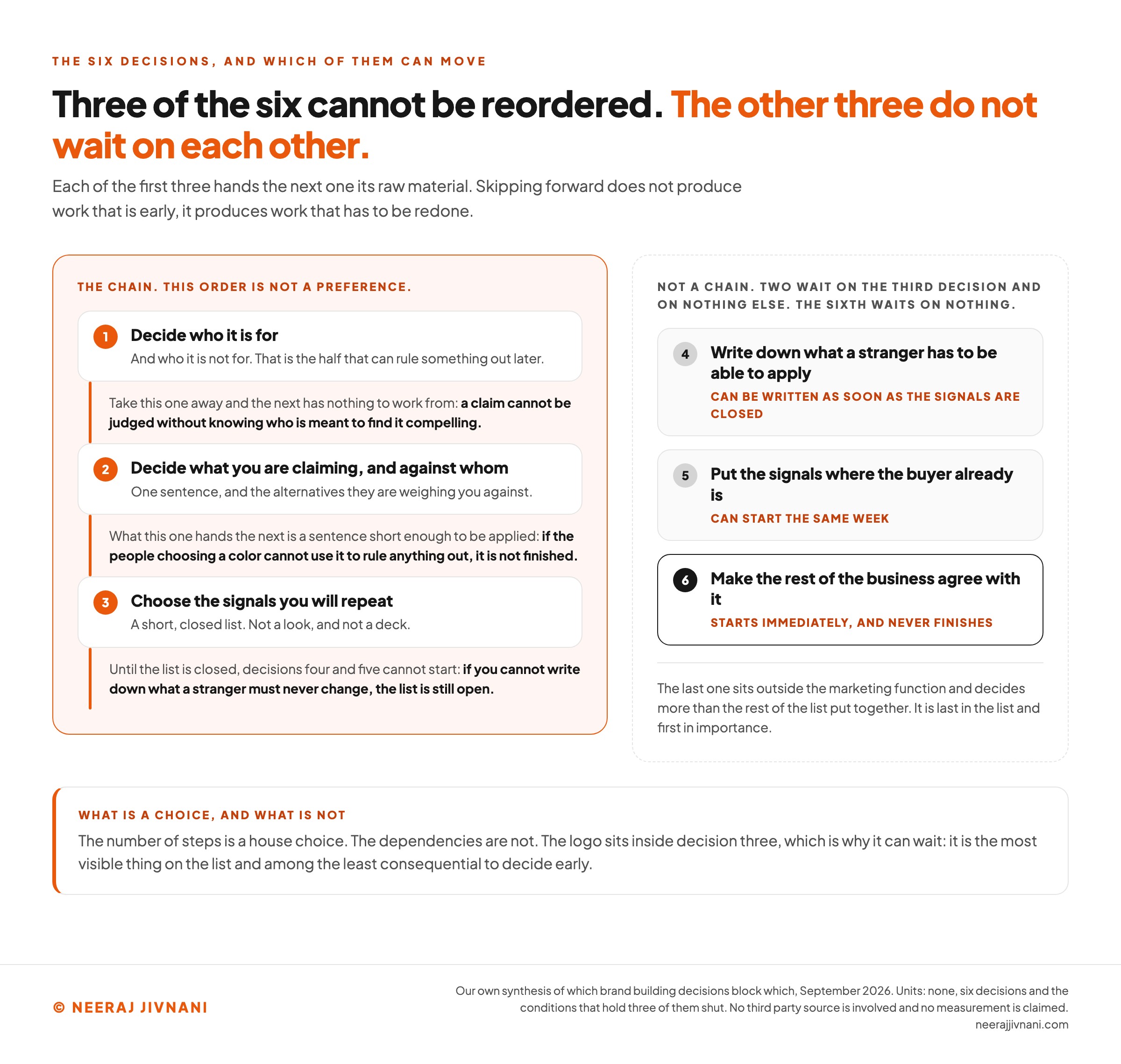
Six decisions, and the first three cannot be reordered.
They cannot be reordered because each hands the next one its raw material. Skipping forward does not produce work that is early, it produces work that has to be redone.
The last three are looser. Two of them wait on the third decision and on nothing else, and the sixth starts immediately and never stops.
Decide Who It Is For
Write down who the brand is for, and who it is not for, before anything else.
This is first because every later decision is unreadable without it. A claim cannot be judged without knowing who is meant to find it compelling, and neither can a typeface.
The useful half of this exercise is the second half.
Naming who you are for produces a broad sentence and settles nothing. Naming who you are not for is the version that can rule something out later, which is the only reason to write either of them down.
A small business usually has a real answer sitting in its invoices already. Look at who buys, how often, and which of those you would like more of.
Decide What You Are Claiming, and Against Whom
Write one sentence saying what you want people to believe, and name the alternatives they are weighing you against.
Those are one decision rather than two. A claim only means something against the things somebody could choose instead, and the same sentence can be distinctive in one comparison set and generic in another.
The test is disagreement.
If every competitor in your category would happily sign your sentence, it describes the category rather than you, and repeating it for three years will teach people what the category is.
A mission statement is a different object and it is for internal use. It tells your own people what to optimize for.
It is not the sentence a customer is meant to believe, and treating it as one is how brand language ends up sounding interchangeable.
What this step hands the next one is a sentence short enough to be applied. If the people choosing a color cannot use it to rule anything out, it is not finished.
Choose the Signals You Will Repeat
The output of this step is a short, closed list of the things you will repeat without variation.
Not a look, and not a deck. A list.
In practice it runs to four or five items, and the name is always one of them.
Something belongs on the list if a returning customer would notice it missing. If nobody outside the building would register the change, leave it off and let it move freely.
You can tell the list is finished by whether the next step can begin. If you cannot write down what a stranger must never change, the list is still open, and the document you are about to commission will be a description rather than a rule.
The name sits inside this step, and it is the one item you cannot cheaply revisit, so it gets decided before anything is drawn.
The voice belongs on the list too, and it is the item most likely to be left open.
Everything else on the list arrives as a file a new hire can apply correctly on their first day. The voice arrives as a description, so it is easy to leave at the stage where it has been discussed rather than decided.
A list with one open item is not a closed list, which means the next step cannot start.
Everything outside the closed list is free to change, and that freedom is what closing the list buys. Nothing outside it has to be settled twice.
Write Down What a Stranger Has to Be Able to Apply
The document exists so that work can happen correctly without you in the conversation.
That is the whole specification, and it is the test for every line in it. A rule somebody has to ask you about has not been written yet.
If nobody on the payroll is a designer, one page does it.
The test for what goes on that page is whether a contractor could finish a job correctly without messaging you. Anything that fails the test is either missing or too vague to use.
A longer document is not a better one. It is a longer one.
This step also absorbs a change nobody planned for.
Drafting tools now let a small team produce far more on-brand material than it used to. That raises the volume of work the rules have to govern, and makes a vague rule expensive in a way it was not five years ago.
Put the Signals Where the Buyer Already Is
Repetition is the mechanism, so choosing a channel is a question about stamina rather than about reach.
This step cannot start before the signals are closed. Promoting a brand whose signals are still moving teaches people something you are about to change, and you pay for that lesson twice.
Two questions settle the channel.
Where is this buyer already spending attention, and what could you still be doing there after a bad quarter?
The second question does more work than the first. A channel you drop in month four teaches nobody anything, and the cost of starting is almost always lower than the cost of sustaining.
Make the Rest of the Business Agree With It
The signals carry a difference. They do not create one.
This decision sits outside the marketing function and decides more than the rest of the list put together.
If the claim is not true of the product, the price, the delivery and the people who answer the phone, repetition makes the gap more visible rather than less.
That is worth saying twice, because it runs against the instinct.
A brand that promises care and delivers a slow support queue is not under-marketed. It is accurately marketed, and the repetition is working.
This one never finishes, which is why it is last in the list and first in importance. The other five are made once and revisited occasionally.
Use this chart — embed code and citation
<a href="https://neerajjivnani.com/blog/brand-building/"><img src="https://neerajjivnani.com/infographics/brand-building/what-depends-on-what.png" alt="Two lanes. On the left, a highlighted chain of three brand building decisions labeled the chain, this order is not a preference: decide who it is for, decide what you are claiming and against whom, and choose the signals you will repeat. Between each pair sits the condition that holds the next one shut, that a claim cannot be judged without knowing who is meant to find it compelling, that if the people choosing a color cannot use the sentence to rule anything out it is not finished, and that if you cannot write down what a stranger must never change the list is still open. On the right, a panel labeled not a chain holds the other three decisions: write the rules down as soon as the signals are closed, put the signals where the buyer already is the same week, and make the rest of the business agree with it, which starts immediately and never finishes. Two of them wait on the third decision and the sixth waits on nothing. A band underneath reads that the number of steps is a house choice and the dependencies are not." width="1200"></a>
<p>Chart: <a href="https://neerajjivnani.com/blog/brand-building/">Neeraj Jivnani</a></p>Neeraj Jivnani, "The Decisions Behind a Brand, in the Order They Have to Be Made", neerajjivnani.com, https://neerajjivnani.com/blog/brand-building/Free to republish with a link back to this page.
Which of Those Can Move
The three that can move are the document, the distribution and the business alignment, and none of them waits on the other two.
The other three are looser. The document can be written as soon as the signals are closed, distribution can start the same week, and making the business agree with the claim starts immediately and never stops.
The decision underneath the one you are on
Name the piece of brand work somebody is asking you for. Nothing below asks about that decision, because a decision cannot tell you whether it is finished. Only the one after it can, so the questions are about what sits behind it.
The work in front of you this week
Six decisions, and the first three cannot be reordered.
That is also the honest answer to the four-stages question, which gets asked because every published sequence has a different length. Five, six, eight, ten and eleven all circulate, so the count is a house choice rather than a finding.
If you want four stages, these four hold up:
- Decide who it is for and what you are claiming.
- Choose the closed list of signals.
- Repeat them where the buyer already is.
- Read whether it took.
The same answer covers the pillars question. A list of seven pillars tells you what exists, which is genuinely useful the first time you see it.
What it cannot tell you is what to do on Monday, because an enumeration carries no order.
How to Tell Whether It Took
You can read whether brand building is working, and the usual reason nobody does is that one number is standing in for four.
The usual number is awareness: how many people have heard of you. It is real, it is worth having, and it is a quarter of the picture.
Reading one of the four and calling it the answer is why brand work loses budget arguments it should win.
Jim Stengel, Cait Lamberton and Ken Favaro put the problem directly in Harvard Business Review in 2023, writing that brand building "has long suffered from having measures, such as 'awareness' and 'advocacy', that have no credible predictive linkage or retrospective connection to financial performance."
The Four Readings, and Why They Move Separately
Their proposal is to read four things rather than one.
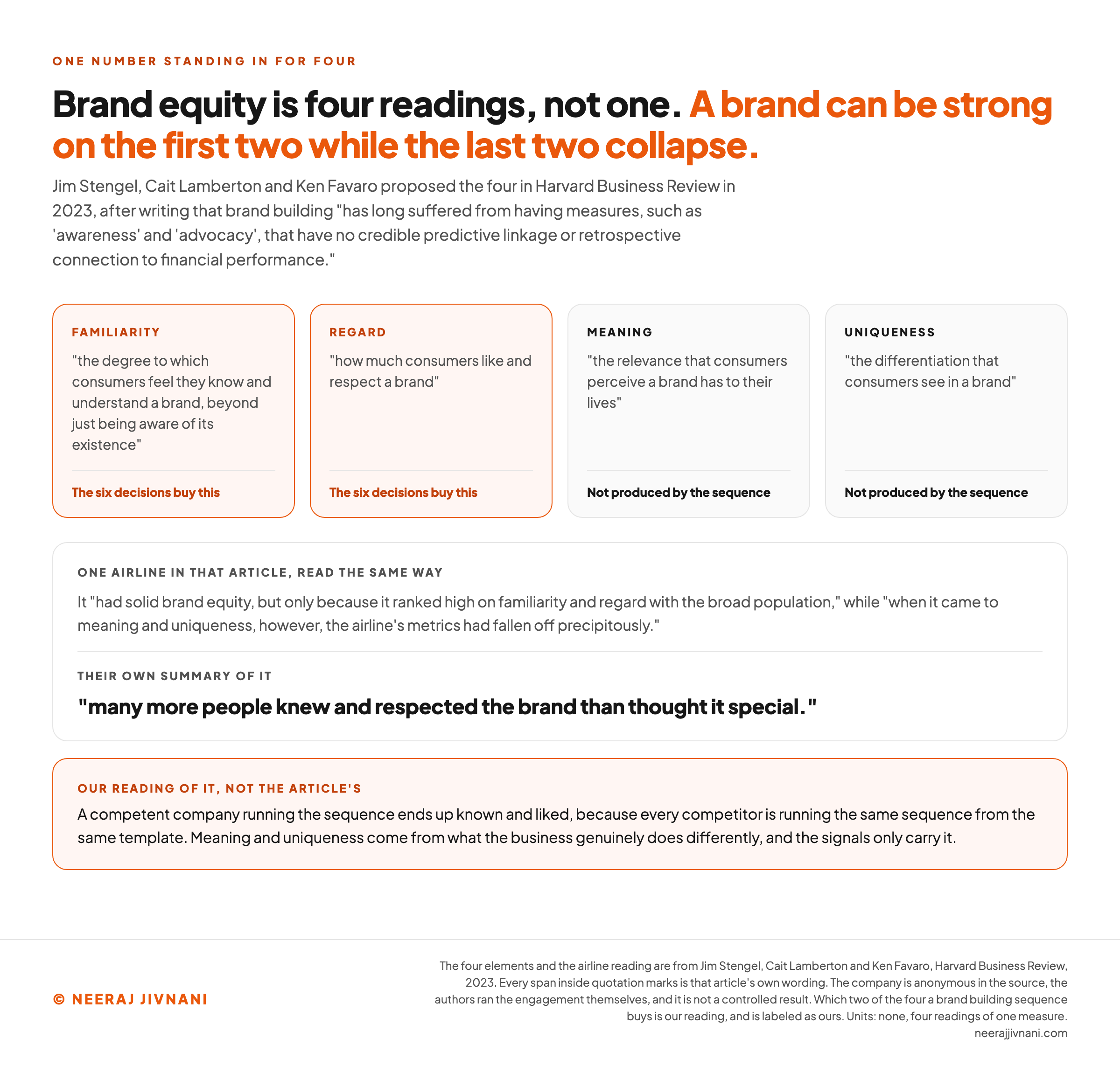
Brand equity is worth measuring as "a composite of four key elements", they write.
The first two are "familiarity, the degree to which consumers feel they know and understand a brand, beyond just being aware of its existence" and "regard, how much consumers like and respect a brand".
The other two are the ones almost nobody reads. They are "meaning, the relevance that consumers perceive a brand has to their lives" and "uniqueness, the differentiation that consumers see in a brand".
Take the four apart and the useful thing appears at once. They can move independently.
One of the three companies in that article is an airline whose readings split exactly that way.
It "had solid brand equity, but only because it ranked high on familiarity and regard with the broad population," the authors write, while "when it came to meaning and uniqueness, however, the airline's metrics had fallen off precipitously."
Their own summary of it is the sentence worth keeping: "many more people knew and respected the brand than thought it special."
Here is our reading of that, and it is not the article's. The six decisions above reliably buy the first two. A competent company running that sequence ends up known and liked, because every competitor is running the same sequence from the same template.
Meaning and uniqueness are not produced by the sequence at all.
They come from what the business genuinely does differently, and the signals only carry it. That is why the last decision in the list is the one that decides the outcome.
So the practical version, for a company with no research budget, is to stop asking whether people have heard of you.
Ask people who are not customers what you are for, and what makes you different from the nearest alternative. Listen for whether they can answer at all.
Blank answers to those two questions, from people who recognize the name, are the exact shape of the airline's problem. It is a brand problem that running the sequence again cannot fix.
What It Looks Like With Numbers Attached
The same article follows three companies through that reading, which is as close to a worked example of brand building as anything published with figures attached.
All three are anonymous in the source, the authors ran the engagements themselves, and none of it is a controlled result. Read them as what those companies did and what moved afterwards.
| The company | What it found | What it changed | What moved |
|---|---|---|---|
| An airline | High familiarity and regard, meaning and uniqueness collapsing | Targeted spend at meaning and uniqueness in named local markets, without raising the total | Gained 1.6 percentage points of relative market share, holding top-quartile profitability |
| A fast-food chain | Very high equity with one segment and little headroom left in it | Positioned on three emotional attributes reaching women with families, without losing the core | Revenue-related KPI up 8% |
| A winemaker | Low familiarity, strong meaning and uniqueness inside a narrow age band, and a potential shareholder-value return four times greater among 25 to 34 year olds than among the over-49s | Changed the packaging and where the wine was sold, to reach a younger cohort | Went from a niche label to a mainstream one without losing its distinctiveness |
Two things are worth noticing across all three, and neither is the size of the numbers.
All three named the audience the change was for before they changed anything. And all three started from a reading of the four rather than from an assumption about which one was the problem.
Say a two-location bakery running the same check. It would find high familiarity locally, decent regard, and almost nothing on uniqueness, because everything it publishes could be published by any bakery.
The answer to that is not a rebrand. It is deciding what it does that the others do not, and then repeating it.
Use this chart — embed code and citation
<a href="https://neerajjivnani.com/blog/brand-building/"><img src="https://neerajjivnani.com/infographics/brand-building/what-the-sequence-buys.png" alt="Four cards across the top, one per element of brand equity as proposed in Harvard Business Review in 2023, each carrying that article's own definition. Familiarity and regard are highlighted and marked as bought by the six decisions, while meaning and uniqueness are marked as not produced by the sequence. Below them a panel quotes one airline in that article, which had solid brand equity only because it ranked high on familiarity and regard while its meaning and uniqueness had fallen off precipitously, and carries the authors own summary that many more people knew and respected the brand than thought it special. A final highlighted panel, labeled as our reading rather than the article's, says a competent company running the sequence ends up known and liked because every competitor is running the same sequence, and that meaning and uniqueness come from what the business genuinely does differently." width="1200"></a>
<p>Chart: <a href="https://neerajjivnani.com/blog/brand-building/">Neeraj Jivnani</a></p>Neeraj Jivnani, "The Decisions Behind a Brand, in the Order They Have to Be Made", neerajjivnani.com, https://neerajjivnani.com/blog/brand-building/Free to republish with a link back to this page.
When Brand Building Is Not the Work in Front of You
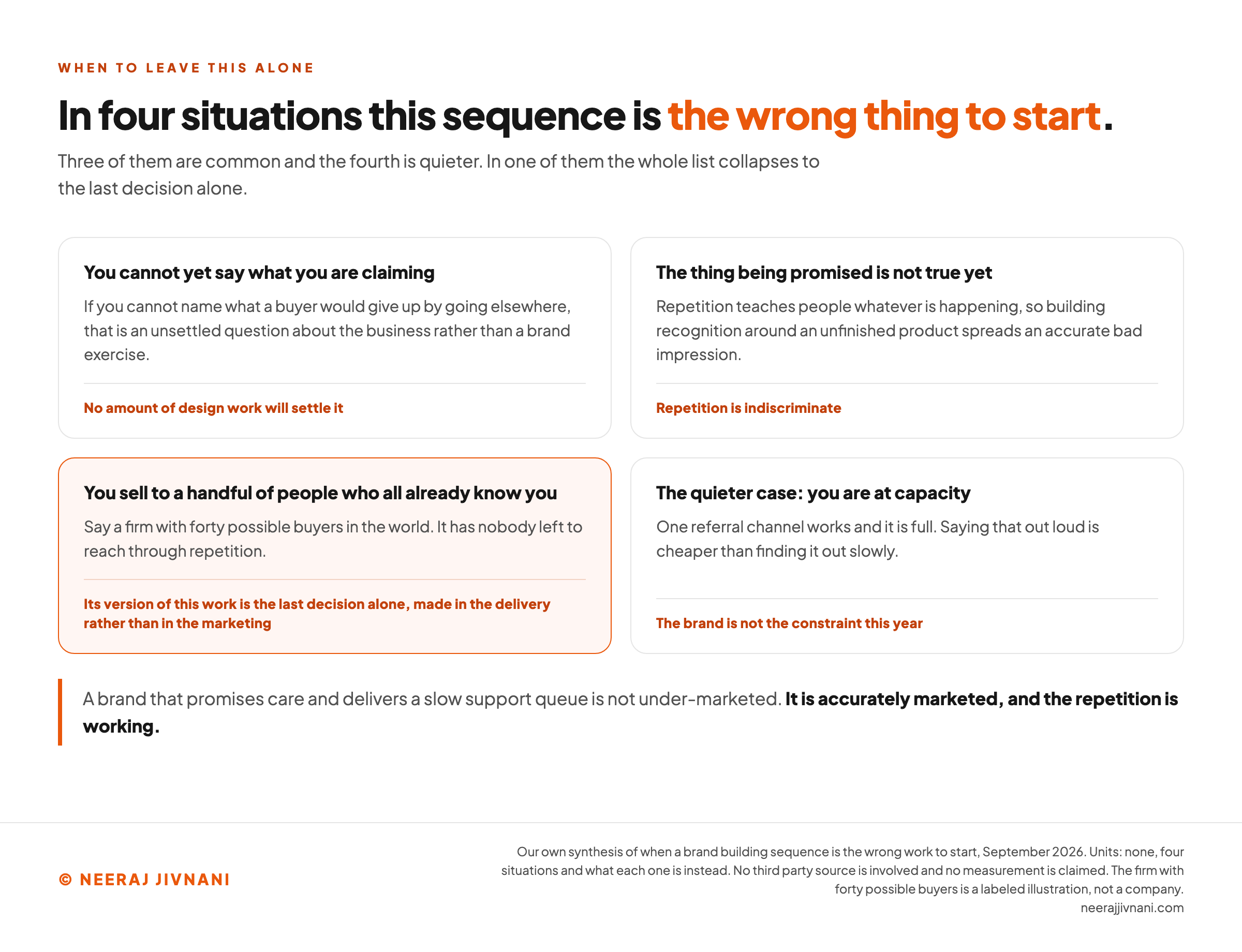
Three situations where this sequence is the wrong thing to start, and all three are common.
You cannot yet say what you are claiming. If you cannot name what a buyer would give up by going elsewhere, that is an unsettled question about the business rather than a brand exercise, and no amount of design work will settle it.
The thing being promised is not true yet. Repetition is indiscriminate. It teaches people whatever is happening, so building recognition around an unfinished product spreads an accurate bad impression.
You sell to a handful of people who all already know you. A firm with forty possible buyers in the world has nobody left to reach through repetition. Its version of this work is the last decision alone, made in the delivery rather than in the marketing.
There is a quieter case too.
If you have one referral channel that works and you are at capacity, the brand is not the constraint this year. Saying that out loud is cheaper than finding it out slowly.
Use this chart — embed code and citation
<a href="https://neerajjivnani.com/blog/brand-building/"><img src="https://neerajjivnani.com/infographics/brand-building/when-it-is-not-the-work.png" alt="Four cards naming the situations in which this sequence is the wrong work to start, each with what it is instead. You cannot yet say what you are claiming, which no amount of design work will settle. The thing being promised is not true yet, where repetition is indiscriminate. You sell to a handful of people who all already know you, highlighted, where the version of this work is the last decision alone, made in the delivery rather than in the marketing. And the quieter case of one referral channel that works and is full, where the brand is not the constraint this year. A line underneath reads that a brand which promises care and delivers a slow support queue is accurately marketed, and the repetition is working." width="1200"></a>
<p>Chart: <a href="https://neerajjivnani.com/blog/brand-building/">Neeraj Jivnani</a></p>Neeraj Jivnani, "The Decisions Behind a Brand, in the Order They Have to Be Made", neerajjivnani.com, https://neerajjivnani.com/blog/brand-building/Free to republish with a link back to this page.
The Order Is the Cheapest Thing to Get Right
Deciding them costs nothing. Getting the order wrong is what makes everything after it expensive.
That is the argument for taking the order seriously.
A company that settles the audience, the claim and the signals in that order, in a week, with no budget, gets better design work six months later than one that starts with a designer and a moodboard.
The second company has handed a designer three decisions that were never a designer's to make, and will pay to have them made again each time it disagrees.
The logo can wait. It is the most visible thing on the list, among the least consequential to decide early, and where almost every first attempt starts.
What cannot wait is the sentence, and the honest answer to whether it is true of the business yet.