All 12 Brand Archetypes, and What You Give Up for Each
The character each one commits you to, the sentences it licenses, the ones it takes off the table, and how to settle a tie between two of them.

/ On this page11 sections
A brand archetype is the character your brand commits to, so that everyone writing, designing and answering the phone makes the same call without asking you first.
Here is the whole list, what each character licenses you to say, and what each one forces you to give up.
Then a way to settle a tie between two that both fit, and to defend that choice six months later when it starts costing you something.
What a Brand Archetype Is
A brand archetype is a character your brand agrees to play, taken from a set of 12 that brand strategy has settled on.
Agreeing to play one is the part that does the work. A character you have not agreed to is a description.
That is a narrower thing than it sounds, and the narrowness is the point. Three distinctions make it usable.
An archetype is about your brand. A persona is about your customer. The persona describes who you are selling to, and the archetype describes who is doing the selling. They look similar on a slide and they answer opposite questions.
An archetype is not a list of adjectives. Any brand can call itself authentic, innovative and human, and most do.
An archetype is a whole character with a motive, so it tells you what the brand would refuse as well as what it would say.
An archetype is not the same as brand personality. The archetype is the decision. The personality is what you get when you translate that decision into traits, a voice and a way of behaving.
The working test is simple. If you can name your archetype but cannot name a campaign you turned down because of it, you have a label rather than a decision.
The 12 Brand Archetypes
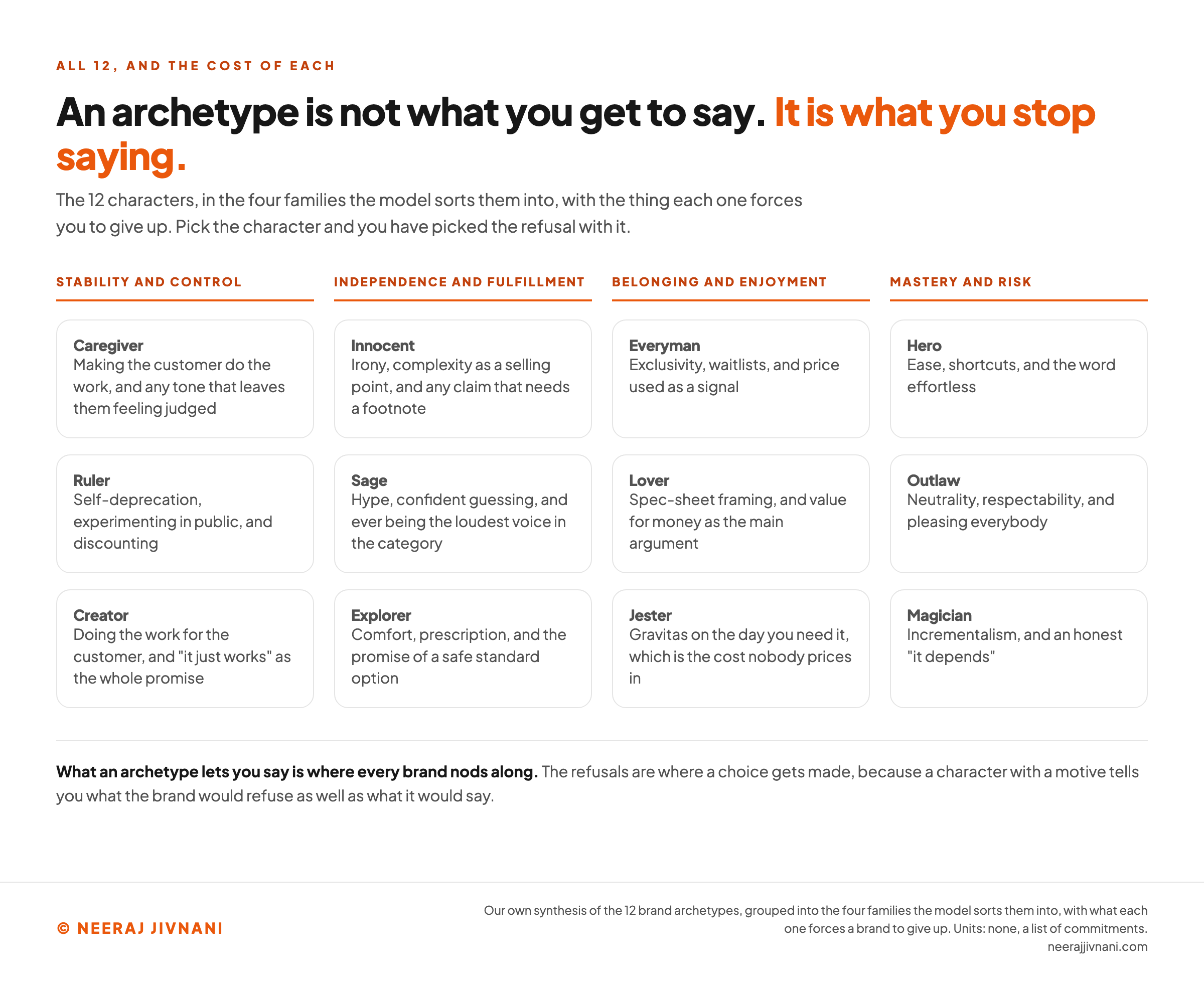
Here are all 12, grouped into the four families the model sorts them into, with what each one wants, what it licenses you to say, and what it costs you.
| Archetype | What it wants | What it lets you say | What it rules out |
|---|---|---|---|
| Caregiver | To protect people who need protecting | We will take care of this for you | Making the customer do the work, and any tone that leaves them feeling judged |
| Ruler | Order that it controls | This is the standard everyone else is measured against | Self-deprecation, experimenting in public, and discounting |
| Creator | To make the thing that did not exist | Build with this, and make it yours | Doing the work for the customer, and "it just works" as the whole promise |
| Innocent | Things to be simple and good | This is honest, this is clean, there is nothing to explain | Irony, complexity as a selling point, and any claim that needs a footnote |
| Sage | To be right, and to be seen to be right | Here is the evidence, and here is what it means | Hype, confident guessing, and ever being the loudest voice in the category |
| Explorer | Room to move | Try it your way, go further, do not settle | Comfort, prescription, and the promise of a safe standard option |
| Everyman | To belong | This is for everyone, and nobody has to prove anything | Exclusivity, waitlists, and price used as a signal |
| Lover | To be wanted | This is beautiful, and it is for you | Spec-sheet framing, and value for money as the main argument |
| Jester | To make the moment lighter | Almost anything, as long as it lands | Gravitas on the day you need it, which is the cost nobody prices in |
| Hero | To prove its worth by doing the hard thing | This is difficult, and you can do it | Ease, shortcuts, and the word effortless |
| Outlaw | The current arrangement broken | This is wrong, and we will not play along | Neutrality, respectability, and pleasing everybody |
| Magician | Transformation | This changes what is possible | Incrementalism, and an honest "it depends" |
The four families are:
- Stability and control. Caregiver, Ruler, Creator.
- Independence and fulfillment. Innocent, Sage, Explorer.
- Belonging and enjoyment. Everyman, Lover, Jester.
- Mastery and risk. Hero, Outlaw, Magician.
Read what each one rules out before you read what it lets you say. It is easy to nod along at what a character lets you say, and the refusals are where a choice gets made.
The Examples Are Readings, Not Facts
Look up a famous brand and you will find it filed under two or three different archetypes.
Apple gets read as the Creator, the Magician and the Outlaw, depending on which decade and which behavior you weigh.
Disney gets read as the Magician and as the Innocent. Red Bull gets read as the Explorer and as the Hero.
None of those readings is wrong. A brand that has been running for decades has behaved in more than one way.
This matters for your own brand more than it looks.
The archetype is not sitting inside your company waiting to be found. Somebody has to choose, and then behave in a way that makes the choice true.
Use this chart — embed code and citation
<a href="https://neerajjivnani.com/blog/brand-archetypes/"><img src="https://neerajjivnani.com/infographics/brand-archetypes/what-each-one-gives-up.png" alt="Four columns, one per archetype family, each holding three cards that name a brand archetype and the thing it forces you to give up: stability and control holds the Caregiver, Ruler and Creator, independence and fulfillment holds the Innocent, Sage and Explorer, belonging and enjoyment holds the Everyman, Lover and Jester, and mastery and risk holds the Hero, Outlaw and Magician." width="1200"></a>
<p>Chart: <a href="https://neerajjivnani.com/blog/brand-archetypes/">Neeraj Jivnani</a></p>Neeraj Jivnani, "All 12 Brand Archetypes, and What You Give Up for Each", neerajjivnani.com, https://neerajjivnani.com/blog/brand-archetypes/Free to republish with a link back to this page.
What You Get for Committing
The honest case for committing to one is internal, and you can test it this week without commissioning anything.
Every brand decision that reaches a customer is made by somebody who was not in the strategy meeting. The sales email, the error message, the reply to a complaint at six on a Friday evening.
An archetype pushes one decision down to all of them at once.
Without one, those people fall back on taste, and taste varies by person. That is how a company ends up sounding warm in support, brisk on the website and slightly manic on social.
A Caregiver brand whose refund email reads like a legal notice has not committed to anything. It has written a word down.
The external case is weaker, and it is worth saying so. Consistency of character probably helps a customer recognize you, but whether a specific archetype causes revenue is not something you can prove about your own brand.
So commit for the reason that survives scrutiny. It makes the small decisions cheaper and more consistent, and there are far more of those than there are campaigns.
If it also does something for recall, take that as a bonus rather than a business case.
Where the 12 Come From
The set of 12 is younger and more specific than it looks.
Carl Jung wrote about archetypes as recurring patterns in the human mind. The 12 used in branding are a later system built on top of that idea, assembled for a different purpose.
Carol Pearson's Awakening the Heroes Within: Twelve Archetypes to Help Us Find Ourselves and Transform Our World was first published in 1991. The 12 reached brand strategy through The Hero and the Outlaw, which Margaret Mark and Carol Pearson published in 2001.
Knowing where they come from changes one practical thing.
The 12 are a useful simplification somebody designed, not a natural law somebody discovered, so a brand that does not sit neatly in one of them is not failing a test.
How to Work Out Which One You Are
Work it out from what your brand has already done, rather than by reading down the twelve and picking the character you like.
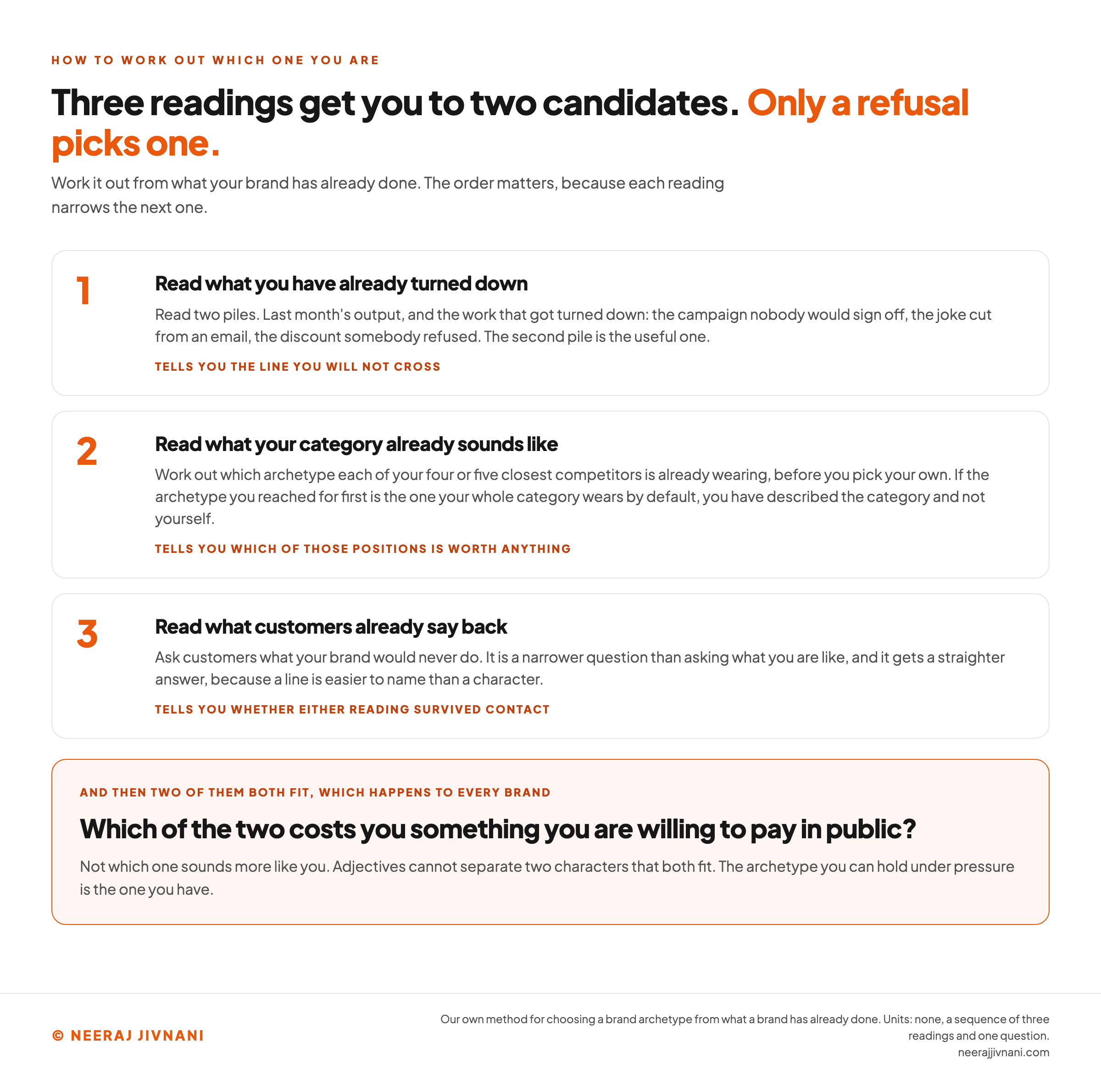
Three readings, in this order, will get you to two candidates. A fourth question settles which of the two you have.
The order matters because each reading narrows the next one. What you turned down tells you where you already are, your category tells you which of those positions is worth anything, and your customers tell you whether either reading survived contact.
Read What You Have Already Turned Down
You have already turned things down, and those decisions say more about your brand than anything you did publish.
So read two piles. Last month's output, and the work that got turned down: the campaign nobody would sign off, the joke cut from an email, the discount somebody refused.
The second pile is the useful one.
A team that keeps cutting the jokes has been behaving as something other than the Jester for a year, and no deck changes that.
Read the first pile the same way. Not for whether it is good, but for the line the writer will not cross.
That line is the archetype you are closest to being able to hold.
Read What Your Category Already Sounds Like
Work out which archetype each of your four or five closest competitors is already wearing, before you pick your own.
Categories converge. Financial services drifts to the Ruler and the Sage, wellness to the Innocent and the Caregiver, outdoor gear to the Explorer and the Hero.
If the archetype you reached for first is the one your whole category wears by default, you have described the category and not yourself.
That is the difference between a position and a description, and it is cheaper to find out now than after a year of work.
Read What Customers Already Say Back
Ask customers what your brand would never do. It is a narrower question than asking what you are like, and it gets a straighter answer, because a line is easier to name than a character.
There is a serious version of this measurement.
WPP's BrandAsset Valuator (BAV) keeps its own set of 12 archetypes, built from Jung's work and its own consumer research.
It scores every brand from 0 to 100 on each of them using how consumers rate it against 48 image and personality attributes, then assigns the highest-scoring type as the primary one.
The number is not the point for a smaller brand. The method is.
Your archetype is what people already believe about you, rather than what you decided about yourself.
Settle the Tie With a Refusal
You will end up with two that both fit. Every brand does.
Do not settle it by adding adjectives. Settle it by asking which of the two costs you something you are willing to pay in public.
If you want the Ruler but you are not willing to stop discounting, you are not the Ruler.
If you want the Jester but the first serious incident will have you writing like a lawyer, you are not the Jester. The archetype you can hold under pressure is the one you have.
Settle the tie with a refusal
Put up the two that both fit. Then go through what each one forces you to give up and say, for each item, whether you would actually give it up. One thing you would keep is enough to end a candidate.
1. The two you are choosing between
Stability and control
Independence and fulfillment
Belonging and enjoyment
Mastery and risk
Pick the two you keep coming back to. Not the one you want, the two you cannot separate.
Use this chart — embed code and citation
<a href="https://neerajjivnani.com/blog/brand-archetypes/"><img src="https://neerajjivnani.com/infographics/brand-archetypes/three-readings-then-a-refusal.png" alt="Three numbered cards in order: read what you have already turned down, read what your category already sounds like, and read what customers already say back. Each card is labeled with what that reading tells you. Beneath them a highlighted panel carries the question that settles a tie between two archetypes, which of the two costs you something you are willing to pay in public." width="1200"></a>
<p>Chart: <a href="https://neerajjivnani.com/blog/brand-archetypes/">Neeraj Jivnani</a></p>Neeraj Jivnani, "All 12 Brand Archetypes, and What You Give Up for Each", neerajjivnani.com, https://neerajjivnani.com/blog/brand-archetypes/Free to republish with a link back to this page.
The Second Archetype, and Why You Probably Want One
The standard advice is to pick exactly one and never mix. That is sound for a brand with nothing to hold yet, and it stops being sound quickly.
Sometimes the category test leaves you nowhere to go, because the honest reading of your brand is the one your whole category already shares. A Caregiver healthcare brand and a Ruler law firm are both correct and both invisible.
A second archetype from a different family is what makes the first one legible.
How Much Contrast to Buy
A different family is the floor. The further the two motives pull against each other, the more the second one buys you.
BAV's own guidance is that brands with a balanced archetype profile, strong in two or more areas, are "more interesting, engaging and successful", and that it is better still when those areas of strength are contrasting.
Its argument is commercial rather than aesthetic. BrandAsset Valuator reports that differentiation accounts for 15% of brands' revenue growth, from its own analysis of over 60,000 brands over 30 years.
That is a finding about differentiation, not about any archetype in particular.
A second archetype is not decoration on the first one. It is the thing that keeps a correctly chosen archetype from reading as a category default.
How to Choose the Second One
Take it from one of the other three families, never from the two archetypes sitting beside your primary inside its own family.
Then give it much less room than the first. As a rule of thumb, keep it near three-quarters primary to one-quarter secondary, which is far enough to notice and not far enough to confuse.
Which second archetype you choose is not neutral, and the wrong one can work against you.
A 2026 paper in the Journal of Small Business Strategy proposes that for a small firm led by the Sage, a Creator second strengthens trust as the firm grows. Its reason is that the Creator turns expertise into visible artifacts, like tools and frameworks.
The same paper proposes the opposite for an Innocent second, which it argues can undercut trust once buyers start judging on authority.
Its authors present that as a model to be tested rather than as a measured result, which is how it should be read.
In practice, pick a second archetype that makes your first one more credible rather than more likable.
What Changes on Monday
An archetype that changes nothing by Monday is a document rather than a decision.
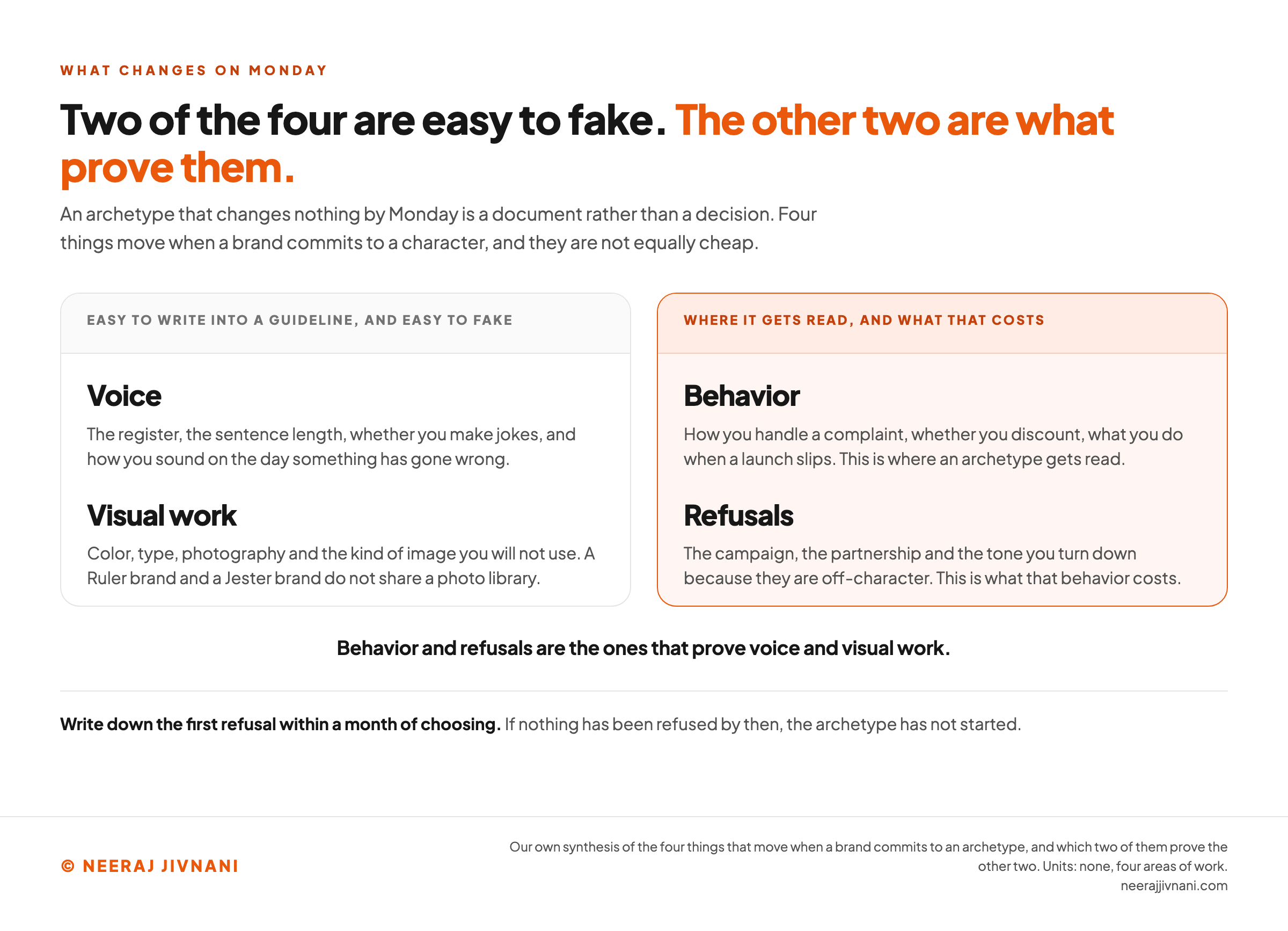
Four things move, and they are not equally cheap.
- Voice. The register, the sentence length, whether you make jokes, and how you sound on the day something has gone wrong.
- Visual work. Color, type, photography and the kind of image you will not use. A Ruler brand and a Jester brand do not share a photo library.
- Behavior. How you handle a complaint, whether you discount, what you do when a launch slips.
- Refusals. The campaign, the partnership and the tone you turn down because they are off-character.
Voice and visual work are easy to write into a guideline and easy to fake.
Behavior is where an archetype gets read, and refusals are what that behavior costs. Those two are the ones that prove the first two.
Write down the first refusal within a month of choosing. If nothing has been refused by then, the archetype has not started.
Use this chart — embed code and citation
<a href="https://neerajjivnani.com/blog/brand-archetypes/"><img src="https://neerajjivnani.com/infographics/brand-archetypes/the-two-that-prove-the-other-two.png" alt="Two bordered panels of two cards each. One panel, headed easy to write into a guideline and easy to fake, holds voice and visual work. The other, highlighted in orange and headed where it gets read and what that costs, holds behavior and refusals. Beneath both, a line reads behavior and refusals are the ones that prove voice and visual work." width="1200"></a>
<p>Chart: <a href="https://neerajjivnani.com/blog/brand-archetypes/">Neeraj Jivnani</a></p>Neeraj Jivnani, "All 12 Brand Archetypes, and What You Give Up for Each", neerajjivnani.com, https://neerajjivnani.com/blog/brand-archetypes/Free to republish with a link back to this page.
The Limits Worth Knowing Before You Commit
Archetypes are a simplification, and three of their limits are worth knowing before you build a year of work on one.
Twelve characters cannot hold every brand. The set was designed to be workable rather than complete. If your brand genuinely does not sit in one, forcing it produces a brand nobody recognizes, including you.
An archetype is a claim, and your customers get a vote. They may read you as something other than what you chose, and their reading is the one that decides whether it worked.
Aesthetics are the easy half and the wrong half. A color palette and a set of taglines can imitate an archetype's style while nothing about how the company behaves has changed at all.
When This Is the Wrong Tool
Sometimes the archetype exercise is a way of avoiding a harder problem. If nobody can say what your product does better than the alternative, an archetype will not fix that, and a year spent on character is a year not spent on the gap.
If you are one person, or five, and everything already goes out in one voice, you do not yet have the problem an archetype solves.
Write down the things you will not say, and come back to the 12 when there are more of you.
How to Tell If It Took
Two readings, taken twice a year, will tell you whether any of this reached a customer.
Ask outsiders which of the 12 you are. Use people who are not customers and not staff, and do not tell them which one you picked. The gap between their answer and yours is the measurement.
Read your own output against the archetype. Take a couple of dozen recent pieces and mark each one on-character, off-character or neutral.
The share that is off-character is the honest number.
When the gap is wide, the fix is not a new set of words. Look at what you said yes to, because a brand drifts by accepting things rather than by describing itself badly.
What Else People Mean When They Ask This
People searching for this ask four adjacent questions alongside it. Two of them mean the same 12 characters, and two mean something else entirely.
What are the 12 archetypes? The Caregiver, Ruler, Creator, Innocent, Sage, Explorer, Everyman, Lover, Jester, Hero, Outlaw and Magician. The Everyman is also called the Regular Guy or Regular Gal, and the Outlaw is also called the Rebel.
What are the 12 brand personality archetypes? The same 12. The phrase adds "personality" because a brand personality is what an archetype gets translated into, but the list does not change.
What are the 7 types of brands? A different taxonomy. Types of brand sort by what a brand is, such as a product, a service, a person or a company, while archetypes sort by the character a brand plays. The archetype count is 12. Seven belongs to the other question.
What are the 7 pillars of personal branding? Also a different question. Personal branding frameworks are aimed at a person building their own reputation, so they answer what you should work on rather than which character a brand plays.
Pick the One You Are Willing to Be Wrong About
Take the archetype whose refusals you would still make in a quarter where the number is short. That is the one you are willing to be wrong about in public, and it is the one you have.
Archetype work goes nowhere when choosing is the enjoyable part and holding is not.
A room full of people can agree on the Hero in an afternoon. Six months later somebody proposes a campaign promising the thing will be easy, and nobody remembers that the Hero cannot say that.
So make the choice, then give it a second archetype from a different family, which is what keeps it from sounding like everyone else in your category.
Then write the refusals down, somewhere the people who publish can see them.
That list of refusals is the archetype. Everything else is a description of it.