Public Relations: What the Job Is, and What It Pays
Public relations earns coverage you cannot buy. Here is what the job covers, the salary band you can expect, and the twelve kinds of PR.

/ On this page9 sections
Public relations, or PR, is the work of earning what other people say about your organization instead of buying it. A journalist you pitch is free to say no, and that refusal is what makes the coverage worth having.
Every named kind of PR is that same job aimed at a different group. Who is on the other end decides the deliverable, and none of those groups is under your control.
Below is what the work covers, the twelve kinds of PR, what it cannot do, what the federal pay data says the job earns, and how people get into it.
What Public Relations Does
Public relations is one job with many counterparties, and the profession's own word for them is publics. It earns coverage nobody paid for, and it handles what third parties say when something goes wrong.
The trade's working definition is "a strategic communication process that builds mutually beneficial relationships between organizations and their publics", in the Public Relations Society of America's wording.
Most days, that job is three things:
- Pitching stories to people who are free to refuse them. A reporter owes you nothing, and a pitch written as though one does is why most of them go unanswered.
- Publishing the organization's own position on the things it would prefer not to discuss, in language it can still stand behind a year later.
- Preparing for the day something goes wrong, before it does, because a crisis is the one situation where there is no time left to decide who speaks.
None of the three gives you control of the outcome. That is the trade the whole profession runs on.
What "Publics" Means, and Why It Is Not "Audience"
A public is any group whose opinion can change what an organization is able to do.
Customers are one. So are regulators, staff, lenders, neighbors and the reporters who cover the sector.
An audience receives a message.
A public can withhold something you need, which is why the trade keeps its own awkward plural instead of borrowing the marketing word.
Reputation is the thing those publics control between them. The Chartered Institute of Public Relations puts it as "the result of what you do, what you say and what others say about you."
Why a Journalist Can Say No and an Advertisement Cannot
An advertisement runs because money changed hands. A story runs because an editor decided it was worth the space, and that editor can say no.
That is the line between earned and paid.
Buying the placement also buys control of the words, and a reader who can see it was bought reads it as an argument rather than a finding.
Earning it means giving the words away.
No press office can promise a headline, and that is what the credibility costs.
Whether Public Relations Sits Inside Marketing or Beside It
Marketing moves a product. Public relations moves a reputation, and the reputation then makes the marketing cheaper or dearer.
PR sits inside the marketing mix rather than beside it, according to a 2019 research starter by Ruth A. Wienclaw for EBSCO, the library database publisher.
The work raises awareness and understanding of what an organization offers. That is the condition marketing needs before it can convert anybody.
On an org chart it sits beside marketing; on a spend sheet EBSCO puts it inside the mix.
The same page draws the limit. PR "cannot fabricate a positive reputation where it is not warranted or conceal legitimate criticisms."
A campaign cannot install a good reputation, and it can lose you the one you have inside a week.
The Trade-Off Between Speed and Credibility
Paid media is fast and controlled. Earned media is slow and credible.
Choosing between them is choosing which of those you need most this quarter. A launch with a date on it needs speed; a business fighting a bad reputation needs the credibility, and that is the one nobody can buy.
Twelve Publics, and the Kind of PR Each One Needs
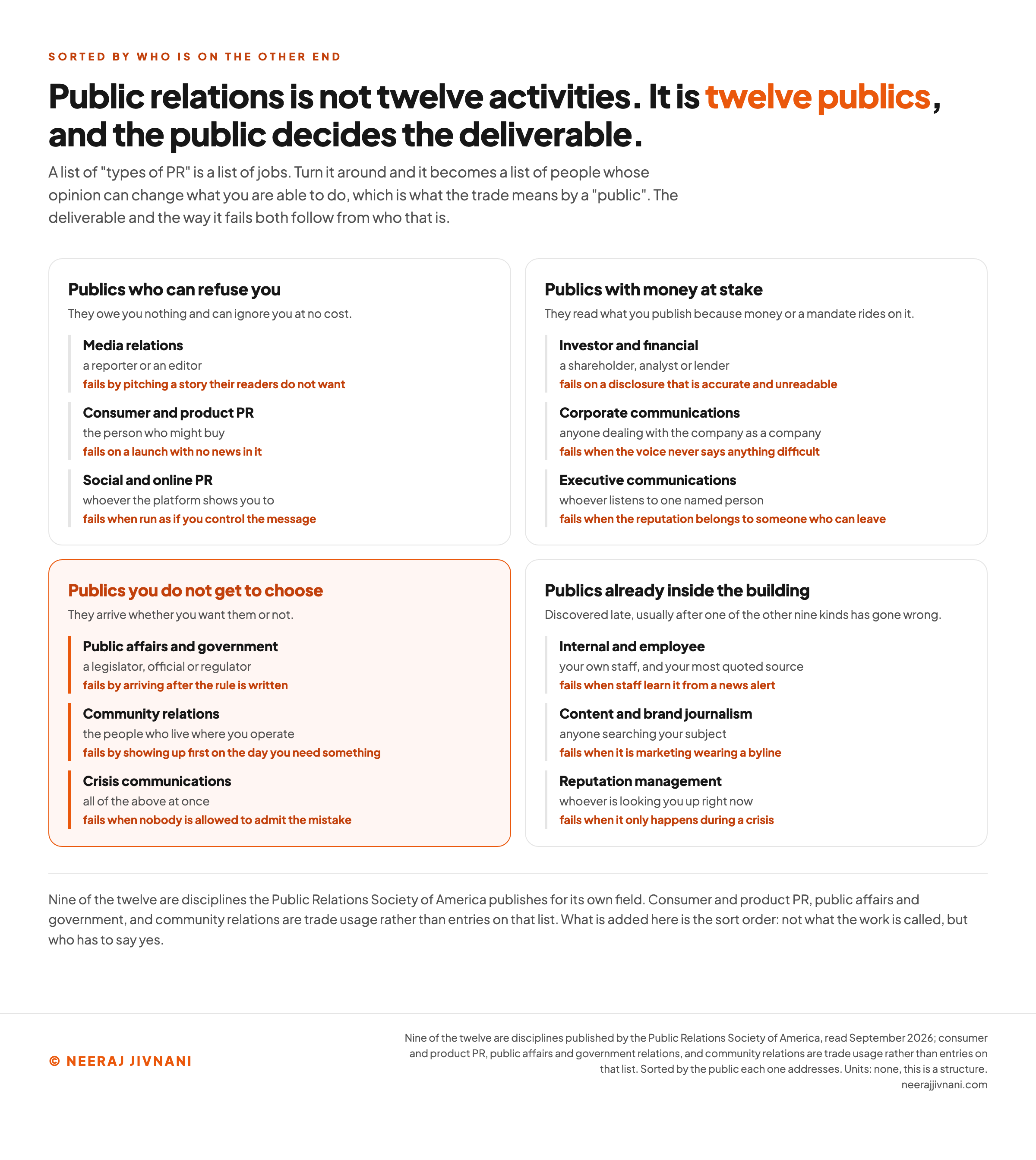
The kinds of public relations are twelve different publics before they are twelve activities. The deliverable changes because the person on the other end changes.
Sorting all twelve by who is on the other end is what makes them worth reading as a set.
Four groups fall out of that sort: the publics who can refuse you, the publics with money at stake, the publics you do not get to choose, and the publics already inside the building.
The Publics Who Can Refuse You
A reporter, a shopper and a platform audience owe you nothing and can ignore you at no cost. Everything in this group is a pitch.
- Media relations. The public is a reporter or an editor. The deliverable is a pitch, a press release and an interview that happens. The failure mode is pitching a story the outlet's readers do not want, which costs you the next pitch too.
- Consumer and product PR. The public is the person who might buy. The deliverable is a launch that reviewers cover, a sample that arrives before the embargo lifts, a demonstration somebody writes up. The failure mode is a launch with no news in it.
- Social and online PR. The public is whoever the platform decides to show you to. The deliverable is a response, a correction, a post that travels. The failure mode is treating it as social media marketing, where you control the message, when the whole point here is that you do not.
The Publics With Money at Stake
Shareholders, boards and the people who report to them read what you publish because money or a mandate rides on it. The register is formal and the exposure is legal.
- Investor and financial communications. The public is a shareholder, an analyst or a lender. The deliverable is the results announcement, the earnings call and the language around a merger. The failure mode is a disclosure that is accurate and unreadable.
- Corporate communications. The public is everybody who deals with the company as a company rather than as a product. The deliverable is the position on a policy, a closure or a layoff. The failure mode is a corporate voice nobody believes because it never says anything difficult.
- Executive communications. The public is whoever listens to one named person. The deliverable is the speech, the byline, the awkward interview. The failure mode is building a reputation that belongs to an individual who can leave.
The Publics You Do Not Get to Choose
A regulator, a town and a bad afternoon arrive whether you want them or not. None of the three is an audience you segment.
- Public affairs and government relations. The public is a legislator, an official or a regulator. The deliverable is a consultation response, a briefing and lobbying that is on the record. The failure mode is arriving after the rule is written.
- Community relations. The public is the people who live where you operate. The deliverable is the sponsorship, the open day, the notice that goes out before the roadworks start. The failure mode is showing up for the first time on the day you need something.
- Crisis communications. The public is all of the above at once. The deliverable is a holding statement inside the hour and a named person who will stand behind it. The failure mode has its own section below.
The Publics Already Inside the Building
The last three are the ones organizations discover late, usually after one of the other nine has gone wrong.
- Internal and employee communications. The public is your own staff, who are also the most quoted source about you. The deliverable is the announcement they hear before the press does. The failure mode is staff learning about a decision from a news alert.
- Content creation and brand journalism. The public is anyone searching for the subject you work in. The deliverable is the explainer, the data release, the piece other people cite. The failure mode is publishing marketing and calling it journalism.
- Reputation management. The public is whoever is looking you up right now. The deliverable is an accurate record: the profile, the entry, the correction that got made. The failure mode is only doing it during a crisis.
Nine of those twelve appear on the Public Relations Society of America's own list of PR disciplines, some under slightly different names.
The other three are trade usage rather than entries on that list: consumer and product PR, public affairs and government relations, and community relations.
Use this chart — embed code and citation
<a href="https://neerajjivnani.com/blog/public-relations/"><img src="https://neerajjivnani.com/infographics/public-relations/twelve-publics.png" alt="Grid of the twelve kinds of public relations sorted by who is on the other end, giving each one the public it addresses, the deliverable it produces and the failure mode it is exposed to, grouped into publics who can refuse you, publics with money at stake, publics you cannot choose and publics already inside the building." width="1200"></a>
<p>Chart: <a href="https://neerajjivnani.com/blog/public-relations/">Neeraj Jivnani</a></p>Neeraj Jivnani, "Public Relations: What the Job Is, and What It Pays", neerajjivnani.com, https://neerajjivnani.com/blog/public-relations/Free to republish with a link back to this page.
The Pitch, the Release, and the Embargo
Most days in public relations are made of three objects: a pitch, a press release and an embargo. None of the three is a campaign.
A pitch is a short note to one named journalist arguing why this story suits their beat this week. It is written for one person, and sending the same note to a list is a common reason none of them answer.
A press release is the on-the-record version: the facts, the quotes anyone may use, the contact who will pick up the phone. It exists so that a reporter who says yes has to do the least possible work.
An embargo is an agreement that a story will not run before an agreed time. It buys reporters the hours they need to write properly, and it collapses the moment one outlet breaks it.
Say a research team has findings to publish. The pitch argues why one reporter's readers care, the release gives them the figures they can quote, and the embargo gives them the days they need to write it properly.
Those three definitions are trade usage rather than anybody's published standard.
Two Tactics That Do Not Go Through a Reporter
Public relations is not only media relations.
Two of its oldest tactics skip the press entirely, and both still work.
The first is face to face. Face to face is the most direct of the public relations tools, on EBSCO's account, and its venues are seminars, meetings, conferences, conventions and exhibitions.
They also typically cost more than other public relations techniques, which is the drawback EBSCO names and the reason they get skipped. When a third party runs the room, you work inside their limits.
The second is publishing your own research. Findings on a subject where you have a stake can generate interest in the subject and in your answer to it at the same time, which is the mechanism EBSCO describes.
That is what an industry survey with a vendor's name on the cover is doing. It has an obvious trap: when the link between the research and the publisher's interest is too neat, the finding gets read as marketing.
Crisis Work, and the One Variable the Cases Turn On
Crisis communications is the part of public relations everybody has an opinion about and almost nobody plans for.
Speed is what gets criticized, and on its own it is not what separates the cases.
The variable that does is whether anybody in the building had the authority to act, and to say the organization got it wrong.
The case the profession still teaches is Johnson & Johnson and the Chicago cyanide-laced Tylenol murders of 1982. Its prompt recall, transparent communication and tamper-proof packaging restored public confidence, in Wikipedia's account of the episode.
Promptness there was not speed for its own sake. Somebody was able to pull the product and say so publicly, and that is the authority, not the clock.
Set against it is the Deepwater Horizon spill of 2010, where BP, the oil company that operated the well, was criticized in the same account for a slow and ineffective response.
The explosion killed 11 workers and led to 87 days of oil and methane gas entering the ocean, in Maryville University's account.
Four More Cases, and the Line Between Them
Four more of the cases in that same Maryville account are worth reading together, and two of them are not crises at all. Reading them together makes the line hard to miss.
In 2010 Greenpeace released a video attacking Nestle over palm oil in KitKat. Nestle's response was denial, and the denial became the story.
In spring 2017 United Airlines removed a passenger, David Dao, from a flight by force.
The chief executive's early statement seemed to shift blame onto Dao rather than accept responsibility, and United's shares dropped in value shortly after, on Maryville's account.
The two positive cases from summer 2018 went the other way. The International House of Pancakes, or IHOP, changed its name to IHOb for long enough to make burgers the topic, and Domino's ran Paving for Pizza, repairing potholes on the roads its deliveries used.
Neither of those was an accident.
Both gave reporters something concrete to describe, which is what a pitch cannot manufacture.
What a Plan Actually Contains
A crisis plan is short. It names who speaks, what the holding line is before the facts are known, which publics get told in what order, and who has authority to say the organization got it wrong.
The last of those is the one that goes missing. A plan that names a speaker but nobody who can concede is a plan for a statement, not for a crisis.
Spin, and the Reputation the Trade Cannot Shake
Public relations carries a reputational problem of its own, and pretending otherwise makes the rest of the field harder to defend.
Spin is choosing which true reading of a fact to put in front of people, and choosing the one that flatters you.
It shades into negative PR, and into reputation laundering, which is hiring a communications firm to clean up a record rather than change it.
The sharpest version is the front group: a body that hides who funds it so that it looks like a grass-roots movement. That is a form of astroturfing, and it is the point where persuasion has become deception.
The Five-Point Test for Ethical Persuasion
There is a published test for ethical persuasion, and it is short enough to apply in a meeting.
That test is T.A.R.E.S., a five-point check on a persuasive message, set out by Sherry Baker and David Martinson in 2001.
Each point carries its own set of questions, and they do not all run the same way. Some you want to answer yes, others no.
The sharpest are these:
- Truthfulness of the message. Is this communicating something factually true and accurate? Does it downplay or diminish evidence?
- Authenticity of the persuader. Do you believe that what is being presented will benefit the people who read it?
- Respect for the persuadee. Is this presented to people who are rational and self-thinking?
- Equity of the appeal. Is the appeal fair and nondiscriminatory? Does it target people who cannot understand the claims and the context?
- Social responsibility for the common good. Will the statement harm groups in society? Has any group been unfairly stereotyped by it?
A harder version of the same duty is written into the job itself. Counseling management at all levels on policy decisions and courses of action, taking into account their public ramifications, is one of the functions the Public Relations Society of America lists.
Read carefully, that is a duty to tell an employer something they do not want to hear.
It is the part of the job description that no salary survey measures.
How the Profession Defines Itself, and How That Changed
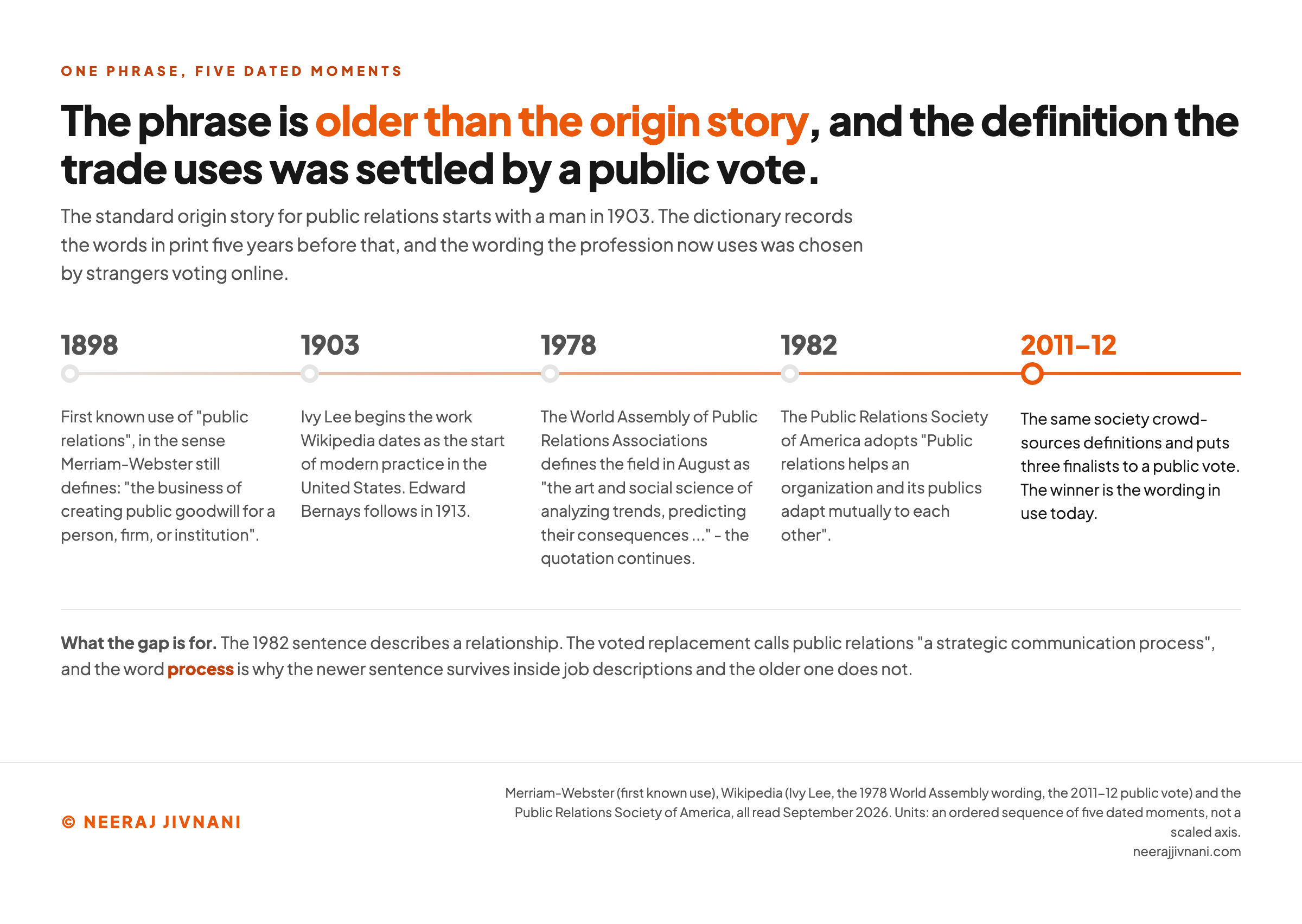
The definition the trade uses now was picked by public vote, and it replaced one that had stood since 1982.
In August 1978 the World Assembly of Public Relations Associations defined the field as "the art and social science of analyzing trends, predicting their consequences, counselling organizational leaders and implementing planned programs of action, which will serve both the organization and the public interest."
Four years later the Public Relations Society of America adopted something shorter: "Public relations helps an organization and its publics adapt mutually to each other."
That puts the organization and the public on equal footing.
It also says nothing about what anybody does on a Tuesday.
In 2011 and 2012 the society asked for crowd-supplied definitions and let the public choose between three finalists, in Wikipedia's account.
The winner was the process sentence, and it is the one the trade still uses. A relationship is a state; a process is something with a person attached to it.
The Phrase Is Older Than the Origin Story
The words were in print before anybody made a profession of them.
The phrase has a first known use of 1898, on Merriam-Webster's record.
Its plain-language gloss of the term is "the business of creating public goodwill for a person, firm, or institution."
The standard origin story starts five years later, with Ivy Lee in 1903 and Edward Bernays handling publicity for theatrical associations from 1913, in Wikipedia's account.
Both can be true, and the gap is a useful check on any history that begins with a founder.
Use this chart — embed code and citation
<a href="https://neerajjivnani.com/blog/public-relations/"><img src="https://neerajjivnani.com/infographics/public-relations/definition-timeline.png" alt="Timeline of how public relations has been defined, showing the 1898 first recorded use of the phrase, Ivy Lee in 1903, the World Assembly of Public Relations Associations wording of August 1978, the Public Relations Society of America definition of 1982, and the crowd-voted replacement adopted after the 2011 and 2012 vote." width="1200"></a>
<p>Chart: <a href="https://neerajjivnani.com/blog/public-relations/">Neeraj Jivnani</a></p>Neeraj Jivnani, "Public Relations: What the Job Is, and What It Pays", neerajjivnani.com, https://neerajjivnani.com/blog/public-relations/Free to republish with a link back to this page.
$74,750 a Year, and What the Next Ten Years Add
Public relations pays well above the national middle, and it is projected to grow barely at all over the next ten years.
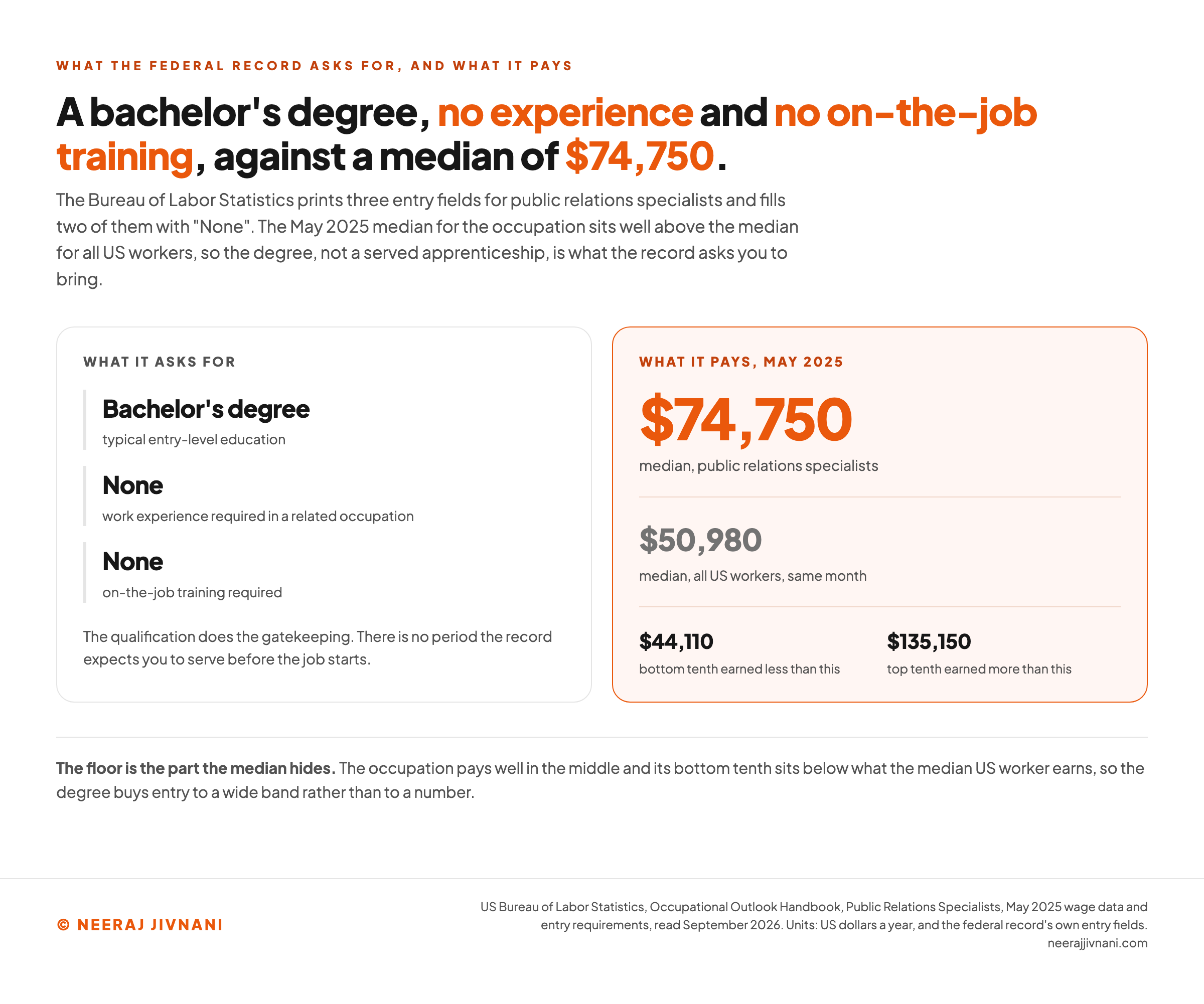
The median annual wage for public relations specialists was $74,750 in May 2025, which is $35.94 an hour, in Bureau of Labor Statistics data. The median for all workers in the same month was $50,980.
The spread matters more than the middle.
The lowest 10 percent of specialists earned less than $44,110, and the highest 10 percent earned more than $135,150.
The manager tier sits higher again. The same federal profile prints a 2025 median pay of $136,470 for public relations and fundraising managers, counted as one occupation rather than two.
That median sits above $135,150, the top tenth of specialists. It also covers fundraising managers, so it is not a clean read on what a public relations manager alone earns.
Those managers direct the creation of materials that enhance an employer's or a client's public image, on the same profile's description.
One number, against the dated band
Put in the figure you are holding, whether it is an offer or your current pay. It is placed against the Bureau of Labor Statistics May 2025 distribution for public relations specialists, then against the median of the industry you pick.
Or start from one of the three points the Bureau publishes:
The industry, if you know it
Where it lands
Nothing entered yet. The band above is the whole occupation in May 2025: the bottom tenth under $44,110, the median at $74,750, the top tenth over $135,150. The median for all US workers in the same month, $50,980, sits inside that band rather than below it.
Where the Jobs Are Is Not Where the Money Is
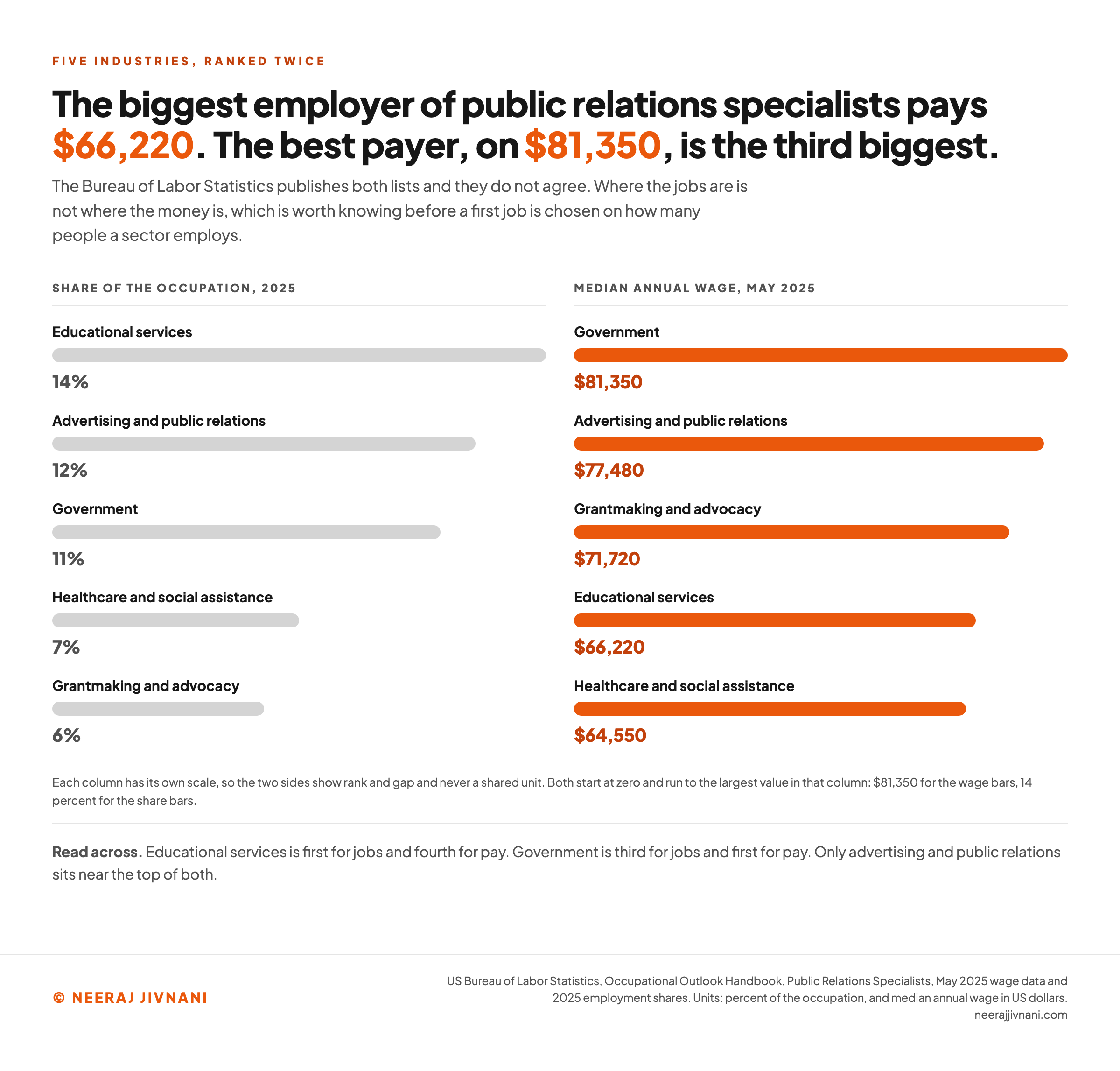
Who employs specialists and what each industry pays them are published side by side, and the two lists do not agree.
The largest employers are educational services at 14 percent of the occupation, advertising and public relations at 12, government at 11, healthcare and social assistance at 7, and grantmaking and advocacy organizations at 6.
Ranked by pay, the same five reorder. Government tops the list at $81,350, with advertising and public relations at $77,480 and grantmaking and advocacy at $71,720.
Educational services, the largest employer of the five, pays $66,220, and healthcare and social assistance pays $64,550. All of it is Bureau of Labor Statistics data for May 2025.
So where the jobs already are is not where the money is. That is worth knowing before a first job is chosen on the strength of how many people a sector employs.
Is PR a High Paying Job?
Yes on the median, and not reliably at the bottom.
Specialists earned $74,750 against $50,980 for all workers in May 2025, in the Bureau's data, so the middle of this occupation sits well above the middle of the labor market.
The bottom tenth is the other answer. It earns less than the median worker across all occupations, so a high-paying job on average is not a high-paying job on arrival.
The Bureau publishes this as a distribution rather than a single average, and that is the part that changes a decision. The band is wide enough that one number in the middle of it says almost nothing about a particular job.
Almost No Growth, and 23,000 Openings a Year
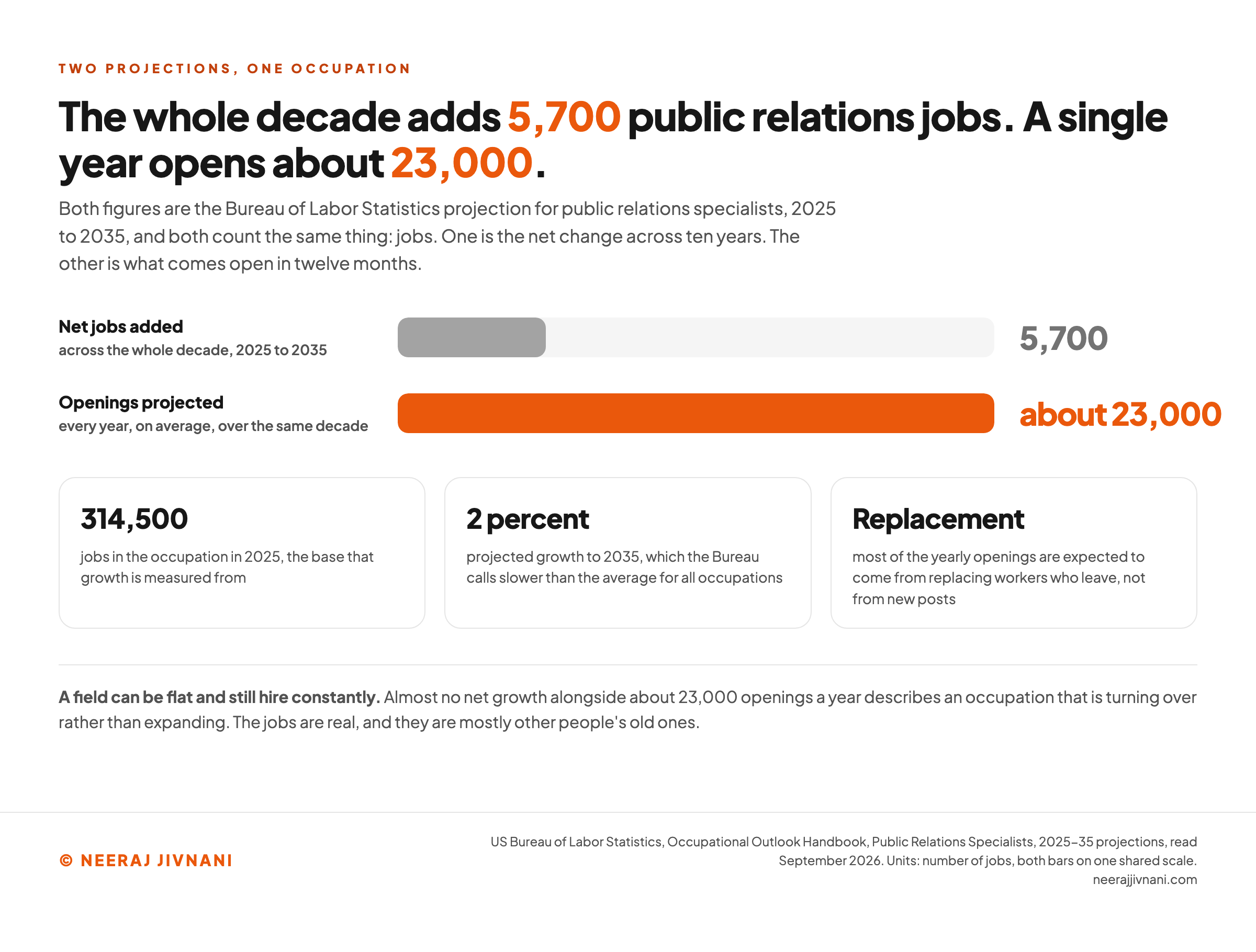
Two federal numbers describe the next decade, and they point different ways.
The Bureau projects 2 percent growth from 2025 to 2035, which adds 5,700 jobs to a base of 314,500. It calls that slower than the average for all occupations.
It also projects about 23,000 openings a year, most of them expected to come from replacing workers who leave rather than from new posts.
A field can be flat and still hire constantly.
That is the difference between an occupation that is growing and one that is turning over.
Use this chart — embed code and citation
<a href="https://neerajjivnani.com/blog/public-relations/"><img src="https://neerajjivnani.com/infographics/public-relations/where-jobs-and-money-sit.png" alt="Paired chart showing that the five largest employers of public relations specialists are not the five best-paying industries, with educational services holding 14 percent of the occupation at a median of 66,220 dollars while government holds 11 percent at 81,350 dollars, from Bureau of Labor Statistics May 2025 data." width="1200"></a>
<p>Chart: <a href="https://neerajjivnani.com/blog/public-relations/">Neeraj Jivnani</a></p>Neeraj Jivnani, "Public Relations: What the Job Is, and What It Pays", neerajjivnani.com, https://neerajjivnani.com/blog/public-relations/Free to republish with a link back to this page.
Use this chart — embed code and citation
<a href="https://neerajjivnani.com/blog/public-relations/"><img src="https://neerajjivnani.com/infographics/public-relations/flat-but-hiring.png" alt="Comparison of the 5,700 public relations jobs the Bureau of Labor Statistics projects will be added over the whole decade from 2025 to 2035 against the roughly 23,000 openings it projects every single year, most of them replacing workers who leave, on a base of 314,500 jobs." width="1200"></a>
<p>Chart: <a href="https://neerajjivnani.com/blog/public-relations/">Neeraj Jivnani</a></p>Neeraj Jivnani, "Public Relations: What the Job Is, and What It Pays", neerajjivnani.com, https://neerajjivnani.com/blog/public-relations/Free to republish with a link back to this page.
The Route In, and What the Numbers Say About Taking It
The route into public relations is shorter on paper than the pay would suggest.
The typical entry-level education for a public relations specialist is a bachelor's degree, on the federal record. The work experience required in a related occupation is none, and so is the on-the-job training.
The qualification does the gatekeeping, and there is no apprenticeship period anybody expects you to serve first.
What a PR Degree Contains
A public relations major runs to 33 credits at Fairfield University.
Those credits are 11 three-credit courses: seven required foundations, one writing course, one ethics course and two electives. Its eight stated learning outcomes are more revealing than that course list.
Graduates are expected to apply primary and secondary research, to write crisis plans across media platforms, to produce ethically sound and socially responsible plans, and to identify the right channel for a given audience and situation.
Research, crisis planning and channel choice are the work itself.
Is Public Relations a Good Career?
The honest answer has two halves and they pull against each other.
On pay, yes. The median beats the national median by a wide margin, the manager tier is well into six figures, and the qualification needed to start is a bachelor's degree with no prior experience.
On prospects, be careful. The growth is slower than the average for all occupations, and most of the openings exist because somebody left rather than because a new post was created.
The openings are real, and they are mostly other people's old jobs.
The better question is not whether public relations pays.
It is whether you want the job that keeps coming open: writing the pitch nobody has to accept, and being the person allowed to say the organization got it wrong.
Use this chart — embed code and citation
<a href="https://neerajjivnani.com/blog/public-relations/"><img src="https://neerajjivnani.com/infographics/public-relations/what-the-job-asks.png" alt="Two-panel chart setting the federal entry requirements for public relations specialists, a bachelor's degree with no required work experience and no on-the-job training, against the May 2025 pay: a median of 74,750 dollars for the occupation, 50,980 dollars for all US workers, a bottom tenth under 44,110 dollars and a top tenth over 135,150 dollars, from Bureau of Labor Statistics data." width="1200"></a>
<p>Chart: <a href="https://neerajjivnani.com/blog/public-relations/">Neeraj Jivnani</a></p>Neeraj Jivnani, "Public Relations: What the Job Is, and What It Pays", neerajjivnani.com, https://neerajjivnani.com/blog/public-relations/Free to republish with a link back to this page.