What Digital PR Involves, and What Decides Whether a Pitch Lands
Most pitches die on relevance, not on your idea. See what the work involves, how it differs from link building, and what to count afterwards.

/ On this page12 sections
Most pitches die on relevance. Not on the idea, not on the writing, and almost never on the effort that went into them.
Digital PR, short for digital public relations, is the work of giving journalists material they would have used anyway, so that your business gets written about by somebody with no reason to flatter it.
Below is what the work consists of, how it differs from the two things it gets confused with, the order to do it in, and how to tell afterwards whether any of it worked.
Digital PR Is Coverage You Did Not Write
Digital PR earns coverage, mentions and links on other people's websites, by handing the people who write for them something worth publishing.
Online PR and online public relations are the same thing, and online public relations is the heading Wikipedia files it under.
The output is a page you do not control, on a site you do not own, written by somebody you cannot instruct.
That is not a drawback of the method. It is the entire mechanism.
A reader discounts what you say about yourself and does not discount what a reporter says about you. You buy that credibility by giving up the words.
Three things come back when it works.
- Readers who had never heard of you. Somebody reads the piece, follows the link or searches your name, and arrives already half persuaded.
- A record in the places people check. Your name in a trade title is what a buyer finds when they look you up six months later.
- A link a search engine reads as a vote. Sometimes. Never on your terms, and never guaranteed.
They are listed in falling order of reliability, and the last one is the one everybody counts first.
Nobody Owes You a Story
A journalist is not your audience. They are a professional with a beat, an editor, a deadline, and readers of their own who are not your customers.
Nothing you want from them is a reason for them to act.
They will run your story if it helps them file something their readers want. Otherwise they will ignore it, at no cost to themselves.
Hold that in mind and most of the advice in this field sorts itself out.
- Personalize the pitch, because a stranger owes you nothing.
- Lead with the story, because the story is the only part they can use.
- Send fewer, because every one you send to the wrong person spends a little of your standing with them.
The rest is execution.
Digital PR and Traditional PR Are the Same Job in a Different Room
Digital PR and traditional PR do the same job: persuade somebody independent that your thing is worth telling their audience about.
What changes is where the telling lands, and what you can see afterwards.
Traditional PR aims at print, broadcast and the trade press in their paper form. Digital PR aims at the same outlets' websites, at publications that only ever existed online, and at newsletters and podcasts.
Most of the difference people name reduces to one of these two.
You can address it. A newspaper reaches a city. A niche trade site reaches the few thousand people in your industry who read it every morning, and you can tell in advance roughly who they are.
You can count it. A clipping on a desk tells you a story ran. A live page tells you how many people came through it, what they did next, and whether the link is still there a year later.
Neither of those makes digital PR better. They make it a different instrument, and the older one still has uses this one cannot cover.
A regional paper, a broadcast slot and a trade magazine's print edition still reach people who will never meet your website. If those people decide whether you get paid, the old instrument is the right one.
What has genuinely gone is the wall between them. The same reporter files for the paper and the site, and the pitch that works for one works for both.
Where Link Building Stops and Digital PR Starts
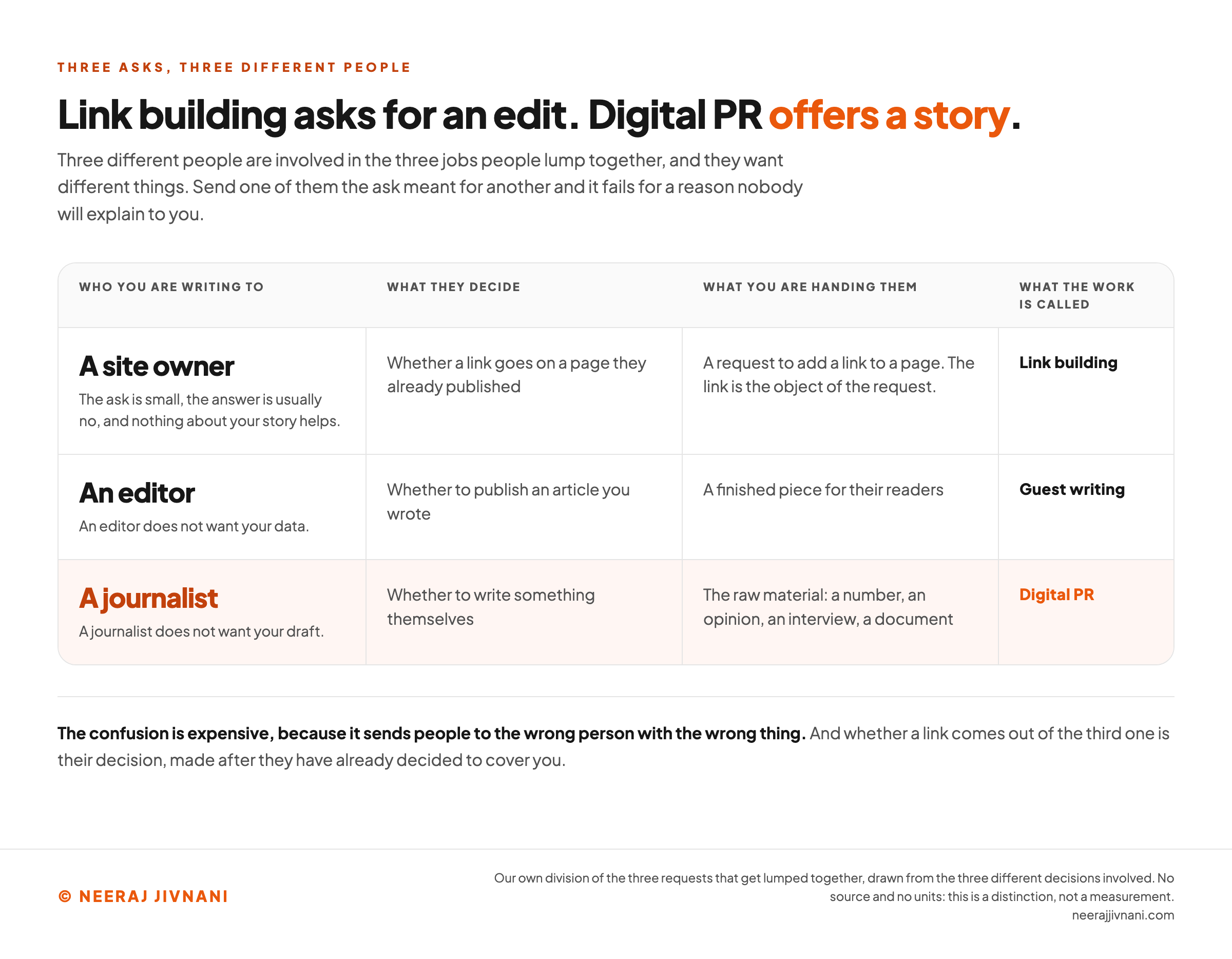
Link building and digital PR differ in the only way that matters: what you are asking a person to do.
Link building asks somebody who runs a website to add a link to a page. The link is the object of the request.
Digital PR gives somebody who writes for a living material for an article they were going to write anyway. Whether a link comes out of it is their decision, made after they have already decided to cover you.
One asks for an edit. The other offers a story.
The confusion is expensive, because it sends people to the wrong person with the wrong thing.
The Editor, the Site Owner and the Journalist
Three different people are involved in the three jobs people lump together, and they want different things.
A site owner decides whether a link goes on a page they already published. The ask is small, the answer is usually no, and nothing about your story helps.
An editor decides whether to publish an article you wrote. That is guest writing, and the thing you are offering is a finished piece for their readers.
A journalist decides whether to write something themselves. That is digital PR, and the thing you are offering is the raw material: a number, an opinion, an interview, a document.
Send one of those three the ask meant for another and it fails for a reason nobody will explain to you. An editor does not want your data. A journalist does not want your draft.
Use this chart — embed code and citation
<a href="https://neerajjivnani.com/blog/digital-pr/"><img src="https://neerajjivnani.com/infographics/digital-pr/three-asks-three-people.png" alt="A four-column table setting the three requests people lump together against the three different people who answer them. A site owner decides whether a link goes on a page they already published, is handed a request to add a link to a page, and the work is called link building; the note beside them says the ask is small, the answer is usually no, and nothing about your story helps. An editor decides whether to publish an article you wrote, is handed a finished piece for their readers, and the work is called guest writing; the note says an editor does not want your data. A journalist, on the highlighted row, decides whether to write something themselves, is handed the raw material of a number, an opinion, an interview or a document, and the work is called digital PR; the note says a journalist does not want your draft. A line beneath says the confusion is expensive because it sends people to the wrong person with the wrong thing, and that whether a link comes out of the third one is their decision, made after they have already decided to cover you." width="1200"></a>
<p>Chart: <a href="https://neerajjivnani.com/blog/digital-pr/">Neeraj Jivnani</a></p>Neeraj Jivnani, "What Digital PR Involves, and What Decides Whether a Pitch Lands", neerajjivnani.com, https://neerajjivnani.com/blog/digital-pr/Free to republish with a link back to this page.
Three Places a Story Can Come From
Underneath the tactic names, there are only three places a story can come from: something you made, something that happened to you, and something that happened to everyone.
Almost every named tactic is one of those three with a label on it.
Original research and thought leadership are things you made. A press release is something that happened to you. Reactive work is something that happened to everyone, and expert commentary is you being useful about it.
Original Research and Data
You count something nobody has counted, and publish it properly.
This is the most reliable thing on the list, because it gives a journalist something they cannot get elsewhere and cannot write without you.
It is also the most work. A survey needs a real sample and a stated method, and a study assembled to reach a conclusion you had already chosen reads exactly like one.
Say you run a payroll product. The distribution of when small firms run payroll, across your own anonymized accounts, is a story. A list of five payroll tips is not.
Expert Commentary
You offer a named person's view on something a reporter is already writing about.
It is the cheapest item here and the one with the shortest shelf life. A useful quote takes twenty minutes and is worth nothing the day after the story runs.
It works in proportion to how specific the expertise is. "We think AI will change hiring" is not commentary. "Here is what changed in our own hiring, and here is the part that surprised us" is.
Reactive PR and Newsjacking
You watch for news your business genuinely has standing to comment on, and you move fast.
Reactive PR is the professional version: a running list of subjects you can speak to, and somebody able to approve a quote within the hour.
Newsjacking is the opportunist version, attaching your brand to whatever is trending. It works occasionally and it fails loudly, because an audience can tell when a business has nothing to do with the thing it is commenting on.
The discipline here is a list of what you will not comment on, written before anything happens.
Press Releases
A press release announces something. Funding, a launch, a hire, an acquisition, a closure.
It is still the right tool when there is a genuine fact to put on the record and several outlets need the same version of it at the same time.
It is the wrong tool for everything else, and most of what gets written as one has no news in it.
A release announcing that your company exists asks a reporter to find the story themselves, which is the one thing a release is supposed to save them.
Wire distribution buys reach, not interest. It puts your announcement in front of many outlets and persuades none of them.
Thought Leadership
A named person at your company argues a position, in public, under their own name.
The word has been worn smooth, and what survives it is simple: this only works when there is an actual position. Something learned the hard way, something the rest of the field has not said, something you would defend in a room full of competitors.
A summary of industry trends under an executive's byline is not thought leadership. It is a blog post with a photograph on it.
The people doing this work say it matters more than it used to. In Muck Rack's 2026 survey of 1,115 public relations professionals, 51% said thought leadership has become more vital to their job.
Working With Creators
You give somebody with an audience of their own a reason to talk about you.
It sits at the edge of this subject rather than inside it, because the relationship is usually paid and the disclosure rules that govern it are their own field.
What makes it digital PR rather than advertising is the same test as everything else here: whether they would have said it anyway.
The Order the Work Goes In
The order is: audience, then outlet, then story, then pitch. Put the story first and you spend the work before you know who it is for.
Decide who you want to reach, and find the ten or so people who reach them. Not the publications with the biggest numbers. The ones your buyers read.
Read what those ten have published in the last month. You are looking for what they cover, how they cover it, and what they have covered recently enough that pitching it again would be a refusal.
Then find the story. Now you know what would suit them, which is a completely different exercise from thinking of something clever and hoping.
Build the thing. The data, the document, the person who will do the interview.
Write to them individually. One person, one note, one ask, and say what you have rather than asking to jump on a call.
Then wait. Coverage takes weeks, and one follow-up a week later is the whole of what a polite second attempt looks like.
What Has to Be Ready Before Any of It
Two things, and both are cheaper to fix before the coverage arrives than after.
- A page worth landing on, that says what the article said you do.
- Somebody who can answer a reporter's question the same day, because a journalist on a deadline will drop you rather than wait.
The Bottleneck Is Fit, Not Volume
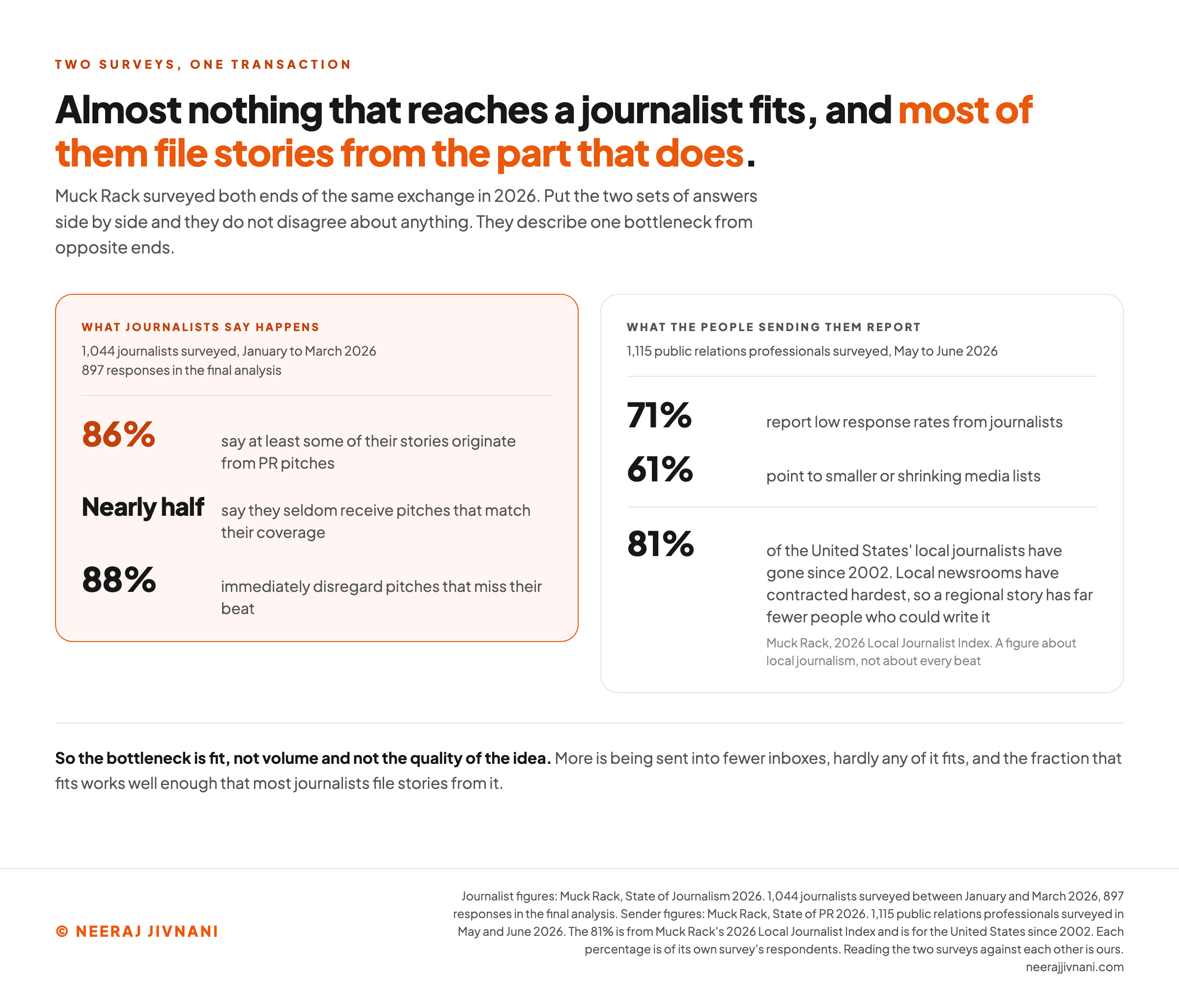
Fit is the bottleneck in digital PR, not volume and not the quality of the idea.
A plain story sent to the one person whose readers want it beats any amount of polish sent to a list. Everything covered so far is execution around that.
The clearest evidence comes from surveying both sides of the same transaction, which Muck Rack did in 2026.
On the receiving side, the channel plainly works. In its survey of 1,044 journalists run between January and March 2026, with 897 responses in the final analysis, 86% said at least some of their stories originate from PR pitches.
And almost none of what arrives is usable. Nearly half of those journalists said they seldom receive pitches that match their coverage, and 88% said they immediately disregard the ones that miss their beat.
On the sending side, the same picture from the other end. In Muck Rack's separate survey of 1,115 public relations professionals in May and June 2026, 71% reported low response rates from journalists and 61% pointed to smaller or shrinking media lists.
Read together, those two surveys do not disagree about anything. They describe one bottleneck from opposite ends.
More is being sent into fewer inboxes, hardly any of it fits, and the fraction that fits works well enough that most journalists file stories from it.
What Relevance Means Here
Relevance is narrower than "people in my industry" and wider than "this reporter's exact subject."
The journalist survey put a useful edge on it. 78% said a pitch feels genuinely relevant when it directly affects the community their audience belongs to.
That is a test you can apply before sending. Not "would this interest them" but "does this change something for the people who read them."
A story about your funding round affects your investors. A story about what your funding round lets you charge affects their readers. Only one of those is a pitch.
Sending More Spends Something You Cannot See
The instinct when nothing lands is to widen the list, and it costs more than it looks.
There are fewer places to widen into than there used to be, and local newsrooms have contracted hardest. Muck Rack's 2026 Local Journalist Index found the United States has lost 81% of its local journalists since 2002, so a regional story has far fewer people who could write it.
A reporter who has had three irrelevant notes from you reads the fourth differently. Nothing tells you that has happened, because the way it shows up is a reply you never get.
The list of people who would genuinely want your story is short. Working it properly takes less time than a wide send does, and it leaves your name intact for the next one.
Use this chart — embed code and citation
<a href="https://neerajjivnani.com/blog/digital-pr/"><img src="https://neerajjivnani.com/infographics/digital-pr/both-sides-of-one-bottleneck.png" alt="Two panels setting what journalists report against what the people pitching them report, under a title saying almost nothing that reaches a journalist fits and most of them file stories from the part that does. The left panel, from Muck Rack's survey of 1,044 journalists between January and March 2026 with 897 responses in the final analysis, carries three figures: 86 percent say at least some of their stories originate from PR pitches, nearly half say they seldom receive pitches that match their coverage, and 88 percent immediately disregard pitches that miss their beat. The right panel, from Muck Rack's survey of 1,115 public relations professionals in May and June 2026, carries 71 percent reporting low response rates from journalists and 61 percent pointing to smaller or shrinking media lists, with a separate figure beneath it from Muck Rack's 2026 Local Journalist Index showing 81 percent of the United States' local journalists gone since 2002, marked on the image as a figure about local newsrooms specifically. A line beneath says the bottleneck is fit rather than volume or the quality of the idea, because more is being sent into fewer inboxes, hardly any of it fits, and the fraction that fits works well enough that most journalists file stories from it." width="1200"></a>
<p>Chart: <a href="https://neerajjivnani.com/blog/digital-pr/">Neeraj Jivnani</a></p>Neeraj Jivnani, "What Digital PR Involves, and What Decides Whether a Pitch Lands", neerajjivnani.com, https://neerajjivnani.com/blog/digital-pr/Free to republish with a link back to this page.
What Coverage Does for SEO
Coverage on a site that search engines trust is, in the usual case, a link nobody paid for, from a page about your subject. That is the kind search engines were built to count.
It is also why this work is so often sold by search engine optimization (SEO) agencies rather than by press offices, and why the pitch for it usually leads on links.
Two limits keep it honest.
The link is not yours to decide. The publication writes the words in it, chooses whether it is followed, and may not include one at all, and pushing on any of that spends goodwill on the part of the placement that matters least.
And coverage cannot rescue a page that should not rank. If the thing you are pointing people at is thin, the links arrive and nothing moves.
Coverage and the Answers Machines Write
Search results are increasingly an answer rather than a list, and those answers are assembled from pages the system considers trustworthy. Most of those pages belong to somebody else.
That makes third-party coverage a discovery channel in a way it was not five years ago. The article about you is now read by the thing writing the answer, not only by the person who found the article.
The profession has noticed and has not organized around it. In its 2026 survey of 1,115 practitioners, Muck Rack found that 29% said nobody at their organization owns generative engine optimization, and 39% said they are not measuring it at all.
The thing that gets you cited by a machine is the same thing that got you cited by a person: coverage in trusted places, about subjects you genuinely belong to.
What it does change is the cost of being absent. A business with no third-party coverage used to be merely hard to find. Now there is nothing for an answer to be assembled from.
What to Count Afterwards
Digital PR has no launch moment, so the before-and-after reading most campaigns get does not fit it.
Coverage arrives in ones and twos over months, from placements nobody scheduled. A piece you pitched in March runs in June, because a reporter finally needed it.
So measure it as a rate rather than as an event. Record four counts a month, and none of them costs anything to keep.
| Count, each month | Kept where |
|---|---|
| Journalists you wrote to | Your sent folder |
| Journalists who answered | Your inbox |
| Pieces that ran | A search for your own name |
| People those pieces sent you | Your analytics, under referral |
The counts are not the point. The gaps between them are, because each gap is one decision you made, and the first gap that opens is the one to fix.
Between the first two sits your choice of people. Between the second and third sits what you offered them. Between the third and fourth sits the outlet you landed in.
A month with nothing sent is the first and commonest break, and the only one with nothing further down to diagnose.
After that, a month with no replies is not a month that failed. It says your list was wrong, before you have spent anything else finding out.
Replies with nothing published says the people were right and the material was not ready. Pieces with nobody arriving says you were read by the wrong readers, which is the same fit problem one step further along.
Four counts, read as one chain
Put in last month’s four numbers. Nothing here is scored and nothing is compared to anybody else. The only thing it hands back is the first place the chain stopped, which is the one thing the counting was for.
Your sent folder
Your inbox
A search for your own name
Your analytics, under referral
All four, including any that are zero. A zero is not a missing number here, it is the reading: the chain is diagnosed by where it stops, so an empty box and a nought say completely different things.
None of these four numbers proves the coverage caused the business you got, and no arrangement of them will.
The Rate Is the Only Number That Improves
Coverage is an outcome and you do not control it. The reply rate is a signal about your own judgment, and it moves as soon as you change who you write to.
Two months of reply rates is enough to tell whether your list is right.
Two months of coverage counts tells you nothing, because three of your best pitches may still be sitting unread.
So read the rate monthly and the coverage quarterly. Reversing those is how people conclude too early that this does not work.
What None of It Proves
None of these four numbers proves the coverage caused the business you got, and no arrangement of them will.
Coverage works on people who go away and come back later through a search for your name, with nothing attached to say where they first heard it.
The strongest honest claim available is that searches for your name rose in the months the coverage ran. Anyone offering you a figure that closes that gap has stopped measuring and started selling.
What It Costs, and When Not to Start
Digital PR costs you either hours or a retainer, and there are three conditions under which it is not worth starting at all.
In hours, doing it yourself: most of a day per campaign to find and read the right journalists, and a second day to build whatever you are offering them.
Bought as a service, it is a monthly retainer with a link or coverage target attached.
One British agency publishes its price on this subject's own search results: £900 a month for a minimum of five links per three-month payment across three to five stories.
An agency promising to keep running stories until the promised links arrive is telling you something useful in its own sales copy. It is describing a business in which stories routinely do not produce links.
When Not to Start
Three conditions make this the wrong instrument, and none of them is fixed by trying harder at it.
Your sector has no press. Some industries have two trade titles and one working reporter between them. Count the bylines covering your subject before you budget an hour, and if you cannot reach ten there is not much of a channel here to work.
You have no news and nothing counted. Outreach does not manufacture a story. If nothing about your business is countable, changing or unusual, the honest next step is to go and make something countable, which is a different project.
You need the result dated. Coverage has no delivery date, because the decision belongs to somebody with their own deadlines. Anything that has to land in a particular month is bought rather than earned.
The Short Answers
Three questions arrive with this subject more than the rest.
Is PR Being Replaced by AI?
No, and the pressure is running the other way.
Machine-written answers are assembled from third-party pages, so the value of being written about by somebody independent goes up rather than down.
What is changing is the tooling around the job. In Muck Rack's 2026 survey of journalists, 82% reported using at least one AI tool, so the person you are pitching is probably drafting and summarizing with one.
What no tool does is pick the person. A model will draft your note in seconds and has no idea whose readers want the story, which is the only part that decides anything.
Is PR a High Paying Job?
Pay is a question about the profession rather than about this practice, and digital PR is not a pay grade of its own.
What moves pay inside this corner of it is narrower. Seniority tracks the relationships somebody carries, because a person a national desk will take a call from is not replaceable by a larger team.
What Are the Seven Types of PR?
There is no canonical seven. The count changes with who is counting, and the lists name the profession's specialties rather than this practice.
The useful question underneath it is what digital PR itself consists of, and that answer is shorter. Something you made, something that happened to you, and something that happened to everyone.
Fewer People, More Carefully
If you take one thing from this, take the arithmetic underneath it.
Almost nothing sent to journalists fits what they cover, and most journalists file stories from the part that does. That is not a reason to work harder at the pitch. It is a reason to spend the time before the pitch, on the part that decides it.
Pick the ten people whose readers are your buyers. Read what they have published this month. Then find the thing they would have wanted anyway, and give it to them.
The rest of this field is technique, and technique has never been what decided it.