What Guest Posting Is, and What Gets a Piece Published
Most pitches are turned down for reasons you can fix before writing a word. How to pick the right publication, pitch it, and get published.


/ On this page12 sections
Guest posting is writing an article for somebody else's publication, under your own name.
Most pitches are turned down, and usually for a reason the writer could have fixed before opening a document. The wrong publication, the wrong idea, or terms nobody read.
All three are decided before you write a word, which is the useful thing to know at the start rather than in month three.
What Guest Posting Is
A guest post is an article you write for a publication you do not own, published under your byline rather than theirs. Guest blogging is the same thing with an older name, and nothing turns on which word you use.
What lands on the page is usually three parts.
The article, your name on it, and a short bio at the foot with a link in it.
Say you keep the books for a handful of restaurants. A trade magazine for restaurant owners runs your piece on why the first year of accounts goes wrong, with your name on it and two lines about you underneath.
That is a guest post.
The word that matters in all of this is "for". You are writing for their readers, not placing something on their domain.
Who Decides What
Almost nothing about the finished piece is yours to decide, and that catches people out.
The editor decides whether it runs at all, when it runs, what the headline says, and what gets cut. You decide what to offer and how well you write it.
That is the whole trade.
You are not buying space, you are giving somebody an article they would have wanted anyway.
What You Get Out of a Published Piece
Three things arrive from a guest post, and they arrive in a fixed order of reliability. Readers first, standing second, the link last and least.
Readers who did not know you existed. Somebody reads the piece, likes how you think, and follows the bio to your site. This happens the week it publishes and you can watch it happen.
A byline on somebody else's masthead. Your name now sits on a publication your buyers already read, and it stays there. This is the part that compounds.
A link, sometimes, that you did not write. The publication decides whether you get one, where it sits, and what it says.
The order is the argument. Get it upside down and you end up writing for places your customers have never heard of.
What It Does Not Do
A guest post does not move your rankings on its own, and nobody can tell you what one is worth.
It also does not work as a substitute for having something on your own site worth reading. A piece that sends people to a page with nothing on it spends the introduction.
And it is slow.
The writing is a day's work. The queue after it is not measured in days at all.
Does Guest Posting Still Work
Yes, and the thing that decides it has not changed: whether the publication would have wanted the article without your link in it.
That is not a moral test, it is a practical one. A publication that would have commissioned the piece has readers who will read it, and a publication that takes anything has readers who read nothing.
The reason people ask is that guest posting went through a decade as a link building tactic, got flooded, and left a lot of publications closed to submissions.
What happened is narrower than the folklore.
The places that were publishing anything for a fee are still doing it and are worth less than they were; the places with real editors still want good pieces and are harder to reach.
So the answer splits by what you are asking for. If you want articles published, this works.
If you want links delivered, you are in a different market, and it announces itself.
Say a trade magazine answers your pitch by asking for an outline and naming a slot about eight weeks out. A marketplace answers the same afternoon with a price list and offers you Tuesday.
The second is not a faster version of the first.
It is a different product, and an editor cannot promise a date because the decision has not been made yet.
Where the Line Sits Between an Article and a Placement
Writing for other publications is not the thing being policed. What is being policed is content parked on a strong domain to borrow that domain's standing, and the two are different acts.
The rule that draws the line is Google's site reputation policy, and its wording is worth having exactly.
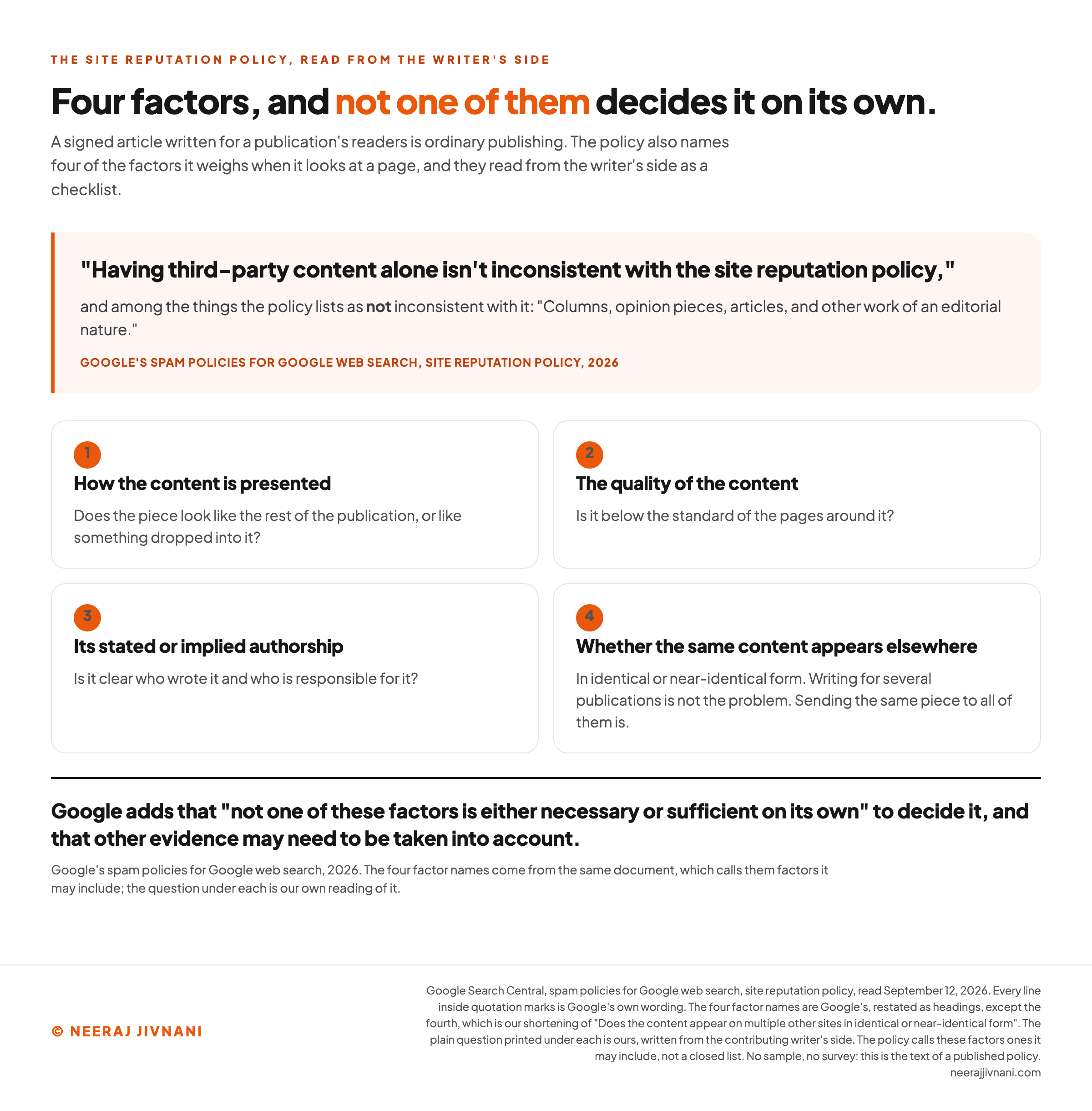
"Having third-party content alone isn't inconsistent with the site reputation policy," Google's spam policies state, and among the things it lists as not inconsistent are "Columns, opinion pieces, articles, and other work of an editorial nature."
So a signed article written for a publication's readers is ordinary publishing.
The policy also names four of the factors it weighs when it looks at a page, and they read from the writer's side as a checklist:
- How the content is presented. Does the piece look like the rest of the publication, or like something dropped into it?
- The quality of the content. Is it below the standard of the pages around it?
- Its stated or implied authorship. Is it clear who wrote it and who is responsible for it?
- Whether the same content appears elsewhere in identical or near-identical form.
Google adds that "not one of these factors is either necessary or sufficient on its own" to decide it, and that other evidence may need to be taken into account.
Read them together and the picture is plain.
A signed, original, well-made piece that belongs where it sits is fine, however many publications you write for.
The Example the Policy Itself Gives
The policy works through a case that is close to a guest post, and it settles the question most contributors are asking underneath the one they ask out loud.
A freelancer writes for a news site's new cooking section. The site is branded consistently, editorial responsibility is stated, and the freelancer is named as the author.
The same freelancer also writes similar pieces for other publications.
Google's verdict is that it is unlikely to act, because the work is "primarily unique content generated for the host site and its end users."
Writing for several publications is not the problem.
Sending the same piece to all of them is.
What This Means for Volume
The question underneath "how many guest posts should we be doing" is usually "how many before something goes wrong", and the policy does not answer in counts at all.
It answers in duplication, authorship and fit. A person writing four genuinely different pieces a year for four publications is nowhere near any of it.
Our own reason for keeping the number low is different and simpler. A piece worth publishing takes real work, and the second one is only easier because the first one earned you an editor who answers.
Use this chart — embed code and citation
<a href="https://neerajjivnani.com/blog/guest-posting/"><img src="https://neerajjivnani.com/infographics/guest-posting/no-single-factor-decides-it.png" alt="Panel setting out four of the factors Google's site reputation policy weighs when it looks at a page, each with the plain question it asks a contributing writer. A quoted band at the top carries the policy's own wording that having third-party content alone is not inconsistent with the site reputation policy, and that columns, opinion pieces, articles and other work of an editorial nature are among the things it lists as not inconsistent with it. The four factors follow as numbered cards: how the content is presented, asking whether the piece looks like the rest of the publication or like something dropped into it; the quality of the content, asking whether it is below the standard of the pages around it; its stated or implied authorship, asking whether it is clear who wrote it and who is responsible for it; and whether the same content appears elsewhere in identical or near-identical form. A closing band quotes Google adding that not one of these factors is either necessary or sufficient on its own to decide it, and notes that the policy calls these factors ones it may include rather than a closed list." width="1200"></a>
<p>Chart: <a href="https://neerajjivnani.com/blog/guest-posting/">Neeraj Jivnani</a></p>Neeraj Jivnani, "What Guest Posting Is, and What Gets a Piece Published", neerajjivnani.com, https://neerajjivnani.com/blog/guest-posting/Free to republish with a link back to this page.
Finding Publications That Take Contributors
Start with the publications you already read. You know their readers, you know what they run, and you can tell in a minute whether your idea has been done there.
Most of them say somewhere whether they take contributors.
Look in the footer for a page called Write for Us, Contribute, or Contributor Guidelines, and look on the contact page if there is nothing in the footer.
When that runs out, search for the phrase rather than the topic. Your subject plus "write for us" in quotes, then plus "contributor guidelines", then plus "submit an article", will surface most of what advertises itself.
Two more sources cost nothing and neither needs a subscription.
- Writers who already do this. Pick somebody in your field who turns up in several publications and look at where their byline appears. Those publications take outside pieces, whether or not they advertise it.
- Publications that have covered your subject before. A site that ran a piece on your topic two years ago has an editor who thinks it is worth covering.
Be slowest about the places that advertise loudest. A page promising placement on a thousand sites is selling access, not an audience.
Qualifying One Before You Pitch It
Open the publication and read it for ten minutes.
That is the whole method, and it beats every score you can buy.
Four things are visible from the outside and all four matter more than any number.
- Whose readers are these? If they are not the people you want, nothing else on this list rescues it.
- Do the contributed pieces read like the staff pieces? Real editing shows. So does its absence.
- What is the publishing rhythm? A site running twelve outside pieces a day on unrelated subjects is a noticeboard.
- Is anybody there? Comments, shares, a masthead with names on it, something published this month.
You will meet Domain Authority, Domain Rating and similar scores offered as the standard way to do this step. They are tool companies' estimates of a domain's link profile, and not one of them can tell you whether anybody there edits.
So a score can shorten a list. It cannot answer the question this step is asking.
What to Pitch, and How to Send It
Pitch a specific article, not yourself.
An editor can say yes to "here is a piece on why restaurant accounts go wrong in year one" and cannot say anything to a general offer to contribute.
The first is a decision they can make in ten seconds. The second asks them to do your thinking and then answer you about it.
Choosing the Idea
The idea does more work than the email around it, so spend the time there.
Look for the piece they would obviously want and have not run. Search their site for your subject first, because pitching something they published two years ago is the fastest refusal there is.
The strongest pitch is something only you can write.
What you have counted, what you have watched go wrong repeatedly, the thing everybody in your trade knows and nobody outside it does.
If the answer is "a general guide to your subject", you do not have a pitch yet. Every publication already has that page.
The Email
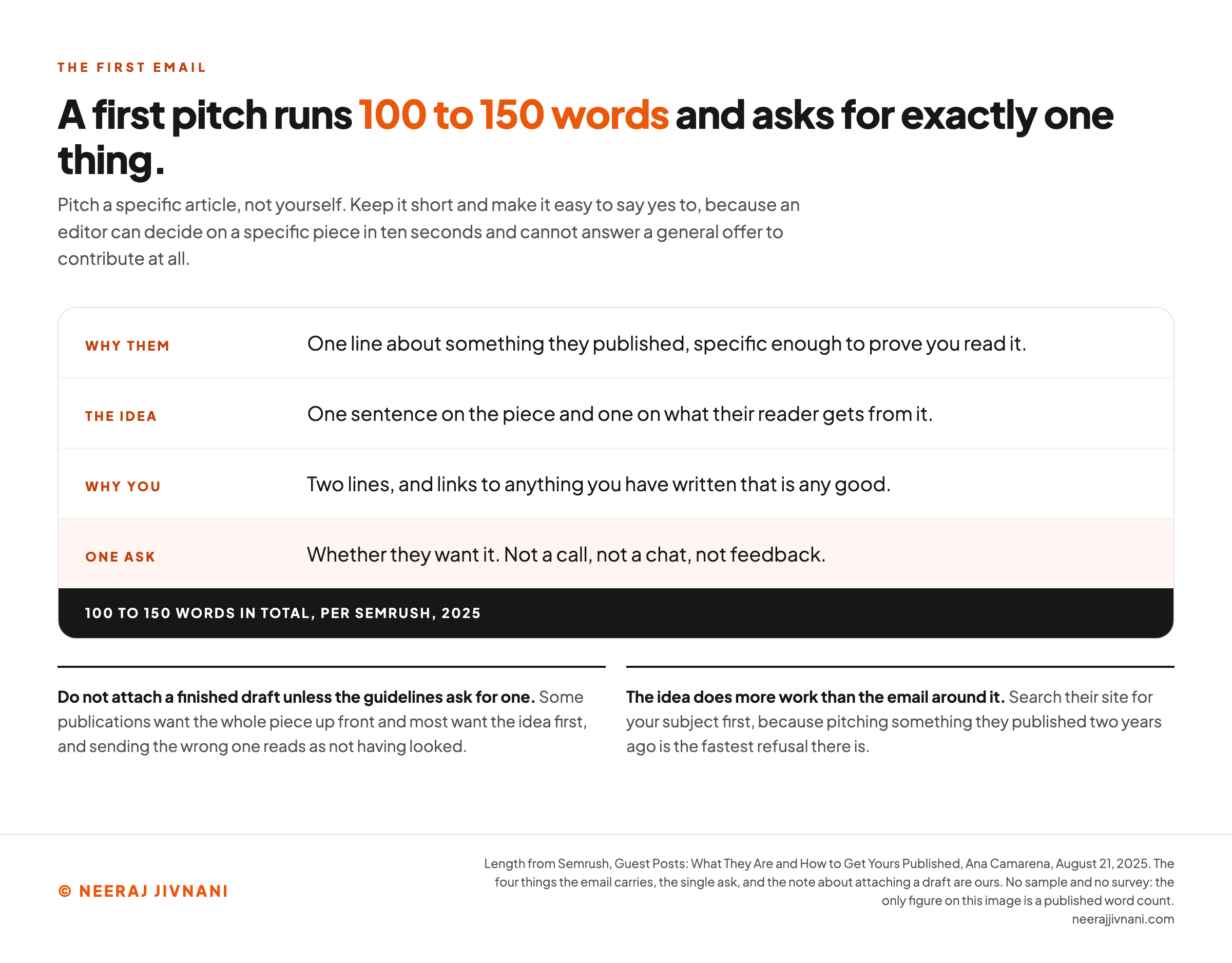
Keep it short and make it easy to say yes to. Semrush puts the useful length at 100 to 150 words, which is about right for a first approach.
Four things belong in it.
- Why them. One line about something they published, specific enough to prove you read it.
- The idea. One sentence on the piece and one on what their reader gets from it.
- Why you. Two lines, and links to anything you have written that is any good.
- One ask. Whether they want it. Not a call, not a chat, not feedback.
Do not attach a finished draft unless the guidelines ask for one. Some publications want the whole piece up front and most want the idea first, and sending the wrong one reads as not having looked.
What Silence Means
Silence is normal and it is not a refusal.
An editor's inbox is a backlog, so a pitch nobody has answered has usually not been judged at all.
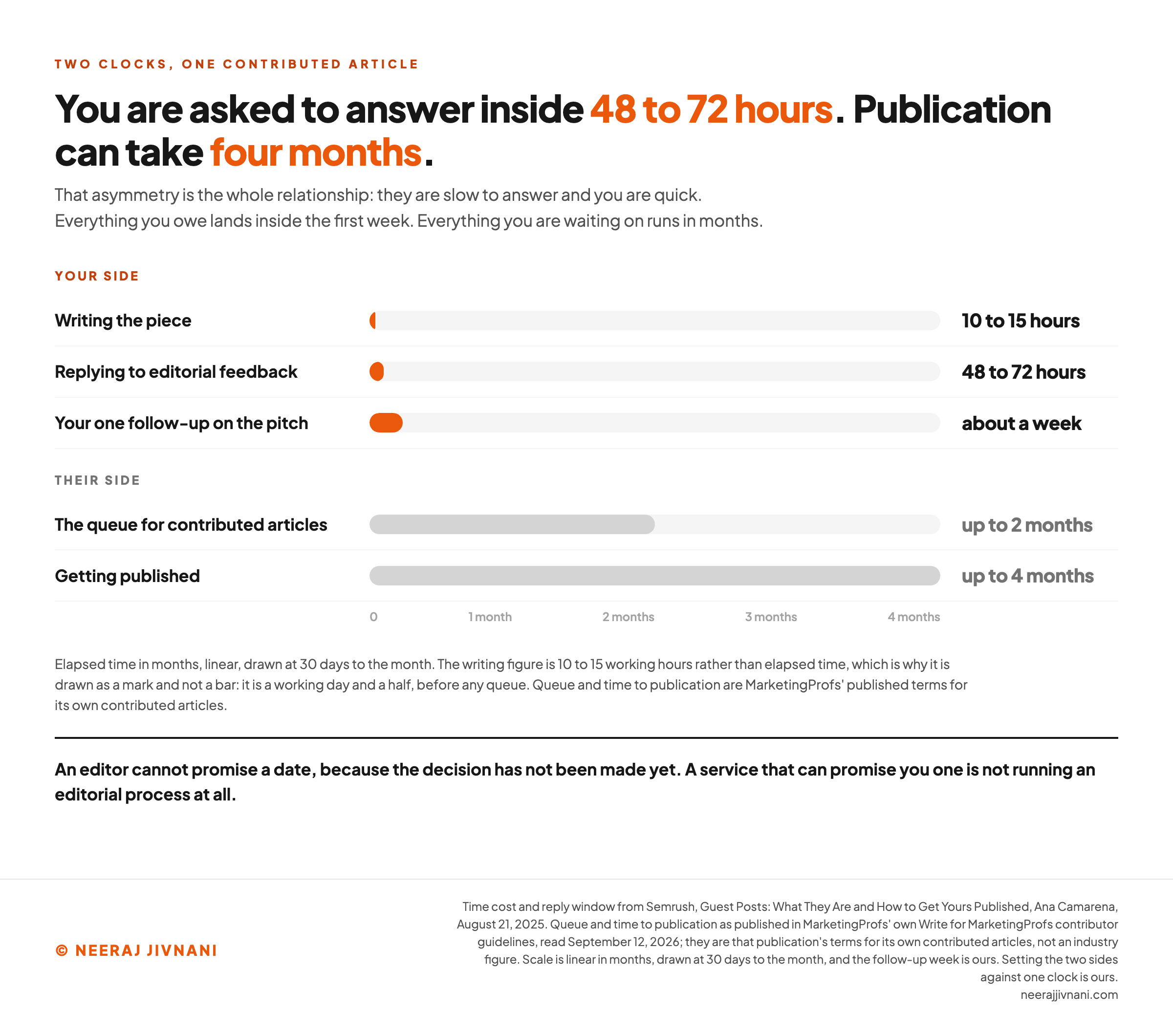
Leave it about a week, then send one short nudge on the same thread. After that, the effort belongs to the next publication rather than to this one.
Semrush suggests replying to editorial feedback within 48 to 72 hours once a conversation is going, and that asymmetry is the whole relationship: they are slow to answer and you are quick.
Use this chart — embed code and citation
<a href="https://neerajjivnani.com/blog/guest-posting/"><img src="https://neerajjivnani.com/infographics/guest-posting/a-first-pitch-is-a-hundred-words.png" alt="Annotated diagram of a first pitch email, laid out as four labeled blocks with a total length of 100 to 150 words printed along the foot. Why them is one line about something they published, specific enough to prove you read it. The idea is one sentence on the piece and one on what their reader gets from it. Why you is two lines, and links to anything you have written that is any good. The final block, marked as the single ask, is whether they want it, and not a call, not a chat, not feedback. Two notes underneath say not to attach a finished draft unless the guidelines ask for one, and that the idea does more work than the email around it." width="1200"></a>
<p>Chart: <a href="https://neerajjivnani.com/blog/guest-posting/">Neeraj Jivnani</a></p>Neeraj Jivnani, "What Guest Posting Is, and What Gets a Piece Published", neerajjivnani.com, https://neerajjivnani.com/blog/guest-posting/Free to republish with a link back to this page.
The Four Things the Guidelines Decide for You
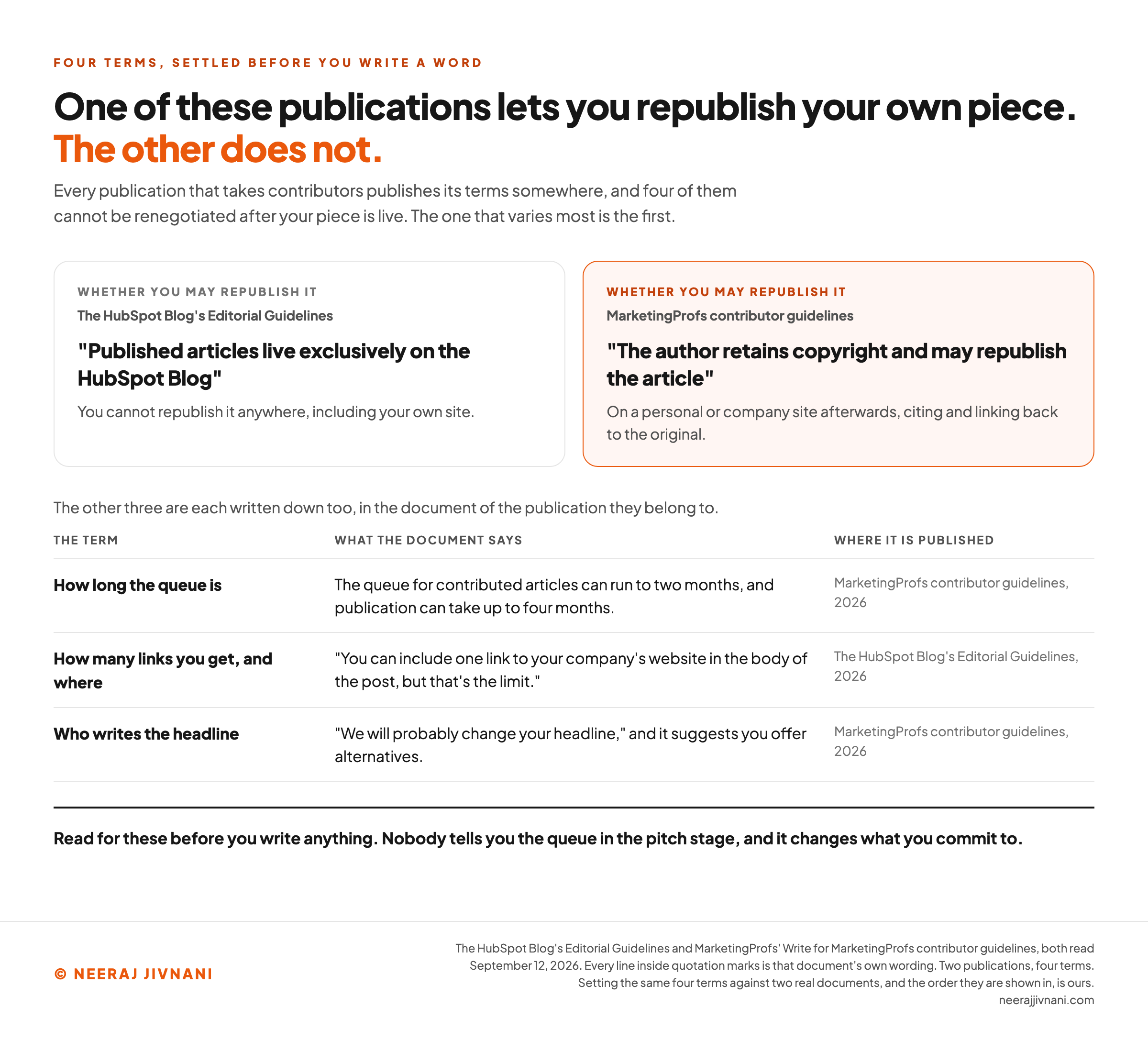
Every publication that takes contributors publishes its terms somewhere, and four of them cannot be renegotiated after your piece is live. Read for these before you write anything.
Whether you may republish it. This one varies most and costs most to get wrong. HubSpot's editorial guidelines state that "Published articles live exclusively on the HubSpot Blog" and that you cannot republish it anywhere, including your own site. MarketingProfs takes the other position: "The author retains copyright and may republish the article" on a personal or company site afterwards, citing and linking back to the original.
How long the queue is. MarketingProfs says its queue for contributed articles can run to two months, and that publication can take up to four months. Nobody tells you this in the pitch stage, and it changes what you commit to.
How many links you get, and where. HubSpot's guidelines are specific: "You can include one link to your company's website in the body of the post, but that's the limit." Assume one, wherever the publication puts it, unless a document tells you otherwise.
Who writes the headline. MarketingProfs says plainly, "We will probably change your headline," and suggests you offer alternatives. This is normal and it is not a slight.
The same documents are also where the refusals are written down, and they are worth reading for what they will not take. HubSpot lists "Anything that may be construed as a link-building scheme" among the things it passes on regardless of quality.
Use this chart — embed code and citation
<a href="https://neerajjivnani.com/blog/guest-posting/"><img src="https://neerajjivnani.com/infographics/guest-posting/the-same-four-terms-two-answers.png" alt="Comparison panel of the four terms a publication settles before a contributor writes anything, with two real contributor-guidelines documents answering them. Two facing cards cover republication and disagree: The HubSpot Blog's Editorial Guidelines state that published articles live exclusively on the HubSpot Blog, so you cannot republish it anywhere including your own site, while MarketingProfs' contributor guidelines state that the author retains copyright and may republish the article on a personal or company site afterwards, citing and linking back to the original. A table below carries the other three, each from one document: MarketingProfs on the queue for contributed articles running to two months with publication taking up to four months; HubSpot allowing one link to your company website in the body of the post and stating that is the limit; MarketingProfs saying it will probably change your headline and suggesting you offer alternatives. A band at the foot says to read for these before you write anything, because nobody tells you the queue at the pitch stage." width="1200"></a>
<p>Chart: <a href="https://neerajjivnani.com/blog/guest-posting/">Neeraj Jivnani</a></p>Neeraj Jivnani, "What Guest Posting Is, and What Gets a Piece Published", neerajjivnani.com, https://neerajjivnani.com/blog/guest-posting/Free to republish with a link back to this page.
Writing It to the House Standard
Write the piece you would want to read in that publication, in the house register rather than your own. That is most of the job.
The house standard is visible in the shape first.
Their piece lengths, their heading style, whether they use lists, how they handle sources.
MarketingProfs, for instance, asks for 800 to 1,000 words and not much more than 1,200. A publication that asks for that and gets something far longer has a problem, not a gift.
Then write it as though the link were not there. If removing every mention of your business would not damage the piece, it is a piece; if it would gut it, it is an advertisement and an editor will see that in a paragraph.
Take your business out
Paste the draft you are thinking of sending, name the words that point at your business, and read what is left.
Your company name, your product names, your own web address. Separate them with commas.
Fill both boxes and this performs the removal on your own words, twice: once with every mention struck out, and once with the sentences around them deleted.
Expect to Be Edited
Your draft is a draft.
Assume at least one round of changes and treat the notes as the editor doing their job.
Push back only on accuracy. If a change makes something wrong, say why, plainly, and offer a fix.
Everything else, the headline, the cuts, the reordering, is theirs. Writers who argue those get published once.
The Bio
The bio is small, it is where your link usually sits, and almost nobody writes it deliberately.
Keep it short.
MarketingProfs asks for 25 words, which is a fair guide anywhere.
Say who you are in a way that makes the article more credible, then point somewhere specific. The page you send people to should continue what they have been reading.
What a Guest Post Costs to Produce
In hours, not money, on the route worth taking. Semrush puts a guest post at 10 to 15 hours once you count finding the publication, pitching it, and writing to somebody else's standard.
That is a working day and a half for one piece, before any queue. The question is not whether that is a lot; it is whether one publication's readers are worth a day and a half of your week.
There is a second market where money changes hands, priced per placement, and it exists because the wait and the refusals are real.
What you buy there is not the same object. You are paying for a slot on a site that will take one, which is the definition of a site where a slot is worth least.
The tell is the speed.
A publication with an editor takes weeks and turns things down; a service that can promise you a date is not running an editorial process at all.
Use this chart — embed code and citation
<a href="https://neerajjivnani.com/blog/guest-posting/"><img src="https://neerajjivnani.com/infographics/guest-posting/you-answer-in-days-they-answer-in-months.png" alt="Horizontal bar chart on a shared linear scale of nought to four months, splitting the clock on a contributed article into your side and theirs. Your side carries three short bars: writing the piece at 10 to 15 working hours, drawn as a mark rather than a bar because it is working time and not elapsed time; replying to editorial feedback within 48 to 72 hours; and your one follow-up on the pitch at about a week. Their side carries two long grey bars: the queue for contributed articles at up to two months, and getting published at up to four months. A line at the foot says an editor cannot promise a date because the decision has not been made yet, and that a service that can promise you one is not running an editorial process at all." width="1200"></a>
<p>Chart: <a href="https://neerajjivnani.com/blog/guest-posting/">Neeraj Jivnani</a></p>Neeraj Jivnani, "What Guest Posting Is, and What Gets a Piece Published", neerajjivnani.com, https://neerajjivnani.com/blog/guest-posting/Free to republish with a link back to this page.
What to Watch Once It Is Live
Four readings tell you whether this was worth doing, and not one of them needs a tool you do not already have.
| What to watch | Where it comes from | What it tells you |
|---|---|---|
| Visits from that publication | Your analytics, under referral traffic | Whether their readers are your readers |
| Searches for your own name | Google Search Console, filtered to your brand | Whether the byline is reaching anybody |
| What those visitors then do | Your analytics, on the page you sent them to | Whether the page you pointed at was ready |
| Whether the editor replies next time | Your inbox | The only one that predicts the next piece |
None of these is a ranking number, and that is deliberate. Nothing you can measure this quarter will tell you what the link did.
Read all four after a quarter rather than after a week. One piece in one publication cannot move any of them in seven days.
One thing to do the day it goes up, before any of that. Share the piece and tell the editor you did, because a minute there is the difference between one guest post and a standing invitation.
Questions People Ask About Guest Posting
The same short list arrives with this subject every time, and none of it needs a long answer. Two are about the words people use, one is about hosting guests rather than being one, and one is about whether any of it is worth starting.
Is Guest Posting the Same as Guest Blogging?
Yes. Guest blogging is the older term from when the hosts were mostly personal blogs, and guest posting is what the same thing is usually called now.
Nothing about the work changes with the word.
Some publications prefer "contributed article" or "contributor piece", which describes it better than either.
Should You Accept Guest Posts on Your Own Site?
Only if you will edit them the way you edit your own, which is more work than it sounds.
The same test applies from your side of the desk. If you would not have commissioned the piece, publishing it puts something on your site that is below everything around it.
What Is the Difference Between a Guest Post and a Link Insertion?
A guest post is a new article you write. A link insertion is a link added to an article that already exists, usually somebody else's, usually for a fee.
They are different products.
The second one has no byline, no readers of yours, and none of the standing that makes the first worth doing.
Is One Guest Post Worth Anything?
On its own, a little. One piece in the right publication puts your name in front of the right readers once, and that is a real thing.
What it mostly buys you is the second one.
An editor who has published you before answers your next email, and that is the only part of this that gets easier.
The Article Is the Ask
Everything in this subject gets simpler once the article is the thing you are offering.
The publication becomes obvious, because you write for the readers you want. The pitch becomes obvious, because you are offering a specific piece.
And the rules stop being frightening, because a signed original article that belongs where it sits was never the thing anybody was worried about.
The part people spend the most time on, the link, turns out to be the part you were never deciding.
Write the piece you would be pleased to see under your name in a publication you respect. Send it to one place that would want it.