What Your Domain Authority Score Can Tell You, and What It Cannot
Your domain authority number is one company's estimate, not a Google metric. See the one thing it is safe to decide with it, and when to stop looking.

/ On this page11 sections
Domain Authority is a number invented by a software company called Moz. Google does not hold it, does not read it, and does not use it to rank anything.
That leaves the score one honest job: putting sites in order against each other, in one tool, on one day.
Everything else people do with it asks for a precision the number does not have.
Below is what it is built from, what a good one looks like, how to check yours free, and the point on the scale where it stops being fine enough to decide anything.
What Domain Authority Is
Domain Authority is a score from 1 to 100 that predicts how likely a website is to rank against its competitors. Moz built it, Moz publishes it, and Moz decides what it means.
The prediction is the whole definition. It is not a measure of quality, of trust, or of how good your writing is.
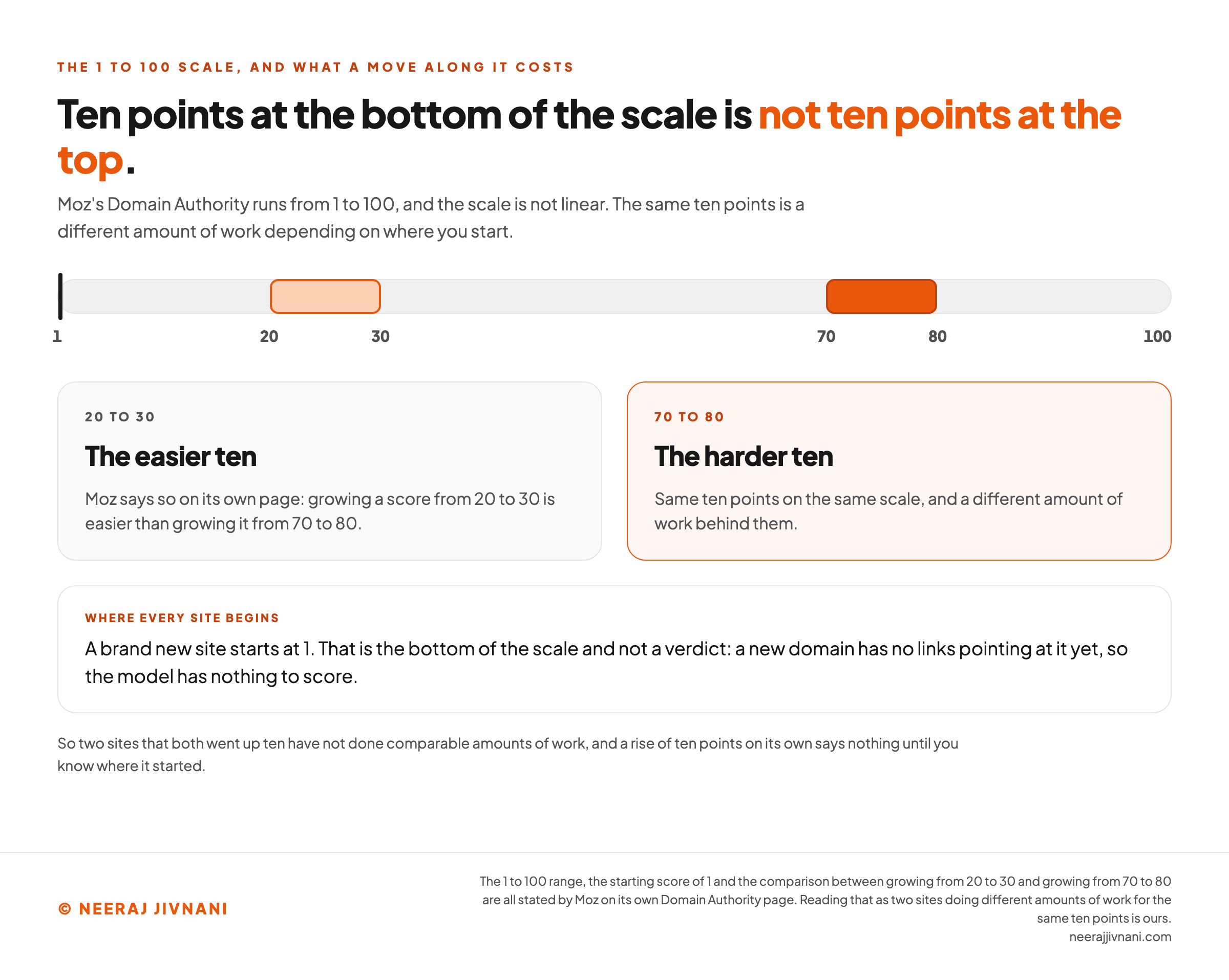
A brand new site starts at 1.
That is the bottom of the scale and not a verdict. A new domain has no links pointing at it yet, so the model has nothing to score.
The scale is also not linear, and Moz puts that in plain terms on its own page: growing from 20 to 30 is easier than growing from 70 to 80.
So ten points means something different at each end. Two sites that both went up ten have not done comparable amounts of work.
Use this chart — embed code and citation
<a href="https://neerajjivnani.com/blog/domain-authority/"><img src="https://neerajjivnani.com/infographics/domain-authority/ten-points-is-not-ten-points.png" alt="A horizontal 1 to 100 scale headed that ten points at the bottom of the scale is not ten points at the top. Two ten point stretches are picked out on the track: 20 to 30, labeled the easier ten, and 70 to 80, drawn in solid orange and labeled the harder ten. A marker at 1 shows where every site begins. The first card repeats that Moz says on its own page that growing a score from 20 to 30 is easier than growing it from 70 to 80; the second says the same ten points on the same scale carries a different amount of work behind it. A panel headed where every site begins says a brand new site starts at 1, that this is the bottom of the scale and not a verdict, and that a new domain has no links pointing at it yet so the model has nothing to score. A closing line says two sites that both went up ten have not done comparable amounts of work, and that a rise of ten points on its own says nothing until you know where it started." width="1200"></a>
<p>Chart: <a href="https://neerajjivnani.com/blog/domain-authority/">Neeraj Jivnani</a></p>Neeraj Jivnani, "What Your Domain Authority Score Can Tell You, and What It Cannot", neerajjivnani.com, https://neerajjivnani.com/blog/domain-authority/Free to republish with a link back to this page.
Whether Google Uses It
No. The clearest statement of that comes from the company that owns the metric: Moz's own page says Domain Authority "is not a Google ranking factor and has no effect on the SERPs."
Semrush says the same about the whole category. It describes website authority as "not an official metric used by Google, AI search platforms, or other search engines", and as a concept the search engine optimization industry created to approximate a site's strength.
What Google has admitted to is looser and older.
Ahrefs notes on its own checker page that Google representatives consistently deny using domain authority as a ranking factor, while John Mueller has said Google holds a sitewide score that "maps to similar things."
So something site-wide exists inside Google. It is not this number, nobody outside Google has seen it, and no tool can read it.
That splits the answer to "is Domain Authority real?" in two. It is real as a measurement, computed from a real index, and anyone can look it up.
It is not real as a ranking factor, because it changes nothing about where you appear.
What the Score Is Counting
The score counts links from other websites, and mostly the number of separate sites rather than the number of links.
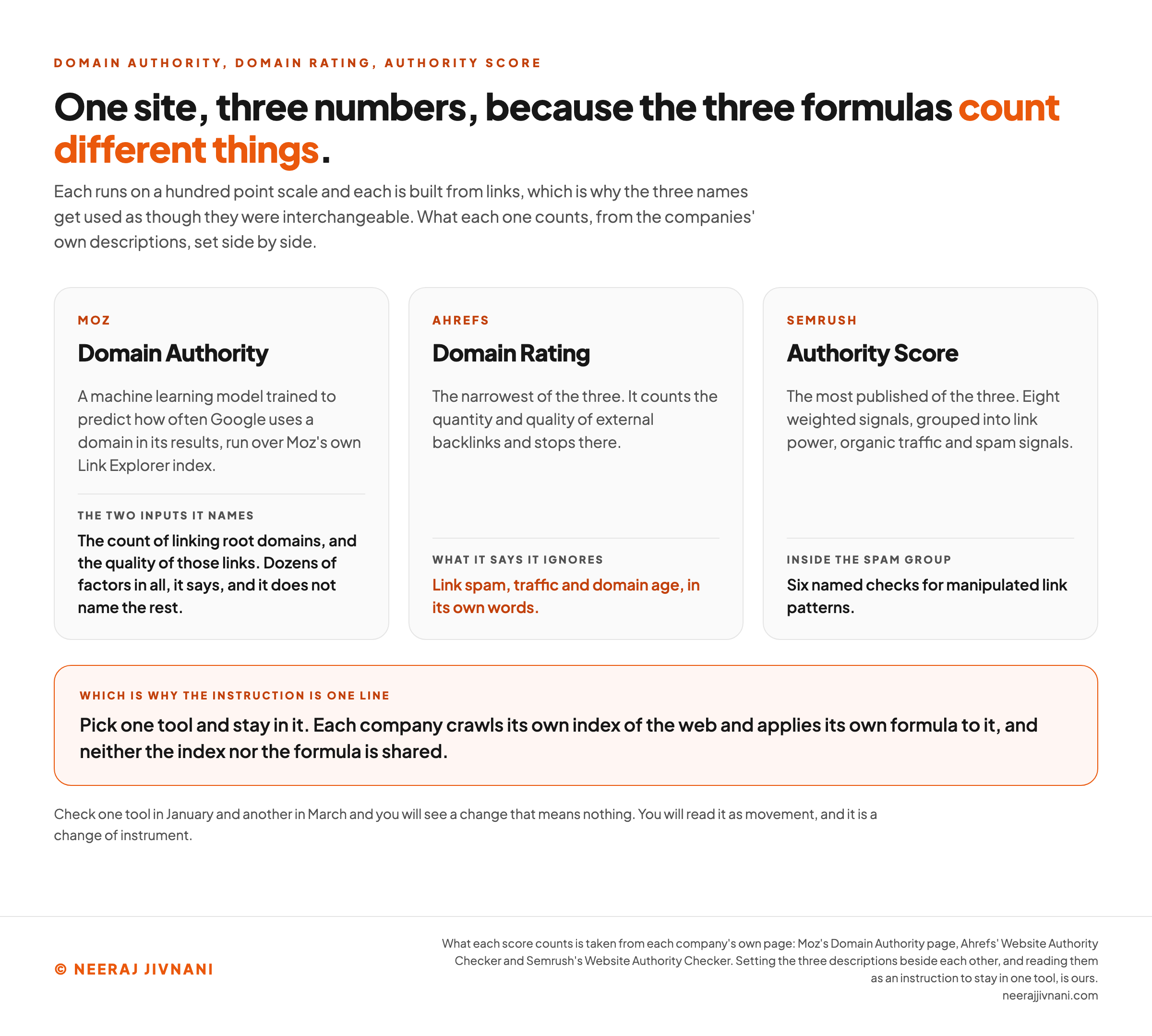
Moz calculates the score with a machine learning model trained to predict how often Google uses a domain in its results, over its own Link Explorer index.
The two inputs it names specifically are the count of linking root domains and the quality of those links. It also says the calculation runs on dozens of factors, and it does not name the rest.
Root domains is the part that trips people up. A hundred links from one website count as one linking root domain, which is close to what they are worth.
Semrush publishes more of its formula than the others do. Its Authority Score combines eight weighted signals across three groups, link power, organic traffic and spam signals, the last being six named checks for manipulated link patterns.
Ahrefs goes the other way and narrows. Domain Rating counts the quantity and quality of external backlinks and, in its own words, takes no account of link spam, traffic or domain age.
Read those three descriptions next to each other and one thing is obvious. They are not counting the same things.
Three Names for the Same Idea
Moz has Domain Authority. Ahrefs has Domain Rating. Semrush has Authority Score.
Each runs on a hundred point scale and each is built from links, which is why the three names get used as though they were interchangeable.
They are not. Semrush's own comparison page calls them different metrics created by different tools, while crediting Moz with introducing the concept to the industry.
The reason is structural. Each company crawls its own index of the web and applies its own formula to it, and neither the index nor the formula is shared.
One instruction follows, and it is most of the practical advice on this subject.
Pick one tool and stay in it.
Check Moz in January and Ahrefs in March and you will see a change that means nothing. You will read it as movement, and it is a change of instrument.
Use this chart — embed code and citation
<a href="https://neerajjivnani.com/blog/domain-authority/"><img src="https://neerajjivnani.com/infographics/domain-authority/three-formulas-not-one.png" alt="A three card comparison of Moz's Domain Authority, Ahrefs' Domain Rating and Semrush's Authority Score, headed that one site gets three numbers because the three formulas count different things. The Moz card describes a machine learning model trained to predict how often Google uses a domain in its results, run over Moz's own Link Explorer index, and names the two it names specifically, the count of linking root domains and the quality of those links, adding that the calculation runs on dozens of factors it does not name. The Ahrefs card calls Domain Rating the narrowest of the three, counting the quantity and quality of external backlinks and stopping there, and lists what it says it ignores: link spam, traffic and domain age. The Semrush card calls Authority Score the most published of the three, with eight weighted signals grouped into link power, organic traffic and spam signals, and six named checks inside the spam group. An orange panel says to pick one tool and stay in it, because each company crawls its own index of the web and applies its own formula to it and neither is shared. A closing line says checking one tool in January and another in March shows a change that is a change of instrument rather than movement." width="1200"></a>
<p>Chart: <a href="https://neerajjivnani.com/blog/domain-authority/">Neeraj Jivnani</a></p>Neeraj Jivnani, "What Your Domain Authority Score Can Tell You, and What It Cannot", neerajjivnani.com, https://neerajjivnani.com/blog/domain-authority/Free to republish with a link back to this page.
How to Check It
You can check any domain free, in a browser, in under a minute. None of the routes below needs a paid plan.
- Moz's Link Explorer takes a domain and returns its Domain Authority alongside the linking root domains and top linking pages behind it. It is free with a Moz Community account.
- The MozBar browser extension puts the same score next to every result while you browse. That is the fastest way to read a whole page of competitors at once.
- Ahrefs and Semrush both run free checkers for their own metrics, returning backlink counts and referring domains with the score.
One more, since the score, Page Authority and spam score get asked about together. All three are Moz metrics, so Moz's own checker is the single place they sit side by side.
Why Your Score Moved When You Did Nothing
Because the score is relative, and the rest of the web does not hold still.
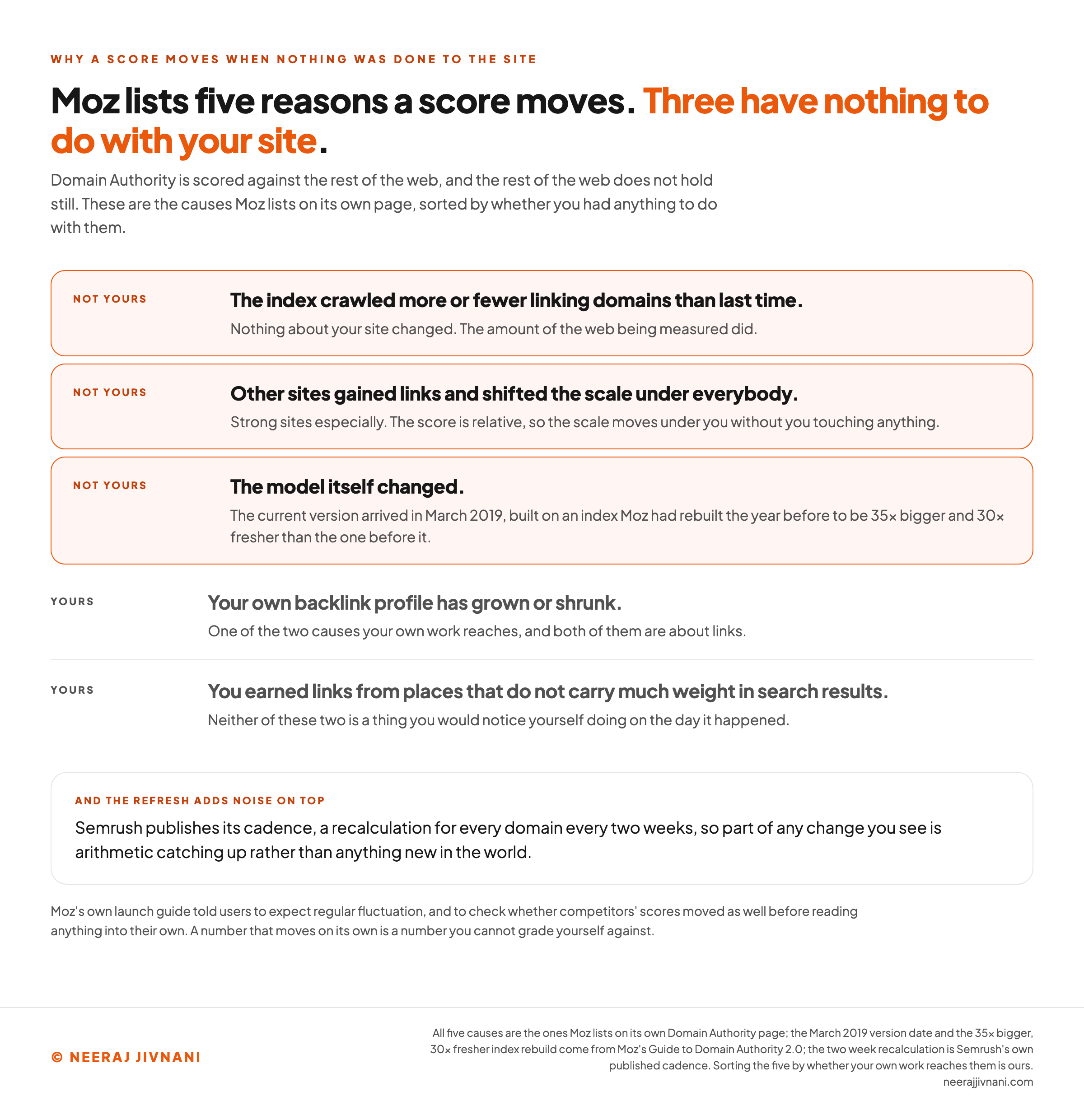
Moz lists five causes on its own page, and three of them have nothing to do with your site.
- Its index may crawl more or fewer linking domains than last time.
- Other sites, especially strong ones, may have gained links and shifted the scale under everybody.
- The model itself may have changed. The current version arrived in March 2019, built on an index Moz had rebuilt the year before to be 35x bigger and 30x fresher than the one before it.
The two that are about your site are both about your links. Your backlink profile may have grown or shrunk, or you may have earned links from places that do not carry much weight in search results.
Neither of those is a thing you would notice yourself doing on the day it happened.
Refresh timing layers more noise on top.
Some of what you see is arithmetic catching up rather than anything new in the world. Semrush recalculates every domain every two weeks, on its own published cadence.
Expect regular fluctuation, then, and check whether competitors' scores moved as well before reading anything into your own. That is what Moz's own launch guide told users to do when the current version arrived.
A number that moves on its own is a number you cannot grade yourself against.
Use this chart — embed code and citation
<a href="https://neerajjivnani.com/blog/domain-authority/"><img src="https://neerajjivnani.com/infographics/domain-authority/three-of-five-are-not-yours.png" alt="A five row list of the reasons a Domain Authority score moves, headed that three of the five have nothing to do with your site. Three rows labeled not yours are drawn in orange: the index crawled more or fewer linking domains than last time, so nothing about your site changed and the amount of the web being measured did; other sites gained links and shifted the scale under everybody, strong sites especially, so the scale moves under you without you touching anything; and the model itself changed, with the current version arriving in March 2019 on an index Moz had rebuilt the year before to be 35x bigger and 30x fresher than the one before it. Two rows labeled yours follow, both of them about links: your own backlink profile has grown or shrunk, and you earned links from places that do not carry much weight in search results, with the note that neither is a thing you would notice yourself doing on the day it happened. A panel underneath adds that Semrush publishes its cadence, a recalculation for every domain every two weeks, so part of any change is arithmetic catching up rather than anything new in the world. A closing line says Moz's own launch guide told users to expect regular fluctuation and to check whether competitors' scores moved as well before reading anything into their own." width="1200"></a>
<p>Chart: <a href="https://neerajjivnani.com/blog/domain-authority/">Neeraj Jivnani</a></p>Neeraj Jivnani, "What Your Domain Authority Score Can Tell You, and What It Cannot", neerajjivnani.com, https://neerajjivnani.com/blog/domain-authority/Free to republish with a link back to this page.
What Moves the Number
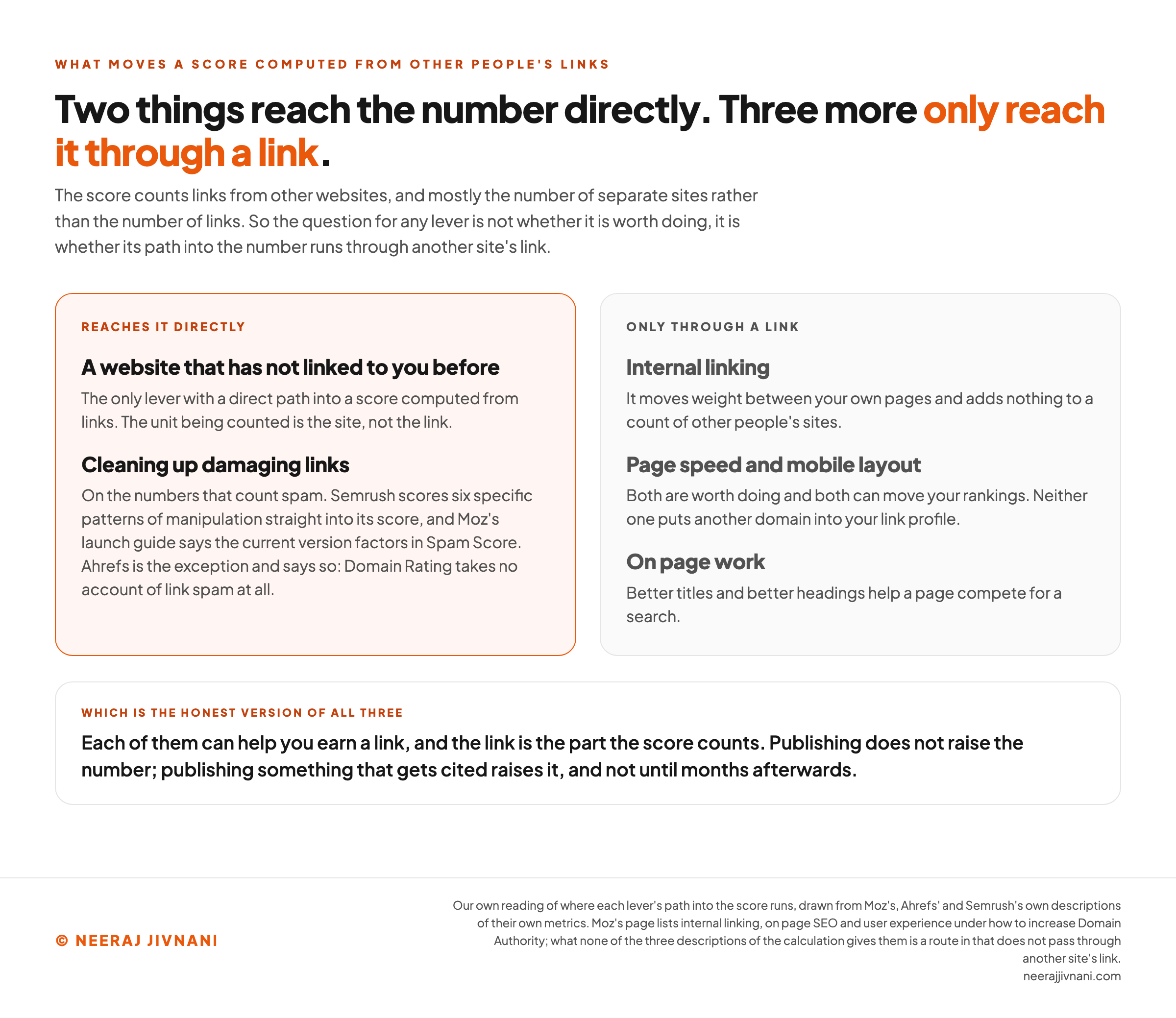
Two things move this number directly, and the larger of them is links from websites that have not linked to you before.
That is the only lever with a direct path into a score computed from links, and everything else on the usual lists reaches it through one.
Earn links from sites that already carry authority, and publish the kind of thing worth linking to: original data, reference material, work somebody has a reason to cite. Ahrefs puts it harder still, saying new referring domains are the only way its own score moves.
Say a trade publication writes about your research and links to it twice. That is one new referring domain, however many times they link, and one is the unit being counted.
Content belongs in this answer for one reason and it is worth being exact about which. Publishing does not raise the number.
Publishing something that gets cited raises it, and not until months afterwards. Read those two sentences again, because almost every complaint about this metric sits between them.
Cleaning up damaging links is the other half of it, on the numbers that count spam. Semrush scores six specific patterns of manipulation straight into its score, and Moz's launch guide says the current version factors in Spam Score.
Ahrefs is the exception and says so: Domain Rating takes no account of link spam at all.
The Levers That Only Reach It Through a Link
Three more things appear on most lists of how to raise your Domain Authority, Moz's own included, and none of them has a direct path into the number.
- Internal linking is the clearest case. It moves weight between your own pages and adds nothing to a count of other people's sites.
- Page speed and mobile layout are worth doing and can move your rankings. Neither one puts another domain into your link profile.
- On page work belongs in the same group. Better titles and better headings help a page compete for a search.
Read the three together and the honest version is the same for all of them. Each can help you earn a link, and the link is the part the score counts.
Do all three. Do not do them expecting this particular number to notice.
The Shortcut That Is Priced In
There is an open market in links sold by the score they claim to lift you into, and you can find the offers on the same pages that give the scores away free.
Every one of these companies now scores manipulation patterns directly.
Semrush names six of them, among them an unusually high share of dofollow domains, referring domains sitting on one network address range, and a backlink profile that does not match the traffic underneath it.
That is the thing worth knowing about that market. The number you would be buying is computed by people looking for exactly that purchase.
Use this chart — embed code and citation
<a href="https://neerajjivnani.com/blog/domain-authority/"><img src="https://neerajjivnani.com/infographics/domain-authority/what-reaches-the-number-directly.png" alt="A two column comparison headed that two things reach the number directly while three things people are told to do only reach it through a link. The left column, drawn in orange and headed reaches it directly, lists a website that has not linked to you before, called the only lever with a direct path into a score computed from links, with the note that the unit being counted is the site and not the link; and cleaning up damaging links, on the numbers that count spam, because Semrush scores six specific patterns of manipulation straight into its score and Moz's launch guide says the current version factors in Spam Score, with Ahrefs named as the exception because Domain Rating takes no account of link spam at all. The right column, headed only through a link, lists internal linking, which moves weight between your own pages and adds nothing to a count of other people's sites; page speed and mobile layout, both worth doing and both able to move your rankings, neither one putting another domain into your link profile; and on page work, where better titles and better headings help a page compete for a search. A panel underneath says each of the three can help you earn a link and the link is the part the score counts, and that publishing does not raise the number while publishing something that gets cited raises it, and not until months afterwards." width="1200"></a>
<p>Chart: <a href="https://neerajjivnani.com/blog/domain-authority/">Neeraj Jivnani</a></p>Neeraj Jivnani, "What Your Domain Authority Score Can Tell You, and What It Cannot", neerajjivnani.com, https://neerajjivnani.com/blog/domain-authority/Free to republish with a link back to this page.
When the Number Is Worth Looking At
Three situations, and they share one property. Each is a comparison between sites, decided once.
- Sizing up a search before committing to it. Put your score beside the pages already ranking and you learn which league the contest is in.
- Sorting a list of link prospects. Fifty sites and one afternoon is the job the score is good at, and Ahrefs describes it that way while warning against judging any site on a sitewide score alone.
- Answering somebody who asks how strong a site is. It is a fast, rough, shared vocabulary, and rough is fine when the decision it feeds is which of two sites to open first.
Outside those three, the number is a distraction dressed as a metric.
Use It Once, Then Stop Looking
Use it once, then stop looking at it.
Domain Authority is a prediction, made by one company, about how a site might fare against other sites. It is at its loosest below the halfway mark of its own scale, and what moves it is other people's sites rather than yours.
A site at 12 and a site at 18 are not meaningfully apart, however much the gap between them reads like one.
Read as a ranking of options the score earns its afternoon. Read as a grade it is a number you cannot move on any schedule and cannot interpret when it moves on its own.
So spend it on the one question it can settle, which is whether the sites ahead of you are in a different league or the same one.
Then let it go. The work that would move the number is the work you would be doing anyway, and what you rank for measures it more honestly.