Which Backlinks Are Worth Having and Which Are Noise
Most links pointing at your site are worth nothing. Here is how to judge one before you spend an hour chasing it, and what the rules allow.


/ On this page13 sections
Most of the links pointing at a small site are worth nothing at all. They sit in directories nobody reads, in forum signatures, in profile pages built to hold links and nothing else.
A few of them move a page up the results, and those few are not hard to spot once you know what to look at.
One thing is worth settling first. A backlink is not something you post; it is something somebody else publishes.
A Backlink Is a Link Somebody Else Points At You
A backlink is a link on another website that points to a page on yours. Some people call it an inbound link or an incoming link, and all three words name the same object.
The direction is the whole definition.
One link is an outbound link for the site that published it, and a backlink for the site it points at. Nothing about the link itself changes; the name changes with the point of view.
Say a bookshop runs a monthly reading group. The local paper writes about reading groups in the city and links to the shop's events page from inside the article.
That link is a backlink for the bookshop. It is also, at the same moment, an outbound link for the paper.
Two things that look similar are not backlinks at all. A link from one page of your site to another is an internal link, and a link from your site out to somebody else's is your outbound link, not theirs.
That difference is the whole reason backlinks get treated as evidence.
Of the three, only a backlink carries a judgment from outside your business, made by a person you cannot instruct.
Why They Count at All
A link does three separate jobs, and only one of them is about ranking.
It is a road first. Somebody reading that newspaper piece clicks through and lands on your events page, and that visit happens whether or not a search engine ever notices the link exists.
It is also how pages get found. A crawl of somebody else's page is how Googlebot reaches yours for the first time, and on a new site it is that or a sitemap you submit yourself.
And it is a signal. A search engine reads a link as one site putting its name to another, so a link from the New York Times counts for more than one from a site nobody has heard of.
Only the first of those three is something you can watch happen. Referral traffic shows up in your analytics the same afternoon, attached to the page that sent it, with nothing to interpret.
The other two are inferred, slowly, over months. That gap between doing the work and seeing anything is what makes this corner of the subject such fertile ground for bad advice.
Sorted by Who Decided to Place It
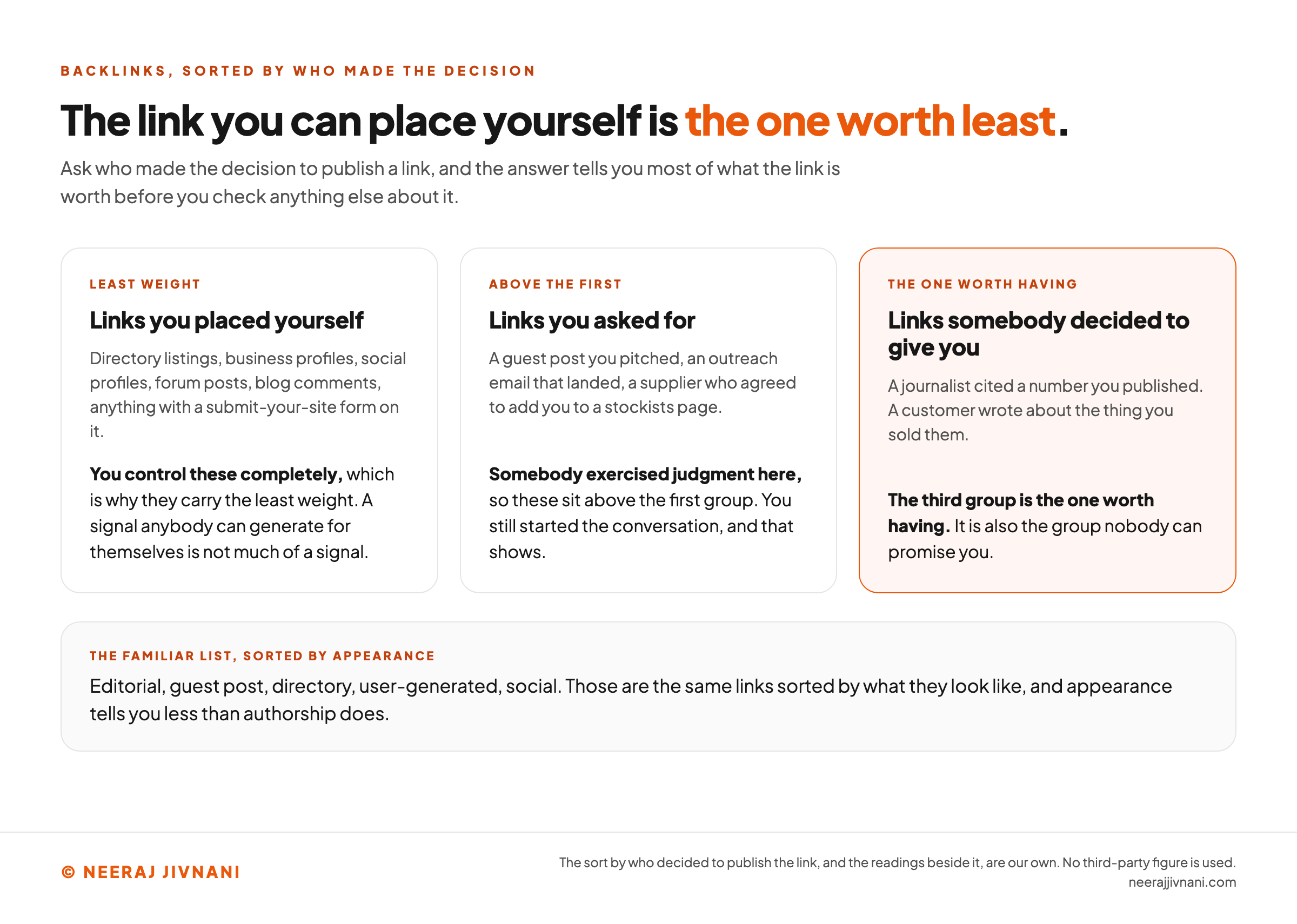
Ask who made the decision to publish a link, and the answer tells you most of what the link is worth before you check anything else about it.
Links you placed yourself. Directory listings, business profiles, social profiles, forum posts, blog comments, anything with a submit-your-site form on it.
You control these completely, which is why they carry the least weight.
A signal anybody can generate for themselves is not much of a signal.
Links you asked for. A guest post you pitched, an outreach email that landed, a supplier who agreed to add you to a stockists page.
Somebody exercised judgment here, so these sit above the first group. You still started the conversation, and that shows.
Links somebody decided to give you. A journalist cited a number you published. A customer wrote about the thing you sold them. Nobody asked and nobody was owed a favor.
The third group is the one worth having.
It is also the group nobody can promise you, and that is the honest problem sitting at the middle of this whole subject.
The familiar list runs editorial, guest post, directory, user-generated, social.
Those are the same links sorted by what they look like. Appearance tells you less than authorship does.
Use this chart — embed code and citation
<a href="https://neerajjivnani.com/blog/backlinks/"><img src="https://neerajjivnani.com/infographics/backlinks/who-decided-to-place-it.png" alt="Three cards sorting backlinks by who decided to publish them, in rising order of what they are worth. The first card, links you placed yourself, covers directory listings, business profiles, social profiles, forum posts, blog comments and anything with a submit-your-site form on it, and is labeled least weight because you control these completely and a signal anybody can generate for themselves is not much of a signal. The second card, links you asked for, covers a guest post you pitched, an outreach email that landed and a supplier who agreed to add you to a stockists page, and sits above the first because somebody exercised judgment here, although you still started the conversation. The third card, highlighted, is links somebody decided to give you: a journalist citing a number you published, or a customer writing about the thing you sold them. It is the group worth having and the group nobody can promise you. A band underneath notes that the familiar list of editorial, guest post, directory, user-generated and social is the same set of links sorted by what they look like, and that appearance tells you less than authorship does." width="1200"></a>
<p>Chart: <a href="https://neerajjivnani.com/blog/backlinks/">Neeraj Jivnani</a></p>Neeraj Jivnani, "Which Backlinks Are Worth Having and Which Are Noise", neerajjivnani.com, https://neerajjivnani.com/blog/backlinks/Free to republish with a link back to this page.
What the Link Attributes Mean
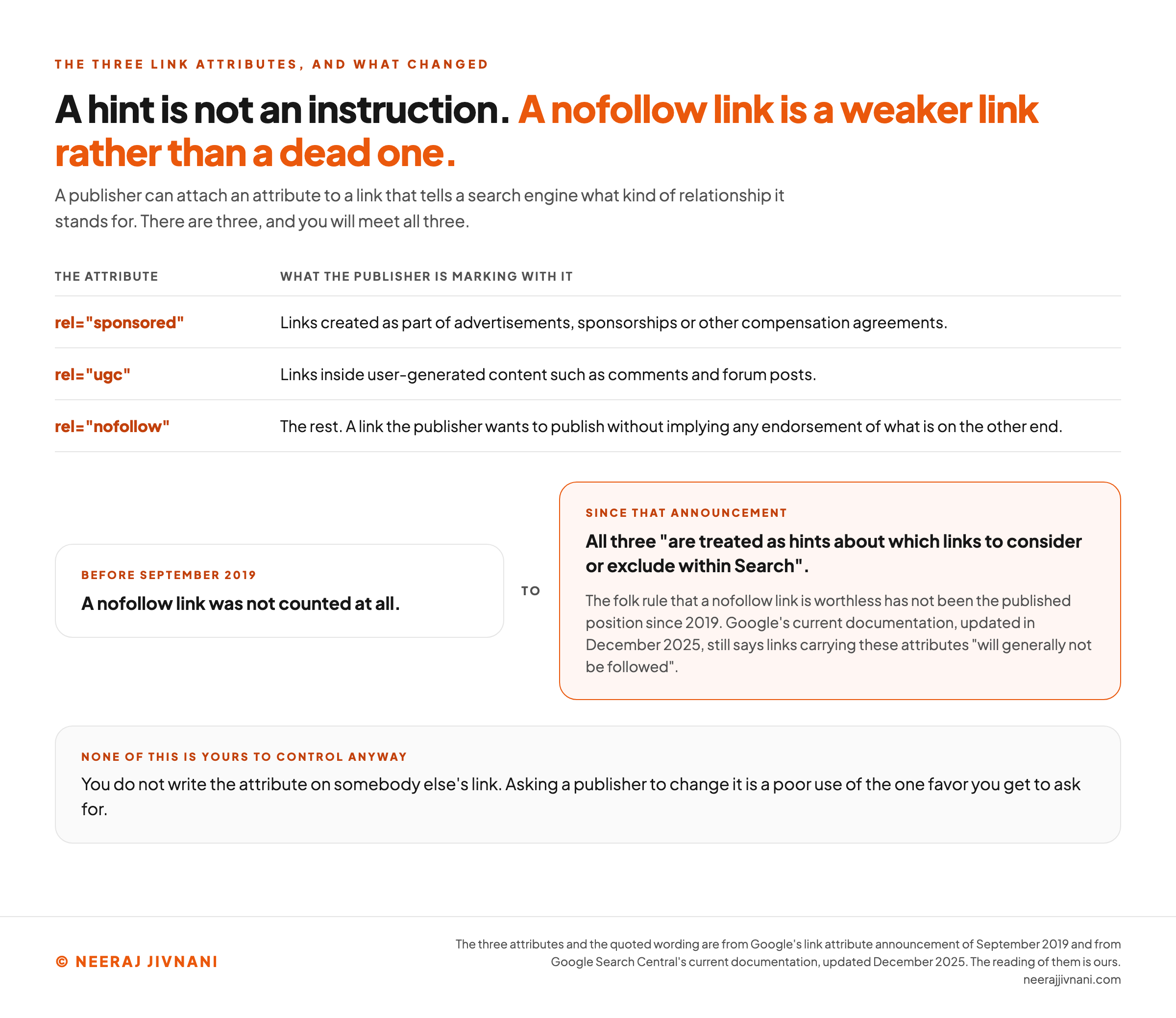
A publisher can attach an attribute to a link that tells a search engine what kind of relationship it stands for. There are three, and you will meet all three, set out by Google in its link attribute announcement of September 2019.
rel="sponsored"marks links created as part of advertisements, sponsorships or other compensation agreements.rel="ugc"marks links inside user-generated content such as comments and forum posts.rel="nofollow"covers the rest. It is for a link you want to publish without implying any endorsement of what is on the other end.
They Are Hints Now, Not Instructions
The folk rule that a nofollow link is worthless has not been the published position since 2019. A hint is not an instruction, and a nofollow link is a weaker link rather than a dead one.
All three "are treated as hints about which links to consider or exclude within Search", Google said in that 2019 announcement, where nofollow had previously meant a link was not counted at all.
Its current documentation, updated in December 2025, says a link carrying one of these attributes "will generally not be followed", and adds that the page on the other end may still be found and crawled another way.
Whether the hint distinction survives into answers assembled by AI is a live question. Nofollow links have nearly the same impact on AI visibility as followed ones, Semrush reports from its own study of 1,000 domains.
None of this is yours to control anyway.
You do not write the attribute on somebody else's link. Asking a publisher to change it is a poor use of the one favor you get to ask for.
Use this chart — embed code and citation
<a href="https://neerajjivnani.com/blog/backlinks/"><img src="https://neerajjivnani.com/infographics/backlinks/hints-not-instructions.png" alt="A reference panel for the three link attributes and the change that came with them. A table gives each attribute and what a publisher is marking with it: sponsored for links created as part of advertisements, sponsorships or other compensation agreements; ugc for links inside user-generated content such as comments and forum posts; and nofollow for the rest, a link the publisher wants to publish without implying any endorsement of what is on the other end. Underneath, two boxes show what changed. Before September 2019 a nofollow link was not counted at all. Since that announcement all three are treated as hints about which links to consider or exclude within Search, so the folk rule that a nofollow link is worthless has not been the published position since 2019, and Google's current documentation, updated in December 2025, still says links carrying these attributes will generally not be followed. The headline reads that a hint is not an instruction and that a nofollow link is a weaker link rather than a dead one. A band at the foot says none of this is yours to control anyway, because you do not write the attribute on somebody else's link, and asking a publisher to change it is a poor use of the one favor you get to ask for." width="1200"></a>
<p>Chart: <a href="https://neerajjivnani.com/blog/backlinks/">Neeraj Jivnani</a></p>Neeraj Jivnani, "Which Backlinks Are Worth Having and Which Are Noise", neerajjivnani.com, https://neerajjivnani.com/blog/backlinks/Free to republish with a link back to this page.
Four Things That Decide What a Link Is Worth
Four things separate a link that helps from a link that sits there doing nothing. They apply in the order below, and the first outranks the other three.
Three of them are visible from the page itself; the fourth is decided by whoever writes the link.
So you can judge most of a link before you spend an hour chasing it, using nothing but the page it would sit on.
Whether the Two Pages Belong Together
Relevance beats size, and it is not close. A link to a bookshop from a review of a novel is worth more than a link from a large site about tires.
The relevance that counts sits at the page level rather than the site level. A link inside an article about your subject and a link on the same site's unsorted links page are not the same thing at all.
This is also the one you can predict in advance. Read the page your link would sit on and ask whether a person reading it has any reason to want yours.
The Page the Link Sits On
The page matters more than the domain it lives on. A link from a well-read article on a mid-sized site beats one from a page on a famous site that nothing points at.
There is a rule of thumb worth carrying here.
Whatever standing a page has, which is what PageRank counts, is shared out among everything it links to. A link on a page carrying dozens of other links is a thinner slice than one on a page carrying three.
That is why a links directory earns you so little.
It is also why one sentence inside an article earns you more than a whole page of listings.
Where on the Page It Sits
Position changes what a link is worth. A link inside the sentence somebody is reading gets clicked; a link in a footer that repeats on every page of a site does not.
Site-wide footer and sidebar links are worth close to nothing.
The version that runs across many different sites is named in Google's list of link spam, as widely distributed links in the footers or templates of various sites.
The Words in the Link
The clickable text is called the anchor, or anchor text. It tells a reader and a search engine what they will get, so the bookshop is better linked as "monthly reading group" than as "click here".
You do not write it. The person linking to you does, and they will usually reach for your page title or your business name.
What you can control is whether your page title makes an obvious anchor. A page called "Reading Group Nights" gets linked with those words far more often than a page called "Our Events" ever will.
One pattern is worth avoiding if you ever do get a say.
Where a high share of the links pointing at one page all use the same keyword phrase, that uniformity is the thing most likely to read as engineered. Anchors written by different people do not converge on one phrase by accident.
Before you spend the hour
Take one link you are thinking of chasing and answer these from the page it would sit on. Nothing here needs a tool, an account or a score.
Who decided
Who would decide to publish it?
Ask who made the decision to publish a link, and the answer tells you most of what the link is worth before you check anything else about it.
First, and it outranks the other three
Would a person reading that page have a reason to click through to yours?
Read the page your link would sit on and ask whether a person reading it has any reason to want yours.
The page it sits on
Whatever standing a page has is shared out among everything it links to.
Where on the page
Where would the link sit?
Answer the three questions above and this reads the post’s own lines back against the link in front of you.
The fourth check is not a question. The words in the link are the anchor, and you do not write it. The person linking to you does, and they will usually reach for your page title or your business name.
How Many You Need
There is no number, and anybody who gives you one is describing their own site or selling you something.
The unit is wrong too. Ten links from one site sit closer in value to one link than to ten, because what is being counted is how many separate places think you are worth pointing at.
So count sites, not links.
There is one figure worth looking up, and it is not a goal. Count how many separate domains link to the pages currently outranking you for the search you want.
That figure bounds the problem instead of setting a target.
It is also the one number here that needs a tool.
Search Console shows your own links and not a competitor's, so this one has to be looked up elsewhere. A free tier covers it, because you look once.
That figure tells you what kind of contest you have walked into, and that is the honest use of it.
Say it comes back at four. That is a contest you can win inside a year, and the four are usually obvious once you open them.
Say it comes back in the hundreds instead.
Nothing you do this year closes that gap. You would be better off finding a narrower search where the number is small again, and Google Search Console will tell you which narrower searches you already show up for.
Where Links Come From in Practice
Two link jobs need nobody's permission, three need a yes from somebody who benefits from giving it, and the rest ask strangers for favors. Sorted that way, the tactics rank themselves.
This is the same three-way split as before, read from the other end. Who decides tells you what a link is worth; how hard the yes is tells you what it costs.
Where Nobody Has to Agree
Two jobs need no permission from anybody, and both are usually left undone:
- Redirect your own dead URLs. A link pointing at a page you retired sends nobody anywhere. Fixing the redirect recovers something you already earned, and it needs no one's consent.
- Fill in the forms. Your trade body, your chamber of commerce, the supplier pages that list stockists, the local directory people in your town use. An afternoon of typing, then it is done.
Neither of these is glamorous and neither takes a budget. Both are finished the day you finish them.
Where One Person Agrees, and Gets Something
The next group asks for a yes from one named person who benefits from saying it:
- Unlinked mentions. Somebody has written your business name without linking it. You are asking a writer to improve their own article, which is a request with a reason inside it.
- Stockist and partner pages. A supplier who lists you is serving their own customers. The link is a by-product of a thing they wanted to do.
- One good guest piece. An editor gets an article worth publishing on a site your customers read. That trade is real, and it works about as often as the piece is good.
This is where the links a small business ends up with mostly come from. The ask is small because the other person is not doing you a favor.
Where a Stranger Gets Nothing
The rest ask strangers to work for your benefit, and the hit rate follows:
- Broken link building. You find a dead link on somebody's page, then persuade a person who has never heard of you to edit a published page. Some of them will. Most will not, and nothing you learn carries to the next one.
- The skyscraper approach. Rewrite the most-linked page on a subject, then ask everyone who linked to the original to switch. That is dozens of separate requests for unpaid maintenance.
- Guest posting at volume. One piece on a site your customers read is a real link. Fifty across sites that publish anything is a different activity, and the sites willing to take fifty are the sites where a link is worth least.
- Competitor link lists. Pulling the list of who links to a competitor is research and not a tactic. It tells you which doors exist. It does not open one.
None of the four is forbidden and none is a waste in every case.
They are the expensive end of the same market. A business with a handful of staff will run out of hours long before it runs out of prospects.
The Part You Cannot Schedule
The work that asks strangers never ends, and the decision it asks for is a budget rather than a plan.
You cannot schedule the outcome, and nobody can tell you what a month of it will return. What you can decide is how many hours a month you will spend before you know whether any of it worked.
Set that number low and then keep it. An hour every other week held for a year does more than two solid weeks of effort abandoned in March.
Small and kept is the version a business with other work to do will hold on to.
A brand new site has a narrower version of the same problem and the same answer. Do the work nobody has to agree to first, then the work one person benefits from, and buy nothing.
Link Spam, in Google's Own List
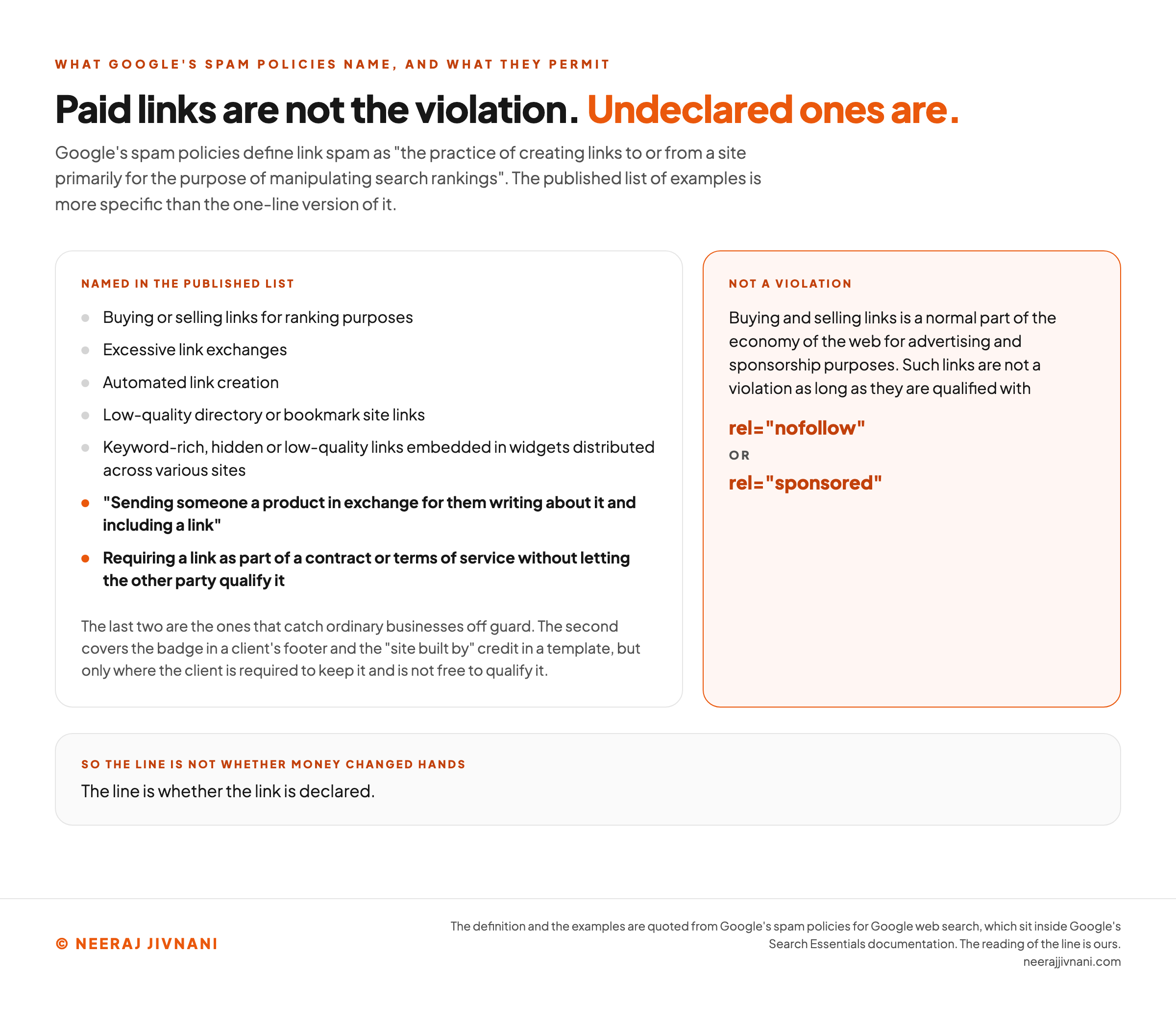
Google's spam policies define link spam as "the practice of creating links to or from a site primarily for the purpose of manipulating search rankings". The published list of examples is more specific than the one-line version of it.
Buying or selling links for ranking purposes is on that list, along with excessive link exchanges and automated link creation.
So are low-quality directory or bookmark site links, and keyword-rich, hidden or low-quality links embedded in widgets distributed across various sites.
The Two That Catch People Out
Two entries catch ordinary businesses off guard. The first is "sending someone a product in exchange for them writing about it and including a link".
A great many small companies send free samples to reviewers without knowing the practice is named there.
The second is requiring a link as part of a contract or terms of service without letting the other party qualify it.
That covers the badge in a client's footer and the "site built by" credit in a template, but only where the client is required to keep it and is not free to qualify it.
One entry runs the other way.
The same Google policy says buying and selling links is a normal part of the economy of the web for advertising and sponsorship purposes. Such links are not a violation as long as they are qualified with rel="nofollow" or rel="sponsored".
So the line is not whether money changed hands.
The line is whether the link is declared, which is also why a declared link is a poor thing to buy for ranking.
The attribute that keeps it inside the rules is the same one that tells Google not to read it as a first-party endorsement.
Is buying links illegal? No, not in itself. It breaks one company's published policy, which is a different thing, and the consequence there is a ranking penalty rather than a legal one.
Use this chart — embed code and citation
<a href="https://neerajjivnani.com/blog/backlinks/"><img src="https://neerajjivnani.com/infographics/backlinks/the-line-is-whether-it-is-declared.png" alt="Two panels setting out what Google's spam policies name as link spam and what they permit. Google defines link spam as the practice of creating links to or from a site primarily for the purpose of manipulating search rankings, and notes that the published list of examples is more specific than the one-line version of it. The first panel lists the published examples: buying or selling links for ranking purposes, excessive link exchanges, automated link creation, low-quality directory or bookmark site links, keyword-rich, hidden or low-quality links embedded in widgets distributed across various sites, sending someone a product in exchange for them writing about it and including a link, and requiring a link as part of a contract or terms of service without letting the other party qualify it. The last two are marked as the ones that catch ordinary businesses off guard, the second covering the badge in a client's footer and the site built by credit in a template, but only where the client is required to keep it and is not free to qualify it. The second panel, highlighted, says buying and selling links is a normal part of the economy of the web for advertising and sponsorship purposes and that such links are not a violation as long as they are qualified with nofollow or sponsored. A band at the foot says the line is not whether money changed hands, it is whether the link is declared." width="1200"></a>
<p>Chart: <a href="https://neerajjivnani.com/blog/backlinks/">Neeraj Jivnani</a></p>Neeraj Jivnani, "Which Backlinks Are Worth Having and Which Are Noise", neerajjivnani.com, https://neerajjivnani.com/blog/backlinks/Free to republish with a link back to this page.
Bad Links Pointing at You
Almost nobody reading this needs to do anything about the links they did not ask for. Anyone can link to your site and you cannot stop them, and that worries people more than the evidence warrants.
The Search Console help page for the disavow tool says so itself: "In most cases, Google can assess which links to trust without additional guidance, so most sites will not need to use this tool."
The published test for using it carries two conditions and both are required. You need a considerable number of spammy, artificial or low-quality links pointing at you, and those links have to have caused a manual action against your site, or be about to.
The same page calls the feature advanced and says it "should only be used with caution", because used incorrectly it "can potentially harm your site's performance in Google Search results".
That warning is the part to take seriously. Disavowing a link tells Google to ignore it, and a list assembled from a low tool score or an unfamiliar domain name will contain links that were doing you good.
One practical detail settles this for a lot of sites. The disavow tool does not support Domain properties in Search Console, so if that is how your site is verified, the tool does not apply to you at all.
Our answer for a business without a manual action is one line. Do nothing.
How to See Who Links to You
Open Google Search Console, go to the Links report, and read External links. The data there comes from Google rather than from an estimate of Google, and it costs nothing.
It gives you the sites linking to you most, the pages of yours that get linked most, and the anchor text people use.
That is enough to see who has already decided you are worth pointing at. The four checks still need you to open the linking page yourself, because no report can tell you whether the two pages belong together.
Two limits are worth knowing.
It does not show you every link, and it does not tell you which of them is doing anything for you.
Read it quarterly rather than weekly. The column that matters is the count of linking sites, and the reading that matters is whether names you did not expect have started to appear.
Whether They Still Matter
Yes, links still help decide which pages rank, and nothing has replaced them.
Across 11.8 million search results, the top result has 3.8 times more backlinks than those ranked two through ten, in Backlinko's analysis updated in July 2026.
Read that carefully. It is a correlation measured across millions of results, not a promise about your page.
It does not say a hundred links will move you, and no honest person can tell you how many would.
What has shifted is that answers now get assembled as well as listed, which is probably why an unlinked mention is no longer worth nothing.
Nobody has published a number for what one is worth. Treat that as a reason to welcome a mention, not a reason to chase one.
None of that changes which links are worth having, which is the question that matters before you spend anything.
The Order We Would Do This In
The order that works is counting first, then the work that finishes, then nothing that calls itself a link building project.
Ten minutes in Google Search Console tells you how many sites link to you today. That number is usually smaller than a business owner assumes and less alarming than they feared.
Then do the finite work. Get listed where your business genuinely belongs, claim the mentions that exist without links, and redirect the URLs you retired.
After that, stop treating links as a project.
The links worth having come from being a business somebody has a reason to mention. That is slower to build than any list of tactics and it is the only part that compounds.
There is no shortcut in that direction.
The shortcuts on offer are the ones the spam policy names.
The test for any link, before you spend an hour on it: would a person reading that page have a reason to click through to yours? If the answer is no, the link is noise whatever score sits beside it.