What a Nofollow Link Is, and Which Half of It You Control
Somebody nofollowed a link to you, or you are about to publish one. Only one of those is a decision, and it takes about ten seconds to make.

/ On this page8 sections
Two things send people looking this up. Either somebody linked to you and mentioned that the link was nofollow, or you are about to publish a link and you do not know what to put on it.
Only one of those is a decision.
The first is a fact about a page you cannot edit. The second is a ten-second decision once you know what the question is, and the question is simpler than the subject makes it look.
What a Nofollow Link Declares
A nofollow link is an ordinary link carrying one extra word in its markup.
``html
<a href="https://example.com/" rel="nofollow">a page we are not vouching for</a>
``
The rel attribute is the whole mechanism. It describes the relationship between the page a link sits on and the page it points to, and nofollow is one of the values it can hold.
Nothing about it changes what a reader gets. Same color, same destination, same tab.
The Word Is Doing Less Than It Sounds Like
The name is the problem, and the standard that defines the keyword shows why.
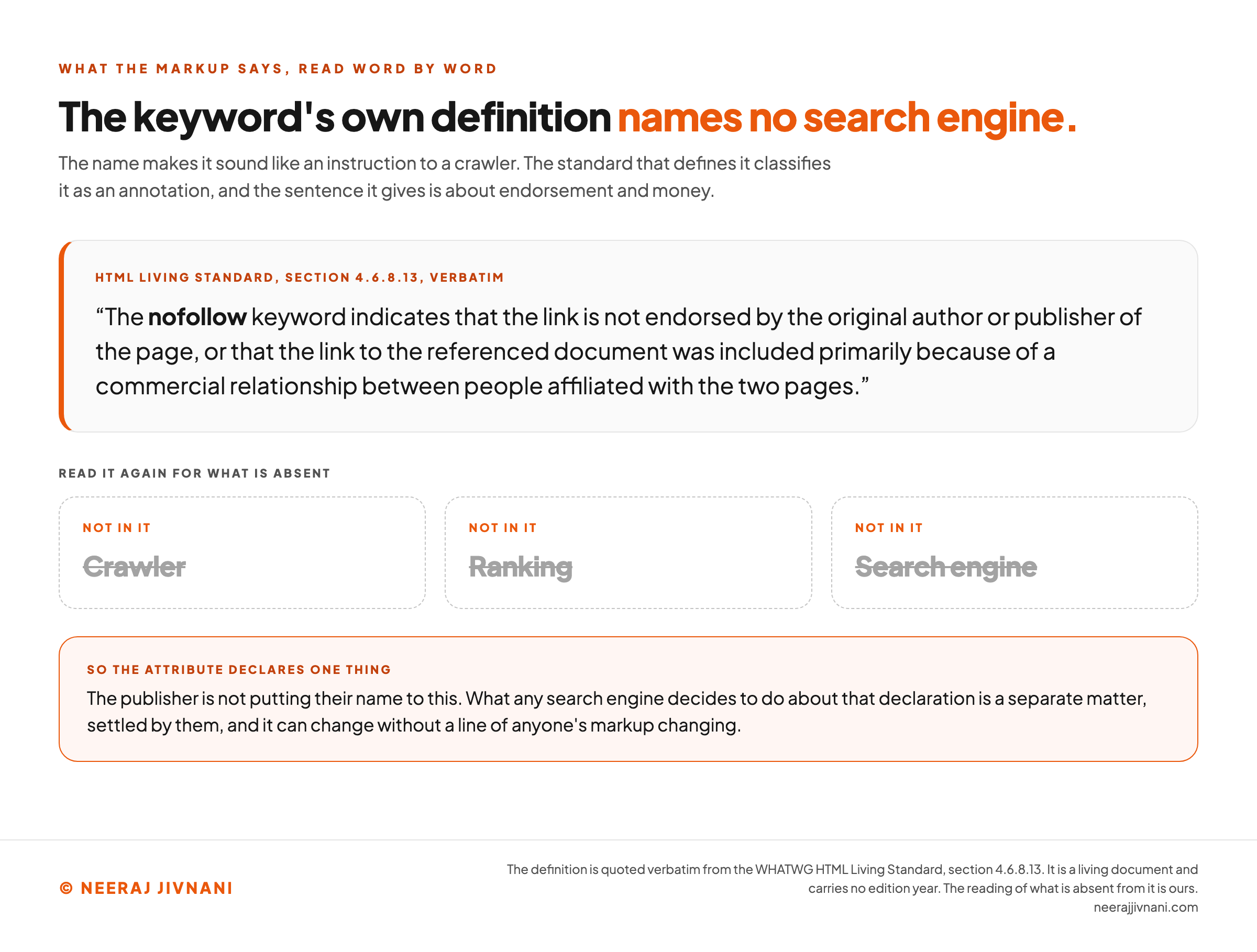
In the HTML Living Standard, nofollow is classified as an annotation rather than an instruction.
The definition reads that the keyword "indicates that the link is not endorsed by the original author or publisher of the page, or that the link to the referenced document was included primarily because of a commercial relationship between people affiliated with the two pages."
Read it again for what is absent.
No crawler. No ranking. No search engine of any kind, anywhere in it.
The markup declares exactly one thing, which is that the publisher is not putting their name to this.
What any search engine decides to do about that declaration is a separate matter, settled by them, and it can change without a line of anyone's markup changing.
That is what happened, in 2019.
Where "Dofollow" Came From
There is no rel="dofollow". A normal link carries no rel value at all.
``html
<a href="https://example.com/">the study this number comes from</a>
``
That is a followed link, and it is the default state of every link on the web. Google's own guidance puts it plainly: for regular links you expect to be fetched and parsed without qualification, "you don't need to add a rel attribute."
"Dofollow" is a word the industry invented so it could talk about an absence, and it stuck because talking about an absence is awkward.
Typing it changes nothing. Nothing defines it as a value, so a link carrying it behaves exactly as it would with no rel attribute at all.
Use this chart — embed code and citation
<a href="https://neerajjivnani.com/blog/nofollow-links/"><img src="https://neerajjivnani.com/infographics/nofollow-links/named-no-search-engine.png" alt="The keyword's own definition, printed verbatim, with the three words that are absent from it struck out beside it. The panel quotes the HTML Living Standard, section 4.6.8.13: the nofollow keyword indicates that the link is not endorsed by the original author or publisher of the page, or that the link to the referenced document was included primarily because of a commercial relationship between people affiliated with the two pages. Under the heading read it again for what is absent, three dashed cards each marked not in it carry a struck-through word: Crawler, Ranking, and Search engine. A highlighted band at the foot says the attribute declares one thing, that the publisher is not putting their name to this, and that what any search engine decides to do about that declaration is a separate matter, settled by them, which can change without a line of anyone's markup changing." width="1200"></a>
<p>Chart: <a href="https://neerajjivnani.com/blog/nofollow-links/">Neeraj Jivnani</a></p>Neeraj Jivnani, "What a Nofollow Link Is, and Which Half of It You Control", neerajjivnani.com, https://neerajjivnani.com/blog/nofollow-links/Free to republish with a link back to this page.
How to Tell If a Link Is Nofollow
You read the markup, and it takes two clicks.
Right-click the link and choose Inspect. Your browser opens its developer tools with that link's own line of HTML highlighted.
Look at the opening <a tag for a rel attribute.
rel="nofollow", rel="sponsored" or rel="ugc" means the publisher has qualified the link. No rel attribute means an ordinary followed one.
Two things catch people out here.
The first is noopener and noreferrer, which appear constantly and belong to browser behavior rather than to search. Most publishing tools add them on their own.
The second is that View Source can mislead you on a page built with JavaScript, because it shows what the server sent rather than what ended up on screen. Inspect shows the rendered version, which is the one a search engine works from.
Setting the attribute is the same two seconds in reverse. Type it into the rel attribute yourself, or find the control for it in your editor's link panel, which almost every content system has somewhere.
The Three Values, and Which One Your Link Needs
Three values cover everything you are ever going to publish, and one question settles which you need: what made this link exist?
Not what kind of page it points at. Not the position it occupies. What put it there.
Somebody paid for it. rel="sponsored". Money, a free product, a free stay, a commission on a sale, an affiliate code, an arrangement of any shape. Google's documentation is direct here. It tells you to use sponsored for "links that are advertisements or paid placements (commonly called paid links)".
A visitor posted it. rel="ugc". Comments, forum threads, reviews, profile fields, anything on your site typed by somebody who does not work for you.
That value comes with a detail worth keeping. If you want to reward trustworthy contributors, Google's guidance says, you might remove the attribute from links posted by people who have consistently made high-quality contributions over time.
That is a polite way of saying the attribute is aimed at strangers rather than at your regulars.
Neither, and you still do not want to stand behind it. rel="nofollow". It is the catch-all, for a page you need to point at without recommending.
Most links need none of the three. If you are citing something because it is good and you want the reader to go and read it, that is a plain link and it needs no attribute.
You can combine them with a space when a link is genuinely two things at once. A sponsored link inside a visitor's comment is rel="ugc sponsored".
The One Where Getting It Wrong Costs Something
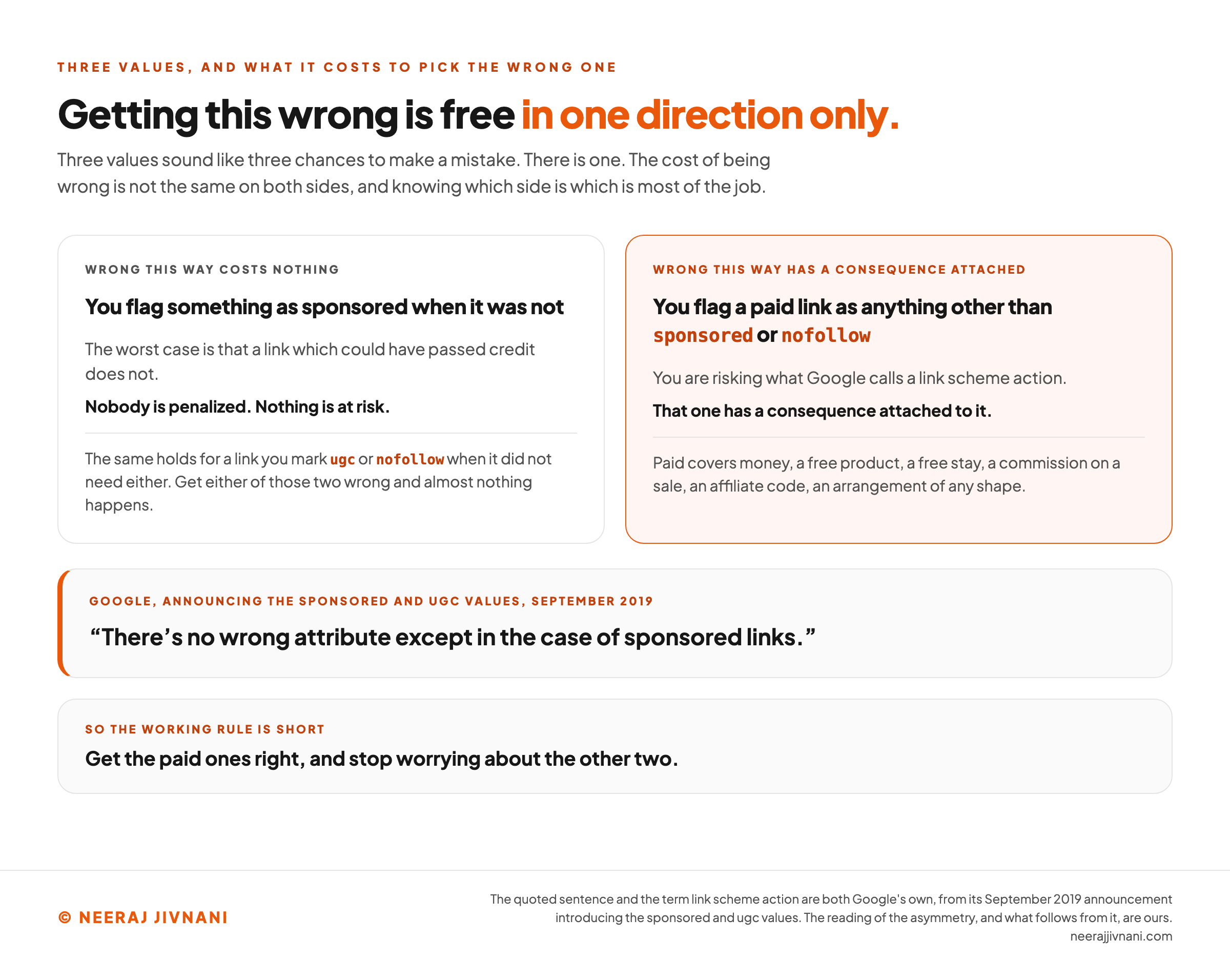
Three values sound like three chances to make a mistake. There is one, and Google said so outright when it introduced the other two: "There's no wrong attribute except in the case of sponsored links."
The asymmetry runs one way, and the 2019 announcement spells it out.
Flag something as sponsored when it was not, and the worst case is that a link which could have passed credit does not.
Nobody is penalized. Nothing is at risk.
Flag a paid link as anything other than sponsored or nofollow, and you are risking what Google calls a link scheme action. That one has a consequence attached to it.
So the working rule is short. Get the paid ones right, and stop worrying about the other two.
Use this chart — embed code and citation
<a href="https://neerajjivnani.com/blog/nofollow-links/"><img src="https://neerajjivnani.com/infographics/nofollow-links/free-in-one-direction.png" alt="Two panels setting the two ways of choosing the wrong link attribute against each other, one free and one not. The left panel, headed wrong this way costs nothing, covers flagging something as sponsored when it was not: the worst case is that a link which could have passed credit does not, nobody is penalized and nothing is at risk, and the same holds for a link marked ugc or nofollow when it needed neither. The right panel, highlighted in orange and headed wrong this way has a consequence attached, covers flagging a paid link as anything other than sponsored or nofollow, which risks what Google calls a link scheme action, and notes that paid covers money, a free product, a free stay, a commission on a sale, an affiliate code, an arrangement of any shape. Below them Google's sentence from its September 2019 announcement of the sponsored and ugc values reads that there is no wrong attribute except in the case of sponsored links, and a closing band gives the working rule: get the paid ones right, and stop worrying about the other two." width="1200"></a>
<p>Chart: <a href="https://neerajjivnani.com/blog/nofollow-links/">Neeraj Jivnani</a></p>Neeraj Jivnani, "What a Nofollow Link Is, and Which Half of It You Control", neerajjivnani.com, https://neerajjivnani.com/blog/nofollow-links/Free to republish with a link back to this page.
What Google Does With It Now
Google treats all three values as hints rather than orders, and has done since 2019. Before that the attribute worked as an off switch, and a link carrying it fed nothing into the ranking systems.
Why it existed at all is worth two sentences. It was introduced in 2005, Google's own account says, to fight comment spam by giving publishers a way to carry a link without vouching for it.
The change came in September 2019, when all three values became hints for ranking. From 1 March 2020 the hint model covered crawling and indexing too.
The stated reason is the useful part. Google's answer was that links carry information worth keeping whatever attribute sits on them, "such as how the words within links describe content they point at".
Ignoring every qualified link threw that away.
What the Hint Model Changes for You
The current documentation, last updated on 10 December 2025, gives the present position in one sentence. Links marked with these attributes "will generally not be followed."
Then comes the caveat, which matters more than the sentence does. The linked pages "may be found through other means, such as sitemaps or links from other sites, and thus they may still be crawled."
Two things follow from the pair, and they are the two that change what you do.
Generally is not never, and nobody outside Google can tell you which qualified links get through. No figure is published, so treat any ranking benefit as something you cannot plan around.
And the attribute was never a way to keep a page out of anything. It only ever described one link.
When Not to Reach for It
There are three things the attribute is not: a default for everything you link to, a way to push weight around inside your own site, and a way to keep a page out of search results.
Each one is a habit somebody is practicing on a site right now, and in all three cases people reach for the attribute because the name makes it sound like it should work.
It Is Not a Default for Everything External
Nofollowing every outbound link is a policy some large publishers run, and it is a poor one to copy.
It tells a search engine that you stand behind nothing you have ever cited, which is rarely true and is not a flattering thing to say about your own sources either.
The test before you qualify a link is simpler than any rule. If you cannot say you trust the page, why are you sending a reader to it?
Link normally to sources you would defend. Qualify the ones you would not defend but still have a reason to show.
It Was Never a Way to Steer Your Own Pages
There was a technique, and it had a name: PageRank sculpting. Nofollow some of a page's outgoing links, the theory went, and whatever those links would have carried piles up in the ones you left alone.
The arithmetic stopped working, and Matt Cutts, then at Google, published exactly how in 2009, saying the change had already been in place for more than a year.
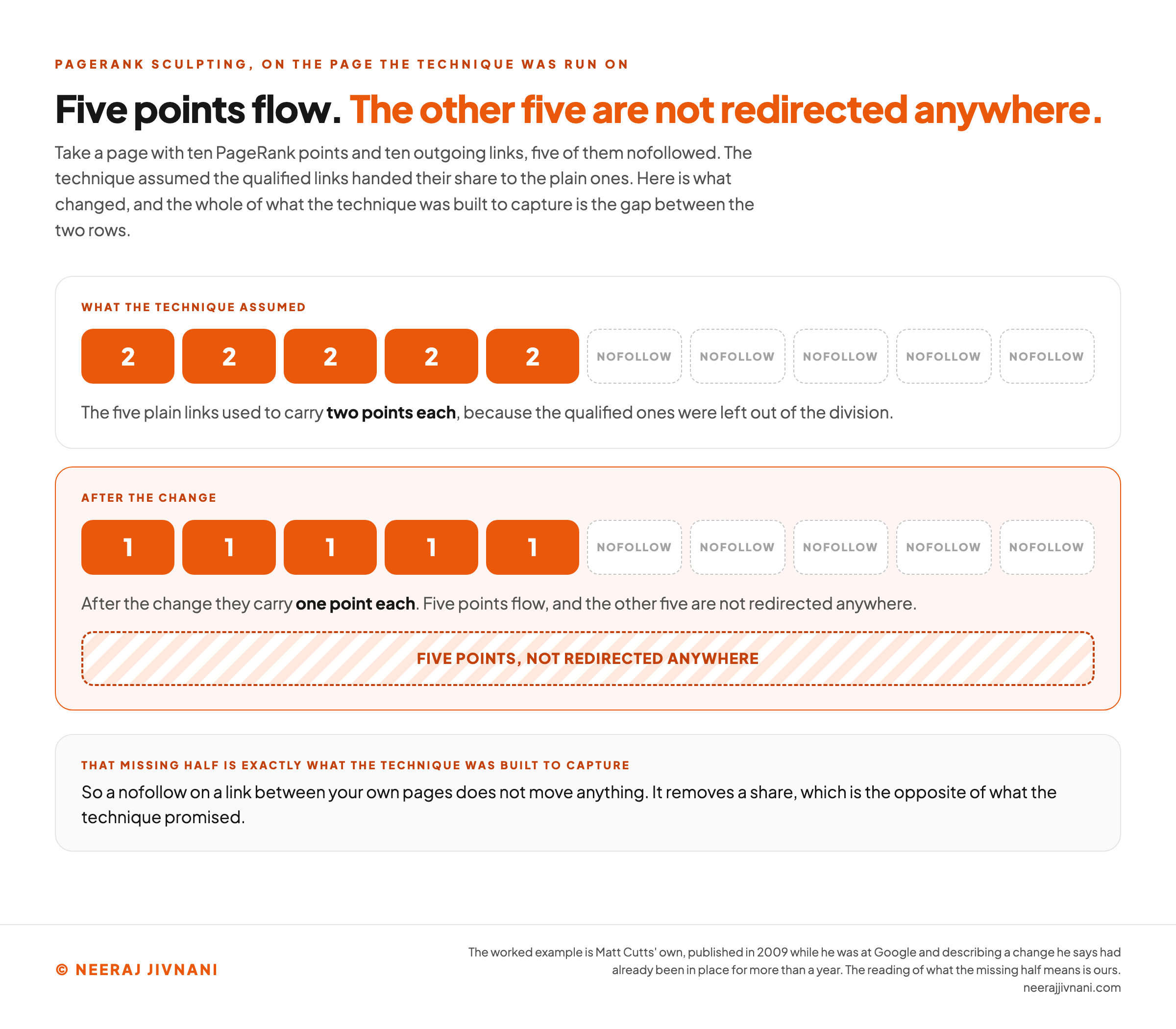
Take a page with ten PageRank points and ten outgoing links, five of them nofollowed.
The five plain links used to carry two points each, because the qualified ones were left out of the division. After the change they carry one point each.
Five points flow, and the other five are not redirected anywhere. That missing half is exactly what the technique was built to capture.
So a nofollow on a link between your own pages does not move anything. It removes a share, which is the opposite of what the technique promised.
If you find the attribute on your internal links today, a plugin or a theme is the likelier author than a person.
It Is Not an Indexing Control
Using nofollow as an indexing control is the misuse that costs something. A page you do not want found gets every link to it nofollowed, and then it turns up in the results anyway.
It was never going to work. The attribute describes one link, while a crawler can arrive from a sitemap, from a menu, or from somebody else's site entirely.
Google's 2019 announcement said as much in passing, noting that depending on nofollow solely to block a page from being indexed "was never recommended."
To keep a page out of the results, the control is noindex, which sits on the page itself rather than on the links pointing at it.
Google's current guidance for that is one line: "allow crawling and use the noindex robots rule". The instruction lives on the page, so a crawler you have blocked in robots.txt never reaches it.
Use this chart — embed code and citation
<a href="https://neerajjivnani.com/blog/nofollow-links/"><img src="https://neerajjivnani.com/infographics/nofollow-links/the-missing-half.png" alt="Two rows of ten links each, showing what PageRank sculpting assumed and what happens instead. Each row draws the same page: five solid orange blocks for the plain links and five dashed outlines labeled nofollow. In the upper row, headed what the technique assumed, every solid block carries a 2, because the five plain links used to carry two points each when the qualified ones were left out of the division. In the lower row, highlighted and headed after the change, every solid block carries a 1, because after the change they carry one point each, and a wide hatched band across the bottom of that row is labeled five points, not redirected anywhere. A closing band says that missing half is exactly what the technique was built to capture, so a nofollow on a link between your own pages does not move anything: it removes a share, which is the opposite of what the technique promised." width="1200"></a>
<p>Chart: <a href="https://neerajjivnani.com/blog/nofollow-links/">Neeraj Jivnani</a></p>Neeraj Jivnani, "What a Nofollow Link Is, and Which Half of It You Control", neerajjivnani.com, https://neerajjivnani.com/blog/nofollow-links/Free to republish with a link back to this page.
When Somebody Nofollows a Link to You
When somebody nofollows a link to your site, there is nothing for you to do. That is the answer in full, and here is why it holds.
The attribute sits in their markup, on their server, under their editorial policy. Nothing in that list is a place you get a vote.
A publisher who qualifies your link has usually set the rule once, in a template, covering every outbound link the site will ever publish. There is no per-link decision there to argue with.
Asking anyway costs you something. Goodwill with a publisher is finite, and this is the least valuable thing you could spend it on.
What a Nofollowed Link Is Worth
Two things, and both are real.
It sends people. The attribute is invisible in a browser, so a qualified link gets clicked at whatever rate its position and its promise earn it, exactly like any other.
That traffic is also the only part of this you can watch arrive.
It also puts you in front of readers who can link to you themselves, and whoever writes that next piece has their own policy about outbound links.
What it will not do is move a ranking on its own.
The Mix You Are Told to Aim For
You will be told that a natural backlink profile contains a mix of both, and that too few qualified links looks suspicious.
The first half is a description. The second turns it into a target, and only the first is true.
Sites that earn links pick up qualified ones on the way, because social platforms, comment sections and a good number of publishers qualify by default. That is what an ordinary profile looks like from the outside.
The number does not exist to be hit. What varies is who links to you and how those particular sites happen to publish, and neither of those is a dial on your side of the web.
Counting them is time you could spend on the half of this you control.
Take the link that sent you here
Two things send people looking this up, and only one of them is a decision. Say which one you are holding and this goes as far as it honestly can.
Whose page does the link sit on?
One of the two answers opens a question. The other one closes the subject, which is the part worth knowing before you spend an evening on it.
Questions People Ask About Nofollow Links
Are nofollow links good for SEO? Not in the way a plain link is. Google treats the attribute as a hint rather than an order, so a qualified link may still be used, and nothing published tells you which ones are. Judge the link by whether the page it sits on reaches people you want, and treat anything else it brings as a bonus.
Do backlinks still matter? Yes, and nobody serious argues otherwise. That is a question about links in general, though, and this one is about a single attribute sitting on some of them.
Do old nofollow links need changing to sponsored? No. Google says there is "absolutely no need to change any nofollow links that you already have". For the paid ones currently marked nofollow, it recommends switching to sponsored if or when it is convenient. New paid links are worth labeling properly from the start, because that is the cheap moment to do it.
Is there a version of this for a whole page? Yes, and it is a separate mechanism with a confusingly similar name. A robots meta tag carrying nofollow applies to every link on the page at once, rather than to one link you chose. That is a page-level instruction and it belongs in the page's head, not in an anchor tag.
Which Half Is Yours
The links you place are yours. Everything on the other side of the link is settled in somebody else's markup before you ever hear about it.
On your own pages, the attribute is a small act of honesty. Say what a link is when it is paid for, posted by a visitor, or something you will not put your name to.
Let every other link stand plainly, because plain is what you mean.
On links pointing at you, there is nothing to decide at all. Read what it says, take what it sends you, and go and spend the afternoon on something that answers to you.