How PageRank Works, and Why There Is Nothing to Look Up
Google still runs the algorithm and gives you no number for it. Here is what it measures, what changed, and what is left for you to act on.

/ On this page9 sections
Google still runs PageRank, and it gives out no number for it. Both halves of that are true at once, and almost every confusion about the subject comes from mixing them up.
Whether PageRank matters is the wrong thing to ask first. What it measures, what changed, and what is left for anyone to act on are the answerable versions.
What PageRank Is
PageRank scores how important a page is, using nothing but the links pointing at it.
The idea underneath it is one line. A link is a recommendation, so a page recommended by many pages is probably worth something, and a page recommended by pages that are themselves worth something is worth more.
That second clause is what makes it interesting.
Counting links alone is easy to fake. Anyone can build a hundred pages and point them all at one page they own.
Weighting each link by the standing of the page that made it is much harder to fake, because the backlinks worth having come from pages that are not yours.
Say a city library's opening-hours page is linked from one place: the city council's homepage. A second page is linked from forty blog comments nobody reads.
Under a plain count, the second page wins forty to one. Under PageRank, the library page can win on the strength of the one link, because of where it came from.
The definition is circular. A page's score depends on the scores of the pages linking to it, and theirs depend on the pages linking to them.
That circularity is not a flaw. It is the design, and it is why the computation has to be run over and over rather than solved in one step.
One Word, Three Different Answers
Three separate things wear this name, and which one somebody means decides the answer they get.
The algorithm. A published method for scoring pages in a linked set. It has a formula, it is in a patent, and anyone can implement it. It has not changed since publication, because a published method cannot.
The public metric. A whole number from 0 to 10, shown in a browser toolbar, which readers used for years as shorthand for how good a page was. It is gone.
The live signal. Whatever Google runs today under that name, which it says has evolved a great deal and which it does not describe in detail.
Read any question about PageRank and ask which of the three it is about.
"Is PageRank still used?" is about the third. "How do I check my PageRank?" is about the second, and the answer is that you cannot.
"How does PageRank work?" is about the first, which is the only one of the three anybody outside Google can read in full.

Use this chart — embed code and citation
<a href="https://neerajjivnani.com/blog/pagerank/"><img src="https://neerajjivnani.com/infographics/pagerank/one-name-three-things.png" alt="Three cards side by side, one for each thing that wears the name PageRank, each ending in a panel saying what a reader can see of it today. Card one, the algorithm, is a published method for scoring pages in a linked set: it has a formula, it is in a patent, and anyone can implement it, and it has not changed since publication because a published method cannot. It is dated as published by Sergey Brin and Lawrence Page in 1998, and what you can see of it is all of it, the only one of the three anybody outside Google can read in full. Card two, the public metric, is a whole number from 0 to 10 shown in a browser toolbar, which readers used for years as shorthand for how good a page was, and which is gone with nothing replacing it. What you can see of it is nothing, because Google publishes no PageRank value for any page, in any product. Card three, highlighted in orange, is the live signal, whatever Google runs today under that name: Google says how it works has evolved a great deal and does not describe it in detail, its guide to Search ranking systems names it among the core ranking systems, and the same page's own Retired systems list does not. It is marked as running now, with that guide last updated December 2025, and what you can see of it is that it exists, with no value and no control over it. A band across the foot reads that you should take any question about PageRank and ask which of the three it is about: is PageRank still used is about the third, how do I check my PageRank is about the second and the answer is that you cannot, and how does PageRank work is about the first." width="1200"></a>
<p>Chart: <a href="https://neerajjivnani.com/blog/pagerank/">Neeraj Jivnani</a></p>Neeraj Jivnani, "How PageRank Works, and Why There Is Nothing to Look Up", neerajjivnani.com, https://neerajjivnani.com/blog/pagerank/Free to republish with a link back to this page.
What the Algorithm Actually Does
The algorithm Sergey Brin and Lawrence Page published in 1998 fits on half a page.
Everything it does follows from three decisions: how a page shares what it has, how often the sharing is interrupted, and what happens when it has nowhere to go. What is below is all of it.
A Link Is Divided, Not Copied
A page does not hand its full score to everything it links to. It divides what it has among its outgoing links, and each link carries one share.
The 1998 paper is explicit about the divisor. It defines C of A as the number of links going out of page A, and every link off that page carries the page's score divided by that count.
The consequence is worth sitting with.
A link from a page with two outgoing links carries far more than a link from a page with two hundred, even though both are links from the same site, on the same day, to the same place.
It also means a link costs the page making it nothing it can feel, while diluting every other link on that page a little.
The Random Surfer, and What It Does Not Measure
There is a second way to read the same arithmetic, and the paper gives it. Imagine somebody clicking links at random, forever.
A page's PageRank is the probability that this imaginary person is on that page at any given moment. The paper says the scores across all pages add up to one, which is what makes them probabilities rather than points.
Pages with many links pointing at them get visited more, so they score higher.
Brin and Page put it plainly: the probability that the random surfer visits a page is its PageRank.
Now the part that gets skipped. This measures importance, and importance is not the same as relevance.
Rank by PageRank alone and the most important page wins the query, whether or not it answers it.
Anvil found exactly that when it built a search engine over its own documentation, where the reference section took the top spot from the page that answered the search.
It was the more important page. It was not the better answer to the question.
That gap is why PageRank was never a ranking system on its own, and why a heavily linked page can still lose to one nobody links to.
The Damping Factor, and the Two Numbers You Will See
A surfer clicking forever is not a person, so the model adds the chance of giving up.
At every page there is some probability the imaginary surfer keeps clicking, and some probability they stop and jump to a page at random instead.
The paper calls that dial the damping factor, d, and sets it to 0.85.
Which end 0.85 sits at is where accounts part company, and the paper is no help. Its own sentence puts d at the stopping end, as the probability at each page that the random surfer will get bored and request another random page.
Its formula puts d at the other end, multiplying the part that follows links.
So some texts define the damping factor as the chance of continuing and others as the chance of stopping, which is whatever is left over.
The same setting then turns up as two different numbers that add to one. Neither convention is wrong.
They describe one dial from opposite ends, and the end being used is almost never labeled.
So work out which convention you are reading before you set one explanation beside another. It is the commonest reason two correct accounts of PageRank look like they disagree.
Why It Has to Run Over and Over
The circular definition has no shortcut. To score a page you need the scores of the pages linking to it, which you do not have yet.
So the computation starts with a guess, usually the same value for every page. It updates every page from that guess, then does it again using the new numbers.
Each pass gets closer. After enough passes the numbers stop moving, and that settled state is the result.
This is why scores lurched about in the early years. The whole thing had to be recomputed across every page and every link, and until it finished, nothing was final.
The Pages That Break It
One kind of page breaks the model, and every real implementation has to patch it.
A page with no outgoing links is a dead end. The imaginary surfer arrives and has nowhere to go, so what flows in never flows out and the arithmetic stops behaving.
The standard fix is to pretend such a page links to everything.
Its share spreads evenly across the whole collection rather than vanishing, which keeps the totals stable. That is a modeling convenience, not a claim about the web.

Use this chart — embed code and citation
<a href="https://neerajjivnani.com/blog/pagerank/"><img src="https://neerajjivnani.com/infographics/pagerank/a-link-is-divided-not-copied.png" alt="Four horizontal bars of identical length, one for the same page drawn with one, two, twenty and two hundred outgoing links, showing how much of what that page passes on any single link carries. Each bar is everything the page passes on, divided into as many equal segments as the page has outgoing links, with one segment filled orange. At one outgoing link the whole bar is orange and the label reads all of it. At two the orange fills half the bar and the label reads a half. At twenty the orange is a narrow slice at the left of a bar ruled into twenty and the label reads a twentieth. At two hundred the bar reads as a dense hatch and the orange is a sliver, labeled a two-hundredth. Beside each row the count is given as C of A, which the 1998 paper defines as the number of links going out of page A, and every link off that page carries the page's score divided by that count. A band underneath reads that a link from a page with two outgoing links carries far more than a link from a page with two hundred, even though both are links from the same site, on the same day, to the same place, and that a link costs the page making it nothing it can feel while diluting every other link on that page a little." width="1200"></a>
<p>Chart: <a href="https://neerajjivnani.com/blog/pagerank/">Neeraj Jivnani</a></p>Neeraj Jivnani, "How PageRank Works, and Why There Is Nothing to Look Up", neerajjivnani.com, https://neerajjivnani.com/blog/pagerank/Free to republish with a link back to this page.
Where 0.85 Comes From
Almost every explanation of PageRank hands over 0.85 as though it were a measured property of human behavior. It is not.
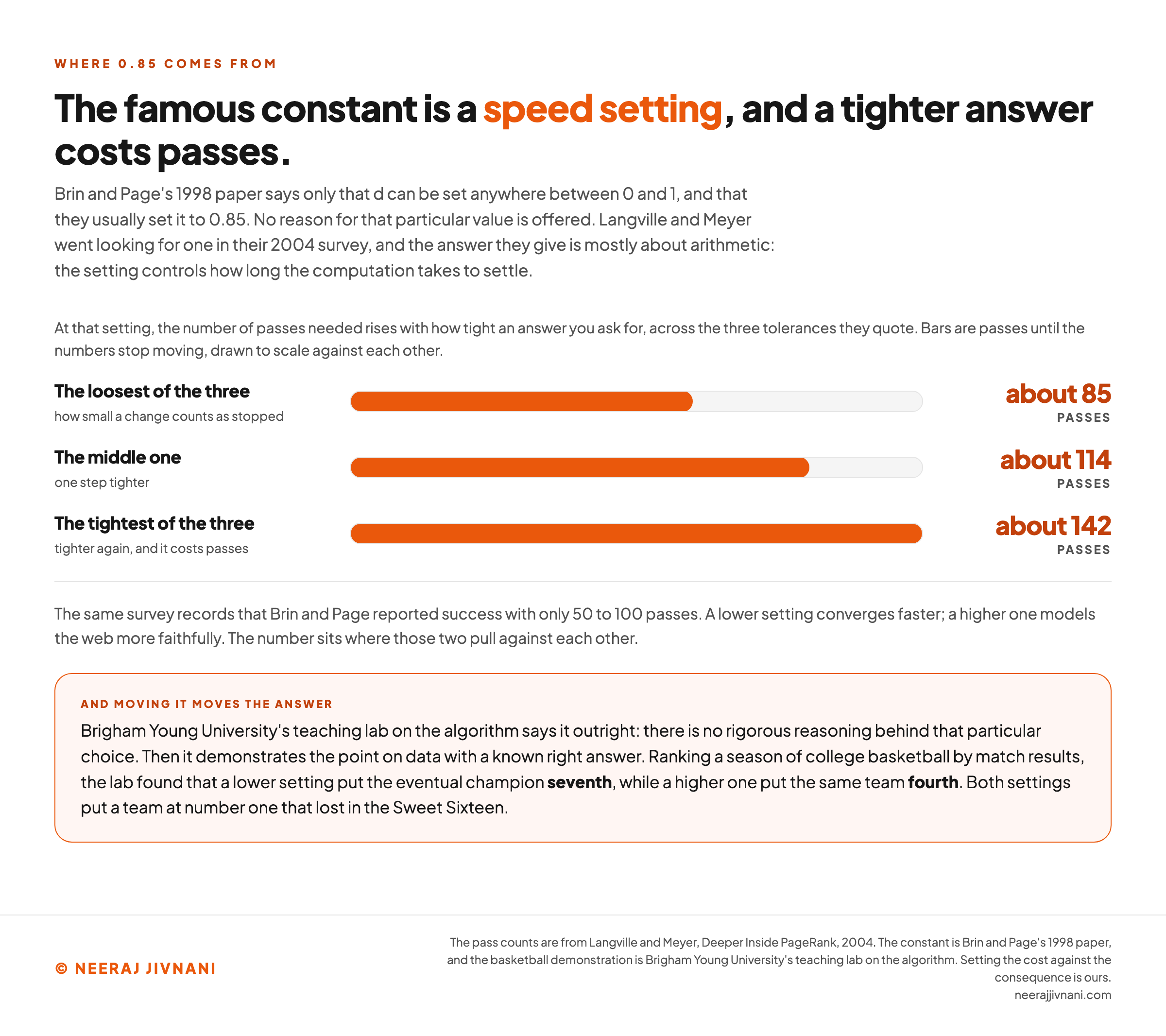
Brin and Page's paper says only that d can be set anywhere between 0 and 1, and that they usually set it to 0.85. No reason for that particular value is offered.
Langville and Meyer went looking for one in their 2004 survey Deeper Inside PageRank. The answer they give is mostly about arithmetic: the setting controls how long the computation takes to settle.
At 0.85, they report, the number of passes needed rises with how tight an answer you ask for. Across the three tolerances they quote, from the loosest to the tightest:
- About 85 passes at the loosest of the three.
- About 114 passes at the middle one.
- About 142 passes at the tightest.
They also record that Brin and Page reported success with only 50 to 100 passes.
A lower setting converges faster; a higher one models the web more faithfully. The number sits where those two pull against each other.
The same survey does offer one intuitive reading of it. At that setting, about one-sixth of the time the imaginary surfer abandons the links and goes somewhere else entirely.
Moving It Moves the Answer
There is no rigorous reasoning behind the choice of .85, and Brigham Young University's teaching lab on the algorithm says so outright.
Then it demonstrates the point on data with a known right answer.
Ranking a season of college basketball by match results, the lab found that a lower setting put the eventual champion seventh, while a higher one put the same team fourth. Both settings put a team at number one that lost in the Sweet Sixteen.
So when an explanation hands you 0.85 as a fact, what it is handing you is a setting somebody chose.
Use this chart — embed code and citation
<a href="https://neerajjivnani.com/blog/pagerank/"><img src="https://neerajjivnani.com/infographics/pagerank/what-the-damping-factor-buys.png" alt="Three horizontal bars showing how many passes the computation needs before the numbers stop moving, at each of the three tolerances Langville and Meyer quote, with the damping factor at the value the 1998 paper sets. The loosest of the three needs about 85 passes, the middle one about 114, and the tightest about 142, the bars drawn to scale against each other so the cost of a tighter answer is visible. A line above the bars reads that the 1998 paper says only that d can be set anywhere between 0 and 1 and that they usually set it to 0.85, with no reason for that particular value offered, and that Langville and Meyer went looking for one in their 2004 survey and found the answer to be mostly about arithmetic. A note under the bars records that the same survey says Brin and Page reported success with only 50 to 100 passes, and that a lower setting converges faster while a higher one models the web more faithfully. A band at the foot, highlighted in orange, reads that Brigham Young University's teaching lab on the algorithm says there is no rigorous reasoning behind that particular choice and then demonstrates it on data with a known right answer: ranking a season of college basketball by match results, a lower setting put the eventual champion seventh while a higher one put the same team fourth, and both settings put a team at number one that lost in the Sweet Sixteen." width="1200"></a>
<p>Chart: <a href="https://neerajjivnani.com/blog/pagerank/">Neeraj Jivnani</a></p>Neeraj Jivnani, "How PageRank Works, and Why There Is Nothing to Look Up", neerajjivnani.com, https://neerajjivnani.com/blog/pagerank/Free to republish with a link back to this page.
The Score You Cannot Look Up
There is no PageRank score to look up, for any page, anywhere.
For years there was one. A browser toolbar showed a whole number from 0 to 10 for whatever page you were on, and a small industry grew around it.
It is gone, and nothing replaced it. Google publishes no PageRank value for any page, in any product.
So the straight answer to how you check a site's PageRank is that you cannot, and neither can anybody else.
Every score you can see today, domain authority among them, is a third party's estimate built from their own crawl and their own formula.
Those numbers can be useful. They are not this number, and their makers do not claim they are.
The absence is not a loss, and that is worth defending rather than mourning.
A visible score turned the algorithm into a target, links into a market, and a page's worth into a digit that could be bought. Taking the digit away removed the scoreboard, not the mechanism, and the scoreboard was the part being gamed.
Run the one you can
Four pages, and you decide what links to what. Then run the method the 1998 paper published, one pass at a time, and watch four numbers stop moving.
Start from a shape, or click any cell
A links to B, B to C, C back to A, and D links in. Every value depends on a value that depends on it.
Who links to whom
| Links from | to A | to B | to C | to D |
|---|---|---|---|---|
| Page A1 link out, so it carries everything | ||||
| Page B1 link out, so it carries everything | ||||
| Page C1 link out, so it carries everything | ||||
| Page D1 link out, so it carries everything |
The count on the left is C of A, the number of links going out of a page. Every link off that page carries the page's score divided by that count, which is why a second link out of a page halves what the first one delivers.
The computation
d = 0.85
Pass 0. Nothing is known yet, so every page starts on the same value. Each pass rewrites all four from the four you are looking at.
Each number is the share of the imaginary surfer's time spent on that page, so the four of them add up to one. It is a measure of importance, and importance is not the same as relevance: the most important page here is not automatically the best answer to anything.
And that is the only one of the three with numbers in it
You just ran the published algorithm, which is the one of the three anybody outside Google can read in full. The retired 0-to-10 public score is gone and nothing replaced it, and Google publishes no PageRank value for any page, in any product.
So the numbers above are genuinely PageRank, on a web of four pages that you built. There is no version of this you can run on the real one, and nobody will hand you the answer.
Is Google Still Using It?
Yes, and this one needs no inference, because Google says so in its own documentation.
Its guide to Search ranking systems, last updated in December 2025, puts PageRank under a heading about link analysis and says this:
"Among these is PageRank, one of our core ranking systems used when Google first launched. Those curious can learn more by reading the original PageRank research paper and patent. How PageRank works has evolved a lot since then, and it continues to be part of our core ranking systems."
Two things in that last sentence. It has changed, and it has not been switched off.
Where it sits on that page matters as much as the sentence.
The same document carries a Retired systems list, for things folded into the core or superseded, and Panda, Penguin, Hummingbird and the helpful content system are all named there. PageRank is not.
The Other Google Page
A second Google page looks like it says the opposite, and does not.
Its starter guide to search engine optimization has a section headed Things we believe you shouldn't focus on, listing meta keywords, keyword stuffing, content length and a handful of others. PageRank is on that list.
What Google writes there is: "While PageRank uses links and is one of the fundamental algorithms at Google, there's much more to Google Search than just links. We have many ranking signals, and PageRank is just one of those."
Read together the two pages give one answer, not two. It runs, it is one input among many, and nothing about it is exposed to you as a control.
Who Built It, and Who Owned It
PageRank was built at Stanford University, and the patent went there too. The assignee on the filing is the university, not Google.
Lawrence Page is named as the inventor on that patent, Method for node ranking in a linked database, and Sergey Brin is his co-author on the paper describing the search engine built around it.
The name works on two readings at once. It is Page's surname, and it is what the thing ranks, which is web pages.
The record for US patent 6,285,999 gives the dates:
- Priority date: January 1997.
- Filed: January 1998, with the university as assignee.
- Granted: September 2001.
- Anticipated expiration: January 2018, and the legal status now reads expired.
So the original method is protected by nobody. It is published, expired and freely implementable, which is why it turns up in graph libraries and undergraduate courses rather than only inside a search engine.
What It Does Away From Search
PageRank scores nodes in any network, so it is used well outside search.
It ranks nodes by how many other nodes point at them, weighted by those nodes' own scores, and nothing in the method is about the web in particular.
Graph databases ship it as a built-in function. It is used there for recommendation engines, for tracing which records in a data pipeline carry the most weight, and as one input among several to fraud detection.
There is a variant worth knowing by name.
Personalized PageRank restricts the imaginary surfer to start from a chosen set of nodes rather than from anywhere. That turns a measure of general importance into a measure of importance relative to those nodes, which is the shape a who-to-follow suggestion needs.
Same arithmetic, narrower starting point.
A Live System With No Dial
PageRank is a live system with no dial, and holding both halves at once is the whole answer.
The algorithm runs inside Google, by Google's own account, and there is no number for it and no control over it.
So the sensible reading of PageRank is historical and structural rather than operational.
With nothing to set, what is left is what it explains: why links carry weight at all, and why a link from a page carrying a hundred other links carries less of it.
It also explains why buying a number was always a category error. The number was a display, and the display is off.
There was a scoreboard for a while, and switching it off is the clearest thing anyone at Google has ever said about how much attention this deserves.