White Hat SEO Is One Document, and Three Things in It Are Required
Only three things are required of your page. The rest is a ban list and seven suggestions, and clearing all of it still buys you less than you think.

/ On this page8 sections
White hat SEO means doing search engine optimization (SEO) inside the guidelines a search engine publishes. Those guidelines are one page, and only three things on it are required of your page.
The rest is a list of what not to do, and seven pieces of advice.
That split is the answer, and it decides how much of this is worth worrying about. Clearing the required half takes an afternoon and earns you eligibility, which is not the same thing as a position.
The Label Points at a Document
White hat SEO is search engine optimization done inside the rules the search engine has written down, as opposed to work that tries to trick it.
Every definition of the term sounds the same because they are all pointing at the same place. For Google that place is Search Essentials, and it is not long.
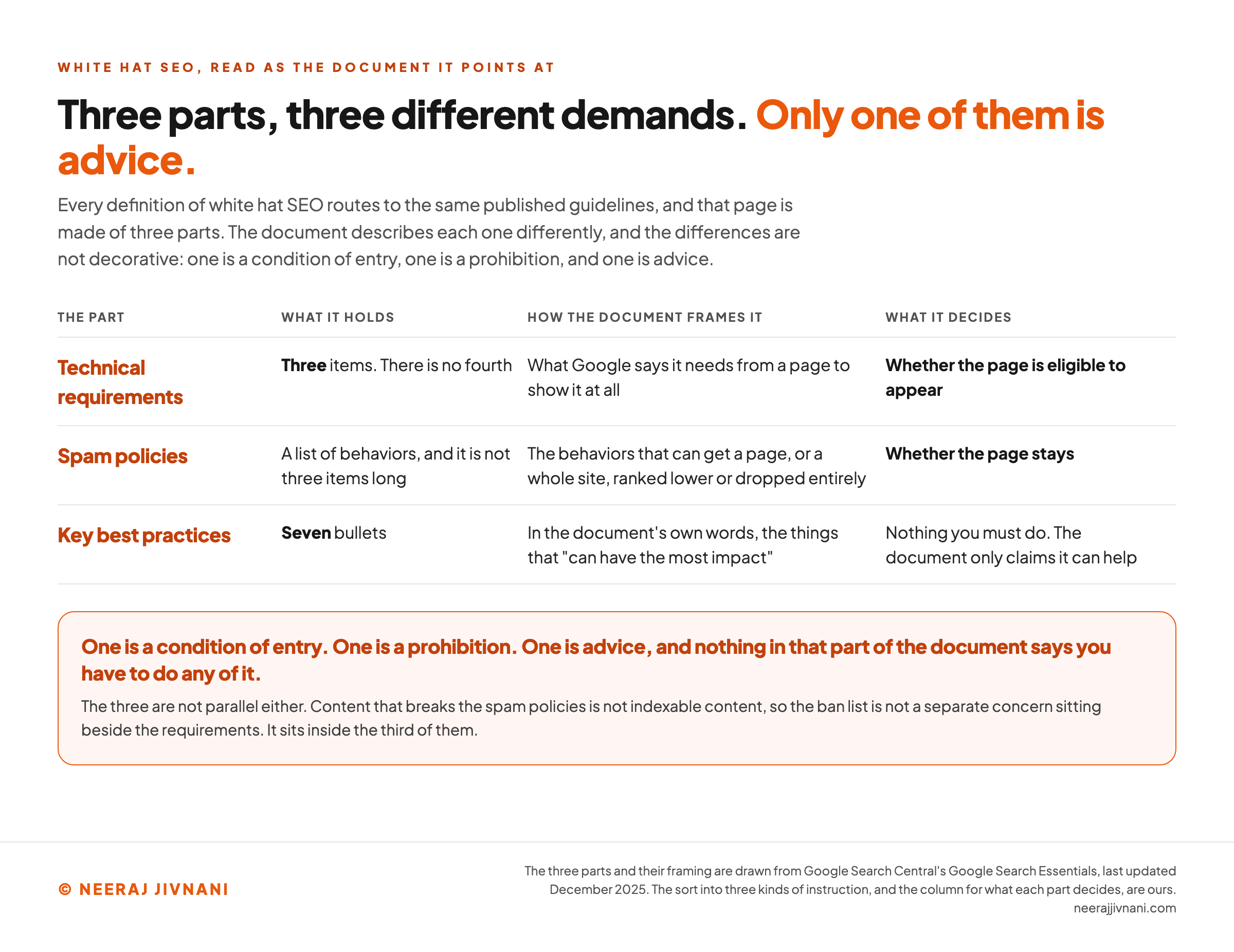
The document is made of three parts, and it describes each one differently:
- Technical requirements are what Google says it needs from a page to show it at all.
- Spam policies are the behaviors that can get a page, or a whole site, ranked lower or dropped entirely.
- Key best practices are, in the document's own words, the things that "can have the most impact" on a page's ranking and appearance.
Read those three framings side by side and the differences are not decorative.
One is a condition of entry. One is a prohibition. One is advice, and nothing in that part of the document says you have to do any of it.
Three Kinds of Instruction, Flattened Into One
The habit this subject encourages is to treat all three as a single checklist of things a responsible site does.
That is the mistake, and it is expensive in a specific way. It spreads attention evenly across a requirement you must meet, a boundary you must not cross, and a suggestion you may weigh.
Those three have nothing in common except a publisher.
Use this chart — embed code and citation
<a href="https://neerajjivnani.com/blog/white-hat-seo/"><img src="https://neerajjivnani.com/infographics/white-hat-seo/three-parts-three-verbs.png" alt="A four-column table of the one document that defines white hat SEO, headed Three parts, three different demands, only one of them is advice. The columns are the part, what it holds, how the document frames it, and what it decides. Technical requirements hold three items and there is no fourth; the document frames them as what Google says it needs from a page to show it at all; they decide whether the page is eligible to appear. Spam policies hold a list of behaviors that is not three items long; the document frames them as the behaviors that can get a page, or a whole site, ranked lower or dropped entirely; they decide whether the page stays. Key best practices hold seven bullets; the document frames them, in its own words, as the things that can have the most impact; they decide nothing you must do, because the document only claims they can help. A panel across the foot reads: one is a condition of entry, one is a prohibition, one is advice, and nothing in that part of the document says you have to do any of it. It adds that the three are not parallel either, because content that breaks the spam policies is not indexable content, so the ban list sits inside the third requirement rather than beside it." width="1200"></a>
<p>Chart: <a href="https://neerajjivnani.com/blog/white-hat-seo/">Neeraj Jivnani</a></p>Neeraj Jivnani, "White Hat SEO Is One Document, and Three Things in It Are Required", neerajjivnani.com, https://neerajjivnani.com/blog/white-hat-seo/Free to republish with a link back to this page.
Three Things Are Required of You
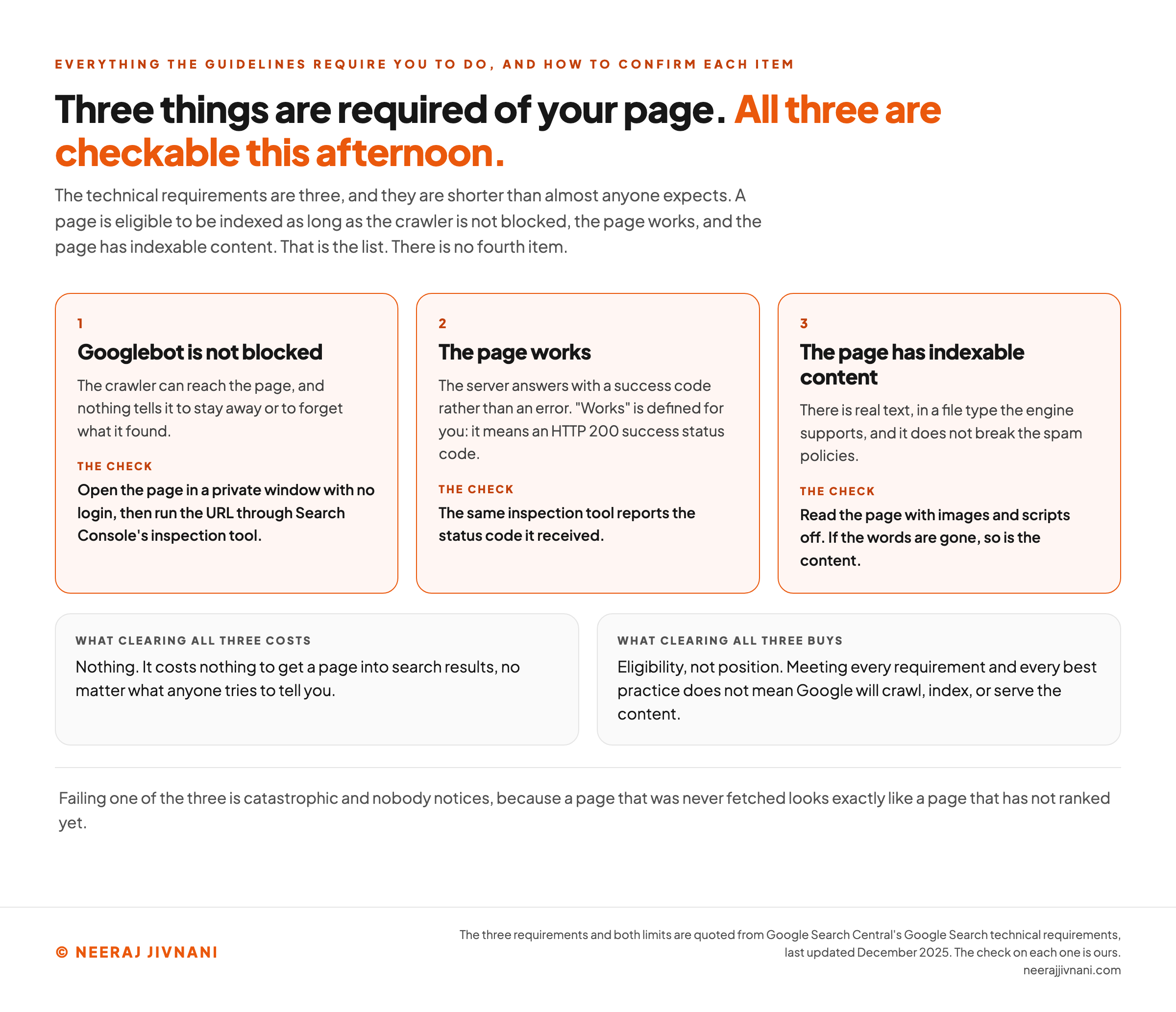
The technical requirements are three, and they are shorter than almost anyone expects.
In Google's published wording, a page is eligible to be indexed as long as Googlebot is not blocked, the page works, and the page has indexable content.
"The page works" is defined for you. It means the server answers with an HTTP 200 status code, which is the Hypertext Transfer Protocol's number for a page that loaded properly rather than erroring.
That is the list. There is no fourth item.
| What is required | What it means | How you check it |
|---|---|---|
| Googlebot is not blocked | The crawler can reach the page, and nothing tells it to stay away or to forget what it found | Open the page in a private window with no login, then run the URL through Search Console's inspection tool |
| The page works | The server answers with a success code rather than an error | The same inspection tool reports the status code it received |
| The page has indexable content | There is real text, in a file type the engine supports, and it does not break the spam policies | Read the page with images and scripts off. If the words are gone, so is the content |
Google's own note about this list is worth reading twice: there are, it says, "very few technical things you need to do to a web page", and most sites pass without ever realizing it.
Notice what is not on it. HTTPS, the encrypted version of the same protocol, is not one of the three. It is worth having for every other reason, and it is not what stands between your page and the index.
What Indexable Content Means
Indexable content is the third requirement and the only one with two halves.
The first half is format: the words have to be in a file type the engine can read. The second half is the one that matters, and it is where the prohibitions enter.
Content that breaks the spam policies is not indexable content. So the ban list is not a separate concern sitting beside the requirements. It is inside the third one.
So a short list of requirements does not make the subject a short subject. The technical floor is three items. The list that can remove a page sits inside the third of them, and it is not three items long.
Meeting All Three Buys Eligibility, Not Position
Clearing the requirements does not move you up. It lets you into the contest.
The document is unusually direct about this. Meeting every requirement and every best practice, it says, does not mean Google will crawl, index, or serve the content.
So the honest reading is that these three are a gate rather than a lever. You do not get credit for clearing a gate; you only get stopped by it.
There is a second line worth carrying out of that page. It costs nothing to get a page into search results, it says, no matter what anyone tries to tell you.
That is a fact about eligibility rather than about effort. Nobody is charging admission. The bill arrives later, in the form of the work, and no part of it is a fee.
Use this chart — embed code and citation
<a href="https://neerajjivnani.com/blog/white-hat-seo/"><img src="https://neerajjivnani.com/infographics/white-hat-seo/the-three-and-the-check.png" alt="Three numbered cards, headed Three things are required of your page, all three are checkable this afternoon. Card one, Googlebot is not blocked: the crawler can reach the page and nothing tells it to stay away or to forget what it found; the check is to open the page in a private window with no login and then run the URL through Search Console's inspection tool. Card two, the page works: the server answers with a success code rather than an error, and works is defined as an HTTP 200 success status code; the check is that the same inspection tool reports the status code it received. Card three, the page has indexable content: there is real text, in a file type the engine supports, and it does not break the spam policies; the check is to read the page with images and scripts off, and if the words are gone, so is the content. Two panels underneath give the document's own limits. What clearing all three costs: nothing, because it costs nothing to get a page into search results no matter what anyone tries to tell you. What clearing all three buys: eligibility, not position, because meeting every requirement and every best practice does not mean Google will crawl, index, or serve the content. A closing line notes that failing one of the three is catastrophic and nobody notices, because a page that was never fetched looks exactly like a page that has not ranked yet." width="1200"></a>
<p>Chart: <a href="https://neerajjivnani.com/blog/white-hat-seo/">Neeraj Jivnani</a></p>Neeraj Jivnani, "White Hat SEO Is One Document, and Three Things in It Are Required", neerajjivnani.com, https://neerajjivnani.com/blog/white-hat-seo/Free to republish with a link back to this page.
Seven Bullets of Advice, and What They Are Worth
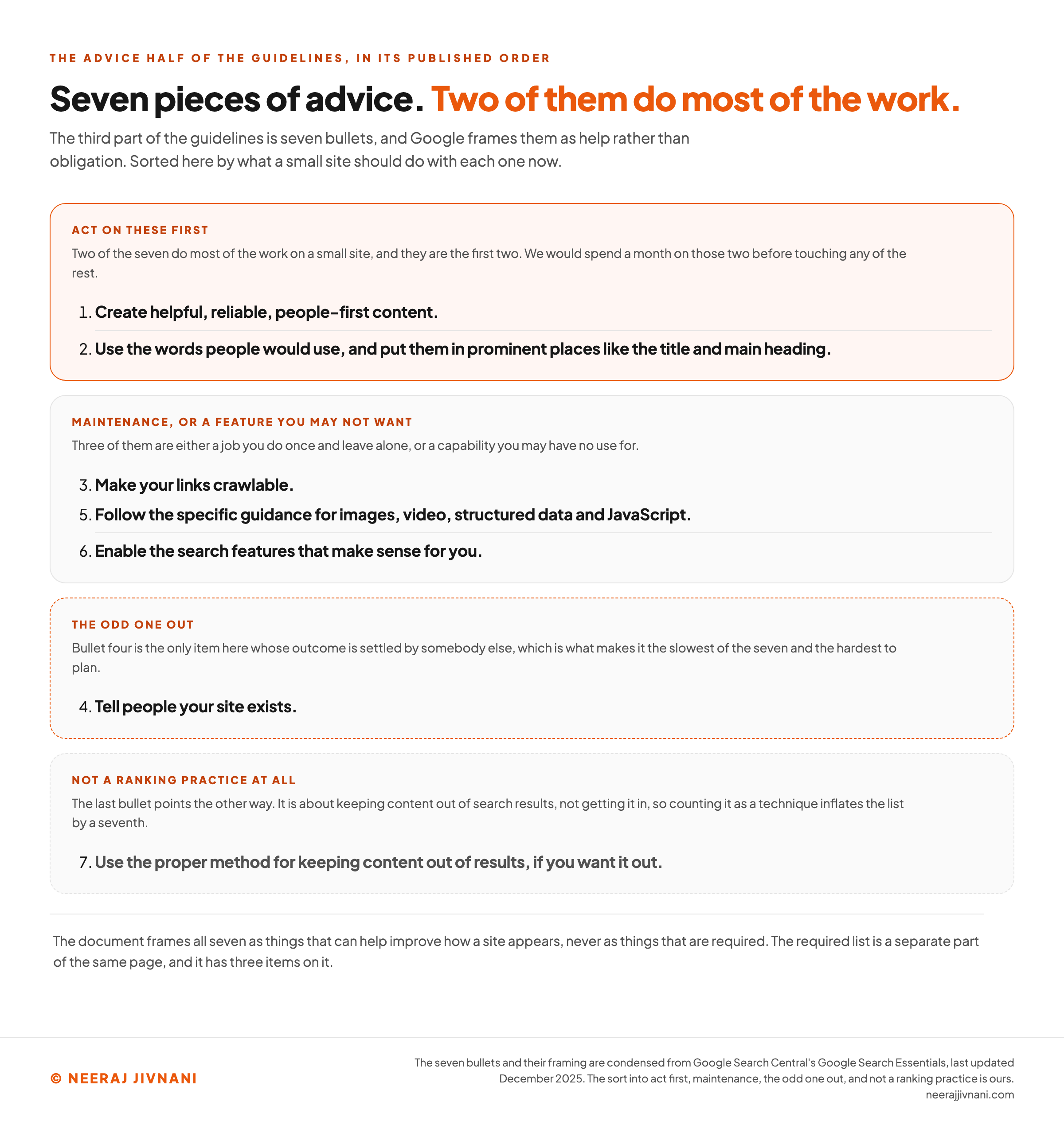
The third part of the document is seven bullets, and Google frames them as help rather than obligation.
Condensed, they are:
- Create helpful, reliable, people-first content.
- Use the words people would use, and put them in prominent places like the title and main heading.
- Make your links crawlable.
- Tell people your site exists.
- Follow the specific guidance for images, video, structured data and JavaScript.
- Enable the search features that make sense for you.
- Use the proper method for keeping content out of results, if you want it out.
If somebody has handed you a nine-step white hat method, hold it against those seven. It will be longer, and it will be an elaboration of them.
The Two Worth Acting On First
Two of the seven do most of the work on a small site, and they are the first two.
Write the page so it answers the question, in the words somebody would type rather than the ones you use internally, and put those words where the page announces itself. Finding those words is keyword research, and it is a job of its own.
Everything else on the list is either a maintenance job or a feature you may not want. Once the requirements are confirmed, we would spend a month on those two before touching any of the rest.
Bullet four is the odd one out. Telling people your site exists is the only item here whose outcome is settled by somebody else, which is what makes it the slowest of the seven and the hardest to plan.
The Seventh Is Not a Ranking Practice
The last bullet is about keeping content out of search results, not getting it in.
It is on the list because it belongs to the same set of controls, and it is a genuinely useful thing to know exists. It is not a technique, and counting it as one inflates the list by a seventh.
That is the shape of the whole third part. A short set of sensible defaults, with one housekeeping item at the end that is not about ranking at all.
The guidelines, against your calendar
How much of this were you going to give it?
Pick the block of time somebody has asked you to spend on being white hat. The document is the same length whichever one you pick. What changes is how much of your block it has anything at all to say about.
The block
We would spend a month on those two before touching any of the rest.
What the guidelines ask of you inside this block: 6 items
- RequiredGooglebot is not blocked
Open the page in a private window with no login, then run the URL through Search Console's inspection tool and confirm the page is in the index.
- RequiredThe page works
The same inspection tool reports the status code it received. A success code rather than an error.
- RequiredThe page has indexable content
Read the page with images and scripts off. If the words are gone, so is the content.
- ProhibitedA read of the prohibited list
It settles whether anything on your site is at risk. Content that breaks the spam policies is not indexable content, so the ban list is not a separate concern sitting beside the requirements. It sits inside the third one.
- AdviceCreate helpful, reliable, people-first content.
One of the two that do most of the work on a small site.
- AdviceUse the words people would use, and put them in prominent places like the title and main heading.
The other one. Everything else on the list is either a maintenance job or a feature you may not want.
Still ahead of you in the document: 5 items
- Make your links crawlable.Advice, and maintenance rather than work.
- Tell people your site exists.Advice, and not yours alone to finish.
- Follow the specific guidance for images, video, structured data and JavaScript.Advice, and maintenance rather than work.
- Enable the search features that make sense for you.Advice, and optional even as advice.
- Use the proper method for keeping content out of results, if you want it out.Not a ranking practice at all.
What the block leaves you
Everything after the month. The two bullets worth acting on first are behind you.
Nothing in the guidelines tells you any of this:
- Which page to write.
- Which question to answer.
- Why anybody should choose you.
What is left once the document is done is whether the page is worth landing on, and no guideline anywhere has been able to answer that one for you.
True at every setting above
It costs nothing to get a page into search results, so no part of this block is a fee.
Clearing the requirements does not move you up. It lets you into the contest, and meeting every requirement and every best practice does not mean Google will crawl, index, or serve the content.
Use this chart — embed code and citation
<a href="https://neerajjivnani.com/blog/white-hat-seo/"><img src="https://neerajjivnani.com/infographics/white-hat-seo/seven-bullets-sorted.png" alt="The seven key best practices Google publishes, numbered in their published order and grouped into four bands by what a small site should do with each one now. The first band, act on these first, is highlighted and holds bullets one and two, create helpful reliable people-first content, and use the words people would use and put them in prominent places like the title and main heading, with the note that these two do most of the work on a small site and are worth a month before touching any of the rest. The second band, maintenance or a feature you may not want, holds bullets three, five and six: make your links crawlable, follow the specific guidance for images, video, structured data and JavaScript, and enable the search features that make sense for you. The third band, the odd one out, holds bullet four on its own, tell people your site exists, with the note that it is the only item here whose outcome is settled by somebody else, which makes it the slowest of the seven and the hardest to plan. The fourth band, not a ranking practice at all, holds bullet seven, use the proper method for keeping content out of results if you want it out, with the note that it points the other way and that counting it as a technique inflates the list by a seventh. A closing line records that the document frames all seven as things that can help improve how a site appears, never as things that are required, and that the required list is a separate part of the same page with three items on it." width="1200"></a>
<p>Chart: <a href="https://neerajjivnani.com/blog/white-hat-seo/">Neeraj Jivnani</a></p>Neeraj Jivnani, "White Hat SEO Is One Document, and Three Things in It Are Required", neerajjivnani.com, https://neerajjivnani.com/blog/white-hat-seo/Free to republish with a link back to this page.
Black, Grey and a List That Grows
Black hat SEO is the industry's name for work that tries to move a page up by manipulating the search engine rather than by being the better answer. The two labels come from one vocabulary and face opposite directions.
So the difference between the two is not a matter of degree or of conscience. It is a matter of membership: one set of behaviors is named in the spam policies inside Search Essentials, and one set is not.
Grey hat is the name for the middle of that line.
A tactic is called grey when it aims at the machine and has not been named yet. The distinction is therefore about timing rather than about conscience.
Which makes a grey tactic a specific kind of bet. You are wagering that a document you do not control, and cannot see the next draft of, will not be edited in a way that covers what you are doing.
That is the honest reading of the three words. Two of them say where you stand relative to a published list. The third says how long you expect that list to stay the length it is.
The Question Assumes a Switch That Is Not There
Asking whether you should always use white hat SEO treats it as a mode you can turn on, and the document's own structure says it is not one.
Look at what is genuinely optional in the three parts.
The technical requirements are not. A page failing one of them is not ranked badly, it is absent, so nobody can decide to skip that part and keep competing.
The prohibitions are not either, and for a different reason. Their consequence can reach a whole site and not the offending page alone, so a site cannot run one section on prohibited tactics and expect the rest to stay insulated.
What is left is the seven bullets at the end of Search Essentials, and those genuinely are yours to weigh.
So the only real choice inside this subject is which of the seven to spend a month on. That is a question about your calendar. It is not a question about your character, and it never was.
The version of this you will be offered instead is that certain markets run on prohibited tactics and you will have to match them. Notice what that proposes: not a different technique, but a different risk appetite, priced by whoever is selling it to you.
The Floor Is Not the Building
White hat SEO is a low bar, your site almost certainly clears it already, and clearing it does not make a page rank. That is the part the label hides.
That is not a criticism of the guidelines. A document about eligibility is doing its job when it stays short, and three items is a feature rather than an oversight.
The mistake is ours, collectively, for reading a floor as a method.
An afternoon settles the three requirements. A read of the prohibited list settles whether anything on your site is at risk. After that, nothing in the guidelines tells you which page to write, which question to answer, or why anybody should choose you.
So the practical value of understanding white hat SEO is the opposite of what the phrase suggests. It is not a discipline to adopt. It is an anxiety to retire, so that the months you were going to spend proving your ethics go into the work that decides the outcome.
If you do one thing today, make it the first requirement. Put the pages you care about through Search Console's URL inspection tool and confirm each one is in the index.
That failure has no symptom. The page renders, reads well and behaves normally for every human who opens it, and it is the one failure that makes every other hour worth nothing.
Four Questions With Short Answers
Legality is the first of four questions here, and the one a wrong answer costs most. The word hides two separate ideas, which is why it goes wrong in both directions.
The other three are the mechanics, the third hat, and a count that gets quoted as though somebody published it.
Is White Hat SEO Legal?
Yes, and so is most of what gets called black hat, because this is not a legal question at all.
Search guidelines are a publisher's rules for its own product rather than law. Breaking them is not illegal, and following them is not a legal defense.
Real legal exposure in this field arrives from somewhere else entirely.
- Copying somebody's copyrighted text.
- Misusing a trademark.
- Making a claim about a product that an advertising regulator would object to.
None of those becomes acceptable because the technique that carried it was white hat.
How Does White Hat SEO Work?
You make the page reachable, keep it off the prohibited list, and then make it the better answer to a question somebody is asking.
The first two are settled quickly and stay settled. The third never finishes, which is why it is the part worth your time.
What Is White Hat, Black Hat and Grey Hat SEO?
White hat is work inside the published guidelines, and black hat is work those guidelines name as prohibited.
Grey hat is work they have not named yet that still aims at the machine rather than at the reader. Calling it grey is a bet that the list will not grow to cover it.
What Are the Four Types of SEO?
The count is not fixed, and the guidelines do not publish one.
Three of the four describe where the work happens: on the page, off the page on sites you do not own, and in the technical plumbing that decides whether the page can be read at all.
The fourth usually added is local, which is not a kind of work. It is a kind of search, with its own result format and its own profile to fill in.
Nobody Is Grading This
White hat SEO has no committee behind it, no certification, and no file with your name on it. Nothing is doing the grading the phrase implies.
What exists is a document naming three requirements, a list naming what is prohibited, and seven suggestions. All three are published, all three are free to read, and most sites satisfy the first before anyone tells them it exists.
What is left once you know that is not a question of ethics. It is whether the page is worth landing on, and no guideline anywhere has been able to answer that one for you.