How Local SEO Works, and How to Get Your Business Into the Map Pack
Your map listing comes from a profile, not your website. See what to fix first, what money cannot buy, and the one field that gets a listing suspended.


/ On this page13 sections
Local SEO, short for local search engine optimization, is the work of getting your business shown to people searching near you. Most of it happens in a record that sits outside your website.
That record is your Business Profile, which feeds the map listings above the ordinary results while your website competes underneath them in the local organic results.
Nothing you can pay for moves you up either list. What moves you is being eligible, completing the record and earning reviews, and one field in that record can cost you the listing altogether.
The Two Result Sets a Local Search Returns
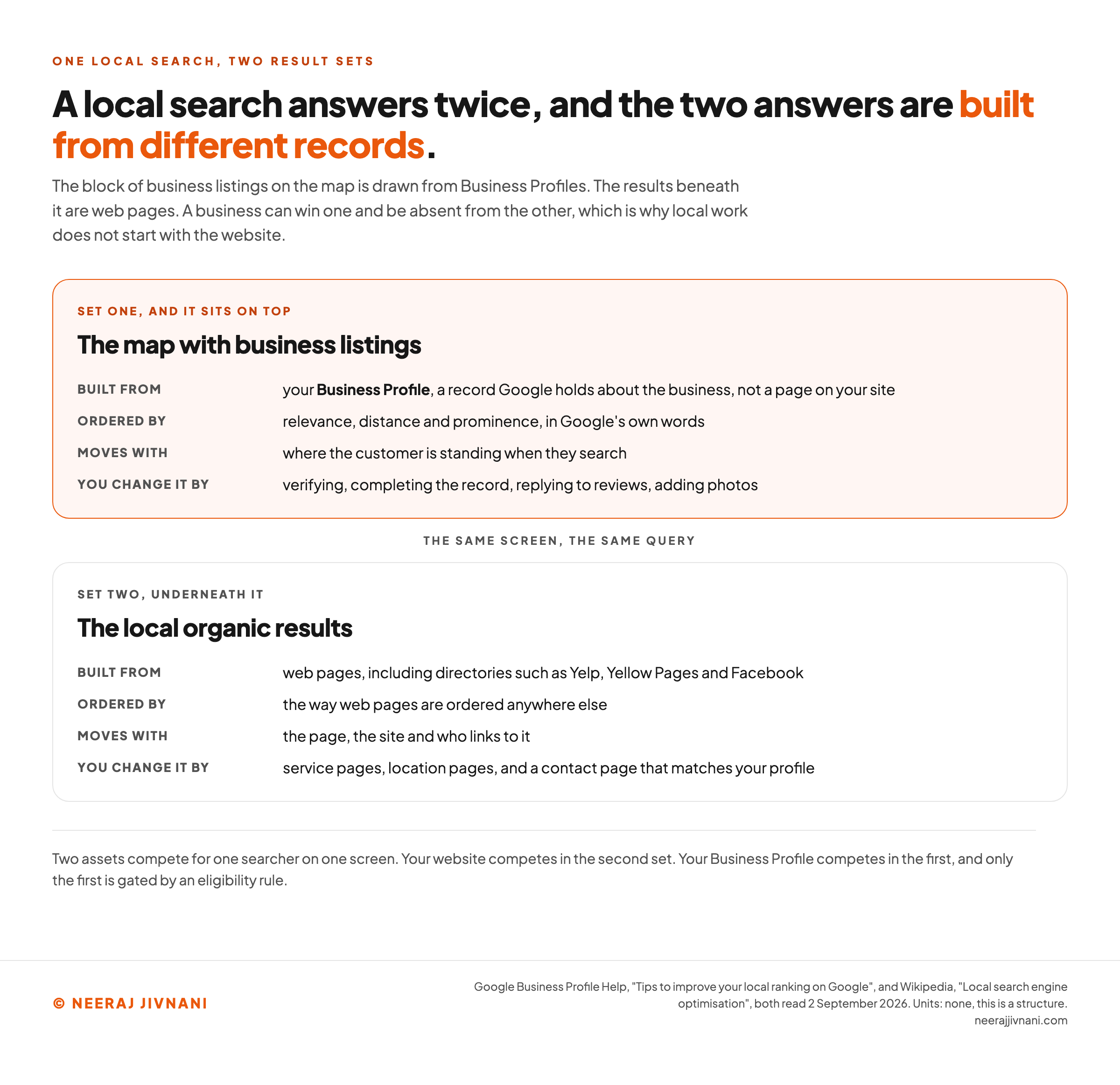
A local search returns two sets of results, and they are not ordered by the same thing. Search for a business or a place near you and both sets show up, in Google Maps and in Search.
The first set is the map with business listings on it, the block usually called the map pack. Each listing there is drawn from a Business Profile, a record that belongs to the business rather than a page on its website.
The second set is the local organic results below. Those are web pages, ranked the way web pages are ranked, and they often include directories such as Yelp, Yellow Pages and Facebook.
So two different assets compete for you on one screen, your website in the second set and your Business Profile in the first.
That is why local work does not begin with the site. The profile is what puts you in the map, and it is where Google's own ranking advice starts too.
Why the Map Listings Are Worth the Attention
The map block deserves more attention than its size suggests, for two reasons.
It sits at the top, above the results people think of as the search results. And the businesses in it are chosen from a different pool.
A page that ranks well in the ordinary blue links below the map can be absent from the map entirely, and the reverse happens too.
Use this chart — embed code and citation
<a href="https://neerajjivnani.com/blog/local-seo/"><img src="https://neerajjivnani.com/infographics/local-seo/two-result-sets.png" alt="Diagram of the two result sets a local search returns, showing the map pack of business listings drawn from Google Business Profiles at the top and the local organic web results underneath, with the different asset, the different record and the different ranking inputs for each set named side by side." width="1200"></a>
<p>Chart: <a href="https://neerajjivnani.com/blog/local-seo/">Neeraj Jivnani</a></p>Neeraj Jivnani, "How Local SEO Works, and How to Get Your Business Into the Map Pack", neerajjivnani.com, https://neerajjivnani.com/blog/local-seo/Free to republish with a link back to this page.
Whether You Are Allowed a Listing at All
Not every business is allowed a Business Profile, and that is settled before any of the work below matters.
You qualify if your business has a physical location that customers can visit, or if it travels to customers where they are. That is the entire eligibility rule, and it comes from Google's guidelines for representing your business.
Read the other way, it excludes a category of business entirely. If there is nowhere a customer can come and nowhere you go, there is no profile to rank.
Three arrangements trip owners up, and the same guidelines settle all three.
- A virtual office. A mailing address you rent but do not operate out of is not eligible for a Business Profile, in Google's own wording.
- A remote mailbox. P.O. boxes or mailboxes located at remote locations are not acceptable as an address.
- A co-working desk. Businesses cannot list an office at a co-working space unless that office maintains clear signage, receives customers during business hours, and is staffed during business hours by your own staff.
Say a bookkeeper works from a spare room, meets nobody there and never travels to a client. On Google's own wording there is nothing to list, and the profile work would have gone into a listing that cannot exist.
What Makes This a Different Job From Ranking a Page
Local SEO against ordinary SEO is the comparison people ask for, and the answer is not the word local.
The difference is that a second record exists, that a guideline decides whether you may hold that record at all, and that one ranking input is the position of the person searching.
No ordinary web page has any of the three.
The Three Things That Decide Who Shows Up
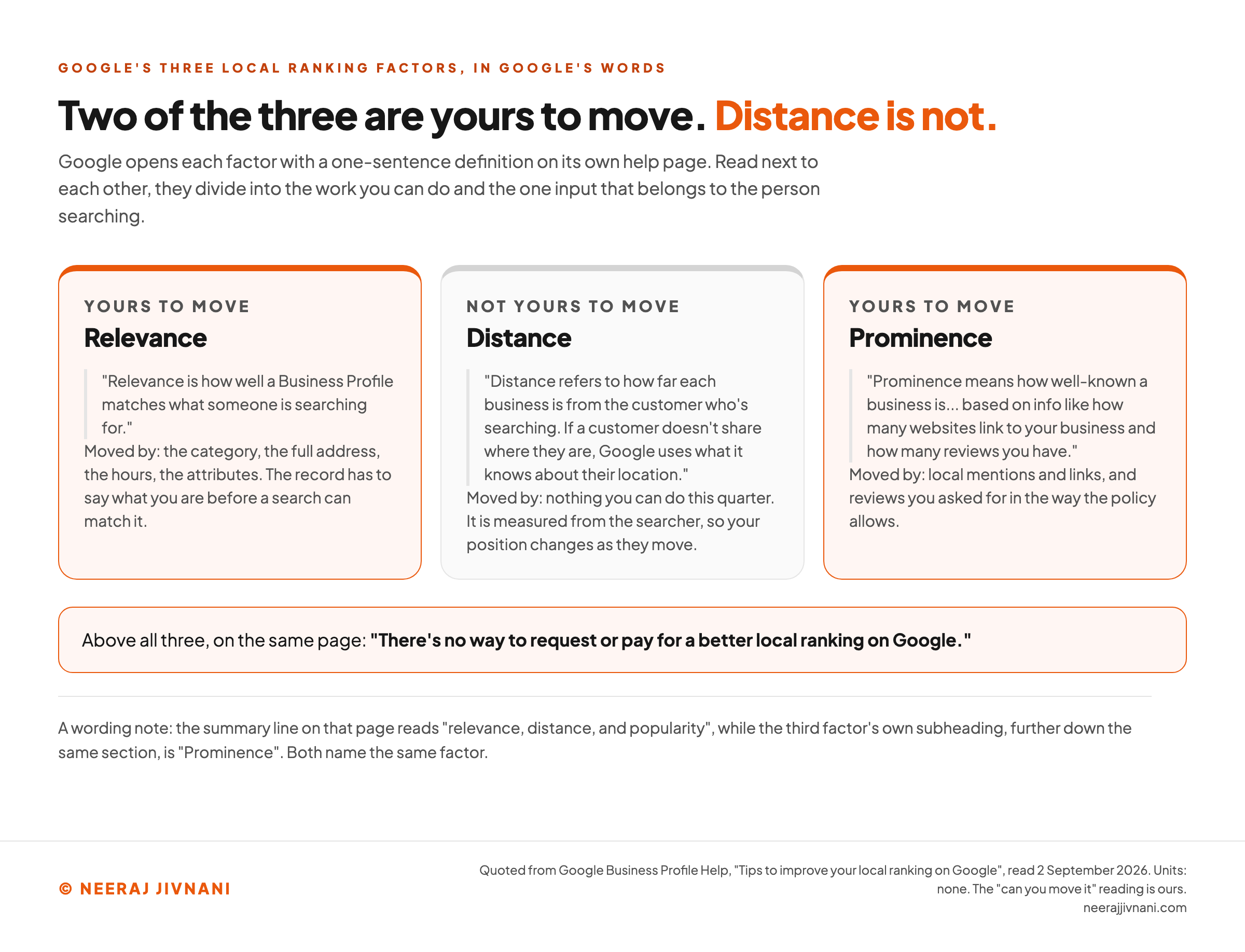
Three factors order the map, and what each one means matters more than what it is called. Google's ranking guidance gives each a single-sentence definition.
- Relevance is how well a Business Profile matches what someone is searching for.
- Distance refers to how far each business is from the customer who is searching. If a customer does not share where they are, Google uses what it knows about their location.
- Prominence means how well-known a business is. It is also based on how many websites link to your business and how many reviews you have, in the same guidance.
Then there is the line above all three, and it is the one that changes what you do.
You cannot buy your way up. There is no way to request or pay for a better local ranking on Google, in Google's own sentence, and the algorithm details stay confidential to keep the system fair for everyone.
Two of the three factors are things you can move. Distance is not one of them.
Say a customer searches from two miles away rather than two blocks. Nothing about your profile has changed, and your position has.
Use this chart — embed code and citation
<a href="https://neerajjivnani.com/blog/local-seo/"><img src="https://neerajjivnani.com/infographics/local-seo/three-factors.png" alt="The three local ranking factors Google publishes, relevance, distance and prominence, each quoted in Google's own words and paired with what an owner can actually move, showing relevance and prominence as workable and distance greyed out as the input measured from wherever the customer is searching and therefore not changeable." width="1200"></a>
<p>Chart: <a href="https://neerajjivnani.com/blog/local-seo/">Neeraj Jivnani</a></p>Neeraj Jivnani, "How Local SEO Works, and How to Get Your Business Into the Map Pack", neerajjivnani.com, https://neerajjivnani.com/blog/local-seo/Free to republish with a link back to this page.
The Six Actions That Come First
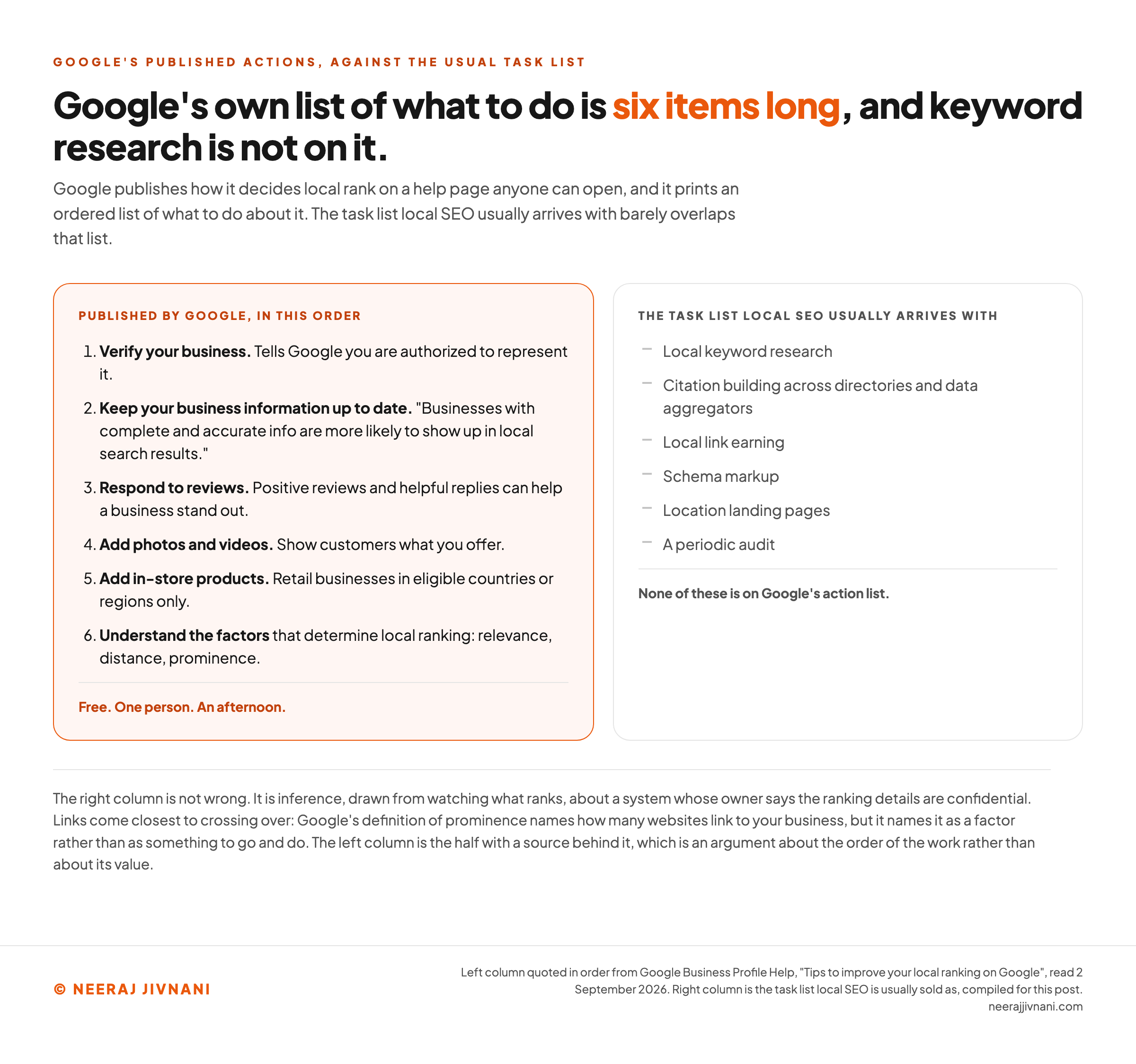
Six actions come before everything else, in the order Google itself lists them on the same page as the three factors.
- Verify your business. This tells Google you are authorized to represent the business, and a verified profile is more likely to show up in search results.
- Keep your business information up to date. Businesses with complete and accurate info are more likely to show up in local search results.
- Respond to reviews. Replying shows that you value customer feedback, and positive reviews with helpful replies can help a business stand out.
- Add photos and videos. These show customers what you offer and tell the story of the business.
- Add in-store products. This one is open only to retail businesses in eligible countries or regions, so most readers can skip it.
- Understand the factors that determine local ranking. Those are relevance, distance and prominence.
Now set that beside the task list local SEO usually arrives with: local keyword research, citation building across directories and data aggregators, local link earning, schema markup, location landing pages and a periodic audit.
None of those tasks appears among the six. Links come closest, and they sit inside the definition of prominence rather than among the things to go and do.
Why the Order of the Work Changes
The standard task list is not wrong, and those tasks matter because the rest of the search results are built on them. What changes is the order you do them in.
Do the six first. Most of it is free, one person can finish it in an afternoon, and it comes from the company that does the ranking.
The longer task list is inference. Reasonable inference, drawn from watching what ranks, and still somebody's reading of a system whose owner keeps the details confidential.
So finish the short list first, and spend money on the inferred one after. The reverse order is the tempting one, because the inferred half is the half with software attached to it.
Use this chart — embed code and citation
<a href="https://neerajjivnani.com/blog/local-seo/"><img src="https://neerajjivnani.com/infographics/local-seo/two-lists.png" alt="Two lists side by side, Google's own six published actions for improving local ranking against the six tasks the standard local SEO task list arrives with, showing that verifying the business, completing the information, responding to reviews, adding photos and videos, adding in-store products and understanding the factors are what Google names, while keyword research, citation building, link earning, schema, location pages and audits are not on Google's action list." width="1200"></a>
<p>Chart: <a href="https://neerajjivnani.com/blog/local-seo/">Neeraj Jivnani</a></p>Neeraj Jivnani, "How Local SEO Works, and How to Get Your Business Into the Map Pack", neerajjivnani.com, https://neerajjivnani.com/blog/local-seo/Free to republish with a link back to this page.
Filling In the Record: Categories, Hours, Photos, and the Name Rule
The second action is the record itself, and it carries the clearest payoff on the list: a complete, accurate record is more likely to show.
A profile with inaccurate information might not show up for relevant searches in your area.
Fill in every field: your full address if customers can visit, your business hours including special hours, what kind of business you are, and the extras Google calls attributes, such as parking or Wi-Fi availability.
Category is the field that answers what kind of business you are. Relevance is measured against what someone is searching for, so a category that is wrong is a wrong answer to every query.
Hours are the field that quietly costs money. A profile showing you open when you are closed produces a wasted trip, and the review that follows is about the trip rather than the work.
The One Field That Gets Profiles Suspended
Use the name that is on the door and nothing else. This is the one rule here that gets broken on purpose rather than by neglect, and it is the one with a penalty attached.
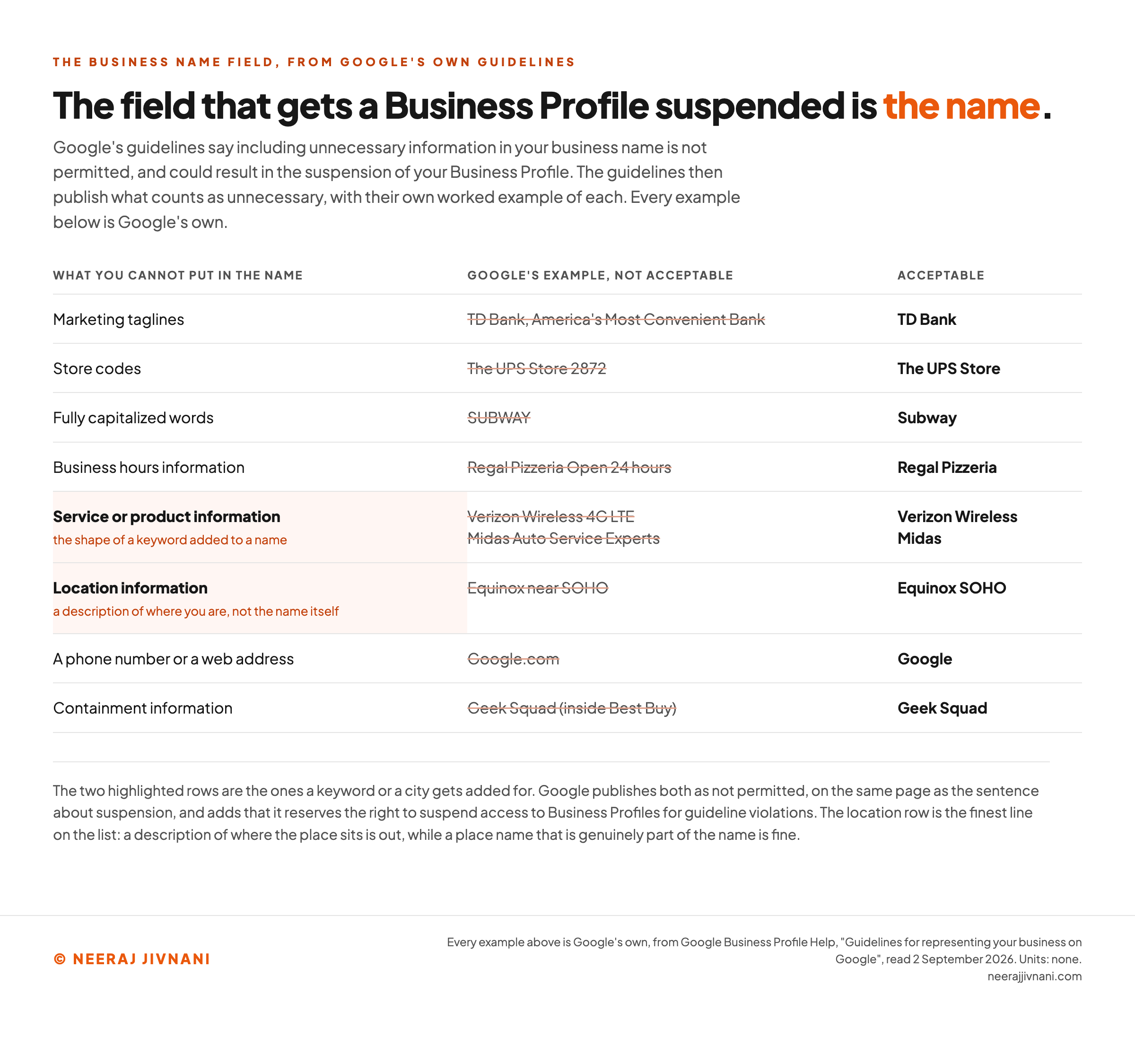
Including unnecessary information in your business name is not permitted and could result in the suspension of your Business Profile, in the wording of Google's guidelines.
What counts as unnecessary is spelled out, with a real example of each.
- Marketing taglines are not allowed, so TD Bank, America's Most Convenient Bank has to be TD Bank.
- Store codes are not allowed, so The UPS Store 2872 has to be The UPS Store.
- Service or product descriptions are not allowed, which is the exact shape of a keyword added to a name. Google's own examples are Verizon Wireless 4G LTE, which has to be Verizon Wireless, and Midas Auto Service Experts, which has to be Midas.
- Location information is not allowed either, and the line is finer than it looks. Equinox near SOHO is out while Equinox SOHO is fine, because the second is the name and the first is a description of where the place sits.
- Fully capitalized words, opening hours and the shop you sit inside are on the same list. SUBWAY has to be Subway, Regal Pizzeria Open 24 hours has to be Regal Pizzeria, and Geek Squad (inside Best Buy) has to be Geek Squad.
- A phone number or a web address is out too, and it is the easiest one to add without thinking about it. Google's own example is Google.com, which has to be Google.
If you run more than one location, there is separate guidance for chains and brands, for departments inside a larger business, and for individual practitioners such as doctors and lawyers.
The line worth carrying from all of it is that you do not create more than one page for each location.
Your business, against the two published tests
Both of these come from Google's guidelines for representing your business, and both are decided before any of the six actions are worth starting. Answer them for your own business and read Google's wording back.
Test one: where you operate
Test two: what is in the name
Tick anything your business name carries beyond the name itself. Each one is Google's own category of unnecessary information, with Google's own example beside it.
What Google's guidelines say back
Nothing ticked in the name, which is the position to be in. The name field is the one with a suspension attached to it, and it is the one broken on purpose rather than by neglect.
Use this chart — embed code and citation
<a href="https://neerajjivnani.com/blog/local-seo/"><img src="https://neerajjivnani.com/infographics/local-seo/name-rule.png" alt="Table of Google's own business name examples showing what is not acceptable against what is acceptable, with marketing taglines, store codes, fully capitalized words, business hours information, service or product descriptions, location information, phone numbers or web addresses and containment information each paired with Google's published corrected version of the same name." width="1200"></a>
<p>Chart: <a href="https://neerajjivnani.com/blog/local-seo/">Neeraj Jivnani</a></p>Neeraj Jivnani, "How Local SEO Works, and How to Get Your Business Into the Map Pack", neerajjivnani.com, https://neerajjivnani.com/blog/local-seo/Free to republish with a link back to this page.
Asking for Reviews Without Breaking the Rules You Are Judged By
Reviews do two jobs here. They feed prominence, and the way you collect them is governed by a separate policy with real prohibitions in it.
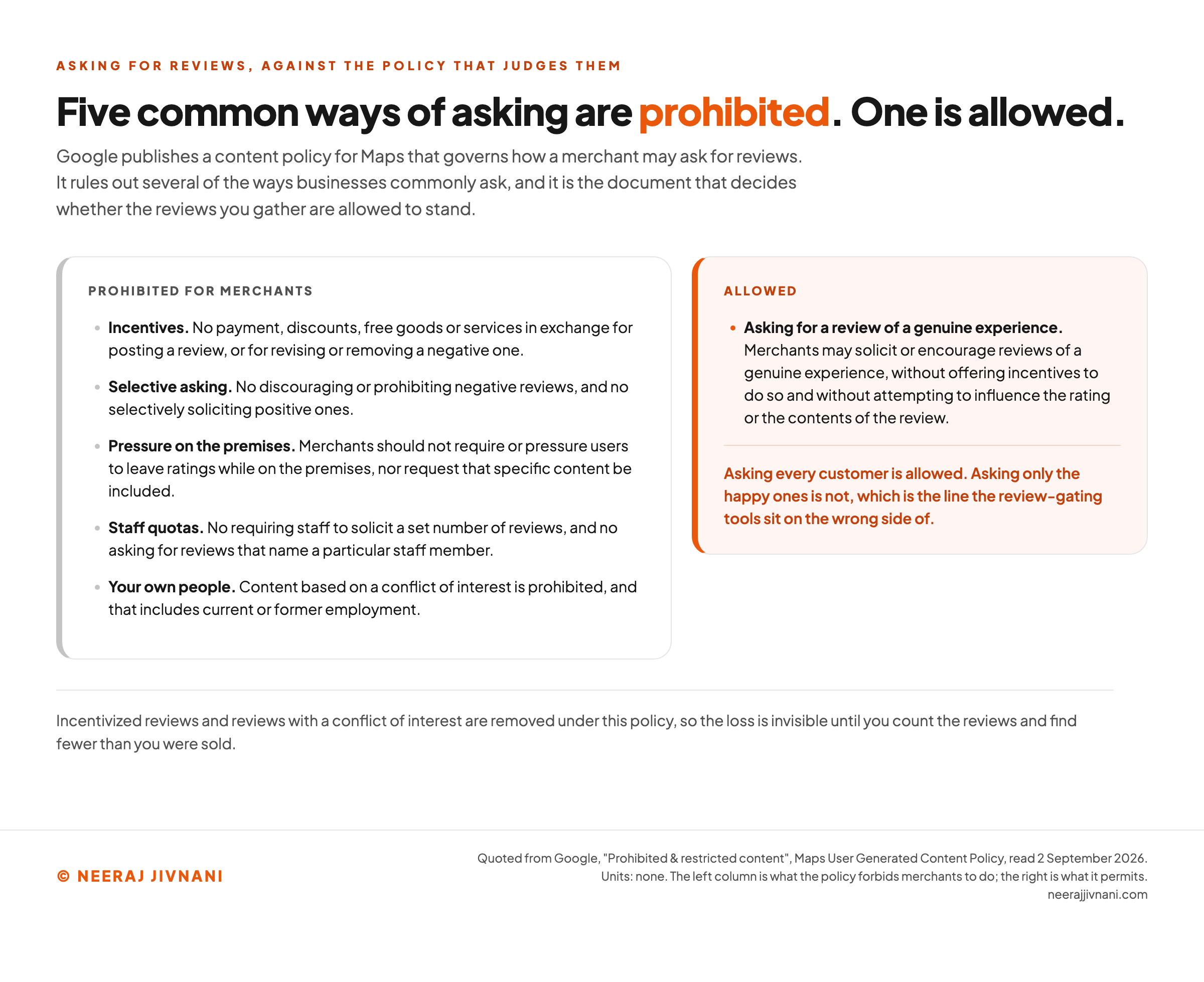
That policy is the Maps content policy, and it prohibits several of the ways businesses commonly ask. Read it as a list of what you may not do.
- No incentives. Merchants may not offer incentives such as payment, discounts, free goods or services in exchange for posting a review, or for revising or removing a negative one.
- No filtering who you ask. The policy prohibits merchants who discourage or prohibit negative reviews, or selectively solicit positive reviews from customers.
- No pressure on the premises. Merchants should not require or pressure users to leave ratings or write reviews while on the premises, and should not request that specific content be included.
- No staff quotas. The policy names merchants requesting that staff solicit a certain number of reviews, and merchants requesting that staff solicit reviews carrying specific content, including content that identifies a staff member.
- No reviews from your own people. Content based on a conflict of interest is prohibited, and the policy defines that to include current or former employment and familial relationships.
What the Policy Allows
What you may do is stated as clearly as what you may not.
Merchants may solicit or encourage reviews of a genuine experience, without offering incentives to do so and without attempting to influence the rating or the contents of the review.
That is a narrower permission than it first reads. Asking everybody is allowed and asking the happy ones is not, which rules out the review-gating flows sold as reputation software.
What Reviews Are Now Worth
Reviews carry less weight than they used to, and there is a measurement for it.
Trust in reviews as much as personal recommendations has fallen from 79% in 2020 to 42%, in BrightLocal's Local Consumer Review Survey 2025, published on January 29, 2025 from a panel of 1,026 US adult consumers.
The floor is high all the same. In the same survey, 4% of consumers say they never read online business reviews.
Read those two numbers together before deciding what reviews are for. Nearly everybody reads them, and fewer than half now treat them the way they would treat a recommendation from a friend.
Use this chart — embed code and citation
<a href="https://neerajjivnani.com/blog/local-seo/"><img src="https://neerajjivnani.com/infographics/local-seo/review-rules.png" alt="Google's Maps content policy for merchants set out as two columns, prohibited against allowed, showing that offering incentives, discouraging or selectively soliciting reviews, pressuring customers on the premises, setting staff review quotas and reviews from current or former employees are all prohibited, while asking for a review of a genuine experience without incentive or influence is allowed." width="1200"></a>
<p>Chart: <a href="https://neerajjivnani.com/blog/local-seo/">Neeraj Jivnani</a></p>Neeraj Jivnani, "How Local SEO Works, and How to Get Your Business Into the Map Pack", neerajjivnani.com, https://neerajjivnani.com/blog/local-seo/Free to republish with a link back to this page.
Where Your Name, Address and Phone Number Have to Agree
A citation is a mention of your business somewhere else on the web, and the part that has to match is the name, address and phone number, or NAP.
A chamber of commerce listing is the standard example.
Consistency is the whole requirement. The same business written three ways across three directories is three weak signals rather than one strong one. Nobody has to be lying for that to happen.
How a Mismatch Gets Made, and How You Find It
Mismatches are created by ordinary events: a move, a new phone number, a suite number added later, a franchise opened by somebody else, or a listing created years ago by a supplier and never touched again.
Finding them is manual and cheap. Search your phone number in quotation marks, then your old address, then the misspelling of your name you know is out there, and read what comes back.
The US data aggregators worth being listed with are Data Axle, Localeze and Foursquare. Beyond those sit the larger platforms a business usually reaches directly, among them Apple Maps, Yelp, Yellow Pages, Bing Places and Facebook.
Set your expectations before you start, though. Citations mattered far more a decade ago: the share of SEOs calling them the most important factor for the map pack fell from 20% in 2014 to 7% in 2021, in the BrightLocal ranking-factors survey Ahrefs reproduces.
Citations are hygiene. They cost you when they are wrong and pay little when they are right, which is the reason to fix them once and stop thinking about them.
The Words People Type, and the Pages That Answer Them
The words people type in a local search hand you the shape of the phrase, which makes local keyword research a narrower job than it usually is.
That shape is a service plus a place, a service plus near me, or a category plus a qualifier such as open now.
Start from what you sell rather than from a tool. Write the plain name of each service, then the places you serve, then read the results for two or three of those phrases to see whether businesses like yours appear in the map at all.
Near me searching rose sharply after Google and Apple both offered it as an option, on the Google Trends readings Wikipedia's local search article collects.
What correlates most with local pack ranking for those phrases is the searched city and state in backlink anchor text, and near me in internal link anchor text. The same article reports both.
The Pages That Answer a Local Search
The pages that answer these searches are the ordinary ones, done properly.
- A service page for each thing you sell, written for somebody deciding, with the price question addressed honestly even when the answer is that it depends.
- A location page for each place you operate from, carrying that location's address, hours and phone number as text rather than only inside an image.
- A contact page that agrees with your profile, character for character, because this is the page a directory or an aggregator will read.
What the site does not need is a page per suburb. A page built for a place you have no presence in has nothing to say, and the reader who lands on it can tell within a sentence.
Earning Mentions in the Place You Actually Operate
Local mentions are the half of prominence you can go out and earn. How many sites link to your business sits beside how many reviews you have, and that is the whole brief for this work.
The reachable links are local and unglamorous, and there are about six places they come from.
- A chamber of commerce or a trade association, which lists members and is usually the fastest one to get.
- A supplier who publishes a stockist or partner list, where you are already a real entry rather than a favor.
- A school, club or team you sponsor, which is the only item here that costs money and the only one with a photograph attached.
- The local paper, when you have done something it would have covered anyway.
- An event you host or speak at, through the organizer's own listing.
- Your own social profiles, which are a mention you control rather than one you earn. Keep them right for the name, address and phone number they carry rather than as a ranking lever.
Say a two-van plumbing firm in one town. Its reachable list is the chamber of commerce, the boiler maker whose stockist page it qualifies for, the junior team on its shirts, and the parish newsletter.
That is four mentions nobody else in its postcode has, and not one came from a link-building campaign.
Directory listings are worth having for a second reason beyond keeping your details consistent. They often rank for local queries themselves, so a listing puts you in front of the people who clicked the directory instead of you.
Why a Small Local Link Beats a Bigger One
None of that scales, and it is not supposed to. The businesses you compete with in the map are the ones on the same few streets, so a handful of local mentions moves you against them further than a national link would.
A club page that names its sponsors is read by people who live near the club. Those are the same people whose searches your listing has to win.
Measuring a Rank That Changes With the Searcher
There is no such thing as your rank in local search, and the reason is distance.
Distance is measured from the customer who is searching, so one query changes its answer between one end of a city and the other. Anyone reporting a single position number for a map listing is reporting where they happened to be standing.
The honest form is a rank across a grid of points, or a range, or nothing.
Two Businesses Too Close Together
Proximity filtering is real and has been adjusted more than once. The Possum update of September 2016 filtered listings that shared an address and a category even when they belonged to different businesses, so several dentists at one address produce one listing.
The Hawk update of August 2017 narrowed that filter to listings within roughly 50 feet, leaving those around 325 feet away alone. Both dates and both distances come from Wikipedia's article on local search.
Those numbers are nine years old, so treat them as history rather than as live settings. What survives is the principle that two similar businesses a few doors apart will not both be shown.
What to Watch Instead
For everything else, read the profile's own reporting. The Business Profile performance and insights report holds what the listing did rather than where it sat, which is the more useful of the two.
Watch actions, not positions. A listing that produced more calls this month did its job whether or not a tracker says it moved.
What Goes Wrong, and What Gets a Profile Taken Down
Most of what goes wrong in local search is a maintenance failure rather than a strategy failure.
The hours were never updated, the category was picked in a hurry, the address changed and two directories still carry the old one, or nobody has replied to a review in a year.
The failures with a stated penalty are a different class.
Google reserves the right to suspend access to Business Profiles on Google or other Google Services for individuals or businesses that violate its guidelines, and to work with law enforcement where the violation is unlawful.
The Failures With a Penalty Attached
Three of the failures with a penalty are worth naming, because they are things people do deliberately.
- Keywords in the business name. The penalty is suspension, which removes the listing rather than moving it down, and there is no version of the tactic that pays for that.
- An address you do not operate from. Nothing is taken away, because nothing was eligible: the work behind that listing was never going to count.
- Reviews you arranged. These are removed under the Maps policy, so the loss is invisible until you count the reviews and find fewer than you were sold.
Say a clinic renames itself to carry the treatment and the city it wants to rank for. That is unnecessary information in the name, and it could cost the profile.
A suspended profile is worse than never having done the work. The listing disappears from the map while your competitors stay in it, and getting it back is an appeal rather than a fix.
What AI Changed for a Local Business, and What It Did Not
For a local business, the thing an AI answer summarizes is mostly your reviews. Google shows review summaries on Business Profiles, and the question worth asking is what customers do with them.
Nearly half read on. Asked how they use review summaries, 48% said they would read the summary and then go on to read a mix of positive and negative reviews, in BrightLocal's 2025 survey.
Another 18% said they would be willing to make a decision on that summary alone.
That second number is the one that changes the work. For close to a fifth of that panel, the summary is the reputation.
It is built from the pattern across your reviews rather than from your best one, which is an argument for volume over a handful of excellent ones.
Reviews People Think Were Written by AI
Asked what makes a review look fake, consumers put artificial text at the top. In the same survey, 46% said a review they thought was written by AI would make them suspicious it was fake, up 6% on the 2024 report.
The survey asked about reviews rather than replies, and our reading is that the suspicion does not stop at the line between them. The people most likely to notice a generated reply are the ones reading closely enough to matter.
None of it changes the underlying job. The summary is made of the reviews you earned, so the work is the same work, and what moved is how few of them a customer now reads before deciding.
What It Takes in Time, and What Money Cannot Buy
Start with what money cannot buy, because it settles the pricing question fastest. There is no paid tier and no partner who can buy a position, on Google's own word.
So what money buys is somebody doing this work instead of you doing it, which is a real service and a different thing from buying a place in the results.
The work itself splits into two speeds.
Verification and the profile fields are finished in an afternoon, and the payoff is the plainest one on offer: complete and accurate information makes a profile more likely to show.
The rest accumulates. Reviews arrive at the rate your customers arrive, local mentions arrive at the rate you earn them, and neither responds to being pushed harder inside a single week.
Say a firm and its competitor do identical work. The one that verified, completed the record and asked every real customer is ahead of the one that bought software, and it spent nothing to get there.
So the honest sequence is short. Check that you are eligible, take the keywords out of your name, complete the record, ask every real customer for a review in the way the policy allows, and give the accumulating half a season before you judge it.