Link Building, Step by Step, and What It Costs to Run
Getting links is mostly asking the right people well. See the whole process, what it costs you to run or to buy, and when you should skip it.


/ On this page11 sections
Link building is the work of getting other websites to link to yours, and most of it is asking the right people well.
Almost none of it is technical. It is deciding who to ask, finding the person who can say yes, and sending an ask that is easy to answer.
What rarely gets a number attached is what it costs you. Hours, if you run it yourself, and published rates if you buy it.
What Link Building Means
Link building is the practice of getting links published on other people's websites that point back at yours. Those links are called backlinks.
Every tactic with a name reduces to one of three moves. Make something worth citing, ask somebody to cite it, or pay somebody to place it.
The third is the one Google's spam policies name, which leaves most of the useful work in the first two.
What makes this hard is not the asking.
The decision belongs to a stranger who owes you nothing and gets nothing for saying yes.
So the work is volume and judgment rather than persuasion. You are looking for the few people for whom linking to you is the obvious move, and leaving everyone else alone.
What Has to Exist Before Anyone Will Link
Nobody links to a page because you asked nicely. They link because the page does something for their reader.
That puts the usual order backwards. The page comes first, and the asking is only what tells people it exists.
The pages that get cited without much prompting are a short list.
- A number nobody else has published. Your own data, counted and dated. This is the most citable thing a business can make, because a citation has no substitute for it.
- A tool that saves a reader a calculation. Calculators and checkers get linked for years, by people who never contacted you.
- A reference page that settles a question. The comparison that genuinely exists in one place, kept current.
- A worked example with real inputs. Not a case study with a name on it, only the arithmetic somebody else can copy.
One test sorts these before you build any of them. Would you link to this from somebody else's site, in an article you were writing for your own readers?
If the honest answer is no, outreach will not fix it.
It will spend your week discovering that.
A page that earns links on its own keeps earning them while you do other work. A campaign stops the day you stop sending emails.
The Page You Want Ranked Is Rarely the Page People Link To
There is an awkward gap here, and it is better named early than discovered in month three.
The pages that earn links are usually free and useful. The pages you need ranked are usually the ones that sell something.
People link to a calculator. Nobody links to a pricing page.
The common resolution is to build links to the useful page and let internal linking carry the standing across to the commercial one. That is why the two page types get planned together.
Finding Sites Worth Asking
Four sources produce almost all of a usable prospect list, and the list decides more than the pitch does. A brilliant email to the wrong site fails, and a plain email to the right one often works.
Here they are, and a small site cannot reach all four for free.
- Whoever already links to the pages beating you. Those sites have linked to something on your subject once, which is the strongest available signal that they might do it again.
- Resource pages. Pages that exist to collect useful links on one subject. Search your topic with
inurl:resources, or with "useful links" in quotes, and they surface quickly. - Writers who cite data. If somebody quotes figures in your subject regularly, and you have published a figure, you are useful to them rather than the other way around.
- People who already mention you without linking. Your name is sitting in somebody's article with no link on it, and nothing about the piece has to change for a link to go on it.
Start with the fourth if your site is small, because the relationship already exists in one direction.
Guest posting and digital public relations both sit in this step, with a different shape.
In a guest post the ask is an article rather than a link. In digital public relations the ask is a story a journalist wants to cover, and each is its own discipline with its own failure modes.
What Needs a Paid Tool, and What Does Not
Three of those four sources need nothing you do not already have. The first one on the list does.
Resource pages, writers who cite data, and unlinked mentions are all reachable with search operators and an alert on your own business name. No subscription is involved in any of them.
Listing who links to a page you do not own means querying somebody's crawl of the web, and nothing free does that at any depth.
One look is usually inside what the paid indexes give away on sign-up. Take it as a one-off research cost rather than a subscription, because you need this list at the start and rarely again.
Which Prospects to Drop
Expect to drop most of the prospects you find. A list is useful in proportion to how ruthlessly it has been cut.
The fastest way to judge a site is to read what it links out to.
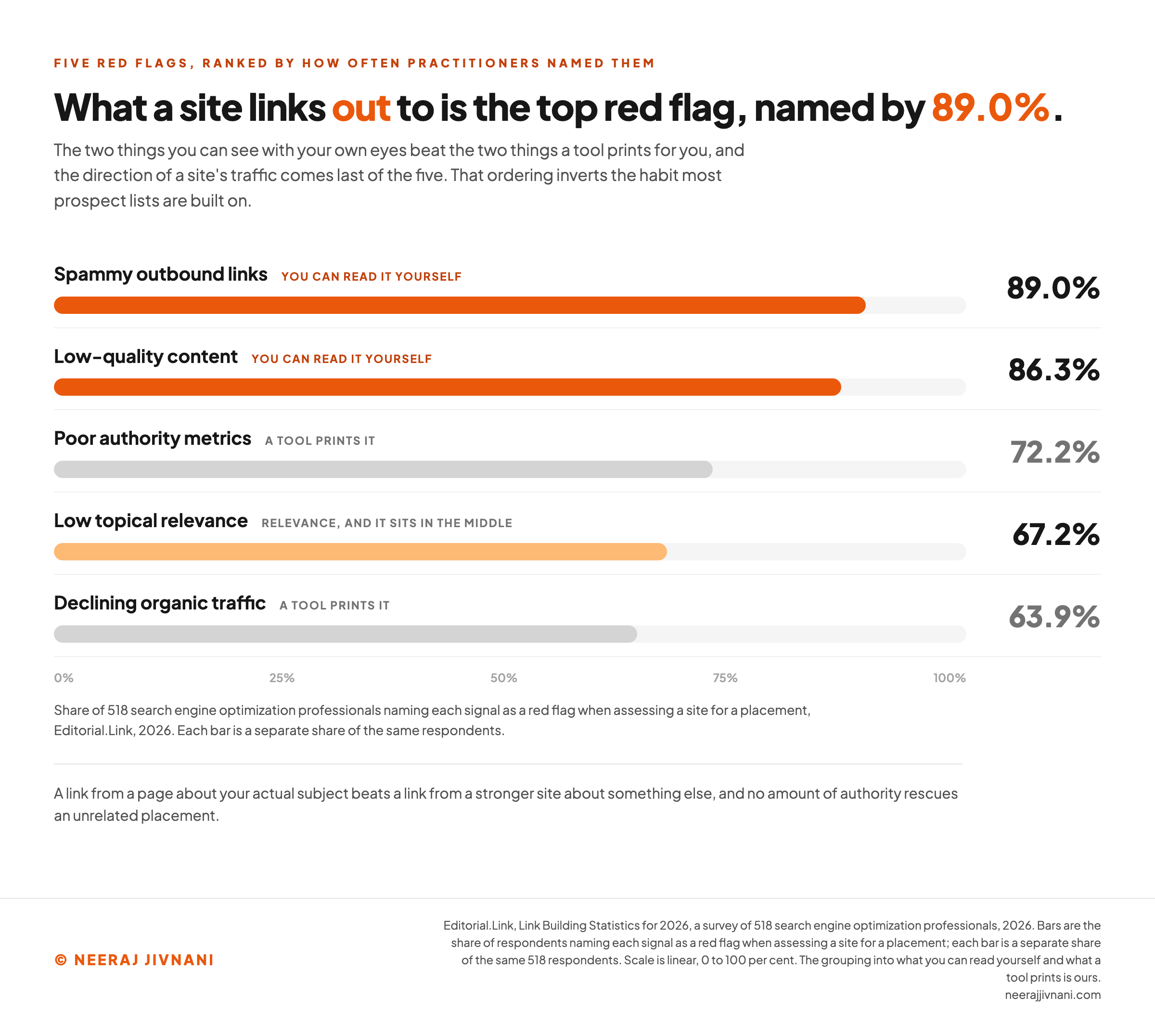
Practitioners surveyed by Editorial.Link in 2026 put that first. Spammy outbound links were named the biggest red flag when assessing a site for a placement by 89.0% of them, ahead of every other signal.
The rest of their list runs in a sensible order. Low-quality content came second at 86.3%, poor authority metrics third at 72.2%, low topical relevance at 67.2%, and declining organic traffic at 63.9%.
That ordering inverts the habit most prospect lists are built on.
The two things you can see with your eyes beat the two things a tool prints for you, and traffic direction comes last of the five.
Relevance sitting in the middle deserves one caveat. A link from a page about your actual subject beats a link from a stronger site about something else, and no amount of authority rescues an unrelated placement.
One more prospect filter costs nothing at all.
If the page you want to sit on has not been touched in three years, your link will live somewhere nobody visits. Check the date on the last thing published there before you write anything.
Use this chart — embed code and citation
<a href="https://neerajjivnani.com/blog/link-building/"><img src="https://neerajjivnani.com/infographics/link-building/what-gets-a-site-rejected.png" alt="Ranked bar chart of five red flags named by 518 search engine optimization professionals surveyed by Editorial.Link in 2026, showing spammy outbound links at 89.0 percent, low-quality content at 86.3 percent, poor authority metrics at 72.2 percent, low topical relevance at 67.2 percent and declining organic traffic at 63.9 percent, with the two signals a reader can judge by eye marked apart from the two a tool prints." width="1200"></a>
<p>Chart: <a href="https://neerajjivnani.com/blog/link-building/">Neeraj Jivnani</a></p>Neeraj Jivnani, "Link Building, Step by Step, and What It Costs to Run", neerajjivnani.com, https://neerajjivnani.com/blog/link-building/Free to republish with a link back to this page.
Finding the Person Who Can Say Yes
Write to a person, not to a department. An email to info@ is a lottery ticket; an email to whoever wrote the article is a conversation.
Start with the byline. Most articles carry an author name, and most author names lead to a public profile with an address on it or a way to reach them.
Three places carry that address often enough to check in order.
- The author's own site. Writers who take pitches usually say so on a contact page, and some publish what they will and will not cover.
- Their professional profile. A working writer's profile normally names their current publication, which tells you whether the article is still theirs to edit.
- The publication's masthead. Where there is no byline, this is where the section editor is named. On a small site the writer and the owner are usually the same person, which is the easiest case in this whole process.
Use the contact form last, and expect nothing from it. Messages sent through one land in a queue nobody owns, and you never learn whether yours arrived.
One limit is worth respecting.
Finding a work address is ordinary practice. Guessing at an address pattern and firing at four variants of somebody's name is how you become the reason a publisher stops reading pitches altogether.
The Email That Gets Answered
Name the page, name the place on their page, and ask for one thing. Under two hundred words, and specific enough that the person can act on it without writing back for detail.
Most pitches fail on the last of those. "Let me know what you think" leaves a busy person with nothing to do, so they do nothing.
Four things belong in the email and nothing else does.
- Why you are writing to them specifically. One line about their article that proves you opened it.
- What you have. The page, and the single sentence that says why their reader would want it.
- Where it fits. Name the section. The easier the edit is, the more often it happens.
- One ask. Not share, link, or reply. One.
Past a couple of hundred words a pitch reads as work rather than as a favor, and it gets read on a phone between other things.
Two parts of the finished link are not yours to decide either way. Whoever publishes it writes the anchor text, and decides any attribute attached to it.
Pushing back on either spends your goodwill on the part of the link that matters least, and it can cost you the placement.
Following Up Once, and Then Stopping
Silence is not a refusal. It is usually an email that arrived on a bad morning.
Send one follow-up about a week later, on the same thread, shorter than the first.
Then stop. A second follow-up converts almost nobody and costs you the next opportunity with that person, because the list is long and their memory is longer.
What to Track, and What the Numbers Mean
Four numbers tell you whether this is working, and one spreadsheet holds all of them.
| What to record | What it tells you |
|---|---|
| Asks sent | Whether the campaign is running at all. Most stall here. |
| Replies, of any kind | Whether your pitch reads as worth answering. |
| Links published | Whether your page is worth linking to. |
| Weeks from first email to live link | What to promise anyone waiting on this. |
No published benchmark is worth holding yourself to on any of these. Reply rates move with the subject, with how known you are, and with how good the page is, so the only useful comparison is against your own first month.
Record the refusals too.
A site that declined for a reason you can fix is a better prospect next quarter than a stranger is today.
Reading Your First Month
Your first month is a baseline rather than a result. Nothing in it tells you whether link building works; it tells you whether your version of it is running.
Three readings cover most of what a first month can say.
- Few asks sent. The campaign is not running. This is the usual outcome and it is a scheduling problem, not a marketing one.
- Asks sent, no replies. Look at the list before the email. A pitch cannot rescue a prospect who was never going to care.
- Replies, no links. The pitch is working and the page is not. That sends you back to what you are asking people to link to.
None of those three is visible in a ranking report, which is why the spreadsheet earns its place.
What It Costs, in Hours and in Money
Running this yourself costs a day of work per batch of prospects, and buying it starts around $220 a link.
Take the hours first, and count them honestly. Prospecting and qualifying take longer than writing the emails, and a decent batch of prospects is most of a working day before a single message goes out.
Put your own hourly cost against that and you have your floor.
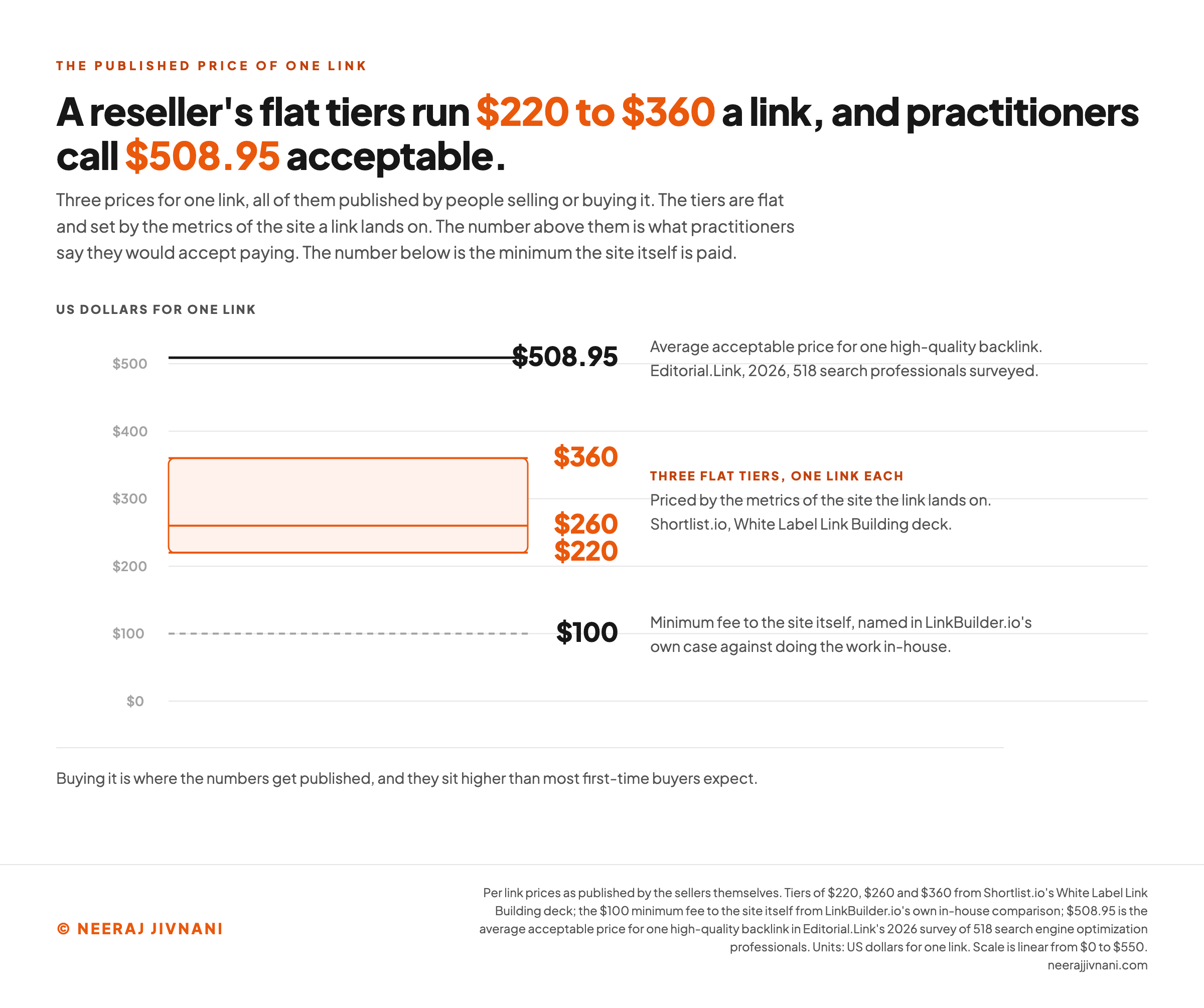
Buying it instead is where the numbers get published, and they sit higher than most first-time buyers expect.
$508.95 was the average acceptable price for acquiring one high-quality backlink, in Editorial.Link's 2026 survey of 518 search engine optimization professionals. The average minimum monthly budget named there for competing in highly competitive niches was $8,406.
The agencies publish the same order of magnitude on their own sales pages. LinkBuilder.io lists a $5,999 monthly tier for at least 16 links and a $9,999 tier for at least 26.
Its case against doing the work in-house sits beside those tiers, and it is the more useful half: a full-time employee at $40,000 a year, plus a minimum of $100 a link in fees to the sites themselves.
Pricing the Experiment Before You Start It
Published rates make this arithmetic rather than a matter of taste.
Fix the rate first. What you will spend in a month, in hours or in dollars, and how many months you will keep spending it.
Give it six months at the least. A placement takes weeks to appear and longer to do anything, so a shorter test measures your patience rather than the work.
Multiply the two and you have the real price of the experiment, which is almost always larger than the number people have in their heads.
Now set that against what the position is worth to you. The monthly searches, a realistic share of the clicks, and what one of those visitors is worth to your business.
If the second number is not comfortably bigger, do not start.
A campaign abandoned in month four buys close to nothing, because the placements that were on their way were still on their way.
Hold your own hours against the rate
One side of this decision is quoted in your hours and the other in their dollars, so nobody compares them. Put a price on an hour of your time and both sides land in the same unit.
Nothing converts until an hour has a price. That number is the whole exchange rate between the two halves of this decision, and it is the one figure no published table can supply for you.
What You Are Buying When You Buy Links
You are buying placements on other people's websites, priced per link or as a monthly volume of them. The vendor finds the site, writes or supplies the content, and gets your link into it.
What you are paying for is access to sites that will publish, and somebody else's time spent asking.
Published terms describe the product better than the sales pages do.
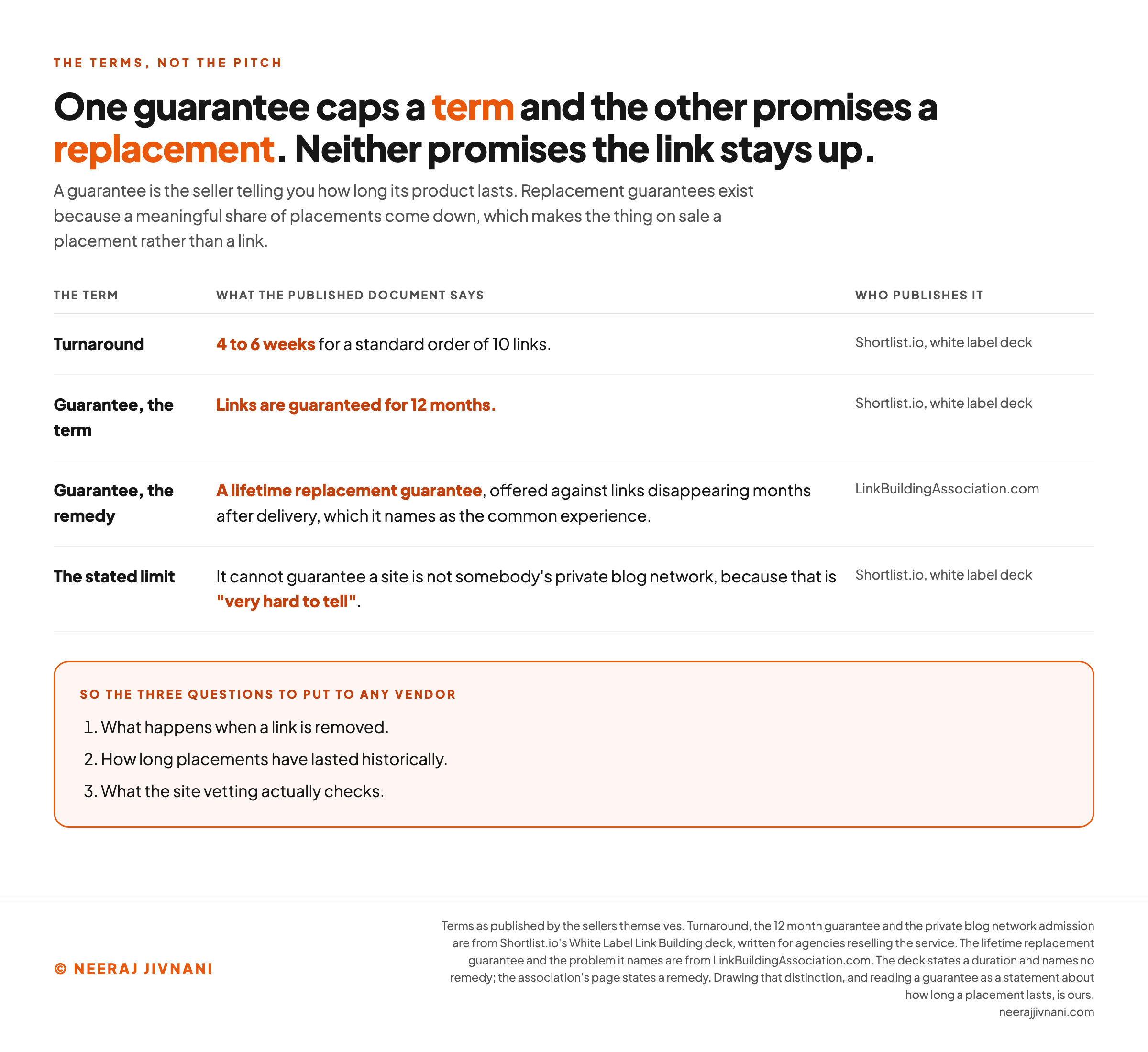
Shortlist.io's white label deck, written for agencies reselling the service, prices links flat by the metrics of the site they land on: $220, $260 and $360 per link across three tiers.
Turnaround is stated as well, at 4 to 6 weeks for a standard order of 10 links. That is the real pace of the work once somebody is doing it full time.
Then comes the line that matters most, and it is in the guarantees rather than the pitch.
The deck guarantees its links for 12 months.
A Guarantee Is a Prediction
Read a guarantee as what it is: the seller telling you how long its product lasts.
LinkBuildingAssociation.com, another firm selling the service, is explicit about the failure it covers. It names links disappearing months after delivery as the common experience, and offers a lifetime replacement guarantee against it.
So the thing on sale is a placement rather than a link.
It sits on somebody else's page at their discretion, and replacement guarantees exist because a meaningful share of placements come down.
The same white label deck is candid about a second limit. It says it cannot guarantee a site is not somebody's private blog network, because that is "very hard to tell".
That candor is worth more than the case studies around it, and it sets the questions to put to any vendor. Ask what happens when a link is removed, how long placements have lasted historically, and what the site vetting checks.
Buying links for ranking purposes is against Google's published spam policies. The market exists anyway and prices itself in the open, and a buyer should at least know the terms being agreed to.
Use this chart — embed code and citation
<a href="https://neerajjivnani.com/blog/link-building/"><img src="https://neerajjivnani.com/infographics/link-building/what-one-link-costs.png" alt="Vertical dollar scale of the published price of one link, showing a minimum fee of $100 paid to the site itself, a band covering three flat reseller tiers at $220, $260 and $360 per link, and a line at $508.95 marking the average acceptable price for one high-quality backlink in a 2026 survey of 518 search engine optimization professionals." width="1200"></a>
<p>Chart: <a href="https://neerajjivnani.com/blog/link-building/">Neeraj Jivnani</a></p>Neeraj Jivnani, "Link Building, Step by Step, and What It Costs to Run", neerajjivnani.com, https://neerajjivnani.com/blog/link-building/Free to republish with a link back to this page.
Use this chart — embed code and citation
<a href="https://neerajjivnani.com/blog/link-building/"><img src="https://neerajjivnani.com/infographics/link-building/what-the-terms-actually-say.png" alt="Table of four published terms taken from link selling documents, listing a turnaround of 4 to 6 weeks for a standard order of 10 links, links guaranteed for 12 months, a lifetime replacement guarantee offered against links disappearing months after delivery, and a stated inability to guarantee that a site is not somebody's private blog network, followed by the three questions to put to any vendor." width="1200"></a>
<p>Chart: <a href="https://neerajjivnani.com/blog/link-building/">Neeraj Jivnani</a></p>Neeraj Jivnani, "Link Building, Step by Step, and What It Costs to Run", neerajjivnani.com, https://neerajjivnani.com/blog/link-building/Free to republish with a link back to this page.
Whether the Work Still Pays
Yes, and the interesting part of the answer is about price. What has moved is what a link costs, and who can carry that cost.
The people doing this for a living report the same squeeze.
In that 2026 survey, 75.1% named the cost of premium backlinks as their biggest challenge and 55.2% called link building the most difficult part of search engine optimization. Another 52.9% said they struggle to measure its return at all.
The last of those three deserves more weight than it usually gets.
An activity whose own practitioners cannot reliably measure its effect is one to buy cautiously and in small amounts, whatever the case studies say.
Answers assembled by artificial intelligence have not brought the price down.
Of those surveyed, 73.2% think backlinks influence whether a brand appears in results generated that way. Whether the belief is correct or not, it is what holds the rate where it is.
The Answer Splits by Who Is Asking
One person with a site and no budget should spend the effort on the thing worth citing, and on the few people who would obviously want it.
Buying volume at these rates is the fastest way to spend a year of marketing money on placements you cannot verify.
A team in a crowded commercial market, with a budget that survives a bad quarter, is where the arithmetic sometimes clears. Then this is a line item rather than a project, and it deserves to be run like one.
Two Decisions Before the First Email
Decide what you are asking people to link to, and decide the rate you will hold for six months. Neither is a tactic, and both are usually skipped.
If nothing on your site is something you would cite from somebody else's article, that is the work, and outreach can wait until it exists.
The rate is the harder one, because this market publishes its own and yours has to stand next to it.
Pick the number you would still be paying in month six, in hours or in dollars, and write it down before you send anything.
Everything else is execution. Those two decisions settle whether it was worth doing, and both are cheaper to get right before the first email than after the fortieth.