Content Syndication: What It Means, and Which of the Two You Are Being Sold
Republishing an article and buying gated downloads get sold as one thing. See which you are being offered, and exactly what to ask for.

/ On this page9 sections
Content syndication means republishing something you already published on a site you do not own. Republishing an article and buying gated downloads both get sold under that one name.
They are not the same purchase. One hands you readers, the other hands you contact records, and advice written for one is regularly wrong for the other.
Telling them apart takes a single question, and everything you should ask for follows from the answer.
Which of the Two You Are Looking At
Look for the form. If the thing being offered to you sits behind one, you are being sold records; if it is out where anybody can read it, you are being sold reach.
That one look names the purchase, and naming it decides what you should be asking for and what you should be worried about.
It does not promise that nothing else gets published under the same deal. That is a separate question with its own answer, and it comes later.
Work the naming out before anything else. The two routes want different terms, and terms are the part that is hard to change afterwards.
The Form Is the Tell
A form has a purpose, and nobody puts one in front of an article they want read. That is why it sorts these two so reliably.
Say a payroll company writes a piece on holiday pay. A trade magazine runs it with a credit line, and anybody can read it: that is the first route.
The same company turns the same material into a guide behind a form on a media network's site. The people who download it arrive as rows in the sales team's system: that is the second.
The rest of the tells follow from that one, and they are worth having in front of you before you talk to anybody selling either.
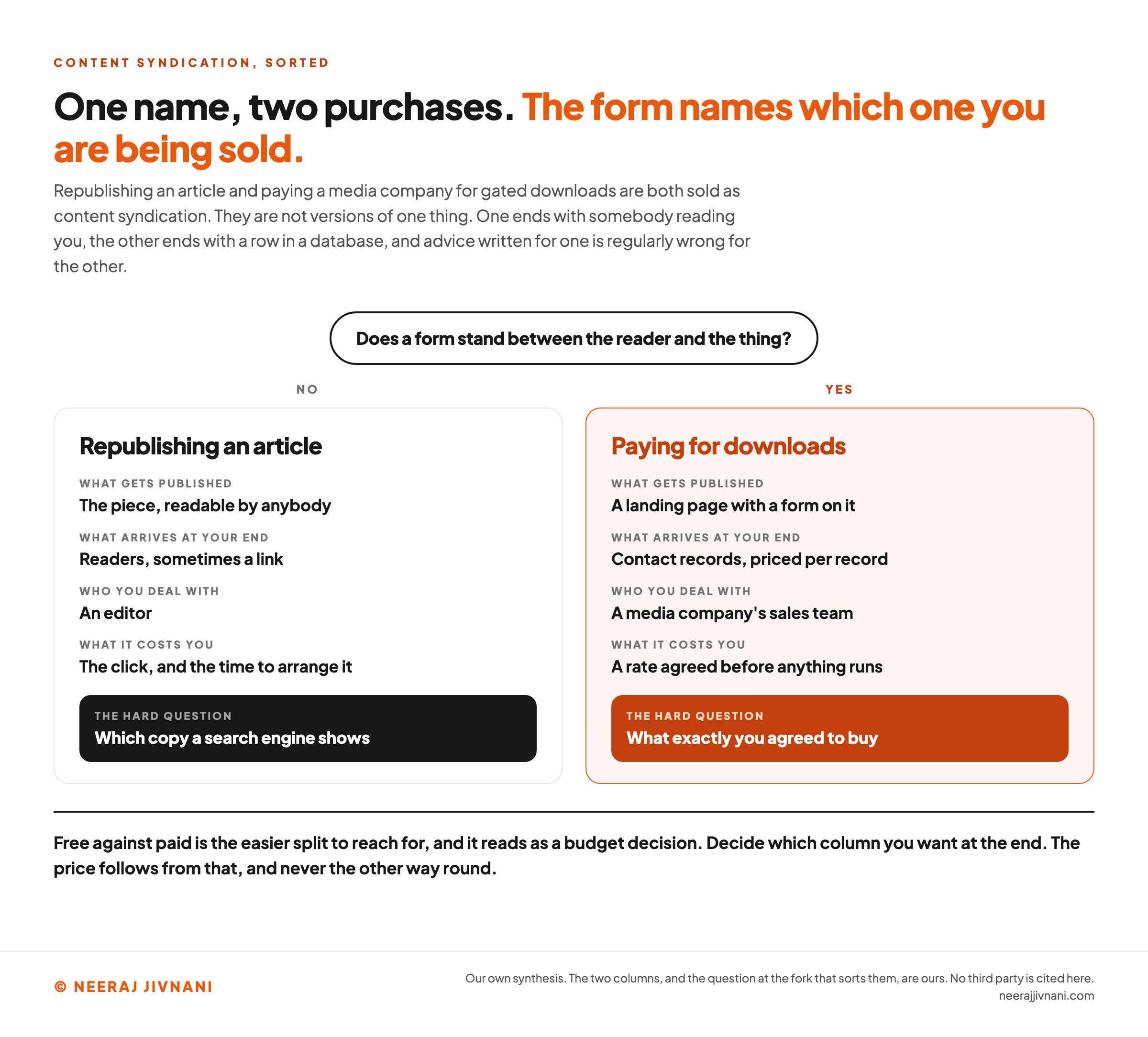
| Republishing an article | Paying for downloads | |
|---|---|---|
| What gets published | The piece, readable by anybody | A landing page with a form on it |
| What arrives at your end | Readers, sometimes a link | Contact records, priced per record |
| Who you deal with | An editor | A media company's sales team |
| The hard question | Which copy a search engine shows | What exactly you agreed to buy |
| What it costs you | The click, and the time to arrange it | A rate agreed before anything runs |
Free Against Paid Is a Different Question
Free against paid is the easier question to reach for, and answering it first is how you end up on the wrong route.
It reads as a budget decision. Ask it early and you conclude there must be a cheap version of the same thing.
There is no cheap version, because these are not versions of one thing.
Decide which column you want at the end. The price follows from that, and never the other way round.
Am I buying readers or records?
Answer each row for the deal actually in front of you, from what you have been told rather than from what it is called. Nothing here is scored, and neither column is the good one.
What gets published
What arrives at your end
Who you deal with
What it costs you
Look for the form. If the thing being offered to you sits behind one, you are being sold records; if it is out where anybody can read it, you are being sold reach.
Work the naming out before anything else. The two routes want different terms, and terms are the part that is hard to change afterwards.
Use this chart — embed code and citation
<a href="https://neerajjivnani.com/blog/content-syndication/"><img src="https://neerajjivnani.com/infographics/content-syndication/one-name-two-purchases.png" alt="Fork diagram sorting the two purchases that share the name content syndication. A single question sits at the top, does a form stand between the reader and the thing, and splits into a no arm and a yes arm. The no arm leads to a card headed republishing an article, which lists what gets published as the piece readable by anybody, what arrives at your end as readers and sometimes a link, who you deal with as an editor, and what it costs you as the click and the time to arrange it, closing on a dark band naming the hard question as which copy a search engine shows. The yes arm leads to a card headed paying for downloads, which lists what gets published as a landing page with a form on it, what arrives at your end as contact records priced per record, who you deal with as a media company's sales team, and what it costs you as a rate agreed before anything runs, closing on an orange band naming the hard question as what exactly you agreed to buy. A line at the foot says free against paid is the easier split to reach for and reads as a budget decision, and that you should decide which column you want at the end because the price follows from that." width="1200"></a>
<p>Chart: <a href="https://neerajjivnani.com/blog/content-syndication/">Neeraj Jivnani</a></p>Neeraj Jivnani, "Content Syndication: What It Means, and Which of the Two You Are Being Sold", neerajjivnani.com, https://neerajjivnani.com/blog/content-syndication/Free to republish with a link back to this page.
Republishing an Article Somewhere Bigger
Republishing works by giving a publication something it would have wanted anyway, in exchange for its readers.
You are not paying for the space and the publication is not doing you a favor. It fills a slot with something good without commissioning it, and your name goes on the piece.
That trade only holds while the piece is genuinely worth running. A publication with an editor will say no, and one that never says no is not offering you readers.
What You Trade for the Reach
You are trading the click, and that is the whole cost of this route.
Somebody reads your piece to the end on a bigger site. They have the answer.
There is nothing left for them to come and find, so most of them never visit you at all.
Every benefit on the table has to be worth more than that visit.
Usually it is, and the arithmetic is not close. Say a piece gets a few hundred readers on your own site and tens of thousands on a trade magazine: that has bought reach you could not buy any other way.
Where it stops being worth it is when the piece was the thing that sold for you.
A worked example with your own numbers in it, a diagnostic, anything a reader was meant to act on. Hand that over whole and you have given away the conversion along with the reader.
What to Settle Before Anything Is Published
Six things, and all of them are cheaper to agree in an email than to renegotiate once the copy is live.
- Whole piece or excerpt. Both are legitimate and they buy different things, so raise it rather than letting the publication assume.
- What the credit line says, and where it sits. Above the piece is worth more than below it, and a credit that names your business reads differently from one that names only the original publication.
- Whether the copy links back. Ask for a link in the credit line, on your own page's address, and expect the publication to decide the wording.
- The indexing instruction. What their copy tells a search engine to do with itself, which is the term people forget to raise and the one that costs most to get wrong.
- Whether they may edit it. Most publications will shorten and rewrite headlines. Agree it rather than discover it.
- When it runs. Publish on your own site first and leave a gap before the copy appears, so your version is the one already in the index when the second one arrives.
Write the answers down in the thread where you agreed them. Nobody remembers this conversation a year later, and a year later is when somebody asks why the other version outranks yours.
Which Copy a Search Engine Shows
Two copies of one article exist, and a search engine has to pick one to show. It may not pick yours.
That is the real risk on this route, and it is worth being precise about what it is not.
It is not a penalty. The question a search engine is answering is which copy to show rather than whether to punish anybody.
It is not plagiarism either, because the copy is published with your permission and your credit.
The risk is that the wrong address collects the visits.
Google's canonicalization troubleshooting guidance, updated in August 2026, lists syndicated content among the things that make Google choose a canonical you did not declare. It sits in that list beside faulty content management settings, server misconfiguration and being hacked.
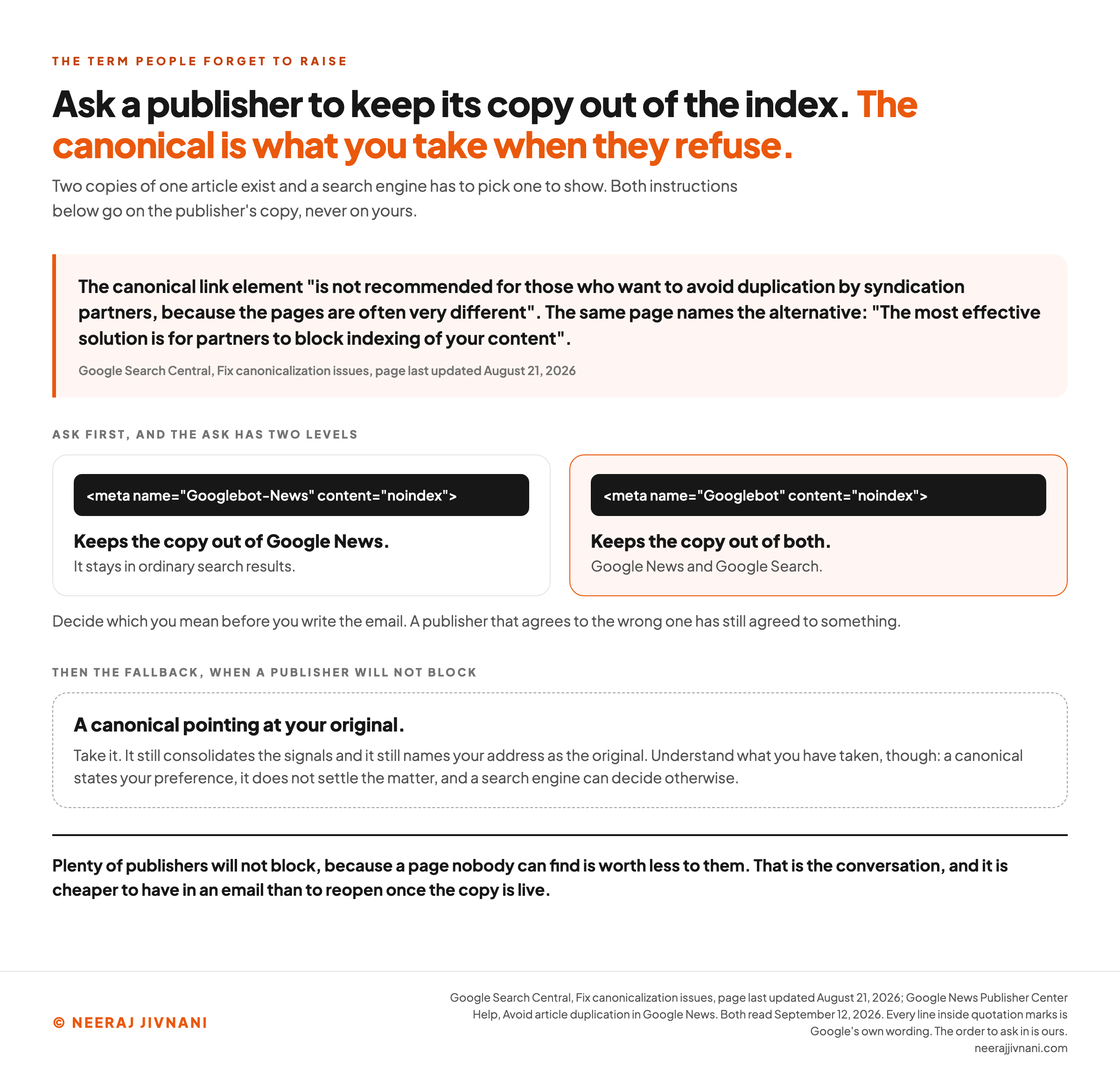
Its answer is direct. The canonical link element "is not recommended for those who want to avoid duplication by syndication partners, because the pages are often very different".
The same page names the alternative: "The most effective solution is for partners to block indexing of your content".
So the first thing you ask a publisher for is not a canonical.
You ask that their copy stays out of the index.
And the ask has two levels. Google's publisher guidance for news sites, which its canonicalization page points to for blocking syndicated content from Search as well, publishes both instructions. They go on the publisher's copy, never on yours.
``html
<meta name="Googlebot-News" content="noindex">
<meta name="Googlebot" content="noindex">
``
The first keeps the copy out of Google News and leaves it in ordinary search results. The second keeps it out of both.
Decide which you mean before you write the email. A publisher that agrees to the wrong one has still agreed to something.
A canonical pointing at your original is the fallback when a publisher will not block indexing. Plenty will not, because a page nobody can find is worth less to them.
Take it. It still consolidates the signals and it still names your address as the original.
Understand what you have taken, though. A canonical states your preference; it does not settle the matter, and a search engine can decide otherwise.
One piece of history is worth knowing, because you will meet it while you are looking this up.
Google's 2009 post on cross-domain duplication answered the same question by leaving the canonical up to you and your publishers. That page is still live and still says so.
It now carries a note at the top, from Google, saying the canonical is no longer recommended for syndicated content. Both sentences sit on one page, and the note is the current answer.
When an Excerpt Is the Better Deal
An excerpt with a link is the better deal whenever the traffic matters more than the reach.
The mechanics are the point. A reader who meets three paragraphs and a link either clicks or does not, and the ones who click arrive on your page with the piece still ahead of them.
A reader who meets the full text has already finished.
Newsletters work this way by default, which is why a newsletter placement usually sends more visits than a full republication on a much larger site.
An excerpt also makes the indexing question smaller, because there is less of a copy to be confused about.
Ask for the excerpt when you want visits, a signup or an inquiry. Ask for the whole piece when you want to be read by people who will never come to your site at all, and count that as the win it is.
Use this chart — embed code and citation
<a href="https://neerajjivnani.com/blog/content-syndication/"><img src="https://neerajjivnani.com/infographics/content-syndication/ask-for-the-block-first.png" alt="Panel setting out the indexing instruction to ask a publisher for, in the order to ask for it. A quoted band at the top carries Google's own wording that the canonical link element is not recommended for those who want to avoid duplication by syndication partners because the pages are often very different, and that the most effective solution is for partners to block indexing of your content, credited to Google Search Central's canonicalization troubleshooting page as last updated August 21, 2026. Below it, headed ask first and the ask has two levels, two cards each carry one meta tag. The first, meta name equals Googlebot dash News with content equals noindex, keeps the copy out of Google News and leaves it in ordinary search results. The second, meta name equals Googlebot with content equals noindex, keeps the copy out of both Google News and Google Search. A note says to decide which you mean before you write the email, because a publisher that agrees to the wrong one has still agreed to something. A dashed box headed then the fallback carries the canonical pointing at your original, noting that it still consolidates the signals and names your address as the original, but that it states your preference rather than settling the matter and a search engine can decide otherwise. A band at the foot says plenty of publishers will not block, because a page nobody can find is worth less to them." width="1200"></a>
<p>Chart: <a href="https://neerajjivnani.com/blog/content-syndication/">Neeraj Jivnani</a></p>Neeraj Jivnani, "Content Syndication: What It Means, and Which of the Two You Are Being Sold", neerajjivnani.com, https://neerajjivnani.com/blog/content-syndication/Free to republish with a link back to this page.
Paying for Downloads
Paying for downloads is a media buy dressed in the language of publishing, and treating it as publishing is how people end up disappointed by it.
A media company already has an audience: a subscriber list, a set of industry sites, a newsletter estate.
You give it an asset worth downloading and a description of who you want reached. What comes back is the record of everybody who filled in the form.
You pay per record, at a rate agreed before anything runs.
What You Are Buying
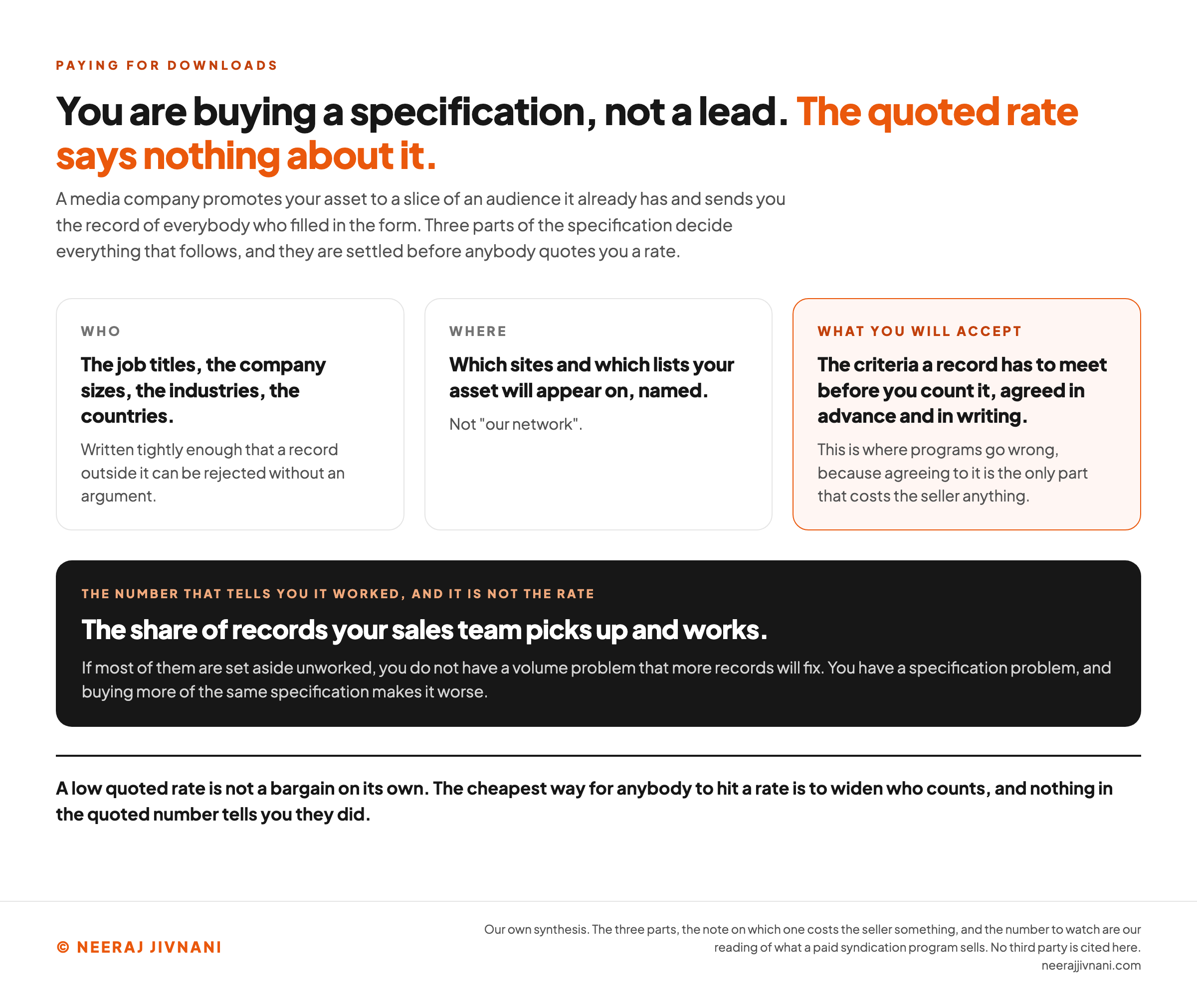
You are buying a specification, and the specification is the product.
Three parts of it decide everything that follows.
- Who. The job titles, the company sizes, the industries, the countries. Written tightly enough that a record outside it can be rejected without an argument.
- Where. Which sites and which lists your asset will appear on, named. Not "our network".
- What you will accept. The criteria a record has to meet before you count it, agreed in advance and in writing.
The third one is where programs go wrong, because agreeing to it is the only part that costs the seller anything.
One thing is worth being honest with yourself about before the first record arrives.
Somebody downloaded a guide on a subject. They did not ask to hear from your sales team and they may not remember your name.
The consent they gave was given to the publisher, not to you. Treating that record as an inbound inquiry is the fastest way to burn it.
The Questions That Separate One Vendor From Another
Five questions, and the answers vary far more than the sales decks do.
- Where exactly will my asset be hosted? A supplier who will name the sites is a different proposition from one who will not.
- Do you handle this yourselves, or subcontract it? A supplier running the campaign on its own sites can answer every other question here. One that hands it on cannot.
- How was consent obtained, and to whom was it given? You want to know what the person agreed to, because it is not you.
- Can you show me the trail for one record? What the person downloaded, where, and when.
- What happens to a record I reject? Replaced, credited, or argued about.
A low quoted rate is not a bargain on its own. The cheapest way for anybody to hit a rate is to widen who counts, and nothing in the quoted number tells you they did.
What Tells You It Worked
One number tells you, and it is not the rate.
Watch the share of records your sales team picks up and works.
If most of them are set aside unworked, you do not have a volume problem that more records will fix. You have a specification problem, and buying more of the same specification makes it worse.
Set that number down before the campaign starts, along with what you would accept as a result. A program judged only after the fact gets judged on whichever number happens to look best.
Give it a quarter at least. Records arrive in days and turn into anything much slower than that, so a month of data is a measure of your patience rather than of the channel.
Use this chart — embed code and citation
<a href="https://neerajjivnani.com/blog/content-syndication/"><img src="https://neerajjivnani.com/infographics/content-syndication/a-specification-not-a-lead.png" alt="Three cards setting out what a paid syndication program actually sells, under the finding that you are buying a specification and not a lead and that the quoted rate says nothing about it. The first card, headed who, carries the job titles, the company sizes, the industries and the countries, written tightly enough that a record outside it can be rejected without an argument. The second, headed where, carries which sites and which lists your asset will appear on, named, and not our network. The third card, highlighted, is headed what you will accept and carries the criteria a record has to meet before you count it, agreed in advance and in writing, with a note that this is where programs go wrong because agreeing to it is the only part that costs the seller anything. A dark band below names the number that tells you it worked, the share of records your sales team picks up and works, and says that if most of them are set aside unworked you have a specification problem rather than a volume problem, and buying more of the same specification makes it worse. A line at the foot says a low quoted rate is not a bargain on its own, because the cheapest way for anybody to hit a rate is to widen who counts." width="1200"></a>
<p>Chart: <a href="https://neerajjivnani.com/blog/content-syndication/">Neeraj Jivnani</a></p>Neeraj Jivnani, "Content Syndication: What It Means, and Which of the Two You Are Being Sold", neerajjivnani.com, https://neerajjivnani.com/blog/content-syndication/Free to republish with a link back to this page.
Where the Two Routes Quietly Meet
The clean split has one hole in it. Find it now rather than after you sign.
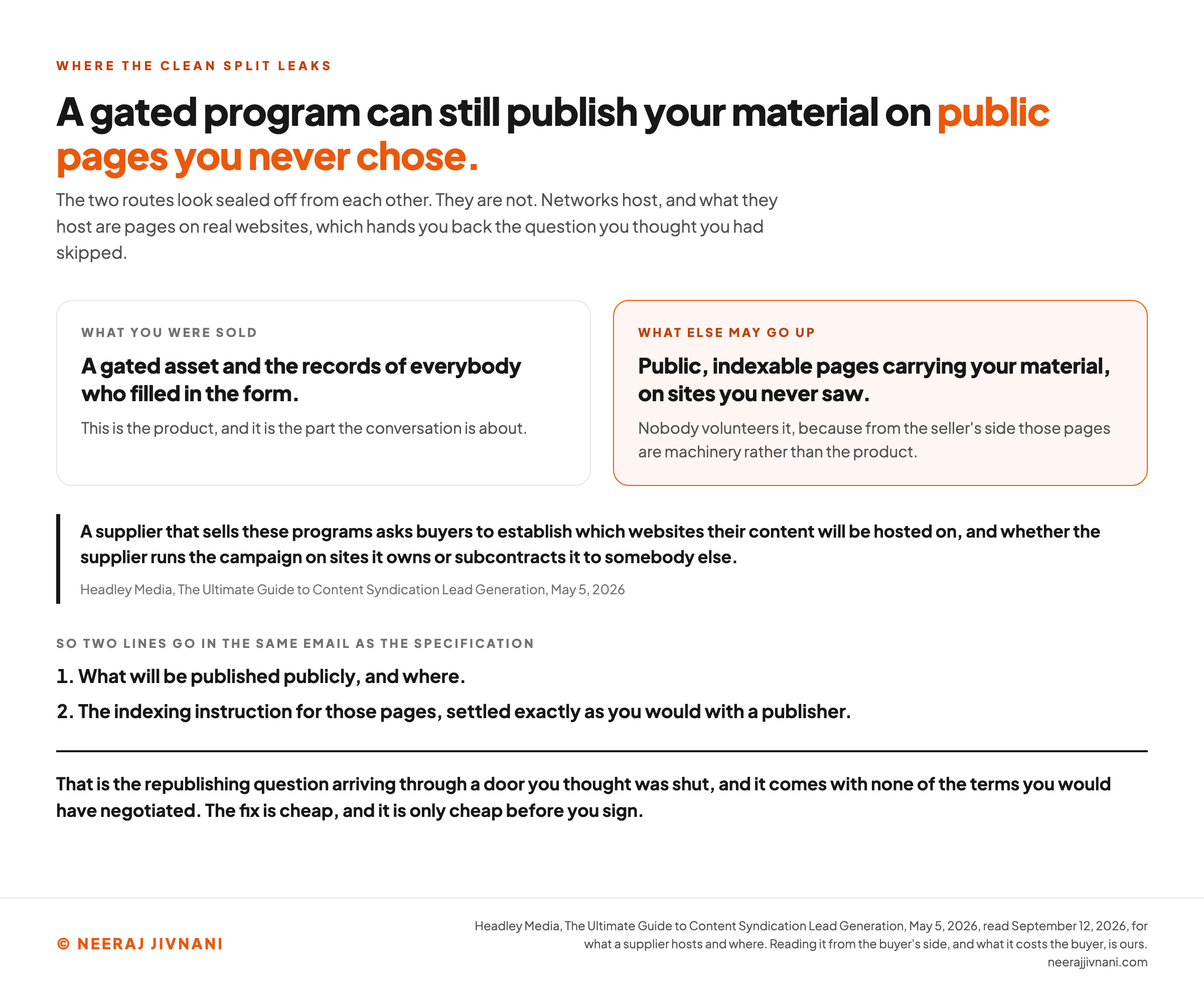
A lead program does not always keep your asset behind a form and nowhere else. Networks host, and what they host are pages on real websites.
Headley Media, which sells these programs, tells buyers in its May 2026 guide to find out which sites a supplier will host their content on, so they can see where their brand ends up associated.
Its own answer is that it uses sites it owns. It asks buyers to check whether a supplier does the same, or subcontracts the campaign to somebody else.
Read that from the other side. Your material can sit on public, indexable pages that you never chose and never saw.
That is the republishing question arriving through a door you thought was shut, and it comes with none of the terms you would have negotiated.
The fix is cheap. Ask, in the same email as the specification, what will be published publicly and where, and settle the indexing instruction for those pages exactly as you would with a publisher.
Nobody volunteers it, because from the seller's side those pages are machinery rather than the product.
Use this chart — embed code and citation
<a href="https://neerajjivnani.com/blog/content-syndication/"><img src="https://neerajjivnani.com/infographics/content-syndication/where-the-split-leaks.png" alt="Two facing cards showing where the split between the two routes leaks. The first, headed what you were sold, carries a gated asset and the records of everybody who filled in the form, noted as the product and the part the conversation is about. The second, highlighted, is headed what else may go up and carries public indexable pages carrying your material on sites you never saw, with a note that nobody volunteers it because from the seller's side those pages are machinery rather than the product. A quoted block below says a supplier that sells these programs asks buyers to establish which websites their content will be hosted on, and whether the supplier runs the campaign on sites it owns or subcontracts it to somebody else, credited to Headley Media's guide to content syndication lead generation dated May 5, 2026. A numbered list of two items follows, headed so two lines go in the same email as the specification: what will be published publicly and where, and the indexing instruction for those pages settled exactly as you would with a publisher. A band at the foot says this is the republishing question arriving through a door you thought was shut, with none of the terms you would have negotiated." width="1200"></a>
<p>Chart: <a href="https://neerajjivnani.com/blog/content-syndication/">Neeraj Jivnani</a></p>Neeraj Jivnani, "Content Syndication: What It Means, and Which of the Two You Are Being Sold", neerajjivnani.com, https://neerajjivnani.com/blog/content-syndication/Free to republish with a link back to this page.
Name the Thing Before You Agree to It
Everything here comes back to one sentence you can say out loud before money or material changes hands.
Am I buying readers or records?
If it is readers, the terms you need are the credit, the link, the excerpt or the whole piece, and the instruction that keeps their copy out of the index.
Ask for the block first. Take the canonical if that is all you can get.
If it is records, the terms you need are the specification, the sites by name, and what you will accept before anybody quotes you a rate.
The programs that disappoint people are almost never bad programs. They are the right program bought by somebody who wanted the other one.