An Affiliate Network Is a Middleman, and Not Every Program Needs One
A middleman charges on top of every commission you pay. See what that buys you, what it never buys, and how to price it against your own rate.


/ On this page8 sections
An affiliate network is a middleman: a marketplace and a payment rail that sits between merchants and the partners who sell for them.
You pay for it on top of every commission, and whether that fee is charged on the commission or on the sale decides what a sale costs you.
What that buys is reach and reconciliation: a directory of partners, one set of tracking, one payment run, and somebody to argue with when a sale goes missing. What it never buys is a partner who has chosen you.
Whether the middle is worth paying for comes down to one sum: your own commission rate, with the network's cut added on top.
The Four Things People Call an Affiliate Network
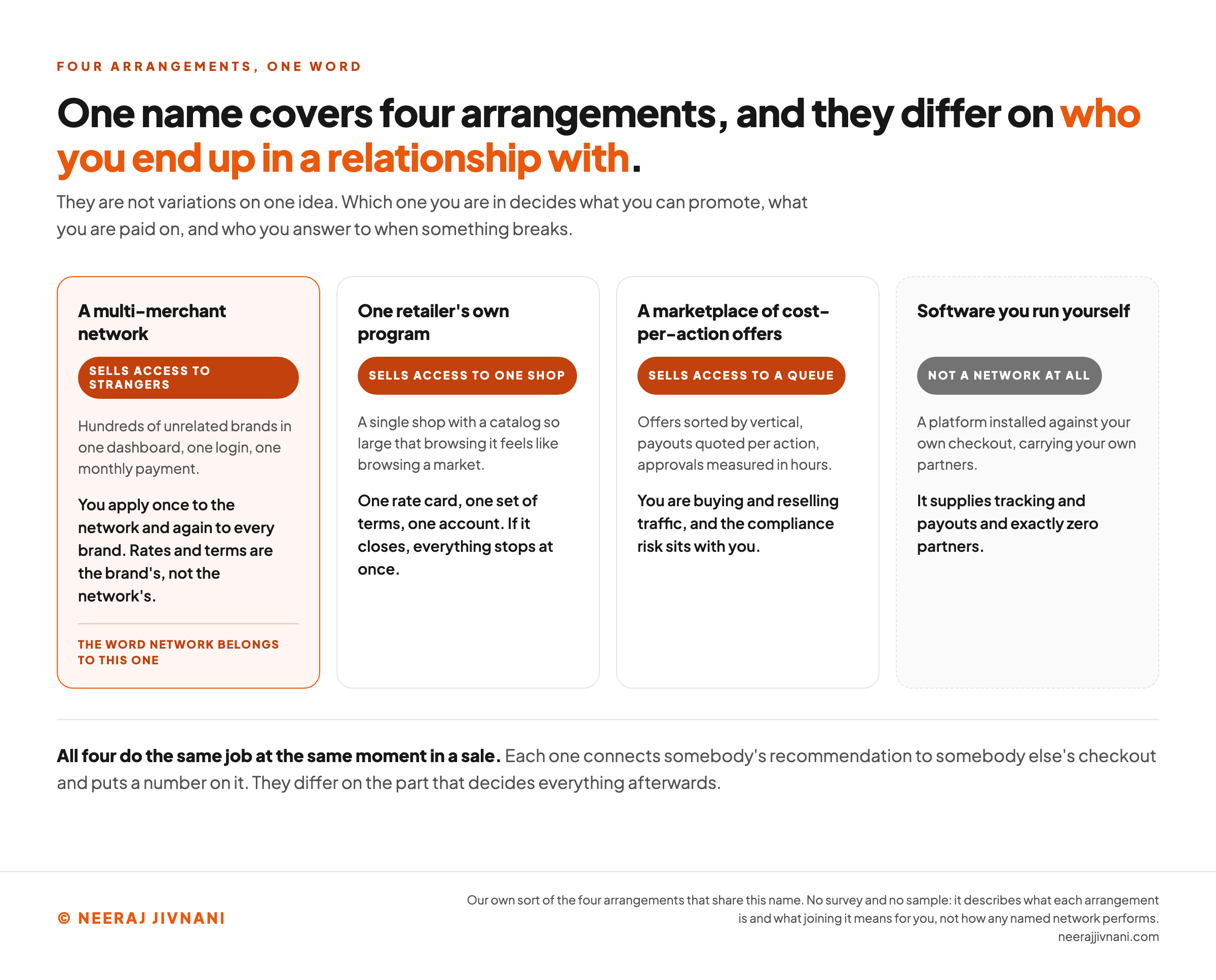
Four different arrangements go by this name, and they are not variations on one idea. Which one you are in decides what you can promote, what you are paid on, and who you answer to when something breaks.
Each of the four changes something different for you.
| The arrangement | What it looks like from outside | What it means for you |
|---|---|---|
| A multi-merchant network | Hundreds of unrelated brands in one dashboard, one login, one monthly payment | You apply once to the network and again to every brand. Rates and terms are the brand's, not the network's |
| One retailer's own program | A single shop with a catalog so large that browsing it feels like browsing a market | One rate card, one set of terms, one account. If it closes, everything stops at once |
| A marketplace of cost-per-action offers | Offers sorted by vertical, payouts quoted per action, approvals measured in hours | You are buying and reselling traffic. The verticals skew heavily, and the compliance risk sits with you |
| Software you run yourself | A platform installed against your own checkout, carrying your own partners | Not a network. It supplies tracking and payouts and exactly zero partners |
The confusion is understandable, because all four do the same job at the same moment in a sale. Each one connects somebody's recommendation to somebody else's checkout and puts a number on it.
They differ on the part that decides everything afterwards, which is who you end up in a relationship with.
Our way of putting it: a network sells access to strangers, a program sells access to one shop, and an offer marketplace sells access to a queue.
All three are useful. The word network belongs to the first.
The One That Catches Beginners
Amazon Associates is where the confusion starts costing something. It is a single retailer's program, and it gets called a network because Amazon sells so much that its catalog feels like a marketplace.
What you join is one shop.
One set of terms, one account, and a rate card that follows the product rather than the seller. The category is chosen for you by whatever the customer happens to buy.
The strongest argument for a real network is that a bad quarter at one brand is covered by the others. Inside a single retailer's program there are no others, and a rate change or a closed account lands on all of your income at once.
That is not an argument against starting there. It is an argument for knowing what you have joined, so that the second thing you do is find something that is not it.
Use this chart — embed code and citation
<a href="https://neerajjivnani.com/blog/affiliate-network/"><img src="https://neerajjivnani.com/infographics/affiliate-network/four-things-one-name.png" alt="Four cards side by side, one for each arrangement that goes by the name affiliate network. A multi-merchant network, marked as the one the word belongs to, sells access to strangers: hundreds of unrelated brands in one dashboard, one login, one monthly payment, where you apply once to the network and again to every brand and the rates and terms are the brand's rather than the network's. One retailer's own program sells access to one shop: a single shop with a catalog so large that browsing it feels like browsing a market, with one rate card, one set of terms and one account, so that if it closes everything stops at once. A marketplace of cost-per-action offers sells access to a queue: offers sorted by vertical, payouts quoted per action, approvals measured in hours, where you are buying and reselling traffic and the compliance risk sits with you. The fourth card, set apart with a dashed border and labeled not a network at all, is software you run yourself, a platform installed against your own checkout that supplies tracking and payouts and exactly zero partners. A closing line says all four do the same job at the same moment in a sale, connecting somebody's recommendation to somebody else's checkout and putting a number on it, and that they differ on the part that decides everything afterwards." width="1200"></a>
<p>Chart: <a href="https://neerajjivnani.com/blog/affiliate-network/">Neeraj Jivnani</a></p>Neeraj Jivnani, "An Affiliate Network Is a Middleman, and Not Every Program Needs One", neerajjivnani.com, https://neerajjivnani.com/blog/affiliate-network/Free to republish with a link back to this page.
What a Network Actually Supplies
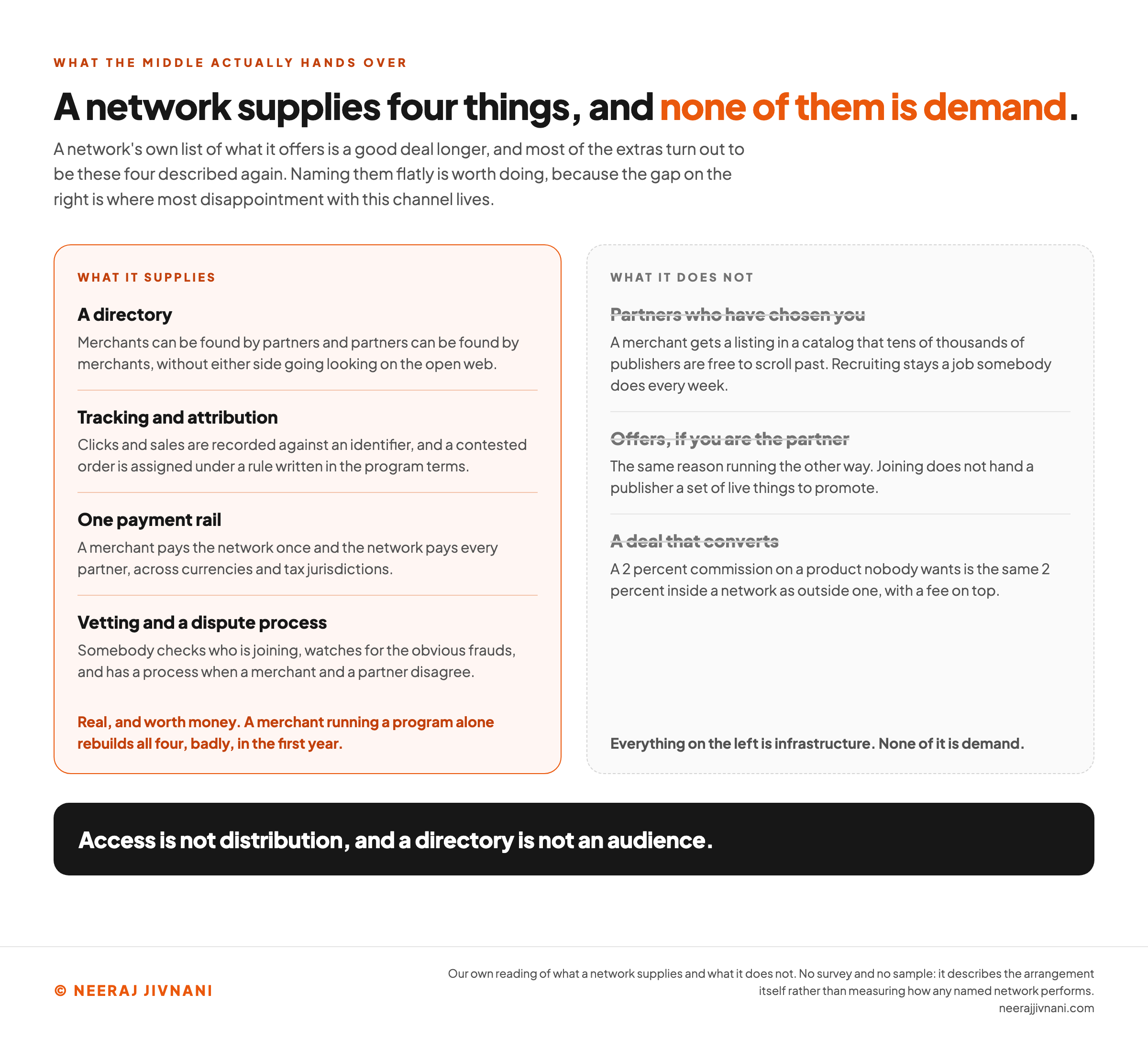
A network supplies four things. Naming them flatly is worth doing, because a network's own list of what it offers is a good deal longer and most of the extras turn out to be these four described again.
A directory. Merchants can be found by partners and partners can be found by merchants, without either side going looking on the open web.
Tracking and attribution. Clicks and sales are recorded against an identifier, and the network decides which partner a contested order belongs to under a rule written in the program terms.
One payment rail. A merchant pays the network once and the network pays every partner, across currencies and tax jurisdictions, which is genuinely tedious work that somebody would otherwise do by hand.
Vetting and a dispute process. Somebody checks who is joining, watches for the obvious frauds, and has a process when a merchant and a partner disagree about a commission.
Those four are real and they are worth money. A merchant running a program alone rebuilds all of them, badly, in the first year.
And What It Does Not
Everything above is infrastructure. None of it is demand, and the gap between those two is where most disappointment with this channel lives.
A network does not give a merchant partners who have chosen them. It gives them a listing in a catalog that tens of thousands of publishers are free to scroll past, and recruiting remains a job somebody has to do every week.
It does not give a partner offers either, for the same reason running the other way.
And it cannot make an unattractive deal convert. A 2% commission on a product nobody wants is the same 2% inside a network as outside one, with a fee on top.
We think this is the most oversold part of the arrangement.
Access is not distribution, and a directory is not an audience.
Use this chart — embed code and citation
<a href="https://neerajjivnani.com/blog/affiliate-network/"><img src="https://neerajjivnani.com/infographics/affiliate-network/four-things-and-no-demand.png" alt="Two panels. The left one, headed what it supplies, lists four things: a directory, so merchants can be found by partners and partners by merchants without either side going looking on the open web; tracking and attribution, where clicks and sales are recorded against an identifier and a contested order is assigned under a rule written in the program terms; one payment rail, where a merchant pays the network once and the network pays every partner across currencies and tax jurisdictions; and vetting and a dispute process, where somebody checks who is joining, watches for the obvious frauds and has a process when a merchant and a partner disagree. It closes by noting that all four are real and worth money, and that a merchant running a program alone rebuilds them badly in the first year. The right panel, headed what it does not, strikes through three things: partners who have chosen you, offers if you are the partner, and a deal that converts, noting that a merchant gets a listing in a catalog that tens of thousands of publishers are free to scroll past, that joining does not hand a publisher a set of live things to promote, and that a 2 percent commission on a product nobody wants is the same 2 percent inside a network as outside one with a fee on top. A black bar underneath reads that access is not distribution and a directory is not an audience." width="1200"></a>
<p>Chart: <a href="https://neerajjivnani.com/blog/affiliate-network/">Neeraj Jivnani</a></p>Neeraj Jivnani, "An Affiliate Network Is a Middleman, and Not Every Program Needs One", neerajjivnani.com, https://neerajjivnani.com/blog/affiliate-network/Free to republish with a link back to this page.
What the Fee Is Charged On
The fee is charged either on the commission or on the sale, and which base your agreement uses decides your real cost of selling.
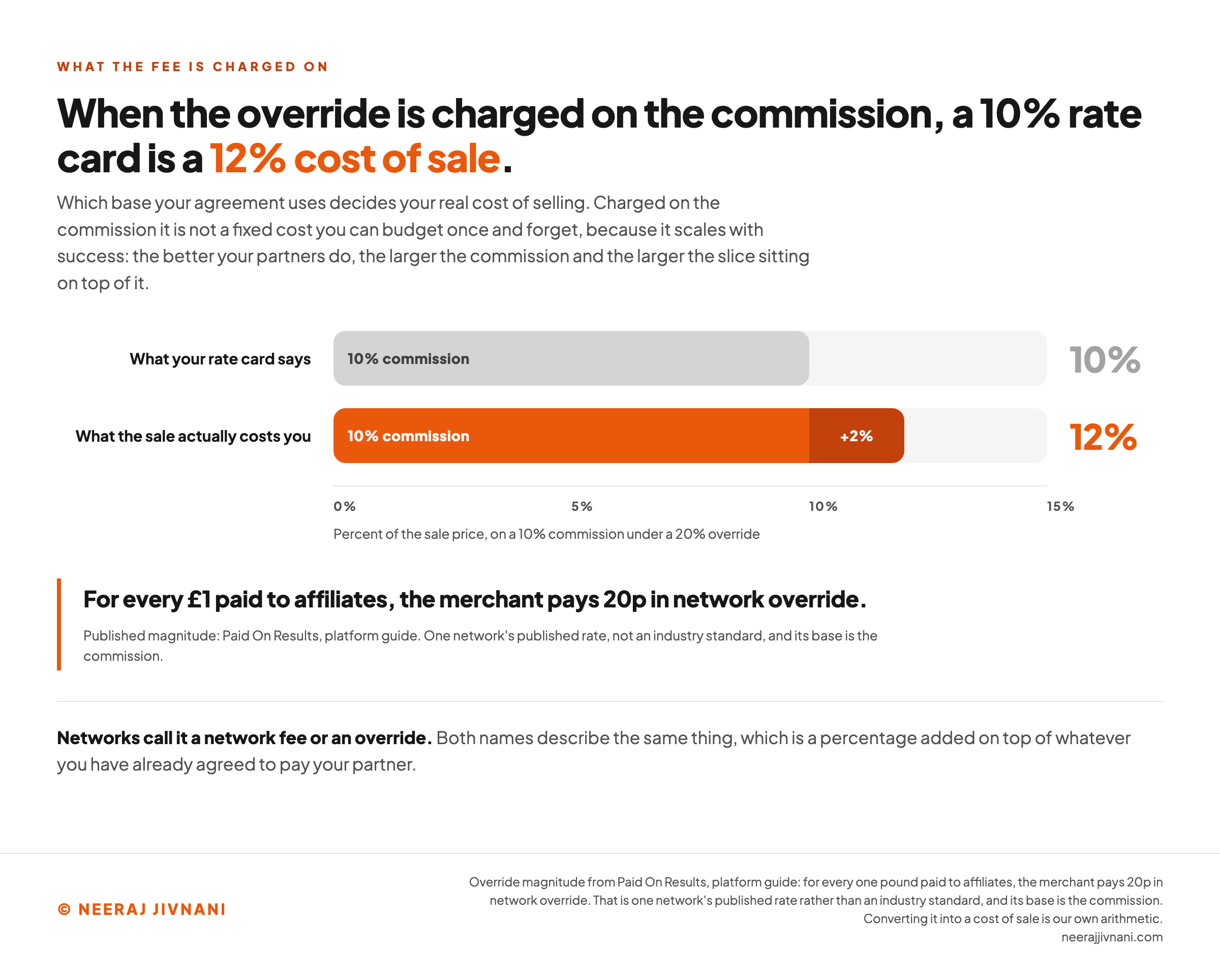
Networks call it a network fee or an override. Both names describe the same thing: a percentage added on top of whatever you have already agreed to pay your partner.
The base is the part that varies. Some agreements calculate it on the commission and some on the sale, a difference Awin puts down to the agreement set up with each individual advertiser.
Charged on the commission, it is not a fixed cost you can budget once and forget. It scales with success, because the better your partners do, the larger the commission and the larger the slice sitting on top of it.
The number is knowable, and some networks publish it outright.
For every £1 paid to affiliates, the merchant pays 20p in network override, a rate Paid On Results publishes on its own platform guide.
That is one network's published rate rather than an industry standard, and the point is not the figure. The point is that the figure exists, is askable, and changes what a sale costs you.
Working Out Your Own Number
The sum takes about a minute and it is the one most merchants skip.
Take the commission rate you pay a partner, then add the override percentage of that commission back on top.
A 10% commission under a 20% override charged on the commission is a cost of sale of 12%, not the 10% on your rate card.
If your agreement puts the override on the sale instead, the quoted percentage will be much smaller, because a commission is only a fraction of the sale it comes from.
Compare them only after you have turned each one into a cost of sale.
Then set that against what the channel is replacing. Twelve percent of a sale you would never otherwise have made is cheap at the price.
Twelve percent of a sale that was already on its way to you is expensive, which is why merchants care so much about which partners create demand and which intercept it.
A platform or monthly fee, where one exists, behaves in the opposite way. Being fixed, it is painful at low volume and invisible at high volume, and it is the part that punishes a program for being small.
The same three costs, read two ways
Put your own rate card in, then move the channel from small to large. In money the override grows with you and the fee never moves. As a share of every sale it is the other way round.
50,000
In money. The override grows every time the channel does. The fee is the same number at any size.
Of every sale. The override is the same share whatever you sell. The fee is the part that moves.
Your cost of sale, before any fixed fee
12%
12% of a sale you would never otherwise have made is cheap at the price. 12% of a sale that was already on its way to you is expensive.
Which of those you are looking at is the part only you know, so this does not decide it. Set the number against what the channel is replacing.
Use this chart — embed code and citation
<a href="https://neerajjivnani.com/blog/affiliate-network/"><img src="https://neerajjivnani.com/infographics/affiliate-network/charged-on-the-commission.png" alt="Two horizontal bars on a scale running from zero to fifteen percent of the sale price. The upper gray bar, labeled what your rate card says, reaches ten percent and is filled entirely by the partner's commission. The lower bar, labeled what the sale actually costs you, reaches twelve percent: the same ten percent commission in orange plus a darker segment marked plus two percent, which is the network override in the case where it is charged on the commission rather than on the sale. A quoted line beneath gives the published magnitude, that for every one pound paid to affiliates the merchant pays twenty pence in network override, credited to Paid On Results on its platform guide and flagged as one network's published rate rather than an industry standard, whose base is the commission. A closing line notes that networks call it a network fee or an override and that both names describe a percentage added on top of whatever you have already agreed to pay your partner." width="1200"></a>
<p>Chart: <a href="https://neerajjivnani.com/blog/affiliate-network/">Neeraj Jivnani</a></p>Neeraj Jivnani, "An Affiliate Network Is a Middleman, and Not Every Program Needs One", neerajjivnani.com, https://neerajjivnani.com/blog/affiliate-network/Free to republish with a link back to this page.
You Are Approved Twice
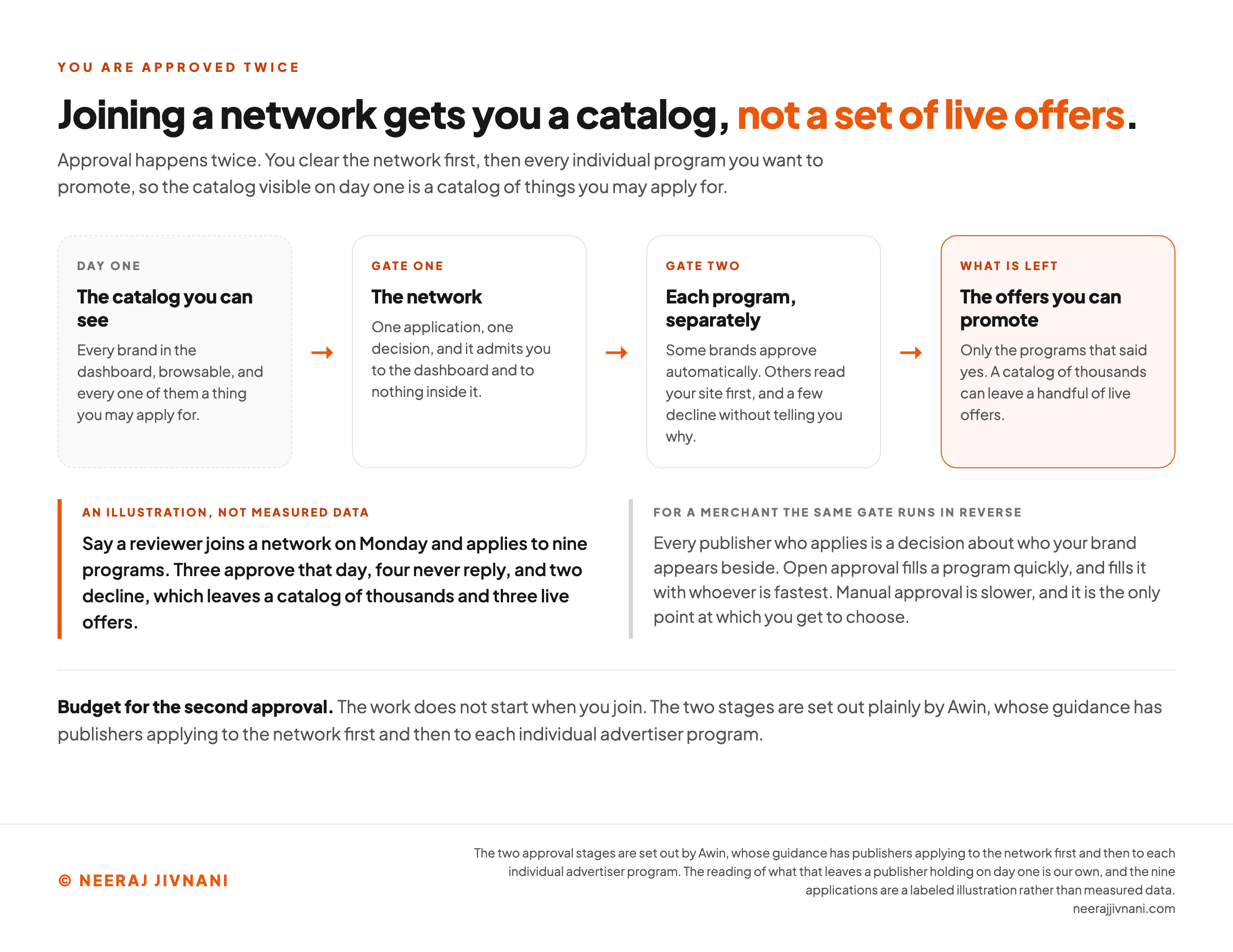
Approval happens twice, and joining a network does not get you the offers inside it. You clear the network first, then every individual program you want to promote.
For a partner, that means the catalog visible on day one is a catalog of things you may apply for. The two stages are set out plainly by Awin, whose guidance has publishers applying to the network first and then to each individual advertiser program.
Some brands approve automatically. Others read your site first, and a few decline without telling you why.
Say a reviewer joins a network on Monday and applies to nine programs. Three approve that day, four never reply, and two decline, which leaves a catalog of thousands and three live offers.
For a merchant the same gate runs in reverse, and it is worth using rather than leaving open.
Every publisher who applies is a decision about who your brand appears beside. Open approval fills a program quickly, and fills it with whoever is fastest, which is rarely the partner you wanted.
Manual approval is slower. It is also the only point at which you get to choose.
The practical version, for either side: budget for the second approval. The work does not start when you join.
Use this chart — embed code and citation
<a href="https://neerajjivnani.com/blog/affiliate-network/"><img src="https://neerajjivnani.com/infographics/affiliate-network/a-catalog-not-a-set-of-offers.png" alt="A four-step flow across the page. Day one is the catalog you can see: every brand in the dashboard, browsable, and every one of them a thing you may apply for. Gate one is the network: one application, one decision, and it admits you to the dashboard and to nothing inside it. Gate two is each program, separately, where some brands approve automatically, others read your site first and a few decline without telling you why. What is left, highlighted in orange, is the offers you can promote, which is only the programs that said yes, so a catalog of thousands can leave a handful of live offers. Below, a labeled illustration says a reviewer joins a network on Monday and applies to nine programs, three approve that day, four never reply and two decline, leaving a catalog of thousands and three live offers. Beside it, the merchant's side of the same gate: every publisher who applies is a decision about who your brand appears beside, open approval fills a program quickly and with whoever is fastest, and manual approval is slower and is the only point at which you get to choose. A closing line says to budget for the second approval because the work does not start when you join." width="1200"></a>
<p>Chart: <a href="https://neerajjivnani.com/blog/affiliate-network/">Neeraj Jivnani</a></p>Neeraj Jivnani, "An Affiliate Network Is a Middleman, and Not Every Program Needs One", neerajjivnani.com, https://neerajjivnani.com/blog/affiliate-network/Free to republish with a link back to this page.
The Questions That Decide It
A feature comparison is the easiest way to choose and the least likely to decide your outcome, because a feature is the thing a rival can copy fastest. Four questions do the real work.
Where are the merchants or partners you already want? A network's value is its particular roster, not its size. If the six brands you write about sit on one network and nowhere else, that network is the right one and the rest of the comparison is decoration.
What does the fee do to your cost of sale? Work the override against your own commission rate before the demonstration rather than after it. A network that looks cheap on a monthly fee and expensive on the override will cost you more every year you succeed.
Who else does this network let in? How hard a network vets varies widely, and it decides the company your brand keeps. A roster full of coupon extensions and thin comparison sites is a roster that will claim credit for sales you already had.
What happens when tracking fails? The question is who adjudicates a disputed order, and what the network owes you when its own record was the thing that failed.
A network that will not put both answers in a contract has already answered.
When a Network Is the Wrong Answer
A network is the wrong answer in three situations, and all three are ordinary rather than exotic.
You already know your partners. If the five people who would sell for you are people you can email by name, an override is a fee for an introduction that has already happened. Run the program yourself on software and keep the difference.
You have one relationship and no plans for a second. A single large partner does not need a marketplace, and the tracking can be agreed directly between two parties who both want it to work.
Your margin cannot carry a stacked cost. Commission plus override plus any fixed fee has to come out of gross margin. On thin-margin goods the stack can exceed what the sale earns, and no amount of partner recruitment fixes arithmetic.
We come down firmly on this. Use a network when you want reach and reconciliation you are not equipped to build yourself.
Run your own when you have a handful of partners you already trust. Never pay an override for access to people you have already met.
The awkward case is the one in between, where a program has outgrown a spreadsheet and has not yet earned a network.
Four Questions People Arrive With
Four questions come with this search, and two of them have an answer that is not the usual one.
What is an affiliate network? A platform that connects merchants with the partners who promote them, records which partner produced a sale, and pays everybody from one account. The merchant pays the commission and pays the network on top of it.
What are the top affiliate networks? The large general-purpose ones are a short list: Awin, CJ Affiliate (formerly Commission Junction), Rakuten Advertising and Impact. We do not rank them, because a ranking dates within months and because the right one is a question about your own merchants. Go where the brands you want already are.
Does an affiliate network pay? It pays partners, out of money the merchant has already agreed to pay, and takes its own cut on top of that. A network is a payment route rather than an employer, so what a partner earns is set by the program's rate and their own traffic.
Which affiliate network is best for beginners? This one rewards rejecting the premise, because the best-known starting point is a single retailer's program and not a network. As a simplest start that is defensible, provided you know it is one shop. Go where the merchants in your subject already are.
What the Middle Is Worth
An affiliate network is a middleman, and middlemen are worth paying for exactly when they do something you cannot do cheaply yourself.
Here that something is specific and unglamorous.
- Finding people you do not know.
- Keeping a defensible record of who produced which sale.
- Paying dozens of them across several countries without a finance team.
- Having somebody to escalate to when a partner and a merchant disagree.
If you need those, an override is a fair price and the alternative is worse.
If you do not, you are paying a percentage of every sale for a service you are not using, and the percentage grows as you do.
So the number to arrive at is the one that comes from your own rate card. Take the commission you pay, add the override on top, and read what it costs you to make a sale.
If that is what a sale is worth to you, the middle has earned its cut.