What LLM SEO Changes About Your Pages, and What It Leaves Alone
One thing about how you write has changed. Three items on the usual checklist have not. See which switches are real, where they live, and what to count.

/ On this page9 sections
One thing about how you write has changed, and it is not the one on the checklists. Three of the tactics you keep being told to add are not required for Google Search, and you can put them down this afternoon.
An assistant does not send a reader to your page; it takes a passage out of it.
What LLM SEO Names
The term names one job: making your pages usable by an assistant that answers a question instead of listing results. A large language model (LLM) is the software underneath ChatGPT, Claude and Perplexity.
The goal is not a position. It is being the source the answer was built from.
Your reader has been joined by a reader's software, and the software has different habits.
It arrives for one paragraph. It does not scroll, and it will not infer what you meant from the heading three screens up.
So the question worth asking is narrow. Not what to add, but which of your habits stop working when the thing reading you takes one piece and leaves the rest.
Two Ways a Model Can Know About You
A model can know about you in two ways. You can influence the second one this week, and the first one not at all.
The first is training. Your pages, and anything anyone wrote about you, went into an enormous corpus before the model existed, and whatever it absorbed is fixed until the next one is trained.
You cannot edit that.
You can add to what the web says about you and wait, which takes quarters. That is a brand problem wearing a technical hat.
The second is retrieval: when a question arrives, the system runs live searches, reads what comes back, and writes an answer grounded in those pages.
Google calls that grounding, or retrieval-augmented generation, and describes it as relying on its core Search ranking systems to fetch relevant, up-to-date pages, then reviewing the specific information in them to build a response.
The second route is where the practical work sits. It runs on today's index and answers to what you publish this week. A change you make there is a change a reader could meet tomorrow.
Write Passages That Survive Being Lifted
Here is the one real change, and it is a change to how you write, not to what you build.
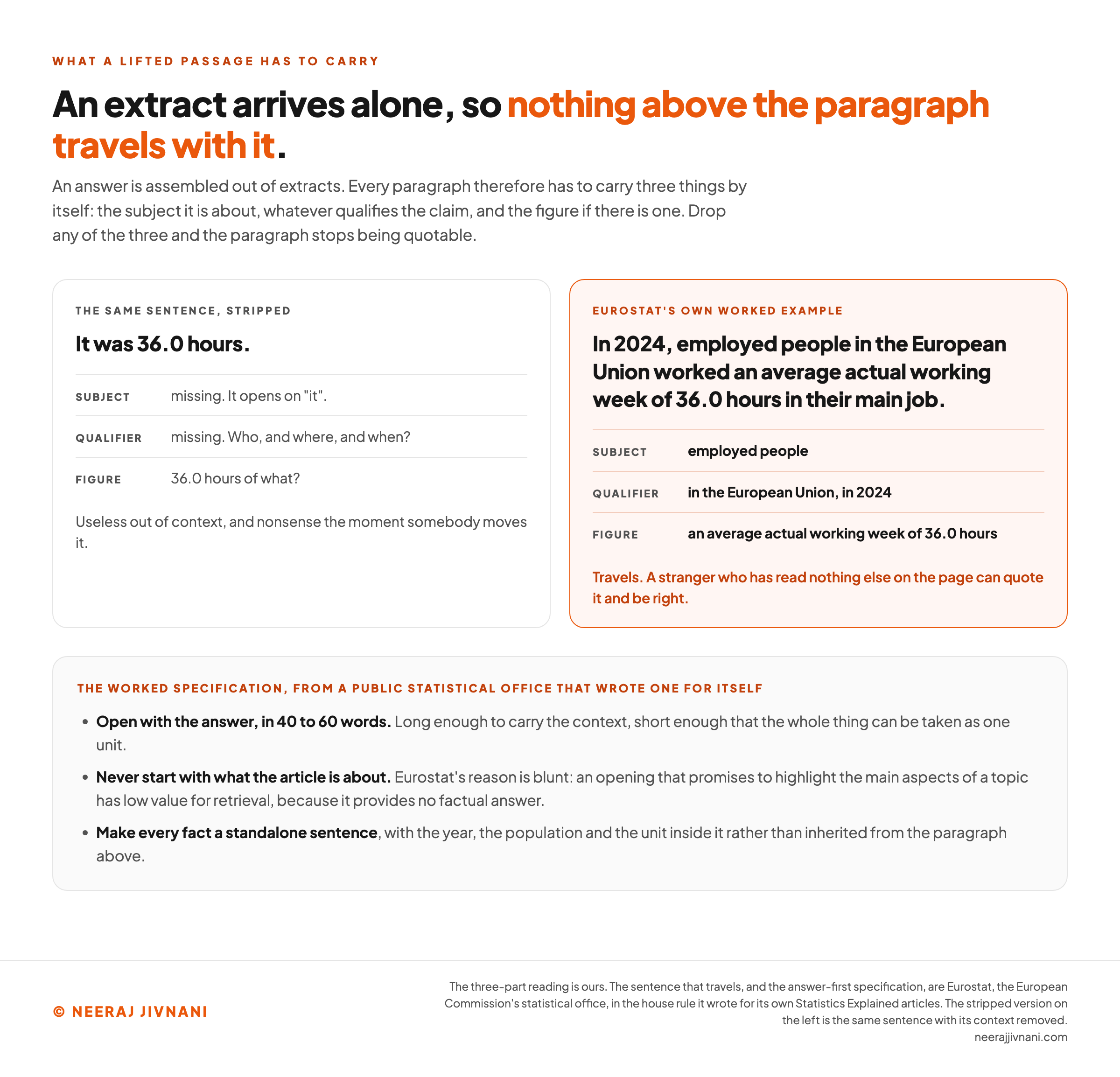
An answer is assembled out of extracts, so every paragraph has to carry three things by itself: the subject it is about, whatever qualifies the claim, and the figure if there is one.
Drop any of the three and the paragraph stops being quotable. It opens on "this", leans on the sentence above it, and turns into nonsense the moment somebody moves it.
The test is a stranger. Could a person who has read nothing else on the page quote that paragraph on its own and be right?
Read it as a stranger
A paragraph has to carry three things by itself: the subject it is about, whatever qualifies the claim, and the figure if there is one. Paste one of yours and read what is left pointing at a page nobody can see.
The specification quoted in this post asks an opening paragraph to open with the answer, in 40 to 60 words, and never to start with what the article is about.
The test is a stranger. Could a person who has read nothing else on the page quote that paragraph on its own and be right?
Copy editors have been asking for this for a century. What changed is the price of ignoring it.
Write for the Question Nobody Typed
Your page is not retrieved for the question your reader asked. It is retrieved for the smaller ones the system asks on their behalf.
Google documents this and calls it query fan-out: a set of concurrent, related queries generated by the model to request more information and fetch additional relevant search results to address the user's query.
Its own example is a lawn full of weeds. Somebody types "how to fix a lawn that's full of weeds", and the sub-queries it names are:
- "best herbicides for lawns"
- "remove weeds without chemicals"
- "how to prevent weeds in lawn"
Read that list again. Three different sections of a lawn-care page are being shopped for separately. A page that answers all three in one long argument is competing three times against material written to be read in pieces.
The practical move is to make each of those answerable on its own. Give the sub-question a heading, answer it underneath in a paragraph that names its own subject, and resist the urge to explain the connection first.
One caution, because it is the obvious wrong turn. Spinning up a separate page for every phrasing, done mainly to move rankings, is what Google's scaled content abuse policy names as spam.
What a Liftable Passage Looks Like
Open with the answer, in 40 to 60 words, which is Eurostat's own rule for its Statistics Explained articles. Long enough to carry the context, short enough that the whole thing can be taken as one unit.
Never start with what the article is about. Its own banned example is the kind of sentence institutions love, the one that promises to highlight the main aspects of a topic, and its reason is blunt: it has low value for retrieval because it provides no factual answer.
Then make every fact a standalone sentence, with the year, the population and the unit inside it rather than inherited from the paragraph above.
That last rule is the one people skip, and it is the one that decides whether an extract survives. Eurostat's own worked example is "In 2024, employed people in the European Union worked an average actual working week of 36.0 hours in their main job."
Strip the context out and you get "it was 36.0 hours", which is useless the moment somebody moves it. The long version travels because the year, the population and the unit are inside the sentence.
Two smaller things fall out of the same idea. Name things precisely, because a page written in generalities gives a model nothing to attach to you. And cover a subject across several linked pages rather than one enormous one, so a specific question has a specific home.
Where Structured Data Earns Its Place
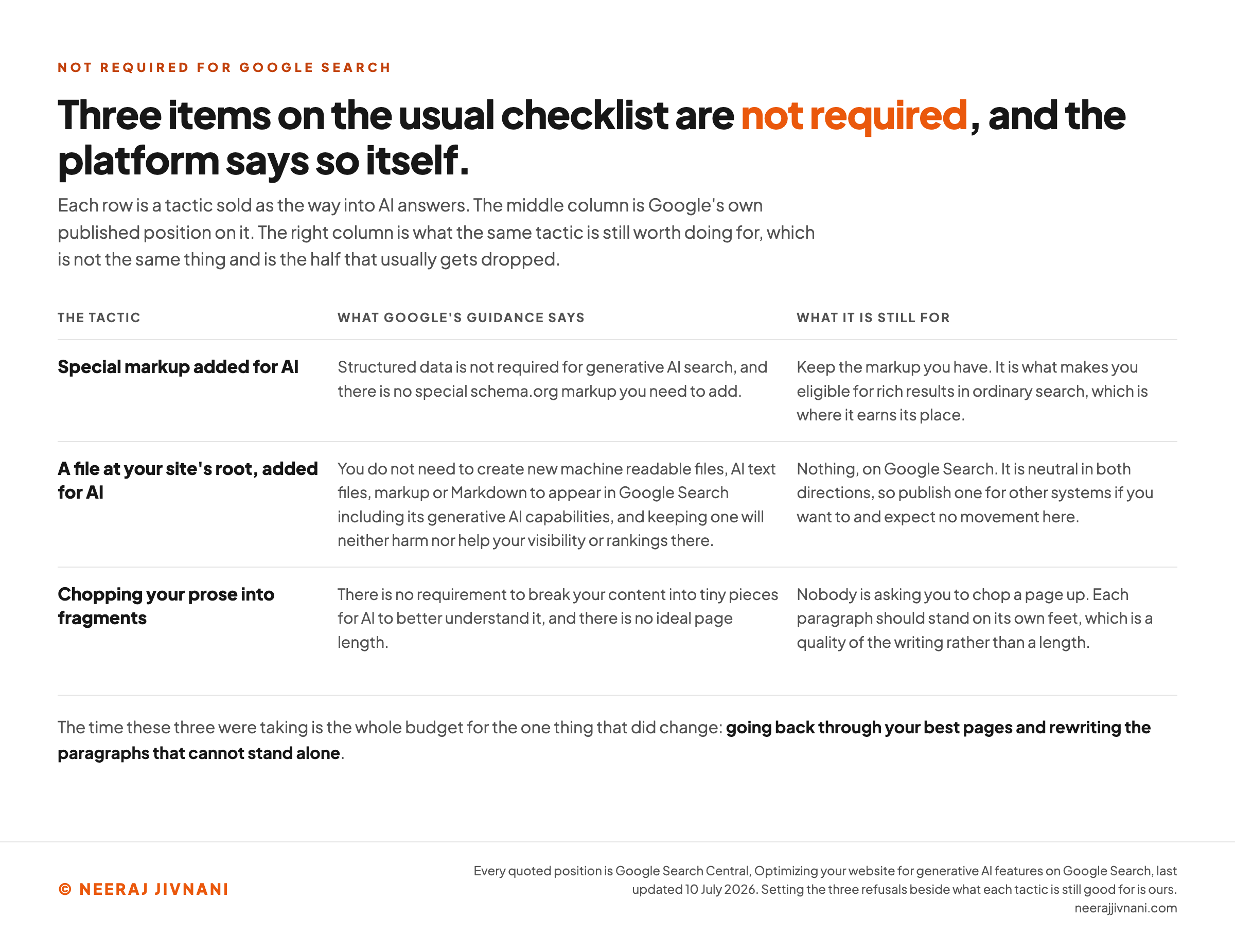
Structured data is not required for Google's AI features, whatever position it holds on the checklist you arrived with.
Its guidance is unambiguous: structured data is not required for generative AI search, and there is no special schema.org markup you need to add. The same page adds that it remains worth using as part of ordinary search work, because it helps with being eligible for rich results.
Keep your markup, and stop treating it as an AI lever.
The file at your site's root, an llms.txt file, gets the same answer. Google's guidance says you do not need to create new machine readable files, AI text files, markup or Markdown to appear in Google Search including its generative AI capabilities. Keeping one, it adds, will neither harm nor help your visibility or rankings there.
And breaking your writing into small pieces is not required either. Google states plainly that there is no requirement to break your content into tiny pieces for AI to better understand it, and that there is no ideal page length.
None of that contradicts writing liftable passages, and the difference is worth stating plainly. Nobody is asking you to chop a page into fragments.
Standing on its own feet is a property of a paragraph, not a length. A 90-word paragraph that names its own subject survives being lifted; a 20-word one that opens on "this" does not.
Freshness, and the Version of It That Is a Trap
Keeping a page current is real work and it matters. Facts go stale, products get renamed, and a page that describes a product that no longer exists will be quoted describing a product that no longer exists.
The trap is the counterfeit version: republishing the same text under a new date every quarter so the timestamp looks recent.
Nothing about the page has changed, so nothing about how it reads has changed either. What you have spent is the one signal a date carries: once your dates are decorative, nobody on your own side can tell the day something moved.
Update when the content changed. Leave the date alone when it did not.
Use this chart — embed code and citation
<a href="https://neerajjivnani.com/blog/llm-seo/"><img src="https://neerajjivnani.com/infographics/llm-seo/nothing-above-it-travels.png" alt="A two panel comparison of the same fact written twice, showing what a paragraph has to carry to survive being lifted out of a page. The left panel holds the stripped sentence It was 36.0 hours, marked as missing its subject because it opens on the word it, missing its qualifier because it never says who or where, and carrying a figure of 36.0 hours of nothing named, so it is useless out of context. The right panel holds Eurostat's own worked example, In 2024 employed people in the European Union worked an average actual working week of 36.0 hours in their main job, with employed people as the subject, in the European Union and in 2024 as the qualifier, and an average actual working week of 36.0 hours as the figure, so a stranger who has read nothing else on the page can quote it and be right. A band beneath carries the worked specification a public statistical office wrote for its own articles: open with the answer in 40 to 60 words, never start with what the article is about because an opening that only promises to highlight the main aspects of a topic has low value for retrieval, and make every fact a standalone sentence with the year, the population and the unit inside it." width="1200"></a>
<p>Chart: <a href="https://neerajjivnani.com/blog/llm-seo/">Neeraj Jivnani</a></p>Neeraj Jivnani, "What LLM SEO Changes About Your Pages, and What It Leaves Alone", neerajjivnani.com, https://neerajjivnani.com/blog/llm-seo/Free to republish with a link back to this page.
Use this chart — embed code and citation
<a href="https://neerajjivnani.com/blog/llm-seo/"><img src="https://neerajjivnani.com/infographics/llm-seo/three-you-can-put-down.png" alt="A three row table setting each popular tactic against Google's own published position on it and against what the same tactic is still worth doing for. Special markup added for AI: the guidance says structured data is not required for generative AI search and there is no special schema.org markup you need to add, while the markup you already have is still what makes you eligible for rich results in ordinary search. A file at your site's root added for AI: the guidance says you do not need to create new machine readable files, AI text files, markup or Markdown to appear in Google Search including its generative AI capabilities, and that keeping one will neither harm nor help your visibility or rankings there. Chopping your prose into fragments: the guidance says there is no requirement to break your content into tiny pieces for AI to better understand it and there is no ideal page length, while each paragraph standing on its own feet remains a quality of the writing rather than a length. A closing line says the time these three were taking is the budget for rewriting the paragraphs that cannot stand alone." width="1200"></a>
<p>Chart: <a href="https://neerajjivnani.com/blog/llm-seo/">Neeraj Jivnani</a></p>Neeraj Jivnani, "What LLM SEO Changes About Your Pages, and What It Leaves Alone", neerajjivnani.com, https://neerajjivnani.com/blog/llm-seo/Free to republish with a link back to this page.
Four Front Doors, Four Separate Switches
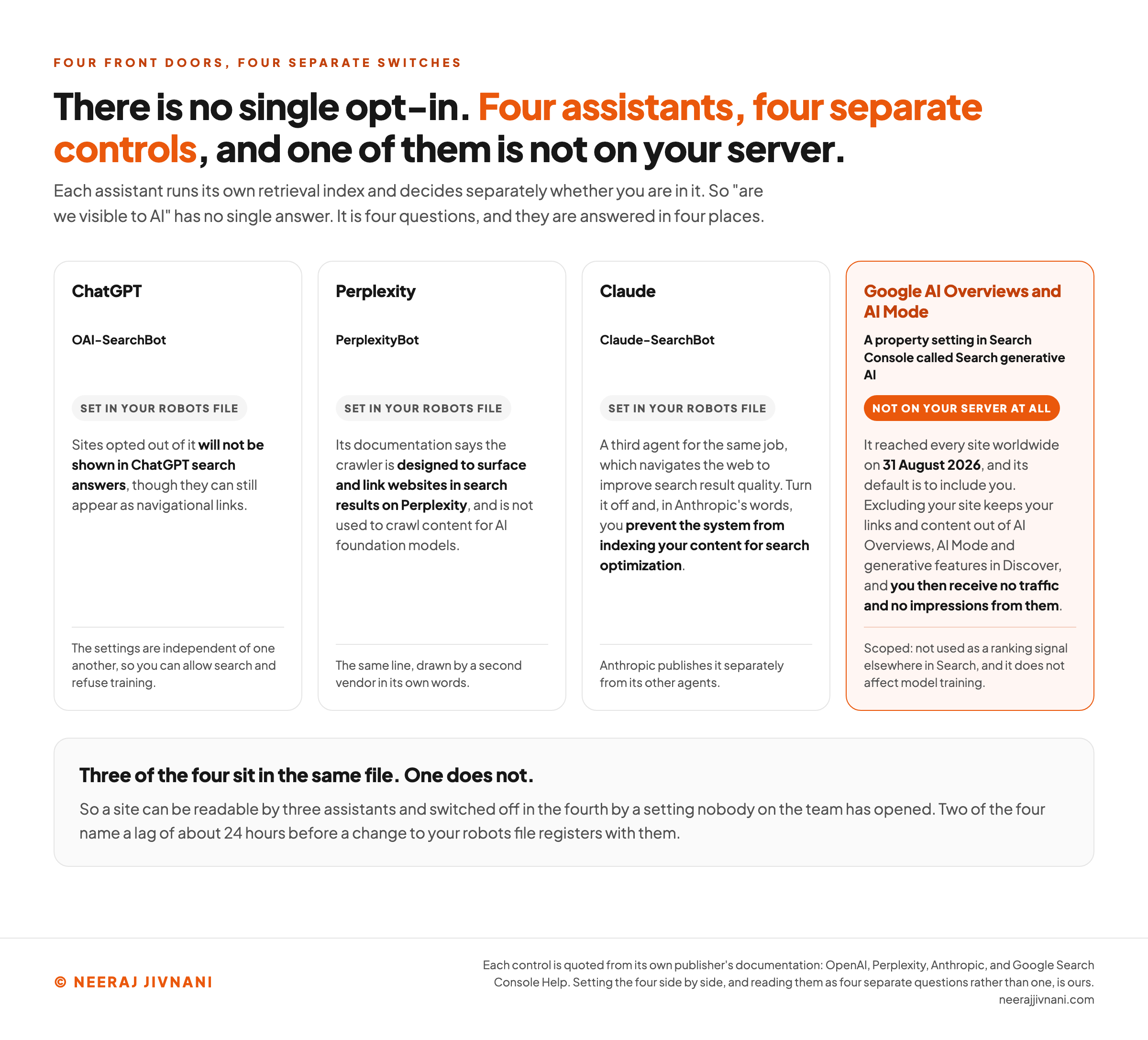
Each assistant runs its own retrieval index, and each decides separately whether you are in it. Four vendors publish four controls, and none of them is wired to the others.
So "are we visible to AI" has no single answer: it is four questions, and they are answered in four places.
OpenAI publishes a crawler for ChatGPT's search features, OAI-SearchBot, and says that sites opted out of it will not be shown in ChatGPT search answers, though they can still appear as navigational links.
Its settings are independent of one another, so you can allow search and refuse training.
Perplexity draws the same line in its own documentation. PerplexityBot is designed to surface and link websites in search results on Perplexity, and it is not used to crawl content for AI foundation models.
Anthropic publishes a third agent for the same job, Claude-SearchBot, which navigates the web to improve search result quality. Turn it off and, in Anthropic's words, you prevent the system from indexing your content for search optimization.
Google's switch is the one nobody looks for, because it is not on your server at all. It is a property setting in Search Console called Search generative AI, it reached every site worldwide on 31 August 2026, and its default is to include you.
Its two positions are worth knowing before anyone touches them: excluding your site keeps your links and content out of AI Overviews, AI Mode and generative features in Discover, and you then receive no traffic and no impressions from them.
The scope is narrow. Google says the control is not used as a ranking signal elsewhere in Search, and that it does not affect model training.
Three of the four sit in the same file. One does not. So a site can be readable by three assistants and switched off in the fourth by a setting nobody on the team has opened.
Being Readable at All
Underneath the four switches is one requirement none of them removes, and it is the oldest one.
For Google, a page has to be indexed and eligible to be shown in Search with a snippet, fulfilling the Search technical requirements. There is no additional technical requirement beyond that.
Since the control arrived there is a second clause. The site also has to be included in Search generative AI features in Search Console.
The rest is what it has been for twenty years. Allow the crawler, and send the words in the response rather than assembling them in the browser afterwards. Do not hide the part that answers the question behind a tab somebody has to click.
OpenAI says a change to your robots file takes about 24 hours to register, and Perplexity says up to 24. Make the change, then go and do something else.
Use this chart — embed code and citation
<a href="https://neerajjivnani.com/blog/llm-seo/"><img src="https://neerajjivnani.com/infographics/llm-seo/four-separate-switches.png" alt="A four column comparison of the separate controls each major assistant publishes for whether your pages can be used in its answers, showing that there is no single opt-in. ChatGPT: OAI-SearchBot, OpenAI's crawler for ChatGPT's search features, set in your robots file, where a site opted out will not be shown in ChatGPT search answers though it can still appear as a navigational link, and where the settings are independent of one another so you can allow search and refuse training. Perplexity: PerplexityBot, set in your robots file, described in Perplexity's documentation as designed to surface and link websites in search results on Perplexity and not used to crawl content for AI foundation models. Claude: Anthropic's Claude-SearchBot, set in your robots file, a third agent for the same job, which Anthropic says you turn off to prevent the system indexing your content for search optimization. Google AI Overviews and AI Mode: the Search generative AI control, a property setting inside Search Console rather than a file on your server, which reached every site worldwide on 31 August 2026, includes you by default, and where excluding a site keeps your links and content out of AI Overviews, AI Mode and generative features in Discover and leaves you with no traffic and no impressions from them. A band beneath states that three of the four sit in the same file and one does not, so a site can be readable by three assistants and switched off in the fourth by a setting nobody on the team has opened, and that two of the four name a lag of about 24 hours before a change to your robots file registers with them." width="1200"></a>
<p>Chart: <a href="https://neerajjivnani.com/blog/llm-seo/">Neeraj Jivnani</a></p>Neeraj Jivnani, "What LLM SEO Changes About Your Pages, and What It Leaves Alone", neerajjivnani.com, https://neerajjivnani.com/blog/llm-seo/Free to republish with a link back to this page.
What You Can Count
You can count how often you appeared, and almost nothing else. That is smaller than the market suggests and it is still worth having.
The thing being chosen is a passage, not a page, and the question it was chosen for is one nobody typed. Nothing in that has a position in it, so a frequency is all there is to count.
One of the Four Gives You a Number
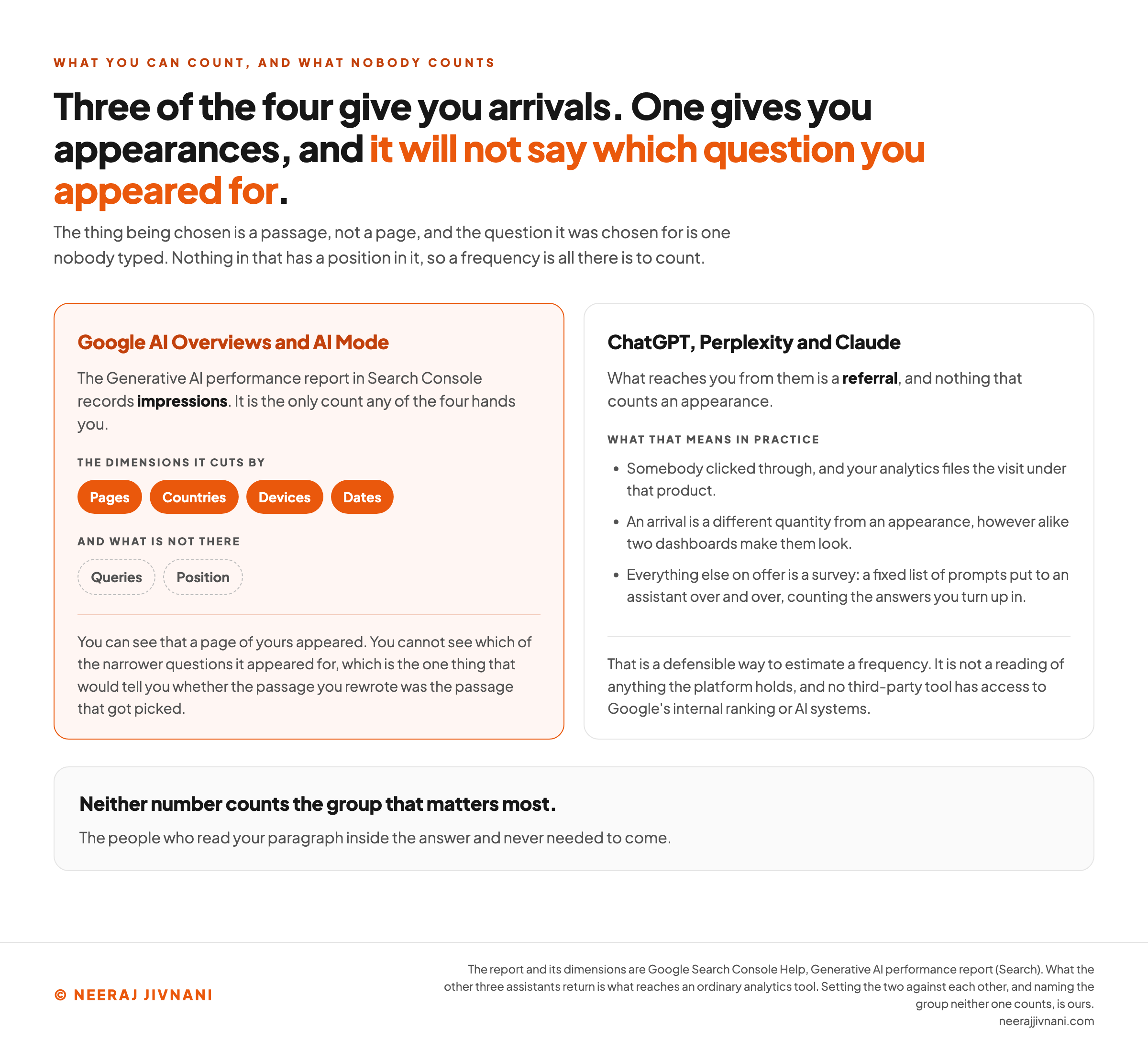
Only Google hands you a count. Its Generative AI performance report in Search Console records impressions for AI Overviews and AI Mode, cut by page, by country, by device and by date.
The omission in that list is the interesting part. There is no queries dimension. You can see that a page of yours appeared, and you cannot see which of the narrower questions it appeared for, which is the one thing that would tell you whether the passage you rewrote was the passage that got picked.
What reaches you from the other three is a referral: somebody clicked through, and your analytics files the visit under that product. So three of the four give you arrivals and one gives you appearances, which are different quantities wearing the same dashboard.
Neither counts the group that matters most, who read your paragraph inside the answer and never needed to come.
What No Tool Can See
Everything else on offer is a survey, and knowing that in advance saves you a subscription.
The machinery under a share-of-voice dashboard is repetition. It puts a fixed list of prompts to an assistant over and over, and counts the answers you turn up in.
That is a defensible way to estimate a frequency. It is not a reading of anything the platform holds.
Which makes one claim worth testing whenever you meet it. Google states that no third-party tool has access to its internal ranking or AI systems, so a product describing itself as reading Google's internal metrics is describing something it does not have.
The number you are shown has a margin of error nobody can compute and a prompt list somebody else chose. Read the direction it moves in and ignore the decimal places.
Use this chart — embed code and citation
<a href="https://neerajjivnani.com/blog/llm-seo/"><img src="https://neerajjivnani.com/infographics/llm-seo/appearances-or-arrivals.png" alt="A two column scoreboard of what each assistant hands back to a site owner. On the left, Google AI Overviews and AI Mode: the Generative AI performance report in Search Console records impressions, cut by pages, countries, devices and dates, with queries and position both shown as absent, so you can see that a page of yours appeared and not which of the narrower questions it appeared for. On the right, ChatGPT, Perplexity and Claude: what reaches you from them is a referral that your analytics files under that product, with everything else on offer being a survey that puts a fixed list of prompts to an assistant over and over. A band beneath states that neither number counts the people who read your paragraph inside the answer and never needed to come." width="1200"></a>
<p>Chart: <a href="https://neerajjivnani.com/blog/llm-seo/">Neeraj Jivnani</a></p>Neeraj Jivnani, "What LLM SEO Changes About Your Pages, and What It Leaves Alone", neerajjivnani.com, https://neerajjivnani.com/blog/llm-seo/Free to republish with a link back to this page.
What Is Different, and What Is Not
Four things are genuinely different and one large thing is not.
Different: the unit of retrieval is a passage, the query you are retrieved for is one the reader never typed, the outcome is a mention rather than a click, and four vendors each hold a separate switch.
Not different: what makes a page worth retrieving. Google's position is that the best practices for SEO continue to be relevant, because its AI features run on its core Search ranking and quality systems.
Our own reading is blunter. If you had to choose one thing to do this quarter, it is not a markup project. It is going back through your best pages and rewriting the paragraphs that cannot stand alone, which also happens to make them better for the person reading them in order.
The Names, Briefly
You will meet several names for this work. Generative engine optimization (GEO) and answer engine optimization (AEO) are the two you will see most, and Google's own guidance treats both as describing work aimed at visibility in AI search experiences.
Its position on the naming is that optimizing for generative AI search is optimizing for the search experience, and so is still SEO.
Pick whichever word your colleagues use and get on with the work. The label has never changed what a page has to do.
The Half That Is Not on Your Site
Some of what decides whether you are named is not on your pages at all, and it is worth being honest about how much of it you control.
An assistant reads the whole web about you: reviews, forum threads on Reddit, comparison posts, trade coverage. What those say shapes how you are described, and the durable way to change them is to be worth describing that way.
Say you sell scheduling software and three review sites still list a feature you dropped last year. No markup on your own site fixes that, because the sentence being quoted is not on your site.
Two things follow. A mention is worth more to you than a bare link, because the sentence around it is the sentence that can be quoted. And people searching for you by name is demand you built, not a tactic you applied.
There is a tempting shortcut here and Google names it. Seeking inauthentic mentions across the web is less helpful than it might seem, because the core ranking systems favor quality content while other systems block spam, and the AI features depend on both.
What People Ask Before They Change Anything
Five questions are worth settling before you change a line.
Is SEO dead now with AI? No, and the mechanism is the reason. AI answers are built by retrieving pages from a search index, so whatever gets a page retrieved is doing the same job it always did. What is dying is the assumption that an impression becomes a visit.
What is AI SEO called now? It has several names, and the two common ones are generative engine optimization and answer engine optimization. Google's guidance calls the practice optimizing for the search experience, and therefore SEO.
Do you need an llms.txt file? Not for Google, which ignores it. Publish one for other systems if you want to, knowing the file is neutral in both directions on Google Search.
Does schema markup get me into AI answers? Not by itself. Keep it for rich results in ordinary search, where it does earn its place.
How do you know whether it is working? Impressions in the Generative AI performance report for Google's features, referral traffic for the rest, and a note of which of your pages the report names. Expect a trend, not a number you can report to two decimal places.
One Change, Three Things You Can Put Down
The change is real and it is narrow. Something reads one paragraph of your page, in answer to a question your reader never typed, and hands the result on without them ever arriving. Write so that paragraph survives the trip.
The three things you can put down are markup added for AI, a file at your root added for AI, and chopping your prose into fragments. None is required, and the time they were taking is better spent on the paragraphs.
What is left is the work you already knew about, held to a stricter standard by a reader that never scrolls back.