Billboard Advertising: What One Format Costs for One Four-Week Flight
A bulletin, a poster and a slot in a digital rotation are three prices, not one. See what each rents you, for how long, and how to compare two quotes.


/ On this page11 sections
A bulletin, a poster and a slot in a digital rotation are three different things to rent, and they carry three different prices.
What makes a quote readable is knowing which product the number is a price for, how long you get it, and whether anyone else is on the face while you are.
A Billboard Is Several Different Products
Billboard advertising is renting space on a large outdoor display for a fixed stretch of time. The display is called a face, and the company that owns it is the media owner.
That much is true of every buy. Almost nothing else is.
The word billboard covers several products that differ in size, in how long your ad sits on the face, and in whether anyone else is on it at the same time. Those three differences are what you are choosing between.
Out-of-home advertising (OOH), which is how a rate card will usually refer to it, is the wider category. It takes in transit posters, street furniture, wallscapes and airport panels as well as roadside boards.
Two words are worth separating before you read any pricing.
A format is the physical thing you rent, such as a bulletin. A placement is where that thing sits, such as a highway shoulder or a transit station.
The format sets the size and the production cost. The placement sets the audience and most of the price.
Bulletins, Posters and Junior Posters
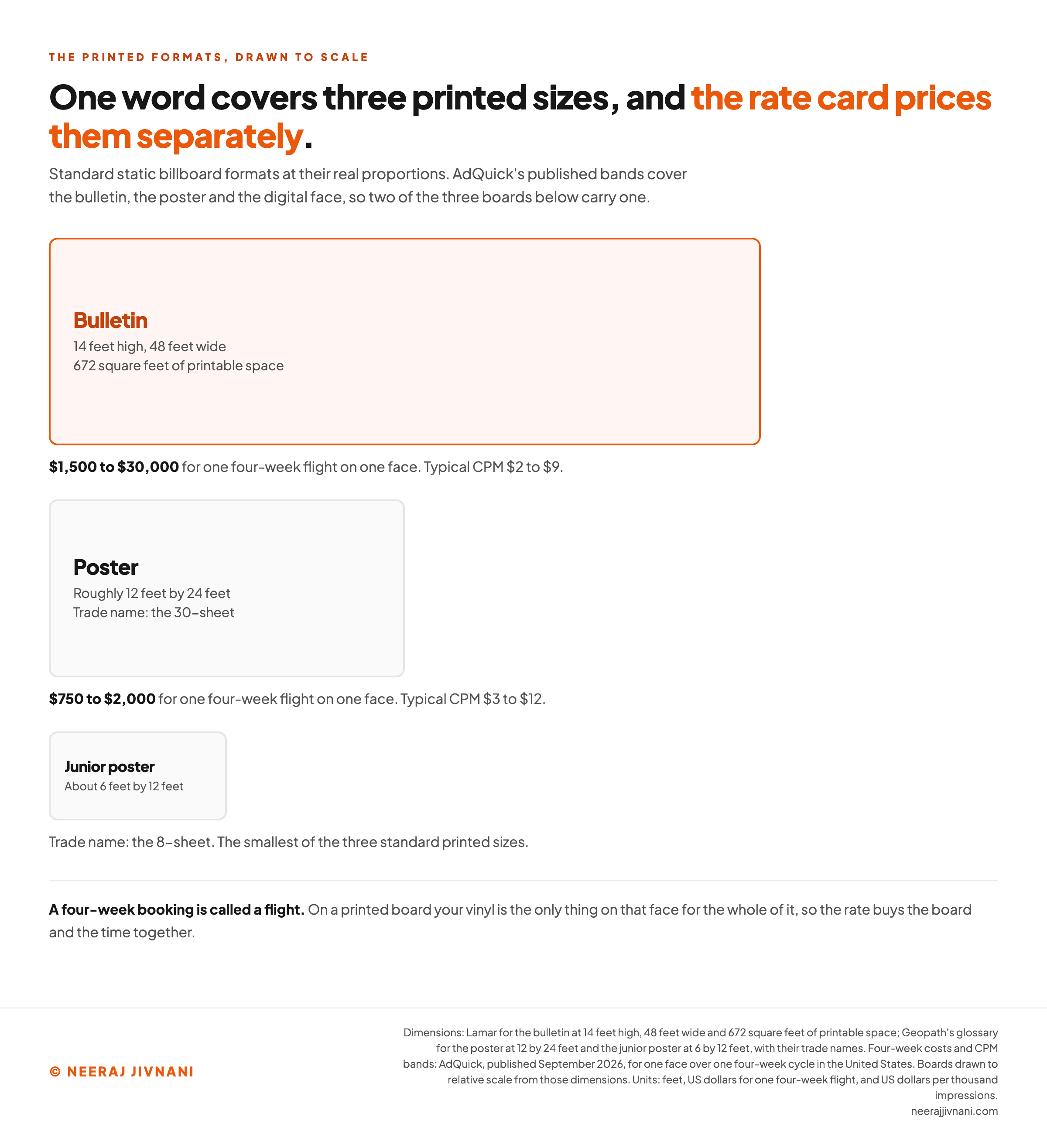
Static billboards are printed on vinyl, mounted on a frame, and sold in three standard sizes.
A bulletin is the large roadside board, and it is the biggest of the standard formats. Lamar, one of the largest US media owners, gives its bulletins as 14 feet high and 48 feet wide, which works out at 672 square feet of printable space.
A poster is the smaller board you see on secondary roads, roughly 12 feet by 24 feet. Geopath's glossary still records its older trade name, the 30-sheet, from the days when it arrived as separate printed sheets.
A junior poster is smaller again, about 6 feet by 12 feet, and its trade name is the 8-sheet.
Between these three, size is what moves the price.
One static variant is worth asking about by name.
A rotary package moves your printed vinyl from one location to another at set intervals, which Lamar puts at every 60 to 90 days. A single production run then covers more of a city over a longer booking.
Digital Faces and the Rotation You Share
A digital billboard is a light-emitting diode (LED) screen, and the difference that matters to a buyer is not the technology. It is that you are sharing it.
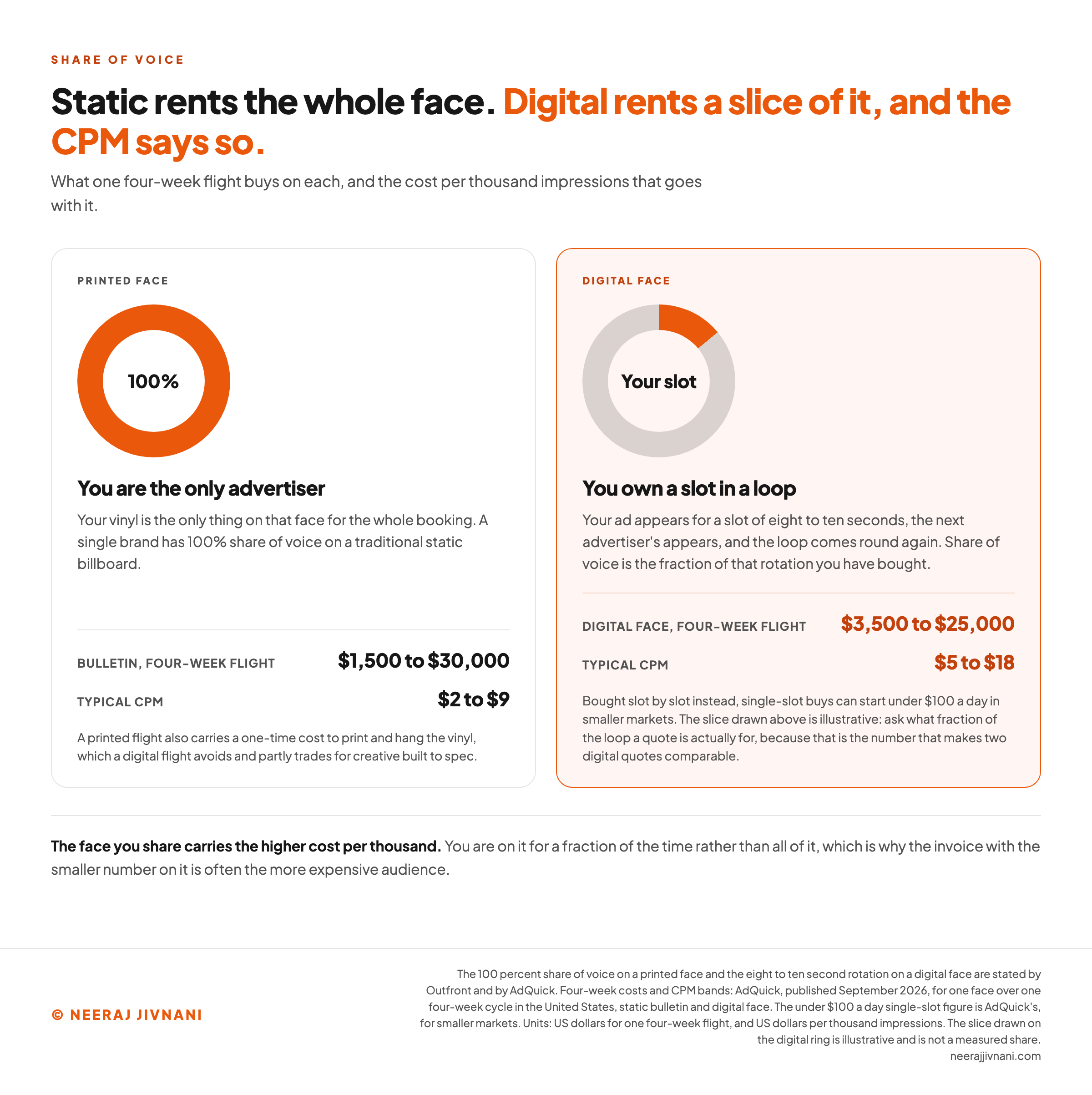
On a printed board your vinyl is the only thing on that face for the whole booking.
Digital works the other way. Outfront, a media owner with boards across the US, states it plainly: a single brand has 100% share of voice on a traditional static billboard, while on digital billboards advertisers rotate in a loop.
Your ad appears for a slot, the next advertiser's appears, and the loop comes round again. AdQuick puts a standard slot at eight to ten seconds.
So the phrase to learn is share of voice, which is the fraction of the rotation you have bought. It is what makes two digital quotes comparable, and it is the first thing to ask for when one is missing.
Blip, a self-serve platform, sells individual eight-second plays and calls each one a blip, across a network it puts at more than 2,700 digital billboard locations in 46 states. AdQuick says single-slot buys can start under $100 a day in smaller markets.
What you get back for sharing the face is control. Creative can be changed remotely, scheduled to particular hours or days, and swapped without anyone driving to the site.
Buying digital inventory through an exchange rather than directly from one media owner is called programmatic out-of-home. It is the newest part of the medium and the part most likely to be quoted to you differently by two sellers.
Boards That Move
Two things get called billboards and are not a fixed roadside face.
A mobile billboard is a printed or lit panel on a truck that drives a route. You are renting a route and a schedule rather than a face, so its audience figure is built differently and does not compare cleanly with a fixed board's.
Transit advertising lives on buses, trains and the stations around them. It is a placement rather than a format, so it is a decision about where, not about what.
Both are real buys, and neither is priced the way a roadside face is.
AdQuick lists mobile billboards by the day rather than by the cycle, at $800 to $3,000, which is the plainest signal that you are buying a different thing.
Use this chart — embed code and citation
<a href="https://neerajjivnani.com/blog/billboard-advertising/"><img src="https://neerajjivnani.com/infographics/billboard-advertising/three-printed-sizes.png" alt="Three standard printed billboard formats drawn to their real proportions, one above the other. The bulletin is the largest, highlighted in orange, at 14 feet high and 48 feet wide with 672 square feet of printable space, and it runs $1,500 to $30,000 for one four-week flight on one face at a typical CPM of $2 to $9. The poster below it is roughly 12 feet by 24 feet, trade name the 30-sheet, at $750 to $2,000 for one four-week flight and a typical CPM of $3 to $12. The junior poster, about 6 feet by 12 feet and known as the 8-sheet, is the smallest of the three standard printed sizes, and a line above the boards notes that AdQuick's published bands cover the bulletin, the poster and the digital face. A closing line says a four-week booking is called a flight, and that on a printed board your vinyl is the only thing on that face for the whole of it, so the rate buys the board and the time together." width="1200"></a>
<p>Chart: <a href="https://neerajjivnani.com/blog/billboard-advertising/">Neeraj Jivnani</a></p>Neeraj Jivnani, "Billboard Advertising: What One Format Costs for One Four-Week Flight", neerajjivnani.com, https://neerajjivnani.com/blog/billboard-advertising/Free to republish with a link back to this page.
The Four-Week Cycle Everything Is Priced Against
Out-of-home is sold by the four-week cycle rather than by the calendar month, and unless somebody says otherwise, the rate you are quoted is the rate for one cycle.
The cycle is the unit underneath everything else. Geopath's glossary says frequency in outdoor advertising is typically measured over a four week period, and Outfront names four weeks as the standard flight length for a traditional billboard campaign.
A booking is called a flight. A calendar year holds more four-week cycles than it holds months, so an annual booking is not twelve of these.
Buying one runs in a short sequence, and it is the same sequence whether you call a media owner or use a platform.
- Pick the market and the format.
- Ask for available faces there, with the traffic and audience figures attached to each.
- Choose the face, or a package of faces, and the number of cycles.
- Get the artwork spec for that exact face, which differs board by board.
- Supply the art, allowing longer for a printed board than a digital one.
- Sign for the flight, and ask for proof of posting once it is up.
Longer commitments are where the discounts live. AdQuick says a longer commitment often earns one, and that the fourth quarter and the summer months tend to carry premium rates.
What a Four-Week Flight Costs
A single static bulletin runs from $1,500 to $30,000 for one four-week flight, and the spread is the information rather than the problem.
Those are the US ranges AdQuick published in September 2026 for one face over one cycle, with the cost per thousand impressions (CPM) that usually goes with each format.
| Format | Four-week cost | Typical CPM |
|---|---|---|
| Static bulletin | $1,500 to $30,000 | $2 to $9 |
| Static poster | $750 to $2,000 | $3 to $12 |
| Digital face | $3,500 to $25,000 | $5 to $18 |
Market does most of the rest of the work. AdQuick puts a static bulletin in New York at $5,000 to $50,000 or more for a cycle, and the same format in Phoenix at $1,000 to $8,000.
Five things move a rate, in roughly this order: the market, the individual face and its traffic, the format, the length of the flight, and your share of the rotation if it is digital.
Production sits outside all of it. A printed flight carries a one-time cost to print and hang the vinyl, which a digital flight avoids and partly trades for creative built to spec.
Cost Per Thousand, and What It Is For
CPM is the one number on a rate card that lets you compare two faces, and it is worth calculating yourself rather than accepting.
Take the price of the flight, divide it by the impressions the media owner credits it with, and multiply by a thousand. Geopath defines cost per thousand as the cost of delivering 1000 impressions from people who see the advertising on displays in a market.
Run it and the table above stops looking strange. A digital face carries a higher CPM band than a static bulletin, $5 to $18 against $2 to $9, because you are on that face for a fraction of the time rather than all of it.
The invoice with the smaller number on it is often the more expensive audience. That comparison is the entire reason the metric exists.
Use this chart — embed code and citation
<a href="https://neerajjivnani.com/blog/billboard-advertising/"><img src="https://neerajjivnani.com/infographics/billboard-advertising/one-face-or-one-slot.png" alt="Two panels comparing what one four-week flight buys on a printed face and on a digital one. On the left a solid orange ring marked 100% heads a panel saying you are the only advertiser, because your vinyl is the only thing on that face for the whole booking, priced at $1,500 to $30,000 for a bulletin's four-week flight with a typical CPM of $2 to $9, and a note that a printed flight also carries a one-time cost to print and hang the vinyl. On the right, highlighted, a mostly grey ring with one orange slice marked your slot heads a panel saying you own a slot in a loop of eight to ten seconds, priced at $3,500 to $25,000 for a digital face's four-week flight with a typical CPM of $5 to $18, and a note that single-slot buys can start under $100 a day in smaller markets and that the slice drawn is illustrative. A closing line says the face you share carries the higher cost per thousand, because you are on it for a fraction of the time rather than all of it." width="1200"></a>
<p>Chart: <a href="https://neerajjivnani.com/blog/billboard-advertising/">Neeraj Jivnani</a></p>Neeraj Jivnani, "Billboard Advertising: What One Format Costs for One Four-Week Flight", neerajjivnani.com, https://neerajjivnani.com/blog/billboard-advertising/Free to republish with a link back to this page.
Where the Impression Number Comes From
The impression figure on a billboard proposal comes from a model, not from a turnstile. It estimates how often an ad was probably registered, and it counts nobody.
That is neither hidden nor a criticism of the industry. Geopath, the non-profit that measures out-of-home audiences in the United States, publishes the definitions itself, and the wording is careful.
Impressions are "the total number of times people passing an OOH display are likely to notice the ad", measured over 12, 18 or 24 hours depending on whether the board is lit.
Reach is "the approximate percentage" of an audience who notice a message at least once. Likely, approximate: the hedges are the measurement body's own.
How the Figure Is Built
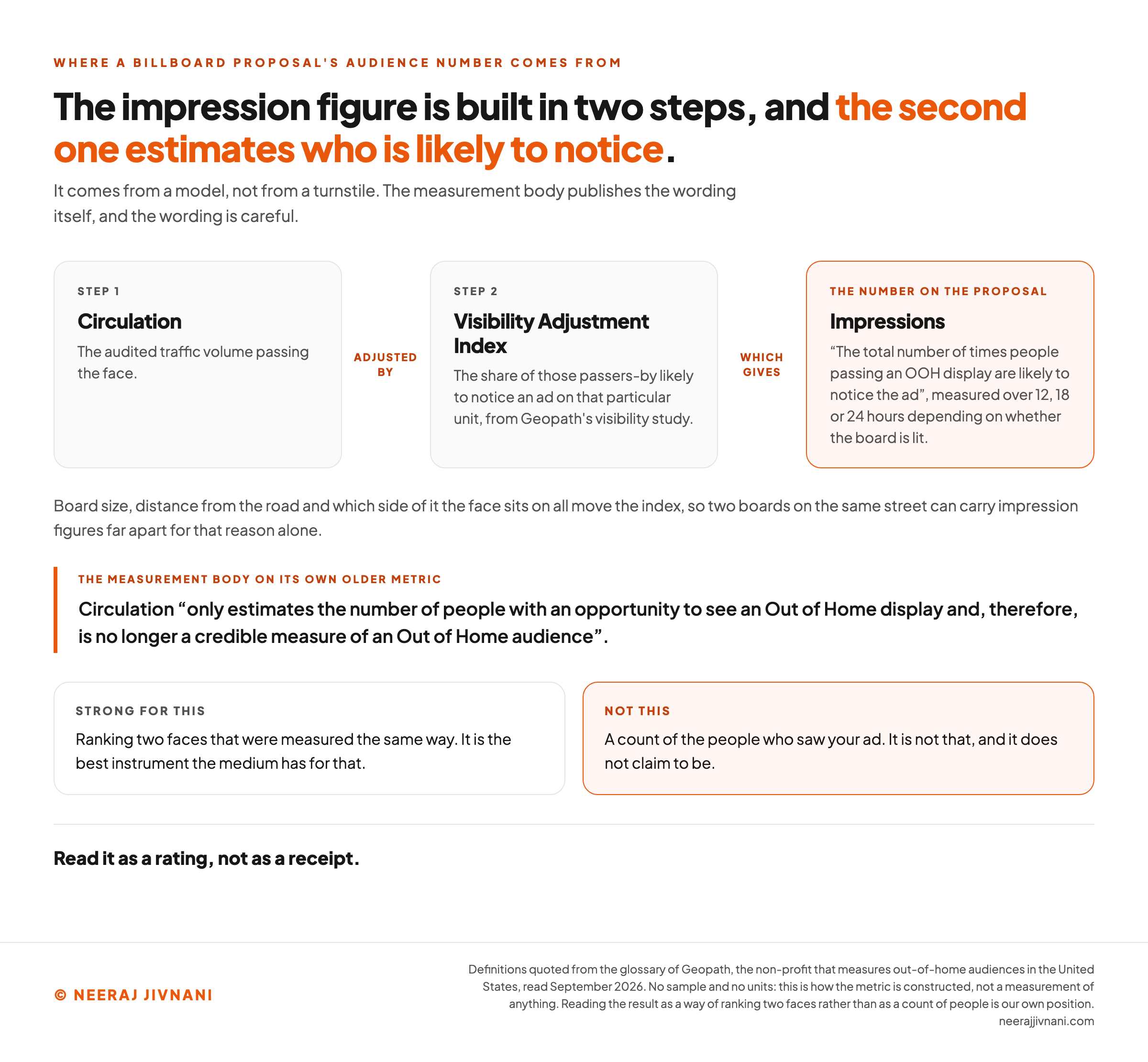
The impression figure is built in two steps, and the second step is where most of the adjustment happens.
First comes circulation, the audited traffic volume passing the face. Then that count is adjusted by a Visibility Adjustment Index, which is the share of those passers-by likely to notice an ad on that particular unit.
The index comes from Geopath's visibility study. Board size, distance from the road and which side of it the face sits on all move it, so two boards on the same street can carry impression figures far apart for that reason alone.
The traffic count on its own is not the audience, and Geopath says so about its own older metric.
Circulation, it writes, "only estimates the number of people with an opportunity to see an Out of Home display and, therefore, is no longer a credible measure of an Out of Home audience".
Our position is that this makes the figure strong in one direction and weak in the other.
As a way of ranking two faces measured the same way, it is the best instrument the medium has. As a count of people who saw your ad, it is not that, and it does not claim to be.
Read it as a rating, not as a receipt.
Use this chart — embed code and citation
<a href="https://neerajjivnani.com/blog/billboard-advertising/"><img src="https://neerajjivnani.com/infographics/billboard-advertising/a-rating-not-a-receipt.png" alt="Three boxes in a row show how a billboard proposal's impression figure is assembled. Circulation, the audited traffic volume passing the face, is adjusted by the Visibility Adjustment Index, the share of those passers-by likely to notice an ad on that particular unit, from Geopath's visibility study, which gives impressions, quoted as the total number of times people passing an OOH display are likely to notice the ad, measured over 12, 18 or 24 hours depending on whether the board is lit. A line below records that board size, distance from the road and which side of it the face sits on all move the index. A pulled quote then states that circulation only estimates the number of people with an opportunity to see an Out of Home display and is therefore no longer a credible measure of an Out of Home audience. Two cards set the verdict against each other: strong for ranking two faces that were measured the same way, and not a count of the people who saw your ad. The closing line reads, read it as a rating, not as a receipt." width="1200"></a>
<p>Chart: <a href="https://neerajjivnani.com/blog/billboard-advertising/">Neeraj Jivnani</a></p>Neeraj Jivnani, "Billboard Advertising: What One Format Costs for One Four-Week Flight", neerajjivnani.com, https://neerajjivnani.com/blog/billboard-advertising/Free to republish with a link back to this page.
Choosing a Face
Choosing between two faces comes down to traffic and readability, in that order.
Ask for the traffic count and the audience figure for each candidate, and ask which direction of travel it faces. A board on the far side of a divided highway is one your audience sees at an angle, if at all.
Then ask how far away it becomes readable and how long a driver holds it in view. That varies more between faces than the size does, and it is the real constraint on your design.
Ask what sits next to it. A face in a cluster competes with the boards either side of it, and a face alone on a stretch of road does not.
One structural fact is worth knowing before you go hunting for something better than you were offered.
Blue Line Media, which sells billboard inventory in more than 300 US cities, states that the construction of new billboard locations is prohibited in most cities in the United States, and that this is what makes the existing ones valuable.
Supply is close to fixed.
The good faces in your market are taken for most of the year, so the way to get one is to ask early rather than to negotiate hard.
Designing for One Glance
Assume a single glance at speed. Every other rule about billboard design follows from it.
Keep the word count low enough to read at speed. Lamar's own guidance puts that at seven words or less, and a board with two ideas on it communicates neither.
Let contrast do the work. The same guidance tells advertisers that high color contrast can improve outdoor recall and that type has to stay legible from a distance, which rules out thin weights and decorative faces.
Leave the phone number off. A driver cannot use it, and Lamar makes the point that a memorable design beats a crowded one, because somebody who remembers you can look you up later.
A brand name and a short web address are usually all a board can carry before the glance is over.
What a Billboard Is Genuinely Good At
A billboard is a brand instrument, and most of the disappointment with the medium comes from buying it as something else.
It is unskippable inside a fixed geography. Nobody blocks it, scrolls past it or closes it, and it reaches everyone who uses that road rather than everyone who matches a profile.
It repeats against a commute. The same people pass the same face on the way out and the way back, every working day of the flight, which is a frequency little else buys at that price.
And it signals scale. A large fixed sign with your name on it reads as a company that can afford a large fixed sign, which is a real effect that nobody can put a number on for you.
None of those is a click.
When a Billboard Is the Wrong Buy
Four situations make a billboard the wrong buy, and the first is about measurement.
It is wrong when you need to know what the spend did. Out-of-home attribution has improved and remains modeled, in the same way the audience figure is: an estimate of exposure, compared against a control.
That is evidence. It is not per-click accounting, and treating it as though it were produces arguments nobody can settle.
It is wrong when your audience is narrow. A face reaches a road rather than a segment, and if your buyer is a small fraction of the traffic, you are paying for everybody else on it.
It is wrong when it has to work this month. A flight against a commute is a frequency play, and a single cycle in one market is usually too little of it to register.
And it is the wrong moment if the creative is not settled. A printed board carries one message for four weeks, and changing your mind costs a reprint on top of the rate.
Where You Cannot Put One
You cannot put a billboard wherever you like, and the limits are set at three levels.
Federal law came first. The Highway Beautification Act of 1965 controls outdoor advertising along 306,000 miles of Federal-Aid Primary, Interstate and National Highway System roads, according to the Out of Home Advertising Association of America.
It works through funding rather than direct prohibition. A state that does not keep effective control of outdoor advertising on the Interstate System and the primary system has its federal highway apportionment "reduced by amounts equal to 10 per centum", in the words of the statute at 23 U.S.C. 131.
Four states go further and allow no new boards at all.
Scenic America, the conservation organization that campaigns on this, states that four states, Alaska, Hawaii, Vermont and Maine, "currently prohibit new billboard construction". That is not the same as removing the boards already standing.
Local government does the rest, and it is where most of the real restriction lives.
Zoning decides which parcels can carry a sign, how tall it may be, how bright, and how close to the next one. Converting a printed face to a digital one usually needs its own permission on top.
None of this is your problem as an advertiser renting an existing face. It is the reason that face is where it is, and the reason there is no new one down the road.
Questions Buyers Ask
Four questions come up more often than the rest, and buyers ask them in roughly this order.
How much does it cost to put up an ad on a billboard? There is no single price, because the formats are sold separately. AdQuick's published US ranges for one four-week cycle on one face are $1,500 to $30,000 for a static bulletin, $750 to $2,000 for a poster and $3,500 to $25,000 for a digital face, with printing and installation on top for the printed ones.
How do I advertise on a billboard? Contact the media owner in the market you want, or a platform that buys across owners. You pick a face from what they have available, agree how many cycles you want it for, and send artwork built to that board's own spec before the flight opens.
What are the four states that banned billboards? Alaska, Hawaii, Vermont and Maine. Scenic America's wording is more precise than the question: those four "currently prohibit new billboard construction", which leaves the existing boards where they are.
Do billboards make a lot of money? That question is usually about owning one rather than advertising on one, and two parties share the income. The media owner rents the face and carries the cost of building, lighting and maintaining it, while the landowner leases the ground underneath and is paid for that.
Lease terms are negotiated site by site, so a single figure for what a billboard earns describes one deal rather than the medium.
What a Quote Should Tell You
A billboard quote becomes readable the moment you can answer four questions about it.
Which format is this? Which face? How many cycles, and how much of that face is yours while it runs?
Answer those and you know what the number is a price for. Put the face's impression figure beside it and you can work out the cost per thousand, which is what lets you hold one quote against another.
Name the four things on your quote
Answer for the quote in front of you. Nothing is scored and no price is worked out here. The sentence below is the one your number has to be able to finish.
The format
The face
The length of the flight
Your share of that face while it runs
What your number is a price for
This number is a price for format not named, on face not named, for flight length not named, with share of voice not named.
Still to ask for
Start with the format. It is the one that decides which of the published bands the number belongs to, and on a printed board it answers the last question as well.
Without the four you are comparing a poster on a suburban road to a slot in a Manhattan rotation and wondering why the numbers are so far apart.
The medium is not complicated. It is sold in units that nobody explains until you ask for them by name.