What AI Advertising Covers, and Whether Ads a Machine Made Actually Work
Two different things hide behind the phrase. See which one a generator does, what it needs from you, and whether the ads it makes perform any better.


/ On this page8 sections
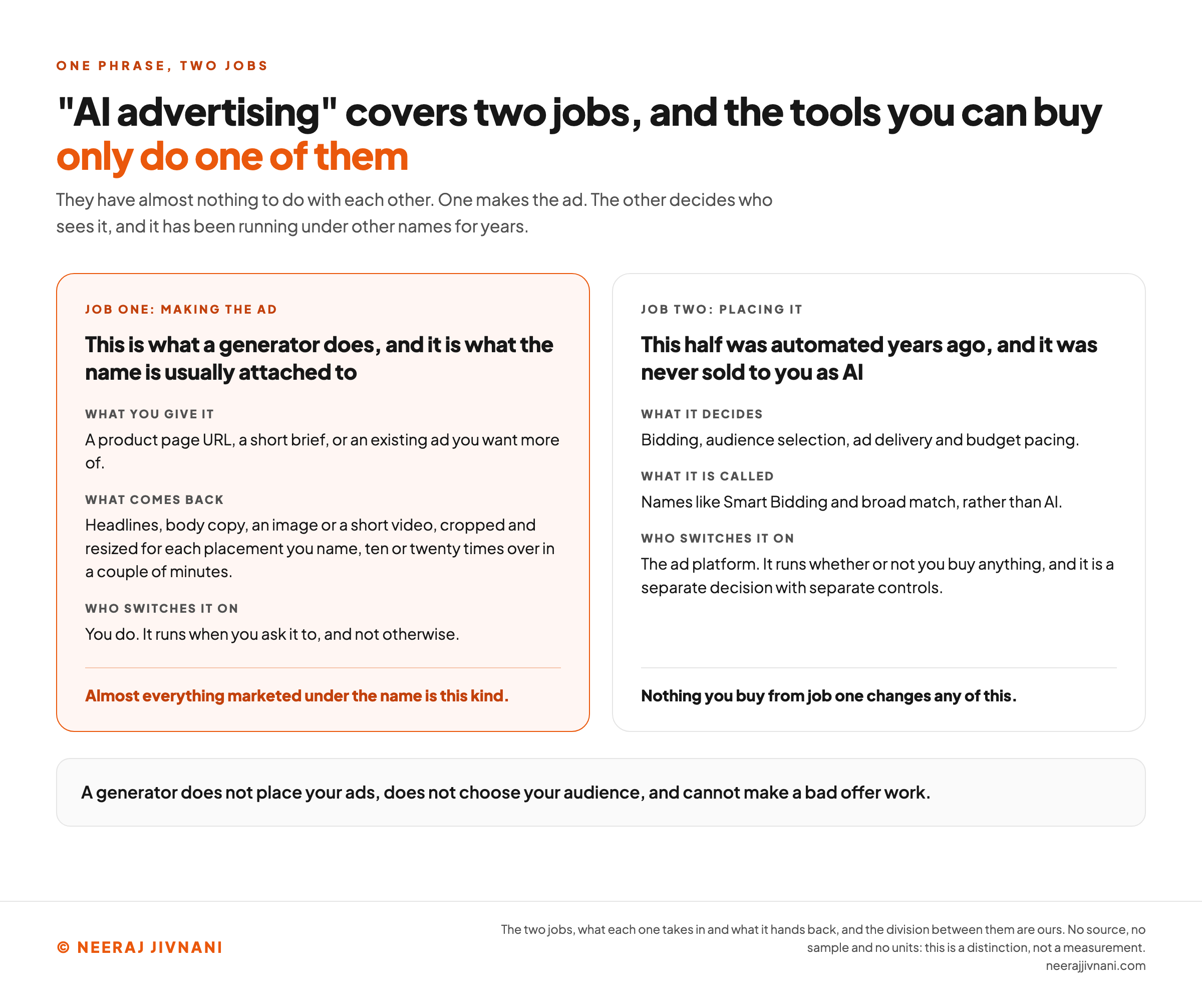
Two different things are sold under this phrase. One is a tool that makes the ad; the other is the platform machinery that decides who sees it.
Search for it and you mostly get the first.
The question those tools leave unanswered is whether the ads work, and the short answer is that nothing measured shows them doing worse than the ones you were making already.
What AI Advertising Means
The term is broad enough to cover anything a model touches in advertising work. In practice it lands on two jobs, and they are not related.
The first is making the ad. You give a tool a product link or a brief, and it returns copy, images, video, or all three, in whatever sizes the platform wants.
The second is placing it.
Bidding, audience selection, ad delivery and budget pacing have been model-driven for years, sold under names like Smart Bidding and broad match rather than as AI.
Almost everything marketed under the name is the first kind, and the two questions people ask most about it are whether an AI can make an ad and what that costs.
So the making half is what this is mostly about. The placing half runs whether or not you buy anything, and it is a separate decision with separate controls.
One thing is worth being precise about before going further. A generator does not place your ads, does not choose your audience, and cannot make a bad offer work.
Use this chart — embed code and citation
<a href="https://neerajjivnani.com/blog/ai-advertising/"><img src="https://neerajjivnani.com/infographics/ai-advertising/two-jobs-one-phrase.png" alt="Two side by side panels setting the two jobs the phrase covers against each other. The highlighted left panel, job one, making the ad, is what a generator does and what the name is usually attached to: you give it a product page URL, a short brief, or an existing ad you want more of; back come headlines, body copy, an image or a short video, cropped and resized for each placement you name, ten or twenty times over in a couple of minutes; and you switch it on yourself, so it runs when you ask it to and not otherwise. A line under that panel says almost everything marketed under the name is this kind. The right panel, job two, placing it, was automated years ago and was never sold as AI: it decides bidding, audience selection, ad delivery and budget pacing; it goes by names like Smart Bidding and broad match; and the ad platform switches it on, so it runs whether or not you buy anything and is a separate decision with separate controls. A line under it says nothing you buy from job one changes any of this. Beneath both, a closing line says a generator does not place your ads, does not choose your audience, and cannot make a bad offer work." width="1200"></a>
<p>Chart: <a href="https://neerajjivnani.com/blog/ai-advertising/">Neeraj Jivnani</a></p>Neeraj Jivnani, "What AI Advertising Covers, and Whether Ads a Machine Made Actually Work", neerajjivnani.com, https://neerajjivnani.com/blog/ai-advertising/Free to republish with a link back to this page.
What a Generator Actually Does
A generator turns one input into many outputs. That is the whole of the mechanism, and everything useful about it follows from that sentence.
You give it a source: usually a product page URL, sometimes a short brief, sometimes an existing ad you want more of.
It returns a set. Headlines, body copy, an image or a short video, cropped and resized for each placement you name, and most tools will do this ten or twenty times over in a couple of minutes.
Most advertising teams now have a model somewhere in the creative process.
A 2025 survey put the share of advertising executives whose company had deployed AI in the creative process at 83%, against 60% the year before, reported by the United Nations Department of Global Communications in an April 2026 issue brief on advertising and AI.
What It Needs From You
Three inputs decide the quality of what comes back, and none of them is the prompt.
- A clear offer. The tool restates what you give it. If the product page hedges, every variant hedges, and you will read twenty versions of nothing.
- The format you are buying. A square feed image and a nine-by-sixteen vertical video are different ads, not the same ad at two sizes, and asking for both at once gets you one of them done well.
- Something to compare against. Without a current ad to beat you have no way to read the result, and the tool will happily produce a set with no winner in it.
What the Refining Step Is For
Every tool tells you the output is a starting point you can edit. That is true and it is stated too mildly.
The editing step is where you remove the tells. It is not a cosmetic pass, and skipping it is the single most consequential thing you can do with one of these tools.
What counts as a tell is the measurable part, and the evidence on it is unusually clear.
Whether Ads a Machine Made Actually Work
The best evidence says machine-made ad images do not come out behind, and one condition decides whether they get ahead.
The hard part is what to compare against. Advertisers who reach for these tools differ from advertisers who do not, so an unadjusted average across accounts measures the advertisers rather than the ads.
One study got around that. Exner, Hartmann, Ding, Zhang and Netzer compared 4,633 "sibling ads", their term for machine-made and human-made images "launched by the same advertisers, in identical campaign settings, at the same time".
That comparison ran across more than 369 million impressions and 2.5 million clicks, in a 2025 Columbia Business School working paper.
One caveat travels with it. The ads ran on Taboola's platform, and the study was run with Taboola, which was preparing to launch its own generator at the time.
Their headline result is a flat one. They "do not find a detectable average click-through-rate disadvantage for AI-generated images relative to their human-made siblings".
Read that carefully, because it is narrower than the claim the tools make. The comparison did not find machine-made images doing worse, which is not the same as finding them doing better.
That is a good outcome for a generator and it is not by itself a reason to buy one. If the ads do not come out worse, the case for the tool rests on what it costs you to produce them.
The One Thing That Did Move the Number
The average hides the finding. The same authors report that "this average masks an important boundary condition: ads with AI-generated images outperform human-made ads when the AI images do not 'look like AI.'"
So the variable is not whether the machine made it. The variable is whether a person can tell.
A second experiment comes at the authorship question from a different direction. Kapoor and Kumar ran a randomized field test on WhatsApp with a direct-to-consumer brand, comparing personalized video ads made with generative AI against personalized image ads and against generic video.
Engagement rose by six to nine percentage points over both baselines, published in Marketing Science in 2025.
Two things about that number are worth holding onto. It is percentage points rather than a relative lift, so it is an absolute movement in engagement rather than a small bump on a small base.
And the contrast is not machine against person. Two of the three groups got personalized ads, so what the number separates is format and personalization, not who or what made the creative.
What Makes an Ad Read as Machine-Made
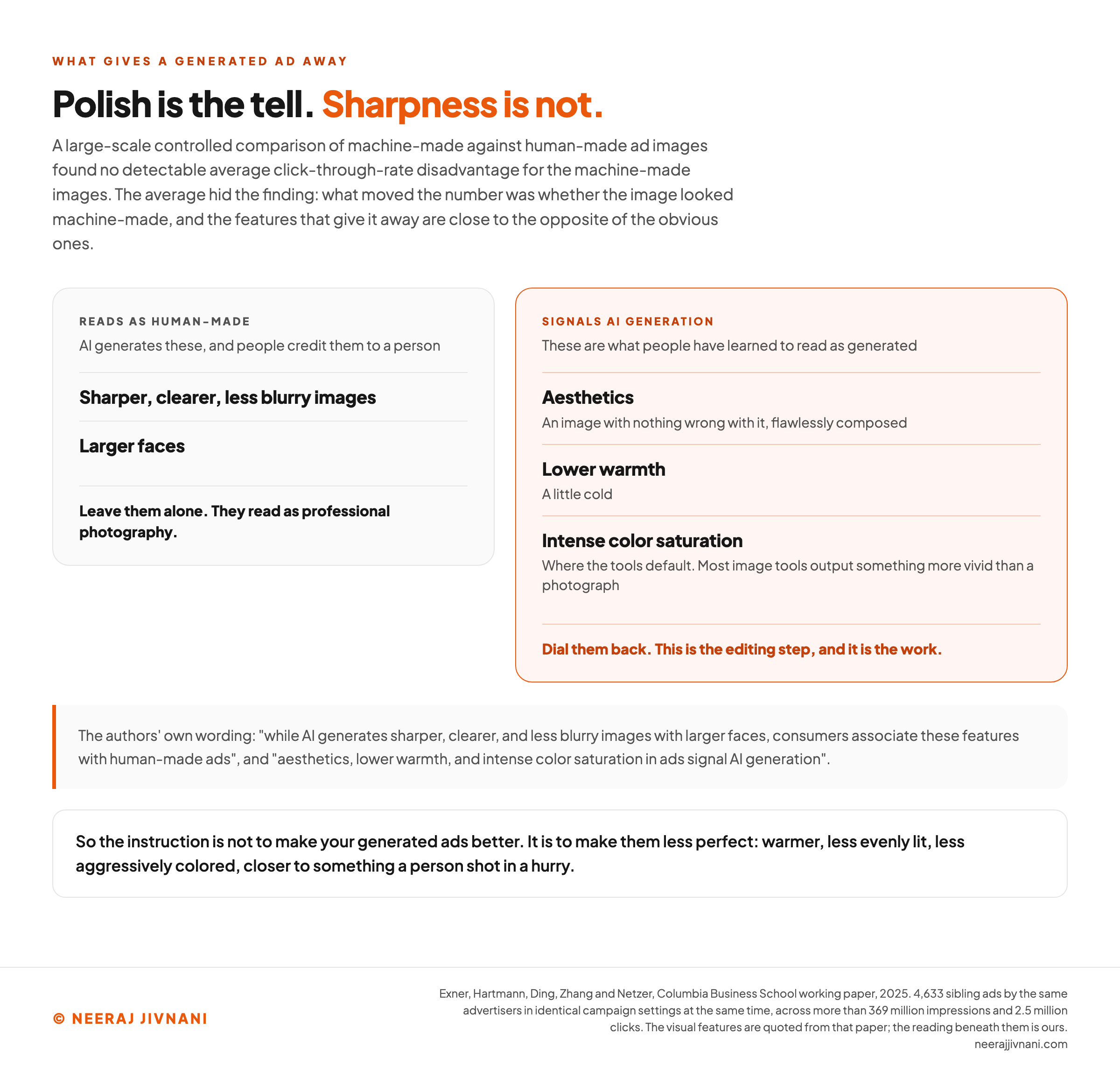
Polish is the tell, not sloppiness. That is close to the opposite of the obvious answer.
The sibling-ad study went looking for the features that make people say an ad looks machine-made.
Its authors report that "while AI generates sharper, clearer, and less blurry images with larger faces, consumers associate these features with human-made ads", and that "aesthetics, lower warmth, and intense color saturation in ads signal AI generation".
The first of those is the surprise, so it is worth unpacking slowly.
Sharpness is not a tell. Neither is a big face. Those read as professional photography, and people credit them to a human.
Polish is the tell. An image with nothing wrong with it, flawlessly composed and a little cold, is what people have learned to read as generated.
Saturation is where the tools default. The output of most image tools is more vivid than a photograph, and vividness is what gives it away.
So the instruction is not to make your generated ads better. It is to make them less perfect: warmer, less evenly lit, less aggressively colored, closer to something a person shot in a hurry.
That is uncomfortable advice, and it is what the evidence says.
Use this chart — embed code and citation
<a href="https://neerajjivnani.com/blog/ai-advertising/"><img src="https://neerajjivnani.com/infographics/ai-advertising/polish-is-the-tell.png" alt="Two columns of visual features, drawn from a controlled comparison of machine-made against human-made ad images. A line above them says the comparison found no detectable average click-through-rate disadvantage for the machine-made images, that the average hid the finding, and that what moved the number was whether the image looked machine-made. The left column, reads as human-made, holds two features AI generates that people credit to a person: sharper, clearer, less blurry images, and larger faces. Its note says to leave them alone because they read as professional photography. The highlighted right column, signals AI generation, holds three: aesthetics, meaning an image with nothing wrong with it, flawlessly composed; lower warmth, a little cold; and intense color saturation, where the tools default, because most image tools output something more vivid than a photograph. Its note says to dial them back, and that this is the editing step and it is the work. A quoted block gives the authors' own wording for both halves. A closing line says the instruction is not to make your generated ads better but to make them less perfect: warmer, less evenly lit, less aggressively colored, closer to something a person shot in a hurry." width="1200"></a>
<p>Chart: <a href="https://neerajjivnani.com/blog/ai-advertising/">Neeraj Jivnani</a></p>Neeraj Jivnani, "What AI Advertising Covers, and Whether Ads a Machine Made Actually Work", neerajjivnani.com, https://neerajjivnani.com/blog/ai-advertising/Free to republish with a link back to this page.
What It Costs, and Where the Cost Goes
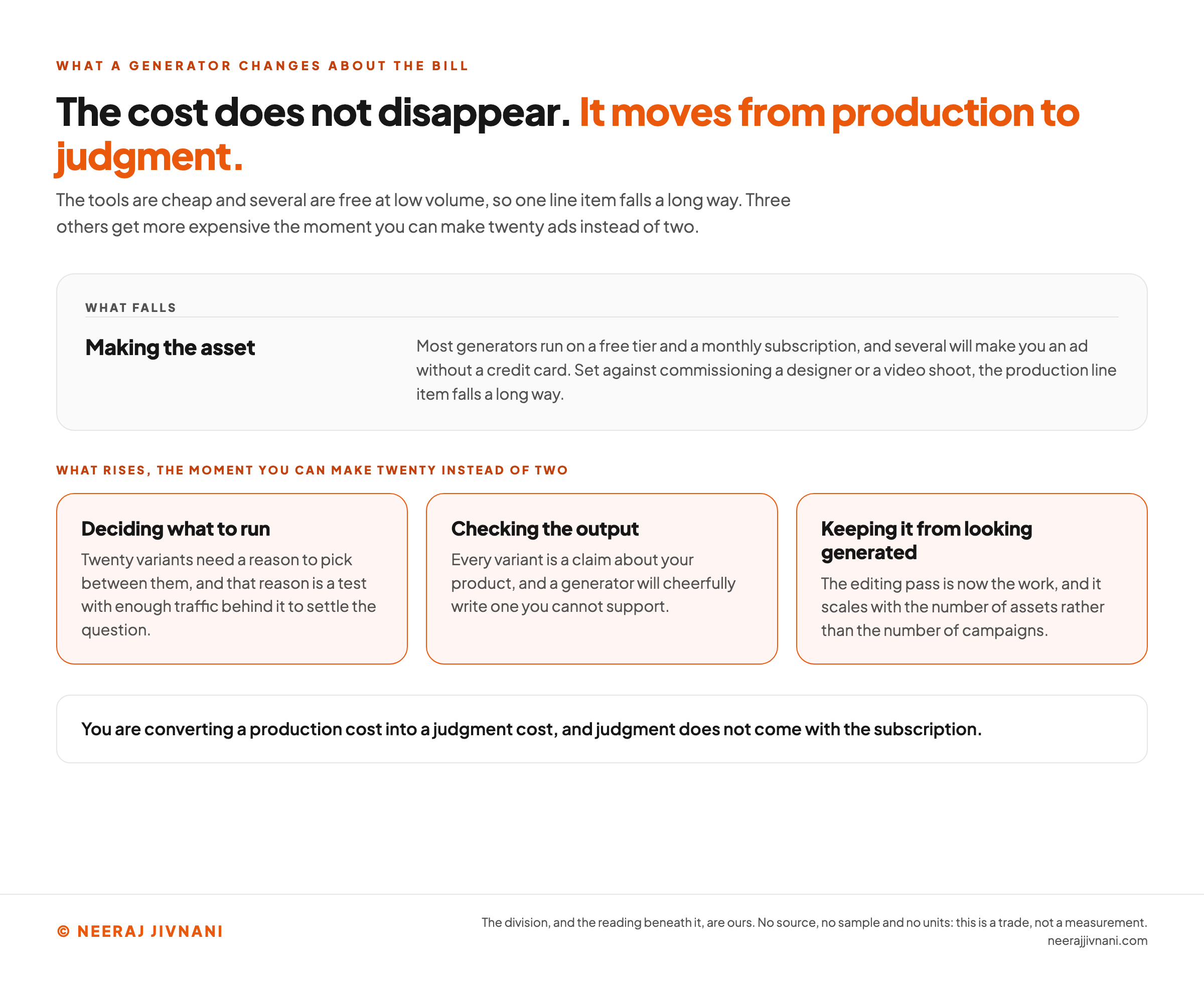
The tools themselves are cheap, so the price of one is the smaller half of the answer.
Most generators run on a free tier and a monthly subscription, and several will make you an ad without a credit card. Set against commissioning a designer or a video shoot, the production line item falls a long way.
The cost does not disappear. It goes somewhere else.
Three things get more expensive the moment you can make twenty ads instead of two.
- Deciding what to run. Twenty variants need a reason to pick between them, and that reason is a test with enough traffic behind it to settle the question.
- Checking the output. Every variant is a claim about your product, and a generator will cheerfully write one you cannot support.
- Keeping it from looking generated. The editing pass above is now the work, and it scales with the number of assets rather than the number of campaigns.
That is the real trade. You are converting a production cost into a judgment cost, and judgment does not come with the subscription.
Use this chart — embed code and citation
<a href="https://neerajjivnani.com/blog/ai-advertising/"><img src="https://neerajjivnani.com/infographics/ai-advertising/where-the-cost-goes.png" alt="A two sided card showing where a generator moves the cost. The left side, what falls, holds one item, making the asset: most generators run on a free tier and a monthly subscription, several will make you an ad without a credit card, and set against commissioning a designer or a video shoot the production line item falls a long way. The highlighted right side, what rises, holds three. Deciding what to run, because twenty variants need a reason to pick between them and that reason is a test with enough traffic behind it to settle the question. Checking the output, because every variant is a claim about your product and a generator will cheerfully write one you cannot support. And keeping it from looking generated, because the editing pass is now the work and it scales with the number of assets rather than the number of campaigns. A closing line says you are converting a production cost into a judgment cost, and judgment does not come with the subscription." width="1200"></a>
<p>Chart: <a href="https://neerajjivnani.com/blog/ai-advertising/">Neeraj Jivnani</a></p>Neeraj Jivnani, "What AI Advertising Covers, and Whether Ads a Machine Made Actually Work", neerajjivnani.com, https://neerajjivnani.com/blog/ai-advertising/Free to republish with a link back to this page.
What a Generator Cannot Be Given
Three limits are structural. No prompt fixes them, and knowing them in advance is most of what separates a useful tool from a disappointing one.
It does not know anything about your customers that you have not written down. Say a plumbing supplier wins most of its business because it answers the phone at seven in the morning. If that is not on the page, it is not in the ad.
It cannot tell you what to test. A generator produces variation, not hypotheses. Twenty headlines with no idea behind them is twenty ways of saying one thing, and the test between them settles nothing.
It cannot judge its own output. The tell it is least able to detect is the one it introduces, because the features that read as machine-made are the features it is optimizing toward.
That last one is the whole of our position on these tools. A generator moves your bottleneck; it does not remove it.
Production was never the scarce thing for most advertisers. Knowing which ad to run was, and a tool that hands you fifty candidates has made that problem bigger rather than smaller.
None of that is an argument against using one, with your eyes open.
If you already know what you want to test and were held up by the cost of making the assets, a generator is straightforwardly good news. If you did not know what to test, you now have fifty ways to not know.
The set, before you ask for it
Ask a generator for twenty variants and you get twenty. What you do not get is a reason to run any particular one of them. So write the reasons first, and watch what comes back carrying them.
How many variants were you going to ask for?
The Questions People Ask About AI Ads
Five questions do most of the work here, and the last of them is not an advertising rule at all.
How is AI used in advertising? In two places. It writes and draws the ad, which is what most tools sold under this name do, and it decides who sees the ad and at what price, which is what ad platforms have been doing with models for years.
Is there an AI that can make ads? Yes, and there are a lot of them. Give one a product page and it will return copy, static images and short video sized for the placements you name, usually in minutes, and usually with a free tier you can test before paying.
How much do AI ads cost? The tools are cheap and several are free at low volume, so the production cost falls sharply. The cost you take on instead is deciding which outputs to run and checking that each one is true, and that grows with the number of assets.
Is it legal to use AI to make ads? Nothing about a machine writing the ad changes the standard it has to meet. The claims in it have to be true and you have to be able to back them, exactly as with an ad a person wrote.
Two things are worth settling before you scale, and neither is exotic. Your tool's terms decide what rights you hold over what it produces, and the platform you are posting to decides what it asks you to disclose.
What is the 30% rule in AI? It is not an advertising rule and no standards body publishes it. Several incompatible versions circulate, splitting a task about 30/70 between a model and a person, and they disagree about which way round. Nothing authoritative settles it, and it has drifted onto advertising searches carrying no weight of its own.
What to Decide Before You Open One
Two decisions settle whether a generator earns its place, and both come before the tool.
Decide what you are testing. Not which headline, but which idea about the buyer: a different promise, a different objection answered, a different moment in the week.
Say a locksmith tests emergency callouts against scheduled lock changes, and that is one idea per variant rather than twenty variants of one idea.
Then decide who removes the tells. Somebody has to look at each asset and ask whether it reads as made by a person, because that is the difference the sibling-ad comparison turned on.
Get those two right and the machine is doing what it is good at, which is making the thing you already decided to make, faster and more cheaply than you could.
Get them wrong and you have bought a faster way to produce ads nobody chose.