Agentic Commerce Is Shopping Inside an Assistant, and Your Feed Decides If You Appear
AI assistants now shop for your customers. See what is live today, how much of it is real, and the three things your product data has to do first.


/ On this page9 sections
AI assistants now shop for your customers, and what is live today is the finding and the comparing rather than the paying.
How much of that is real depends on which half you mean. Assistants are reading product pages in volume, and almost none of those visits end in a purchase.
Your product data has three jobs, and not one of them is a platform project.
What Agentic Commerce Is
Agentic commerce means a shopper delegates the middle of a purchase to software. You say what you want in a sentence, the assistant goes and finds it, and the buying happens without anyone opening a store.
Everything turns on the word agent.
An agent is software that takes a goal and acts on it, instead of answering and waiting. Ordinary ecommerce asks the person to do that acting: search, filter, open six tabs, compare, type a card number.
Agentic commerce moves the middle of that job to software. The person still sets the goal, and still approves the money, at least for now.
It is a smaller idea than the language around it suggests. Nothing in it requires a new kind of store.
What Happens When an Assistant Buys Something
An agentic purchase has four moments, and from your side of the glass you can see three of them.
Somebody asks for an outcome, not a product. "A waterproof jacket that fits a 10-year-old, in stock, and here before Saturday." Constraints, not keywords.
The assistant matches that against structured data. Not your page design, and not your copy. Price, size, stock, shipping window and return policy, all as fields.
It hands the shopper somewhere. Usually to your site, sometimes to a checkout inside the assistant, and that difference decides who keeps the customer.
An order arrives. It looks like any other order, minus almost everything you would normally have learned on the way to one.
The third moment is the one that has moved recently.
It moved toward you, and knowing which way it moved changes what you build.
Use this chart — embed code and citation
<a href="https://neerajjivnani.com/blog/agentic-commerce/"><img src="https://neerajjivnani.com/infographics/agentic-commerce/what-agents-actually-touch.png" alt="Bar chart of AI agent website interactions by page type, showing product pages at 86.6 percent, miscellaneous and navigational at 6.4 percent, account and login at 3.9 percent, payment and checkout at 2.2 percent, and content and informational at 1.0 percent. The product bar dwarfs the rest and the payment and checkout bar is a sliver, making the point that agents are reading catalogs rather than completing purchases. Source named on the image as HUMAN Security's 2026 agentic commerce guide, drawn from telemetry the company describes as over 20 trillion digital interactions verified weekly." width="1200"></a>
<p>Chart: <a href="https://neerajjivnani.com/blog/agentic-commerce/">Neeraj Jivnani</a></p>Neeraj Jivnani, "Agentic Commerce Is Shopping Inside an Assistant, and Your Feed Decides If You Appear", neerajjivnani.com, https://neerajjivnani.com/blog/agentic-commerce/Free to republish with a link back to this page.
Agentic Commerce and Agentic AI Are Not the Same Thing
Agentic AI is the general capability. Agentic commerce is that capability pointed at buying and selling.
One is a category of software. The other is a thing that happens to your revenue.
The distinction is worth holding because the two lead to different rooms. Agentic AI takes you to orchestration, architecture and internal workflow; agentic commerce takes you to whether a shopper can find your jacket.
If you sell something, the commerce half is the only half you need.
What Is Live Right Now
Several assistants will shop with you right now, and each one is a separate arrangement.
ChatGPT does product discovery. You describe something, it compares options and links you out.
OpenAI extended the Agentic Commerce Protocol to cover discovery in March 2026, and named Target, Sephora, Nordstrom, Lowe's, Best Buy, The Home Depot and Wayfair as integrated for it.
Google put buying into AI Mode in Search and the Gemini app, through the Universal Commerce Protocol, announced in January 2026.
At Google I/O in May it added Universal Cart, one cart that carries across Search and the Gemini app in the US, with YouTube and Gmail to follow.
You can check out with Google Pay or move the items to the merchant's site. Google says the brand stays the merchant of record either way.
Microsoft Copilot, Perplexity and Amazon each run their own version, on their own terms.
None of what is live right now is a standard you switch on. Each of them is a relationship you enter.
The Two Protocols, and Who Is Behind Each
Two standards cover the transaction itself, and they belong to competitors.
The Agentic Commerce Protocol is maintained by OpenAI and Stripe, published under the Apache 2.0 license, and still marked beta. Stripe's own documentation now describes it as created with Meta as well.
The Universal Commerce Protocol came from Google, developed with partners including Shopify, Etsy, Wayfair, Target and Walmart. More than twenty partners have endorsed it, including Visa, Mastercard and Stripe.
You do not have to pick a side. Most sellers will reach both through a platform they already pay for.
Building It Is Not Being In It
Implementing a protocol does not put your products in front of anyone.
The protocol's own documentation says so. Asked whether implementing it means products are automatically listed, the answer given is no, and that each AI platform runs its own process for taking part.
OpenAI's merchant page says merchants can apply, and that if you have already applied you are on the waitlist. Google's route runs through a Merchant Center account and a merchant interest form.
It is a queue, not a switch.
How Big It Is Today
Two measurements answer this honestly, and today they point in opposite directions.
As a referral channel it is real and still growing.
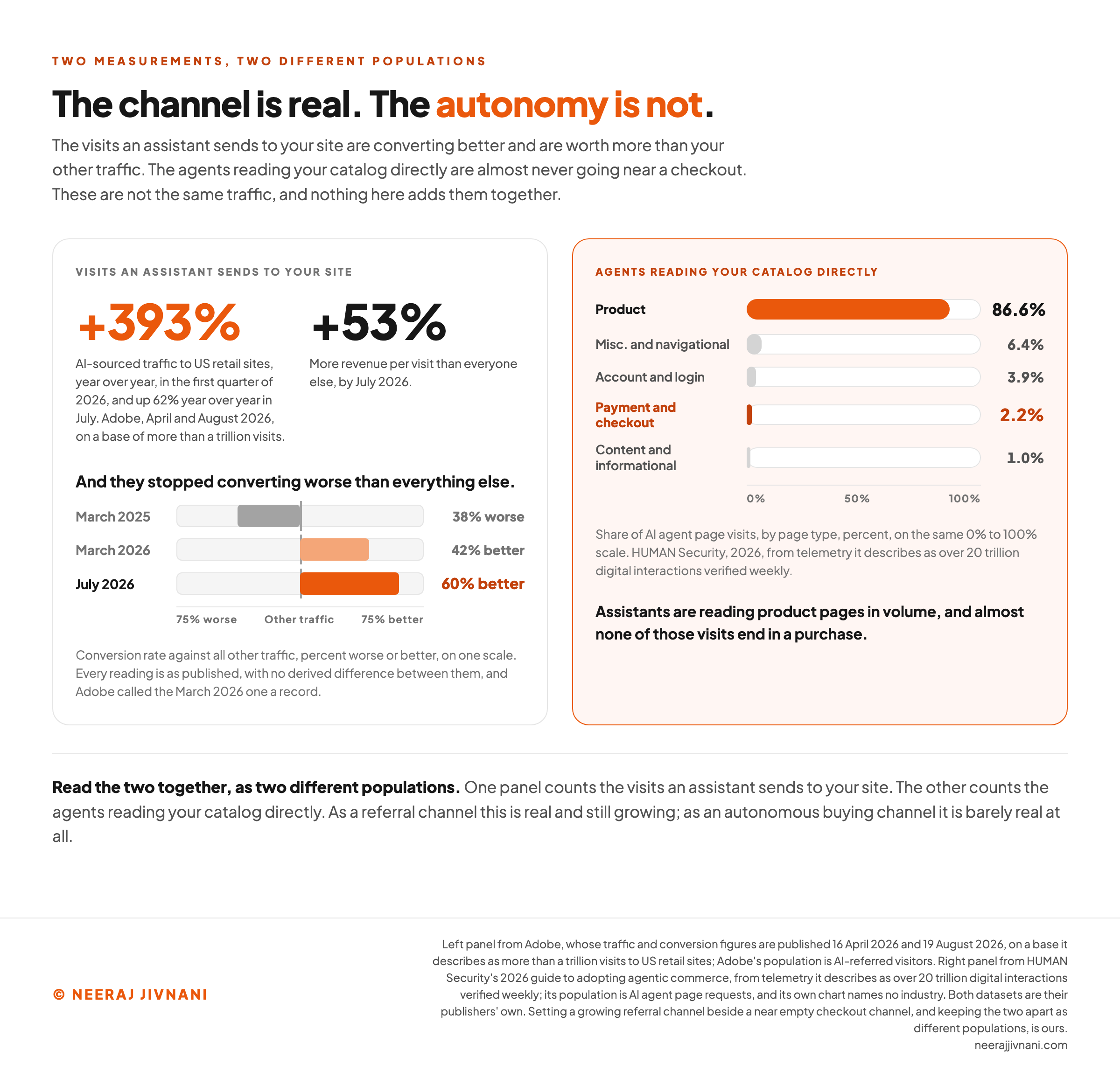
Adobe measured AI-sourced traffic to US retail sites up 393% year over year in the first quarter of 2026, and up 62% year over year in July, on a base of more than a trillion visits.
More usefully, that traffic buys.
It converted 42% better than other traffic in March 2026, which Adobe called a record, against 38% worse a year before that. By July the gap was 60%, and those visitors were generating 53% more revenue per visit than everyone else.
As an autonomous buying channel it is barely real at all.
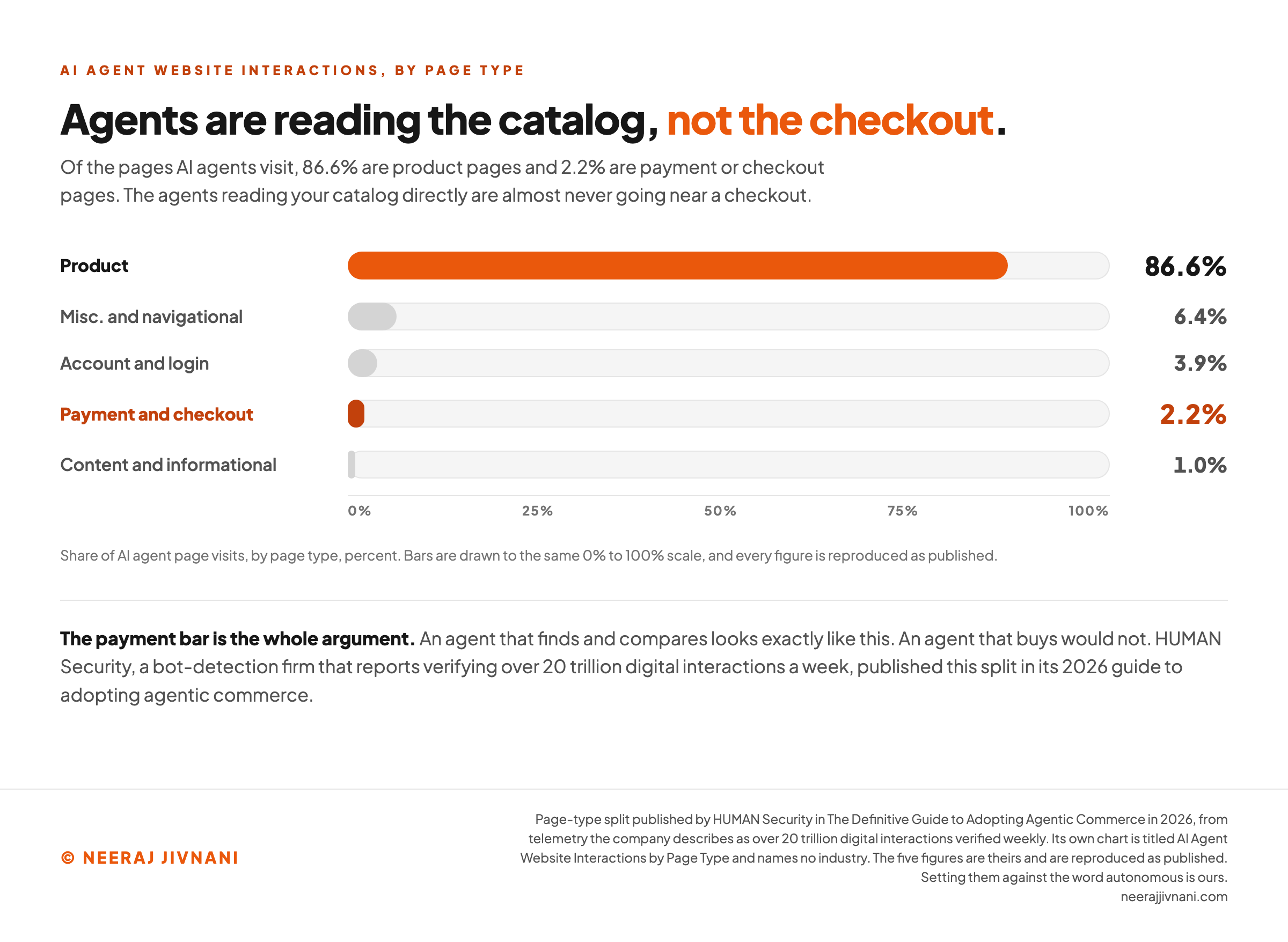
HUMAN Security, a bot-detection firm that reports verifying over 20 trillion digital interactions a week, breaks agent page visits down by type. Product pages take 86.6% of them.
Navigation takes 6.4%, account and login 3.9%, payment and checkout 2.2%, and informational pages 1.0%.
Read the two together and the picture settles, as long as you read them as two different populations.
The visits an assistant sends to your site are converting better and are worth more than your other traffic. The agents reading your catalog directly are almost never going near a checkout.
The trillion-dollar figures attached to this subject are forecasts for 2030. Useful in a board deck, useless for deciding what to do this quarter.
Use this chart — embed code and citation
<a href="https://neerajjivnani.com/blog/agentic-commerce/"><img src="https://neerajjivnani.com/infographics/agentic-commerce/arriving-to-read.png" alt="Two panel figure setting two different measurements side by side and saying plainly that they are not the same traffic. The left panel, headed visits an assistant sends to your site, plots AI-sourced traffic to United States retail sites rising 393 percent year over year in the first quarter of 2026 and 62 percent year over year in July 2026, shows those visitors generating 53 percent more revenue per visit than other traffic by July, and plots three conversion readings on one scale: 38 percent worse than other traffic in March 2025, 42 percent better in March 2026, and 60 percent better in July 2026. The right panel, headed agents reading your catalog directly, shows the share of AI agent page visits by type, with 86.6 percent on product pages, 6.4 percent on navigation, 3.9 percent on account and login, 2.2 percent on payment and checkout and 1.0 percent on informational pages, on the same 0 to 100 percent scale. The caption reads that the channel is real and the autonomy is not. Sources named on the image as Adobe, April and August 2026 for the traffic, revenue and conversion figures, and HUMAN Security 2026 for the page type split." width="1200"></a>
<p>Chart: <a href="https://neerajjivnani.com/blog/agentic-commerce/">Neeraj Jivnani</a></p>Neeraj Jivnani, "Agentic Commerce Is Shopping Inside an Assistant, and Your Feed Decides If You Appear", neerajjivnani.com, https://neerajjivnani.com/blog/agentic-commerce/Free to republish with a link back to this page.
What Your Store Has to Do
Three jobs, in this order.
Two of them are data hygiene and the third is a form. None needs a replatform.
None of them is wasted if agentic commerce stalls, either, because all three improve the store you already have. A complete feed with honest stock is worth having whether or not a machine ever reads it.
The order matters. Applying to a platform before your data is clean puts a thin catalog into a wider window.
Make the Product Page Readable by a Machine
An assistant cannot recommend what it cannot parse, and most retail product pages are only partly parseable.
Adobe scored US retail pages on how much of their content a language model can read. Homepages averaged 75% and category pages 74%.
Individual product pages came in at 66%.
That is the number to sit with, because the pages that decide whether you get recommended are the worst-prepared pages you own.
The fix is ordinary structured data work. Emit product markup with a stable identifier, a real price, real stock, and your return and shipping terms as fields rather than as sentences inside a tab.
Then check that the markup and the visible page agree. A page that says 30 days beside markup that says 45 has handed the assistant a reason to skip you.
Get the Feed Complete, Consistent and Current
Your feed is a storefront now. Treat a gap in it the way you would treat a broken checkout.
Every variant should resolve to one product rather than five, and every item should carry the same identifier in the feed, on the page and in whatever your systems hand out.
Stale stock is the expensive one.
An assistant that recommends something you cannot ship has been given a reason to prefer somebody else next time, and you will never see it happen.
Apply to Share Your Product Data, Per Platform
Applying is how your product data reaches an assistant, and there is no single place to do it. Each one has its own door, its own eligibility rules and its own queue.
Check what your platform already does for you before you do anything yourself. OpenAI says Shopify merchants' product data is already in ChatGPT through Shopify Catalog, with no additional work required from individual merchants.
If you are not on a platform that does it for you, apply directly and get in line.
What You Give Up
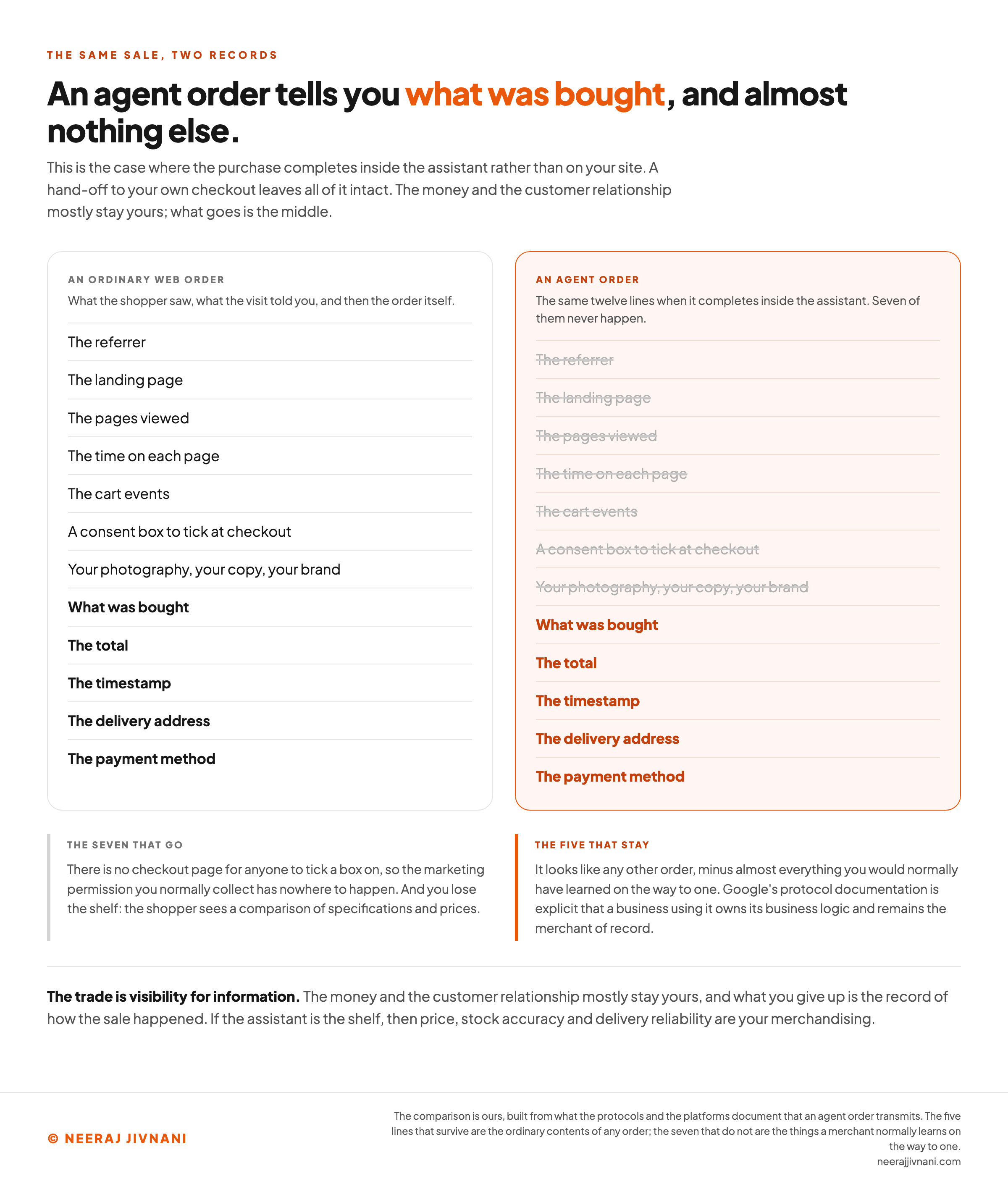
You give up the record of how the sale happened, when the purchase completes inside the assistant rather than on your site.
A hand-off to your own checkout leaves all of it intact.
The money and the customer relationship mostly stay yours. Google's protocol documentation is explicit that a business using it owns its business logic and remains the merchant of record.
What goes is the middle. An ordinary session tells you the referrer, the pages, the time on each and the cart events.
An agent order tells you the items, the total, the time, the delivery address and the payment method, and nothing either side of it.
There is no checkout page for anyone to tick a box on, so the marketing permission you normally collect has nowhere to happen.
Say you run a 30-day return window and a loyalty tier.
The assistant can read the return window straight out of your markup. The loyalty tier survives only if the platform carries it, which is why Google said in March 2026 that its protocol would carry loyalty linking.
Disputes get harder to argue, because the record of who agreed to what now sits partly outside your systems.
And you lose the shelf. The shopper sees a comparison of specifications and prices, not your photography, your copy or your brand.
That last one is the strategic question. If the assistant is the shelf, then price, stock accuracy and delivery reliability are your merchandising.
One product, written down three times
Your feed is a storefront now. Take one product you sell and fill in each fact as each place states it today: on the visible page, in the feed, and in whatever your systems hand out when the order lands. The return-policy row opens on the example from the section above, and it is there to be overwritten.
Price
What one unit costs today
Nothing typed yet. Put the same fact in all three columns, exactly as each one states it today.
Size
The variant a shopper asks for by name
Nothing typed yet. Put the same fact in all three columns, exactly as each one states it today.
Stock
Whether you can ship it now
Nothing typed yet. Put the same fact in all three columns, exactly as each one states it today.
Shipping window
When it arrives
Nothing typed yet. Put the same fact in all three columns, exactly as each one states it today.
Return policy
How long they have to change their mind
All three say something different. A person reads one answer and an assistant matches on another, so you lose the recommendation. Then the one it did match on is not what you can actually do, which is a reason to prefer somebody else next time.
Two columns are compared only when both are filled in, as typed, ignoring case, spacing and a trailing period. Writing one fact two ways counts as a disagreement here, because it counts as one to something matching on fields rather than on meaning.
What a person reads
Your page design and your copy, which is not what any of this is matched against.
- Price
- not stated
- Size
- not stated
- Stock
- not stated
- Shipping window
- not stated
- Return policy
- 30 days
What the assistant has
Fields, and nothing else. This is the record that decides whether you appear.
- Price
- not stated
- Size
- not stated
- Stock
- not stated
- Shipping window
- not stated
- Return policy
- 45 days
What actually happens
What you can really do when the order lands, which is what the shopper finds out last.
- Price
- not stated
- Size
- not stated
- Stock
- not stated
- Shipping window
- not stated
- Return policy
- 30 days
0not in the feed. Facts a shopper can ask for and you cannot be matched on.
1page against feed. A page that says 30 days beside markup that says 45 has handed the assistant a reason to skip you.
1feed against your systems. Stale stock is the expensive one, and you will never see it happen.
Three counts, not one score. They are three different failures with three different fixes, and adding them together would hide that. A person who skims forgives a missing size field. Software does not, and it does not come back later to check whether you fixed it.
Use this chart — embed code and citation
<a href="https://neerajjivnani.com/blog/agentic-commerce/"><img src="https://neerajjivnani.com/infographics/agentic-commerce/what-an-order-carries.png" alt="Side by side comparison of what a merchant learns from an ordinary web order against an order that completes inside the assistant. A deck above the two columns says this is the case where the purchase completes inside the assistant rather than on your site, and that a hand-off to your own checkout leaves all of it intact. The left column, headed what the shopper saw, what the visit told you and then the order itself, lists referrer, landing page, pages viewed, time on each page, cart events, an on-page consent checkbox and the branded storefront experience. The right column shows the same twelve lines with seven of them greyed out and struck through, keeping only the order contents, the total, the timestamp, the delivery address and the payment method. A band across the foot reads that the trade is visibility for information, that the money and the customer relationship mostly stay yours, and that what you give up is the record of how the sale happened." width="1200"></a>
<p>Chart: <a href="https://neerajjivnani.com/blog/agentic-commerce/">Neeraj Jivnani</a></p>Neeraj Jivnani, "Agentic Commerce Is Shopping Inside an Assistant, and Your Feed Decides If You Appear", neerajjivnani.com, https://neerajjivnani.com/blog/agentic-commerce/Free to republish with a link back to this page.
Questions People Ask About Agentic Commerce
Four questions about agentic commerce get asked most often, and short answers serve them better than long ones.
What are the differences between agentic AI and agentic commerce? The first is a way of building software, the second is a sales channel. Only one of them has anything to do with whether your jacket gets recommended.
Can you give me an example of agentic commerce? Somebody describes a rain jacket to ChatGPT with a budget and a delivery date, gets a handful of compared options back, and buys one of them. The comparing is the agentic part.
What are some examples of agentic commerce companies? Three different lists, which is why the question is confusing. The assistants people shop inside are ChatGPT, Gemini, Copilot, Perplexity and Amazon; the protocols behind them come from OpenAI and Stripe, and from Google and Shopify; the platforms that carry your feed into them are the ones you probably already use.
How big is agentic commerce? Big enough to prepare for, small enough that nobody is losing a quarter over it. The referral traffic is still growing and converting better than other channels, and the autonomous buying is close to a rounding error.
The Work Is Boring, Which Is the Good News
The boring version of this work is the version that pays. Complete product data, honest stock, terms a machine can read and registering for a channel are the same four jobs that shopping feeds and marketplaces have asked for since the 2000s.
None of it is new.
What changed is who is reading.
A person who skims forgives a missing size field. Software does not, and it does not come back later to check whether you fixed it.
So the honest position is neither of the two on offer. This is not a transformation, and it is not hype either.
It is a new reader with narrow habits, arriving at pages that were built for somebody else. The boring work is what closes that gap, and it pays for itself whether or not the autonomous half ever shows up.