AI Marketing: What Is Already Deciding for You, and What Is Not
Most of it is running in your ad accounts right now. Work out which parts a model should hold, which stay yours, and what to check before handing one over.


/ On this page11 sections
Most of what gets sold to you as AI marketing is already running inside your ad accounts, and has been for years.
The part that is new is the part you can watch happening, which is why it gets the attention and most of the budget.
Sorting the two out is the useful work. One kind you approve before it goes anywhere.
The other chooses on your behalf and shows you an aggregate weeks later, and that is the one spending money.
AI Marketing Is Three Jobs, Not One
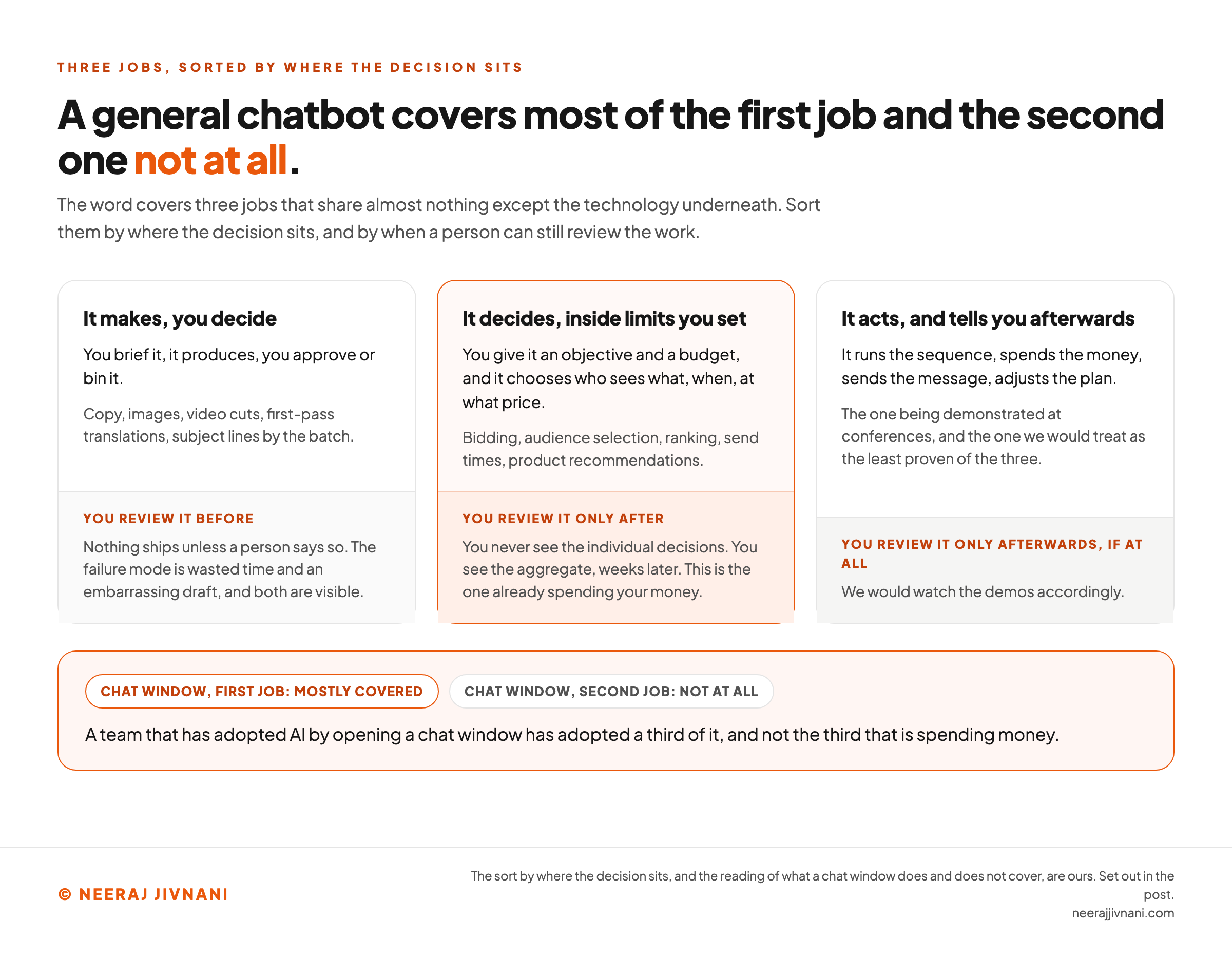
AI marketing means using a model to do part of the marketing work, and the word covers three jobs that share almost nothing except the technology underneath.
Sort them by where the decision sits.
It makes, you decide. You brief it, it produces, you approve or bin it. Copy, images, video cuts, first-pass translations, subject lines by the batch.
Nothing ships unless a person says so. The failure mode is wasted time and an embarrassing draft, and both are visible.
It decides, inside limits you set. You give it an objective and a budget, and it chooses who sees what, when, at what price. Bidding, audience selection, ranking, send times, product recommendations.
You never see the individual decisions. You see the aggregate, weeks later.
It acts, and tells you afterwards. It runs the sequence, spends the money, sends the message, adjusts the plan.
This is the one being demonstrated at conferences, and the one we would treat as the least proven of the three. We would watch the demos accordingly.
A general chatbot covers most of the first job and the second one not at all. So a team that has adopted AI by opening a chat window has adopted a third of it, and not the third that is spending money.
Use this chart — embed code and citation
<a href="https://neerajjivnani.com/blog/ai-marketing/"><img src="https://neerajjivnani.com/infographics/ai-marketing/a-chatbot-covers-one-of-the-three.png" alt="Three cards setting the three jobs out side by side, sorted by where the decision sits and by when a person can still review the work. The first card, it makes and you decide, is briefing a model and approving or binning what comes back, with copy, images, video cuts, first-pass translations and subject lines by the batch as its examples, and a strip underneath reading you review it before, because nothing ships unless a person says so and the failure mode is wasted time and an embarrassing draft, both visible. The second card, drawn in orange, is it decides inside limits you set: you give it an objective and a budget and it chooses who sees what, when and at what price, across bidding, audience selection, ranking, send times and product recommendations, and its strip reads you review it only after, because you never see the individual decisions and you see the aggregate weeks later, and this is the one already spending your money. The third card, it acts and tells you afterwards, is running the sequence, spending the money, sending the message and adjusting the plan, and its strip reads you review it only afterwards, if at all, with the note that it is the one being demonstrated at conferences and the one we would treat as the least proven of the three, so we would watch the demos accordingly. A band underneath carries two chips, one saying a chat window covers most of the first job and one saying it covers the second not at all, above the line that a team that has adopted AI by opening a chat window has adopted a third of it, and not the third that is spending money." width="1200"></a>
<p>Chart: <a href="https://neerajjivnani.com/blog/ai-marketing/">Neeraj Jivnani</a></p>Neeraj Jivnani, "AI Marketing: What Is Already Deciding for You, and What Is Not", neerajjivnani.com, https://neerajjivnani.com/blog/ai-marketing/Free to republish with a link back to this page.
Most of It Is Already Switched On
You are almost certainly running the second job already. If you have used automated bidding, a lookalike audience, a recommended-products block or an optimized send time, a model has been choosing on your behalf for years.
Nobody sold it to you as AI marketing at the time. It arrived as a checkbox called "maximize conversions", and it worked well enough that you stopped thinking about it.
Your first move is not a purchase. It is an audit of what is already deciding things, what objective each of those systems was given, and whether anyone has looked at that objective since.
We would put that audit ahead of any tool evaluation.
Where It Shows Up in a Marketing Week
Across a normal week a model shows up in five kinds of work: drafting, choosing, predicting, answering and listening, and each belongs to one of the three jobs.
Drafting. Ad variants, subject lines, product descriptions, social captions, alt text. The making job, start to finish.
You get speed and volume. What you do not get is anything the model could not have inferred from what you gave it.
Choosing who sees what. Bidding, audience expansion, placement, the order of a product grid, which of four emails a contact receives.
That is the deciding job, and it is the one already spending your money.
Predicting. Lead scores, churn risk, next-best-action, forecast demand. Also the deciding job, wearing a different product name, running on the same machinery.
Answering. Support chat, pre-sales questions, the widget in the corner of the pricing page. Making and deciding at once, in front of a customer, with no approval step.
It is the one we would put behind an approval step longest.
Listening. Sentiment on a brand mention, clustering survey answers, summarizing reviews. The making job again, over your own material.
This last one is the most underrated. It is cheap, it is checkable against the source, and it answers questions you already had.
Two of the five are a person writing with help. Two are a system ranking options and picking one.
Answering is both at once, which is what makes it the hardest of the five to supervise.
The Objective You Set Is the Whole of Your Control
Once a system is choosing on your behalf, the objective you handed it is your only remaining lever. You cannot inspect the individual choices and you cannot overrule them one at a time.
So it will get you what you asked for.
That is the problem, not the reassurance it sounds like. Ask an ad system to maximize conversions and it will find the people most likely to convert.
Some of those people were going to buy from you anyway. Buying them again is the cheapest way to hit the target you set.
The campaign reports beautifully. The business does not move.
Say a bookshop turns on automated bidding with conversions as the goal. Two weeks later the cost per sale has halved and the weekly revenue has not changed, because the system found the people already walking toward the till.
Nothing there is a malfunction. It is the model succeeding at the thing that was specified, and the specification was the part that needed the thought.
The same shape turns up wherever the deciding job runs. Optimize a product grid for clicks and it will promote the things people click and do not buy.
Optimize send time for opens and it will find the hour your most engaged contacts check email, which you knew.
Which is why "set clear objectives" is not throat-clearing. It is the entire job.
Writing an Objective That Survives Contact
An objective is worth handing over when it names the outcome you want, over a window long enough for that outcome to happen.
Two things make it hold, and both are about what you are willing to count.
- Name the event that means value to you, rather than the nearest proxy the platform offers.
- Say which conversions you do not want counted, because otherwise the cheapest way to hit the target is to buy the customers you already had.
The second one is the harder sentence to write, and it is the one the bookshop needed.
The cheapest way to hit it
Pick the one that is already choosing on your behalf. It reads back what satisfying its objective the cheap way looks like, and then asks the three questions a register of what is switched on has to answer.
Which of these is running somewhere in your accounts
A model has been choosing on your behalf for years if any of them is on. Nobody sold it to you as AI marketing at the time.
What It Needs From You Before Any of It Works
Your records are not an input to the deciding layer. They are its menu.
A system choosing between your customers can only choose between distinctions you wrote down. If you never recorded who canceled, then "people who canceled" is not a weak segment for it, it is a group that does not exist in its world.
So the question to ask of a record is not whether it is clean. It is which decisions it makes possible at all, and three things widen that.
The events have to be recorded. Not only the purchase. The trial start, the cancellation, the support ticket, the second visit.
The records have to be joined. The person in your email tool and the person in your order history have to be one row, or every model you point at them is looking at two half-people.
The permission has to be real. Whatever you use to target and personalize has to be data you were allowed to collect and are allowed to use that way.
Add a field and you have not improved anything yet. You have added a distinction the system is now allowed to act on, and that is the only way its menu ever grows.
Which is why the useful question before any of this is not what you want it to optimize. It is what you would want it to be able to tell apart.
If You Sell Into the EU, Three Things Are Now Required
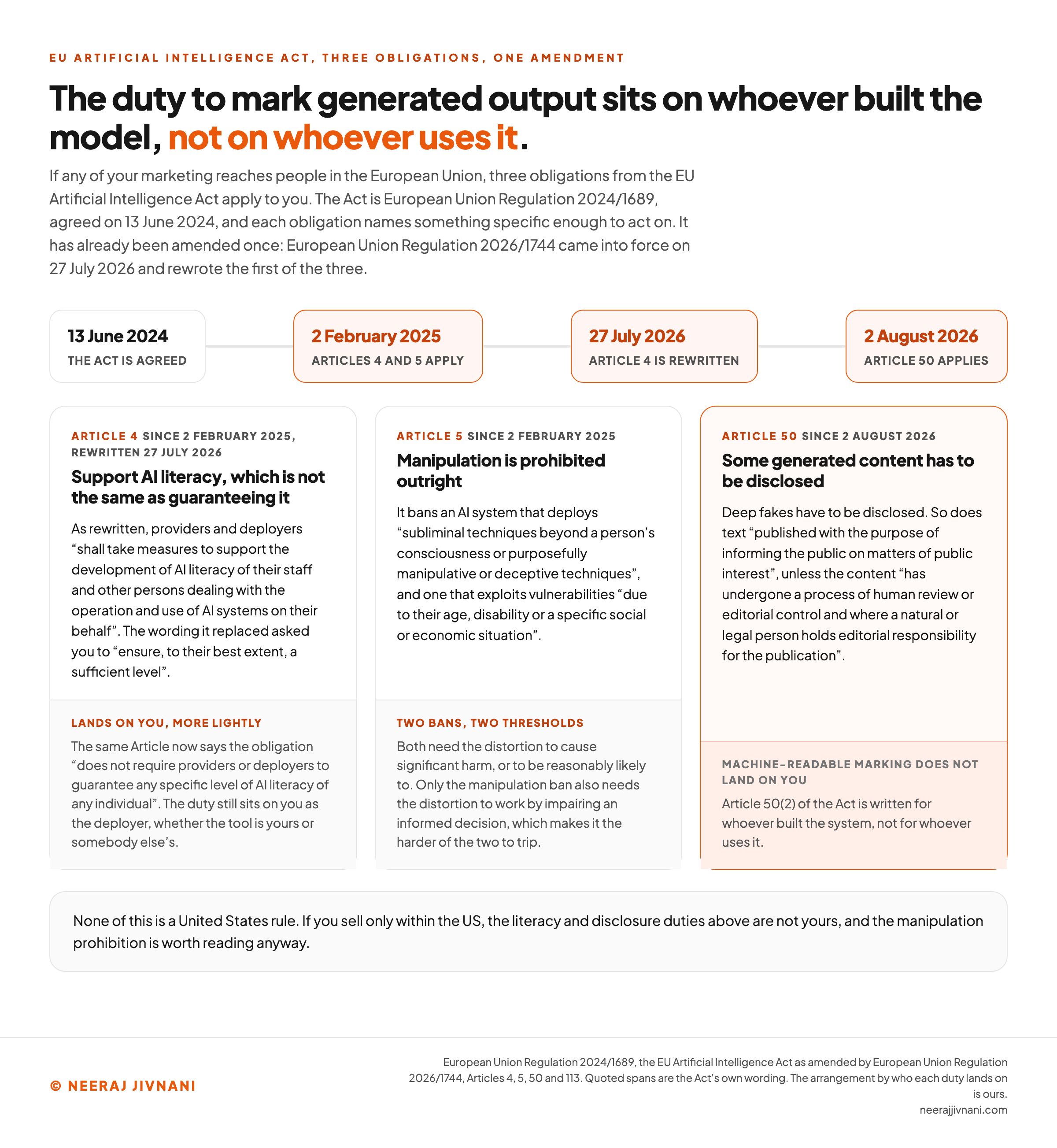
If any of your marketing reaches people in the European Union (EU), three obligations from the EU Artificial Intelligence Act apply to you. The Act is European Union Regulation 2024/1689, agreed on 13 June 2024 and amended once since.
Two of the three obligations took effect on 2 February 2025 and the third on 2 August 2026.
Article 4: Support AI Literacy, Which Is Not the Same as Guaranteeing It
Article 4 was rewritten by European Union Regulation 2026/1744, which came into force on 27 July 2026, and the rewrite changed what you owe.
Providers and deployers now "shall take measures to support the development of AI literacy" of their staff and of anyone operating these systems for them.
The same Article adds that this "does not require providers or deployers to guarantee any specific level of AI literacy of any individual".
The wording it replaced asked you to "ensure, to their best extent, a sufficient level".
Article 5: Manipulation Is Prohibited Outright
Since 2 February 2025, Article 5 has banned an AI system that deploys "subliminal techniques beyond a person's consciousness or purposefully manipulative or deceptive techniques", and one that exploits vulnerabilities "due to their age, disability or a specific social or economic situation".
Both bans need the distortion to cause significant harm, or to be reasonably likely to. Only the manipulation ban also needs the distortion to work by impairing an informed decision, which makes it the harder of the two to trip.
Neither ban waits for the distortion to land. The objective of distorting behavior is enough on its own, so a system does not have to have worked for the ban to bite.
Article 50: Some Generated Content Has to Be Disclosed
Article 50 has applied since 2 August 2026. The duty to mark generated output in a machine-readable format sits on the model's provider, not on you, because Article 50(2) is written for whoever built the system.
The exception is if you had one built and put it into service under your own name, which makes you the provider.
Two of the duties it puts on you as the deployer touch most marketing work. Deep fakes have to be disclosed, and so does text "published with the purpose of informing the public on matters of public interest".
That second one does not apply where the content "has undergone a process of human review or editorial control and where a natural or legal person holds editorial responsibility for the publication".
That carve-out is the interesting part. It does not ask you to label anything; it asks somebody to be responsible by name.
What This Does Not Change
None of this is a United States rule. If you sell only within the US, the literacy and disclosure duties above are not yours.
The manipulation prohibition is worth reading anyway. It describes an optimization aimed at people who cannot afford what is being sold to them, and in one large market that practice now has a legal name.
Use this chart — embed code and citation
<a href="https://neerajjivnani.com/blog/ai-marketing/"><img src="https://neerajjivnani.com/infographics/ai-marketing/who-each-duty-lands-on.png" alt="A timeline above three cards, setting out three obligations of the EU Artificial Intelligence Act by their date and by who each one lands on, with the July 2026 amendment marked on the timeline. The timeline runs from 13 June 2024, when the Act is agreed, to 2 February 2025, when Articles 4 and 5 apply, to 27 July 2026, when Article 4 is rewritten, to 2 August 2026, when Article 50 applies. The first card is Article 4, in force since 2 February 2025 and rewritten on 27 July 2026: as rewritten, providers and deployers shall take measures to support the development of AI literacy of their staff and other persons dealing with the operation and use of AI systems on their behalf, where the wording it replaced asked you to ensure, to their best extent, a sufficient level, and the strip underneath, headed lands on you more lightly, says the same Article now states the obligation does not require providers or deployers to guarantee any specific level of AI literacy of any individual, and that the duty still sits on you as the deployer whether the tool is yours or somebody else's. The second card is Article 5, also in force since 2 February 2025: it bans an AI system that deploys subliminal techniques beyond a person's consciousness or purposefully manipulative or deceptive techniques, and one that exploits vulnerabilities due to their age, disability or a specific social or economic situation, above two thresholds that are not the same: both need the distortion to cause significant harm, or to be reasonably likely to, and only the manipulation ban also needs the distortion to work by impairing an informed decision, which makes it the harder of the two to trip. The third card, drawn in orange, is Article 50, in force since 2 August 2026: deep fakes have to be disclosed, and so does text published with the purpose of informing the public on matters of public interest, unless the content has undergone a process of human review or editorial control and where a natural or legal person holds editorial responsibility for the publication, and its strip says the machine-readable marking duty does not land on you, because Article 50(2) of the Act is written for whoever built the system, not for whoever uses it. A band underneath says none of this is a United States rule." width="1200"></a>
<p>Chart: <a href="https://neerajjivnani.com/blog/ai-marketing/">Neeraj Jivnani</a></p>Neeraj Jivnani, "AI Marketing: What Is Already Deciding for You, and What Is Not", neerajjivnani.com, https://neerajjivnani.com/blog/ai-marketing/Free to republish with a link back to this page.
Proving It Did Anything
Whether any of this worked is harder to establish than it looks, and the reason is structural rather than a matter of effort.
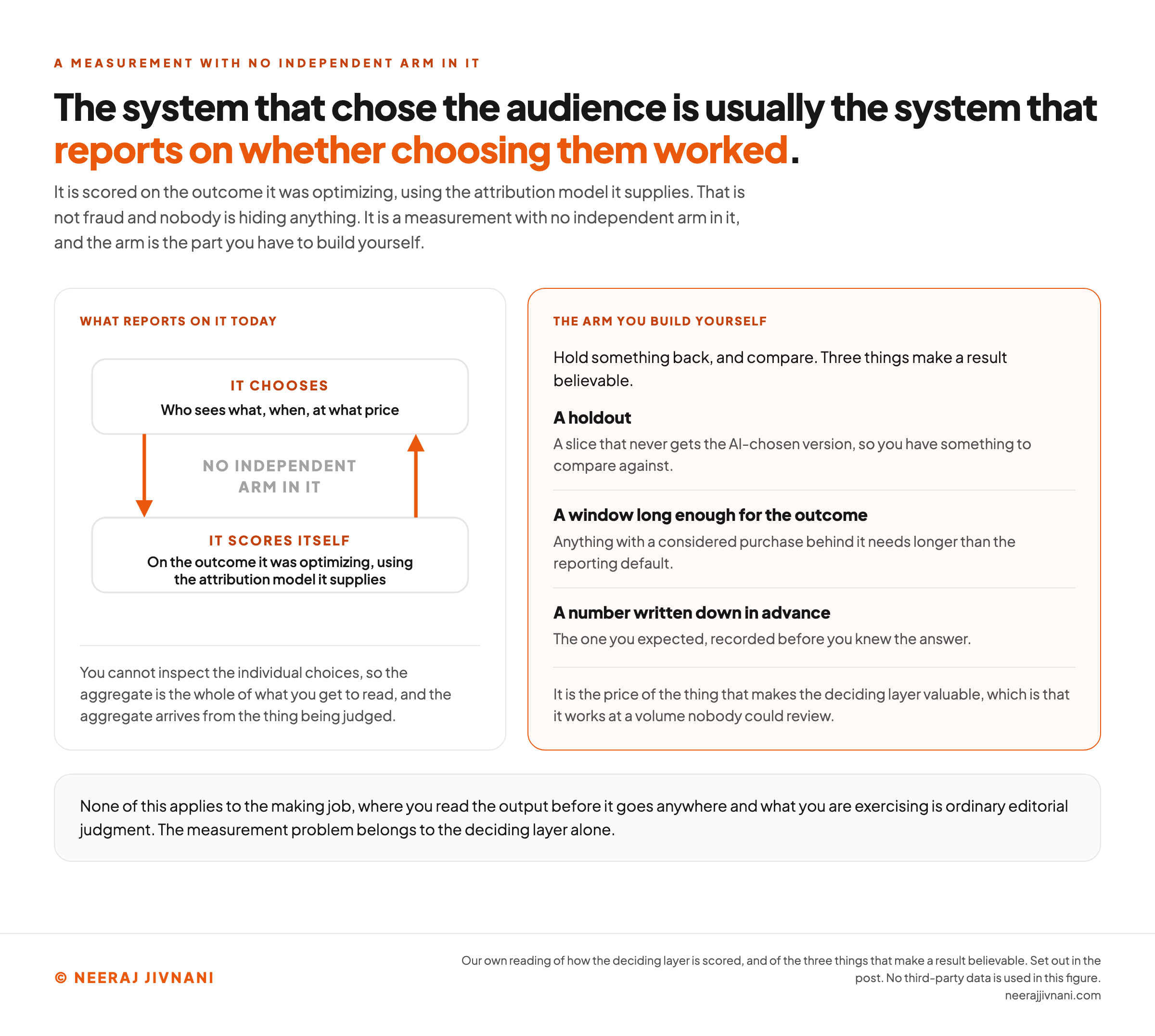
The system that chose the audience is usually the system that reports on whether choosing them worked.
It is scored on the outcome it was optimizing, using the attribution model it supplies. That is not fraud and nobody is hiding anything.
It is a measurement with no independent arm in it.
So you have to build the independent arm yourself, and there is only one way to do it. Hold something back, and compare.
Three things make a result believable.
A holdout. A slice that never gets the AI-chosen version, so you have something to compare against.
A window long enough for the outcome. Anything with a considered purchase behind it needs longer than the reporting default.
A number written down in advance. The one you expected, recorded before you knew the answer.
None of that applies to the making job, where you read the output before it goes anywhere and what you are exercising is ordinary editorial judgment.
The measurement problem belongs to the deciding layer alone. It is the price of the thing that makes that layer valuable, which is that it works at a volume nobody could review.
Use this chart — embed code and citation
<a href="https://neerajjivnani.com/blog/ai-marketing/"><img src="https://neerajjivnani.com/infographics/ai-marketing/no-independent-arm.png" alt="Two panels on how the deciding layer is measured. The left panel is a closed two step loop drawn in orange: one box reads it chooses, who sees what, when, at what price, an arrow leads down to a second box reading it scores itself, on the outcome it was optimizing, using the attribution model it supplies, and a second arrow leads back up to the first, closing the loop. The space inside the loop is labeled no independent arm in it, and a note underneath says you cannot inspect the individual choices, so the aggregate is the whole of what you get to read and it arrives from the thing being judged. The right panel, drawn in orange, is the arm you build yourself: hold something back and compare, then three numbered items. A holdout, a slice that never gets the AI chosen version so you have something to compare against. A window long enough for the outcome, because anything with a considered purchase behind it needs longer than the reporting default. And a number written down in advance, the one you expected, recorded before you knew the answer. A band underneath says none of this applies to the making job, where you read the output before it goes anywhere, and that the measurement problem belongs to the deciding layer alone." width="1200"></a>
<p>Chart: <a href="https://neerajjivnani.com/blog/ai-marketing/">Neeraj Jivnani</a></p>Neeraj Jivnani, "AI Marketing: What Is Already Deciding for You, and What Is Not", neerajjivnani.com, https://neerajjivnani.com/blog/ai-marketing/Free to republish with a link back to this page.
The Predictable Disappointments
Four disappointments are predictable enough to plan for, and they are why the deciding layer needs supervision it rarely gets.
It optimizes toward the wrong thing, confidently. The objective failure, and the most expensive of the four, because the reporting looks healthy the whole time.
It inherits whatever your data already does. A model trained on who has bought from you will go and find more people like the people who have bought from you.
That is what you asked for. It is also how an audience quietly narrows to the customers you already had.
The version of this with a legal name is discrimination against a protected group, and it is a live risk anywhere targeting touches housing, credit, employment or insurance.
You cannot inspect the reasoning. When a system ranks one lead above another, no sentence anywhere explains why.
You see inputs and outcomes and nothing in between. That is fine when you are ranking ad placements and not fine when somebody asks you to justify a decision about a person.
The approval step quietly disappears. This one is organizational rather than technical.
A review step survives a bad launch and dies during a good quarter. Somebody removes it to go faster, nobody records that it went, and the first bad output ships at full volume.
Write down when it was removed and who agreed. A decision nobody made is the one that gets unmade.
Choosing the First One to Try
Start with a making job on your own material that somebody reads before it goes out. There is no best AI tool for marketing, and the question is worth replacing rather than answering.
Tools change every quarter. What you are handing over does not.
Three questions decide it, and they keep working after the products have all been renamed.
Which of the three jobs is this? Making, deciding, or acting. The answer tells you what kind of supervision you are signing up for.
What would you be able to check? For a making job you read the output. For a deciding job you need a holdout and a window, or you will never know.
What happens on a bad day? A weak draft costs you an hour. A bad objective on an automated bidding system costs you a month of budget before the report looks wrong.
That is which job to hand over first, and it comes after the audit rather than instead of it.
Handing over a making job costs an afternoon and teaches you something. The systems already choosing on your behalf are where the money is.
What Changes About the Work
What changes about the work is what you hand over. A marketer used to hand over a campaign; increasingly what gets handed over is a specification for one.
Four things are now the deliverable, and not one of them is finished work.
- The brief, which is what you hand the making job.
- The objective, which is what you hand the deciding job.
- The holdout, without which you never find out.
- The register of what is switched on, which almost nobody keeps.
That last one is the gap worth closing this quarter. If you cannot name every system currently choosing on your behalf, and say what each was told to aim at and by whom, you do not have a register.
It Comes Back to What You Asked It For
AI marketing is three jobs with different failure modes, and two of them are probably running in your accounts already, one of them without anyone having decided to start.
The acting job we would leave for later, and let somebody else pay for the demos.
Everything else reduces to one sentence. A system that chooses on your behalf will do exactly what you asked, at a scale you cannot review, and the asking was always yours.