What a Value Proposition Is, and Why Most of Them Would Fit a Competitor
Put a competitor's name in your statement. If it still reads true, here is what to fix, and the sequence for rebuilding it.


/ On this page11 sections
Take the line at the top of your homepage and put a competitor's name in front of it.
If it still reads as true, you have not written a value proposition. You have written a description of the category you are both standing in.
A value proposition is the reason one particular person should buy from you rather than from whatever they would otherwise choose.
Below is what the sentence has to contain, the sequence for building one, and what the frameworks and the famous examples are worth once you have it.
What a Value Proposition Claims
A value proposition names one customer, one thing that changes for them, and one alternative it beats.
Those three are the claim. Everything on the page around them is there to make them believable.
Notice what is not in that. There is no requirement to be clever, or memorable.
Those are properties of a tagline, and a tagline is a different object.
There is also no requirement that it appear anywhere at all. Plenty of companies never publish theirs and still have one, because the proposition is the decision, not the copy.
Why You Have Read Three Definitions and Got Three Answers
If the explanations you have seen disagree with each other, that is the subject and not you.
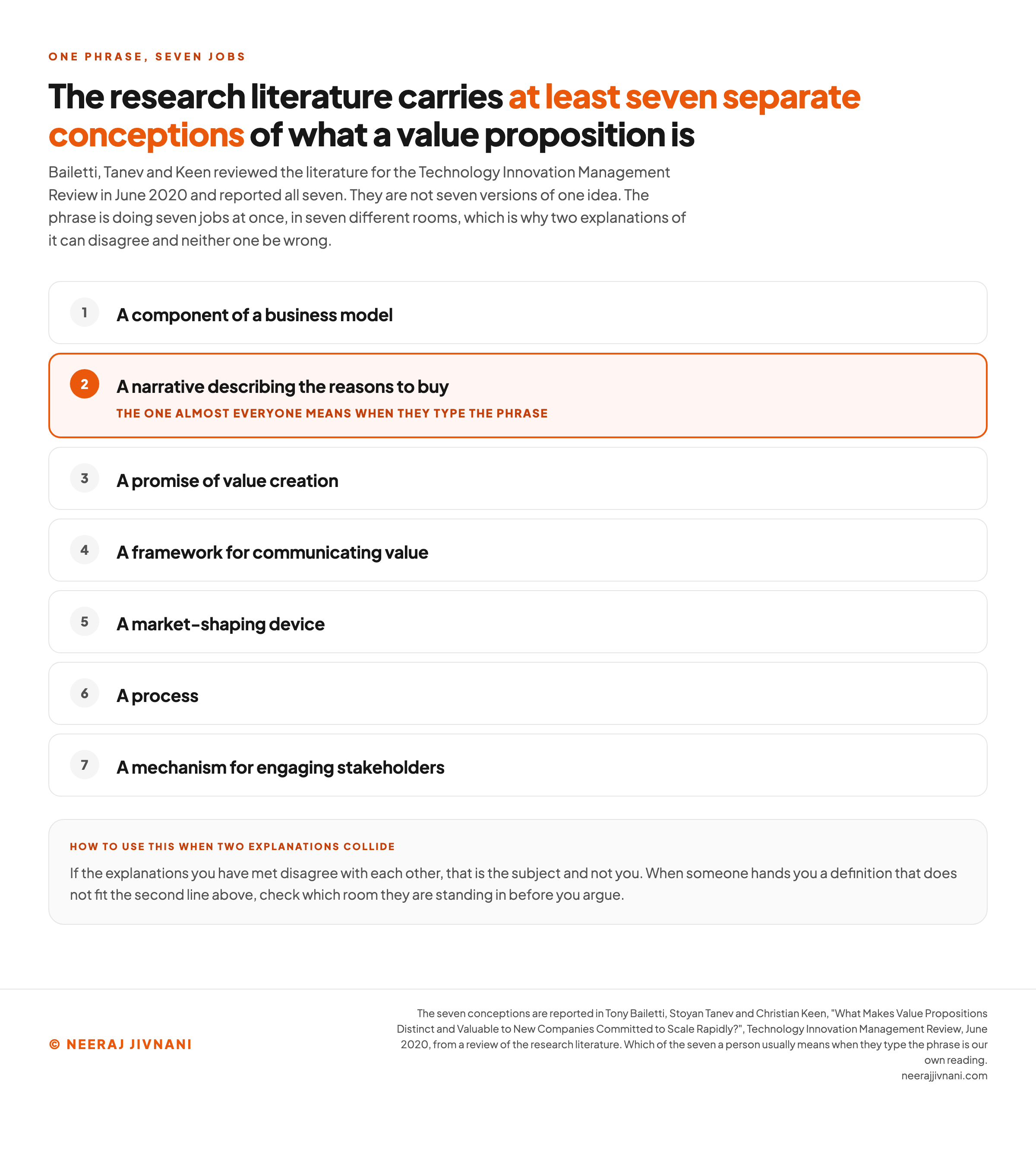
At least seven separate conceptions of a value proposition sit in the research literature, reported by Bailetti, Tanev and Keen in the Technology Innovation Management Review in June 2020.
Among them: a component of a business model, a narrative describing the reasons to buy, a promise of value creation, a framework for communicating value, a market-shaping device, a process, and a mechanism for engaging stakeholders.
So the phrase is doing seven jobs at once, in seven different rooms.
The one almost everyone means when they type it is the second on that list, the narrative that gives a customer a reason to buy.
That is the sense in use here. If someone hands you a definition that does not fit it, check which room they are standing in before you argue.
Use this chart — embed code and citation
<a href="https://neerajjivnani.com/blog/value-proposition/"><img src="https://neerajjivnani.com/infographics/value-proposition/seven-meanings-one-phrase.png" alt="Numbered list of the seven conceptions of a value proposition reported in the research literature: a component of a business model, a narrative describing the reasons to buy, a promise of value creation, a framework for communicating value, a market-shaping device, a process, and a mechanism for engaging stakeholders. The second is marked in orange as the one almost everyone means when they type the phrase, and a panel underneath says that when two explanations disagree the subject is the cause rather than the reader, so check which of the seven a definition was written for before arguing with it." width="1200"></a>
<p>Chart: <a href="https://neerajjivnani.com/blog/value-proposition/">Neeraj Jivnani</a></p>Neeraj Jivnani, "What a Value Proposition Is, and Why Most of Them Would Fit a Competitor", neerajjivnani.com, https://neerajjivnani.com/blog/value-proposition/Free to republish with a link back to this page.
The Test That Tells You Whether Yours Is Real
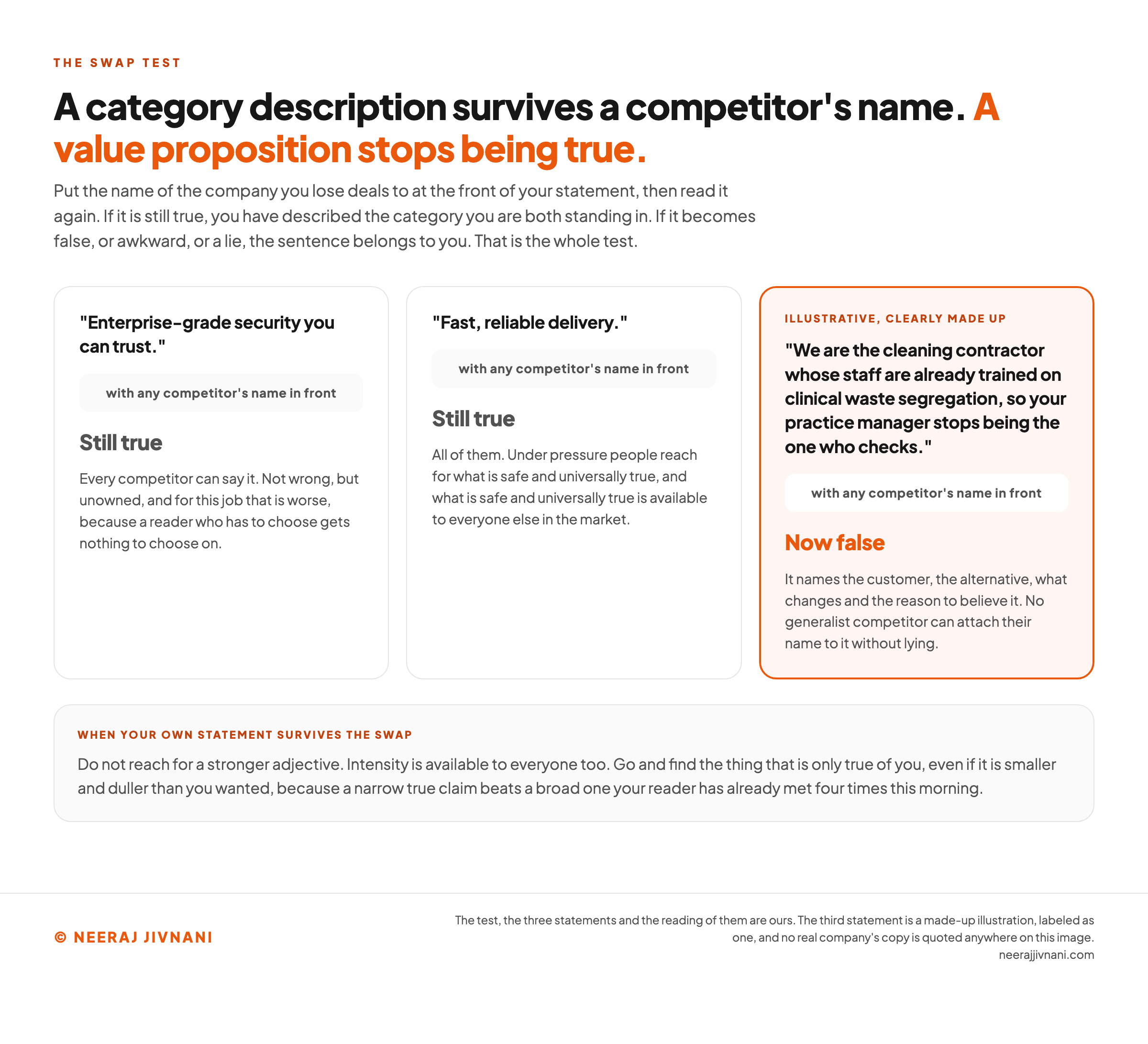
Use the company you lose deals to most often, not the market leader. Put their name at the front of your statement and read it again.
If it is still true, you have described the category. If it becomes false, or awkward, or a lie, you have a value proposition.
That is the whole test, and it is quick enough to run on a sentence before you have finished reading it. What it settles is whether your statement belongs to you or to the category.
It works because it catches the one failure this kind of writing keeps producing. Under pressure, people reach for what is safe and universally true.
What is safe and universally true is also available to everyone else in the market.
"Enterprise-grade security you can trust." Every competitor can say it. "Fast, reliable delivery." All of them.
Those sentences are not wrong. They are unowned, which for this job is worse, because a reader who has to choose gets nothing to choose on.
What to Do When It Fails
Do not reach for a stronger adjective.
That is the reflex, and it makes the sentence worse, because intensity is available to everyone too.
Go and find the thing that is only true of you, even if it is smaller and duller than you wanted.
A narrow true claim beats a broad one your reader has already met four times this morning.
If nothing is only true of you, the problem is not the sentence. It is the business, and no amount of writing fixes that.
Use this chart — embed code and citation
<a href="https://neerajjivnani.com/blog/value-proposition/"><img src="https://neerajjivnani.com/infographics/value-proposition/what-survives-the-swap.png" alt="Three statements set side by side and run through the swap test, each shown with any competitor's name put in front of it. Enterprise-grade security you can trust is still true afterward, so it describes the category and every competitor can say it. Fast, reliable delivery is still true afterward, because what is safe and universally true is available to everyone else in the market. A made-up illustration about a cleaning contractor whose staff are trained on clinical waste segregation becomes false afterward, because it names the customer, the alternative, what changes and the reason to believe it. A band across the foot says that when your own statement survives the swap the answer is not a stronger adjective but the thing that is only true of you." width="1200"></a>
<p>Chart: <a href="https://neerajjivnani.com/blog/value-proposition/">Neeraj Jivnani</a></p>Neeraj Jivnani, "What a Value Proposition Is, and Why Most of Them Would Fit a Competitor", neerajjivnani.com, https://neerajjivnani.com/blog/value-proposition/Free to republish with a link back to this page.
Value Proposition, USP, Tagline, Mission: Which Is Which
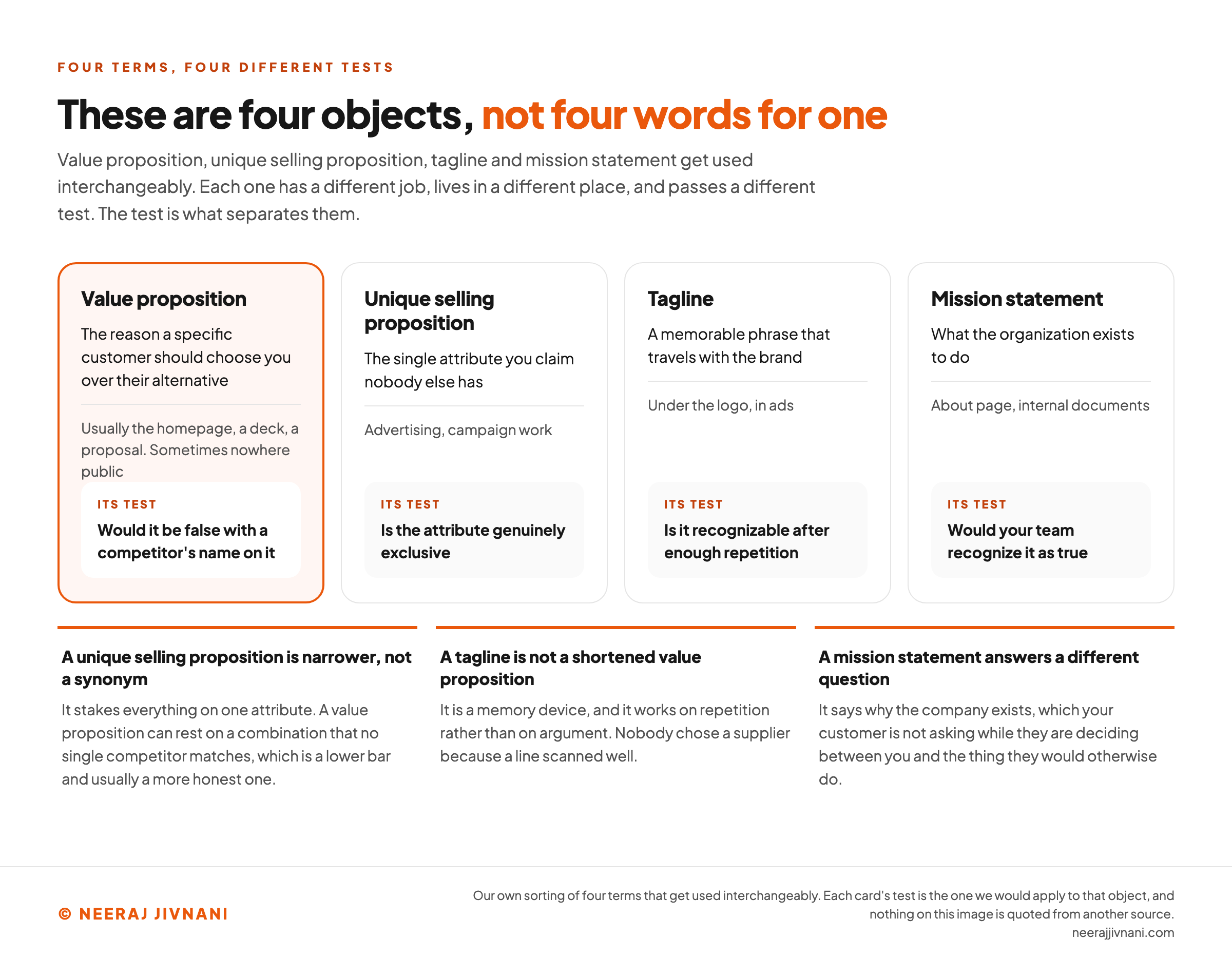
Four terms get used interchangeably here, and they are not the same object.
Each one has a different job, lives in a different place, and passes a different test. Here is what each is for.
| The term | What it is | Where it lives | The test it has to pass |
|---|---|---|---|
| Value proposition | The reason a specific customer should choose you over their alternative | Usually the homepage, a deck, a proposal; sometimes nowhere public | Would it be false with a competitor's name on it |
| Unique selling proposition (USP) | The single attribute you claim nobody else has | Advertising, campaign work | Is the attribute genuinely exclusive |
| Tagline | A memorable phrase that travels with the brand | Under the logo, in ads | Is it recognizable after enough repetition |
| Mission statement | What the organization exists to do | About page, internal documents | Would your team recognize it as true |
Why the Four Get Confused
A unique selling proposition is narrower than a value proposition, not a synonym for it. It stakes everything on one attribute.
A value proposition can rest on a combination that no single competitor matches. That is a lower bar and usually a more honest one.
A tagline is not a shortened value proposition. It is a memory device, and it works on repetition rather than on argument.
Nobody chose a supplier because a line scanned well.
Mission statements answer why the company exists, which your customer is not asking while deciding.
Use this chart — embed code and citation
<a href="https://neerajjivnani.com/blog/value-proposition/"><img src="https://neerajjivnani.com/infographics/value-proposition/four-terms-four-tests.png" alt="Four cards comparing value proposition, unique selling proposition, tagline and mission statement, each with what it is, where it lives and the test it has to pass. A value proposition is the reason a specific customer should choose you over their alternative, usually on the homepage, a deck or a proposal, and its test is whether it would be false with a competitor's name on it. A unique selling proposition is the single attribute you claim no rival has, used in advertising and campaign work, and its test is whether the attribute is genuinely exclusive. A tagline is a memorable phrase under the logo, tested by whether it is recognizable after enough repetition. A mission statement is what the organization exists to do, on the about page, tested by whether your team would recognize it as true. Three notes underneath explain why the four get confused." width="1200"></a>
<p>Chart: <a href="https://neerajjivnani.com/blog/value-proposition/">Neeraj Jivnani</a></p>Neeraj Jivnani, "What a Value Proposition Is, and Why Most of Them Would Fit a Competitor", neerajjivnani.com, https://neerajjivnani.com/blog/value-proposition/Free to republish with a link back to this page.
The Four Things It Has to Contain
You may have been told there are five key parts to a value proposition. There is no canonical five.
Different frameworks break it into different numbers of parts.
We use four things, and the number is not the point.
The point is that all four have to be answerable.
- One customer, named narrowly. Not "businesses" and not "teams". A category you could hand to a stranger and have them recognize a member of it on sight.
- What changes for them. Stated as an outcome in their life, not a feature in your product. The gap between those two is where most drafts die.
- The alternative you expect to beat. A named competitor, a spreadsheet, an in-house hire, or doing nothing. Doing nothing is the most common one and the most often forgotten.
- A reason to believe it. A number, a mechanism, a guarantee, a demonstration. This one is not a fourth claim, it is what holds the other three up, and a claim with nothing under it reads as a claim.
The Benefit Clause Is the One That Fights Back
Everyone has heard that you should lead with benefits rather than features. The rule is easy to repeat and hard to apply, and the reason is worth knowing.
You cannot say what a benefit is worth without saying what it is better than.
Saving four hours a week means nothing on its own. It means something against the four hours your customer spends today.
Which is why the alternative has to be decided before the benefit can be written, and not after.
How to Write Yours, Starting With the Alternative
The comparison usually arrives last. Here it comes first.
You cannot say what changes for someone until you know what they are changing from, and you cannot claim a difference until you know what you are different to.
Five steps below. The first one is not writing.
Start With What They Do Today
Before anything else, write down what your customer does right now instead of buying from you.
This is a fact about them, not a judgment call for you. So go and ask.
Ten customers, one question: "What were you doing about this before you found us?"
The answers are frequently not competitors. They are a spreadsheet, an intern, a workaround somebody built in 2019, or nothing at all.
That answer sets the bar the rest of the sentence has to clear.
Write Down What It Costs Them
Take the alternative you named and write what it costs the person using it. Hours, money, errors, risk, or the deals they lose while it runs.
Be specific enough to be wrong.
"Inefficiency" is not a cost. "Two quotes a week go out with last year's prices on them" is a cost, and it is checkable.
Say What Changes
Now write what is different once they use you instead. One sentence, in their words, about their week.
If you cannot say what changes without describing how your product works, you do not have it yet.
Go back to the cost and start again from there.
Say Why You and Not the Other Thing
The differentiation clause is what the swap test is hunting for, and it is the one a draft most often leaves implied.
Name the thing about your offer that the alternative structurally cannot copy. Not "better service", which anyone can assert, but the reason the assertion is true.
How you are built, where you specialize, what you refuse to do, or what you have that took years to accumulate.
Narrow is fine here. Narrow is usually the only honest answer.
The four decisions, in the order they happen
The comparison is not the last decision here, it is the first, because every other one in the sentence depends on it. Each box below stays shut until the box it depends on has an answer in it.
The alternative
This is a fact about them, not a judgment call for you, so go and ask. Ten customers, one question: "What were you doing about this before you found us?"
What it costs them
What does that alternative cost the person using it?
Name the alternative first. That answer sets the bar the rest of the sentence has to clear.
What changes
What is different once they use you instead?
Write the cost first. You cannot say what changes for someone until you know what they are changing from.
Why you
Why you and not the other thing?
Say what changes first. You cannot claim a difference until you know what you are different to.
0 of 4 decided
The first one is not writing. It is a fact about your customer that you go and collect, and the three below it are waiting on it.
Cut It to One Sentence, Then Test It
Assemble the four parts and cut until one sentence carries them. Two is acceptable, and three means a decision has not been made yet.
Then run the swap test.
Then hand it to a customer rather than a colleague, and ask them what it means. Colleagues fill in context that a stranger does not have.
The Templates, and What They Can and Cannot Do
A template arranges an answer you already have. It does not produce one, and no template ever will.
Reaching for a template before the work above is done is how people end up with a grammatically perfect sentence that says nothing.
The most durable template is a single line: "We help X do Y by doing Z." Steve Blank called it a good format in a September 2011 guide to building a web startup.
It survives because of Z. X and Y are the customer and the outcome, which most drafts manage, and Z forces you to name the mechanism.
Naming the mechanism is where a claim either becomes specific or falls apart.
Longer templates exist, and the useful ones end on the comparison. Any template whose last clause is the benefit will let you skip the part that makes the sentence yours.
Use one if the blank page is the problem. Throw it away as soon as the sentence stands up on its own, because the shape of a template is visible in finished copy and readers can feel it.
The Value Proposition Canvas, and What It Can Actually Do
You are going to run into the Value Proposition Canvas, so it helps to know what it is before somebody puts it in front of you in a workshop.
It is a commercial tool built and sold by Strategyzer, with books, licenses and training courses behind it.
Strategyzer maps six blocks in two halves.
On the customer's side: their jobs, their pains and their gains. On yours: your products and services, your pain relievers and your gain creators.
The work is checking whether the second half answers the first.
It is genuinely useful for a team that needs a shared vocabulary and a wall to argue at. It is heavier than a single sentence needs.
Filling it in is the beginning of the work.
Strategyzer's page, dated February 2025, says that using the canvas as a thinking and design tool "is only a start", and that "To get the best out of it, you need to combine it with testing and pivoting."
The canvas has a bigger reputation than its own publisher claims for it.
A canvas organizes what you know. It cannot tell you whether what you know is true, and it will happily accept a customer profile you invented in a meeting.
The Famous Examples, and Why They Are the Wrong Model
The two questions people ask most here are what Nike's value proposition is and what McDonald's is.
Both are the same question underneath. What do the famous ones say, and can you do that.
The honest answer is no, and running the test says why.
Take the public line of any company whose logo you could draw from memory and put a rival's name in front of it. It survives, almost every time.
That is not a failure of their copy. It is what a line looks like when the logo does the persuading and the sentence is only along for the ride.
You can still learn from examples. Grade them on the right thing.
The ones that fail the swap, the ones that would fit any competitor, are running on recognition.
The ones that pass have something to teach you. They are often companies small enough that vagueness costs them the sale.
One Worked Example, Clearly Made Up
Say you run a commercial cleaning company that works only on medical clinics.
"Professional cleaning services you can rely on" fails immediately. Any cleaning company can say it.
Now try this. "We are the cleaning contractor whose staff are already trained on clinical waste segregation, so your practice manager stops being the one who checks."
That does not survive a swap. It names the customer, the alternative, what changes and the reason to believe it, and no generalist competitor can attach their name to it without lying.
It is longer than a tagline. It is not competing with taglines.
Where the Sentence Actually Goes
Once it exists and you have decided to publish it, put it where the decision is made rather than where there is space.
- The top of your homepage, above anything a visitor has to scroll for. This is the one place it is genuinely load-bearing.
- The first slide of a proposal, because a proposal gets read by people who were not in the meeting.
- The first line of a sales conversation, where you will find out fastest whether it works.
- Your job posts, where it does an unexpected amount of work by filtering for people who want that particular problem.
It does not have to be word for word identical everywhere, and insisting that it is produces stiff copy.
What has to be identical is the claim underneath. If the homepage promises one thing and the sales call promises another, you have two propositions and a trust problem.
How You Know It Is Working
You will know it is working when prospects start repeating it back to you unprompted.
An experiment on the headline answers this too, if you have the traffic to reach significance, which a business writing its first statement rarely does.
Four things tell you whether the sentence is working, and you can read all four this week.
- What prospects repeat back. If people describe you in your own words without being prompted, the sentence has landed. If they describe you as the category, it has not.
- What sales gets asked after the pitch. A good proposition removes a specific question. If the same question keeps arriving, the sentence is not answering it.
- Who you stop hearing from. A sharp proposition loses you the wrong prospects. Fewer bad-fit inquiries is a result, not a problem.
- Whether your own team can say it. Ask four colleagues separately, not to judge the wording but to see whether the same sentence comes back. Four different answers means the decision was never made.
None of these are precise. They are available now, which is the whole advantage.
What Would Have to Change Before the Sentence Does
A value proposition is not on a review cycle. It changes when the thing it is a claim about changes.
Rewrite it when the alternative moves. A competitor closes the gap you were standing in, a new option appears, or the workaround your customers were using stops being painful.
Rewrite it when you find you are selling to a different customer than the one it names, which happens more often than anyone plans for.
If neither the alternative nor the customer has moved, nothing has changed about the sentence.
One last thing, and it is what separates a proposition from a promise. You have to be able to deliver the choice you described.
A sentence that survives the swap test and then does not survive contact with the customer is not a writing problem. It is a delivery problem, and you fix it by changing what you deliver or by narrowing what you claim.
Name one customer, name what they would do instead, say what changes and why you, then check that a competitor could not sign their name to it. If they could, you have not finished.