What Market Research Is, How to Do It Yourself, and How Far to Trust the Answer
Find out what your customers do, not what they say, using free published data and a few good conversations, and know when to trust the answer.


/ On this page14 sections
Most of what you want to know about your customers is already published, free, and findable in an afternoon.
The rest you get by talking to a small number of the right people, and by paying attention to what they do rather than what they say.
The hard part is neither of those.
It is knowing how far a handful of answers can be stretched before they stop being evidence. So this covers where to look first, how to ask, and when what you got back is solid enough to act on.
What Market Research Is
Market research means learning what a group of people want, what they already do, and what they would pay for, so that you can decide something with less guessing than before.
That is the definition, and the mechanic underneath it matters more.
You are never going to ask everyone.
You ask a few, then treat what they said as though it stands for the many you did not ask. Everything that makes research useful or worthless happens in that one step.
So the question running through the whole exercise is not "what did they say". It is "who did I hear from, and who does that let me speak for".
Market Research and Marketing Research
The two phrases get used interchangeably, and in ordinary use they do mean the same thing.
Where a distinction is drawn, market research is about the market: the people, the demand, the size, the competition. Marketing research is wider, and takes in how your own marketing performs as well.
You do not need to police the difference. Notice only that the two labels get swapped, so check which one you are reading.
Why It Is Worth Doing, and When It Is Not
Research is worth doing when it stops you making a decision blind, and the size of the decision is what pays for it.
Four questions carry a real bill when you get them wrong.
Does anyone want this? Getting that wrong costs you the whole build, and it is the cheapest of the four to check.
Who is the customer? Teams routinely discover, a year in, that the people buying are not the people they designed for, and every message written in between was aimed at the wrong person.
What should it cost? Price is the one number that changes revenue immediately in both directions.
Which version? Two plausible designs, one budget, and no way to build both.
Research is the wrong tool when the answer will not change what you do. If you would go ahead either way, you are buying reassurance, and reassurance is expensive.
It is also the wrong tool when a cheap test would settle the matter faster. Asking forty people whether they would click a headline is slower and weaker than running the headline as an A/B test and counting the clicks.
And it is the wrong tool for questions nobody can answer accurately about themselves. That includes almost every question beginning "how much would you pay", which is why a pricing decision gets researched by watching what people pay rather than by asking them.
Start With What Somebody Has Already Published
Almost everyone starts by writing a survey. Start here instead.
Secondary research means using data somebody else collected and published. It is free, it is immediate, and it will often answer half of what you wanted to know before you speak to a single person.
It makes the primary work better too. You stop spending scarce conversations on facts you could have looked up.
The Free Sources, By Name
Government statistics agencies publish population, income, spending and business counts, broken down small enough to describe a single town. In the United States that is the Census Bureau, and most countries run an equivalent.
Trade associations publish industry surveys.
Regulators publish filings, and public companies publish annual reports that describe their own markets in detail, because they are obliged to describe them accurately.
Search data tells you what people typed, which is a record of what they wanted rather than what they told a researcher they wanted.
Your own records count as secondary data, and they are the most underused source on this list. Sales history, support tickets, cancellations and site search logs are all evidence you already own and have never read as research.
What Competitors Tell You About the Market
A competitor's public behavior is a cheap read on demand.
What they charge, what they quietly stopped selling, and what they keep buying ads for all say something about what the market is rewarding.
Read it as a signal about the market rather than a verdict on them. That they raised prices and stayed in business is a fact about customers, not about their pricing team.
Where Published Data Runs Out
Published data describes what has already happened to somebody else. It cannot tell you what your particular customers make of your particular idea.
It is also aggregated, so it hides the narrow segment you might serve. And it ages, which bites hardest on exactly the topics that move.
When you reach a question the published record cannot settle, that is the signal to go and ask.
Going and Asking People Yourself
Primary research is any research where you collect the data yourself. You pick the people, you write the questions, and you own what comes out.
That control is the point. It is also the risk, because every choice you make is a way for the answer to bend.
What follows is the four ways of asking, then the three decisions that determine whether any of them works.
Qualitative and Quantitative, and Why the Order Matters
Qualitative research gives you words: interviews, group discussions, open questions, watching somebody use a thing. It tells you what is going on and why.
Quantitative research gives you counts: how many, how often, what share. It tells you how common something is.
Do them in that order.
You cannot write a good multiple-choice question about a topic you do not yet understand, because you will leave out the option most people would have chosen.
A handful of conversations will usually hand you both the vocabulary and the list of options, and then the survey is worth writing.
The Ways of Asking, and What Each One Is Good For
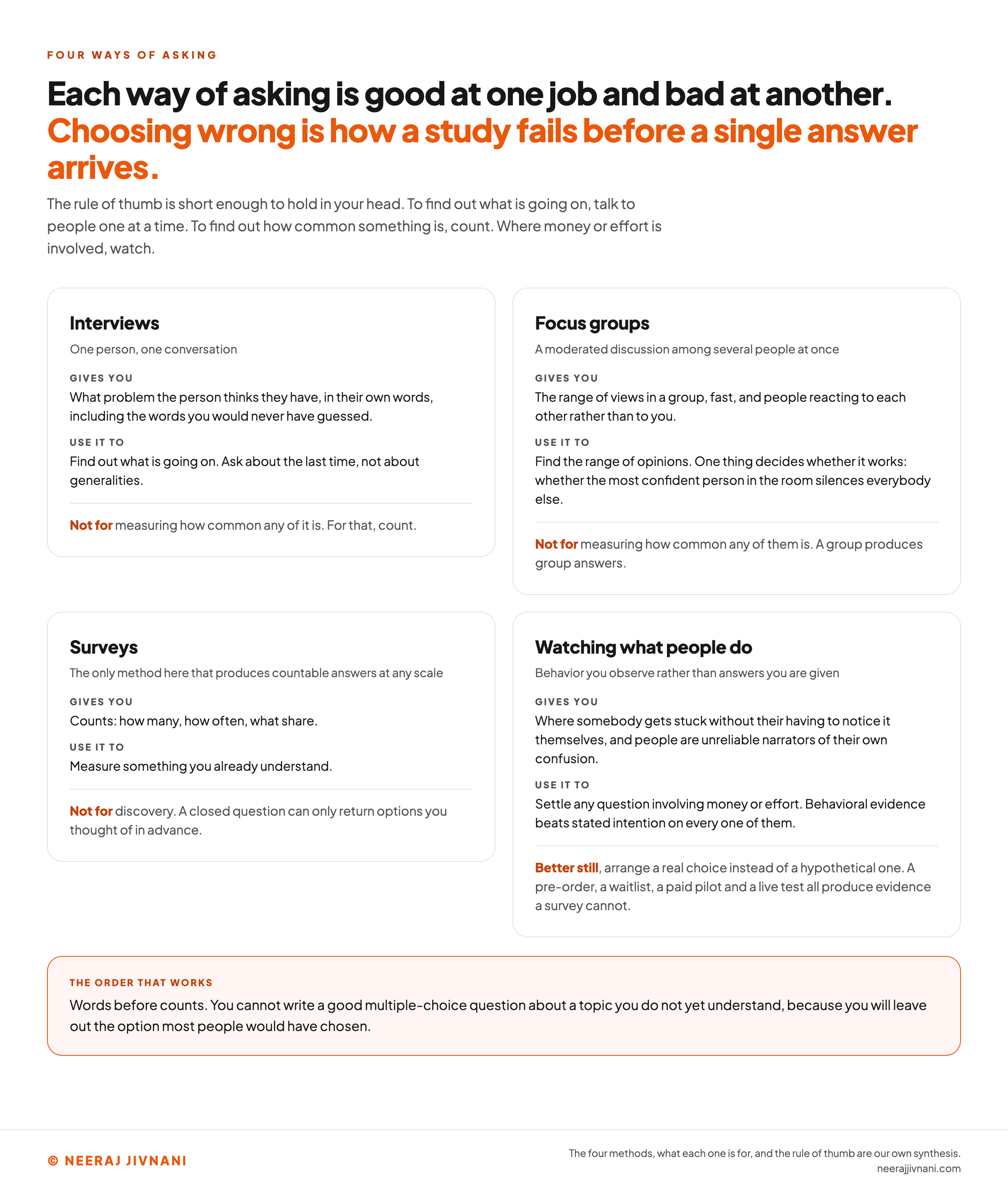
Four ways of asking cover nearly everything a small team will do: interviews, focus groups, surveys, and watching what people do.
Each is good at one job and bad at another, and choosing wrong is the most common way a study fails before a single answer arrives.
The rule of thumb is short enough to hold in your head.
To find out what is going on, talk to people one at a time. To find out how common something is, count. Where money or effort is involved, watch.
Interviews
One person, one conversation. This is the highest-value hour in research and the one people skip because it feels unscientific.
It is where you learn what problem the person thinks they have, in their own words, including the words you would never have guessed.
Ask about the last time, not about generalities. "Tell me about the last time you needed this" produces a story with real detail in it. "What do you usually look for" produces a policy the person invented while you waited.
Focus Groups
A moderated discussion among several people at once. It is fast for surfacing the range of views in a group, and for hearing people react to each other rather than to you.
One thing decides whether it works: whether the most confident person in the room silences everybody else.
A group produces group answers. Keeping that from happening is the whole of the moderator's job, and it is why running your own is harder than it looks.
Use the format to find the range of opinions. Do not use it to measure how common any of them is.
Surveys
A survey is the only method here that produces countable answers at any scale, and it is the easiest to get wrong, because writing one feels easy.
Surveys are good at measuring something you already understand. They are poor at discovery, because a closed question can only return options you thought of in advance.
Question wording is the difference between a survey that measures an opinion and one that manufactures it.
Watching What People Do
Behavioral evidence beats stated intention on every question involving money or effort.
Watching somebody try to finish a task shows you where they get stuck without their having to notice it themselves, and people are unreliable narrators of their own confusion.
You already hold some of this. Site analytics, abandoned carts, which help article gets opened, which feature nobody touches.
Where you can arrange a real choice instead of a hypothetical one, do that. A pre-order, a waitlist, a paid pilot and a live test all produce evidence a survey cannot.
Use this chart — embed code and citation
<a href="https://neerajjivnani.com/blog/market-research/"><img src="https://neerajjivnani.com/infographics/market-research/what-each-way-of-asking-gives-you.png" alt="Four cards comparing the four ways of asking. Interviews, one person and one conversation, give you what problem the person thinks they have in their own words, are for finding out what is going on, and are not for measuring how common it is. Focus groups, a moderated discussion among several people at once, give you the range of views fast and people reacting to each other, turn on whether the most confident person in the room silences everybody else, and are not for measuring how common any view is. Surveys, the only method that produces countable answers at any scale, give you counts of how many and how often, are for measuring something you already understand, and are not for discovery, because a closed question can only return options you thought of in advance. Watching what people do gives you where somebody gets stuck without their having to notice it themselves, settles any question involving money or effort, and is better still when you can arrange a real choice such as a pre-order, a waitlist, a paid pilot or a live test. A band across the foot says words come before counts." width="1200"></a>
<p>Chart: <a href="https://neerajjivnani.com/blog/market-research/">Neeraj Jivnani</a></p>Neeraj Jivnani, "What Market Research Is, How to Do It Yourself, and How Far to Trust the Answer", neerajjivnani.com, https://neerajjivnani.com/blog/market-research/Free to republish with a link back to this page.
Setting Up a Piece of Research That Can Answer Something
Three things are settled before you write a single question. What are you deciding, who counts as your market, and what will you put in front of them.
Get those right and a rough study still tells you something. Get them wrong and a beautifully executed one tells you nothing.
They are also the three that no tool prompts you for, which is why they are the three that get skipped.
Name the Decision Before You Write a Question
Write down the decision in front of you, then write down what you would do under each plausible answer.
If both branches lead to the same action, stop. The research cannot pay for itself, because nothing hangs on the result.
Four more questions decide whether the study is worth running at all.
Are the objectives unambiguous and specific? Have other surveys already collected the data?
Would a different method suit the question better? And is a survey on its own enough, or will you need other kinds of data as well?
Those four are not our invention. The March 2022 guidance from the American Association for Public Opinion Research (AAPOR) asks researchers to consider exactly these before committing to a survey.
A survey written to confirm something is not research with a bias problem. It is not research.
AAPOR's guidance puts that as a prohibition: surveys "should not be used to produce predetermined results, campaigning, fundraising, or selling", and doing so violates its code of ethics.
Decide Who Counts as Your Market
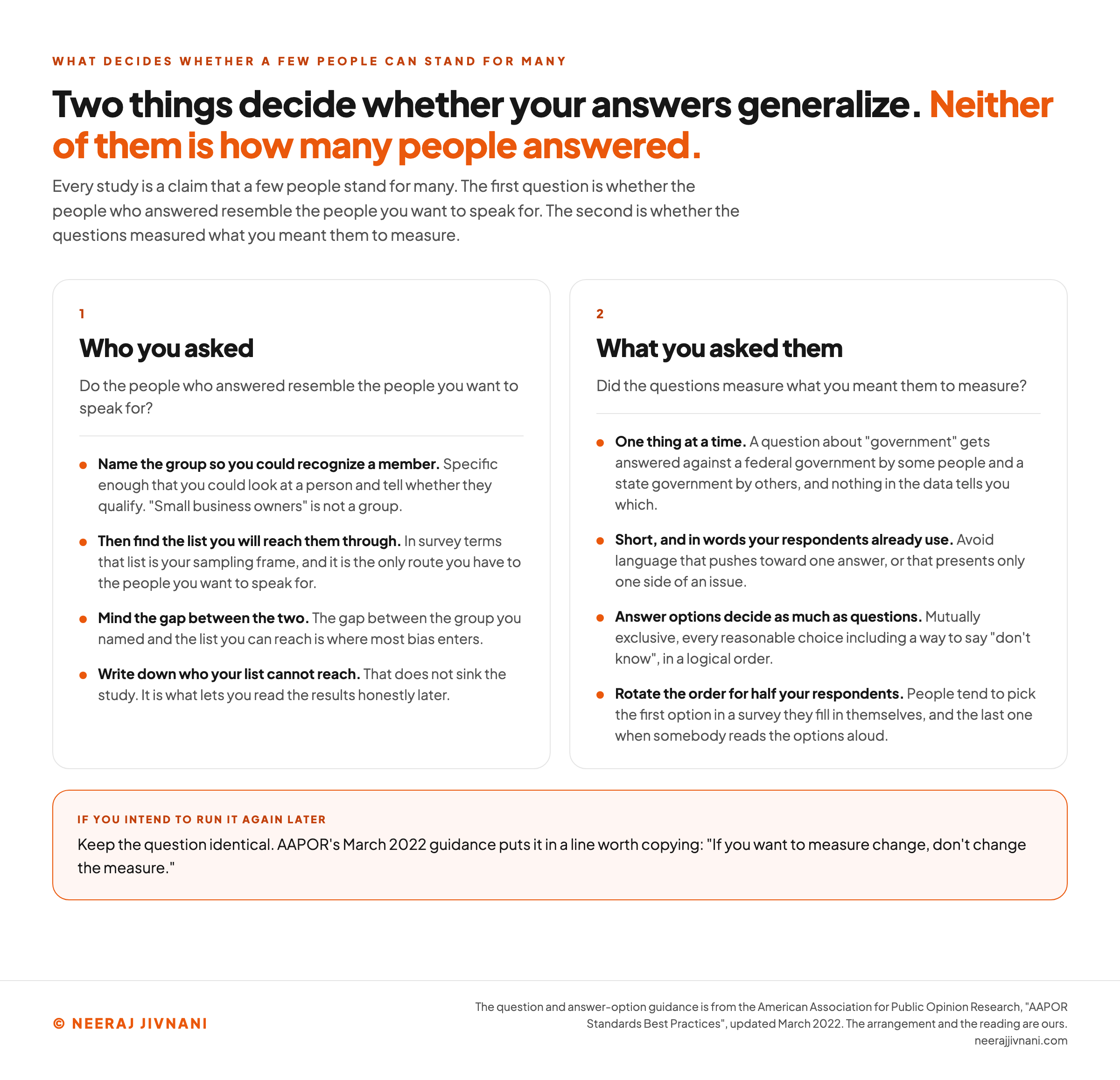
Before you can ask a group anything, you have to say who counts as your market, and this is the decision that most often ruins an otherwise careful study.
Be specific enough that you could look at a person and tell whether they qualify. "Small business owners" is not a group. "Owners of independent restaurants with under twenty staff who changed suppliers in the past year" is.
Then find the list you will reach them through.
In survey terms that list is your sampling frame. It is the only route you have to the people you want to speak for, which makes it quietly decisive.
The gap between the group you named and the list you can reach is where most bias enters. If your list is your email subscribers, you are studying people who already like you, whatever question you put to them.
That does not sink the study, and it is no argument for skipping the work. Write down who your list cannot reach, so that you remember it when you read the results.
Who that lets you speak for
The question running through the whole exercise is not what they said. It is who you heard from, and who that lets you speak for. Set the three choices behind a study you are planning, or one you have already run. The answers you collect never change. What you are allowed to conclude from them does.
1. Who you named as your market
2. The list you will reach them through
3. What you put in front of them
This starts on a survey, because almost everyone starts by writing one.
What this study lets you say
What this way of asking gives you
You will get counts: how many, how often, what share. A survey is good at measuring something you already understand and poor at discovery, because a closed question can only return options you thought of in advance.
And the order
You are about to write a multiple-choice question about a topic you do not yet understand, so you will leave out the option most people would have chosen. A handful of conversations will usually hand you both the vocabulary and the list of options, and then the survey is worth writing.
Still to set: who counts as your market, and the list you will reach them through. These are two of the three things settled before you write a single question, and they are the two that no tool prompts you for.
Nothing here is scored. Every line above is this post’s own position, read back against the three choices you made.
Writing Questions That Do Not Lead
Write questions that could plausibly return an answer you would not like, and you have done most of the job. A question can decide its own answer, and it usually does so without anybody in the room noticing.
Ask about one thing at a time.
A question about "government" gets answered against a federal government by some people and a state government by others, and nothing in the data tells you which.
Keep questions short, and use words your respondents already use. Avoid language that pushes toward one answer, or that presents only one side of an issue.
Two habits work against you the whole time. People drift toward the answer they think is socially acceptable, and they drift toward agreeing, sometimes to be pleasant to whoever is asking.
Say you are testing a price. "Would you pay more for faster delivery?" is a question almost nobody answers no to, because it costs nothing to say yes. "The last time you paid extra for faster delivery, what were you buying?" cannot be answered by a person who never has.
The second one can come back empty, and that is what makes it worth asking.
Answer Options Decide As Much As Questions
Watch your answer options as hard as the questions themselves.
No two options should overlap, every reasonable answer needs somewhere to go including "I don't know", and the order should follow something a respondent could predict.
Order matters too. People pick the first option in a survey they fill in themselves, and the last one when somebody reads the options aloud, a tendency AAPOR's March 2022 guidance records.
Rotating the order for half your respondents is how you find out whether it happened to you.
And if you intend to repeat the study later, keep the question identical. AAPOR's guidance puts it in a line worth copying: "If you want to measure change, don't change the measure."
Use this chart — embed code and citation
<a href="https://neerajjivnani.com/blog/market-research/"><img src="https://neerajjivnani.com/infographics/market-research/who-you-asked-and-what-you-asked.png" alt="Two columns setting out what decides whether a few people can stand for many. The first, who you asked, tests whether the people who answered resemble the people you want to speak for: name the group specifically enough that you could tell whether a person qualifies, then find the sampling frame you will reach them through, mind the gap between the two where most bias enters, and write down who your list cannot reach. The second, what you asked them, tests whether the questions measured what you meant them to measure: one thing at a time, short and in words respondents already use, answer options that are mutually exclusive and include a way to say don't know, and rotating the option order for half your respondents. A band across the foot quotes AAPOR, that if you want to measure change you should not change the measure." width="1200"></a>
<p>Chart: <a href="https://neerajjivnani.com/blog/market-research/">Neeraj Jivnani</a></p>Neeraj Jivnani, "What Market Research Is, How to Do It Yourself, and How Far to Trust the Answer", neerajjivnani.com, https://neerajjivnani.com/blog/market-research/Free to republish with a link back to this page.
How Many People You Need to Ask
There is no honest single number, and the ones in circulation are answers to a question you are probably not asking.
You will be told there is a minimum number of respondents below which a survey does not count, and a right number of people for a focus group. Those rules almost never arrive with the condition that makes them true.
What the Margin of Error Assumes
Start with what those numbers are answering. The margin of sampling error describes how far your result might sit from the answer you would have got by asking everybody, and it holds under one condition only.
It applies to probability-based surveys, where every person in the population has a known and non-zero chance of being picked. In AAPOR's own words, it "does not apply to opt-in online surveys and other non-probability based polls."
If you posted a link, emailed your list, or bought responses from a panel, you have an opt-in sample. The plus-or-minus figure a calculator hands you is not measuring your survey.
What a Bigger Sample Buys You
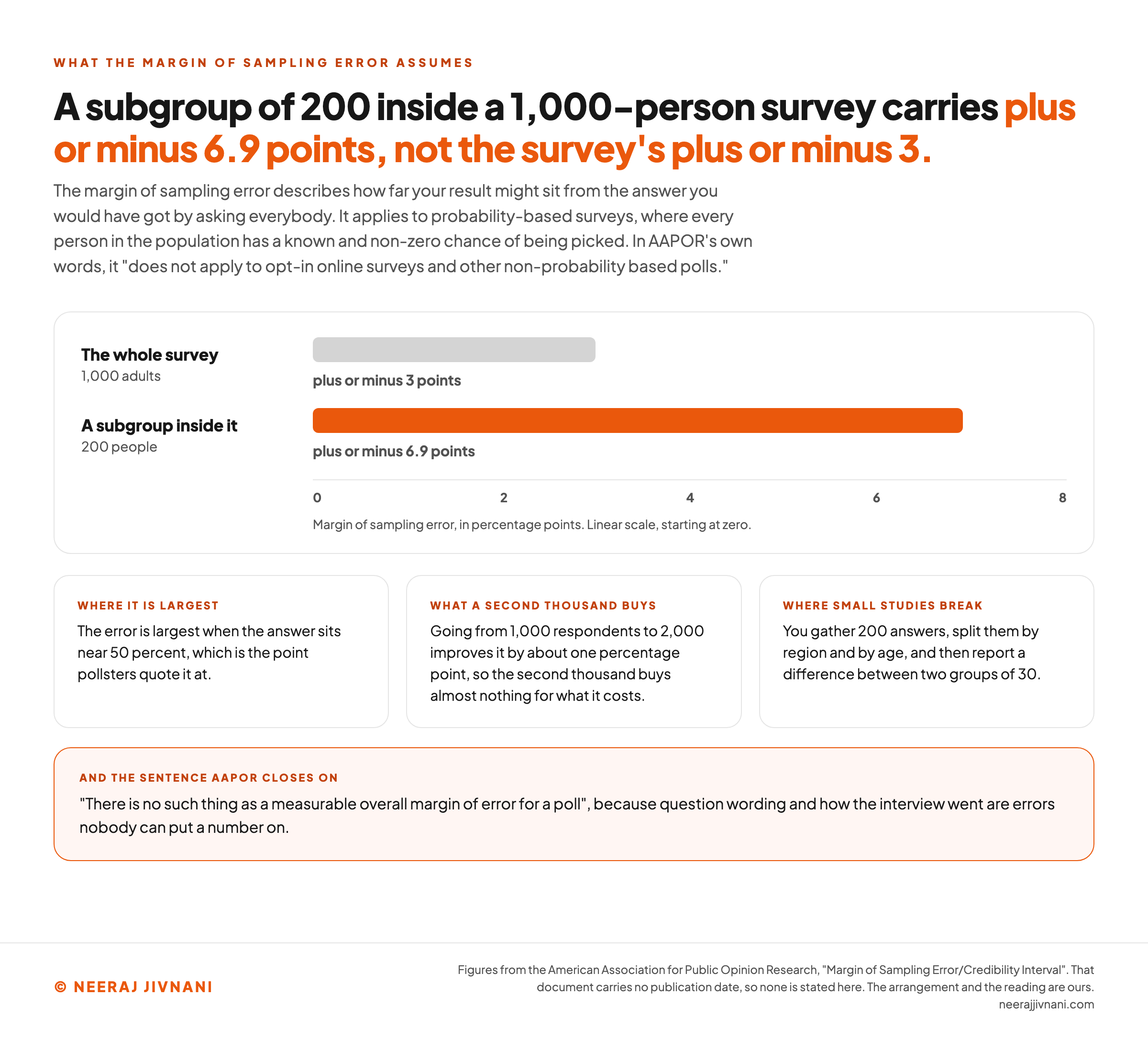
The error is largest when the answer sits near 50 percent, which is the point pollsters quote it at.
Going from 1,000 respondents to 2,000 improves it by about one percentage point, so the second thousand buys almost nothing for what it costs.
And a subgroup carries its own error, not the survey's.
In a survey of 1,000 adults with an overall margin of plus or minus 3 percentage points, a subgroup of 200 people inside it carries plus or minus 6.9 points, which is the figure for a sample of 200.
That last one is where small studies quietly break. You gather 200 answers, split them by region and by age, and then report a difference between two groups of 30.
And that plus-or-minus figure never covered everything anyway. Question wording and how the interview went produce errors nobody can put a number on.
AAPOR says it plainly: "There is no such thing as a measurable overall margin of error for a poll." That sentence belongs on the front of every survey tool.
What to Spend the Effort On Instead
So here is our position.
Stop treating sample size as the thing that makes a study credible, because for the way you are going to collect answers it mostly is not.
A round number gives a false sense of precision to a sample that was never random in the first place.
Spend the effort on the two things that decide whether your inference holds.
The first is whether the people who answered resemble the people you want to speak for. The second is whether the questions measured what you meant them to measure.
Then say plainly how you collected the answers and let the reader weigh it. A study of twelve people, honestly described, is worth more than a thousand responses presented as though they were a poll.
Use this chart — embed code and citation
<a href="https://neerajjivnani.com/blog/market-research/"><img src="https://neerajjivnani.com/infographics/market-research/a-subgroup-carries-its-own-error.png" alt="Bar chart of the margin of sampling error on one survey, drawn on a linear scale running from zero to eight percentage points. The whole survey of 1,000 adults carries plus or minus 3 points; a subgroup of 200 people inside that same survey carries plus or minus 6.9 points, a bar more than twice as long. Three cards underneath say the error is largest when the answer sits near 50 percent, that going from 1,000 respondents to 2,000 improves it by about one percentage point, and that small studies break when 200 answers are split by region and by age into groups of 30. A band across the foot quotes AAPOR, that there is no such thing as a measurable overall margin of error for a poll." width="1200"></a>
<p>Chart: <a href="https://neerajjivnani.com/blog/market-research/">Neeraj Jivnani</a></p>Neeraj Jivnani, "What Market Research Is, How to Do It Yourself, and How Far to Trust the Answer", neerajjivnani.com, https://neerajjivnani.com/blog/market-research/Free to republish with a link back to this page.
Reading the Results Without Fooling Yourself
Read the results against the decision you wrote down at the start. Not against what you hoped for, and not against the most interesting thing in the data.
Small differences are usually nothing.
If one option edges out the other in a sample you recruited by posting a link, you have not found a majority. You have found that the question did not separate people.
Look for the answer that surprised you, and take it seriously. That is the one your existing beliefs were never going to produce on their own.
Then separate three things that get blurred together in every summary: what people said, what you think it means, and what you propose to do about it. Each has different evidence behind it, and the third is the only one that is yours to argue.
Where the qualitative and the quantitative disagree, go back to the words. Usually the survey asked something slightly different from the question you thought you were asking.
Writing It Down So It Survives the Meeting
Record who you asked, how you found them, how many answered, what you asked word for word, and when.
That is not bureaucracy.
Six months from now somebody will quote your finding without any of it attached, and the method is the only thing that lets anyone judge whether the quote still means anything.
Then write the recommendation as a decision rather than a summary. "We should price at the higher tier, because the objection we expected did not appear in a single interview" is usable. "Customers are price sensitive" is not.
Where AI Fits, and Where It Does Not
Where AI fits is the unglamorous middle of the job. A model is good at grouping open-ended answers into themes, summarizing a pile of transcripts, drafting question wording for you to cut down, and finding the passage you half remember from an interview.
Treat every one of those as a first pass you check. The failure mode is quiet rather than loud: a theme that reads well, drawn from answers that never said it.
Synthetic Respondents, and What the Standard Now Requires
The tempting part is the part to be careful with. Tools now offer synthetic respondents, sometimes called synthetic personas, which generate survey answers from a model instead of collecting them from people.
If you use them, say so, and say how much of the work a person checked.
That is the professional standard, not a matter of taste.
The International Chamber of Commerce (ICC) and Esomar, in the 2025 fifth edition of their International Code, require that a client be told when AI or other emerging technologies are used in compiling datasets, in analysis, in reporting or in interpreting findings.
The Code names synthetic data and synthetic personas as included, and requires that the extent of human oversight be stated.
Responsibility does not transfer to the tool either. The ICC/Esomar Code of 2025 puts it as a general duty: "Researchers have the overall responsibility and oversight for the research they undertake, irrespective of the method, technique and technology applied."
You may have no client to inform. Tell whoever reads your results instead, in the same words.
The reason is not squeamishness about new tools. A model trained on published text can tell you what has been written about a category, which is sometimes useful, and it cannot tell you what your customers will do, because it has never met them.
Use it to move faster through material you gathered. Do not let it become the source of the material.
Market Research as a Job, and as a Way to Get Paid
Market research is a real profession, usually titled market research analyst or insights analyst, and it sits between statistics and marketing. It suits people who enjoy designing questions and defending conclusions.
You can also be paid to take part in research rather than run it.
Panels, interviews and focus groups pay participants, usually modestly and per session. Legitimate ones tell you who is running the study and how to reach them, never charge you to join, and never ask for bank details.
The Question You Asked and the Conclusion You Drew
The gap between the question you asked and the conclusion you drew is the whole of the risk, and it is decided by who you reached and what you put in front of them.
Every study you run is a claim that a few people stand for many. Nothing else in the exercise matters as much as whether that claim holds.
None of this needs a budget.
It needs the decision written down first, the published half found before you go asking, a small number of real conversations, and honesty about the distance between what you measured and what you concluded.
Do that, and a small study earns the conclusion you draw from it. Skip it, and no quantity of answers will.