Guerrilla Marketing: The Types, the Real Costs, and When It Is the Wrong Call
Which type fits, what a stunt really sets you back, where it stops being legal, and how you tell whether yours worked. The unglamorous version.


/ On this page9 sections
Guerrilla marketing trades money for surprise. Which type fits, what a stunt sets you back, where it stops being legal, and how you judge the result afterwards: those four questions are the whole decision.
The cheap part is real. The free part is not, because somebody still builds the thing and somebody still gets permission for the ground it stands on.
What Guerrilla Marketing Is
Guerrilla marketing is promotion that wins attention by surprise instead of buying it as media. It places something unexpected in an ordinary setting and depends on the people who see it to carry it to the people who did not.
The name is a claim about resources rather than about tactics. A small force cannot win a straight fight over budget, so it picks the ground, the moment and the method instead.
That is why one label covers a chalk drawing and a stadium-sized installation. Size is not what makes something guerrilla.
Taking the attention rather than renting it is.
Where the Name Comes From
Jay Conrad Levinson named the idea in Guerrilla Marketing: Secrets for Making Big Profits From Your Small Business, published in Boston by Houghton Mifflin in 1984.
The subtitle is the important half. He wrote it for owners who could not outspend anyone.
The whole method follows from that one constraint.
Four decades of reissues have blurred the original argument into a synonym for "stunt". It was never that.
It was a way of choosing where to compete when you cannot compete everywhere.
The Two Things That Have to Happen
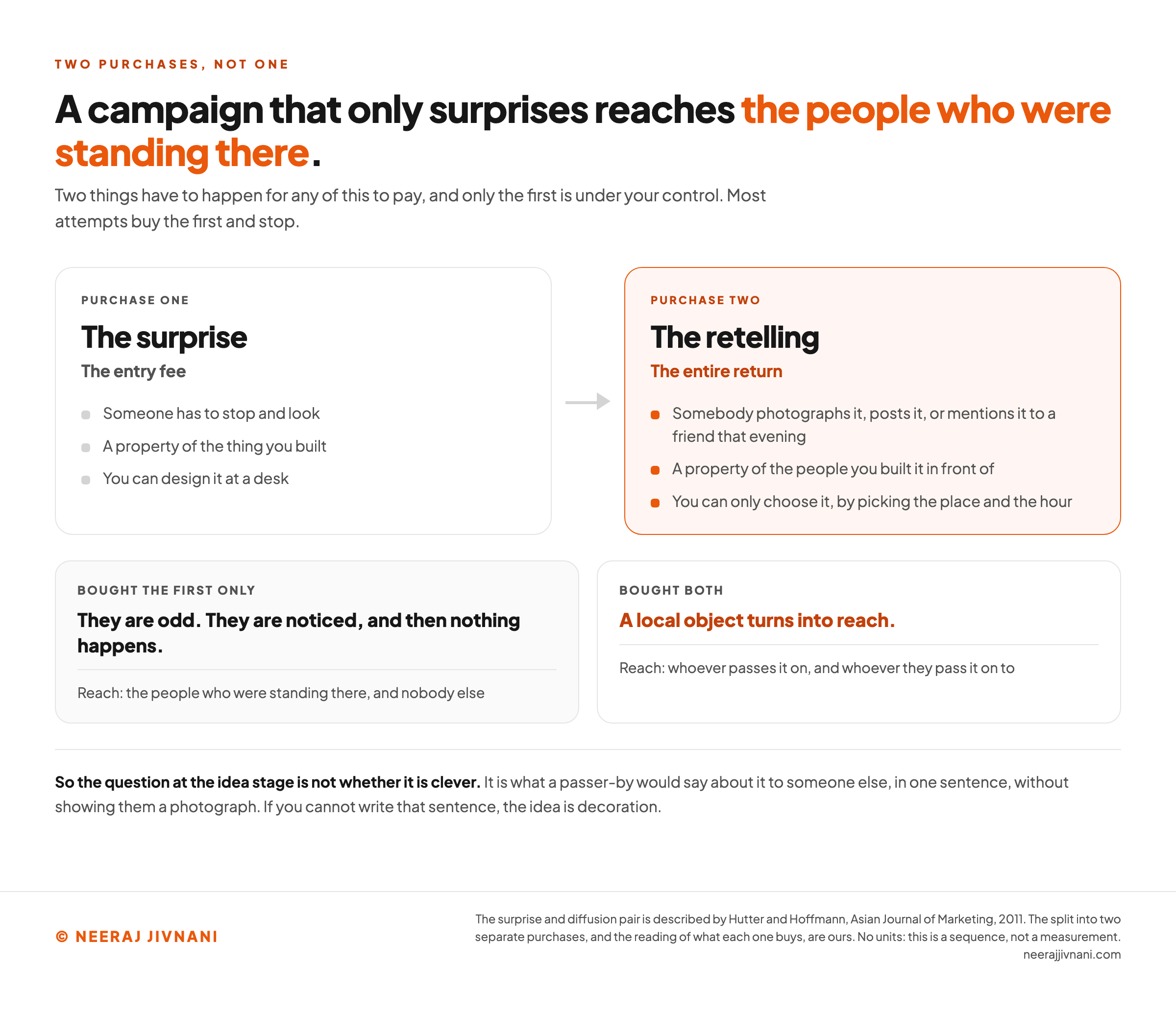
Two things have to happen for any of this to pay, and only the first is under your control.
The surprise is the entry fee. Someone has to stop and look. They have to register that this is not what they expected on that wall.
The retelling is the entire return. If nobody photographs it, posts it, or mentions it to a friend that evening, you reached the people who were standing there and nobody else.
The two halves have names: a surprise effect and a diffusion effect. The second is what turns a local object into reach.
Hutter and Hoffmann named the pair in the Asian Journal of Marketing in 2011, describing how guerrilla instruments try to reach a large audience at low cost.
Most attempts get the first one right and stop there. They are odd. They are noticed, and then nothing happens.
Surprise is a property of the thing you built. Diffusion is a property of the people you built it in front of.
You can design the first at a desk. The second you can only choose, by picking the place and the hour.
So the question at the idea stage is not whether it is clever. It is what a passer-by would say about it to someone else, in one sentence, without showing them a photograph.
If you cannot write that sentence, the idea is decoration.
Use this chart — embed code and citation
<a href="https://neerajjivnani.com/blog/guerrilla-marketing/"><img src="https://neerajjivnani.com/infographics/guerrilla-marketing/the-second-purchase.png" alt="Two panels side by side under a title stating that a campaign which only surprises reaches the people who were standing there. The left panel, headed purchase one, is the surprise and is labeled the entry fee: someone has to stop and look, it is a property of the thing you built, and you can design it at a desk. An arrow leads to the right panel, headed purchase two, the retelling, labeled the entire return: somebody photographs it, posts it or mentions it to a friend that evening, it is a property of the people you built it in front of, and you can only choose it by picking the place and the hour. Two outcome boxes below set the two states against each other. A campaign that bought the first only is odd, is noticed, and then nothing happens, reaching the people who were standing there and nobody else. A campaign that bought both turns a local object into reach that travels to whoever passes it on and to whoever they pass it on to." width="1200"></a>
<p>Chart: <a href="https://neerajjivnani.com/blog/guerrilla-marketing/">Neeraj Jivnani</a></p>Neeraj Jivnani, "Guerrilla Marketing: The Types, the Real Costs, and When It Is the Wrong Call", neerajjivnani.com, https://neerajjivnani.com/blog/guerrilla-marketing/Free to republish with a link back to this page.
The Types, and What Each One Is Buying
Every type below buys attention with a different currency, and the name tells you which one. Read them that way rather than as a taxonomy to memorize.
They sort onto three axes: where the thing sits, how it spreads, and whether the audience knows it is being marketed to.
Those are separate decisions, made independently.
Most of the confusion in this vocabulary comes from treating them as one list.
Ambient and Street Marketing
Ambient marketing puts the message into an ordinary object or surface: a manhole cover, a stairwell, the handle of a coffee cup, the shape of a shadow at four in the afternoon.
Street marketing does the same thing in public space, where there are people to meet it. Chalk, projections, pop-ups, someone handing you something you did not ask for.
Both buy their surprise from context.
The object is unremarkable, and that a message is riding on it is the whole idea.
Say a bookstore wants the ambient version. It stencils a line of footprints from the bus stop to its door in a paint that only shows when the sidewalk is wet.
Cheap, surprising once, and worth nothing in a city where other stores did it last year. The effect dies the moment the format becomes familiar.
Outdoor, Indoor and Experiential
Outdoor and indoor are not types. They are a note about where the thing sits, and the distinction matters only because it decides whose permission you need.
Experiential is a genuine difference, because it asks the audience to do something. Walk through it, play it, taste it, stand in line for it.
That participation is what buys the retelling. A person who took part has a story in the first person, which travels further than a photograph of a clever object.
It also costs the most per head. It caps hard, too. A room holds what a room holds.
Ambush Marketing
Ambush marketing trades on an event you did not pay to sponsor. You buy attention that somebody else assembled and paid for.
It is also the type with the sharpest legal edge, and in the United States that edge is written into statute rather than left to a judge.
Under 36 U.S.C. 220506, the United States Olympic and Paralympic Committee holds the exclusive right to the five interlocking rings and to the words "Olympic", "Olympiad" and "Paralympic".
Anyone using them "for the purpose of trade, to induce the sale of any goods or services" without consent can be sued.
So the word is reserved in trade, not only the mark. Most ambush campaigns you can name gesture at an event without ever naming it. That is why.
Viral and Buzz Marketing
Viral marketing means the artifact travels: the video, the image, the post itself moves from person to person.
Buzz marketing means the conversation travels. The thing may stay where it is while people talk about it.
The distinction is worth keeping because they fail differently.
A viral attempt nobody shares reached its first audience and stopped. A buzz attempt nobody discusses leaves you with an object in a street.
Neither is a plan on its own. Both are outcomes.
Describing an outcome as a tactic is how a brief ends up with "make it go viral" written in the objectives.
Stealth, Grassroots and Astroturfing
Stealth marketing hides that it is marketing. The audience sees a person, a moment, a recommendation, and does not see the brand behind it.
Grassroots marketing is the honest version of the same shape: real people, small scale, and open about who they are.
Astroturfing is the dishonest version. It is the one type here we would not run under any brief.
Fake reviews, invented supporters, staffed enthusiasm presented as spontaneous.
The argument against it is not squeamishness. Ask what happens to each of these when you explain it afterwards.
The open types survive the explanation. Astroturfing is destroyed by it, and stealth is only ever as safe as its disclosure.
That asymmetry is the whole test.
Guerrilla Marketing Online
Online guerrilla marketing is the same two effects running on somebody else's platform. Surprise arrives as a post that does not look like an ad, and diffusion is the share button.
Augmented reality, or AR, gets treated as a category of its own. It is not one.
An AR activation is an ambient installation whose object happens to be rendered on a phone, and the question underneath is unchanged. Is there a sentence a person would repeat?
The trade online is speed for control. You can test five ideas in a week.
You also own none of the ground you are standing on, so the rules can change under a campaign already running.
Three decisions, then, and not one name. Run them against an idea you already have.
Three separate decisions, not one label
Answer all three about the idea you are holding. The list of types is three lists, and most of the confusion in this vocabulary comes from treating them as one.
Decision One
Where does it sit, and what does it lean on?
Decision Two
How is it meant to spread?
Decision Three
Does the audience know it is being marketed to?
Nothing answered yet
One name will not cover it
Every type buys attention with a different currency, and the name tells you which one. Read them that way rather than as a taxonomy to memorize.
Answer the three questions above about an idea you already have. The three answers are made independently, which is why picking one word off a list of nine has never worked.
Two Campaigns, and What Each One Cost
Two campaigns are worth reading properly, because between them they contain most of what goes right and most of what goes wrong.
One is a bronze statue in Lower Manhattan, the version everybody wants. The other is a set of blinking signs that closed roads across Boston, the version everybody fears.
The Statue That Started on a Seven-Day Permit
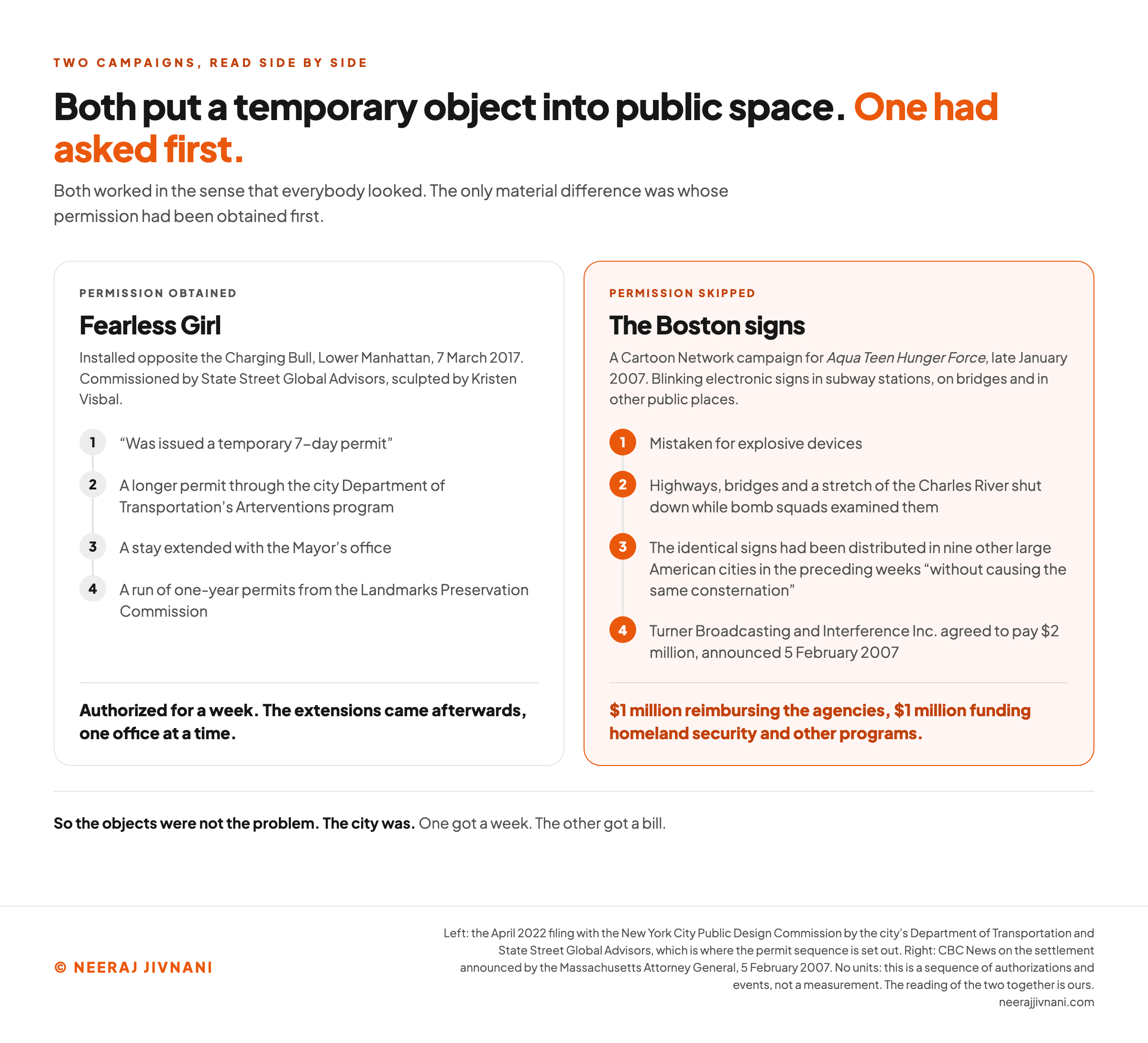
Fearless Girl was installed opposite the Charging Bull in Lower Manhattan on 7 March 2017, commissioned by State Street Global Advisors and sculpted by Kristen Visbal.
The part that never survives the retelling is the paperwork.
The statue "Was issued a temporary 7-day permit", according to a 2022 filing with the New York City Public Design Commission by the city's Department of Transportation and State Street Global Advisors.
The sponsor then worked with the city's Department of Transportation "to obtain a longer permit through their Arterventions program", and with the Mayor's office "to extend her stay".
Seven days.
The installation that ended up staying for years was authorized for a week. The extensions came afterwards, one office at a time, and eventually as a run of one-year permits from the Landmarks Preservation Commission.
That is the honest shape of a successful stunt. The idea is the smallest part of it, and the paperwork is the part that decides whether it ever stands up.
The Campaign That Skipped the Permission
In late January 2007 a Cartoon Network campaign for the show Aqua Teen Hunger Force put blinking electronic signs in subway stations, on bridges and in other public places around Boston.
They were mistaken for explosive devices. Highways, bridges and a stretch of the Charles River were shut down while bomb squads examined them.
The identical signs had been distributed in nine other large American cities in the preceding weeks "without causing the same consternation", CBC News reported when it covered the settlement in February 2007.
So the objects were not the problem. The city was.
Turner Broadcasting and the advertising firm Interference Inc. agreed to pay $2 million to resolve any potential civil or criminal claims, announced by the Massachusetts Attorney General on 5 February 2007.
The split was $1 million to reimburse the agencies and $1 million to fund homeland security and other programs, according to CBC News.
Read the two campaigns together. Both put a temporary object into public space, and both worked in the sense that everybody looked.
The only material difference was whose permission had been obtained first.
One got a week. The other got a bill.
Use this chart — embed code and citation
<a href="https://neerajjivnani.com/blog/guerrilla-marketing/"><img src="https://neerajjivnani.com/infographics/guerrilla-marketing/one-got-a-week.png" alt="Two campaigns drawn as parallel numbered tracks under a title saying that both put a temporary object into public space and one had asked first. The left track, marked permission obtained, is Fearless Girl, installed opposite the Charging Bull in Lower Manhattan on 7 March 2017, commissioned by State Street Global Advisors and sculpted by Kristen Visbal: it was issued a temporary 7-day permit, then a longer permit through the city Department of Transportation's Arterventions program, then a stay extended with the Mayor's office, then a run of one-year permits from the Landmarks Preservation Commission, so it was authorized for a week and the extensions came afterwards one office at a time. The right track, marked permission skipped, is the Cartoon Network campaign for Aqua Teen Hunger Force of late January 2007, whose blinking electronic signs in subway stations, on bridges and in other public places were mistaken for explosive devices, shutting down highways, bridges and a stretch of the Charles River while bomb squads examined them, although the identical signs had been distributed in nine other large American cities in the preceding weeks without causing the same consternation; Turner Broadcasting and Interference Inc. agreed to pay $2 million, announced 5 February 2007, $1 million reimbursing the agencies and $1 million funding homeland security and other programs." width="1200"></a>
<p>Chart: <a href="https://neerajjivnani.com/blog/guerrilla-marketing/">Neeraj Jivnani</a></p>Neeraj Jivnani, "Guerrilla Marketing: The Types, the Real Costs, and When It Is the Wrong Call", neerajjivnani.com, https://neerajjivnani.com/blog/guerrilla-marketing/Free to republish with a link back to this page.
What a Campaign Costs to Run
A campaign costs money in three places, and not buying media saves you none of it.
The idea. This is the cost people are willing to pay, because it is paid in someone's time and it feels like the fun part. It is also the only input money cannot substitute for. Everything else on this list can be bought.
The production. A physical object that will stand in weather, in public, with the public touching it, is fabrication work. It gets engineered, transported, installed, watched and removed, and the removal is the line item that disappears from every budget.
The permission. Somebody owns the ground. A landlord, a transit authority, a city agency, a mall, a stadium, a platform.
Getting that permission takes weeks more often than days, and the answer is frequently no.
A fourth cost sits on no budget line, which is the failure rate.
The ones you can name are the survivors of a much larger population nobody wrote about.
Price the idea as a portfolio rather than as a purchase. If one campaign has to work, buy media instead, because media is the thing you buy when you need a guaranteed number.
Is Guerrilla Marketing Illegal?
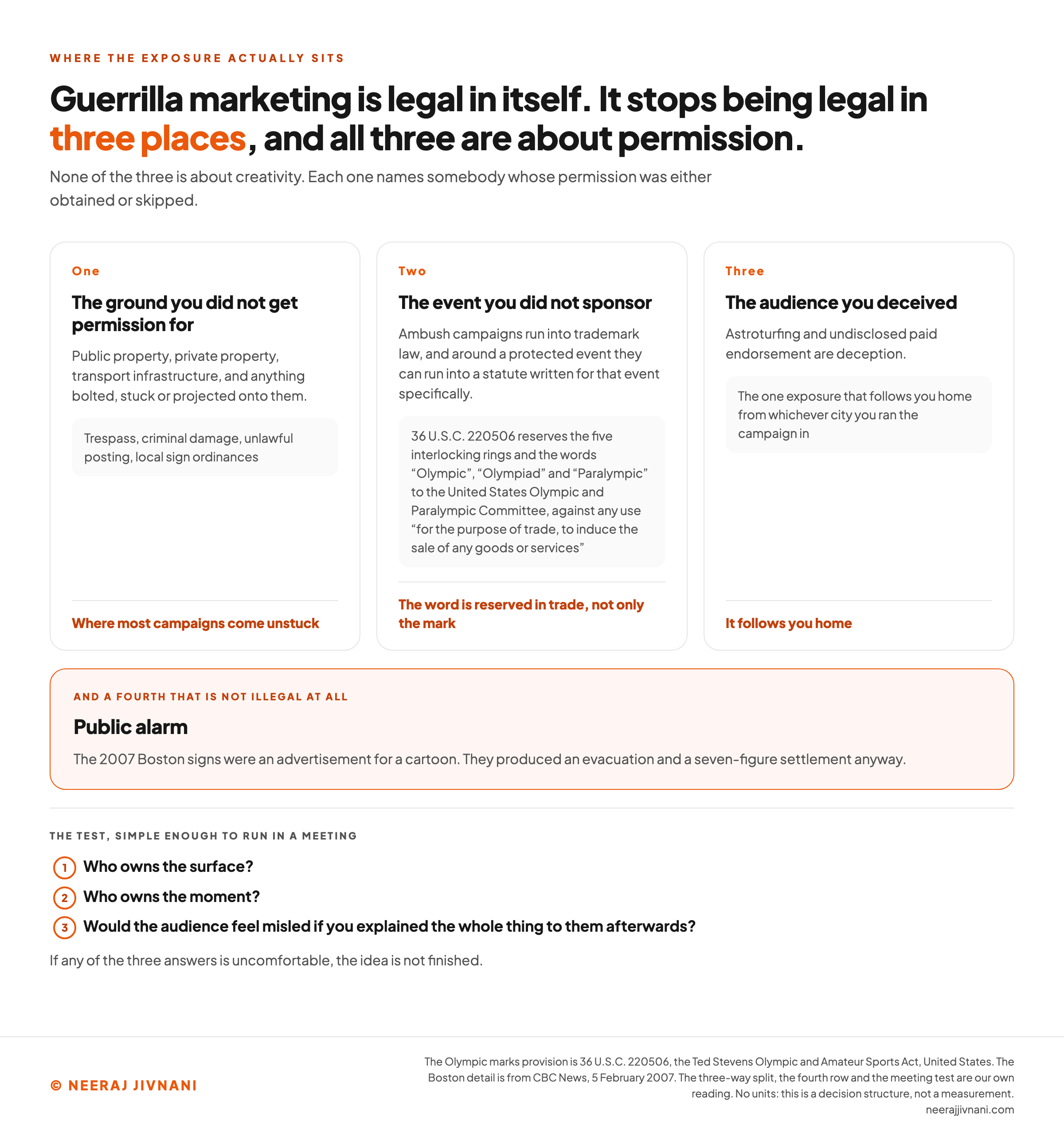
Guerrilla marketing is legal in itself. It stops being legal in three specific places, and all three are about permission rather than about creativity.
The ground you did not get permission for. Public property, private property, transport infrastructure and anything bolted, stuck or projected onto them. This is where trespass, criminal damage, unlawful posting and the local sign ordinances live, and it is where most campaigns come unstuck.
The event you did not sponsor. Ambush campaigns run into trademark law, and around a protected event they can run into a statute written for that event specifically, as 36 U.S.C. 220506 does for the Olympic marks in the United States.
The audience you deceived. Astroturfing and undisclosed paid endorsement are deception, and that is the one exposure that follows you home from whichever city you ran the campaign in.
A fourth thing is not illegal and behaves as if it were, which is public alarm.
The Boston signs were an advertisement for a cartoon. They produced an evacuation and a seven-figure settlement anyway.
The practical test is simple enough to run in a meeting.
Ask who owns the surface, who owns the moment, and whether the audience would feel misled if you explained the whole thing to them afterwards. If any of the three answers is uncomfortable, the idea is not finished.
Use this chart — embed code and citation
<a href="https://neerajjivnani.com/blog/guerrilla-marketing/"><img src="https://neerajjivnani.com/infographics/guerrilla-marketing/where-it-stops-being-legal.png" alt="Three cards under a title saying guerrilla marketing is legal in itself and stops being legal in three places, all three about permission. The first is the ground you did not get permission for, covering public property, private property, transport infrastructure and anything bolted, stuck or projected onto them, where trespass, criminal damage, unlawful posting and local sign ordinances live, and it is marked as where most campaigns come unstuck. The second is the event you did not sponsor, where ambush campaigns run into trademark law and, around a protected event, into a statute written for that event specifically: 36 U.S.C. 220506 reserves the five interlocking rings and the words Olympic, Olympiad and Paralympic to the United States Olympic and Paralympic Committee against any use for the purpose of trade, to induce the sale of any goods or services, so the word is reserved in trade and not only the mark. The third is the audience you deceived, where astroturfing and undisclosed paid endorsement are deception, and it is marked as the exposure that follows you home. A fourth panel set apart says public alarm is not illegal at all and behaves as if it were: the 2007 Boston signs were an advertisement for a cartoon and they produced an evacuation and a seven-figure settlement anyway. A three-question test closes the figure, asking who owns the surface, who owns the moment, and whether the audience would feel misled if you explained the whole thing to them afterwards, with the note that if any of the three answers is uncomfortable the idea is not finished." width="1200"></a>
<p>Chart: <a href="https://neerajjivnani.com/blog/guerrilla-marketing/">Neeraj Jivnani</a></p>Neeraj Jivnani, "Guerrilla Marketing: The Types, the Real Costs, and When It Is the Wrong Call", neerajjivnani.com, https://neerajjivnani.com/blog/guerrilla-marketing/Free to republish with a link back to this page.
How to Tell Whether It Worked
Decide what "it worked" means before you build anything. Afterwards the temptation is to accept whichever number flatters the campaign.
The one you will be offered is advertising value equivalency, often presented as earned media value: an estimate of what the coverage would have cost to buy as advertising.
It is not a measure of value, and the industry that invented it says so. That is worth knowing before somebody presents you with one.
Advertising value equivalents "should not be used", says Barcelona Principles 4.0, the communications trade's own measurement standard, published in 2025. Measure the campaign by its outcome and its impact instead.
What is left is less impressive and more useful. Count the things only this campaign could have caused, over a window you fixed in advance.
- Branded search volume in the days after.
- Direct traffic from the city or the venue.
- The volume and the sentiment of mentions that were not prompted.
- The ordinary commercial numbers over the same window, with a matched window before it.
None of those is clean. All of them are measurable. A dirty number you can defend beats a large number you cannot.
Set the window before you launch, too. A campaign judged over whatever period makes it look best has not been judged.
When It Is the Wrong Call
Four situations make this the wrong call almost every time, and the honest answer in all four is to spend the money somewhere else.
When you need a predictable number. Guerrilla campaigns have a wide spread of outcomes and no floor underneath them. If this quarter depends on the result, this is not the instrument.
When the surprise contradicts the brand. A bank being unpredictable in public is not charming. The tactic amplifies whatever you already are, and it amplifies the gap between what you say and what you do with equal efficiency.
When the claim invites a check. A stunt that makes a statement about your values is an invitation to examine whether you live by it. Somebody will accept the invitation. The coverage that follows is then about the gap rather than about the campaign.
When the audience will not be standing there. Diffusion needs people with a reason to pass something on. A business selling to a few dozen procurement managers is not going to reach them from a sidewalk.
There is a softer version of the same judgment. If the idea only works because it is unexpected, ask how long it stays unexpected in your category.
Formats age fast. Chalk on a sidewalk was surprising once.
Is Guerrilla Marketing Still Worth Running?
Yes, and the label matters much less than it did.
It is still worth running for the reason it always was. When you cannot outbid anyone for attention, you have to earn it somewhere nobody is bidding.
What Levinson's readers had to arrange in the street in 1984, a feed now provides for free: the rails a thing travels on. Whether anybody puts it on them is still not your call.
So the tactic has not gone anywhere. It has been absorbed, which is a stranger fate than dying.
What has not changed sits underneath all of it.
You are still buying a sentence in somebody else's mouth. Everything above, the type, the budget, the permit, the metric, is in service of whether that sentence gets said.
If you can write it before you build anything, run the campaign. If you cannot, you are about to spend real money on an object that will be admired by the people who happen to walk past it.