B2B Marketing: The Channels Are the Same, the Buyer Is Not
Your reader can recommend you but cannot approve the spend. What you publish, which channels you pick and when you judge them all follow from that gap.


/ On this page10 sections
B2B marketing is marketing aimed at organizations rather than at people buying for themselves. The channels are the ones you already know: search, content, email, social, events and advertising.
What changes is who is on the other end. The person reading your page usually cannot approve the spend, and the person who can will hear about you second-hand, from a colleague, in a summary.
Almost everything that feels strange about B2B marketing comes out of that one gap: what is worth publishing, which channels to start with, and how long to wait before any of it means anything.
What B2B Marketing Is
B2B marketing, short for business-to-business marketing, is the work of getting an organization to buy from you rather than getting an individual to. The customer is a company; the reader is a person inside it.
That covers far more of the economy than the phrase suggests.
Software sold to companies is the obvious case, and it is a small part of the whole.
A firm making components that end up inside somebody else's finished product is doing B2B marketing. So is an accountancy practice, a freight company, a commercial insurer, or a factory selling to wholesalers.
The professional services case is the most common and the least discussed. A design studio, a law firm or a consultancy sells expertise, which cannot be photographed and cannot be trialed for free, so almost all of its marketing is evidence that the expertise exists.
Plenty of companies do both at once.
The same business can sell a subscription to individuals and an enterprise agreement to their employer. Those are two jobs, and they need separate work rather than one campaign with a second audience bolted on.
Why it gets treated as its own discipline comes down to consequence.
A consumer who buys the wrong thing is mildly annoyed. An operations director who signs the wrong contract has to explain it, live with it, and often renew it once before they can get out.
What Actually Changes When the Customer Is a Company
Six things change when the customer is an organization, and none of them is the channel list. The table below is the short version and the sections under it are the part worth reading.
| Selling to a person | Selling to a company | |
|---|---|---|
| Whose money | Theirs | The organization's, and somebody signs for it |
| Who decides | The buyer | The reader recommends, others approve |
| What decides it | Want, price, convenience | Whether it can be defended afterward |
| How long | Minutes to weeks | Months, sometimes more than a year |
| What ends it | A purchase | A contract, and then a renewal |
| What kills it | A better offer | Nobody making the case internally |
The first three rows are about the purchase itself. The last three are about the time it takes, and about what can go wrong inside that time.
That second half is the one a consumer marketer arrives here least prepared for, and the final row is where most B2B marketing quietly fails.
The Reader Is Not the Approver
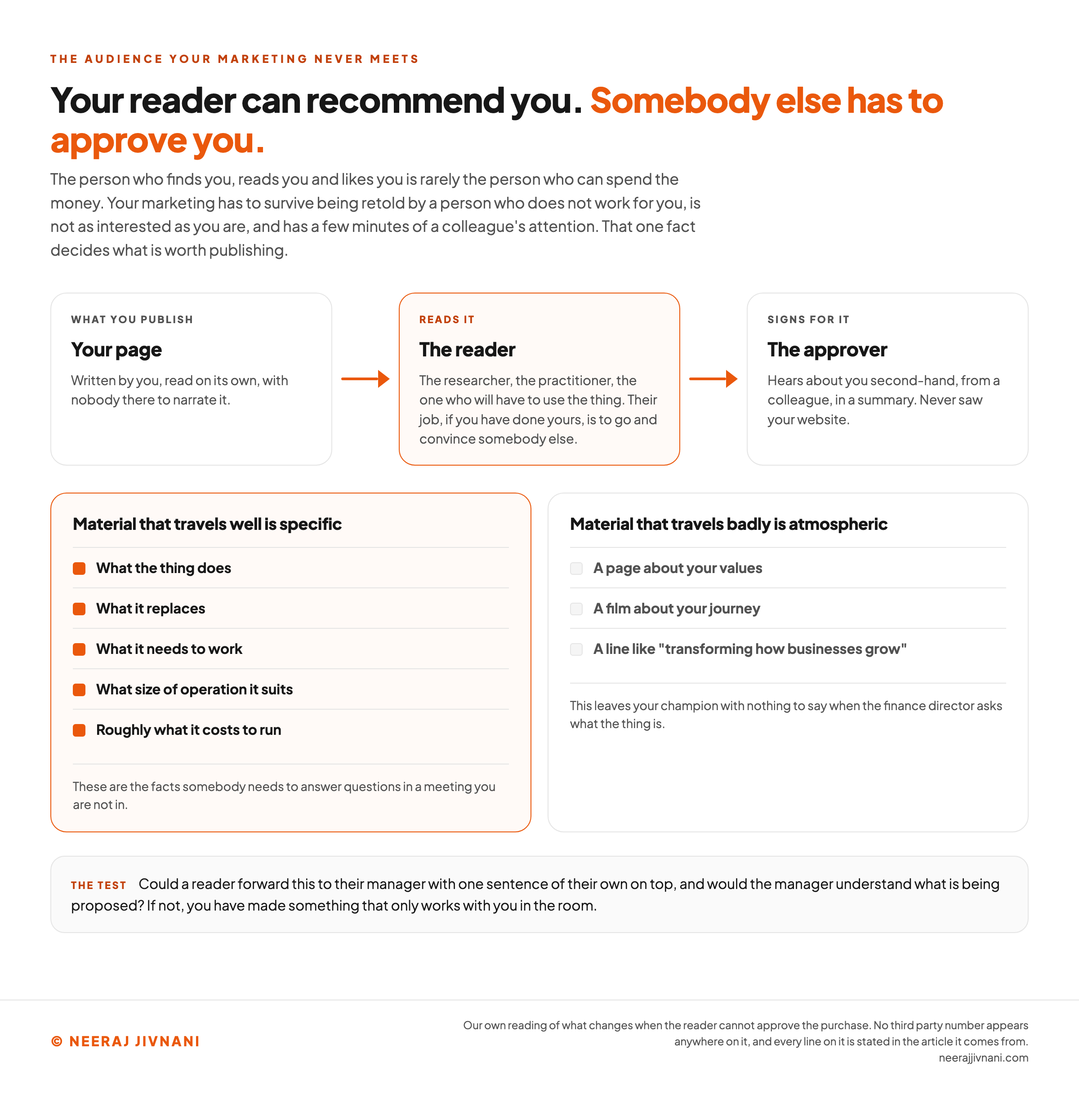
The person who finds you, reads you and likes you is rarely the person who can spend the money. They are the researcher, the practitioner, the one who will have to use the thing.
Their job, if you have done yours, is to go and convince somebody else.
So your marketing has a second audience it never meets. It has to survive being retold by a person who does not work for you, is not as interested as you are, and has a few minutes of a colleague's attention.
That one fact rules out a great deal of what B2B marketing spends money on.
Material that travels well is specific. What the thing does, what it replaces, what it needs to work, what size of operation it suits, and roughly what it costs to run.
Those are the facts somebody needs to answer questions in a meeting you are not in.
Material that travels badly is atmospheric. A page about your values, a film about your journey, or a line like "transforming how businesses grow" leaves your champion with nothing to say when the finance director asks what the thing is.
Check anything you are about to publish against one test. Could a reader forward this to their manager with one sentence of their own on top, and would the manager understand what is being proposed?
If not, you have made something that only works with you in the room.
The Timing Is Theirs, Not Yours
You do not choose when the buying starts. It starts when a contract comes up for renewal, a budget is approved, a system breaks, a person joins, or a rule changes.
None of those sits on your calendar.
This is why B2B campaigns produce so little in their first months, and why so many are canceled at exactly the wrong moment.
The work was not failing. The people it reached were not able to buy yet.
There is a real calendar underneath it, and it is the budget year. Most organizations set what they can spend once a year and then live inside that number, which is why a good answer in month two often has to wait for month eleven.
Knowing that changes what you ask of a campaign.
Instead of asking whether it produced replies this month, ask whether the people who will eventually buy now know what you do. Those are different questions with different evidence behind them, and only one of them can be answered in thirty days.
Where B2B and B2C Are Exactly the Same
B2B and B2C get treated as opposites far more often than they are, and that overstatement is why so much B2B writing is bad.
Business buyers are not a separate species. They skim, they judge your site in a few seconds, they trust a recommendation from someone they know over anything you publish, and they notice whether you look like you will still exist in three years.
The claim that B2B is rational and B2C is emotional does not hold up either.
Nobody picks a supplier purely on a spreadsheet. The strongest feeling in the room is usually a professional one, which is the fear of being the person who chose the vendor that failed.
So write for a human being at work, not for a job title. "Procurement decision-makers seeking to optimize vendor consolidation" is nobody, and no such person will recognize themselves in it.
The genuine differences are the ones above: whose money it is, who has to be convinced, and how long it takes. Everything else you already know about writing for people still applies here.
Use this chart — embed code and citation
<a href="https://neerajjivnani.com/blog/b2b-marketing/"><img src="https://neerajjivnani.com/infographics/b2b-marketing/what-survives-the-retelling.png" alt="Three linked boxes showing the path a piece of B2B marketing takes: your page, written to be read on its own with nobody there to narrate it; the reader, who is the researcher or the practitioner and whose job is to go and convince somebody else; and the approver, who hears about you second-hand from a colleague, in a summary, and never saw your website. Below them two lists set the material that travels well because it is specific, what the thing does, what it replaces, what it needs to work, what size of operation it suits and roughly what it costs to run, against the material that travels badly because it is atmospheric, a page about your values, a film about your journey and a line like transforming how businesses grow. A closing test asks whether a reader could forward the piece to their manager with one sentence of their own on top and have the manager understand what is being proposed." width="1200"></a>
<p>Chart: <a href="https://neerajjivnani.com/blog/b2b-marketing/">Neeraj Jivnani</a></p>Neeraj Jivnani, "B2B Marketing: The Channels Are the Same, the Buyer Is Not", neerajjivnani.com, https://neerajjivnani.com/blog/b2b-marketing/Free to republish with a link back to this page.
How Business Buyers Actually Find You
Most of them do not find you at the moment they need you. They find you earlier, remember roughly what you do, and come back when the need appears.
There are three routes in, and they are not equal.
Somebody asks a peer. This is the strongest and the one you influence least directly. It works only if past customers can describe what you do in one sentence, which is a marketing problem disguised as a word-of-mouth problem.
Somebody searches. They search for the problem long before they search for the category, and for the category long before they search for you by name. Each of those is a different query and a different page, and deciding which phrase gets which page is what keyword research is for.
Somebody already knows you. They read something of yours a year ago, or saw you at an event, and you were in the small set of names that came to mind.
The third route is the one most B2B teams underfund, because it is the hardest of the three to attribute to anything.
When the Search Returns an Answer Instead of Links
Some of that early research now ends in a generated answer rather than a list of pages, which is one form of a zero-click search.
This matters more for a business buyer than for a consumer. The early questions are exactly the ones that get summarized: what is this, what are the options, what should I look for.
The consequence is narrow and worth acting on.
Our reading is that a summary can do something with a specific and nothing with a benefit. Prose that gestures at outcomes leaves it nothing to quote.
This is not a new discipline to buy. It is the same instruction as the section above, arriving from a different direction: be specific, in writing, where it can be read.
What Each Channel Is Doing in a Long Cycle
B2B channels sort into three groups: the ones that carry an argument, the ones that put you in a room, and the ones people buy before they are ready for them.
Every one of them exists in consumer marketing too. What changes is the job it is doing, and here a channel pointed at the wrong job takes two or three quarters to reveal it.
By then the budget is spent, which is why the sorting is worth doing first.
The Ones That Carry an Argument
Content exists to arm somebody. In consumer marketing content often does the selling itself; here it is raw material for a conversation you will not attend, which is why comparison pages, worked examples, implementation detail and honest limits are worth more here than another piece of thought leadership.
Thought leadership is worth something only when it contains a position somebody could disagree with. A piece that surveys the field and concludes that the field is changing has taken up a slot and said nothing.
Search is where the problem-shaped questions get answered. Somebody typing a symptom is worth more to you than somebody typing your category, because they are earlier and nobody else is talking to them yet.
Email is the channel that survives a long cycle. It is where you can stay present in a way somebody asked for, week after week, while their current contract runs down.
The Ones That Put You in a Room
Events are the channel where B2B genuinely diverges from consumer marketing, and they get less attention than they deserve.
A trade show, a conference talk or a small hosted dinner does something no page can do.
It puts you in front of people who are hard to reach any other way, and it lets them judge you as a person. That is most of what they are trying to work out.
Webinars are the cheap version and they work when they are honest. A session that teaches something specific earns attention; one that is a demonstration wearing a lecture's clothes gets people to register and never watch.
The honest limit is cost. A stand at a large trade show can consume a small firm's entire annual marketing budget, and the return arrives, if it arrives, a year later.
If you are small, speak at events rather than exhibiting at them. Speaking costs preparation time and buys the same room.
The Ones People Buy Too Early
Paid advertising works in B2B, and it works best when there is already something to say and somewhere for it to land. Bought first, it produces clicks from people who have no idea who you are.
Marketing automation is worth adding once you have more conversations than you can follow up by hand. Bought before that, it automates a process nobody has designed.
Account-based marketing narrows everything down to a named list of companies and works the people inside each one. It suits a small number of large contracts and it is expensive per account, so it is a choice rather than a default.
Social media in B2B is mostly one thing, which is being visible to people in your industry between purchases. Treating it as a lead source generally disappoints; treating it as the reason your name is familiar later is closer to what it does.
Building the Plan, in the Order the Decisions Block Each Other
Each decision below makes the next one answerable, which is why a plan built out of sequence stalls.
- Write down who you sell to, and who you do not. Not a persona document. A description narrow enough that you could look at a company and say yes or no in ten seconds.
- Decide what you claim, in a sentence somebody else could repeat. If your own team cannot say it the same way twice, no customer will manage it.
- List the three or four things a buyer has to know before they could recommend you. These become the first things you make, and they are usually duller and more concrete than what a marketing team wants to write.
- Pick one channel to reach people who do not know you, and one way to be found by people already looking. Two, not six.
- Agree with sales what happens when somebody replies. Including how fast, and who owns the silence when nothing happens for three months.
- Set the review dates before you start, because you will otherwise judge everything at the wrong moment.
Step three is the one that gets skipped, and skipping it is why so much B2B content reads as filler. The material a buyer needs is boring to write and it is the only material that gets forwarded.
Step five is the one that quietly destroys programs. Marketing generates interest, nobody has agreed who calls it, and weeks later everybody agrees the campaign did not work.
If You Are the Whole Marketing Team
Much B2B advice is written for a department. Most B2B marketing is done by one person, often the founder, usually part-time.
At that size the sequence above still holds and the fourth step collapses to one channel, not two.
Pick the one where your buyers already are.
Then commit to it for longer than one cycle, because a channel abandoned at month four on a nine month cycle has produced nothing you can even learn from.
The other adjustment is to lean on the things that do not scale. Market research at this size is a dozen real conversations with people who fit your description, which will teach you more in a month than a year of published posts and costs nothing but time.
Where the Budget Argument Actually Is
Every B2B marketing team eventually has the same fight.
One side wants the money in lead generation, which produces meetings this quarter. The other wants it in brand, which produces nothing you can point at until much later.
The fight is usually framed as a disagreement about which one works. It is not.
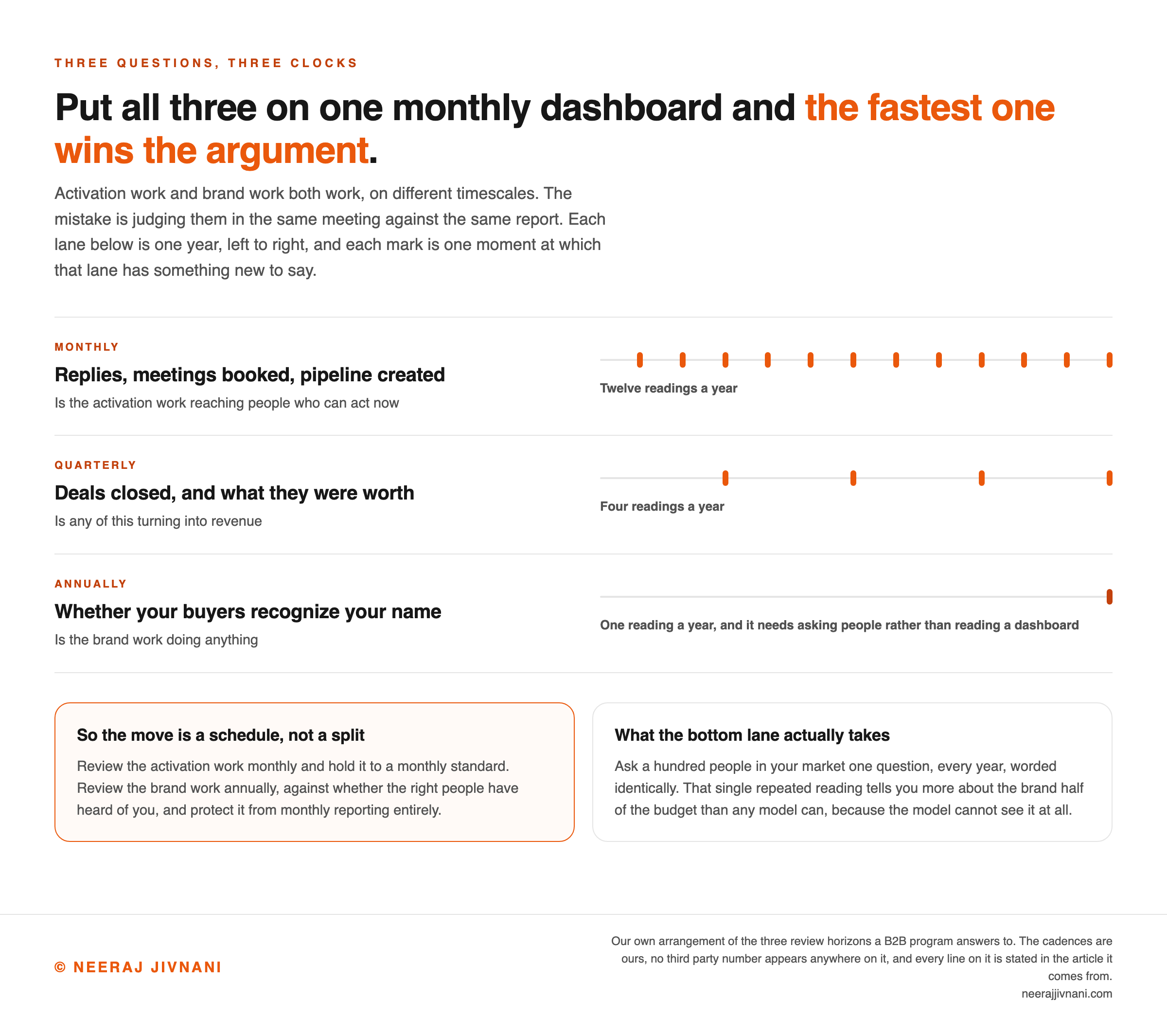
Both work, on different timescales. The mistake is judging them in the same meeting against the same report.
Demand generation and lead generation are not the same job. One makes people want the category at all; the other captures details from the ones who already do.
Both sit on the activation side of this argument, and both answer a quarterly question with a quarterly answer. Brand work answers whether you are on the list when a company finally goes looking, and that answer arrives in a year or two.
Put both on one monthly dashboard and the faster one wins the argument every time, whatever it is worth.
So the practical move is not a split, it is a schedule.
Review the activation work monthly and hold it to a monthly standard. Review the brand work annually, against whether the right people have heard of you, and protect it from monthly reporting entirely.
Roughly Half the Budget Belongs to People Who Cannot Buy Yet
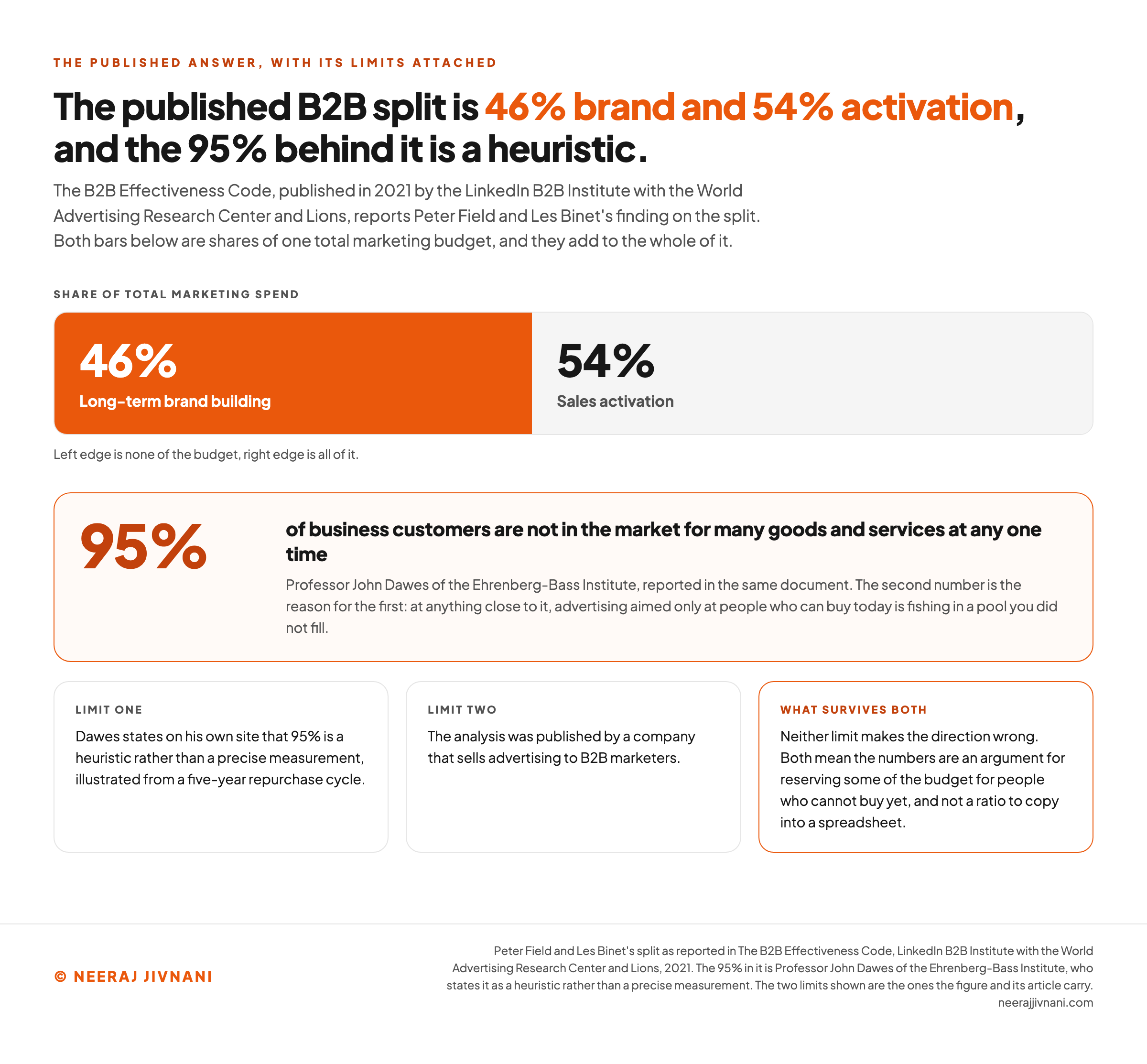
The published answer to the split is 46% of spend on long-term brand building and 54% on sales activation.
That is Peter Field and Les Binet's analysis, reported in The B2B Effectiveness Code, published in 2021 by the LinkedIn B2B Institute with the World Advertising Research Center and Lions.
The reason behind it sits in the same document. At any one time, 95% of business customers are not in the market for many goods and services, a finding from Professor John Dawes of the Ehrenberg-Bass Institute.
At anything close to that 95%, advertising aimed only at people who can buy today is fishing in a pool you did not fill.
The brand half is not decoration. It is what makes you a candidate at the moment somebody starts looking, and that moment is one nobody tells you about.
Two limits belong with those figures. Dawes states on his own site that 95% is a heuristic rather than a precise measurement, illustrated from a five-year repurchase cycle, and the analysis was published by a company that sells advertising to B2B marketers.
Neither limit makes the direction wrong. Both mean the numbers are an argument for reserving some of the budget for people who cannot buy yet, and not a ratio to copy into a spreadsheet.
Use this chart — embed code and citation
<a href="https://neerajjivnani.com/blog/b2b-marketing/"><img src="https://neerajjivnani.com/infographics/b2b-marketing/the-split-and-its-limits.png" alt="The published B2B budget split drawn as one bar across a whole marketing budget, with 46% given to long-term brand building on the left in orange and 54% to sales activation on the right in grey, above a panel carrying the 95% of business customers who are not in the market for many goods and services at any one time as the reason behind it. Three cards underneath carry the two limits and what survives them: that Professor John Dawes states the 95% as a heuristic rather than a precise measurement, illustrated from a five-year repurchase cycle; that the analysis was published by a company that sells advertising to B2B marketers; and that neither limit makes the direction wrong, because the numbers are an argument for reserving some of the budget for people who cannot buy yet rather than a ratio to copy into a spreadsheet." width="1200"></a>
<p>Chart: <a href="https://neerajjivnani.com/blog/b2b-marketing/">Neeraj Jivnani</a></p>Neeraj Jivnani, "B2B Marketing: The Channels Are the Same, the Buyer Is Not", neerajjivnani.com, https://neerajjivnani.com/blog/b2b-marketing/Free to republish with a link back to this page.
What to Measure, and When to Look at It
Measurement in B2B is genuinely hard, for one honest reason. The gap between the work and the result is long enough that most of what you can measure this month is evidence about the fast half only.
Three horizons, and each has its own question.
| Look at | How often | The question it answers |
|---|---|---|
| Replies, meetings booked, pipeline created | Monthly | Is the activation work reaching people who can act now |
| Deals closed, and what they were worth | Quarterly | Is any of this turning into revenue |
| Whether your buyers recognize your name | Annually | Is the brand work doing anything |
Almost nobody runs the third row, because it needs asking people rather than reading a dashboard.
Ask a hundred people in your market one question, every year, worded identically. That one repeated measure of brand awareness tells you more about the brand half of the budget than any model can, because the model cannot see it at all.
And treat a quiet quarter as information rather than a verdict.
The opening months of a program produce nothing by design. Canceling then is the most expensive mistake available in B2B marketing, because it destroys the work at the exact point before any of it could have paid.
Put your own two dates on one axis and the three horizons read back differently.
Set the review dates before you start
You do not choose when the buying starts, so the two marks below are the ones that decide what any report of yours can honestly contain. Put your own cycle on the rule, then the month you have agreed to judge the program, and read the three horizons back against them.
Months from the day the program starts
Your review lands inside your own cycle, 6 months before a purchase that started with the program could finish.
A channel abandoned at month 3 on a 9 month cycle has produced nothing you can even learn from. Canceling then is the most expensive mistake available in B2B marketing, because it destroys the work at the exact point before any of it could have paid.
Monthly
Answerable
Replies, meetings booked, pipeline created
Is the activation work reaching people who can act now
Month 3 is 3 readings in, and this is the row that can be answered in thirty days. Hold it to a monthly standard and nothing else.
Quarterly
Nothing in it yet, by design
Deals closed, and what they were worth
Is any of this turning into revenue
Nothing that started with the program can have closed before month 9, and month 3 is short of that. The opening months of a program produce nothing by design. You will have taken one quarterly reading by then, and it could not have carried a deal.
Annually
Not asked yet
Whether your buyers recognize your name
Is the brand work doing anything
This one is asked once a year and month 3 is before the first reading. Protect it from monthly reporting entirely rather than putting an empty row on the dashboard.
Review the activation work monthly and hold it to a monthly standard. Review the brand work annually, against whether the right people have heard of you, and protect it from monthly reporting entirely.
Use this chart — embed code and citation
<a href="https://neerajjivnani.com/blog/b2b-marketing/"><img src="https://neerajjivnani.com/infographics/b2b-marketing/three-clocks-one-dashboard.png" alt="The three review horizons drawn as three lanes on the same one-year scale, running left to right, with one mark for every moment that lane has something new to say. The monthly lane, replies, meetings booked and pipeline created, answers whether the activation work is reaching people who can act now and carries twelve marks. The quarterly lane, deals closed and what they were worth, answers whether any of this is turning into revenue and carries four. The annual lane, whether your buyers recognize your name, answers whether the brand work is doing anything and carries a single mark at the right edge, noted as the one that needs asking people rather than reading a dashboard. Two panels below set out the schedule the difference argues for and what the bottom lane actually takes." width="1200"></a>
<p>Chart: <a href="https://neerajjivnani.com/blog/b2b-marketing/">Neeraj Jivnani</a></p>Neeraj Jivnani, "B2B Marketing: The Channels Are the Same, the Buyer Is Not", neerajjivnani.com, https://neerajjivnani.com/blog/b2b-marketing/Free to republish with a link back to this page.
Where B2B Marketing Goes Wrong
Four failures turn up again and again, and in every one of them what went wrong was a decision rather than the execution.
None needs a better marketer to fix it. Each needs a decision somebody never took.
They come in two pairs. Two are defaults adopted in place of a decision, and two give away recognition that had already been earned.
Defaults Taken in Place of a Decision
Buying software first. A platform bought before there is a plan becomes the plan, and the plan is then whatever the software makes easy. The same is now happening with AI tools: teams adopt one, produce more material faster, and publish more of the atmospheric writing that was not working when it was slower.
Writing to a job title. Nobody has ever thought of themselves as a mid-market operations decision-maker. The material that works reads as though a person wrote it to another person who has a specific problem.
Ground Gained and Then Given Back
Changing the message every year. A buyer who meets you three times across a long cycle should meet the same claim each time. Teams rewrite their positioning annually, and each rewrite resets the clock on everyone who had started to recognize them.
Treating one contact as the account. Your champion changes jobs, and if nobody else at that company knows who you are, the work goes with them.
Common Questions
Four questions come up on this topic more than any others, and two of them have shorter answers than people expect.
What is the 3-3-3 rule in marketing? There is no such rule in B2B marketing. The reason people go looking for one is that a long cycle gives you nothing to check against for months, and a mnemonic will not fix that.
Does B2B marketing pay well? Published salary data is reported by job title rather than by whether the customer is a business, so there is no reliable figure for B2B as a category and anyone quoting one has estimated it. What can be said is what pay follows here, which is the seniority of the decisions you are trusted with rather than the channel you work in.
What are the four C's of B2B marketing? They are a rewriting of the four Ps from the buyer's side: customer instead of product, cost instead of price, convenience instead of place, and communication instead of promotion. No single B2B version of the four is agreed on. The one worth keeping is cost, because in B2B it means the whole cost of adopting you, including the work of switching, and not the figure on your invoice.
Is B2B marketing the same as B2B sales? No. Marketing decides who hears about you and what they understand; sales handles the people who reply. The handover between them is where most B2B programs leak.
The Two Conditions Everything Else Follows From
B2B marketing is not a separate craft with its own channels and its own vocabulary. It is ordinary marketing carried out under two conditions that consumer marketing does not have.
The reader cannot approve the purchase, and the purchase happens on a schedule you do not set.
Everything useful follows from taking those two seriously.
Publish material specific enough that somebody else can repeat it. Pick fewer channels, and give each one a full buying cycle before you judge it.
Fund some of the work for people who cannot buy this year, and then stop asking that work to prove itself every month.
The teams that do well at this are rarely the ones with the most channels or the newest tools. They are the ones whose customers can explain, in one sentence, exactly what they do.