Content Marketing: How It Works, What It Costs, and What to Expect
Get the plain definition, how to pick formats you can keep making, what each one costs you, and what marketers honestly report getting back.


/ On this page9 sections
Content marketing, in plain terms, is the practice of publishing material an audience finds worth their time, so they come to you instead of you interrupting them with an advertisement.
Three things have to be true at once. The material is worth having on its own, it is made for an audience you can name, and it lands where they are in deciding rather than where you are in selling.
The harder questions are which formats you can keep making, what each one costs you, and what you can honestly expect back.
The Three Moments a Piece Can Be Aimed At
Content marketing works by arriving at one of three points in somebody's decision, which is the same split a marketing funnel draws by default, and the point you build for settles everything else about the piece.
Awareness is before they know they have a problem. Consideration is while they are weighing ways to solve it. Closing is when they are down to you and one or two others.
Naming the moment first is the cheapest quality control there is. It fixes the length, the format and the number you will judge the piece by, before a word is written.
Awareness
At the awareness stage the reader does not know you exist and is not looking for you. The piece has to answer a question they already have. Its only job is to be found and to be worth the time.
What awareness content cannot do is close a sale. Judging it on revenue is a category error.
Consideration
At the consideration stage the reader has the problem defined and a shortlist forming. Comparisons, worked examples and honest limits do the work here. A reader at this point wants reasons to eliminate options, not reasons to be impressed.
Consideration content cannot create demand that was not already there.
Closing
At the closing stage the reader has decided to buy something and is choosing from whom. Case detail, implementation notes and straight answers to objections are what move somebody already most of the way there.
Closing content cannot repair a weak awareness stage, because nobody arrives to be closed.
One Campaign That Published Every Number
The arithmetic below belongs in front of anyone planning a first campaign. It comes from one published case that discloses every number the promotion produced, reported by Shankman in 2014 and collected in Linchi Kwok's chapter on content marketing.
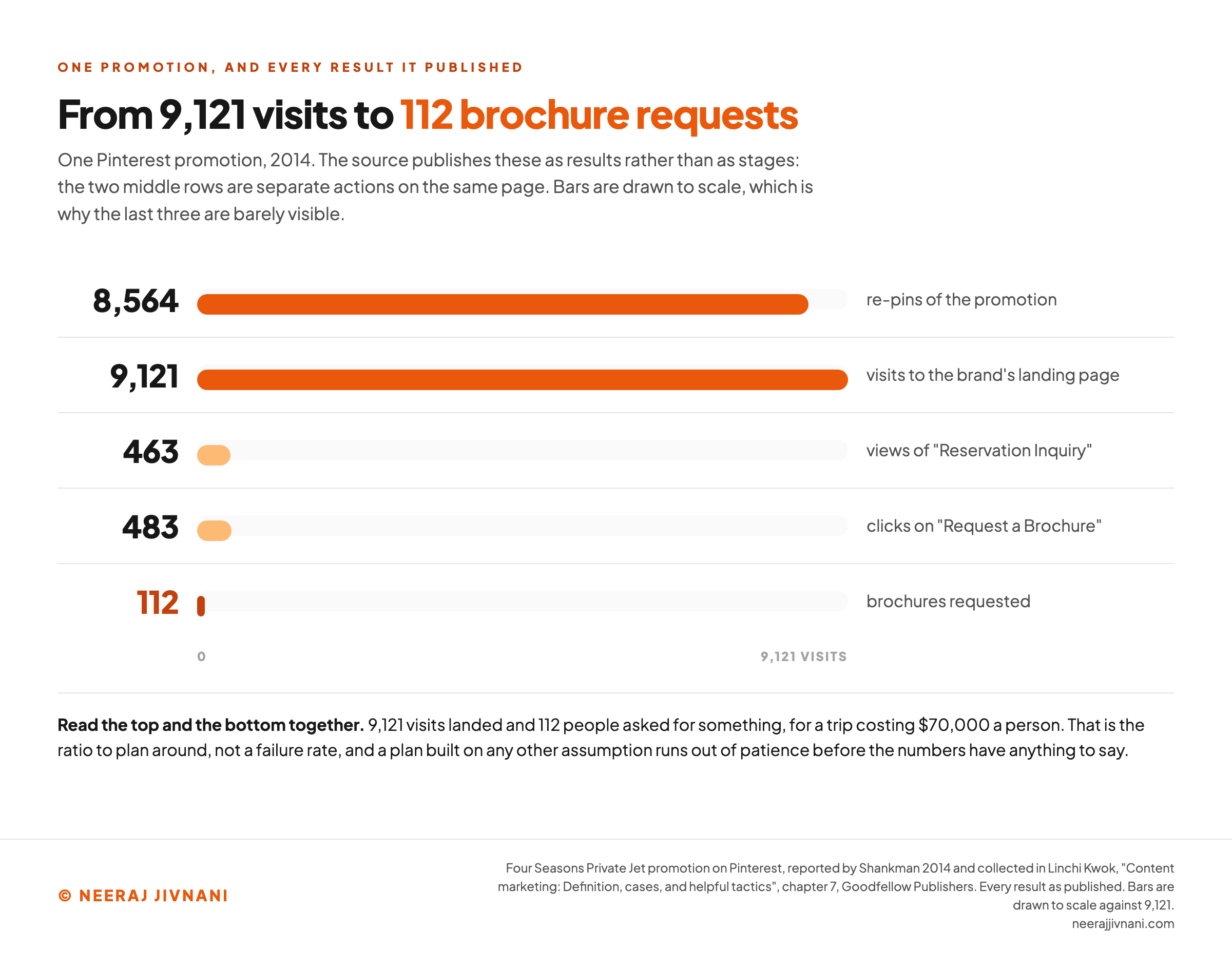
Four Seasons pinned a promotion for a private jet trip and recorded what followed. The promotion drew 8,564 re-pins and 9,121 visits to the brand's landing page.
It also recorded 463 views of the reservation inquiry, 483 clicks on the request-a-brochure button, and 112 people asking for the brochure, for a trip costing $70,000 a person.
Read the top against the bottom and the shape of the discipline is visible. Nearly everyone who arrived did nothing. The handful who acted are the entire return.
The numbers in it belong to different moments: the re-pins measure awareness, and the brochure requests measure closing.
That shape is not a failure rate. It is the ratio to plan around, and a plan built on any other assumption runs out of patience before the numbers have anything to say.
Use this chart — embed code and citation
<a href="https://neerajjivnani.com/blog/content-marketing/"><img src="https://neerajjivnani.com/infographics/content-marketing/four-seasons-cascade.png" alt="A chart of the Four Seasons Pinterest promotion reported by Shankman in 2014, showing 8,564 re-pins and 9,121 landing page visits against 463 inquiry views, 483 brochure clicks and 112 brochure requests." width="1200"></a>
<p>Chart: <a href="https://neerajjivnani.com/blog/content-marketing/">Neeraj Jivnani</a></p>Neeraj Jivnani, "Content Marketing: How It Works, What It Costs, and What to Expect", neerajjivnani.com, https://neerajjivnani.com/blog/content-marketing/Free to republish with a link back to this page.
What Counts as Content Marketing, and What Does Not
Content marketing gets confused with three neighbors, and the difference decides who you should be talking to about it.
Advertising rents attention. You pay for a placement and the placement runs. The attention stops on the day the payment does.
Content marketing earns attention instead. That is slower, and you own the result rather than renting it.
Content strategy is the plan behind the work: who it is for, who owns it, and when it is retired.
Content management is the software and process that stores, versions and publishes the result, such as the system your website runs on.
A useful test is which noun the question needs. What to publish next month is content marketing, who approves it is strategy, and where the file lives is management.
Where the Published Definitions Disagree
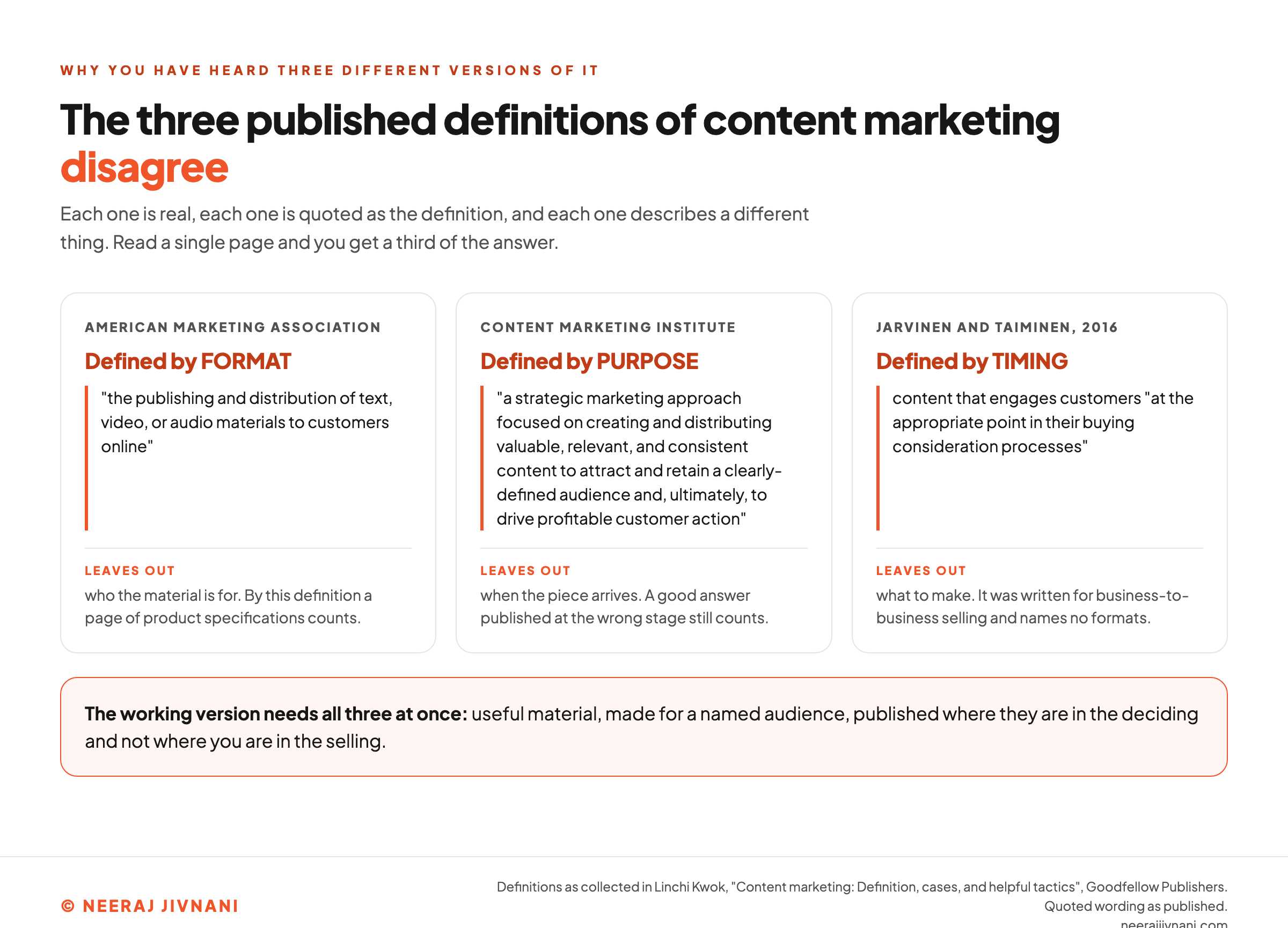
The published definitions each pick one part of the job and leave the others out, which is why you have probably read three different versions of this. Linchi Kwok's chapter sets three of them side by side.
One defines it by format: "the publishing and distribution of text, video, or audio materials to customers online". That is the American Marketing Association's, as Kwok quotes it.
One defines it by purpose: attract and retain a clearly defined audience, then drive profitable customer action. That is the Content Marketing Institute's.
One defines it by timing, asking that a piece reach a customer at the point they are weighing the decision. That is Jarvinen and Taiminen's, written in 2016 for business-to-business selling.
Distrust the format definition on its own.
Material with no named audience is publishing, and material with no sense of when it arrives is publishing on a schedule.
The Three C's, Answered Plainly
There is no standard three C's of content marketing. People ask constantly and no authority publishes an answer.
The closest real thing is the American Marketing Association's three key elements: content creation, content distribution and content engagement. Creation is the piece, distribution is how it reaches anyone, and engagement is the interaction that tells you whether it landed.
Any triad you find under the three C's name is somebody's teaching device. Use it if it helps you remember something, and do not quote it as though it were settled.
Digital Content Marketing Is a Different Job
Digital content marketing shares most of a name and almost none of the work. Rowley defined it in 2008 as a management process for satisfying customer requirements "in the context of digital content", meaning bit-based products distributed through electronic channels.
Those products are e-books, paid academic articles, ringtones and pay-per-view video.
Marketing one of those is not the same job as publishing an article to attract the people who might buy it.
If a number you are reading feels strange for the subject, check which of the two it was measuring. Some studies mix them up, as Kwok's chapter warns.
Use this chart — embed code and citation
<a href="https://neerajjivnani.com/blog/content-marketing/"><img src="https://neerajjivnani.com/infographics/content-marketing/three-definitions.png" alt="Three cards comparing the published definitions of content marketing, showing that the American Marketing Association defines it by format, the Content Marketing Institute by purpose, and Jarvinen and Taiminen by timing in the buying process." width="1200"></a>
<p>Chart: <a href="https://neerajjivnani.com/blog/content-marketing/">Neeraj Jivnani</a></p>Neeraj Jivnani, "Content Marketing: How It Works, What It Costs, and What to Expect", neerajjivnani.com, https://neerajjivnani.com/blog/content-marketing/Free to republish with a link back to this page.
Why Bother With It
Why bother, when buying attention is faster? Because published work keeps arriving and rented attention does not.
Published work buys three things, and none of them is free:
- It compounds. A piece that answers a real question keeps answering it for as long as people keep asking, including through a quarter when you have stopped spending.
- It reaches people who are not looking for you yet. Somebody with a problem they have not yet named will never search for your product. They will search for the problem.
- It earns the right to be believed. Being useful before you ask for anything does work that a cold pitch has to do twice over.
Now the prices. The returns arrive slowly.
The work needs somebody producing on a schedule, which is a salary rather than a license fee. And none of it rescues a product nobody wants.
The Formats, and What Each One Costs to Keep Making
Pick the formats you can keep making, not the ones that perform best on a chart. The question is usually asked the other way around, and that is why so many plans stall before they have produced anything worth judging.
Two columns decide that: what one more piece costs, and how long a single piece keeps working. A video costs about the same on its tenth outing as on its first. A blog post gets cheaper as you learn the subject.
Nine formats, with those two columns attached.
| Format | What it is good for | What it costs to keep making | How long one piece keeps working |
|---|---|---|---|
| Blog post | Answering a question somebody typed | Low money, steady writing time | Years, while the question is still asked |
| Video | Showing a process, a place or a person | High, and it stays high per piece | Months on search, hours on a feed |
| Social post | Reaching people who are not searching | Low each, heavy in volume | Hours, sometimes a day |
| Podcast | Depth with an audience that returns | Moderate money, high scheduling load | A long tail, small per episode |
| Infographic | Making one finding obvious at a glance | High per piece, mostly design | Years, and it earns links while it lives |
| Reaching people who already said yes | Low, once a list exists | One send, unless it is built as a series | |
| White paper | Justifying a considered purchase | High, research plus design | A year or two, until the data ages |
| Interactive content | Letting a reader use their own numbers | Highest, and it needs maintenance | Years, and it keeps being cited |
| Expert or thought leadership | Taking a position worth quoting | Moderate money, expensive attention | Years, while the position holds |
Why the Cost Column Decides It
A purpose tells you what a format is for. It does not tell you whether you will still be making it in March.
The cost column is where plans die.
A format you can produce once and cannot produce every week is a format you have not chosen yet.
Storytelling is not a format on that list. It is what the video and podcast rows are for, and it is most of the reason those two cost what they do.
Start with two formats you can sustain rather than five you cannot. The second one exists for a single reason. A bad week in the first should not stop everything.
How to Start
Starting content marketing is not writing a plan document, because almost everybody already has one. In the Content Marketing Institute and MarketingProfs survey of 1,015 B2B marketers, 97% said they have a content strategy.
What improved things for them was refining it. Among those in the same survey who reported their strategy improved over the year, 74% pointed to refining the strategy, ahead of new technology at 51% and team restructuring at 40%.
So the thing that matters is what the plan decides, not that it exists.
The Decisions, in the Order a Plan Forces Them
There are six, and you will revise every one of them as you learn.
- Who it is for. Name one audience you can describe without a persona document. Some competitor analysis helps here, mostly to see which questions are already answered well.
- What each piece is for. Awareness, consideration or closing, decided before it is written rather than argued about after.
- Which formats. From the cost column, not the performance column.
- The cadence you can hold. Pick the calendar you will still keep in month six, not the one that looks right in week one. It is where the cost column stops being theoretical, and it is worth being pessimistic about.
- Where it goes after publishing. Decide the distribution before you write, because it changes the piece.
- The one number you will judge it by. Choose it now, while nothing is riding on it.
Personalization Is Smaller Than It Sounds
Personalization is one more decision, and a smaller one than it is usually made to sound. In the same Content Marketing Institute and MarketingProfs survey, 89% say their organizations personalize content and 59% describe that as basic personalization in one or two channels.
The basic version carries most of the value.
Naming the reader and sending them the thing they asked about is the whole of it, and everything past that is a project competing with the work itself.
Where a Piece Goes After You Publish It
Distribution is not what happens to a piece afterwards. It is a property of the piece, and each channel asks for something different.
Search wants a piece that answers a question completely enough that nobody returns to the results. That is a discipline of its own, search engine optimization (SEO), and what it asks of the piece is depth.
Social wants a piece that makes sense without a click. The value has to be visible in the post, which usually means the piece is rebuilt for the channel rather than linked from it.
An email list wants a piece written for people who already said yes. It can assume context a search visitor does not have. That is the one case where shorter is better.
Promotion follows what is easy to start rather than what works. A Semrush breakdown cited by Copyblogger had 73% posting organically on social media, 53% sending emails, 51% using paid social ads and 33% optimizing for organic traffic.
That order tracks effort, not effect.
What Content Marketing Costs to Run
Formats cost you effort, one piece at a time. Running the whole thing costs money, every month, and the line that repeats is a person rather than a piece of software.
Budgets cluster in the low thousands a month rather than the tens of thousands. Copyblogger, summarizing a Semrush study in an undated post, puts 39% of companies between $1,000 and $5,000 a month, 33% above $5,000, and 27% under $1,000.
Treat that as a shape rather than a rate. It gives you the order of magnitude, which is what you need before you plan anything.
Asked which top three areas they plan to increase investment in during 2026, the 1,015 marketers in the Content Marketing Institute and MarketingProfs survey named eleven. The top of that list, and the bottom of it:
- 45% named AI-powered marketing tools, the largest single item on the list.
- 9% named human resources, meaning salaries, training and development, and it is last of the eleven.
More of them plan to add budget to the tools that make content than to anything else on the list, and fewer to the people who make it.
Set your own budget the other way round. The tools do not produce anything on their own, and the person does.
Does Content Marketing Pay Well?
Content marketing pays what its employers are willing to fund, and the list above is where to look. Resource constraints of time, people and budget are a top-three challenge for 39% of the same respondents, in the Content Marketing Institute and MarketingProfs survey.
A field that names people as its constraint and funds them last is unlikely to be one where pay is being bid up, whatever the demand for the work looks like.
What It Returns, and How Soon
Content marketing returns moderate effectiveness, not a multiple, and it returns it in quarters rather than weeks.
How soon a number can be read matters as much as the number itself. Judge a piece too early and you will conclude the wrong thing about work that was going fine.
What Marketers Report
The realistic outcome is somewhat effective. That is the single largest group, and the share reporting anything stronger is small.
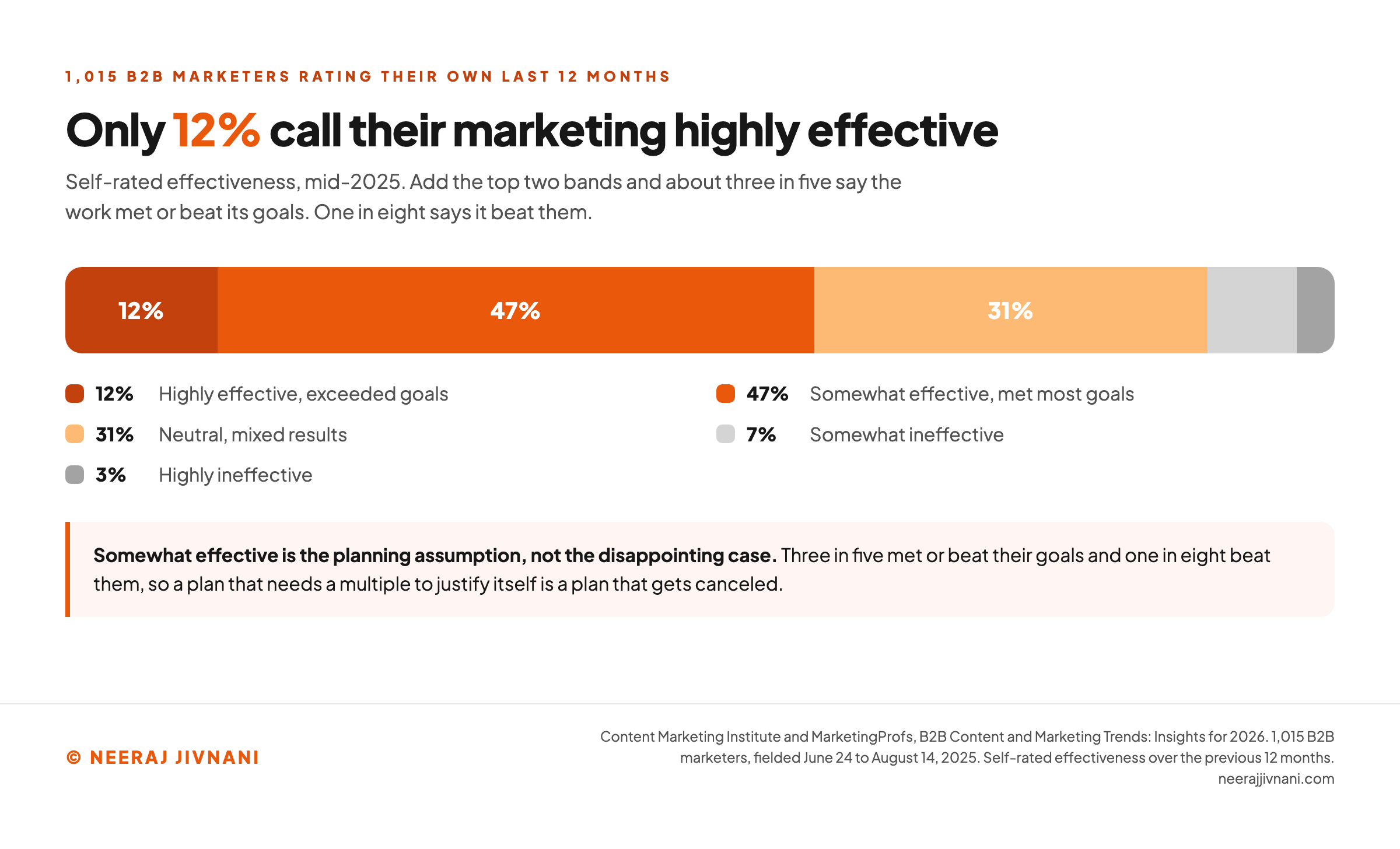
Asked to rate their effectiveness over the previous 12 months, the 1,015 B2B marketers surveyed by the Content Marketing Institute and MarketingProfs in mid-2025 split like this. 12% said highly effective, which the survey defines as exceeding their goals. Another 47% said somewhat effective, meaning they met most of them.
The rest said neutral at 31%, somewhat ineffective at 7% and highly ineffective at 3%.
So roughly three in five report the work met or beat its goals. We would take that as the planning assumption rather than the disappointing case. A plan that needs a multiple to justify itself is a plan that gets canceled.
What stops this work is almost never a shortage of ideas. Asked for their top three challenges, 40% named creating content that prompts a desired action, 39% named resource constraints of time, people and budget, and 33% named measuring content effectiveness.
Where AI Moved the Numbers, and Where It Did Not
AI changed how fast content gets made and left the results roughly where they were. In the same survey, 95% of B2B marketers said their organizations use AI-powered applications.
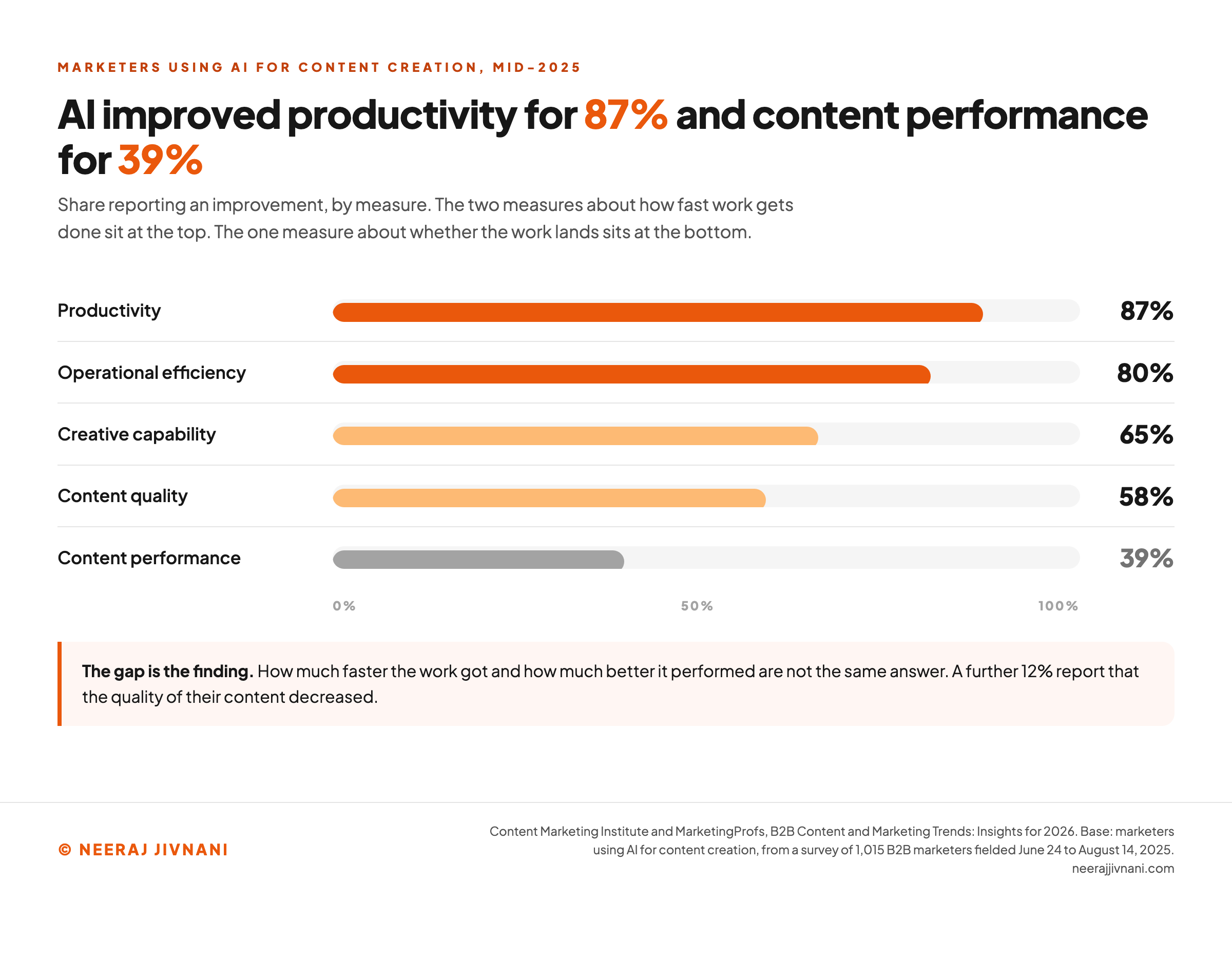
Among those using it for content creation, 87% said productivity improved and 80% said operational efficiency improved. The deeper measures moved less.
On creative capability 65% reported an improvement. On content quality 58% did, and on content performance 39% did. Another 12% said the quality of their content decreased.
The gap between 87% on productivity and 39% on performance is the whole finding. Content got cheaper to produce without getting proportionally better at its job, which suggests the constraint was never how fast you can write.
Which Numbers Can Mean Anything Yet
Most of the numbers you will be shown early cannot mean anything yet, and knowing which is which saves a lot of arguing. Three groups behave differently.
Within weeks you can read production and reception: pieces shipped against plan, people arriving, time on the page, and which pieces got shared. Those numbers say whether the machine is running. They do not say whether it is working.
Within quarters you can read search visibility, returning readers, and the share of arrivals that convert later. That is the window in which the work either starts compounding or does not.
Some outcomes never attribute cleanly.
A reader who found an article, forgot it, and bought eight months later is a real result and an unreadable one.
Before you commit to a number, check that it can answer the question you are about to ask it.
Check the number before you commit to it
Pick the moment the piece you are about to publish is aimed at, and the number you were going to judge it by. That pairing is the sixth decision a content plan is made of, and this is the moment to make it, while nothing is riding on it.
Its job is to be found, and be worth the time of someone who does not know you exist.
Often never attributes cleanly at all.
This is the category error
Awareness content cannot close a sale, so revenue is not a verdict on it. It is a verdict on everything that happened afterwards.
- Reads itPeople arriving, readable within weeks.
- Reads itTime on the page, readable within weeks.
- Reads itWhich pieces got shared, readable within weeks.
- Reads itSearch visibility, readable within quarters, and not before.
Use this chart — embed code and citation
<a href="https://neerajjivnani.com/blog/content-marketing/"><img src="https://neerajjivnani.com/infographics/content-marketing/effectiveness-split.png" alt="A stacked bar of self-rated marketing effectiveness among 1,015 B2B marketers surveyed in mid-2025, with 12% highly effective, 47% somewhat effective, 31% neutral and the rest ineffective." width="1200"></a>
<p>Chart: <a href="https://neerajjivnani.com/blog/content-marketing/">Neeraj Jivnani</a></p>Neeraj Jivnani, "Content Marketing: How It Works, What It Costs, and What to Expect", neerajjivnani.com, https://neerajjivnani.com/blog/content-marketing/Free to republish with a link back to this page.
Use this chart — embed code and citation
<a href="https://neerajjivnani.com/blog/content-marketing/"><img src="https://neerajjivnani.com/infographics/content-marketing/ai-gap.png" alt="Paired bars showing that among B2B marketers using AI for content creation, 87% report improved productivity while only 39% report improved content performance, with creative capability and content quality in between." width="1200"></a>
<p>Chart: <a href="https://neerajjivnani.com/blog/content-marketing/">Neeraj Jivnani</a></p>Neeraj Jivnani, "Content Marketing: How It Works, What It Costs, and What to Expect", neerajjivnani.com, https://neerajjivnani.com/blog/content-marketing/Free to republish with a link back to this page.
What to Expect
Expect a sustained plan to make you somewhat effective, on a timescale measured in quarters. The thing to plan around is capacity: the work stops when nobody has the time to keep making it.
You need this if the people you sell to research before they buy, and you do not if they do not. Everything else follows from two answers: who it is for, and what you can keep making every week without dreading it.