The Marketing Funnel: Its Stages, and How Many Yours Should Have
See what each stage of your funnel is for, what to count inside it, and how to decide how coarse or fine your own funnel should be.

/ On this page12 sections
A marketing funnel splits the path from stranger to customer into stages, so you can see which stage is losing people.
Three questions decide whether yours is worth having: what each stage means, what to count inside it, and how many stages to draw.
The published models disagree on all three. Some run three stages and some run six.
The longer ones are not more accurate, only more subdivided.
What a Marketing Funnel Is
A marketing funnel is a model that divides the path to a purchase into ordered stages, each holding fewer people than the one above it, so a business can plan and measure each stage on its own terms.
The shape is not a claim about psychology. Any process with steps loses people at every step, so the population narrows.
Say a company selling accounting software runs an advertisement. Fewer people click it than see it, fewer of those ask for a quote, and fewer still buy.
That narrowing is the funnel, and nobody had to believe anything about desire for it to happen.
What the funnel is not is a description of how one person buys. Nobody experiences an awareness phase.
They see something, forget it, see it again, ask a friend, and buy eight months later on a Tuesday.
The funnel is what that looks like from the outside, across thousands of people, once you group them.
What a Funnel Is For
A funnel does two things that are hard to do without one.
The first is that it turns one bad number into a located number.
"Sales are down" is not something you can act on. "Sales are down and the number of people reaching the pricing page is flat" is.
The second is that it gives each activity a fair test.
A conference talk and a discount code are both marketing, and one shared number will always flatter the discount code.
Once each stage has its own job, the talk is measured on whether more of the right people entered the funnel, and the code on whether more of the people already at the bottom finished.
Most arguments about which channel to cut are arguments about which stage that channel was supposed to serve.
The Stages, and Why Nobody Agrees How Many There Are
The number of stages in a funnel is a choice you make, not a fact about buying that somebody discovered.
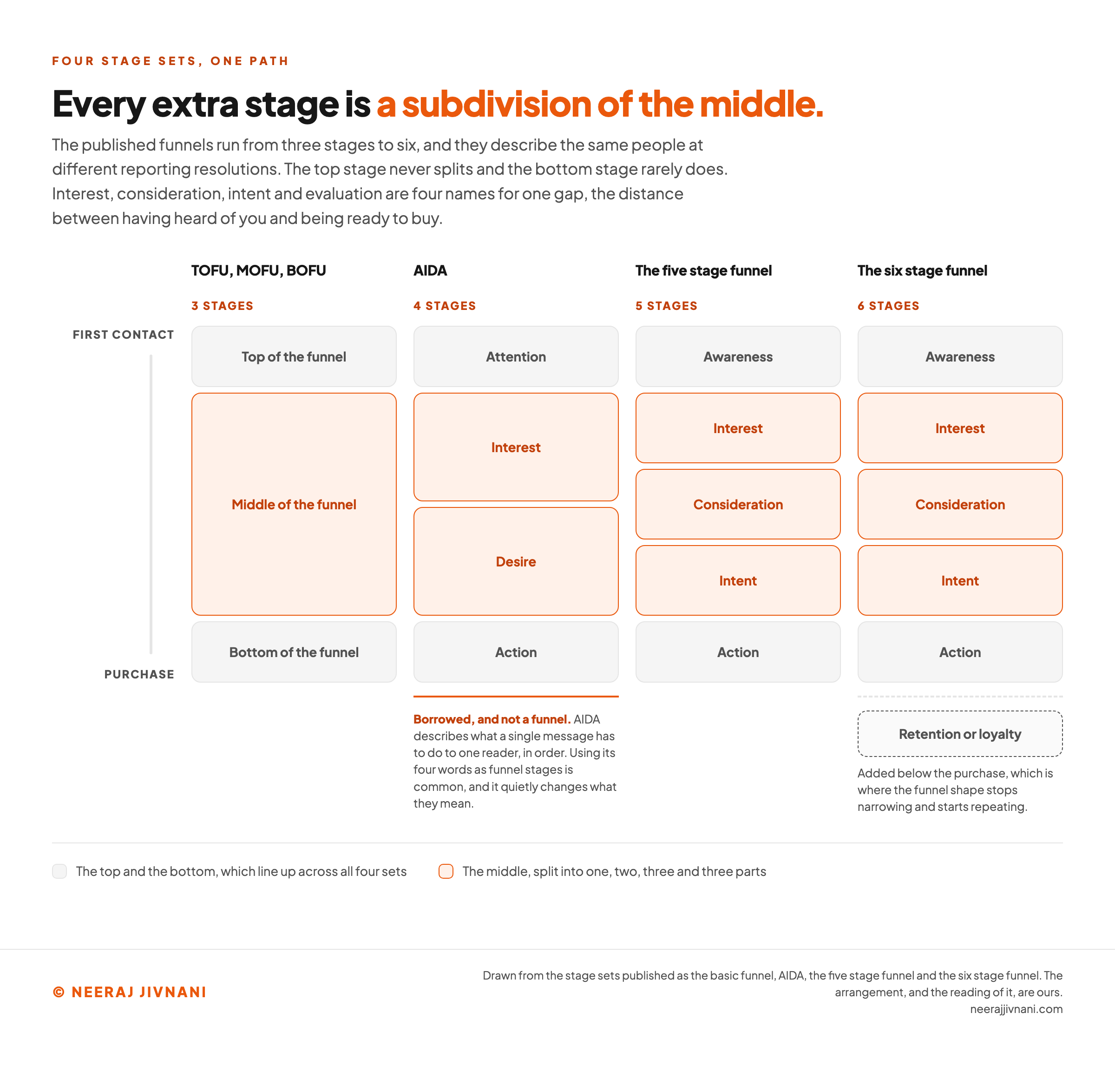
That is why the published versions run from three to six and all of them work. They are different reporting resolutions on one path.
A three-stage funnel and a six-stage funnel built on the same business describe the same people. One of them draws more lines across the middle.
So the question is never which model is correct. It is how fine a resolution your own data can support.
Three Stages: Top, Middle and Bottom
The three-stage funnel is the working default, and it is the right starting point for a team building its first one.
The three are top of the funnel (TOFU), middle of the funnel (MOFU) and bottom of the funnel (BOFU).
Top of the funnel holds everybody who has encountered you and has no intention yet. They arrived from a search, a post, an advertisement or somebody's recommendation.
Middle of the funnel holds people who know you exist and are weighing whether you solve their problem. They are reading, comparing and asking questions.
Bottom of the funnel holds people who intend to buy something and are deciding what, and from whom.
Three works because it maps onto three different jobs, three kinds of material and three budgets.
It is also the smallest number of stages that still tells you something when one of the numbers moves.
The Five and Six Stage Versions
The five stages of the marketing funnel, as they are most commonly named, are awareness, interest, consideration, intent and action.
Six-stage versions keep those five and add a stage after the purchase, usually called retention or loyalty. Some replace intent with evaluation, or split action into purchase and repeat purchase.
Look at what the extra stages are doing and a pattern appears at once. The top stage never splits, and the bottom stage rarely does.
Interest, consideration, intent and evaluation are four names for one gap: the distance between having heard of you and being ready to buy.
That gap is the longest part of the path and the part with the least evidence in it, which is why it attracts more labels. Nobody can see it, so anybody can divide it.
This matters practically.
If you cannot tell a person at "consideration" from a person at "intent" using anything in your records, you do not have two stages. You have one stage with two names.
The Named Models, and What Each One Adds
Several named models circulate, and they differ in what they add rather than in what they claim. The table below is the short version of each.
| Model | Stages | What it adds | When it earns its place |
|---|---|---|---|
| TOFU, MOFU, BOFU | 3 | Nothing, and that is the point | Almost always, as the default |
| AIDA (attention, interest, desire, action) | 4 | A sequence for one message | Writing a single page, email or advertisement |
| The five-stage funnel | 5 | Splits the middle into interest, consideration and intent | You can tell those three apart in your data |
| The six-stage funnel | 6 | A stage after the purchase | Subscriptions, renewals, anything where the second sale matters more than the first |
| See, Think, Do, Care | 4 | Intent bands you can target advertising against | Planning paid media rather than reporting on it |
| The flywheel | A loop, not stages | Removes the ending, so customers feed the top | Referral is a real source of your new business |
| The bowtie | 3 plus 3 | Mirrors the funnel after the sale, into adoption and expansion | Revenue after the first contract is most of your revenue |
AIDA (attention, interest, desire, action) needs one clarification, because it gets used as a funnel and it is not one.
It describes what a single message has to do to one reader, in order.
A funnel describes a population moving through stages over weeks. Borrowing AIDA's four words as funnel stages is common, and it quietly changes what they mean.
How Many Stages Yours Should Have
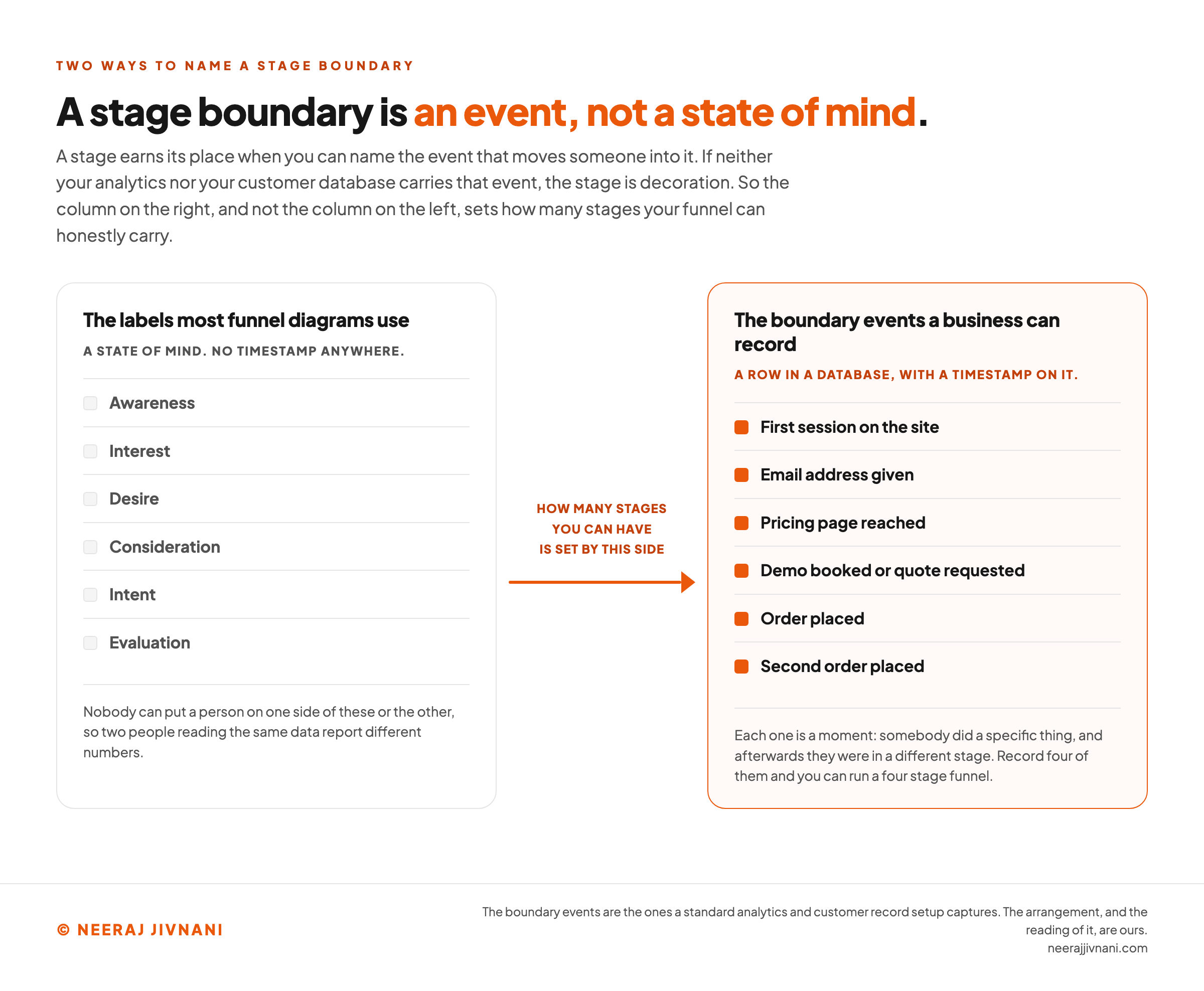
Use the smallest number of stages whose boundaries you can name as events, and where your systems record those events.
The test is stricter than it sounds.
A stage boundary is a moment: somebody did a specific thing, and afterwards they were in a different stage.
Six such moments come up again and again, and a business with a website and a customer record can usually check for all six.
- First session on the site
- Email address given
- Pricing page reached
- Demo booked or quote requested
- Order placed
- Second order placed
Each one is a row in a database with a timestamp on it. Awareness, interest, desire and intent are not.
So work backwards from the events. If your setup records four of those moments, you can run a four-stage funnel and every number in it will mean something.
If it records two, you have a two-stage funnel, and drawing six will produce four stages nobody can populate.
Three or four stages is the honest answer for a business with one product and one analytics setup. Anything more is a diagram rather than a report.
The funnel your records can support
Tick the boundary events that already carry a timestamp in your analytics or your customer records, and mark any pair you cannot tell apart. It draws back the funnel those events support.
Nothing to draw yet
First session on the site
Email address given
Pricing page reached
Demo booked or quote requested
Order placed
Second order placed
Nothing here carries a timestamp yet. Every stage you drew would be decoration, because there is no event to move anybody into it.
Use this chart — embed code and citation
<a href="https://neerajjivnani.com/blog/marketing-funnel/"><img src="https://neerajjivnani.com/infographics/marketing-funnel/every-extra-stage-is-the-middle.png" alt="Four published stage sets drawn side by side on one shared vertical axis running from first contact at the top to purchase at the bottom: the three stage top, middle and bottom version, the four stage AIDA (attention, interest, desire, action) version, the five stage awareness, interest, consideration, intent and action version, and the six stage version that adds retention below purchase. The top band and the bottom band line up across all four, while the middle band is split into one, two, three and three parts respectively, so the highlighted middle shows that every extra stage before the purchase subdivides the same span between having heard of you and being ready to buy. A note under the AIDA column records that AIDA is borrowed as a funnel and is not one, because it describes what a single message has to do to one reader, so using its four words as funnel stages quietly changes what they mean." width="1200"></a>
<p>Chart: <a href="https://neerajjivnani.com/blog/marketing-funnel/">Neeraj Jivnani</a></p>Neeraj Jivnani, "The Marketing Funnel: Its Stages, and How Many Yours Should Have", neerajjivnani.com, https://neerajjivnani.com/blog/marketing-funnel/Free to republish with a link back to this page.
Use this chart — embed code and citation
<a href="https://neerajjivnani.com/blog/marketing-funnel/"><img src="https://neerajjivnani.com/infographics/marketing-funnel/a-stage-is-an-event.png" alt="Two column comparison titled so it reads alone. The left column lists the stage labels most funnel diagrams use, awareness, interest, desire, consideration, intent and evaluation, each marked as a state of mind with no timestamp available. The right column lists the corresponding boundary events a business can record, first session on the site, email address given, pricing page reached, demo booked or quote requested, order placed and second order placed, each marked as a database row with a timestamp. An arrow between the columns shows that the number of stages a funnel can honestly carry is set by the right column, not the left." width="1200"></a>
<p>Chart: <a href="https://neerajjivnani.com/blog/marketing-funnel/">Neeraj Jivnani</a></p>Neeraj Jivnani, "The Marketing Funnel: Its Stages, and How Many Yours Should Have", neerajjivnani.com, https://neerajjivnani.com/blog/marketing-funnel/Free to republish with a link back to this page.
What Happens at Each Stage
Each stage holds a different group of people, is entered by a different event, and can be judged on a different number.
Getting those three right, stage by stage, is most of the work of running a funnel, and success at one stage is not success at another. It is also where disagreements inside a team usually turn out to be located.
Top of the Funnel
The top is the one stage you cannot count properly. Everybody who has met you and has no intention yet is in it, and much of that contact leaves no trace you can find.
Somebody who reads half a page and closes it has met you. Nothing in your records says so, and no proxy you pick will ever say so.
So the top's number is always a proxy: first sessions, impressions, reach, brand mentions. Pick one and keep it, because switching proxies halfway through a year destroys every comparison you had.
What feeds the top is anything aimed at a problem the reader already has: search results, social posts, video, ads, public relations and word of mouth.
The boundary out of the top is the first moment somebody becomes identifiable or comes back. A return visit, a follow, a subscription, an email address.
The Middle of the Funnel
The middle holds people who know you exist and have decided nothing, and it is the stage most funnels get wrong.
It goes wrong because it gets defined by what somebody is thinking rather than by what they did. "Considering us" has no timestamp.
So pick the one event that means somebody moved from browsing to evaluating. A pricing page reached, a comparison page opened, a reply sent, a second visit inside a week.
That event is the middle's entry, and it is what makes the middle countable at all.
Content marketing earns its place here, answering the questions somebody asks between a first visit and a quote. What it costs, what it does not do, and who else is already using it.
The middle is also the longest stage in most funnels, which is why marketing automation lives here, in sequences and reminders.
Bottom of the Funnel
The bottom holds people who have signaled that they intend to buy, and it is the smallest stage with the most information in it.
Its entry should be an action rather than an inference. Somebody asked for a quote, opened the checkout, or booked a call.
Its exit is the order, which is the one stage boundary nobody in a company argues about.
What belongs at the bottom is the answer to the last objection. Terms, delivery, security, refunds, and what happens the day after the order.
Everybody at this stage has already spent time getting to you, so the things that move this number are small and specific. A missing answer, an unclear term, a step that asks for something people do not have to hand.
After the Sale
The funnel shape breaks after the purchase, and every model that adds a stage there is patching the same hole.
A funnel narrows. Retention does not narrow, it repeats.
That is why the flywheel and the bowtie exist as alternative pictures rather than as a sixth stage.
Put it on the report anyway, whatever you draw. Repeat purchase, renewal, expansion and referral all raise the same question the rest of the funnel asks, which is how many of the people who reached this point went on to the next one.
What to Measure at Each Stage
Every stage carries two metrics: how many people are in it, and what share of them went on. After the sale, going on means buying again rather than moving down.
The count tells you about volume. The rate tells you about fit.
A stage with a growing count and a falling rate is filling with the wrong people.
The Two Numbers, Stage by Stage
Every row below names the count, the rate, and the reading a bad rate usually deserves. This is the three-stage version with the after-sale row added.
The fourth column is the part worth arguing about internally, because a rate can fall for reasons that sit one stage above it.
| Stage | The count | The rate | What a bad rate here usually means |
|---|---|---|---|
| Top | People who reached you for the first time in the period | Share who came back or gave you a way to reach them | You are reaching people, and they are the wrong people |
| Middle | People with an identifier who engaged again | Share who reached a buying page or asked | Your material answers questions nobody is asking yet |
| Bottom | People who reached a buying page or asked to talk | Share who bought | Something at the point of purchase is unclear, missing or frightening |
| After | Customers in the period | Share who bought again | The first sale was sold harder than it was fit |
Two Rules That Keep the Numbers Honest
Write the definition of each stage boundary down, in a sentence, before you build the report. Whatever that sentence says is what the number means, from then on.
And read the stages together rather than separately.
Take a quarter where top-of-funnel volume doubled and the bottom-of-funnel rate fell by a point. More people arrived, a different mix of them reached the bottom, and the rate moved for a reason that has nothing to do with the buying page.
Read alone, that rate looks like a broken checkout. Read next to the stage above it, it looks like a successful quarter.
Why the Funnel Survives Even Though Nobody Buys That Way
The usual criticisms of the funnel are correct, and none of them is a reason to stop using one.
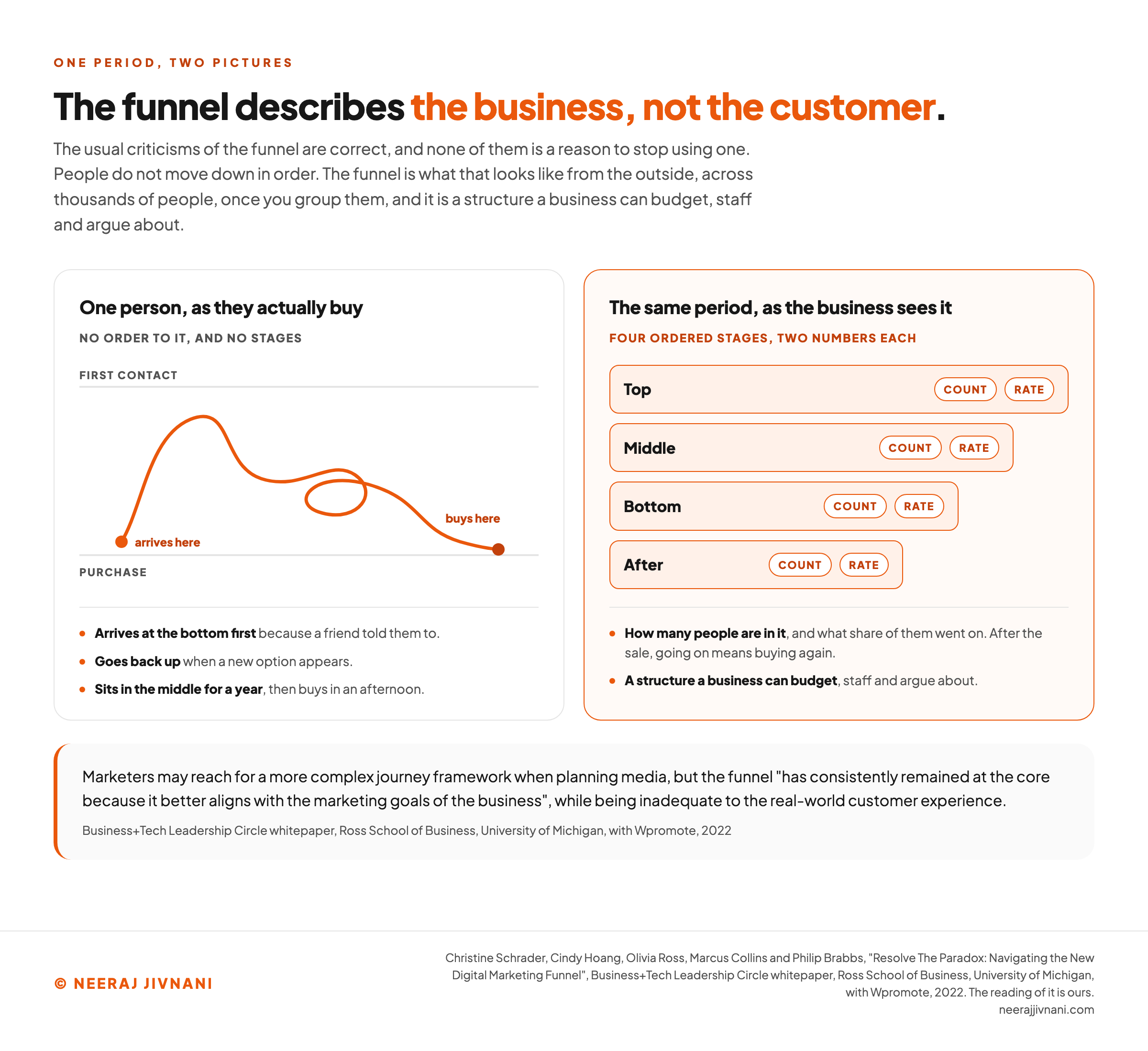
People do not move down in order. They arrive at the bottom first because a friend told them to.
They go back up when a new option appears. They sit in the middle for a year and then buy in an afternoon.
The funnel survives anyway because the picture is drawn for the business. It matches how a company sets goals, funds work and holds a team to a number, and a faithful map of one person's path does none of that.
That trade is made openly. The funnel "has consistently remained at the core because it better aligns with the marketing goals of the business", says a 2022 whitepaper from the University of Michigan's Ross School of Business, written with the agency Wpromote.
The same paper calls the funnel inadequate to the real-world customer experience, and both things are true at once. The funnel is a reporting structure a business can budget, staff and argue about.
The customer journey is what the customer does.
Those are two different objects, and you need both, for different purposes.
So keep the funnel for planning and reporting. Stop defending it as a description of buying, because it is not one and it does not need to be.
Use this chart — embed code and citation
<a href="https://neerajjivnani.com/blog/marketing-funnel/"><img src="https://neerajjivnani.com/infographics/marketing-funnel/why-the-funnel-survives.png" alt="Two panels side by side under a title stating the finding, that the funnel describes the business rather than the customer. The left panel draws one real buying path as a looping line that enters near the bottom on a referral, moves back up when a new option appears, circles in the middle for a year and only then reaches the purchase. The right panel draws the same period as the business sees it, a stack of four ordered stages with a count and a rate against each, which is a structure a business can budget, staff and argue about. A caption records that a 2022 Business+Tech whitepaper from the Ross School of Business at the University of Michigan, written with Wpromote, finds the funnel has remained at the core of planning because it better aligns with the marketing goals of the business." width="1200"></a>
<p>Chart: <a href="https://neerajjivnani.com/blog/marketing-funnel/">Neeraj Jivnani</a></p>Neeraj Jivnani, "The Marketing Funnel: Its Stages, and How Many Yours Should Have", neerajjivnani.com, https://neerajjivnani.com/blog/marketing-funnel/Free to republish with a link back to this page.
Marketing Funnel Versus Sales Funnel
A marketing funnel counts an anonymous audience narrowing into identified people. A sales funnel counts named opportunities that a salesperson is working.
The units are different, which is the part that gets missed.
A marketing funnel's stages are things a person did. A sales funnel's stages are things a deal reached: qualified, proposal sent, negotiation, closed.
They meet at one point, and that point is where most of the argument inside a company happens.
Marketing hands over somebody it believes is ready. Sales decides whether that person counts.
Two teams looking at the same handoff will report different numbers unless the boundary event is written down.
A business with no sales team has no sales funnel. Its marketing funnel runs all the way to the order.
B2B and B2C Funnels Are Not the Same Shape
Business-to-business and business-to-consumer funnels differ in the middle, and the difference is large enough to change how you build the thing.
A B2C funnel is often short, and sometimes it has no middle at all. Somebody sees a product, wants it, and buys it in the same session, so the top and the bottom are minutes apart.
A B2B funnel has a middle that can run for months, with more than one person inside it.
Several people evaluate, one signs, and none of them is required to identify themselves while they are looking.
Two practical consequences follow.
First, a B2B middle needs stages that do not depend on one individual advancing, because progress often happens between people you never see.
Second, "lead" means different things on each side, and what you count as one decides your cost per lead as much as what you spend does.
In B2C a lead is usually somebody close to buying. In B2B a lead can be one researcher on a team that has not started a budget conversation.
Where a business sells to both, run two funnels rather than averaging them. An average of a two-minute path and a nine-month path describes neither.
Building Your Own, in Order
Five steps, in this order, and the order is the part that saves the work.
- Name the audience. Who this funnel is for, specifically enough that you could say who it excludes. A funnel built for everybody has no stages that mean anything.
- Write the ending first. Name the single action that counts as the conversion. Everything above it exists to produce more of that action.
- List the events you already track. Not the ones you could add. Open your analytics and your customer records and write down what already carries a timestamp.
- Draw the stages between those events. One stage per boundary you can record. If two events always happen together, they are one boundary.
- Put one count and one rate on each stage, and write the definition of each boundary in a sentence.
Then leave it alone for a quarter.
A funnel with three months of history in it tells you something. A funnel redefined every month tells you nothing, because every comparison crosses a definition change.
Where Funnels Go Wrong
Five failures cover most broken funnels. The first two are the same mistake in different clothes, which is drawing a diagram the data cannot fill.
Too many stages. Six stages against three recordable events produces three real stages and three that get filled with guesses.
Stages defined by feelings. If the boundary is "starts to consider us", nobody can put a person on one side of it or the other, and two people will report different numbers from the same data.
Everything judged at the bottom. Measuring top-of-funnel work on sales is how the work that fills the funnel gets cut, after which the bottom empties one cycle later.
Nothing after the purchase. A funnel that stops at the first order cannot show whether anybody came back, so the number that says whether the business compounds is missing from the report.
Treating the diagram as the plan. The funnel says where you are losing people. It is where the work of conversion rate optimization starts, and it is not a strategy on its own.
The 70/20/10 and 3-3-3 Rules, Which Are Not Funnel Models
Both turn up in the same conversations as funnels. Neither one says anything about stages.
The 70/20/10 rule splits a marketing budget three ways, and the three numbers are the split itself.
What belongs in each of the three buckets is not fixed, and people using the phrase mean different things by it.
It sits next to a funnel rather than inside one, because a split like that decides how each stage gets funded.
The 3-3-3 rule has no single accepted meaning in marketing. The name gets attached to several unrelated frameworks, and none of them is a funnel model.
So if somebody uses the phrase, ask which one they mean before agreeing to it.
Keeping the Funnel Honest
A marketing funnel is worth having for one reason. Without it, a business has a single number and no idea which part of its own process produced it.
Build the smallest one your data can support.
The stage labels matter far less than the boundaries. Anyone can argue about whether a person is at consideration or intent, and nobody can argue about whether they booked a demo on the fourteenth.