The AIDA Model: Four Stages for One Message, and What Each One Asks
Attention, interest, desire, action, and what each one asks of your draft. Check one message against all four, and know when the model will mislead you.


/ On this page7 sections
AIDA is a four-part checklist for a single message: attention, interest, desire, action. Learning the four takes a minute.
Using them takes longer, and that is the part worth having: what each stage asks of a draft, how to tell which one your message skips, and where the model stops being trustworthy.
Read it as a completeness check on one page, one email or one advertisement and it earns its place. Read it as a description of how people buy and it will let you down.
What the Four Letters Ask You to Do
The four letters name what one persuasive message has to do in order: stop someone who was not looking for you, hold them, make them want the outcome, and ask for one specific act.
That is the whole model. What follows is what each stage demands of a draft, and how to tell when yours has skipped one.
Attention
Attention is what the first line has to take, and it is taken from someone who was doing something else.
The first A is attention, not awareness, and swapping the words quietly changes what the stage asks of you.
Awareness is a state your reader may already be in. Attention is something your subject line has to win in the moment.
So the test is not whether they have heard of you. It is whether the first thing they see survives a thumb that is already moving.
Interest
Interest is the reason to keep reading, and it has to be about the reader rather than about you.
A message that jumps from a good headline straight to a reason to buy has skipped the step that makes anyone care.
The tell is an opening paragraph that would read identically to every person on your list. If a reader cannot work out in one sentence whether this is about them, there is nothing to hold.
Desire
Desire is wanting the outcome, and that is different from understanding the offer.
Your reader has to be able to picture having the thing, not to admire your description of it.
The tell here is a paragraph that explains the product well and never names what the reader gets to stop doing. Features are understanding. The free Saturday is desire.
Action
Action is a call to action: one specific thing to do, named, with nothing else on the page competing for it.
It is also the stage most drafts drop. A message can take attention, hold it, build real desire, and then end without asking for anything at all.
That is the ordinary ending, and it looks like success right up to the moment nothing happens. The reader agrees with you, and leaves.
Using It on One Page, One Email, One Ad
Use AIDA on one message at a time, and use it to check completeness rather than to predict a sale. That is the scale it was written at, and it is the scale where it holds.
The table below is the whole method, and there is nothing else to it. Take the draft in front of you and answer the middle column.
| Stage | The question to ask of your draft | What a message that skips it does |
|---|---|---|
| Attention | Does the first thing they see stop someone who was not looking for you? | Gets skimmed past by people who would have bought |
| Interest | Is there a reason to keep reading that is about them rather than about you? | Wins the click and loses the reader in the first paragraph |
| Desire | Can they picture having the outcome, not only understand the offer? | Explains itself well and moves nobody |
| Action | Is there one named thing to do, with nothing competing for it? | Ends on interest, and the reader agrees and leaves |
One Email, Walked Through All Four
Say a two-person accounting firm is writing one email to its own list about a new filing deadline. Take the same message against each of the four questions in turn.
Attention. The subject line names the deadline and its date, because that is the one thing in the message a reader who was not thinking about tax will stop for. A subject line about the firm stops nobody.
Interest. The opening line says who the deadline applies to, so a reader can tell in one sentence whether it is about them. That is the difference between a reason to keep reading and a newsletter.
Desire. A sentence about not spending the weekend on it does the third job. What the reader wants is the free Saturday, not the form, and the message has to say the Saturday out loud.
Action. This is where that email usually fails, because it ends with three links: a booking page, a guide, and an invitation to reply.
Three choices is the same as none.
Naming one act, and removing the other two, is the whole of what the fourth stage asks for.
The Same Four Questions on a Landing Page
A landing page fails somewhere else, which is the point of running the four questions across message types rather than memorizing one.
Say a physiotherapy clinic has one page it sends to every referral. That page usually passes attention and interest without trying, because a referral already knows who sent them and why.
It fails at desire, where it lists treatments instead of naming the morning the reader gets out of bed without thinking about it.
Then it fails at action twice over. A page offering a call, a contact form and a phone number has offered nothing, and a page whose only ask sits below three screens of copy has offered it to nobody.
That is why the order matters. Frank H. Dukesmith and his co-author wrote in 1905 that the four "must follow in logical order, or the sale itself will die in the making if any of these elements are missing".
Your draft, against the four states
Take the message in front of you, one page or one email or one advertisement, and answer the four questions in order. Each one is the question this model asks at that stage.
What the checklist says back
Nothing ticked yet. Answer the four for your own draft, in order, and this reads back where the message stops.
What the AIDA Model Cannot Tell You
AIDA can tell you a message is complete. It cannot tell you the message will sell, and it never could.
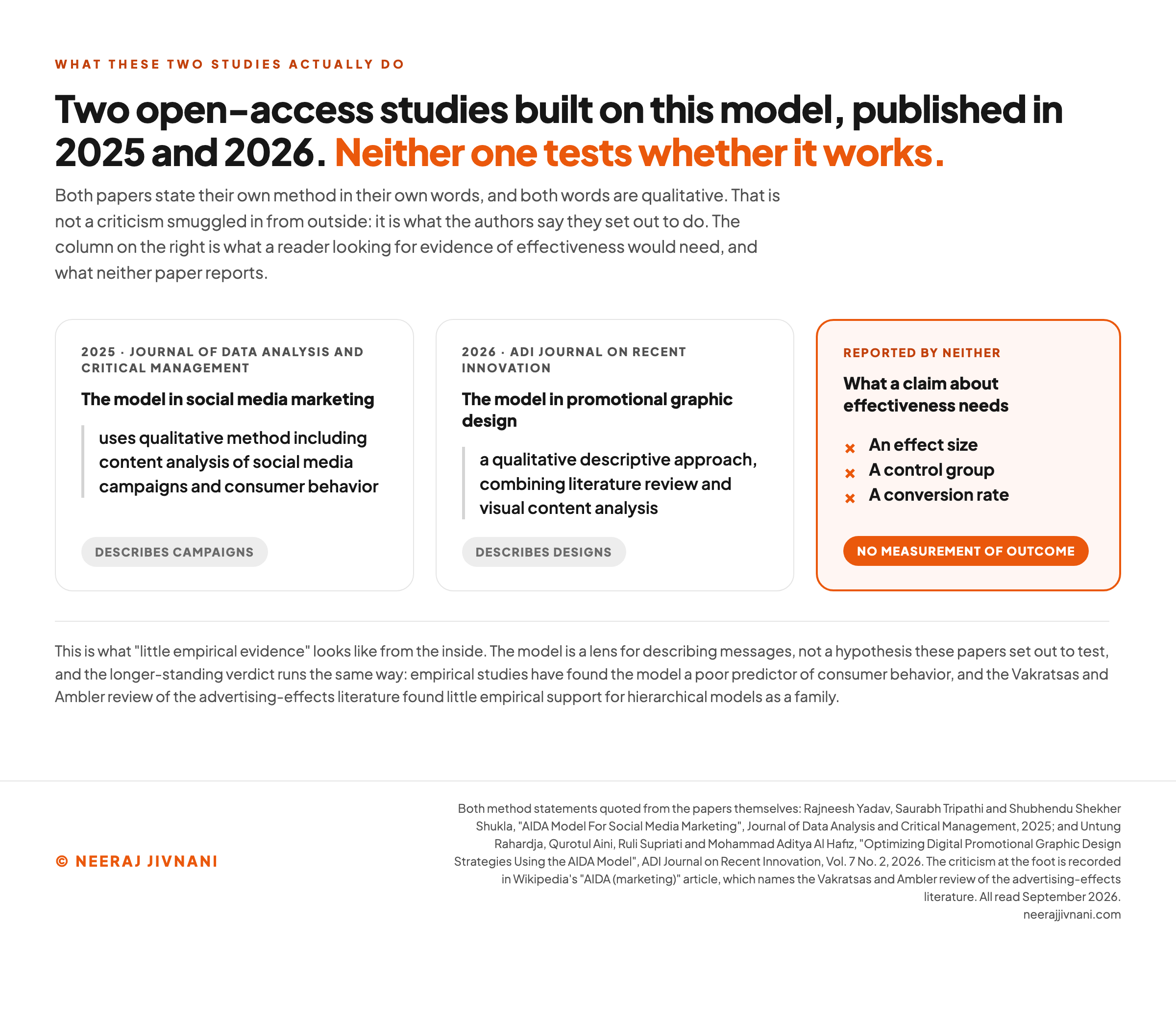
Empirical studies have found the model a poor predictor of consumer behavior, which Wikipedia's article records alongside the review that made the general case: Vakratsas and Ambler found little empirical support for hierarchical models as a family.
Found's 2026 guide puts it more bluntly, calling what supports the model "extraordinarily little empirical evidence".
So the honest claim from a completed checklist is narrow. Your message asks for all four states. Nothing about the conversion rate follows from that, and treating a completed checklist as a forecast is where the model does real damage.
What the Recent Papers Are Made Of
The reason the support is thin shows up in what gets published on the model. Two recent open-access papers built on it both describe their own method as qualitative.
A 2025 paper in the Journal of Data Analysis and Critical Management, on the model in social media marketing, states that it "uses qualitative method including content analysis of social media campaigns and consumer behavior".
A 2026 paper in the ADI Journal on Recent Innovation, on promotional graphic design, employs "a qualitative descriptive approach, combining literature review and visual content analysis".
Neither reports an effect size, a control group or a conversion rate. The model is being used as a lens for describing messages, not as a hypothesis anybody set out to test.
Artificial intelligence has not changed that. It changes how fast you can produce and test the material for each stage, and it leaves the model's own standing exactly where it was.
A generator writes and tests opening lines for attention. A language model drafts the interest paragraph against a named reader, and analytics rank which version of a single named act gets taken.
All of that is worth having. None of it is evidence about the model, and a generated first line still has to take attention from somebody who was not looking for you.
Use this chart — embed code and citation
<a href="https://neerajjivnani.com/blog/aida-model/"><img src="https://neerajjivnani.com/infographics/aida-model/what-the-research-measures.png" alt="Panel comparing what two open-access studies built on the AIDA model, published in 2025 and 2026, say about their own method, each quoted in full, against a third panel listing the three measurements neither of them reports: an effect size, a control group and a conversion rate, closing on the standing criticism that empirical studies have found the model a poor predictor of consumer behavior." width="1200"></a>
<p>Chart: <a href="https://neerajjivnani.com/blog/aida-model/">Neeraj Jivnani</a></p>Neeraj Jivnani, "The AIDA Model: Four Stages for One Message, and What Each One Asks", neerajjivnani.com, https://neerajjivnani.com/blog/aida-model/Free to republish with a link back to this page.
The Models That Came After, and What Each One Changes
Each of the later models includes something AIDA leaves out, or orders the states differently. They all belong to one family, the hierarchy of effects models, which run cognition, then affect, then behavior, as Wikipedia's article groups them.
Four are worth knowing, because between them they cover most of the complaints people make about the original:
- AIDAS adds satisfaction after action, which answers the criticism that the model treats the sale as the end of the relationship.
- AISDALSLove adds search before desire, then like or dislike, share, and love or hate after action, which is an attempt to describe how a purchase happens when the buyer can look things up and tell people.
- Lavidge and Steiner's hierarchy of effects, published in 1961, replaces the four with awareness, knowledge, liking, preference, conviction and purchase, splitting the middle into more states than AIDA allows.
- McGuire's model, from 1978, runs presentation, attention, comprehension, yielding, retention and behavior, and it is the one that puts the message itself at the start.
Every one of these inherits the evidence problem of the original, and adding a stage does not fix it. What the extensions are useful for is naming the thing your own message needs and AIDA has no word for.
The Purchases It Describes Badly
AIDA describes a message well and describes several kinds of purchase badly, and the mismatches are predictable enough to check before you reach for it. Three of them matter in practice.
The first is what the longer models were built to fix. With no stage after the sale, anything you sell on a subscription is half described: a software renewal, a monthly retainer, a gym membership. The work that keeps those, customer retention, starts where AIDA stops.
The second is the assumption of a straight line. Paid search inverts it, because somebody typing a query already has the interest and meets you afterwards.
The third is the hierarchy itself. People may process a promotional message through two pathways at once, thinking and feeling together, rather than climbing a set of stairs, and Wikipedia's article lists that among the standard criticisms.
Where does that leave you? Reach for AIDA when you are writing copy: one message, to one reader, asking for one act, because that is the case it was built on.
Reach for something else when the purchase involves several people over several months, when the buyer already wants the thing and needs a reason to trust you, or when the value of the sale is in what happens after it.
Who Actually Wrote It
The evidence points to two salesmanship writers, Frank H. Dukesmith and Arthur Frederick Sheldon.
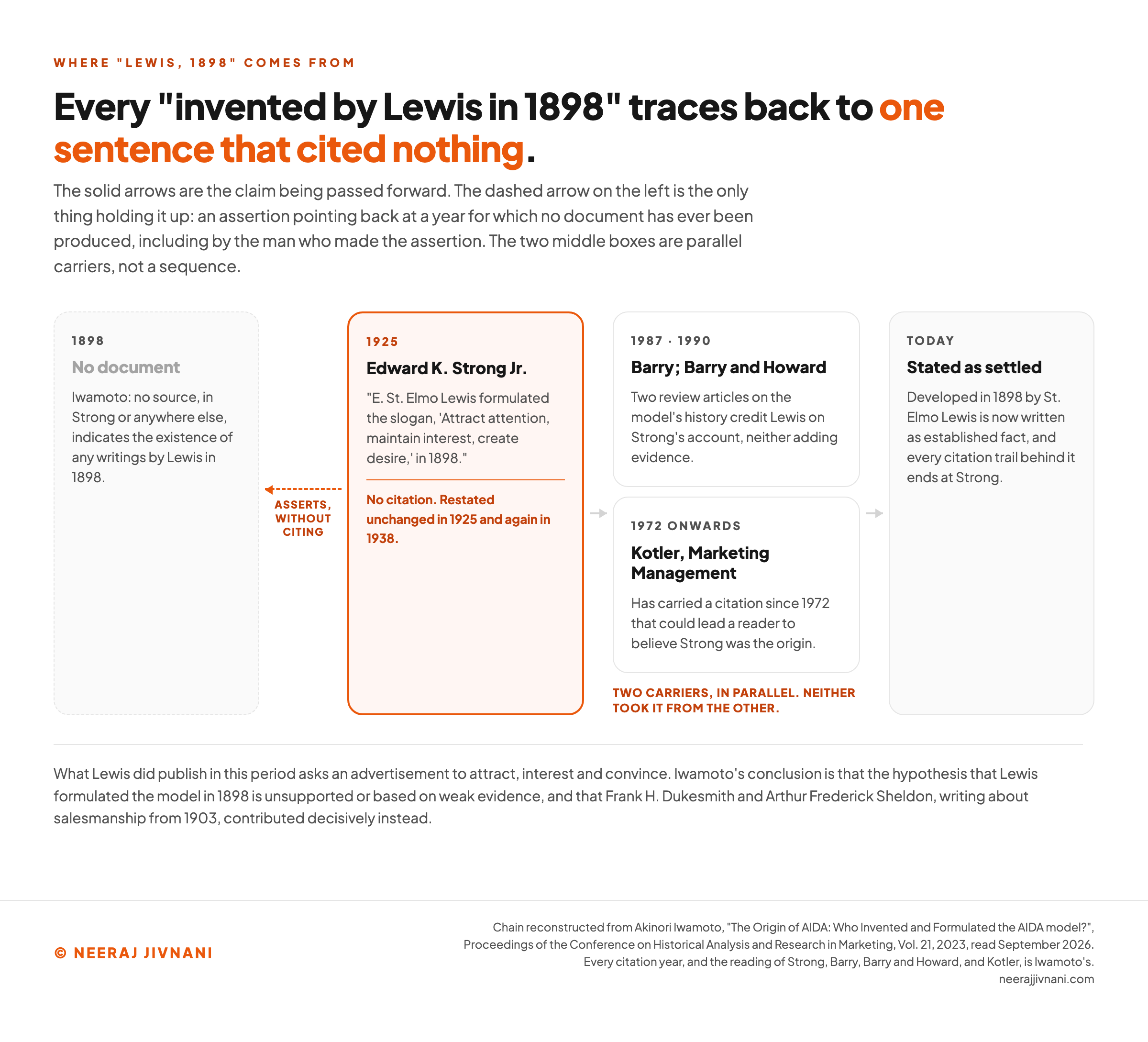
The credit goes to Elias St. Elmo Lewis, for a slogan he is said to have written in 1898.
No document from 1898 has ever been produced.
The date rests on one sentence. In 1925 Edward K. Strong Jr. wrote that Lewis "formulated the slogan, 'Attract attention, maintain interest, create desire,' in 1898", and that Lewis later added the fourth term, "get action".
Strong gave no citation and never revised it, restating it unchanged in 1938. Barry accepted it in 1987 and Barry and Howard in 1990, and Kotler's Marketing Management has carried a citation since 1972 that could lead a reader to believe Strong was the origin.
Akinori Iwamoto of Kansai University went looking for the missing document. He published the search in 2023, in the Proceedings of the Conference on Historical Analysis and Research in Marketing, and found no writings by Lewis in or around 1898.
What Lewis did publish is on the record, and it is not the slogan. From 1899 to 1908 he asked an advertisement to attract, interest and convince.
Dukesmith got there first in print. The June 1903 first issue of Salesmanship: A Monthly Magazine set out "four distinct conditions to be brought about by the salesman every time a sale is made": securing attention, arousing the interest, creating desire, and closing the sale.
Sheldon, who ran a school for salespeople, wrote the four in their familiar order in 1910: "First, attention; Second, interest; Third, desire; Fourth, action."
Iwamoto concludes that Dukesmith and Sheldon contributed decisively to the formulation of AIDA, and that Sheldon can be regarded as its originator. He does not close the question, and says so.
The acronym came later, in a 1921 Printers' Ink article by C. P. Russell, who suggested remembering the four words by noticing that their initials spell the opera Aida.
Why the Fourth Stage Came From Selling
One part of that history changes how you use the model, and it explains the stage most drafts drop.
Advertising writers of the period stopped at conviction, which is where Lewis's own published formulas end. A copywriter whose advertisement leaves the reader believing has done the job the advertisement was bought to do.
A salesperson has not, and it was the salesmanship writers who added the fourth word.
Action is in the model because a sale is not finished until the customer has done something. That is why dropping it breaks the model rather than shortening it.
Use this chart — embed code and citation
<a href="https://neerajjivnani.com/blog/aida-model/"><img src="https://neerajjivnani.com/infographics/aida-model/attribution-chain.png" alt="Diagram of how the "Lewis, 1898" attribution traveled, read left to right: an empty box for 1898 marked no document, a dashed arrow running back to it from Edward K. Strong Jr.'s uncited 1925 sentence, then that claim passed forward to two parallel carriers, the Barry and the Barry and Howard review articles of 1987 and 1990 and Kotler's Marketing Management from 1972 onwards, and on to a final box marked Today, which reads that the 1898 date is now written as established fact and that every citation trail behind it ends at Strong." width="1200"></a>
<p>Chart: <a href="https://neerajjivnani.com/blog/aida-model/">Neeraj Jivnani</a></p>Neeraj Jivnani, "The AIDA Model: Four Stages for One Message, and What Each One Asks", neerajjivnani.com, https://neerajjivnani.com/blog/aida-model/Free to republish with a link back to this page.
Keeping the Checklist, Dropping the Claim
AIDA is a good checklist and a weak theory. Keep the first, stop making the second, and it stays useful on every message you write.
It will tell you whether your email is complete. Whether that email earns a reply is a separate question, and the model has never been able to answer it.
So the next draft you write gets one question it did not get before. What exactly are you asking this person to do, and have you said it once?
Write that down before you write anything else. The rest of the draft tends to arrange itself around it.