The Three Types of Brand Awareness, and How to Tell Which One You Have
Recognition, recall and top of mind come from three different questions. Learn which one your business should be reading, and how to measure it.

/ On this page7 sections
Brand awareness is how many people in a market can name or recognize you, and how easily they do it. Recognition, recall and top of mind are three levels of that, and a different question produces each one.
Which level you should be reading depends on how big you already are and on how your category gets bought.
Below is what each level means, how to measure one without a research budget, and what the answer is worth once you have it.
Brand Awareness in One Sentence
Brand awareness is the share of a defined group of people who can recognize or name your brand, and the ease with which they manage it.
Two words in that sentence carry the weight.
Defined group. A percentage with no population attached is not a measurement. 40% of whom?
Ease. Awareness is not a switch. Somebody who has to be shown your logo before they place you sits in a different state from somebody who names you before the question finishes.
Awareness is not something you own or hold. It sits in other people's heads, and the only way to read what is in there is to go and ask them.
That rules out most of what gets counted in its name. Impressions, reach, followers and site sessions are records of what happened on your channels, not of what anybody kept.
They are worth having on their own terms.
What Awareness Is Separate From
Awareness is separate from attitude. A person can know you well and think you are overpriced.
It is separate from preference too. Being remembered puts you in the set of options a buyer considers, and it tells you nothing about whether they think you are any good.
Holding the three apart matters for a practical reason: each needs its own question, and a survey that blends them returns a number nobody can act on.
Recognition, Recall and Top of Mind
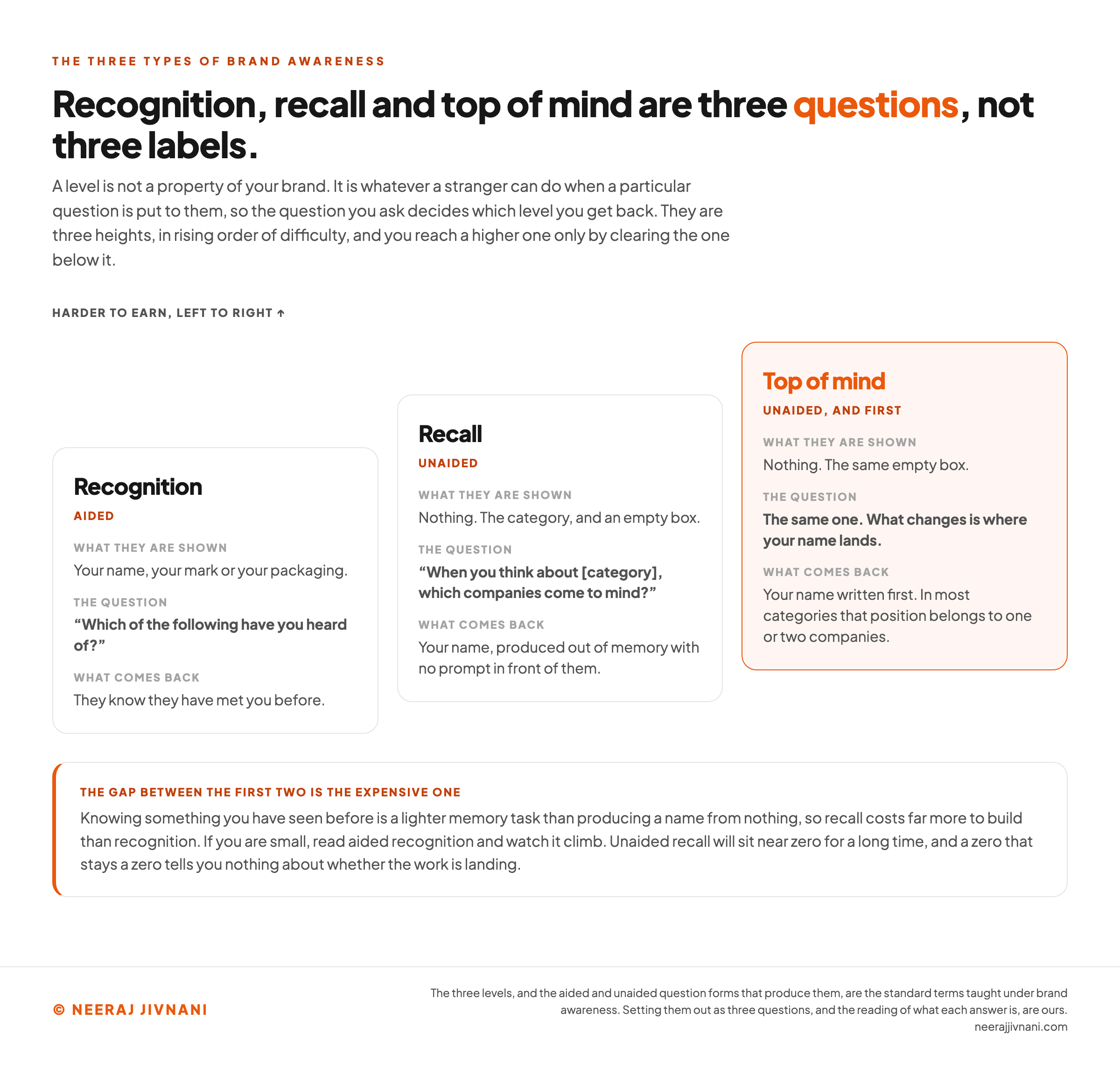
The three types of brand awareness are recognition, recall and top of mind. They describe three heights rather than three flavors, and you reach a higher one only by clearing the one below it.
Recognition is aided awareness. Shown your name, your mark or your packaging, a person knows they have met you before.
Recall is unaided awareness. Given nothing but the category, a person produces your name out of memory with no prompt in front of them.
Top of mind is the first name they produce. In most categories that position belongs to one or two companies.
That position is worth a lot, because shortlists get written from memory before anybody opens a browser tab, and a name that is not on the shortlist rarely gets added later.
The Level That Costs Much More to Earn
Recall is far more expensive to build than recognition. Knowing something you have seen before is a lighter memory task than producing a name from nothing.
That difference decides which number you should be reading now.
If you are small, unaided recall will sit near zero for a long time, and a zero that stays a zero tells you nothing about whether the work is landing. Read aided recognition instead and watch it climb.
Once recognition is high inside your target group, recall becomes the number worth tracking. Top of mind comes after that, if it comes at all.
Top of mind in a broad category is out of reach for a company without a national media budget. The version worth chasing is top of mind in the narrow category your buyers describe when the problem shows up.
Use this chart — embed code and citation
<a href="https://neerajjivnani.com/blog/brand-awareness/"><img src="https://neerajjivnani.com/infographics/brand-awareness/three-questions-not-three-labels.png" alt="A rising three step diagram setting the three types of brand awareness out as three different questions rather than three labels. The lowest step, recognition, is the aided one: the person is shown your name, your mark or your packaging and asked which of the following they have heard of, and what comes back is that they know they have met you before. The middle step, recall, is unaided: they are shown nothing but the category and an empty box, asked which companies come to mind, and your name has to be produced out of memory with no prompt in front of them. The highest step, top of mind, uses that same unaided question, and what changes is where your name lands, because in most categories the first position belongs to one or two companies. A band underneath says the gap between the first two is the expensive one, because knowing something you have seen before is a lighter memory task than producing a name from nothing, and that a small company should read aided recognition and watch it climb rather than track an unaided recall that will sit near zero for a long time." width="1200"></a>
<p>Chart: <a href="https://neerajjivnani.com/blog/brand-awareness/">Neeraj Jivnani</a></p>Neeraj Jivnani, "The Three Types of Brand Awareness, and How to Tell Which One You Have", neerajjivnani.com, https://neerajjivnani.com/blog/brand-awareness/Free to republish with a link back to this page.
What Awareness Buys You
Awareness buys you the benefit of the doubt at the moment somebody chooses.
Being the brand somebody has already heard of wins choices, including some of them against a better product.
The cleanest evidence for that is a controlled experiment that has been run twice by unconnected researchers. Hoyer and Brown published the original in the Journal of Consumer Research in 1990, using peanut butter.
Macdonald and Sharp published an independent replication in the Journal of Business Research in 2000, using orange cordial and a larger sample of 462 Australian students.
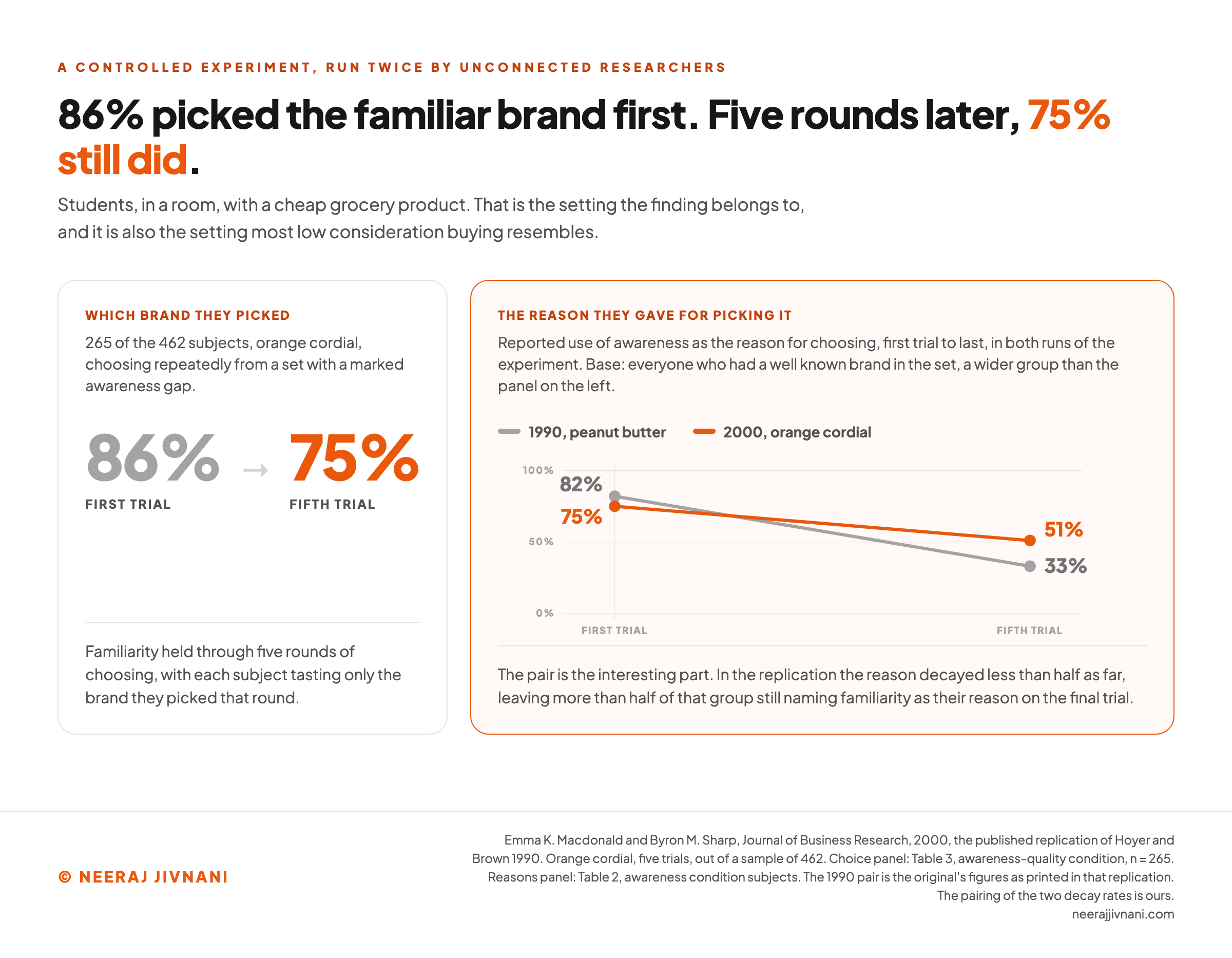
The group that matters here is the 265 of them who chose repeatedly from a set holding one well known brand and two little known ones.
86% picked the well known brand on the first trial. After five rounds of choosing and tasting, 75% were still picking it.
Nothing stopped them trying the other two, and the study's own second finding is that the people who knew one brand tried fewer of them.
The pair of decay rates is the interesting part, and Macdonald and Sharp print the original's figures beside their own. In 1990 the reported use of awareness as a reason for choosing fell from 82% on the first trial to 33% on the last.
In the 2000 replication it fell only from 75% to 51%, leaving more than half of everyone who had a well known brand in the set still naming familiarity as their reason on the final trial.
Both studies were run on students, in a room, with a cheap grocery product. That is the setting the finding belongs to, and it is also the setting that most low consideration buying resembles.
The Limit, Said Plainly
Awareness is not demand.
A November 2024 review of the field says exactly that. Lopez-Rodriguez and colleagues, writing in TEM (Technology, Education, Management, Informatics) Journal, conclude that brand awareness "is not an indicator that strongly and ultimately determines the effective increase in demand" for a company's products.
We agree, and we would put it more bluntly. Awareness gets you into the room.
Where the buyer is genuinely weighing the options, what happens next is settled by price, fit, timing and whether the product is any good.
Cheap, repeated purchases mostly get no weighing at all. There the familiar name often settles the choice by itself, which is the narrow and entirely real case for spending on awareness.
It does not manufacture a reason to buy, and no volume of it will.
Use this chart — embed code and citation
<a href="https://neerajjivnani.com/blog/brand-awareness/"><img src="https://neerajjivnani.com/infographics/brand-awareness/familiarity-held-after-tasting.png" alt="Two panels reading the 2000 Journal of Business Research replication by Macdonald and Sharp, run with orange cordial on a sample of 462. The left panel shows which brand people picked, among the 265 subjects in the awareness and quality condition: 86% chose the well known brand on the first trial and 75% still chose it on the fifth, with each of them tasting only the brand they picked that round. The right panel is a slope chart of the reason people gave for choosing, from the first trial to the fifth, carrying both runs of the experiment. The 1990 original with peanut butter falls steeply from 82% to 33%, drawn in gray. The 2000 replication with orange cordial falls only from 75% to 51%, drawn in orange, leaving more than half the awareness condition subjects still naming familiarity as their reason on the final trial." width="1200"></a>
<p>Chart: <a href="https://neerajjivnani.com/blog/brand-awareness/">Neeraj Jivnani</a></p>Neeraj Jivnani, "The Three Types of Brand Awareness, and How to Tell Which One You Have", neerajjivnani.com, https://neerajjivnani.com/blog/brand-awareness/Free to republish with a link back to this page.
How to Measure Awareness
You measure brand awareness by asking people, in a form you can repeat, and comparing the answer against the last time you asked. There is no way around the asking.
Four decisions settle whether the reading is worth having: who you ask, which category you name, how you order the questions, and how long after a campaign you ask.
The numbers already in your dashboards come at the end, because each of them answers a different question from the one you are putting.
Ask People Who Are Not Your Customers
An awareness study goes wrong at the sample before it goes wrong anywhere else. Somebody sends it to a list of people who already know the brand.
Your customers, your subscribers and your followers are all selected on awareness. They are on those lists because they found you.
Asking that group whether they have heard of you returns a figure close to 100% and settles nothing.
The population you want is the market you are trying to reach and have not reached yet. That group is harder to reach, and its answer is the one carrying information.
In practice it means buying a small sample from a panel provider, or intercepting people somewhere your buyers genuinely gather.
A sample of strangers in your market will tell you something. A far bigger one drawn from your own database will tell you that your database knows who you are.
The Category You Name Decides the Answer
An unaided question has to name a category, and the category you pick sets the number before a single person answers.
Ask what accounting software somebody can name and a five person firm scores near zero. Ask who they would call about payroll for a restaurant and the same firm might lead the list.
Neither figure is wrong. They answer two different questions, and the market you compete in is described by one of them.
Choose the category the way your buyer would describe their problem out loud. Write the wording down and keep it identical between waves.
A category that drifts turns a tracking study into noise, because every reading is then answering a slightly different question.
Ask Unaided First, Aided Last
An aided question contaminates every unaided answer that follows it. Once you have shown somebody a list of names, you can never again ask them what they can remember.
So ask in this sequence, and never rearrange it.
- The unaided question, first and alone. "When you think about [category], which companies come to mind?" Leave the box empty and let them type. The first name they write is your top of mind measure; every name they write is your total unaided figure.
- The follow-up prompt, once. "Any others?" This catches the second and third names that people have but do not volunteer, and it is the cheapest question in the set. Ask it a second time and you are measuring persistence rather than memory.
- The aided question, after both of those. "Which of the following have you heard of?" with your name in a list beside four or five competitors and, if you can, one company that does not exist. That last one tells you your false positive rate, which is how many people claim to know a name they cannot possibly know.
- The qualifying question, at the end. Something that tells you whether this person is in your market at all. An awareness figure that includes people with no use for the category is a figure about the general public.
Everything you need sits in the answers to those four. Total unaided recall is the share who wrote your name anywhere in question one, and top of mind is the share who wrote it first.
Aided recognition is the share who ticked you in question three, less the share who also ticked the company that does not exist.
The order you would ask them in
Put the four questions into the order you would put them in front of a stranger. The panel underneath reads back which of the four numbers your arrangement still produces.
It goes into the open question below, and nowhere else.
They start in no particular order. Move them into yours.
- 1The aided questionWhich of the following have you heard of?Your name in a list beside four or five competitors and, if you can, one company that does not exist.
- 2The qualifying questionSomething that tells you whether this person is in your market at all.An awareness figure that includes people with no use for the category is a figure about the general public.
- 3The unaided questionWhen you think about [category], which companies come to mind?Leave the box empty and let them type.
- 4The follow-up promptAny others?Ask it a second time and you are measuring persistence rather than memory.
The aided question is asked at 1, before the open question at 3
An aided question contaminates every unaided answer that follows it. Once you have shown somebody a list of names, you can never again ask them what they can remember.
Nothing later in the sequence recovers it, and the answers still arrive looking like answers.
What this order still measures
- Total unaided recallgoneThe share who wrote your name anywhere in the open question.
- Top of mindgoneThe share who wrote it first.
- Aided recognitionstill thereThe share who ticked you in the aided question, less the share who also ticked the company that does not exist.
- Whether this person is in your marketstill thereAn awareness figure that includes people with no use for the category is a figure about the general public.
Leave a Gap Before You Ask
Timing is the fourth decision. Do not ask straight after a campaign.
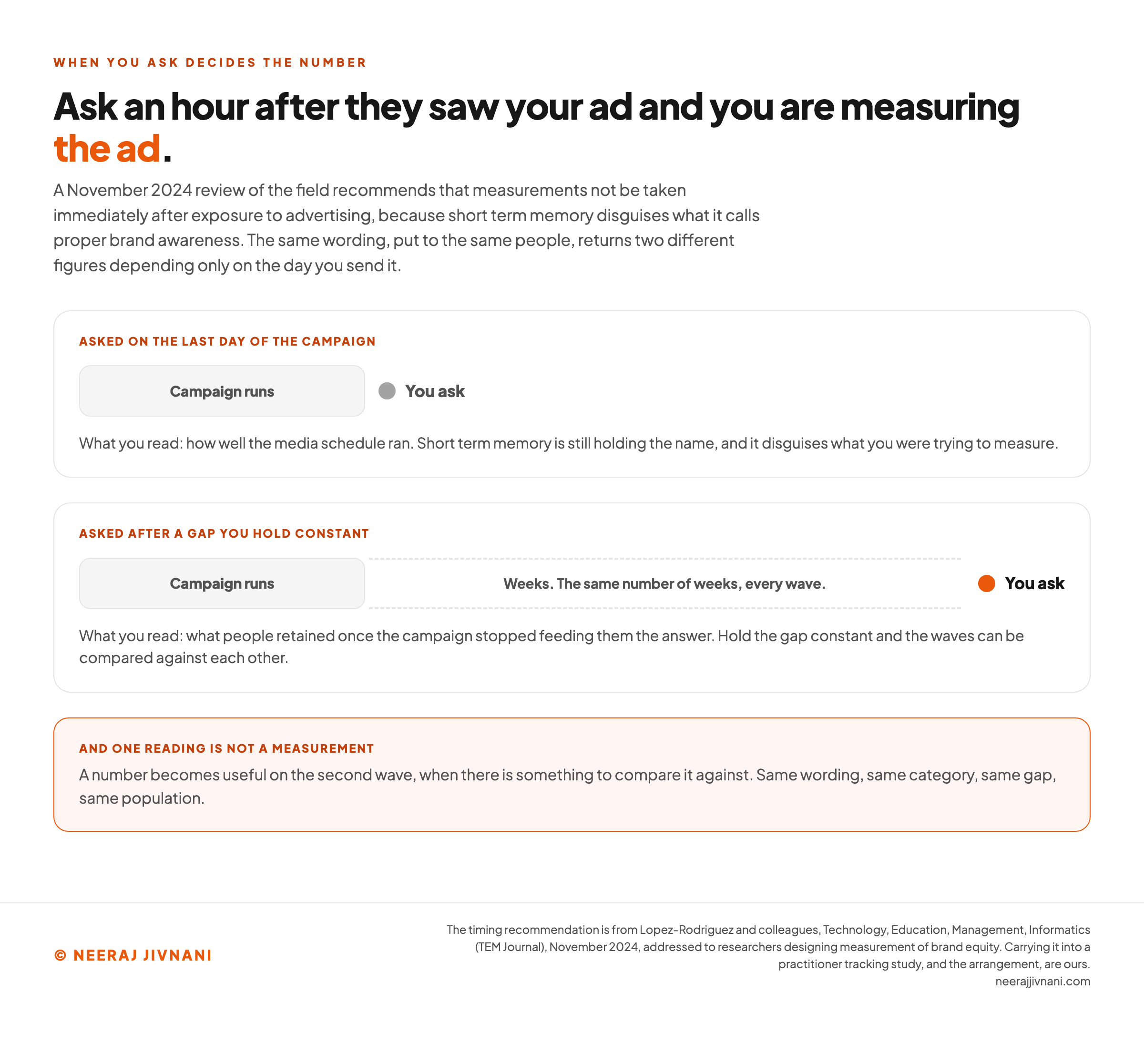
Ask somebody an hour after they saw your ad and you are measuring the ad, not what they will still know next month.
Leave weeks between the campaign and the question, and hold that gap constant across waves so the readings can be compared.
The research points the same way. The November 2024 TEM Journal review recommends that measurements not be taken immediately after exposure to advertising, on the grounds that short term memory disguises what it calls proper brand awareness.
One reading is also not a measurement. A number becomes useful on the second wave, when there is something to compare it against.
Reading the Numbers You Already Have
The numbers already sitting in your dashboards are worth reading, as long as you know which question each of them answers.
| Number | The question it answers | The question it leaves open |
|---|---|---|
| Impressions and reach | Delivery: how much you sent, and to how many people | Whether anybody retained any of it |
| Direct and branded search traffic | Demand from people who already know the name | Anything about people who do not |
| Followers and social engagement | Interest inside an audience that has already found you | The size of the group who could name you |
| Brand mentions and share of voice | Presence in published conversation | Presence in private memory |
| Ad recall and brand lift studies | Awareness, when a memory question is put to an exposed group against a control | Awareness of the brand outside that campaign |
Branded search volume is the strongest free proxy on that list, and a free keyword tool will show it to you.
It counts people typing your name into a search box, which is unaided recall happening in the wild. What it never tells you is what share of the market that is.
Its limit is that it moves with demand as well as with memory. A category with a season will show a climb that nobody built.
Use this chart — embed code and citation
<a href="https://neerajjivnani.com/blog/brand-awareness/"><img src="https://neerajjivnani.com/infographics/brand-awareness/leave-a-gap-before-you-ask.png" alt="Two timelines comparing when an awareness survey is sent. On the top rail the question is asked on the last day of the campaign, with the marker sitting flush against the end of the campaign block, and the note says what you read there is how well the media schedule ran, because short term memory is still holding the name and disguises what you were trying to measure. On the bottom rail the same campaign block is followed by a dashed gap labeled weeks, the same number of weeks every wave, before the marker, and the note says what you read there is what people retained once the campaign stopped feeding them the answer, and that holding the gap constant is what lets the waves be compared. A band underneath adds that one reading is not a measurement, because a number becomes useful on the second wave when there is something to compare it against, using the same wording, the same category, the same gap and the same population." width="1200"></a>
<p>Chart: <a href="https://neerajjivnani.com/blog/brand-awareness/">Neeraj Jivnani</a></p>Neeraj Jivnani, "The Three Types of Brand Awareness, and How to Tell Which One You Have", neerajjivnani.com, https://neerajjivnani.com/blog/brand-awareness/Free to republish with a link back to this page.
Building It, in the Order That Spends Least
The order that spends least starts with demand somebody has already expressed and holds paid reach back until the message is known to work, because awareness is bought with repetition rather than with budget.
So the first decision is not which channel to use. It is which single thing you can keep repeating for years without resenting it.
That constraint sorts the options faster than any comparison of channels does. Here is the order we would spend in, with the reason each step comes where it does.
- Be findable under the words your buyer uses. Search demand that already exists is the cheapest awareness there is, because somebody has raised their hand before you paid anything. It is also slow, which is why it goes first rather than last.
- Publish on a schedule you can hold. The schedule matters more than the format. Two pieces a month for three years beats a launch of twelve and then silence, because recognition is built by the repetition rather than by the volume.
- Borrow somebody else's audience. Guest pieces, joint work, creators and press all put you in front of a group that somebody else spent years assembling. This is the fastest way for a small company to reach strangers.
- Pay for reach once the message is known to work. Paid media multiplies whatever you put into it. Buying reach for a message that has never landed organically buys you a wider audience for something that does not work.
- Show up where the category physically gathers. Trade events and local sponsorship are expensive per person reached and strong on the people they do reach, so they suit narrow markets and suit broad ones badly.
Two of those five, done for long enough to become predictable, beat all five started at once.
The limit is attention rather than money.
Long enough is a measurement question, not a calendar one. You cannot see a channel working faster than you ask, so if you run two waves a year, six months is the shortest honest trial any of these gets.
What the Rest of the Brand Has to Do
Awareness is memory of a signal, so the signals have to hold still long enough to be learned. A name, a mark and a color that get refreshed every couple of years reset the count each time.
That is also our answer to the five C's of branding. Whichever five you are shown, consistency is the only one that does anything for being remembered.
Clarity and credibility are the two worth keeping beside it, and they are about being understood and being trusted rather than about being recognized.
Nothing about awareness depends on the list reaching five.
When Awareness Is Not Your Problem
Awareness is the wrong goal when the people who already know you are not buying. That reads as obvious, and it is still the costliest wrong turn on this subject, because more awareness is always a plausible answer and never a cheap one.
The diagnosis is a single comparison.
If the people who have heard of you convert at a normal rate and there are too few of them, awareness is your constraint and spending on it is right.
If they convert badly, the problem sits downstream of awareness, and buying more of it sends more people into the same leak.
A low awareness number also has a dull explanation more often than it has a brand explanation.
Say a firm selling machine guarding to food factories. Unaided recall of its name across any general population will read at or near zero forever, and that is correct rather than a failure, because the buying population is a few hundred plant engineers.
Measure the few hundred, or measure nothing.
Decide What You Are Asking Before You Spend
The expensive mistake is committing an awareness budget before anybody has decided which of the three levels the money is meant to move.
Recognition, recall and top of mind cost different amounts, take different lengths of time, and are worth different things to different businesses. A plan that does not name one is buying all three badly.
So decide it in writing. Which level you are asking about, the exact category you will ask it in, and the figure it stands at today.
Then spend against that one thing for long enough for a person to have met you more than once, and ask the identical question again.
That commits you to less than most awareness plans do, and it is the only kind that can tell you afterwards whether the money did anything.