What a Microsite Is, and When a Page on Your Own Site Is Better
A microsite is a few pages about one thing, at its own address. It works when you send people to it, rarely when they search.


/ On this page8 sections
A microsite is a few pages about one thing, published at an address of its own rather than inside your main site.
That address is the whole decision. It inherits nothing your main site has spent years earning, so a microsite makes sense when you send people to it, and much less when they have to find it.
Somebody has probably proposed one for a launch, a campaign or an annual report.
A Small Site That Lives Somewhere Else
Most microsites are small. Fewer than ten pages is typical, and plenty are a single page.
The page count is not the thing that defines it.
The separateness is. A microsite has its own address, usually its own design, often its own tone, and it can be taken down without touching anything else you publish.
That separateness is the whole point and the whole cost.
It buys freedom from your own templates, your own navigation and your own brand rules.
It gives up everything those carry with them.
There is a second, narrower use of the word worth knowing before it confuses you. Some publishers use microsite to mean a block of their pages that you embed in your own site and that keeps itself current.
The US Centers for Disease Control and Prevention describes its microsites that way, as syndicatable collections of its pages that update automatically on your site as it updates its own.
If you meet the word used like that, you have not misread it. Everything below is about the marketing sense.
Microsite, Landing Page, or Website
Three things get called by each other's names, and the difference between them is not size.
A website is where everything you do lives, and it is built to last. A microsite is a few pages about one thing, at its own address, usually for a season rather than for good.
A landing page is one page on the site you already have, built to get one thing done. A microsite is several pages at an address of its own, built to hold a story rather than close a single action.
What separates them is how many pages, whose address, how long it is meant to live, and what each one inherits.
What Changes Between Them
| Landing page | Microsite | Website | |
|---|---|---|---|
| Pages | One | A few, rarely more than ten | As many as the business needs |
| Address | Your site | Its own, or a subdomain | Your site, and it is the reason your site exists |
| Lifespan | As long as the campaign | A season, sometimes longer | Indefinite |
| Design | Your templates | Its own, if you want it | Your brand system |
| What it inherits | Everything your site has | Whatever the address choice allows | Everything |
| What it is for | One action | One story | Everything you do |
Read across the inheritance row and the trade is obvious.
A landing page inherits your whole site because it is part of it. A microsite inherits whatever its address lets it inherit, and that is the choice being made whether anyone says so or not.
Say a company is running one webinar. A date, a signup form and a confirmation is a landing page.
Say the same company runs an annual conference with a name of its own, speakers, a schedule and a venue. That is a microsite.
So the honest default is the boring one. If one page would do the job, one page is the answer, and it belongs on the site you already own.
What People Build Them For
There are six jobs a microsite genuinely does better than a page, and each of them is about a thing that would look wrong sitting inside your normal site.
A product launch. The product needs more room than a page and a different feeling from the rest of the catalog, for a few months.
An event. A conference, a festival, an awards night. It has its own name, its own dates and its own audience, and it comes round again next year.
A report. An annual report, an impact report, a research piece. It is a document that wants to be read rather than a page that wants to convert.
A recruitment drive. Candidates want to know about working somewhere, which is a different question from what the company sells, asked by people who will never read the product pages.
A separate audience. A second brand, a second market, a group your normal site is not written for. Keeping them apart is a real reason and one of the few that survives scrutiny.
A story that would look wrong on your site. A campaign with its own art direction, a cause you are backing, an idea with no product attached. Your brand rules exist for a reason and this is the case they were not written for.
When the Reason Is Right and the Address Is Still Wrong
Say a software company is launching a tool its usual buyers do not use.
The main site talks to procurement teams, the new thing is for individual developers, and every sentence on the homepage is aimed at the wrong person.
That is a legitimate microsite, and the reason is the audience rather than the launch.
Now take that same software company's user conference. It has a name of its own, its own dates and its own audience, which is the event case exactly.
It is also three pages. Three pages sit perfectly well in a folder on the site the company already owns, and a job being legitimate is not the same as the address being separate.
Two things are worth noticing about those six. Every one is a reason about the thing you are publishing, not about search.
And all but one has an end date. The exception is the separate-audience case, and even that outlives whoever set it up.
The Question That Decides It: Found, or Sent?
Here is the question, and it settles most of these arguments in about a minute.
How will people get to this thing?
If they will be sent, a new address costs you almost nothing.
Somebody clicks an ad, opens an email, scans a code on a poster, follows a link a salesperson gave them, or types a short name they saw on television.
In every one of those, the traffic arrives because you sent it. The address is a label on a door people were already walking through.
If people have to find it instead, a new address costs you almost everything.
Search does not know your new address. It has no history with it, no links pointing at it, and no reason yet to trust it.
Every bit of that which your main site has, and it took years, stays with your main site.
A campaign is rarely long enough for a new address to finish starting. You spend the season building something up and then the season ends.
A microsite is a design decision that people keep making as a search decision, and as a search decision it is usually the wrong one.
The question that decides it
How will people get to this thing?
The four addresses below stay where they are. Change the one thing that is not about the address at all, and watch which of them survives the arrival intact.
Pick how they will arrive
The four places it can go
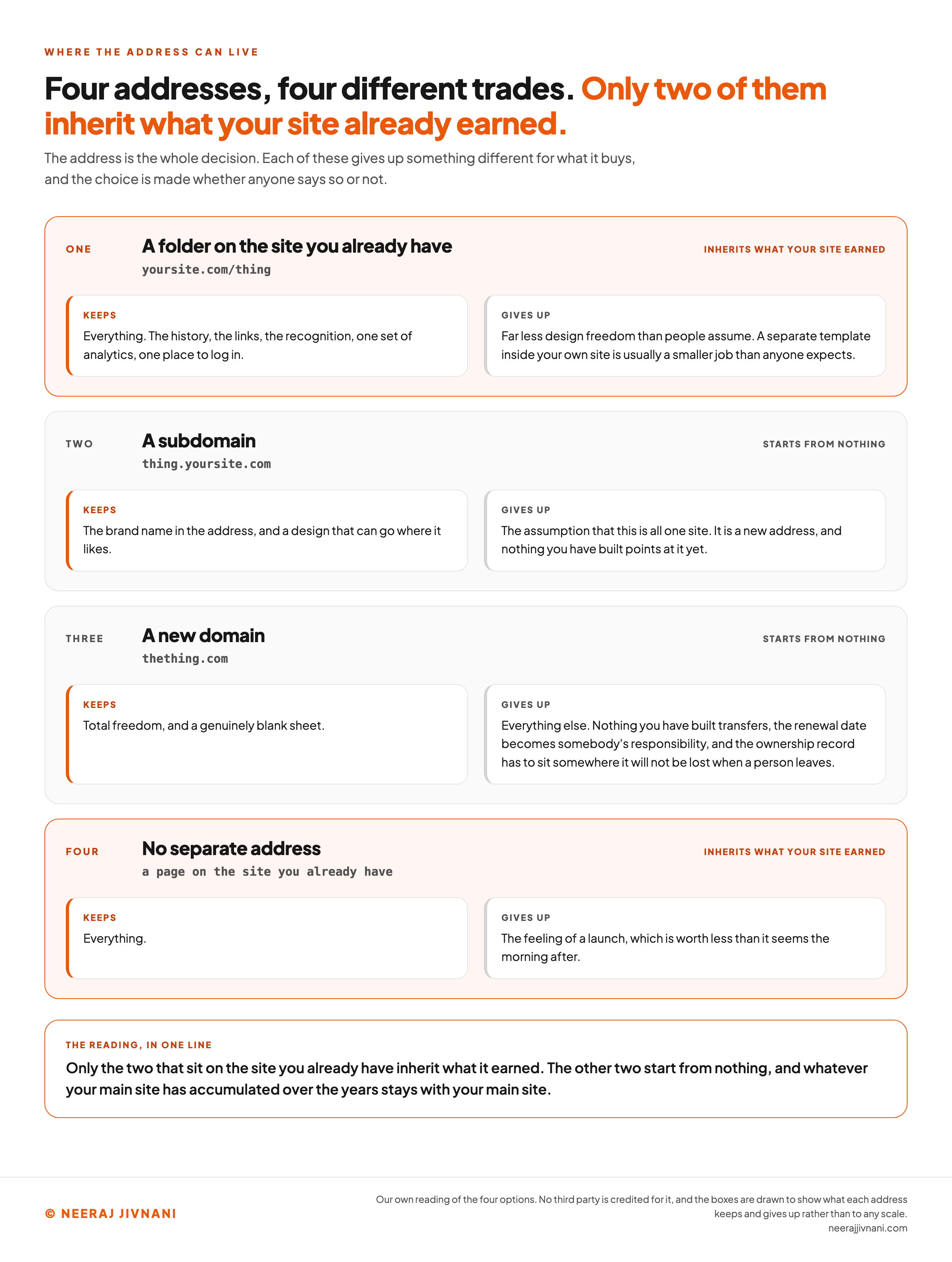
- A folder on the site you already have · yoursite.com/thing
Keeps. It inherits everything: the history, the links, the recognition, one set of analytics, one place to log in.
Gives up. Far less design freedom than people assume. A separate template inside your own site is usually a smaller job than anyone expects.
- A subdomain · thing.yoursite.com
Keeps. The brand name stays in the address and the design can go where it likes.
Gives up. The assumption that this is all one site.
- A new domain · thething.com
Keeps. Total freedom, and a genuinely blank sheet.
Gives up. Nothing you have built transfers, the renewal date becomes somebody's responsibility, and the ownership record has to sit somewhere it will not be lost when a person leaves.
- No separate address · a page on the site you already have
Keeps. It keeps everything.
Gives up. The feeling of a launch, which is worth less than it seems the morning after.
Nothing picked yet
A separate address inherits nothing your main site has spent years earning, which makes this the most consequential choice in the whole decision. The question above settles most of that argument in about a minute.
The One Honest Exception
Occasionally the thing you are making is more interesting than the company making it, and it gets shared and linked to precisely because it does not look like a corporate page.
That happens, and it is a bet on the work rather than on the format. Make the bet with your eyes open.
The Four Places It Can Go
There are four places the thing can go, and picking between them is the most consequential choice in this whole decision.
Two of them keep it on the site you already have, which means what you build is not a microsite any more. That is frequently the right answer, which is why the address is worth deciding on purpose rather than by default.
A folder on the site you already have. The thing lives at your own address, with a path after it. It inherits everything: the history, the links, the recognition, one set of analytics, one place to log in. It gives up far less design freedom than people assume, because a separate template inside your own site is usually a smaller job than anyone expects.
A subdomain. The brand name stays in the address and the design can go where it likes. What you give up is the assumption that this is all one site.
Your tools have to be told. Google's Search Console help states that if you support multiple subdomains you must add a separate property for each, though a domain-level property covers all of them at once.
So the measurement becomes a decision instead of a default. Either set up a property that spans the whole domain, or accept a second place to look.
A new domain. Total freedom, and a genuinely blank sheet. Nothing you have built transfers, the renewal date becomes somebody's responsibility, and the ownership record has to sit somewhere it will not be lost when a person leaves.
No separate address. A page on the site you already have. It keeps everything and gives up the feeling of a launch, which is worth less than it seems the morning after.
The Failure This Turns Into
There is a version of the separate-address idea that goes wrong, and it has a name.
Google's spam policies for web search define doorway abuse as sites or pages created to rank for specific, similar search queries, which lead users to intermediate pages that are not as useful as the final destination.
Two of the four examples it publishes describe a microsite pattern closely enough to be uncomfortable.
One is having multiple websites with slight variations to the URL and home page to maximize their reach for any specific query. The other is generating pages to funnel visitors into the actual usable or relevant portion of a site.
That second one is worth reading twice. A microsite whose real job is to catch a search and pass the visitor along to your main site is describing itself in that sentence.
What keeps a microsite on the right side of the line is that it is the destination. A person who lands on it gets what they came for without being handed onward.
That is the found-or-sent question again, asked by a search engine rather than by you.
If the microsite is where the visit ends, it is a microsite. If it is a hallway, it is a doorway.
Use this chart — embed code and citation
<a href="https://neerajjivnani.com/blog/microsites/"><img src="https://neerajjivnani.com/infographics/microsites/the-four-addresses.png" alt="The four places a microsite's address can live, each card showing what it keeps from the site you already have and what it gives up for that. One, a folder on the site you already have, written as yoursite.com/thing: it keeps everything, the history, the links, the recognition, one set of analytics and one place to log in, and it gives up far less design freedom than people assume, because a separate template inside your own site is usually a smaller job than anyone expects. Two, a subdomain, written as thing.yoursite.com: it keeps the brand name in the address and a design that can go where it likes, and it gives up the assumption that this is all one site, because it is a new address that nothing you have built points at yet. Three, a new domain, written as thething.com: it keeps total freedom and a genuinely blank sheet, and it gives up everything else, since nothing you have built transfers, the renewal date becomes somebody's responsibility, and the ownership record has to sit somewhere it will not be lost when a person leaves. Four, no separate address at all, a page on the site you already have: it keeps everything and gives up the feeling of a launch, which is worth less than it seems the morning after. Cards one and four are tinted orange and labeled as inheriting what your site earned; cards two and three are left grey and labeled as starting from nothing. A band across the foot says that only the two sitting on the site you already have inherit what it earned, and that the other two start from nothing, because whatever your main site has accumulated over the years stays with your main site." width="1200"></a>
<p>Chart: <a href="https://neerajjivnani.com/blog/microsites/">Neeraj Jivnani</a></p>Neeraj Jivnani, "What a Microsite Is, and When a Page on Your Own Site Is Better", neerajjivnani.com, https://neerajjivnani.com/blog/microsites/Free to republish with a link back to this page.
What It Costs After Launch
The build gets budgeted. What comes after it rarely does.
A second site is a second thing to keep current, and stale is more visible on a microsite than anywhere else, because the whole page is about one moment.
It is a second thing to secure and to patch. It is a second analytics setup, a second set of consent and privacy plumbing, and a second place your forms can quietly stop delivering.
It is also a second place your brand drifts. The freedom you bought at the start is the same freedom that means nobody notices when the typography stops matching.
Then there is the cost that never reaches a budget line.
The person who built it moves on, and the microsite gets inherited by somebody who did not choose it and cannot tell which parts still matter.
Say a campaign site ships in March with a form, a video and a countdown. In eighteen months somebody has to decide whether the form still goes anywhere, and they were not in the room in March.
None of that is a reason not to build one. It is the reason to decide, before you start, who owns the thing in a year and what they are expected to do with it.
How It Ends
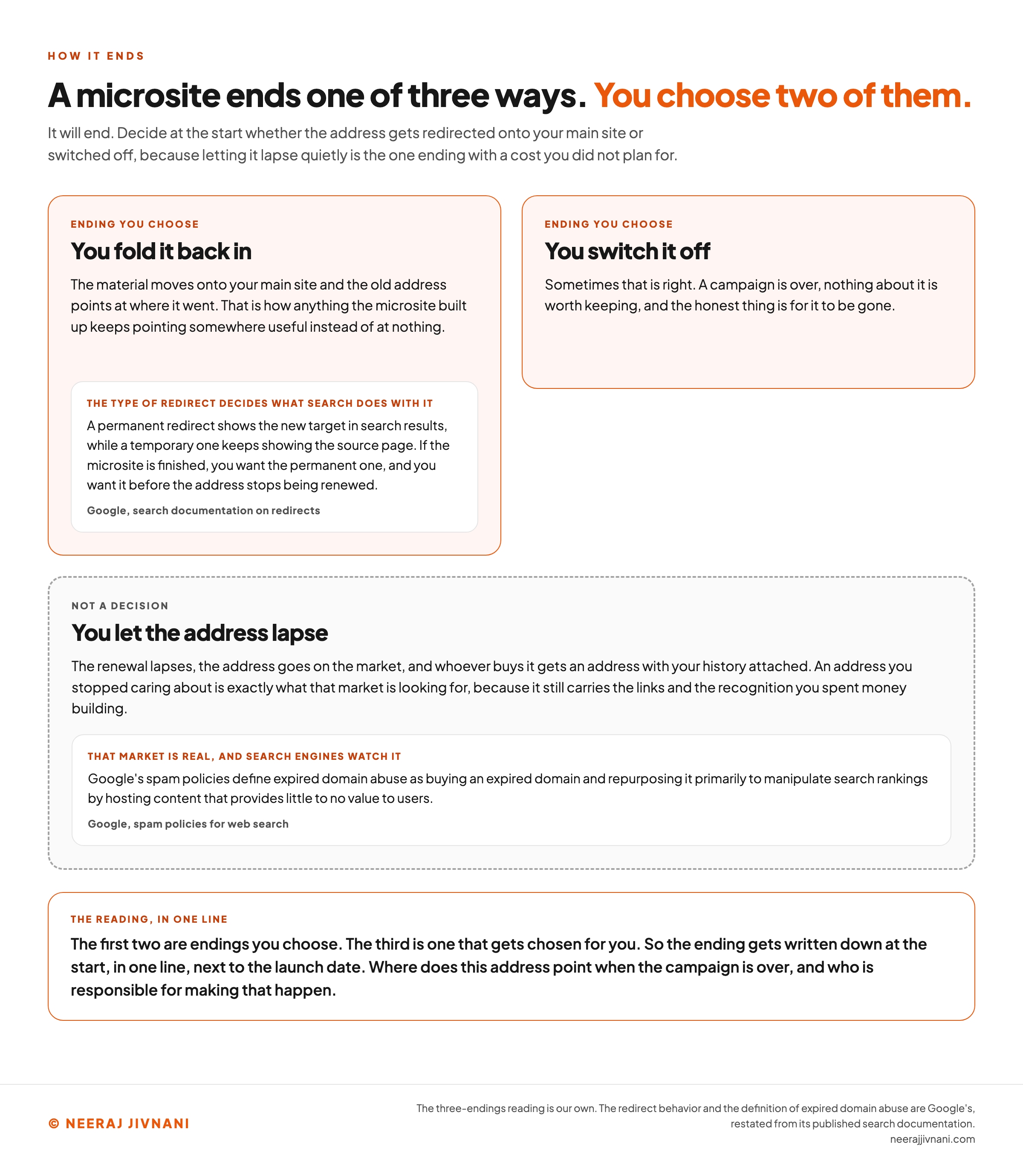
A microsite ends one of three ways, and you choose two of them.
You fold it back into your main site, you switch it off, or you let the address lapse and find out what happens next.
You fold it back in. The material moves onto your main site and the old address points at where it went. That is how anything the microsite built up keeps pointing somewhere useful instead of at nothing.
The type of redirect decides what search does with it.
A permanent redirect shows the new target in search results, while a temporary one keeps showing the source page, which is how Google's own redirect documentation draws the line.
If the microsite is finished, you want the permanent one, and you want it before the address stops being renewed.
You switch it off. Sometimes that is right. A campaign is over, nothing about it is worth keeping, and the honest thing is for it to be gone.
The Ending Nobody Chooses
The third one is what happens when nobody decides. The renewal lapses, the address goes on the market, and whoever buys it gets an address with your history attached.
That market is real and search engines watch it. The same spam policies define expired domain abuse as buying an expired domain and repurposing it primarily to manipulate search rankings by hosting content that provides little to no value to users.
An address you stopped caring about is exactly what that market is looking for, because it still carries the links and the recognition you spent money building.
So the ending gets written down at the start, in one line, next to the launch date. Where does this address point when the campaign is over, and who is responsible for making that happen?
That line takes a minute to write and it is the difference between a microsite that leaves something behind and one that leaves a liability.
Use this chart — embed code and citation
<a href="https://neerajjivnani.com/blog/microsites/"><img src="https://neerajjivnani.com/infographics/microsites/how-it-ends.png" alt="Two panels showing the two ways a microsite's life can end, and a third band for the thing that happens when nobody chooses. The first panel, folding it back in, shows the material moving onto the main site with the old address pointing at where it went, so that anything the microsite built up keeps pointing somewhere useful instead of at nothing; a note inside it says the type of redirect decides what search does with it, because a permanent redirect shows the new target in search results while a temporary one keeps showing the source page, so a finished microsite wants the permanent kind and wants it before the address stops being renewed, credited on the image to Google's search documentation on redirects. The second panel, switching it off, says that is sometimes right: a campaign is over, nothing about it is worth keeping, and the honest thing is for it to be gone. Beneath both, a third band drawn in grey and marked not a decision shows the renewal lapsing and the address going on the market with the brand's history still attached, and notes that Google's spam policies define expired domain abuse as buying an expired domain and repurposing it primarily to manipulate search rankings by hosting content that provides little to no value to users. A line across the foot says the first two are endings you choose, the third is one that gets chosen for you, and so the ending gets written down at the start, in one line, next to the launch date: where does this address point when the campaign is over, and who is responsible for making that happen." width="1200"></a>
<p>Chart: <a href="https://neerajjivnani.com/blog/microsites/">Neeraj Jivnani</a></p>Neeraj Jivnani, "What a Microsite Is, and When a Page on Your Own Site Is Better", neerajjivnani.com, https://neerajjivnani.com/blog/microsites/Free to republish with a link back to this page.
What to Do With All of That
A microsite is a good format with a narrow brief. It is for one thing that genuinely needs its own room, aimed at people you are going to send there.
Work through the questions in this order and the decision usually makes itself.
Would one page on your own site do the job? If not, how will people arrive?
If they arrive because you sent them, pick the address that gives you the freedom you need and no more. Then write down what happens to it when the campaign ends, and who does it.
Say a team answers the arrival question honestly and admits people will arrive by searching. Then the thing they want is not a microsite.
It is a good section of the site you already have, where every year of work you have already done is waiting to help.