The Nut Graf: What It Does, Where It Goes, and How to Write One
It is the paragraph that tells your reader why to keep going. Get the placement rule newsrooms publish, the length ceiling, and how to test yours.


/ On this page9 sections
A nut graf is the paragraph that tells your reader what your piece is about and why it is worth their time. It sits after your opening, and it is the reason somebody who liked your first line keeps reading.
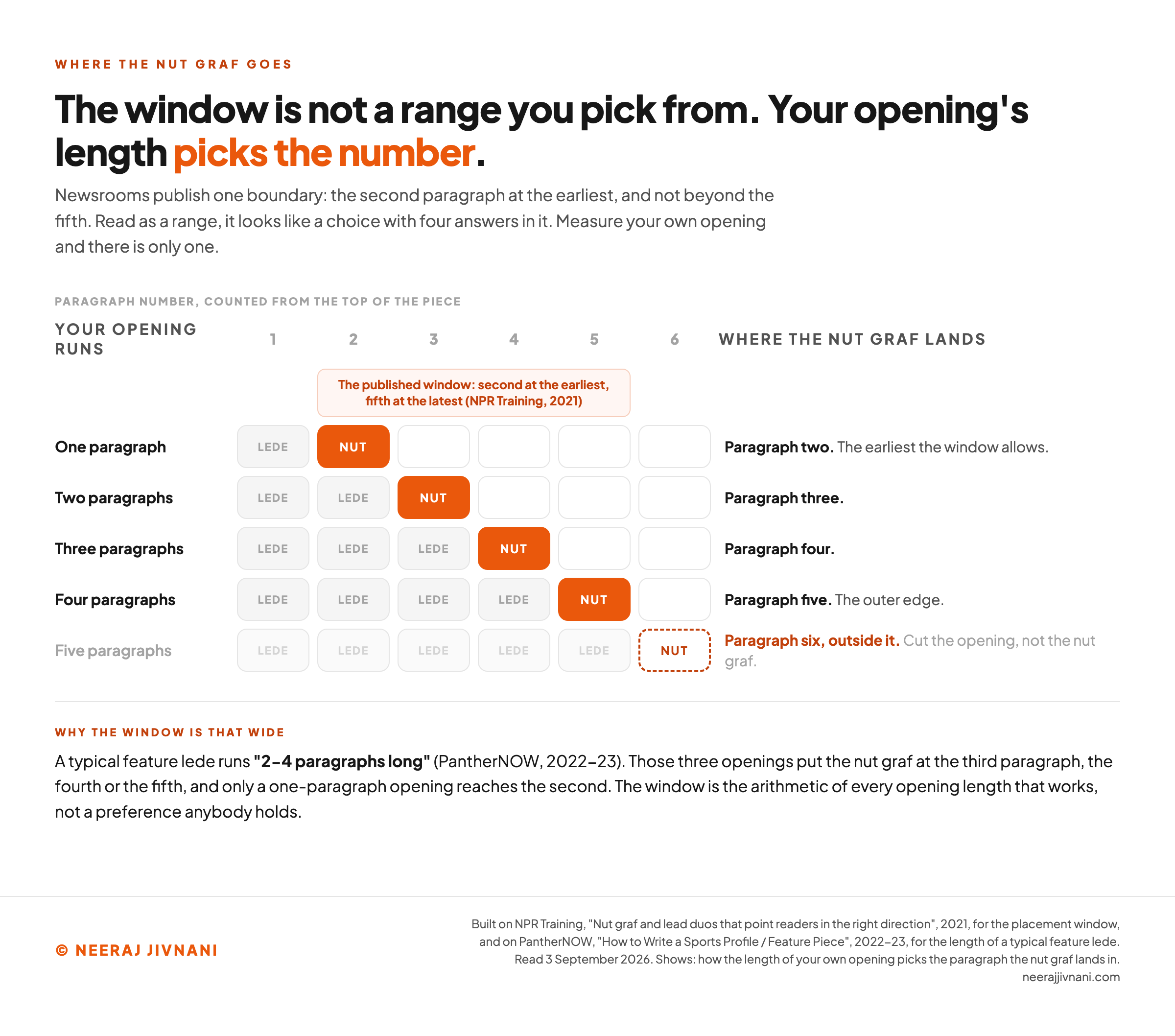
It goes early. The window runs from the second paragraph to the fifth, which is where National Public Radio (NPR) draws it in its 2021 training guidance.
Keep it to a sentence or two, and if you cannot write it at all, you do not yet know what your piece is about.
What a Nut Graf Is
A nut graf puts your piece in a nutshell and says why anyone should spend time on it.
Its job is to put the important facts in context and make the angle unmistakable.
That is the definition in Rodrigo Zamith's 2023 American Journalism Handbook: to "contextualize the most important facts of an article and provide audiences with a clear understanding of that article's angle".
Underneath that one job sit four smaller ones, and a good nut graf does all four in the same breath. They are the four purposes Chip Scanlan set out for Poynter in 2003.
- It justifies the piece. The reader learns why this is worth reading, in their terms rather than yours.
- It connects the opening to everything after it. Your first line earned attention. This is where the attention gets a destination.
- It says why now. Something changed, or something is about to. A piece with no answer to why now is usually a piece with no nut graf.
- It brings the supporting material. Enough of it, early, to show why this matters instead of asserting that it does.
All four compress into one line. A nut graf is "a core statement that answers the basic question lurking in the mind of every reader: 'Why should I bother with this story?'", in a line from Jack Hart of The Oregonian that Scanlan quotes.
You will meet the paragraph under other names. It is also called a billboard, because it lets a reader "preview a story's main themes and arguments from a distance before diving into the details", as The Open Notebook put it in 2014.
Reporters at the Philadelphia Inquirer called it the "You may have wondered why we invited you to this party?" section, in Scanlan's account.
Every one of those names points at the same thing. The paragraph exists to answer a question the reader has not said out loud.
Graf, Graph, or Nutgraph
All three spellings are in print and none of them is wrong.
"Graf" is newsroom shorthand for paragraph. "Graph" is the spelling that survives a spell checker.
None of them changes what the paragraph has to do.
Choose one, use it consistently in your own drafts, and spend no further thought on it.
Nut Graf and Lede: Which One Does What
Your lede makes somebody start reading. Your nut graf makes them continue.
That is the whole division of labor. Almost every confusion about the two comes from asking one of them to do both jobs.
The lede is your opening paragraph, sometimes two. A news lead usually runs two to three sentences, short enough that it cannot answer everything, the length Zamith's handbook gives it.
So the lede is a promise and the nut graf is the receipt.
Which Openings Owe a Nut Graf
Whether you owe one at all depends on the opening you chose.
A summary lead pays its own debt. It puts the who, the what, the when, the where and the why up front, which is the inverted pyramid working as designed.
That leaves nothing for a second paragraph to explain.
In a straightforward breaking news story, "the lead will do the nut graf's work, too", as NPR Training puts it.
Every other kind of opening borrows against the reader's patience.
Three of them do it on purpose. An anecdotal lead opens on a story, an analysis lead opens on synthesis, and a blind lead holds back the who or the what to build tension.
Scene-setting openings and one-line zingers work the same way.
Each of those buys attention by holding something back, and the nut graf is where you give it up.
Read your opening back and ask what a reader still does not know.
If the honest answer is nothing, you have written a summary lead and you owe no nut graf. If the answer is what the piece is about, the nut graf is due, and it is due now.
Where It Goes, and How Long It Runs
Where the nut graf goes is the second paragraph at the earliest and the fifth at the latest, and it runs better short than long.
That is NPR Training's 2021 wording: "the second paragraph at the earliest, and shouldn't fall beyond the fifth".
The looser version, "usually the second or third paragraph", is what Western Confluence gives its own contributors.
Why the Window Is That Wide
The window looks vague until you notice what decides it, which is the length of your own opening.
A typical feature lede runs "2-4 paragraphs long", the figure in PantherNOW's guide, written by its sports director Brian Olmo in 2022-23. Do the arithmetic and the window stops being a range you choose from.
A one-paragraph opening puts the nut at paragraph two. A four-paragraph scene puts it at five, which is the outer edge.
Nothing legitimate lands it at six, because no opening needs five paragraphs to earn its keep.
So do not pick a number off the window. Measure your own opening and let it place the paragraph for you.
Where yours goes, and whether you owe one
Answer for the opening you have actually written. Two facts about it decide both questions, and the window stops being a range you choose from.
Nothing is decided yet. Whether you owe a nut graf at all is decided by the opening you chose, not by the piece.
How Long It Should Run
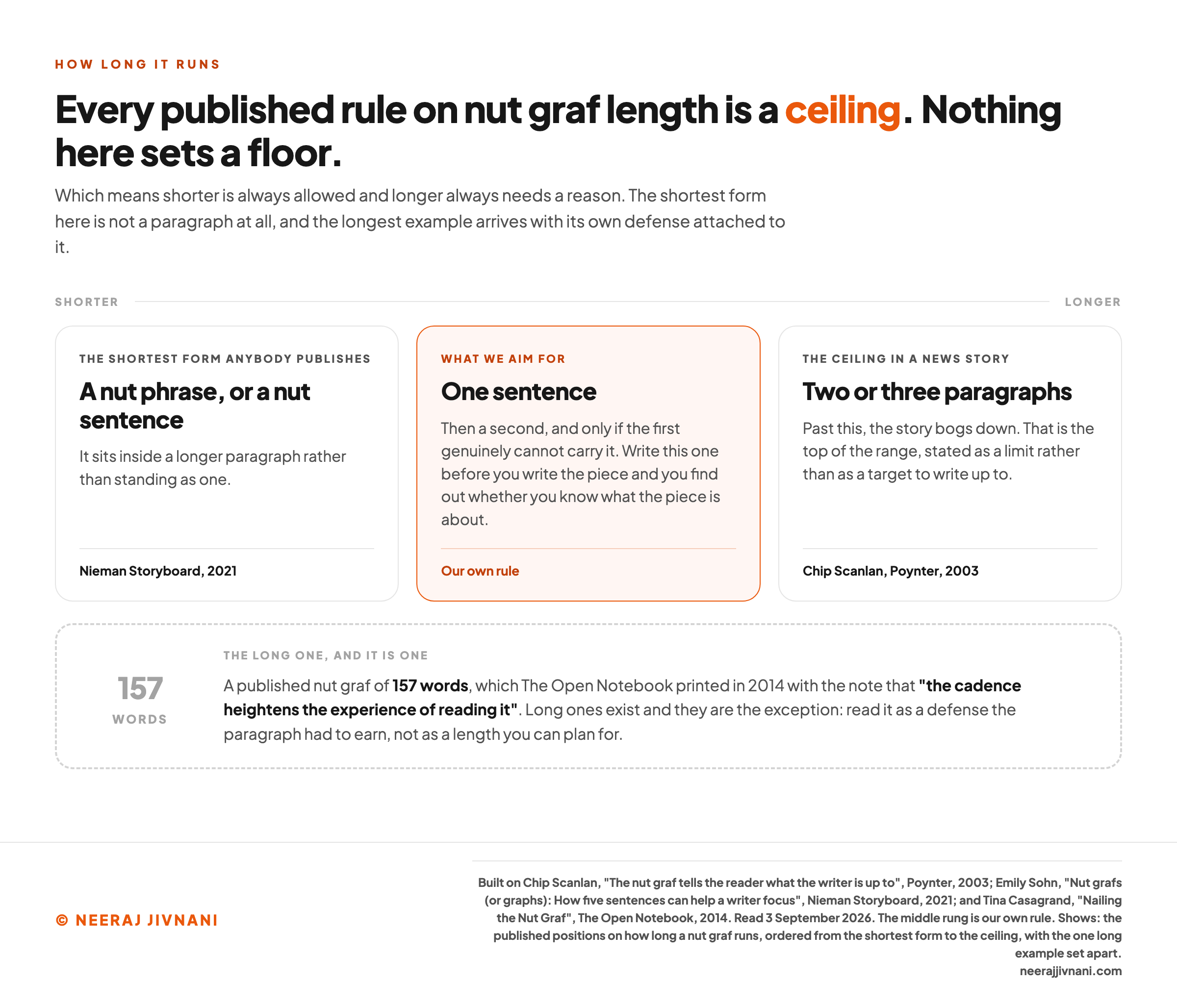
Short. Two or three paragraphs is the ceiling in a news story, and past that the story bogs down, a limit Chip Scanlan set for Poynter in 2003.
Longer than that and you are writing the piece instead of promising it.
At the other end it can shrink below a paragraph entirely, into what Nieman Storyboard in 2021 called "nut phrases" or "nut sentences" inside a longer paragraph.
That is usually the least intrusive form the device takes.
Long ones exist and they are the exception. One published example runs 157 words, printed by The Open Notebook in 2014 with the note that "the cadence heightens the experience of reading it".
That is a defense the paragraph has to earn, not a length you can plan for.
Our own rule is one sentence, then a second only if the first genuinely cannot carry it.
Use this chart — embed code and citation
<a href="https://neerajjivnani.com/blog/nut-graf/"><img src="https://neerajjivnani.com/infographics/nut-graf/your-opening-picks-the-number.png" alt="A five-row chart showing how the length of an opening decides which paragraph the nut graf lands in. Paragraph positions one to six run across the top, and positions two to five are shaded as the published window NPR Training set out in 2021: the second paragraph at the earliest, and not beyond the fifth. A one-paragraph opening puts the nut graf at paragraph two, a two-paragraph opening at three, a three-paragraph opening at four, and a four-paragraph opening at five, which is the outer edge. A five-paragraph opening pushes it to paragraph six, drawn outside the window, with the instruction to cut the opening rather than move the nut graf. A footer notes that a typical feature lede runs two to four paragraphs, which is why the window is that wide." width="1200"></a>
<p>Chart: <a href="https://neerajjivnani.com/blog/nut-graf/">Neeraj Jivnani</a></p>Neeraj Jivnani, "The Nut Graf: What It Does, Where It Goes, and How to Write One", neerajjivnani.com, https://neerajjivnani.com/blog/nut-graf/Free to republish with a link back to this page.
Use this chart — embed code and citation
<a href="https://neerajjivnani.com/blog/nut-graf/"><img src="https://neerajjivnani.com/infographics/nut-graf/every-rule-is-a-ceiling.png" alt="A scale of four published positions on how long a nut graf runs, ordered from shorter to longer. The shortest is a nut phrase or a nut sentence sitting inside a longer paragraph, the form Nieman Storyboard reported in 2021. The middle position, marked as our own rule and as what we aim for, is one sentence, with a second only if the first genuinely cannot carry it. The third is two or three paragraphs, the ceiling Chip Scanlan set for a news story in Poynter in 2003, past which the story bogs down. Set apart in a dashed box is the exception: a published nut graf of 157 words that The Open Notebook printed in 2014 with the note that the cadence heightens the experience of reading it." width="1200"></a>
<p>Chart: <a href="https://neerajjivnani.com/blog/nut-graf/">Neeraj Jivnani</a></p>Neeraj Jivnani, "The Nut Graf: What It Does, Where It Goes, and How to Write One", neerajjivnani.com, https://neerajjivnani.com/blog/nut-graf/Free to republish with a link back to this page.
How to Write One
Write it before you write the piece. The writers who lean on it hardest draft it earliest, and the reason has nothing to do with phrasing.
Drafting early shows you the holes while there is still time to go and fill them.
Experienced reporters say they find it helpful to "constantly write and rewrite the nut graf through the course of reporting the story", in Scanlan's account for Poynter.
The same habit gets taught to beginners. At the University of California, Santa Cruz, Erika Check Hayden teaches her science communication students "to write them before sitting down to write the first draft", as Nieman Storyboard reported in 2021.
Four steps, in this order.
The first happens before you draft anything; the other three happen once your opening exists.
Write the One Sentence First
One sentence, before any of the rest of it. What is this about, and why should anybody read it.
Treat that as a test, not as advice. Until you can "distill your story into one sharp sentence" you do not know what the article is about, and Western Confluence's instruction to its contributors is to keep working until you can.
One sentence in the paragraph carries the weight, and it is the last one. A nut graf "ends with the nut sentence, which puts the take-away message from your story into concise, clear language, without giving away the ending", in Western Confluence's words.
Write the last sentence first, then work out how little setup it needs in front of it.
Answer What the Opening Left Open
Once your opening is on the page, list what it left open. Every question it raised and did not settle belongs in the nut graf, and the classic list is who, what, when, where, why and how.
Answer them in the order the reader needs, which is rarely the order of the mnemonic.
The one that carries the paragraph is why. A nut graf that answers who and what and skips why has described your piece without selling it, and a reader who does not know why is a reader who leaves.
Say Why It Matters Now
Timing is the third of Scanlan's four purposes. A nut graf "often tells readers why the story is timely", in his wording.
Something has changed, or is about to, or has quietly been true for long enough that somebody noticed.
Say which.
If nothing has changed, you may still have a piece worth reading. You do not have a news peg, and pretending otherwise in the nut graf is where writers reach for the words that make a paragraph sound urgent instead of being urgent.
Do Not Give Away the Ending
The nut graf sells the piece. It does not summarize it, and confusing the two is what turns a nut graf into a spoiler.
"Never give away the ending of the story". That guideline is James B. Stewart's, a former Wall Street Journal front page editor, quoted by Scanlan for Poynter.
Feature work draws the same line. "Unlike hard-news leads, the nut graf doesn't have to spoil the ending", NPR Training says.
There is a caution attached. A piece about a study still has to reveal what the study found, in or before the nut graf.
Say what the piece is about. Do not say how it comes out.
What One Looks Like on the Page
Here is what a good one looks like: two that were published, and one built from scratch.
Read each lead first. Then notice what the paragraph after it has to do to earn the attention that lead bought.
Count the sentences in each nut graf as you go.
A Scene With a Hole in It
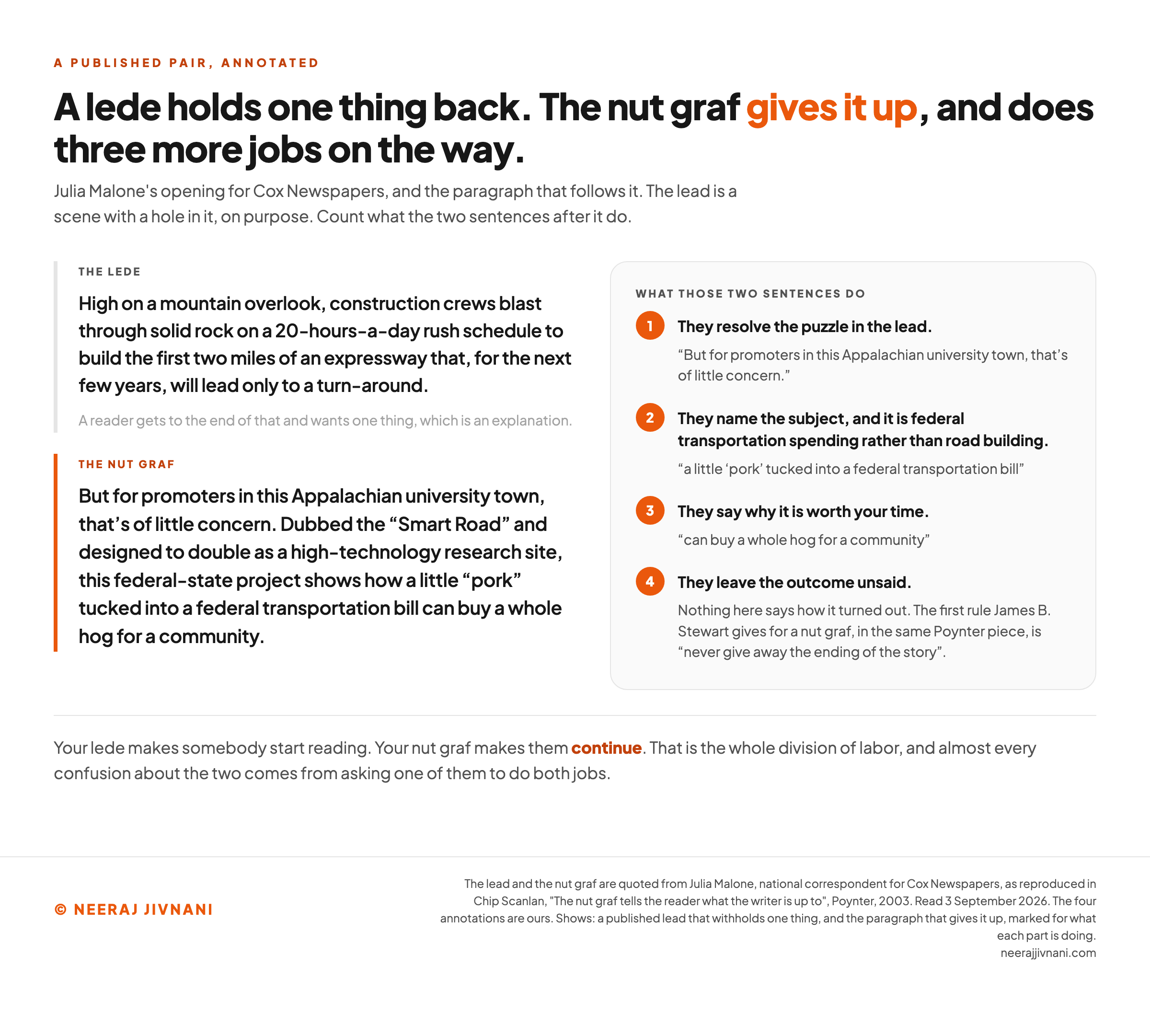
The first is a scene with a hole in it, on purpose, from Julia Malone of Cox Newspapers in a story Scanlan takes apart for Poynter.
High on a mountain overlook, construction crews blast through solid rock on a 20-hours-a-day rush schedule to build the first two miles of an expressway that, for the next few years, will lead only to a turn-around.
A reader gets to the end of that and wants one thing, which is an explanation. The next paragraph supplies it.
But for promoters in this Appalachian university town, that's of little concern. Dubbed the "Smart Road" and designed to double as a high-technology research site, this federal-state project shows how a little "pork" tucked into a federal transportation bill can buy a whole hog for a community.
Count what those two sentences do. They resolve the puzzle in the lead, they name the subject as federal transportation spending rather than road building, they say why it is worth your time, and they leave the outcome unsaid.
One Sentence That Widens the Lens
The second is a single sentence, from a Wall Street Journal feature of 2017, and it is the move at its cleanest.
Its lead follows one woman's bedtime routine. The nut widens the lens in one stroke.
Zit-popping has joined the ranks of YouTube-driven internet subcultures, turning some dermatologists into celebrities and many watchers of the videos into confessed pop-a-holics.
That is the shape NPR Training calls the "so-and-so is not alone" graf, with the warning that you must never write the words "so-and-so is not alone".
Two sentences in the first example, one in this one, and the job is identical.
One Built From Scratch
The third example is illustrative rather than reported. Say you are writing about a school district that redrew its bus routes, and the reporting is all in your notebook.
The one-sentence version comes first. Parents in one district are driving their children to school because the new routes made the ride too long to face.
Now grow it, behind an opening that follows one family out of the door before dawn.
Families across the district have given up on the bus since the routes were redrawn in August. Administrators say the new map saves money. Parents say it has moved the cost onto them.
Scale in the first sentence, both sides in the next two, and no verdict anywhere. The numbers a real version would carry are the ones you would go and get.
Use this chart — embed code and citation
<a href="https://neerajjivnani.com/blog/nut-graf/"><img src="https://neerajjivnani.com/infographics/nut-graf/a-published-pair-annotated.png" alt="A published lead and the nut graf that follows it, side by side and annotated. Julia Malone's opening for Cox Newspapers describes construction crews blasting through solid rock to build the first two miles of an expressway that will lead only to a turn-around, which withholds the explanation on purpose. The nut graf beside it names the Smart Road as a federal-state research project and reads it as an example of pork tucked into a federal transportation bill. Four numbered annotations mark what those two sentences do: they resolve the puzzle in the lead, they name the subject as federal transportation spending rather than road building, they say why it is worth your time, and they leave the outcome unsaid." width="1200"></a>
<p>Chart: <a href="https://neerajjivnani.com/blog/nut-graf/">Neeraj Jivnani</a></p>Neeraj Jivnani, "The Nut Graf: What It Does, Where It Goes, and How to Write One", neerajjivnani.com, https://neerajjivnani.com/blog/nut-graf/Free to republish with a link back to this page.
When You Do Not Need One
Two kinds of piece are better off without one.
A straight news story does not need one; its summary lead has already done the job. A narrative strong enough to pull the reader along may not need one either.
The second case is the interesting one.
A nut graf can become a crutch, and then it is not doing the work. Sam Fromartz of the Food and Environment Reporting Network told The Open Notebook in 2014 that a nut is sometimes unnecessary for exactly that reason.
And some accomplished writers reject the device on principle.
"Hate them. They should be illegal", Rowan Jacobsen wrote in Nieman Storyboard's 2021 piece, because they "destroy any hope of a complex narrative".
The objection goes further than taste.
Formalism of that sort is "a part of the rote methodology that governs the thought of people who don't have better ideas", John McPhee wrote in "Draft No. 4: On the Writing Process".
The working compromise is to use them in drafts, then pare them down or remove them from the published story, which is how Michelle Nijhuis, an Atlantic project editor, put it.
That compromise is the right reading of the argument.
The nut graf is a thinking tool first and a published paragraph second. Writing it is never wasted, because it forces the decision about what the piece is.
Whether it survives into print is a separate question, and on a strong narrative the answer is sometimes no.
Where the Name Comes From
The name comes from the newsroom, and the half worth knowing is the nut.
It is named that way "because, like a nut, it contains the 'kernel,' or essential theme, of the story", in Scanlan's gloss.
Even the credit is hedged. "Many blame the Wall Street Journal for the coinage", NPR Training says, and blame is the word it chooses.
What the Journal certainly did invent is the story form the paragraph belongs to, and it started with a rule about dates.
Barney Kilgore arrived as the Journal's managing editor in 1941 and banned the words "today" and "yesterday" from its leads, on the reasoning that "it doesn't have to have happened today to be news", in Scanlan's account.
Once a story no longer had to open on an event, it needed a paragraph to explain why it was running at all.
The Journal, in Scanlan's account, "is home to a form best known as the 'nut graf' story", also called the news feature.
Outside Journalism, the Same Paragraph Works
The same paragraph works anywhere a reader can walk away, and nothing about the device is specific to news.
The range is wide. A nut graf can work for "a chapter in a novel, a personal essay, a research paper, a business report, a cover letter, a piece of advertising copy", in Betty Ming Liu's list, updated in 2023.
The rule underneath it does not change. Somebody has to be told what they are reading and why.
A report that opens on a chart, a memo that opens on a complaint, a proposal that opens on a story about a customer: each one has bought attention with something other than its subject, and each one owes the paragraph that explains the purchase.
The convention has a newsroom name because newsrooms needed it first, and hardest.
The Paragraph Is a Decision, Not a Formula
The nut graf looks like a formatting convention and behaves like an editorial one. Where it goes is settled, and how long it runs is settled. Neither of those is what makes one work.
What decides it is whether you know what your piece is about before you start writing it.
So write the sentence first, put it where your own opening stops explaining itself, and cut it to the shortest form that still answers why anybody should read on. If the sentence will not come, the problem is not the paragraph.