Account-Based Marketing: The Unit Is a Buying Committee, Not a Lead
An account is a company and several people, any of whom can stop the deal. See how many you sell to, what it costs, and why lead counts stop working.


/ On this page11 sections
Account-based marketing, or ABM, is business-to-business marketing whose unit of work is a named company rather than a person who filled in a form.
A company signs nothing. Inside it sits a group of people who decide together, and any one of them can stop the deal.
That group is the buying committee. Its size decides what reaching an account costs, which channels can carry it, and whether the lead count you have been reporting means anything at all.
The Unit Changed, and Everything Else Follows
The change of unit is where every hard part of ABM starts.
The marketing funnel runs backwards. You name a defined set of high-value accounts first, instead of marketing broadly and hoping leads convert.
The score at the end of the quarter can no longer be a count of leads.
Nobody argues about the definition. The trouble starts one level down, where you decide who inside the account you are talking to and what it costs to reach them.
Two labels sit beside this one. Account-based selling is the sales side of the same list, and account-based experience, or ABX, extends the idea past the sale into retention.
The sharpest objection is worth putting plainly. Is this not detailed, data-driven marketing with a new name?
The data is not what makes it different. The order of operations is.
Against Lead-Based Marketing and Inbound
Lead-based marketing waits for a hand to go up, then works out which company the hand belongs to. Account-based marketing names the company first and goes looking for the hands.
That is the whole inversion, and it is also why the two coexist without much friction. Run both. LinkedIn's ABM guide calls it not an either-or decision, and nothing in ABM stops a form from converting.
Inbound content keeps working here, reinforcing the outbound effort on the named accounts.
What ABM changes is what happens to a form from a company nobody chose. Under a lead model it enters the same queue as everything else.
Under an account model it is either on the list or it is not, and that decision was made before the form arrived.
How Many People Are Inside One Account
How many people are inside one account is a number you count yourself. Open the last three closed opportunities in your records and count every person who appeared.
Published averages exist, and borrowing one is a mistake. The figure depends entirely on who the publisher decided to count.
A number that includes external influencers describes a different object from one that counts only the people on your side of the table.
So count your own, and be strict about who qualifies. A person is on the committee if they appeared on a call, replied on a thread, asked for something to be changed, or signed anything.
Include the one who only approved the invoice. Procurement and finance rarely appear early and are the most common place a closed deal stops on its way to a signature.
Three deals is the floor for the sample, not the target.
Two tells you nothing about the spread, and a single unusual deal moves the number too far.
Count separately for the segments you sell to. A committee in a small business is not the same object as one in a multinational, and averaging the two gives you a size that describes neither.
That count is the input to every decision that follows. It decides how many pieces of content one account consumes, how many relationships one seller carries, and whether an advertising audience built from your list can exist at all.
The committee you counted, and what it costs you
Put in the number you took off your last three closed deals, the accounts on your list, and how many of the committee you have a live relationship with today. Nothing here is a score. It is the same count read back as the three things it decides.
One. The relationships the program carries
20 accounts at 4 people each is 80 people to keep live.
That is the number a seller carries, and it is why the tier is a budget decision rather than a style. Fix the number of accounts to what your hours can carry.
Two. Committee coverage, the measure that replaces the lead count
25% reached
One live relationship on a committee of 4 people is a single thread. Remove that contact and ask who else would still return a call. If the answer is nobody, the deal leaves when the person does.
The people on a committee are not all buying the same thing. One is buying an outcome, one an integration, one a payback period, which is why one asset cannot carry an account.
Three. Whether an advertising audience built on the committee can exist
Committee below the floor
80 people is the whole committee across your named list, against the 300 member accounts LinkedIn requires to start an ad set. The list itself is under the 300 rows a company targeting list needs to upload, so it cannot be loaded as a list at all.
Targeting the whole company rather than the committee can clear the floor, which is why what the platform refuses is not your accounts but your committee. Narrowed onto the committee, the channel plan is sales outreach, direct mail, events and named-person email.
Mapping Who Is In It
Mapping a committee means naming real people against real roles, before the campaign is built rather than after it stalls.
Start from the roles. For a company selling marketing software they are the chief marketing officer, digital marketing managers, the chief information officer and the chief financial officer, in LinkedIn's own worked example.
Notice what those four have in common: they want different things. The marketing chief is buying an outcome, the technology chief is buying an integration, and the finance chief is buying a payback period.
That is why one asset cannot carry an account. A case study that convinces the marketing chief says nothing to the person who has to connect the system to what you already run.
Three sources will give you the names without a data purchase. Your CRM's contact roles on past deals, the job titles listed on the account's own LinkedIn page, and the people your seller has already met.
Why a Single Champion Is a Single Point of Failure
A single champion inside an account is the quietest way an ABM program fails, because the deal leaves when the person does.
The fix has a name. Multi-threading means holding a live relationship with more than one member of the committee at once.
It is not a tactic. It is insurance on the work already spent.
The test is easy to run on your own pipeline. Take any open opportunity, remove your main contact from it, and ask who else would still return a call. If the answer is nobody, the account has one thread.
Picking a Tier Is Picking a Cost Per Account
Choosing a tier is choosing how many hours each account gets. Everything else about the tier follows from that number.
They go by two sets of names and you will meet both. One-to-one is also called strategic ABM, one-to-few is ABM lite, and one-to-many is programmatic ABM.
One-to-one is a dedicated senior-level marketer partnering with the account team to build programs for markets of one, in Demandbase's description.
One-to-few applies the same research-based principles to clusters of 5 to 15 accounts that share a business issue or an industry. One-to-many is personalization at scale for hundreds of named accounts.
The top tier is one to five accounts in Leadfeeder's advice, while the bottom tier is the same funnel pointed at hundreds or thousands of companies.
Real lists run larger than the labels suggest. One-to-one averages 39 accounts with a median of 14, and one-to-few averages 177 with a median of 50, figures Factors.ai publishes inside bands of 10 to 50 and 50 to 200.
Those bands describe other people's programs, not your budget.
Few companies can afford true one-to-one for more than a handful of accounts, so a real program blends all three. That blend is the normal shape.
What Each Tier Has Been Spent On
The published examples are the fastest way to see what a tier costs in hours.
At the top tier, GumGum commissioned a custom comic book starring T-Mobile's chief executive as a superhero, mailed it to the decision makers and won the deal, a campaign Factors.ai documents. One account, one commissioned artefact, one outcome.
In the middle, Snowflake's Data Cloud Tour ran in-person executive briefings for about 100 named enterprise accounts, with personalized landing pages and dedicated outreach behind them, which Factors.ai also documents.
Cognism's own middle-tier work is a gifting program, its cupcake campaign, alongside executive roundtables and bespoke microsites.
At the bottom tier the examples become channels rather than campaigns: webinars, direct mail, email, paid advertising, web personalization and retargeting.
Nothing on that list is unique to ABM, and that is the tier working as intended.
Choosing the Accounts Before Anyone Raises a Hand
Account selection here is fit judged before any behavior exists, and that is what makes it different from every other kind of targeting you have done.
There is no click to score, no email opened, no page visited. You are deciding that a company deserves the budget on the strength of what it is, not what it has done.
Start with the ideal customer profile, and settle it before anyone opens a list. Every name that follows is scored against it.
Fit, Judged Before Any Behavior Exists
Four questions do most of the work, and they are answerable from what you already hold.
- Can this account carry the contract? Your average deal size against their size, their budget and what they already spend on the problem. An account that cannot sign a deal worth the hours is the wrong account however attractive the logo.
- Do they have the problem you solve? Not a related problem. The specific one, visible in something they have published, hired for, or been reported doing.
- Can you name the committee? If you cannot list four roles and put real names against two of them, you have a company, not an account.
- Is there a way in? An existing relationship, a shared customer, an event they attend. Accounts with no route are a research project, not a campaign.
Existing customers belong on this list too. An account you already serve is the one where the committee is already mapped.
Say a firm sells a system that takes nine months to implement. An account planning a merger this year has the problem and no capacity to act on it, which is a fit judgment no behavioral score would ever make.
The Smallest Audience a Platform Will Serve
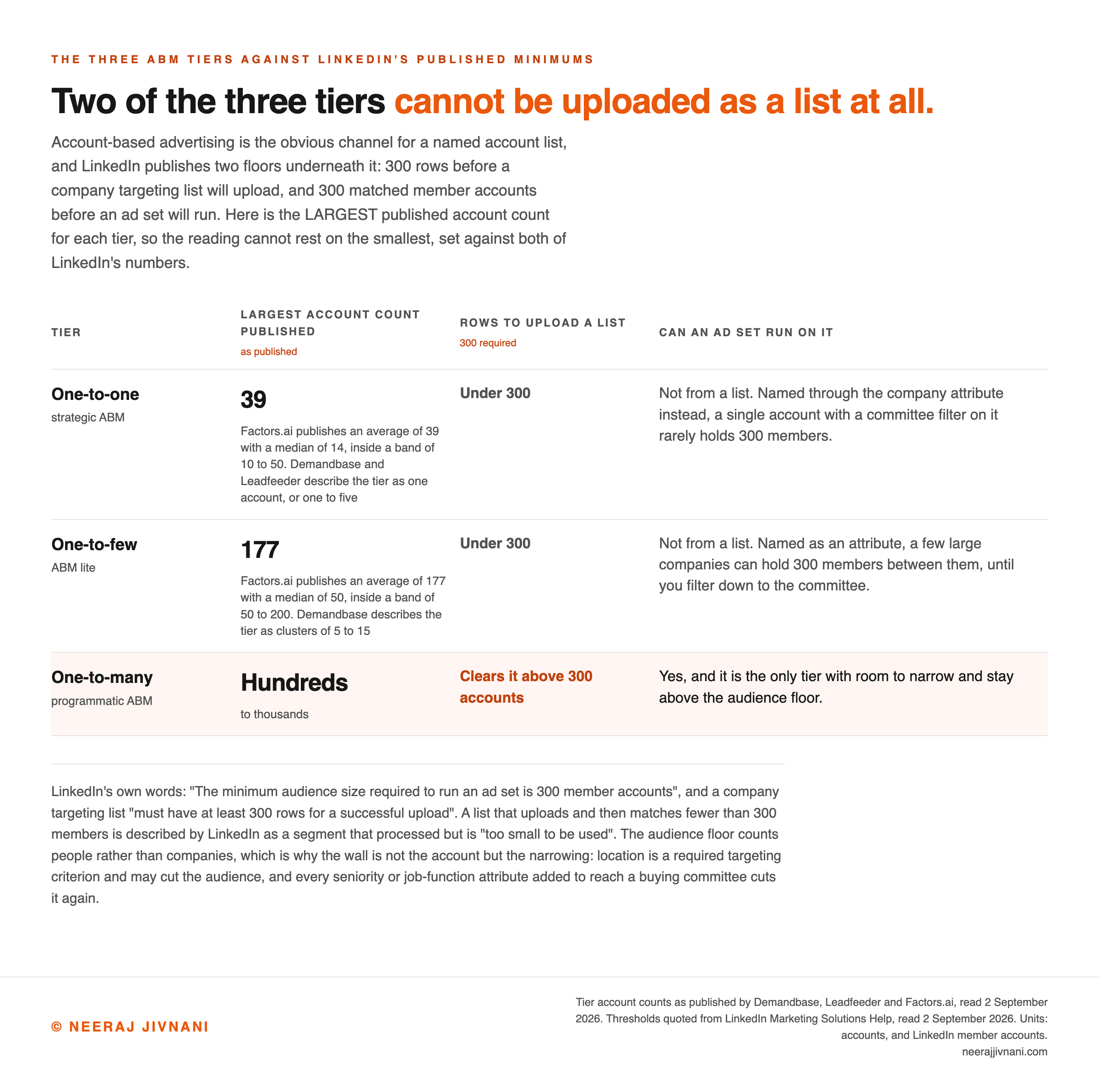
The smallest audience LinkedIn will serve is published, and there are two floors under it. A company targeting list will not upload with fewer than 300 rows, and an ad set will not start under 300 matched member accounts.
The list floor is a straight count of companies, and no one-to-one or one-to-few list reaches it on any published band. The ad-set floor counts people rather than companies, so it bites in a different place.
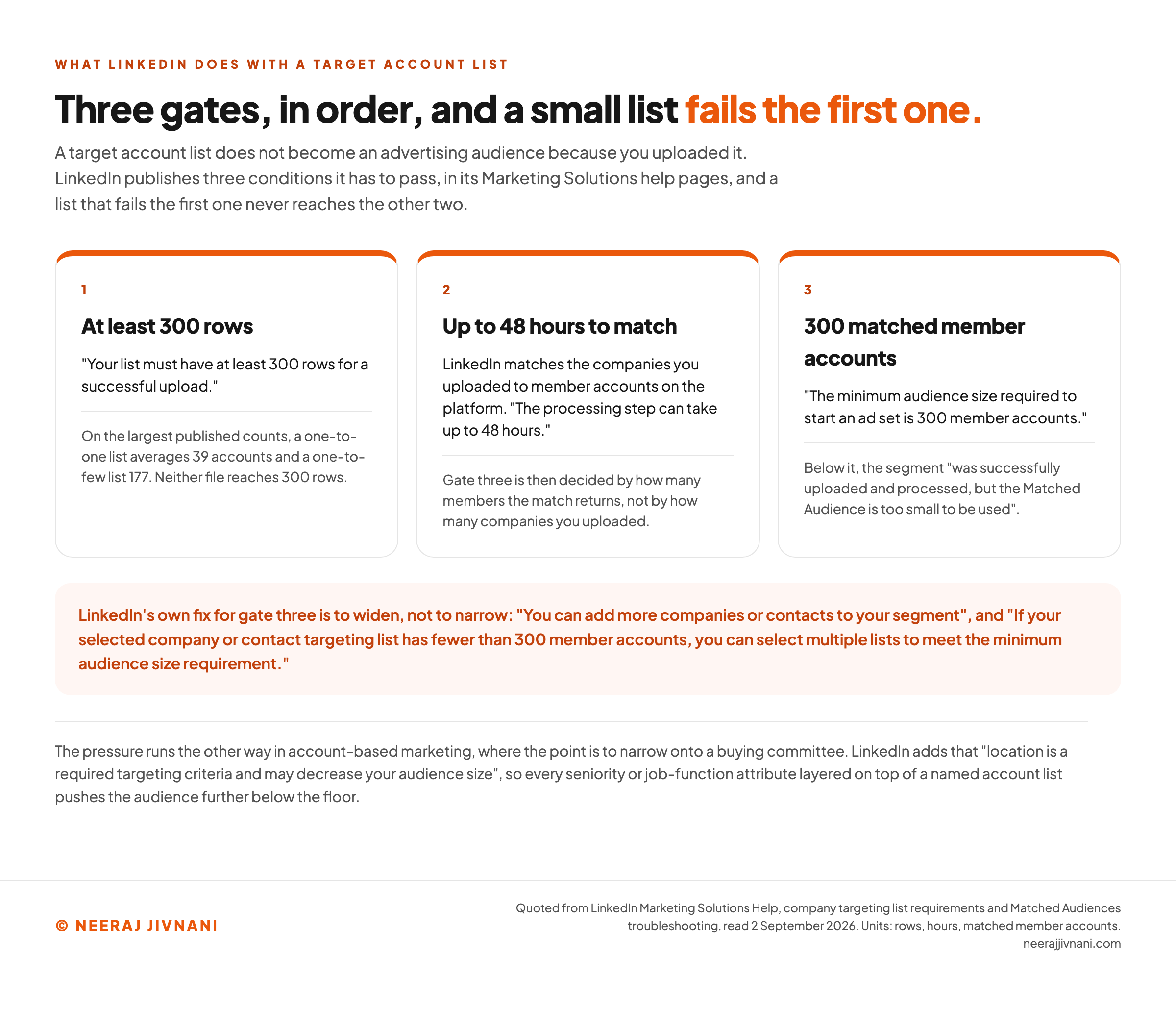
The two floors stack rather than substitute. An uploaded list must then match a minimum of 300 member accounts before an active ad set can use it, and LinkedIn says that matching can take up to 48 hours.
LinkedIn also publishes what happens when the list is too small. A segment uploads and processes, and then cannot be used, because the matched audience sits below the floor.
Its own suggested fix is to add more companies, or to combine several lists into one audience.
Two further details make the floor bite harder than it looks. Location is a required audience targeting criterion and may cut the audience further, and every attribute you add to reach the committee rather than the whole company cuts it again.
Which Tiers Can Buy Advertising at All
Put the tiers against those thresholds and one route shuts immediately. Take the top of each published band, so the conclusion cannot rest on an average.
That is 50 accounts for one-to-one and 200 for one-to-few, the top of each band Factors.ai states.
None of those reaches 300 rows, and neither does Demandbase's 5 to 15. So neither tier can be uploaded as a company targeting list, which is the obvious route: take your account list, load it in, advertise to it.
The other route stays open, and it is where the floor does its real work. You can name companies through the platform's company attribute without uploading anything, and the 300 member account minimum still applies to the ad set built on top of it.
That minimum counts people, not companies. A few dozen large enterprises will usually hold more than 300 members between them, so the ad set can run, as long as you keep targeting all of them.
Narrowing is what breaks it. Add the seniority and the job functions that turn an audience from a payroll into a buying committee, and the count falls toward a floor that does not move with it.
What the platform refuses is not your accounts but your committee.
Only the one-to-many tier has room to narrow and stay above 300, and even then the list itself has to pass 300 companies before it will upload. Account-based advertising is a one-to-many instrument, and the two tiers people mean when they say ABM are run by human beings.
None of this says the approach fails. It says the channel plan for the top tiers is sales outreach, direct mail, events and named-person email, and that a media budget written for them was never going to be spent.
Use this chart — embed code and citation
<a href="https://neerajjivnani.com/blog/account-based-marketing/"><img src="https://neerajjivnani.com/infographics/account-based-marketing/tiers-against-the-floor.png" alt="The three ABM tiers with the widest published account count bands for each, stopping at 50 for one-to-one and 200 for one-to-few, set against LinkedIn's two published thresholds of 300 rows to upload a company targeting list and 300 matched member accounts to run an ad set, showing that one-to-one and one-to-few both fall below the upload floor so cannot be loaded as a list at all, while only one-to-many has room to narrow onto a buying committee and stay above the audience floor." width="1200"></a>
<p>Chart: <a href="https://neerajjivnani.com/blog/account-based-marketing/">Neeraj Jivnani</a></p>Neeraj Jivnani, "Account-Based Marketing: The Unit Is a Buying Committee, Not a Lead", neerajjivnani.com, https://neerajjivnani.com/blog/account-based-marketing/Free to republish with a link back to this page.
Use this chart — embed code and citation
<a href="https://neerajjivnani.com/blog/account-based-marketing/"><img src="https://neerajjivnani.com/infographics/account-based-marketing/where-the-list-fails.png" alt="LinkedIn's published path for a company targeting list, showing the three gates it must clear in order, at least 300 rows to upload, up to 48 hours of matching, and a minimum of 300 matched member accounts before an active ad set can use it, with the platform's own description of what a list that fails the last gate looks like." width="1200"></a>
<p>Chart: <a href="https://neerajjivnani.com/blog/account-based-marketing/">Neeraj Jivnani</a></p>Neeraj Jivnani, "Account-Based Marketing: The Unit Is a Buying Committee, Not a Lead", neerajjivnani.com, https://neerajjivnani.com/blog/account-based-marketing/Free to republish with a link back to this page.
Personalization, Priced by the Hour It Takes
Personalization is where the budget goes, and the tactics are easy to name and hard to price.
The familiar vehicles are web personalization, direct mail, webinars, email campaigns and paid advertising.
Then the ones that take real production: personalized video messages, custom microsites and landing pages, tailored demos and co-created content.
None of that is a plan. The items differ by an order of magnitude in what they take to produce.
| The tactic | What one account consumes |
|---|---|
| A tailored email sequence | Writing time, and it reuses your existing positioning |
| A personalized video message | One recording per contact, so it scales with committee size |
| A custom microsite or landing page | Design, build and copy, then upkeep for as long as the deal runs |
| A commissioned artefact, such as GumGum's comic book | A brief, an external commission and a delivery plan |
| An executive dinner or briefing | A venue, a date, and senior time on both sides |
That spread is why relevance breaks down as the account count rises. The tactic that survives fifty accounts is the one that took the least work to make.
The answer is not to buy more capacity. Fix the number of accounts to what your hours can carry, and let the depth stay real, because a microsite built for fifty accounts is a template with a logo swapped into it.
Two Teams Working One List
Two teams working one list is what alignment means in practice, and without a few written agreements the word means nothing at all.
Marketing has been shipping a unit sales does not use. "Sales works on accounts", and contact-level lead generation is "a neophyte marketing output and considered essentially useless by sales", in B2B Marketing and Propolis's 2023 words.
The list is where the two units get reconciled, which is why it goes in writing first.
Four things belong in writing before a campaign runs.
- The account list, signed by both teams. The agreement is the launch condition, not a formality settled after the campaign is built.
- Who follows up, and how fast. A written follow-up service level agreement between the two teams, carrying a stated response time rather than an implied one.
- What counts as engagement worth a call. Without this, marketing forwards activity and sales ignores it.
- How an account joins or leaves the list. Sales will want additions. Deciding the route in advance keeps the list from becoming a wish list.
Name the people outside the two teams who need to know. Customer success reps meet the same accounts and are usually told last.
Judging It Without a Lead Count
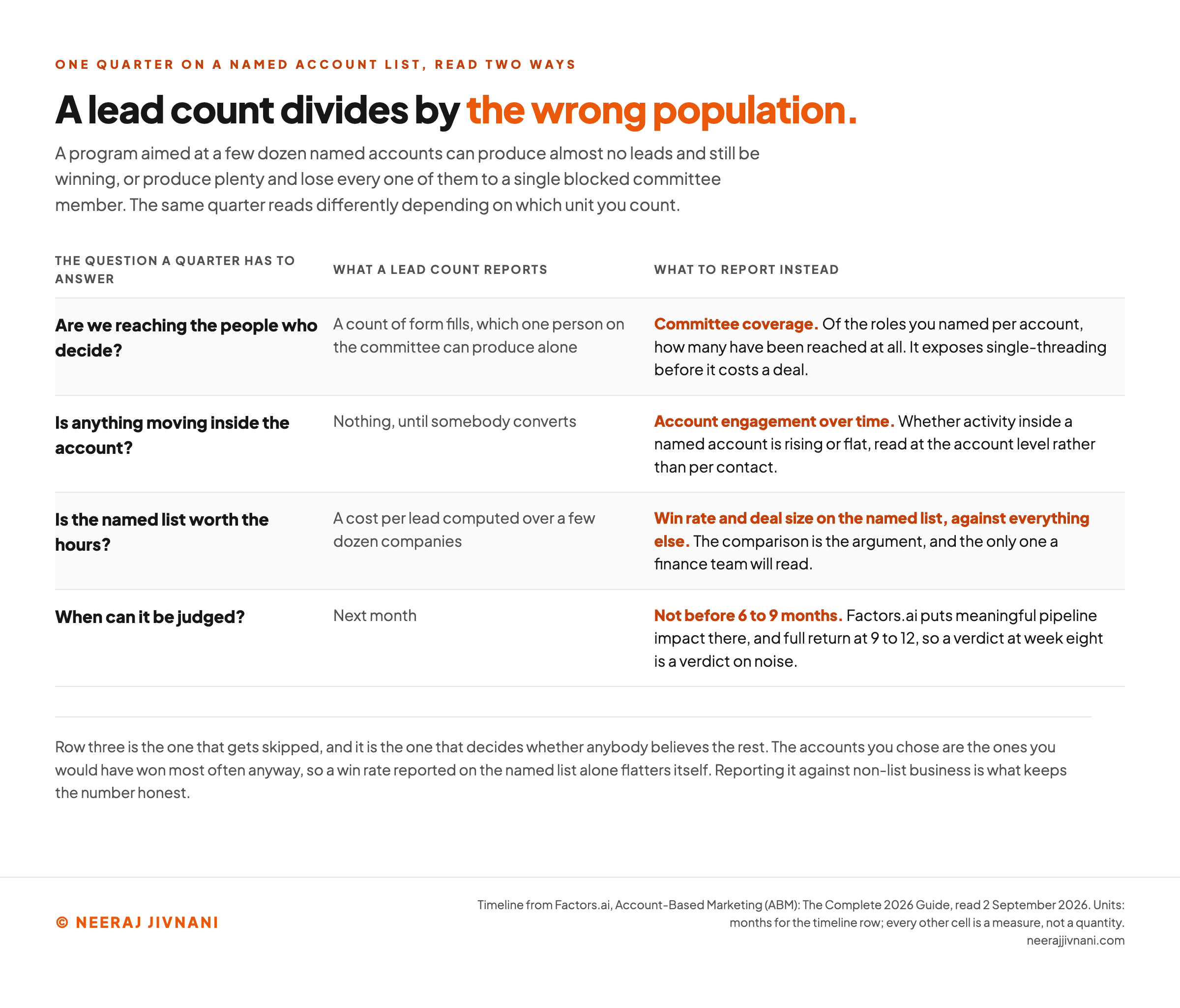
The lead count stops working the moment the unit changes, because it divides by the wrong population.
A program aimed at a few dozen named accounts can produce almost no leads and still be winning, or produce plenty and lose every one of them to a single blocked committee member.
What replaces it is account-centric: engaged accounts, pipeline and revenue.
The workable set adds engagement depth, meeting conversions, pipeline movement and sales alignment.
What a Quarter Reports Instead
Three measures cover most of what a quarter needs to report.
- Committee coverage. Of the roles you named per account, how many have you reached at all. This is the measure that exposes single-threading before it costs a deal.
- Account engagement over time. Whether activity inside a named account is rising or flat, read at the account level rather than per contact.
- Win rate and deal size on the named list, against everything else. The comparison is the argument, and it is the only one a finance team will read.
Impact is genuinely hard to prove here, and the reason is uncomfortable. The accounts you chose are the ones you would have won most often anyway, so reporting the comparison against non-list business is what keeps the number honest.
The timeline matters as much as the metric. ABM asks for significant investment and 6 to 9 months of patience before results, on Factors.ai's own reckoning, so a program judged at week eight will be judged on noise.
Use this chart — embed code and citation
<a href="https://neerajjivnani.com/blog/account-based-marketing/"><img src="https://neerajjivnani.com/infographics/account-based-marketing/the-wrong-population.png" alt="One quarter on a named account list set out twice, showing the four questions a quarter has to answer, what a lead count reports against each of them, and the account-level measure that answers it instead, from committee coverage and account engagement through win rate and deal size on the named list against everything else, ending on the timeline that says a verdict at week eight is a verdict on noise." width="1200"></a>
<p>Chart: <a href="https://neerajjivnani.com/blog/account-based-marketing/">Neeraj Jivnani</a></p>Neeraj Jivnani, "Account-Based Marketing: The Unit Is a Buying Committee, Not a Lead", neerajjivnani.com, https://neerajjivnani.com/blog/account-based-marketing/Free to republish with a link back to this page.
Buying Software for a Category That Is Not One
There is no single ABM product category, which is why asking for the top account-based marketing platforms has no clean answer.
Five different products share the one word. Comparing them by feature list is comparing an advertising network with a data provider with a workflow tool.
B2B Marketing and Propolis, rating 26 vendors independently in 2023, called the field "a broad mix of vendors with a wide variety of claims: data collection and analytics, targeted advertizing, marketing campaign orchestration, enabling intelligent engagement, and even sales enablement".
Score the vendor, not the software. Market momentum, customer focus, price against value and implementation success are what separate two products that look identical on paper, and they are the four criteria that report grades its vendors on.
That reasoning is worth borrowing whatever you buy. Marketers are not only buying kit, the report argues, they are buying into a long term partnership, and a vendor's vision, ethos and ways of working are what is most critical to a successful implementation.
The order matters more than the shortlist. Settle what success means before you settle on software, so the tier, the account count and the measure are all decided first. The category you need then becomes obvious.
Four Categories Behind One Label
Four buying categories sit behind the one label, and a first program rarely needs all of them.
- Account identification and intent. Tells you which named accounts are on your site or in market. Worth buying when the list is long and the signal is invisible.
- Advertising and audience delivery. Serving ads to the named list. It only clears LinkedIn's 300 member account floor at the one-to-many tier.
- Orchestration. Usually the marketing automation platform or the CRM you already run, extended to work at account level.
- Measurement and attribution. Account-level reporting, which is the piece most existing stacks genuinely lack.
The Businesses This Does Not Suit
ABM is the wrong approach for a business whose contract value cannot carry the hours a named account consumes, and that is arithmetic rather than an opinion.
Four conditions decide it, and Factors.ai names them: annual contract value, total addressable market, whether the product category is established or new, and whether you sell to small business, mid-market or enterprise.
One of them comes with a number. A total addressable market under about 5,000 accounts is the range Factors.ai says ABM suits, and it states plainly that ABM does not replace lead generation.
Run the arithmetic on your own figures. Take the hours one account consumes at the tier you want, multiply by what those hours cost you, and set it against the gross margin on one closed deal at your average contract value.
Say a company sells a product at a few thousand dollars a year into a market of tens of thousands of buyers. One-to-one attention would cost more than the contract returns, and the one-to-many tier is broad marketing with an account list attached.
When the Arithmetic Says No
Three conditions make it the wrong call, and each one is visible before any money is spent.
- Small contracts and a large market. The tier that fits is the cheapest one, and at that point the account list is doing little that good segmentation would not.
- No named committee. Identifying decision makers inside large accounts is hard without intent data, as Factors.ai notes. If you cannot name them and cannot buy the signal, the mapping step has no input.
- No patience. With results 6 to 9 months out, a program that has to prove itself this quarter will be canceled before its first renewal cycle.
The honest middle case is the common one. Many businesses have a handful of accounts worth one-to-one attention and a long tail that is not, which is why blending the tiers is the normal answer rather than a compromise.
What a First Quarter Should Actually Contain
A first quarter of ABM is a sequence, and doing it in this order is what stops it becoming a rebranded campaign calendar.
- Agree the account list with sales, in writing. Both teams sign the same list against a stated profile. Nothing below this line works if the list is marketing's opinion.
- Name the committee for each account. Four roles per account, real names against at least two, taken from past deals, the account's own page and your seller's contacts.
- Sort the list into tiers. A handful at one-to-one, clusters of 5 to 15 at one-to-few, the rest at one-to-many. Decide the hours each tier gets before deciding the tactics.
- Choose the channel per tier against the platform floors. The top two tiers are outreach, direct mail, events and named-person email. Advertising belongs to the tier that clears 300.
- Build one real thing per top-tier account. Not a template with a logo. One artefact that would embarrass you if it were sent to a different company.
- Write down the measure before anything ships. Committee coverage, account engagement and pipeline on the named list, with the comparison against non-list business already defined.
- Set the review three quarters out. Meaningful pipeline impact lands at 6 to 9 months and full return at 9 to 12, on Factors.ai's numbers. A verdict at one quarter is a verdict on noise, and a verdict at two sits at the earliest edge of the band.
Do those seven and the difficult questions answer themselves. The tier tells you the budget, the committee tells you how many assets an account needs, and the floor tells you which channel can carry it.
What you will not have is a lead count that compares to last year, and that is the point. The unit changed, and the report has to change with it.