Listicles, and How to Tell Whether Your Subject Is Really a List
Most drafts pick the number first. Work out whether your subject splits into a list before you write one, and let the count follow the items.


/ On this page9 sections
A listicle is an article whose structure is a list: a headline naming a number, then that many items, each with some writing under it. It works when every item answers the same question about the same thing.
When one of them does not, the number is the only thing holding the piece together.
Whether every item answers the same question is the judgment the whole piece turns on, and most drafts skip it.
Make that call first, because a no changes what you write rather than whether you write.
What Counts as a Listicle
Two things make an article a listicle rather than an article containing a list. The structure is the list, and the count is announced in the headline before anyone commits to reading.
Everything else moves. Items can be three or ninety. Each can run a sentence or a thousand words.
The word is a blend of list and article. Arika Okrent, writing in the University of Chicago Magazine in 2014, called the form "gloriously underspecified," and that is why it gets blamed for so much.
A listicle's count is a promise, and the piece owes it in full.
Ranked, Collected, or Sequenced
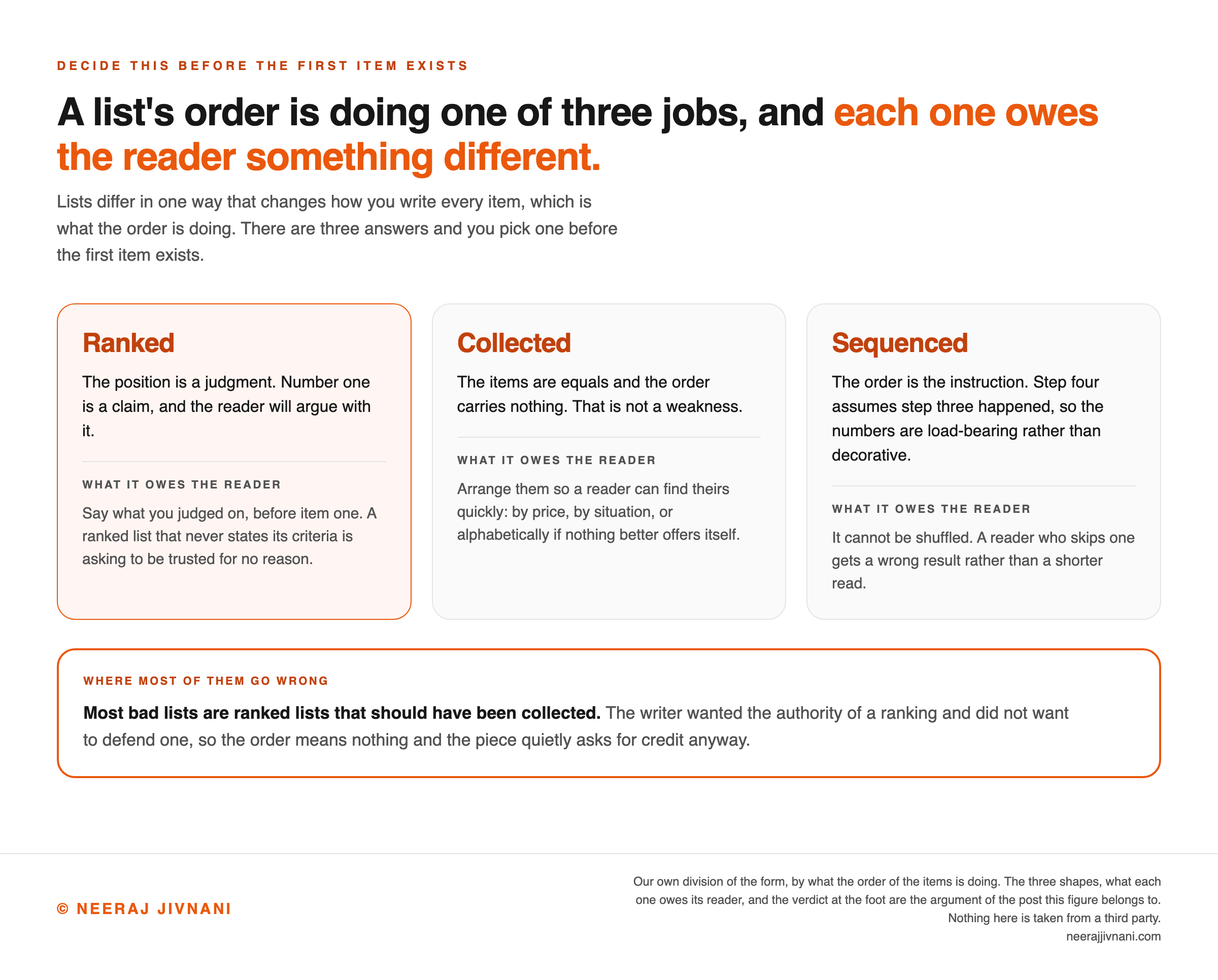
Lists differ in one way that changes how you write every item: what the order is doing. There are three answers and you choose between them early.
- Ranked. The position is a judgment. Number one is a claim, the reader will argue with it, and the argument is only fair if you have said what you judged on. A ranked list that never states its criteria is asking to be trusted for no reason.
- Collected. The items are equals and the order carries nothing. That is not a weakness, but it does put a job on you: arrange them so a reader can find theirs quickly, by price, by situation, or alphabetically if nothing better offers itself.
- Sequenced. The order is the instruction. Step four assumes step three happened, so the numbers are load-bearing rather than decorative, and a reader who skips one gets a wrong result rather than a shorter read.
Most bad lists are ranked lists that should have been collected. The writer wanted the authority of a ranking and did not want to defend one, so the order means nothing and the piece quietly asks for credit anyway.
What the Three Shapes Look Like on a Page
The subgenres you already recognize are versions of those three shapes. The "best of" and "worst of" lists are ranked, the "helpful hints" and "mistakes you might be making" lists are collected, and a "reasons why" list is usually collected pretending to be ranked.
Those five are the ones Okrent names among the classic subgenres in 2014, and she does not offer them as a closed set. The labels are conventions; the three shapes are what change how you write.
Say a hardware shop writes two pieces. "Seven Tools Worth Buying Once" is a collected list, and "Repointing a Brick Wall in Five Steps" is a sequenced one.
The second cannot be shuffled.
The first can be, and should be arranged by whatever the reader is deciding between.
Use this chart — embed code and citation
<a href="https://neerajjivnani.com/blog/listicle/"><img src="https://neerajjivnani.com/infographics/listicle/what-the-order-is-doing.png" alt="Three cards setting out what the order of a list is doing, with the obligation each one puts on the writer: a ranked list, where the position is a judgment and number one is a claim, which owes the reader a statement of what you judged on before item one; a collected list, where the items are equals and the order carries nothing, which has to be arranged so a reader can find theirs quickly, by price, by situation or alphabetically; and a sequenced list, where the order is the instruction and step four assumes step three happened, which cannot be shuffled because a reader who skips one gets a wrong result rather than a shorter read. A band underneath carries the verdict that most bad lists are ranked lists that should have been collected." width="1200"></a>
<p>Chart: <a href="https://neerajjivnani.com/blog/listicle/">Neeraj Jivnani</a></p>Neeraj Jivnani, "Listicles, and How to Tell Whether Your Subject Is Really a List", neerajjivnani.com, https://neerajjivnani.com/blog/listicle/Free to republish with a link back to this page.
Why a List Is Comfortable to Read
A list is comfortable to read because it tells you the size of the reading before you begin.
Okrent described the effect exactly in 2014: "In a listicle the numbers mark the trail; you know how many items there will be, and you tick them off one by one as you go."
That sounds small.
It is most of the mechanism.
An article of unknown length asks the reader to trust that it goes somewhere. A list of nine asks for nine short decisions instead, each one cheap, each one with a visible end.
The reader is never more than one item away from a clean place to stop.
The mechanical reasons are duller and no less real. A list helps readers skim and scan, it makes every step in a process identifiable, and it adds white space.
Only the selection is ours. The six they are picked from sit in Digital.gov's plain language guide, the U.S. General Services Administration's writing guidance.
Each is a claim about reading rather than about performance, and you can check it against your own.
Whether Your Subject Splits That Way
A subject wants a list when it comes apart into pieces of the same kind, and refuses one when it does not. Check that first.
Plenty of subjects come apart. Tools, mistakes, options, steps, places, questions people ask you: these arrive in the world already separated, and a list is the honest way to hand them over.
Plenty do not.
An argument that builds does not survive being cut into numbered pieces, because the fourth piece only makes sense once the third has landed.
The test that decides it is short. Try to say what the items have in common in one clause, out loud, without using the word "things."
"Seven tools worth buying once" passes. "Nine things about email" does not, and the failure is not in the writing.
The second names no shared property, so nothing could ever be excluded from it. A set nothing can be excluded from is not a set.
When it fails, you have not lost the material. You have found out that it is an argument, or a guide, or two separate pieces, and it wanted a different shape.
Writing One That Holds Together
A list holds together when a reader can move from any item to any other and feel that both belong in the same piece.
Three decisions get you there, and they run in order. The first sits above the list and decides what the other two are working with.
Start With the Sentence Above the List
Write the sentence that introduces the list before you write a single item. Digital.gov's plain language guide makes it a rule for anyone writing for the public: always use a lead-in sentence to explain your lists.
That reads as formatting advice, and it is not.
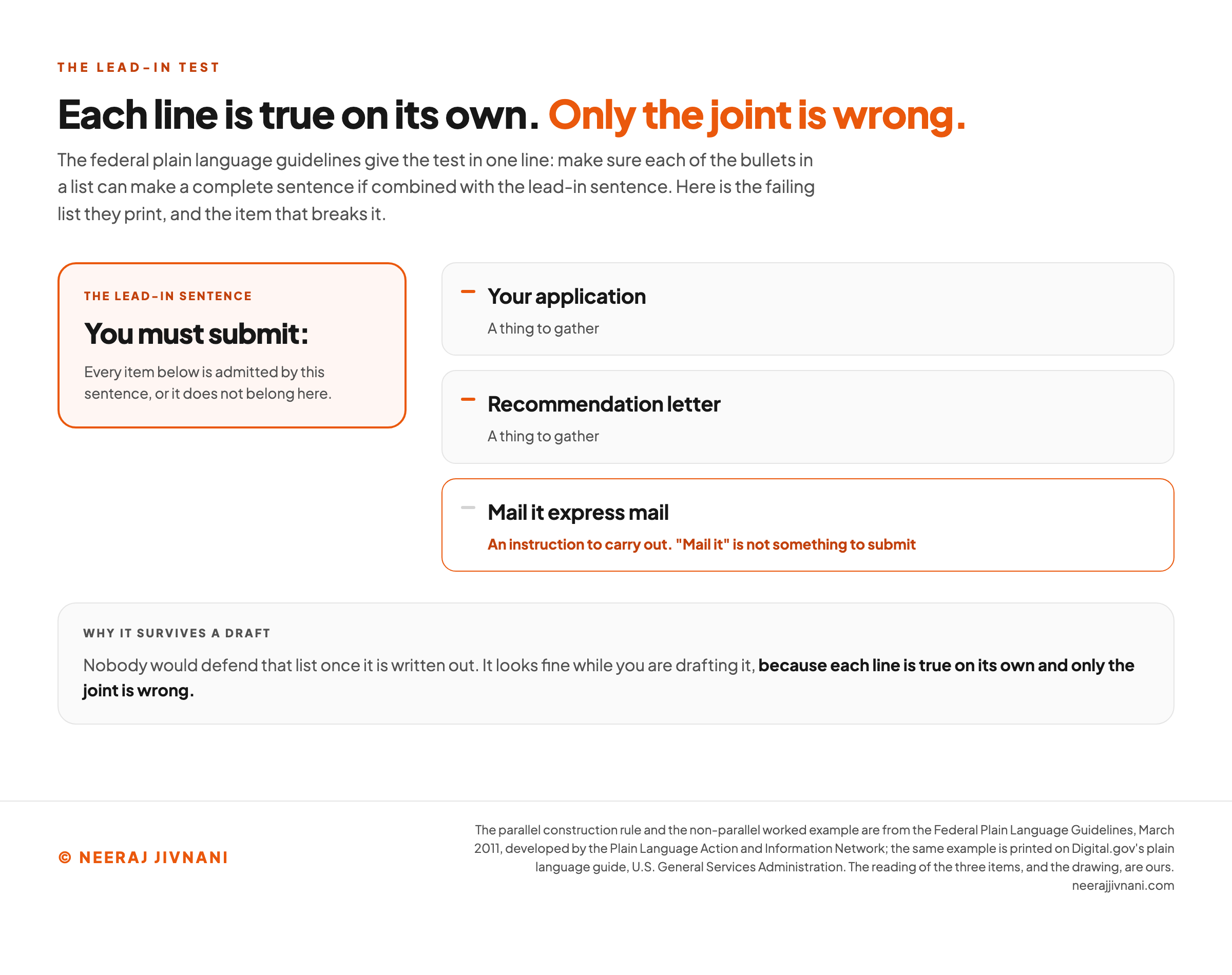
The lead-in is not an introduction. It is the boundary of the set, and every item below it is admitted by it or does not belong there.
That makes it the only sentence in a list with authority over the others.
"Here are the tools we would replace first" and "here are the tools we own" admit completely different items. Neither is more correct until you have decided which piece you are writing.
Write it narrow. A narrow lead-in throws items out, which is the work, and a wide one lets everything in, which is why wide ones are so much more comfortable to write.
Every Item Has to Finish the Same Sentence
Here is a test that costs you one pass down the page and catches most of what is wrong with a weak list.
Read the lead-in sentence, then read each item straight after it, one at a time. Every item should make a complete, sensible sentence when joined to it, and where your items are already whole sentences, the question is whether the lead-in admits each one.
Any item that does not is either in the wrong piece or pitched at a different level from the rest.
That is not our invention. It is the rule in the federal plain language guidelines, the writing standard the Plain Language Action and Information Network published in 2011, which calls it parallel construction.
The worked failure it prints is worth borrowing. A list opens "You must submit:" and reads:
- Your application
- Recommendation letter
- Mail it express mail
The third one breaks it.
The first two name things to gather; the third is an instruction to carry out, and as Digital.gov puts it, "mail it" is not something to submit.
Nobody would defend that list once it is written out. The point is that it looks fine while you are drafting it, because each line is true on its own and only the joint is wrong.
Run the test on a list you have already written and the failures come in the same few shapes.
- One item is a category and the rest are members of it. It sits a level above them, so a reader cannot tell whether it is a peer or a heading.
- Another is advice where the others are objects. The lead-in admits a set of things, and this one asks the reader to act instead.
- A third is a summary of the whole list, promoted to sit inside it. It is the closing sentence, and it has wandered into the set it was meant to close.
Fix it by cutting or by rewriting the item, never by rewriting the lead-in to be vague enough to admit everything. A lead-in stretched until nothing can fail it has stopped being a promise.
Run the lead-in test on a list you are holding
Write the sentence above your list first, then put your items in one at a time and read each one straight after it. Nothing here decides for you. It only puts the two together so you cannot look away from the joint.
Write it narrow. A narrow lead-in throws items out, which is the work, and a wide one lets everything in.
Write the sentence that introduces the list before you write a single item.
Nothing counted yet. The count comes last, and it is whatever survives the sentence above.
Deciding the Order
The order is the last decision, and by this point most of it is made for you: ranked, collected or sequenced settled it, and that choice came first.
What is left is the arrangement inside a collection, the one shape of the three that leaves you a real choice. The trap is leaving the items in the order they arrived in.
Long lists need one more thing. Past about a dozen items, group them under headings so a reader can skip a whole block, because scanning fifty flat items is worse than reading a paragraph.
Use this chart — embed code and citation
<a href="https://neerajjivnani.com/blog/listicle/"><img src="https://neerajjivnani.com/infographics/listicle/only-the-joint-is-wrong.png" alt="Diagram of the lead-in test run on the failing list the federal plain language guidelines print. The lead-in sentence, You must submit, sits in a panel on the left, marked as the sentence that admits every item or excludes it. Three items sit on the right, each marked with a short rule: your application and recommendation letter carry an orange rule and are labeled a thing to gather, while mail it express mail carries a greyed one and is labeled an instruction to carry out, because mail it is not something to submit. A band underneath explains why the list survives a draft, which is that each line is true on its own and only the joint is wrong." width="1200"></a>
<p>Chart: <a href="https://neerajjivnani.com/blog/listicle/">Neeraj Jivnani</a></p>Neeraj Jivnani, "Listicles, and How to Tell Whether Your Subject Is Really a List", neerajjivnani.com, https://neerajjivnani.com/blog/listicle/Free to republish with a link back to this page.
Deciding How Many Items You Have
You do not choose the number of items. You count what survived the lead-in test, and that count is your headline.
The usual method runs the other way: settle on ten, then go looking for ten.
Work backwards from a target and the last few items are the weakest ones. A reader notices that at exactly the moment they were meant to be impressed.
Say a hardware shop has seven tools it would genuinely stand behind and a headline aiming at ten. The three it invents to reach ten are the three a customer remembers.
The failure has a signature.
Somewhere near the bottom, one item restates an earlier one in different words, and another is a piece of general advice that would fit in any article on any subject.
Both are there because a slot needed filling.
You will see rules about which numbers perform best. Five items, seven, ten.
They are worth ignoring. The number worth caring about is the one your material supports.
If eight items survive and you promised nine, change the headline.
The Objection, and What It Gets Right
The objection is right about most listicles and wrong about listicles, and it is worth separating those two.
The case is older than the word, and its strongest version is not snobbery. It is that the form replaces thinking with sorting.
Okrent, who writes them and defends them, put the objection at its full strength in 2014: the complaint is that listicles cater to distractible reading, "replacing complex arguments and reasoned transitions with snack-packs of bullet points."
That is a fair description of a bad one.
It is also a description of a writing failure rather than a structural one. Nothing about a numbered set prevents the items from being sharp, sourced, and hard to argue with.
The reply to the snobbery is dull, and that is its strength.
The federal government's own writing standard recommends lists outright, and for the least glamorous reason available: readers find things faster in them.
That standard is the Federal Plain Language Guidelines. The Plain Writing Act of 2010 requires federal agencies to use plain writing in the documents that explain a benefit, a service or how to comply with a rule.
The Office of Management and Budget's 2011 guidance on carrying that out tells agencies to follow those guidelines.
The guidelines carry the honest limit in the same breath. Lists can be overused, they say, and the failure is using them to overemphasize trivial matters.
That is the same worry from the other side: not that numbered items are lazy, but that they can make trivial material look important.
Generated Lists and the Empty Slot
A list invites filler, for a structural reason rather than a moral one.
It is a set of slots with a count on the front. Filling a slot takes no argument, no transition, and no decision about what comes next.
Generated items pass the eye. They fail the lead-in test.
If you use a model to draft one, the useful discipline is to run the lead-in test on the output before you read it for style. It fails there first, and it fails visibly.
Lists Age One Item at a Time
A list ages one item at a time, and that is the quiet advantage of the form.
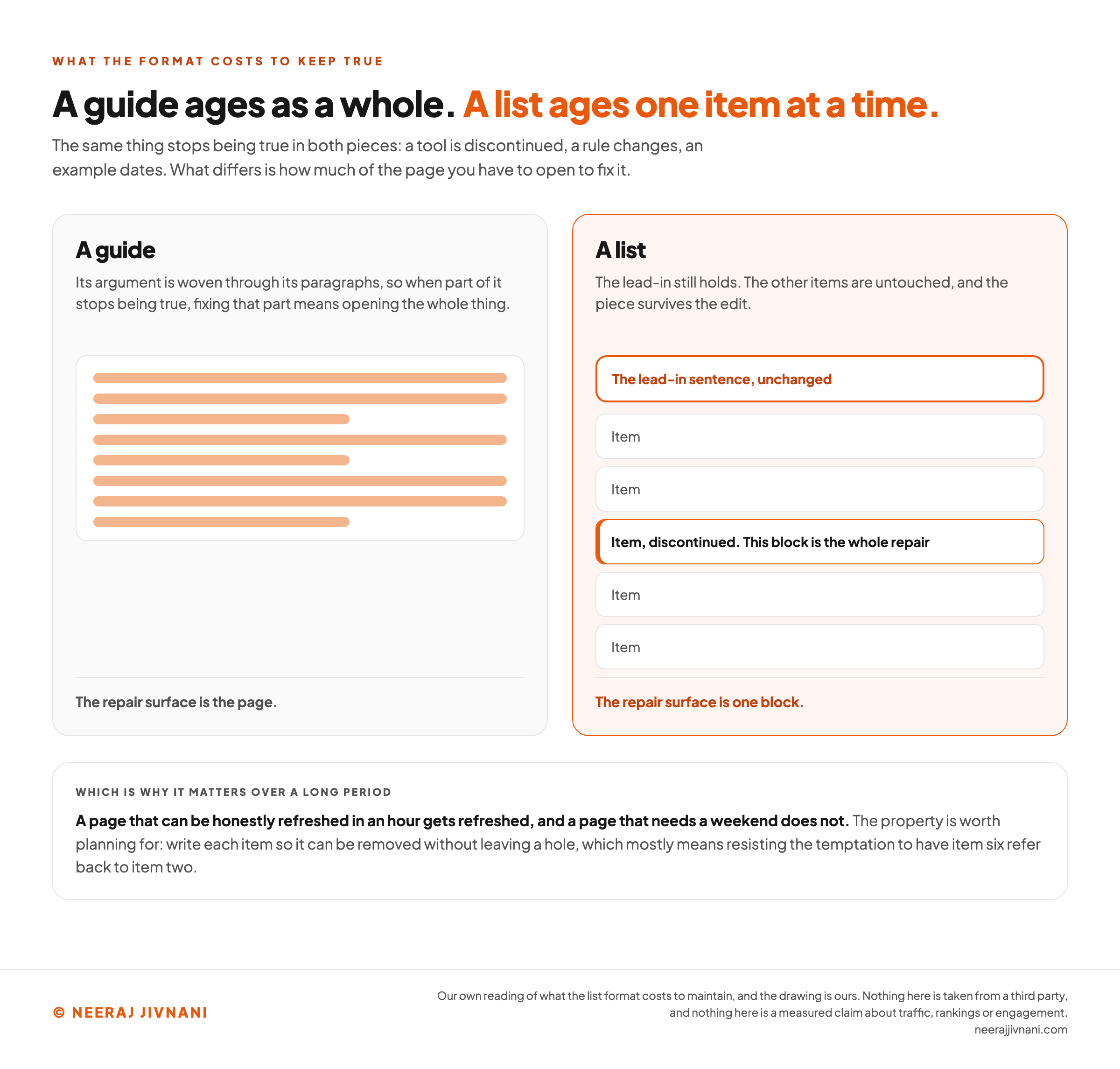
A guide ages as a whole. Its argument is woven through its paragraphs, so when part of it stops being true, fixing that part means opening the whole thing.
Lists come apart cleanly instead. A tool is discontinued, a rule changes, an example dates, and the repair is one block.
The lead-in still holds.
The other items are untouched, and the piece survives the edit.
Say a tool on the hardware shop's list of seven is discontinued next spring.
You delete one block, and the headline reads six.
The property is worth planning for. Write each item so it can be removed without leaving a hole, which mostly means resisting the temptation to have item six refer back to item two.
Over a long run in search, that is the property that pays. A page that can be honestly refreshed in an hour gets refreshed, and a page that needs a weekend does not.
Use this chart — embed code and citation
<a href="https://neerajjivnani.com/blog/listicle/"><img src="https://neerajjivnani.com/infographics/listicle/how-a-list-ages.png" alt="Two panels comparing what it costs to keep a guide true against what it costs to keep a list true, when the same thing stops being true in both. The guide is drawn as one block of woven paragraph lines, every one of them shaded, because its argument runs through all of them and fixing one part means opening the whole thing, so the repair surface is the page. The list is drawn as a lead-in sentence that stays unchanged above five separate item blocks, only one of which is marked discontinued and highlighted, so the repair surface is one block. A band underneath says that a page which can be honestly refreshed in an hour gets refreshed and a page that needs a weekend does not." width="1200"></a>
<p>Chart: <a href="https://neerajjivnani.com/blog/listicle/">Neeraj Jivnani</a></p>Neeraj Jivnani, "Listicles, and How to Tell Whether Your Subject Is Really a List", neerajjivnani.com, https://neerajjivnani.com/blog/listicle/Free to republish with a link back to this page.
When the List Earns Its Number
A list earns its number when the number is the last thing decided rather than the first.
Find what belongs together, write the sentence that says what they have in common, keep the items that finish it, and count what is left.
If the answer is six, it is a piece about six things. If nothing finishes the sentence, what you are holding is not a list, and no headline number will make it one.