What Brand Safety Is, and Where Your Line Is Already Set
Your ads land beside content you never chose. See what brand safety covers, the default setting your account is on, and what tightening it costs.

/ On this page9 sections
Brand safety is the work of keeping your ads off content that would damage your brand by association. In programmatic buying you pick an audience and a bid, and a machine picks the page your ad lands on.
Your ad account has a setting that decides how close to that content you are willing to run, and it is already switched to something whether anybody chose it or not.
Tightening it costs you reach, and nothing in the account tells you how much.
What Brand Safety Means
Brand safety means keeping your advertising away from content that almost everybody would agree nobody should pay to support, such as terrorist material or graphic depictions of harm.
That is the objective half of ad placement. It is settled before anything about your particular brand comes into it.
The name points at the wrong object, because nothing about your ad is unsafe.
What is at stake is the page, the video or the feed your ad lands beside, and what a customer concludes from finding the two together.
The cost of getting it wrong is not the money spent on the impression. It is a screenshot of your logo above a story you would never have sponsored, and that outlives the campaign by years.
Safe and Suitable Are Not the Same Setting
Safe and suitable are two different settings, and the difference is who decides.
Safety is the part almost everybody already agrees on. Suitability is the part only you can answer.
Suitability is the match between your ads and the content you want to be seen beside, judged on your values, your tone and everything else only you can rank.
Say you sell running shoes. A hunting and fishing site is not unsafe, and it can still be the wrong place for you. A page about a fatal collapse at a marathon is unsafe for everybody, and that is the difference in one pair.
So your brand values are an input here rather than a topic. They are what a suitability setting gets configured from, and the settings themselves have no opinion about you.
The Vocabulary Everyone Borrowed
The words the industry uses for this came out of a single document: the Brand Safety Floor and Suitability Framework, published by the Global Alliance for Responsible Media (GARM) in September 2020.
It sets one floor and three levels above it.
The floor is content that gets no advertising support at all, and the three levels are High, Medium and Low risk, category by category.
The floor table runs to twelve categories. Terrorism, hate speech, adult content, illegal drugs, arms and ammunition, online piracy and misinformation are among them.
An older list is still in circulation, the industry's Dirty Dozen categories, to which the Interactive Advertising Bureau added a thirteenth, fake news.
The two are not the same kind of list. The Dirty Dozen names harms done to a brand, such as counterfeiting, piracy and trademark abuse, while the floor names content a brand should not fund.
The Standard Everyone Cites Ended in 2024
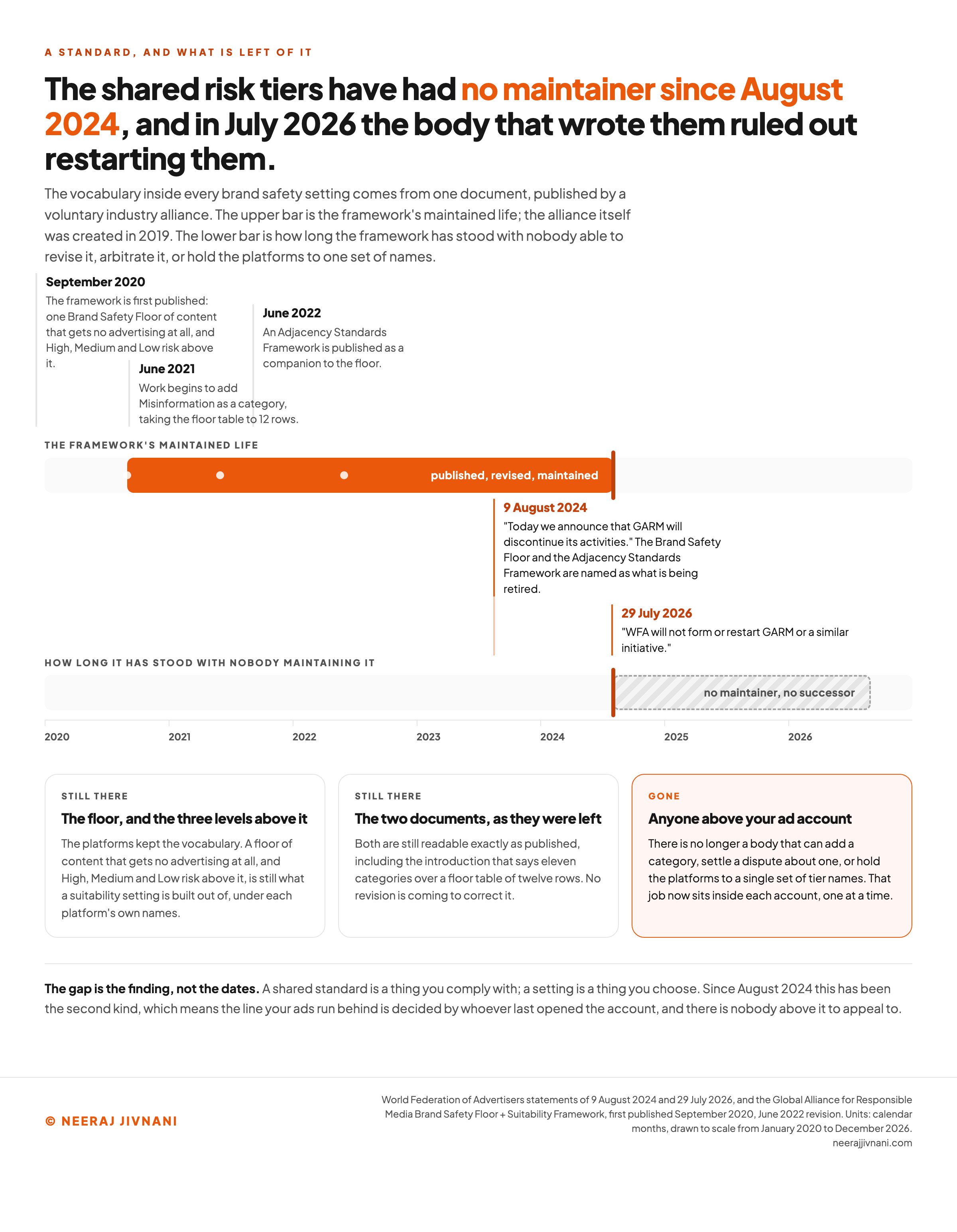
The standard everyone still cites is maintained by nobody.
The World Federation of Advertisers (WFA) ran GARM as a voluntary cross-industry initiative, created in 2019 after the Christchurch mosque attack was livestreamed.
The framework did work, measurably. Ads on harmful and illegal content fell from 6.1% in 2020 to 1.7% in 2023, on the federation's own numbers.
The Two Statements That Ended It
The alliance ended anyway. On August 9, 2024 the federation published a statement opening with the sentence "Today we announce that GARM will discontinue its activities."
Two years later, settling litigation over it, the federation ruled out a comeback.
Its statement of July 29, 2026 reads: "On August 9, 2024, WFA discontinued GARM. WFA will not form or restart GARM or a similar initiative."
You will still meet the vocabulary everywhere, because the platforms kept it. What you will not find behind it is a committee to appeal to when one of them renames a tier.
So the position is awkward rather than complicated. Nobody outside your own account decides where your line sits, and the tiers you configure are each platform's own version of a document nobody maintains.
Use this chart — embed code and citation
<a href="https://neerajjivnani.com/blog/brand-safety/"><img src="https://neerajjivnani.com/infographics/brand-safety/no-maintainer-since-2024.png" alt="A timeline from 2020 to 2026 with two bars on one calendar scale, the upper one running from the framework's first publication in September 2020 to August 9, 2024 and marked published, revised, maintained, the lower one running from that date to the present and marked no maintainer and no successor, with the June 2021 start of work on Misinformation and the June 2022 companion framework marked above the first bar, and the two World Federation of Advertisers statements quoted at the point each was published, alongside three cards separating what still exists, the floor and the three risk levels inside the platform settings and the two documents as they were left, from what is gone, any body able to revise a category, settle a dispute or hold platforms to one set of tier names." width="1200"></a>
<p>Chart: <a href="https://neerajjivnani.com/blog/brand-safety/">Neeraj Jivnani</a></p>Neeraj Jivnani, "What Brand Safety Is, and Where Your Line Is Already Set", neerajjivnani.com, https://neerajjivnani.com/blog/brand-safety/Free to republish with a link back to this page.
What the Controls Are Guarding Against
Placement settings are guarding against ordinary news, not only the dark corners of the internet.
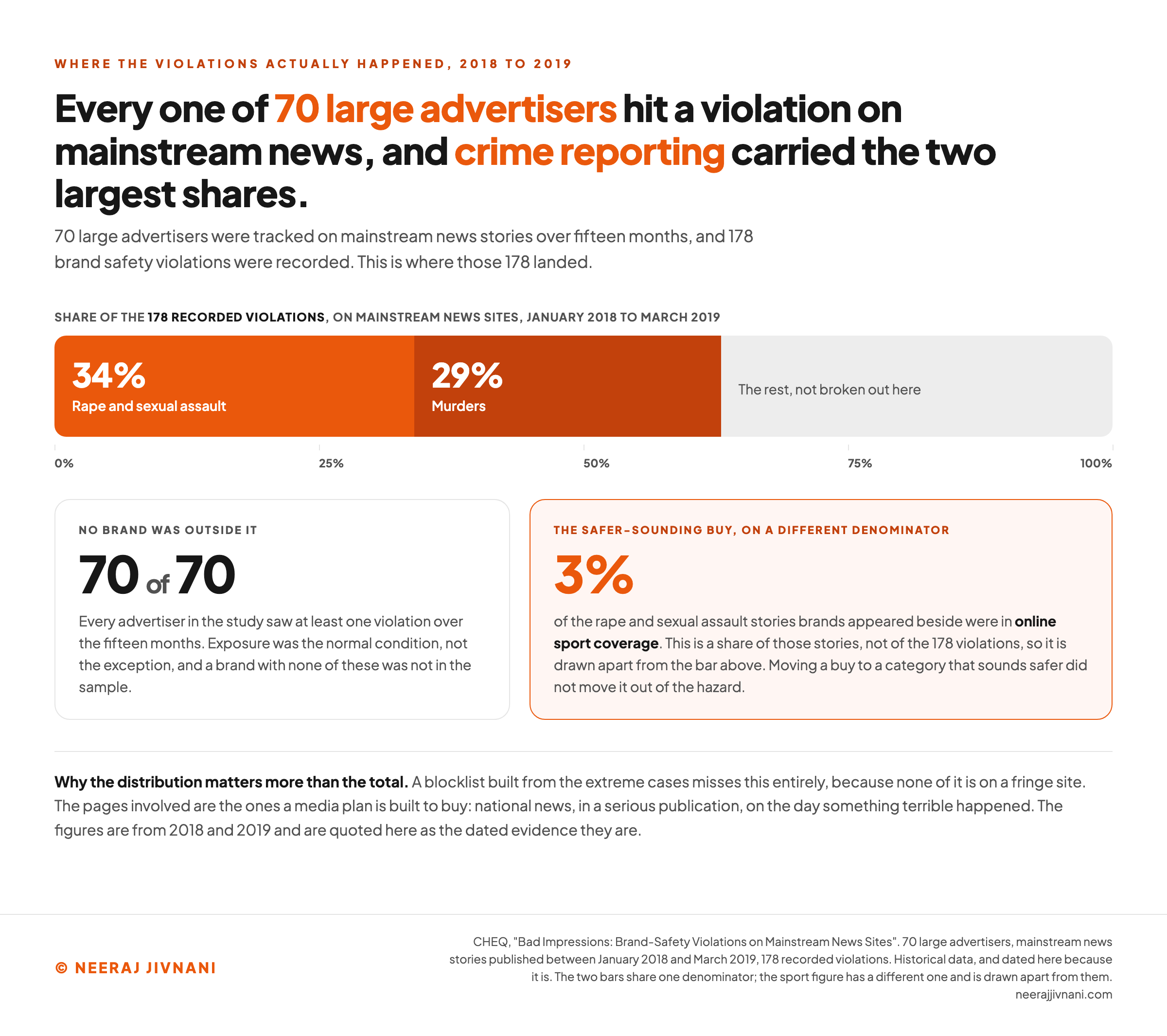
Across 70 large advertisers on mainstream news sites, 178 brand safety violations turned up, and every one of the 70 was hit at least once.
Those counts are CHEQ's, from its report Bad Impressions, covering stories published between January 2018 and March 2019.
The distribution is the part that changes what you do.
Rape and sexual assault accounted for 34% of those violations and murders for 29%, which puts the common hazard in the crime pages of publications a media plan is built to buy.
Moving your buy to a safer-sounding category does not fix it. In the same study, online sport coverage carried 3% of the rape and sexual assault stories that brands appeared beside.
The Rest of the Exposure
Misinformation is on the floor, and it arrived there late. If you are working from a category list written before June 2021, it is not on yours.
User-generated content is the exposure the placement settings do not reach. Your ad can sit beside a clean video and above a comment thread that is anything but, and a topic exclusion does not read comments.
Creators are their own exposure. Somebody you paid last quarter can post something next quarter that puts your brand beside it, and nothing in the ad account reaches that.
What you check before signing an influencer marketing deal, and what the contract lets you do afterwards, are the only controls here, which makes this a paperwork question rather than a settings one.
Fake inventory is the last on the common list. Pages and apps built only to collect ad money exist, and your placement report is where they surface.
Use this chart — embed code and citation
<a href="https://neerajjivnani.com/blog/brand-safety/"><img src="https://neerajjivnani.com/infographics/brand-safety/where-the-violations-were.png" alt="A stacked bar dividing the 178 brand safety violations CHEQ recorded on mainstream news sites between January 2018 and March 2019, showing rape and sexual assault at 34% and murders at 29% against the remaining 37% that is not broken out, with two panels beside it giving 70 of 70 advertisers in the study seeing at least one violation and 3% of the rape and sexual assault stories brands appeared beside sitting in online sport coverage, that last figure drawn apart because it is a share of those stories rather than of the 178 violations." width="1200"></a>
<p>Chart: <a href="https://neerajjivnani.com/blog/brand-safety/">Neeraj Jivnani</a></p>Neeraj Jivnani, "What Brand Safety Is, and Where Your Line Is Already Set", neerajjivnani.com, https://neerajjivnani.com/blog/brand-safety/Free to republish with a link back to this page.
AI Is on Both Sides of This Now
AI sits on both sides of brand safety now. It generates content the controls are meant to catch, and it is also the thing doing the catching.
Start with the catching, because it decides what any setting of yours can reach.
No human reads your placement before it runs. A classifier does, at the speed the auction needs, which is what makes a suitability setting cost nothing to switch on and impossible to guarantee.
On the Display Network and YouTube, pages, videos and apps are analyzed by Google's classification technology and given a digital content label.
None of it is a promise. Google says content exclusions are done to the best of its ability, and that it cannot guarantee all related content will be excluded.
The other side is the generated content. A deepfake is an image or recording altered convincingly enough to show someone doing or saying something they never did.
That covers content aimed at you, such as a video of a senior employee appearing to announce a recall that never happened, and content that merely exists to carry ads.
Your own use of these tools is an exposure as well. A generated line carrying a false claim is a brand safety problem you created, and no placement control anywhere will catch it.
Where the Line Is Set, Platform by Platform
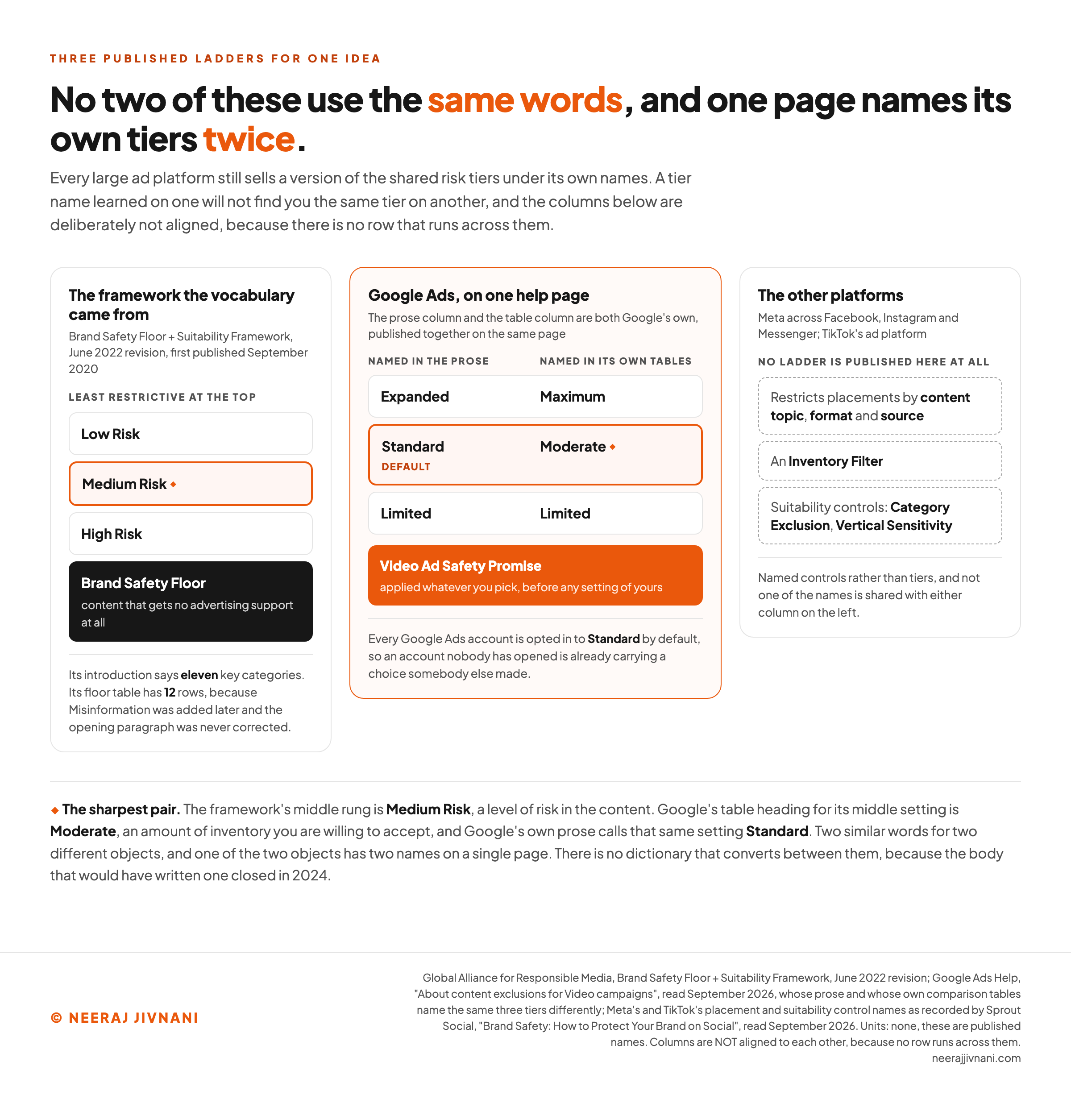
Your line is set inside each ad platform, one account at a time, and the platforms do not use the same words for it.
There is no single screen where your policy lives, and a tier name you learned on one platform will not find you the same tier on another.
Google Ads
Google applies one layer whatever you choose. Its Video Ad Safety Promise excludes ads from the most controversial content, such as terrorist acts, nudity, and recent sensitive events, before any setting of yours applies.
Above that layer, Video campaigns get three inventory types, and Google opts every account into the middle one by default.
Google's prose names the three Expanded, Standard and Limited. Its comparison tables, on the same page, head the identical columns Maximum, Moderate and Limited.
Both namings are Google's own, published together.
Changing the setting has a visible price. Move an account from Standard to Limited and Google says your ads will be excluded from showing on some of YouTube's most popular music videos and other pop culture content.
One control has already moved. The classification still runs, and Google's page notes that starting September 2024 the digital content labels it produces no longer apply to ads served on YouTube, while they continue to apply on the Display Network.
Everywhere Else
The other platforms give you the same idea under different names.
Meta's controls run across Facebook, Instagram and Messenger, and restrict placements by content topic, format and source. TikTok's ad platform carries an Inventory Filter, plus suitability controls such as Category Exclusion and Vertical Sensitivity, both sets of names as Sprout Social's guide records them.
On social platforms the job then splits in two. The placement controls are one half, and the comment moderation and social listening that sit with whoever runs the account are the other.
Underneath all of these settings sit four kinds of list, and they do different jobs:
- An exclusion list names the domains you refuse to appear on.
- An inclusion list names domains you have pre-approved, whatever the other settings say.
- A keyword list names the words you will not appear beside.
- A required list restricts serving to a named set of sites and nothing else.
Contextual avoidance and contextual targeting are easy to confuse. One steers you away from content, the other steers you towards it, and only one of them is brand safety.
Use this chart — embed code and citation
<a href="https://neerajjivnani.com/blog/brand-safety/"><img src="https://neerajjivnani.com/infographics/brand-safety/ladders-do-not-line-up.png" alt="Three columns of published control names set side by side and deliberately not aligned to each other, the first giving the framework's ladder of Low, Medium and High Risk above a Brand Safety Floor with a note that its introduction says eleven categories against a floor table of twelve rows, the second giving Google Ads with its prose names Expanded, Standard and Limited beside the Maximum, Moderate and Limited used in its own comparison tables on the same page, the default marked on Standard and the Video Ad Safety Promise shown as a band applied underneath whichever tier is picked, and the third giving Meta's placement restrictions by content topic, format and source and TikTok's Inventory Filter, Category Exclusion and Vertical Sensitivity, which publish no ladder at all." width="1200"></a>
<p>Chart: <a href="https://neerajjivnani.com/blog/brand-safety/">Neeraj Jivnani</a></p>Neeraj Jivnani, "What Brand Safety Is, and Where Your Line Is Already Set", neerajjivnani.com, https://neerajjivnani.com/blog/brand-safety/Free to republish with a link back to this page.
Blocking Too Much Costs You Something
Blocking too much costs you reach, and the cost stays invisible unless you go looking for it.
The size of it has been measured on one topic. Of coronavirus content, 76% was considered safe for ads in Oracle Advertising's 2020 data, and 1 in 4 of those safe articles was being hit by keyword blocklists anyway.
One blocked word shows the shape of the whole problem. In Oracle's own worked example the keyword was Ambush, the story it blocked was a cancer survivor thrilled with an Ambush Makeover, and the loss was 32% of impressions.
The damage is not evenly spread. Vice found terms like gay placed higher on blacklists than keywords such as rape, death and heroin, in the same CHEQ report.
Whole categories go the same way. Block all News and the money stops reaching the independent journalism you probably wanted to appear beside.
A blocklist is a bet whose losing side is never reported back to you. An exclusion report names the category and the volume, never the page that was worth having, so reading the exclusions yourself is the only way to see what a setting cost.
Setting It Up, in Order
Setting this up in order is a short job, and the order matters more than the individual choices.
Six steps, and the first one is not in any settings screen:
- Write the line down first. One sentence naming what your brand will not appear beside, agreed with whoever owns the brand, before an account is opened.
- Read the default you are already on. Google opts every account into Standard inventory on its Video campaigns, so an account nobody has touched is already carrying a choice somebody else made.
- Set the account level before the campaign level. The account-wide setting is the one that still holds when a new campaign is built by someone who was not in this conversation.
- Use lists only for what the tiers cannot say. The tiers handle categories; an exclusion list handles the three specific domains your team keeps arguing about.
- Name one owner. Brand safety fails quietly when it belongs to everybody, and the owner's real job is the monitoring, not the setup.
- Put a date on the review. Platforms rename and retire these controls, as Google did with digital content labels on YouTube in September 2024.
None of that is a policy document. It is one sentence, one default checked, one account-level setting, one short list, one name and one date.
Step one is the awkward one. A single sentence has to be expressed in four different kinds of control, and some of what it names is not a setting at all.
Take your own sentence apart below.
Take your sentence apart
Tick what your one sentence actually names, and where you buy. This reads back the control each piece becomes, the name it goes by on each platform you picked, and the pieces that no placement setting reaches at all.
1. What your sentence names
2. Where you buy
Nothing ticked yet. Write the sentence first, then tick the parts of it above: the answer changes completely depending on whether your line is about kinds of content, named sites, particular words, or people.
What to Look at Afterwards
What to look at afterwards is the placement report, and the question to ask of it is not the obvious one.
The obvious question is where your ads appeared. The more useful one is what your settings removed, and how much inventory that removal was worth.
That second figure is the one that settles it. Criteo's test is whether your protection level is "calibrated or just conservative".
A useful report shows you three things. The placements your ads ran on, the categories your settings excluded, such as News or Debated Sensitive Social Issue, and the volume behind each exclusion.
Read it against the sentence you wrote at the start.
If the exclusions no longer match the line, either the setting moved or the line did, and one of them needs changing.
Read the exclusions before the placements.
If you would not have been comfortable seeing your logo beside everything that ran, the line is in the wrong place. And a line whose cost you have never measured is not calibrated, it is only untested.