What Rebranding Is, What Usually Triggers One, and What the Logo Can and Cannot Fix
Most rebrands follow a change in the business, not a creative decision. See what that means for your name, your logo, and the people who explain it.

/ On this page9 sections
Rebranding is changing the signals a company sends about who it is: the name, the logo and visual system, the voice, the positioning, or some combination of those. Redesigning a logo on its own is not the same act.
Most rebrands follow a change in the business, not a creative decision. The usual trigger is structural, most often a merger or an acquisition, which Muzellec and Lambkin found across 166 rebranded companies in 2006.
Below is what the word covers, what triggers a rebrand, what a new name and logo can carry, and why the people who have to explain them matter more than either.
The Word Covers Four Different Operations
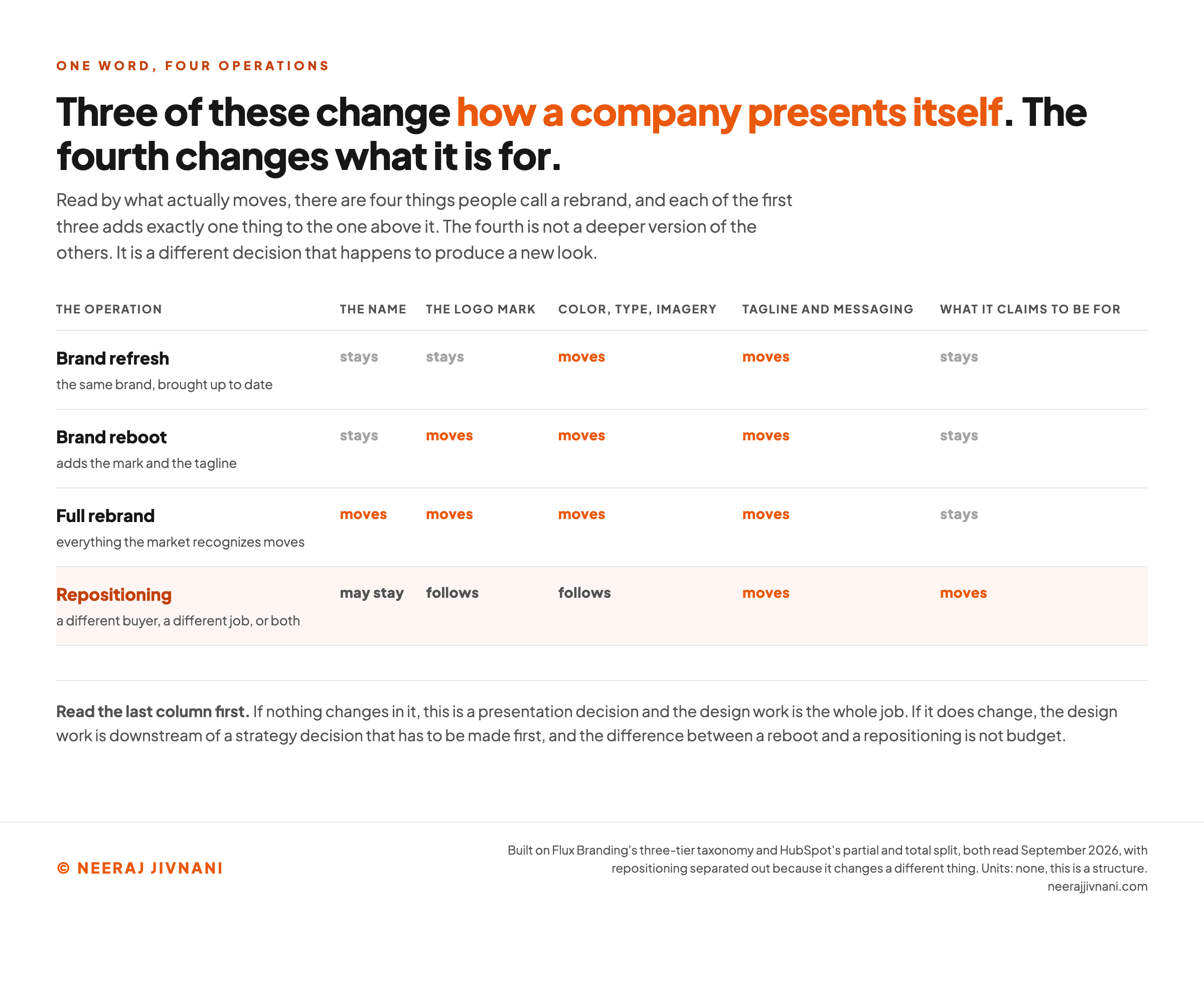
Three of the four operations are the same job at different depths. What varies is how many signals move: the name, the mark, the voice, the position.
The fourth is a different act altogether, and calling it by the same word is where most of the confusion in this category starts.
The three depths have names worth keeping, and Flux Branding's guide is where this particular set of them comes from.
- A brand refresh modernizes what is already there. Colors, type, imagery and messaging move; the name, the logo and the position stay.
- A brand reboot adds the logo and the tagline. The visuals change across everything the company publishes, while the name and the position hold.
- A full rebrand moves the name too, along with the mark, the visuals, the messaging and the voice. Everything the market recognizes changes at once, and the position underneath it can still be the same one.
You will also meet a simpler two-way split, a partial rebrand against a total one. It is the same ground with the middle tier folded in, and it holds up.
The more established the business, the more a total rebrand has to lose.
Repositioning changes what the company claims to be for. A refresh, a reboot and a full rebrand all change how a company presents itself to the same buyer for the same job.
A repositioning changes the buyer, or the job, or both. The new look is a consequence of that rather than the point of it, and knowing which one you are running is the difference between a design project and a strategy change.
That distinction is also the answer to what another word for rebranding is: refresh, reboot and full rebrand are synonyms for degrees of one operation, and repositioning is not a synonym at all.
The 3-7-27 Rule of Branding
The 3-7-27 rule of branding is a piece of trade folklore, and the versions in circulation do not agree with each other.
One telling gives a brand about three seconds to catch attention, seven seconds to say what it is worth, and 27 words to do it in. Another gives three seconds, seven interactions and 27 exposures.
Nobody published it. The rule has no primary source and no named originator, which is why its versions drift.
Use this chart — embed code and citation
<a href="https://neerajjivnani.com/blog/rebranding/"><img src="https://neerajjivnani.com/infographics/rebranding/four-operations.png" alt="Matrix showing which parts of a brand move in each of the four operations, with the name, the logo mark, the color and type and imagery, the tagline and messaging, and the market position marked as moving or staying across a brand refresh, a brand reboot, a full rebrand and a repositioning." width="1200"></a>
<p>Chart: <a href="https://neerajjivnani.com/blog/rebranding/">Neeraj Jivnani</a></p>Neeraj Jivnani, "What Rebranding Is, What Usually Triggers One, and What the Logo Can and Cannot Fix", neerajjivnani.com, https://neerajjivnani.com/blog/rebranding/Free to republish with a link back to this page.
Why Companies Say They Rebrand, and What Sets One Off
The reasons a company gives for rebranding and the events that produce one are not the same list, and only one of them has been measured.
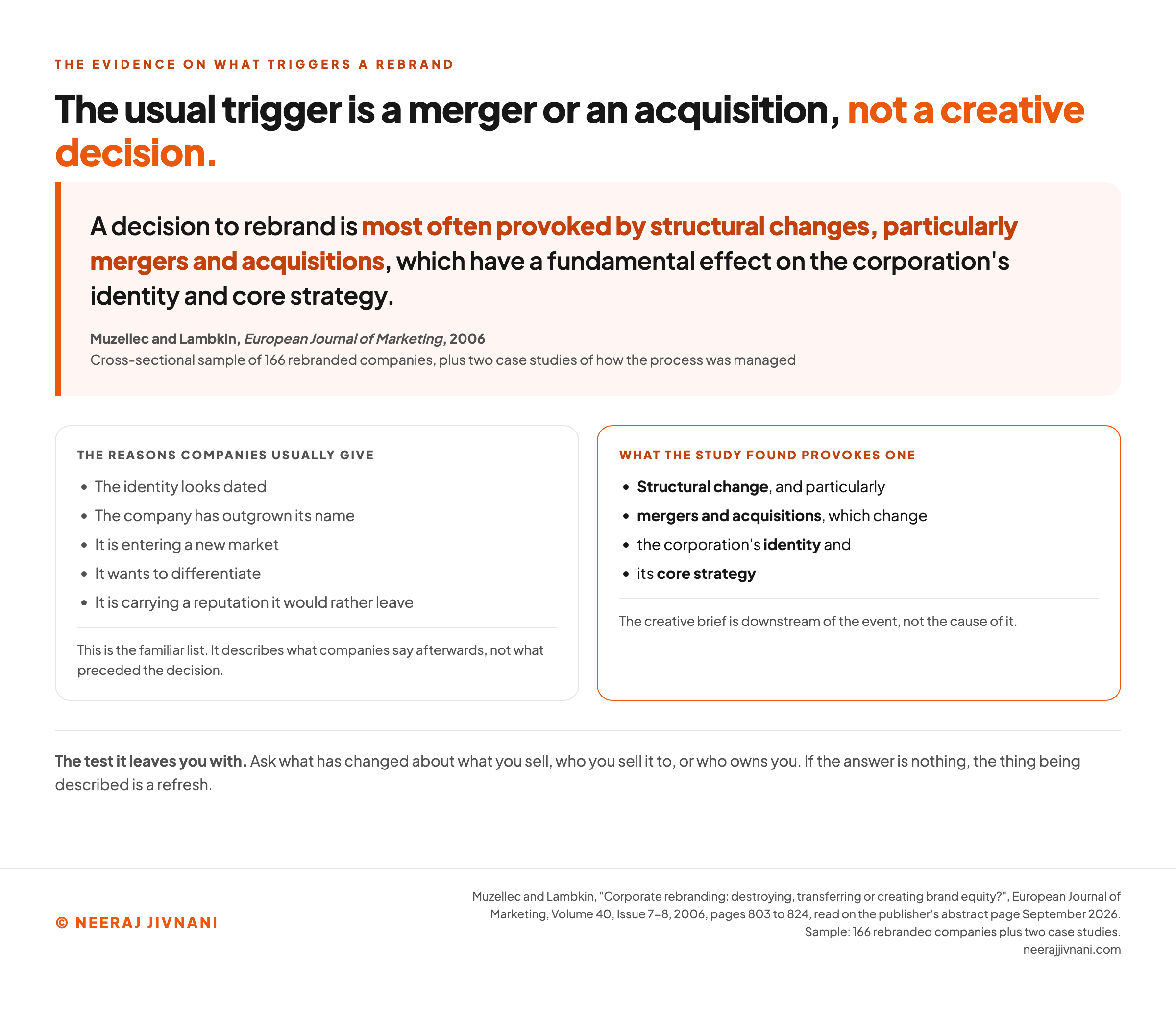
Ask a company why it rebranded and you get a short, familiar list.
The identity looks dated. The company has outgrown its name, or it is entering a new market, or it wants to differentiate, or it is carrying a reputation it would prefer to leave behind.
Philip Morris became Altria on 27 January 2003 for the last of those. Wikipedia records the change of name and logo as driven by the negative connotations of tobacco, which could have affected the profitability of the company's other brands.
Three more reasons belong on that list and rarely get named.
The first is distress. A rebrand can arise from Chapter 11 corporate restructuring or bankruptcy, which is a legal event rather than a marketing one.
The second is an acquisition, in either direction. Chemical Bank took on the Chase branding after that merger, as Wikipedia records.
The third is quieter and easier to miss. A product line can grow past the thing its name says it sells, which is a cost that was decided back at brand naming.
Dunkin' Donuts, Joann Fabrics and Weight Watchers each removed or abbreviated part of the name, to stop implying a narrower offer than they had.
What Comes Before a Rebrand
The events that usually produce a rebrand are things that happened to the company's structure, not things the marketing team decided. That reorders the list above, and it puts the creative brief downstream of the structural event.
A decision to rebrand, Muzellec and Lambkin write, is "most often provoked by structural changes, particularly mergers and acquisitions, which have a fundamental effect on the corporation's identity and core strategy".
That is the one measured answer on this question. It was published in the European Journal of Marketing in 2006, from a cross-sectional sample of 166 rebranded companies plus two case studies of how the process was managed.
So the first question is not what the brand should look like. It is whether anything underneath it has moved.
Use this chart — embed code and citation
<a href="https://neerajjivnani.com/blog/rebranding/"><img src="https://neerajjivnani.com/infographics/rebranding/the-one-study.png" alt="Card carrying the finding from Muzellec and Lambkin's 2006 European Journal of Marketing study of 166 rebranded companies, that a decision to rebrand is most often provoked by structural changes and particularly mergers and acquisitions, set against the reasons companies usually give for rebranding." width="1200"></a>
<p>Chart: <a href="https://neerajjivnani.com/blog/rebranding/">Neeraj Jivnani</a></p>Neeraj Jivnani, "What Rebranding Is, What Usually Triggers One, and What the Logo Can and Cannot Fix", neerajjivnani.com, https://neerajjivnani.com/blog/rebranding/Free to republish with a link back to this page.
The Logo Is the Smallest Part of What People Respond To
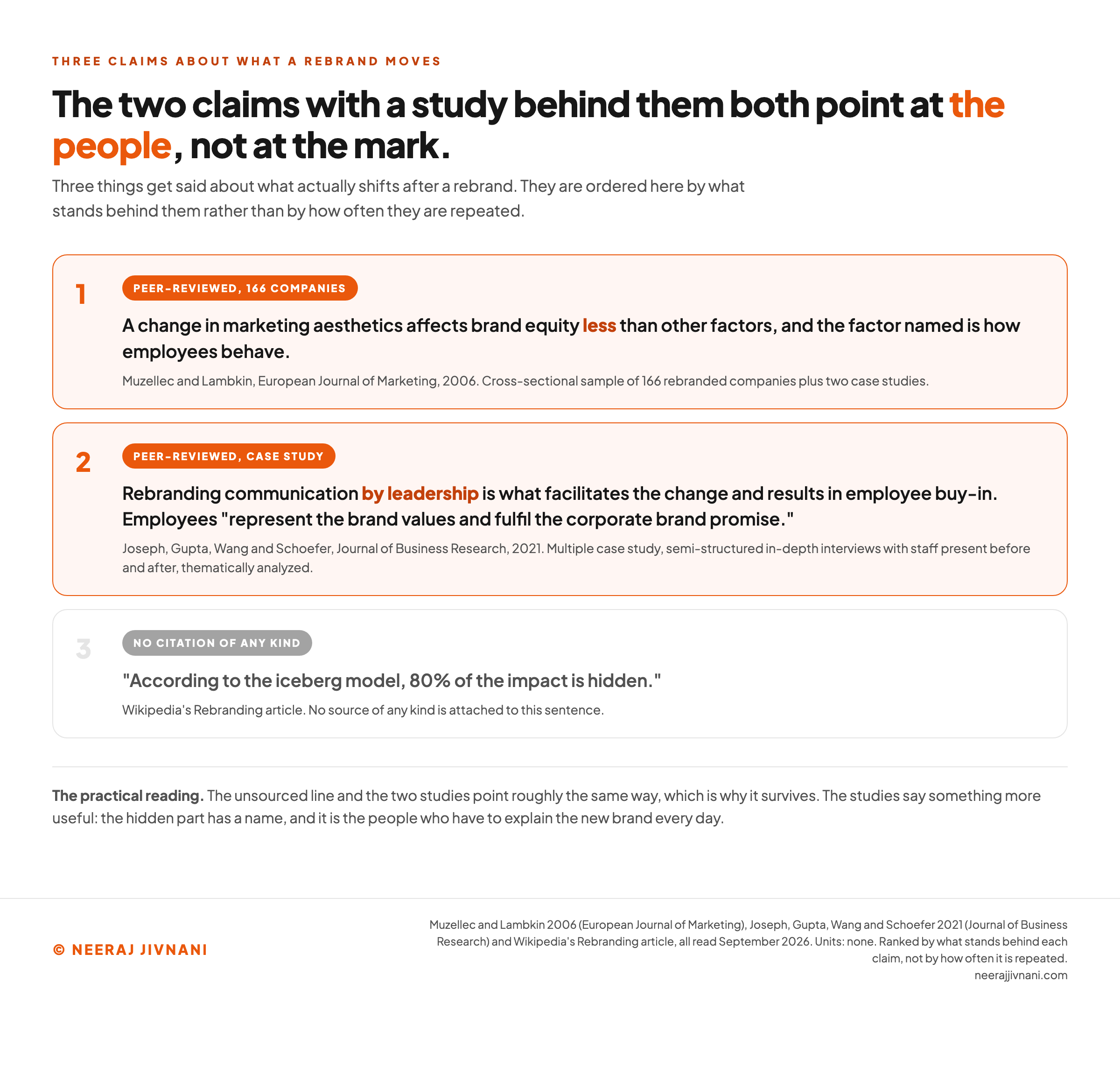
The logo moves brand equity less than the people who work for you do.
That is the second finding in Muzellec and Lambkin's 2006 study, which reports that a change in marketing aesthetics affects brand equity less than other factors, employees' behavior among them.
That is an uncomfortable result for a category whose deliverable is usually a logo, a palette and a set of guidelines.
It does not say the aesthetics are worthless. It says they are outweighed.
What Your Own Staff Believe Is What Customers Meet
Your employees are the version of the brand a customer encounters, so what they believe about the change decides how it lands.
Employees, as Joseph, Gupta, Wang and Schoefer put it, "represent the brand values and fulfil the corporate brand promise".
It is the second study on this, fifteen years after the first, and it reached the same place from the other direction.
Their evidence is interviews with people who were there before and after a rebrand, published in the Journal of Business Research in 2021, rather than a sample counted from the outside.
The Hidden Half Has a Name
The hidden half of a rebrand is the people who have to explain it every day.
You will meet a tidier version of that, an iceberg model in which 80% of the impact is hidden. It points in roughly the right direction, which is why it travels so well.
What it never says is who those people are. The number itself has no source: Wikipedia's rebranding article, which carries it, attaches no citation to it.
Use this chart — embed code and citation
<a href="https://neerajjivnani.com/blog/rebranding/"><img src="https://neerajjivnani.com/infographics/rebranding/what-moves-equity.png" alt="Comparison of what the evidence says moves brand equity after a rebrand, showing the Muzellec and Lambkin 2006 finding that marketing aesthetics matter less than employee behavior, the Joseph and colleagues 2021 finding that leadership communication is central to employee buy-in, and Wikipedia's unsourced iceberg claim that 80 percent of the impact is hidden." width="1200"></a>
<p>Chart: <a href="https://neerajjivnani.com/blog/rebranding/">Neeraj Jivnani</a></p>Neeraj Jivnani, "What Rebranding Is, What Usually Triggers One, and What the Logo Can and Cannot Fix", neerajjivnani.com, https://neerajjivnani.com/blog/rebranding/Free to republish with a link back to this page.
The Reasons That Look Like Triggers and Are Not
Some reasons for rebranding survive contact with the evidence above and some do not, and the ones that do not tend to arrive with the most urgency.
Before you get to them, two things are worth settling, and neither is about design.
The first is resource allocation. A rebrand takes time and budget, and if it is handled in-house that time comes out of the marketing team's capacity for everything else.
The second is employee alignment, and it belongs in front of the process rather than after it, because the people inside are what a customer meets.
Four Reasons That Are Not Triggers
Four reasons come up more than any others, and each one calls for something other than a rebrand.
- A competitor changed theirs. Their structural situation is not yours, and copying the response to it produces a brand that looks derivative in the one dimension you were trying to own. Look at what changed for them, not at what they made.
- A new marketing lead wants a mark of their own. This is the reason most likely to be expensive and least likely to be examined, because nobody in the room is positioned to say it out loud. A new leader has a first ninety days, and a rebrand is not what those are for.
- The identity feels stale to the people who look at it every day. Their boredom proves nothing on its own, because they meet the mark every working day and a customer meets it rarely enough to still find it new. A refresh answers this; a full rebrand answers a question nobody asked.
- The price is meeting resistance. That is a positioning problem or a product problem, and a new look does not move either. If the answer is repositioning, the visual work follows that decision rather than substituting for it.
None of those four is a structural change, which is the test the 166-company study leaves you with.
Each Stage of a Rebrand, and What It Has to Produce
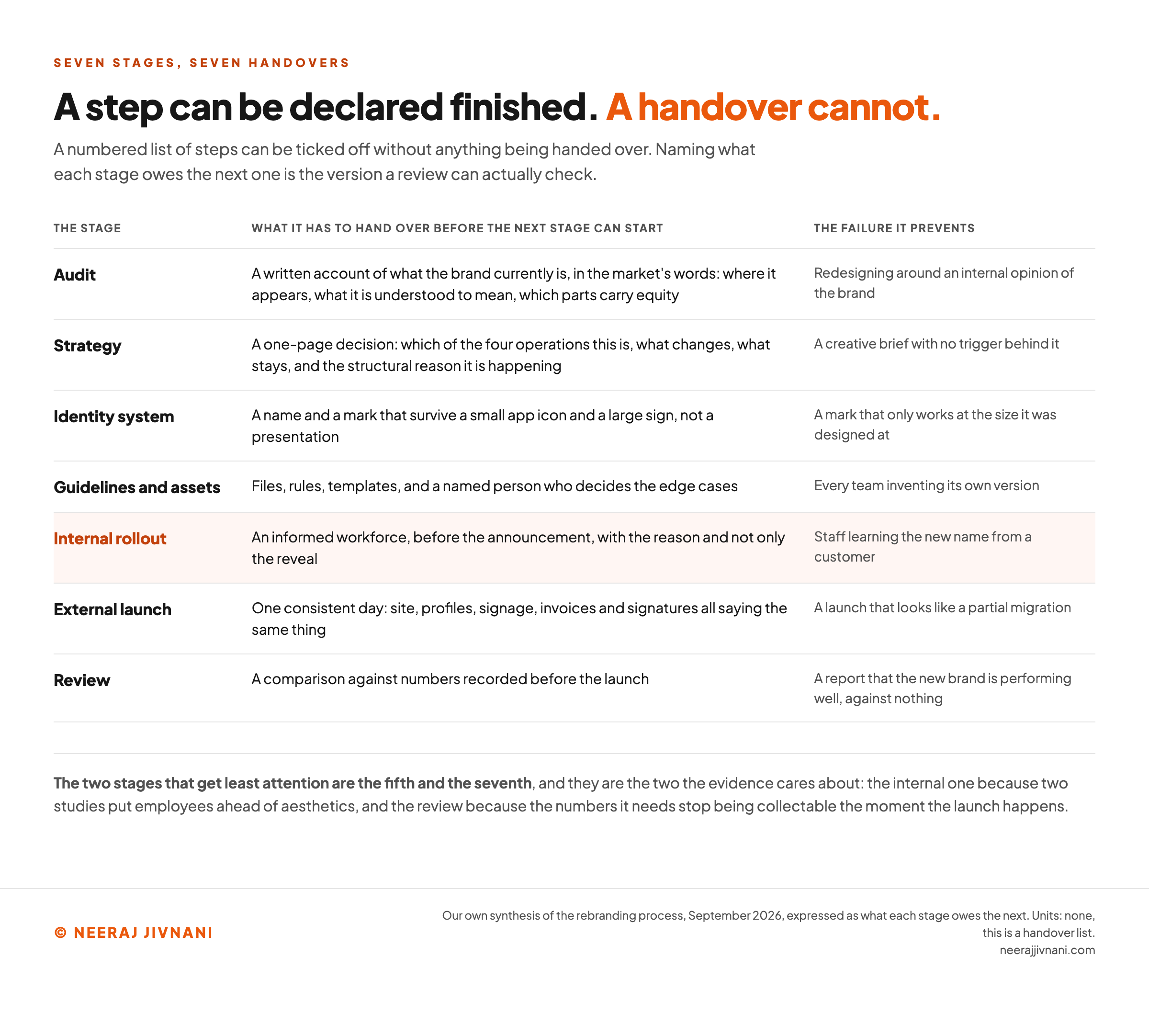
A rebrand is easier to run as a sequence of handovers than as a list of steps, because a step can be declared finished and a handover cannot.
There are seven stages, and each one owes the next a specific thing before the work can move on.
- The audit owes a written account of what the brand currently is, in the market's words rather than yours: where it appears, what it is understood to mean, and which parts of it have equity worth carrying.
- The strategy owes a decision, in one page: which of the four operations this is, what changes, what stays, and the structural reason it is happening.
- The identity system owes a name and a mark that survive the places they will be used, such as a small app icon and a large sign rather than a presentation.
- The guidelines and assets owe everything the rest of the company needs to stop asking: the files, the rules, the templates, and a named person who decides the edge cases.
- The internal rollout owes an informed workforce, before the announcement, with the reason and not only the reveal.
- The external launch owes one consistent day: the site, the profiles, the signage, the invoices and the email signatures all saying the same thing.
- The review owes a comparison, which is only possible if a baseline was recorded first.
The stages do not change with the size of the company. What changes is what each one costs to produce.
The timing changes too.
A large company can move gradually, because the old name is worth managing down. A small business with little recognition to protect is usually better off changing in one short window.
So a small company's version of the identity system is a name, a mark and two colors that work at the sizes it will meet, and its version of the guidelines is a single page somebody can find rather than an agency's deliverable.
What Stays Is Where the Equity Goes
Deciding what stays is where the equity is either carried across or thrown away, and it is the easiest part of the job to leave until last.
A name buyers use, a color they can pick out at a distance, a phrase they repeat back to you. Each of those is an asset that a full rebrand spends.
Use this chart — embed code and citation
<a href="https://neerajjivnani.com/blog/rebranding/"><img src="https://neerajjivnani.com/infographics/rebranding/stages-and-handovers.png" alt="Table of the seven stages of a rebrand, naming for each one the single artefact it has to hand over before the next stage can begin, from the audit's written account of the current brand through to the review's comparison against the baseline recorded before launch, and naming the failure each handover prevents: redesigning around an internal opinion of the brand, a creative brief with no trigger behind it, a mark that only works at the size it was designed at, every team inventing its own version, staff learning the new name from a customer, a launch that looks like a partial migration, and a report that the new brand is performing well against nothing." width="1200"></a>
<p>Chart: <a href="https://neerajjivnani.com/blog/rebranding/">Neeraj Jivnani</a></p>Neeraj Jivnani, "What Rebranding Is, What Usually Triggers One, and What the Logo Can and Cannot Fix", neerajjivnani.com, https://neerajjivnani.com/blog/rebranding/Free to republish with a link back to this page.
Telling the People Inside Before You Tell Anyone Else
Telling the people inside first is where most of the outcome is decided. The internal announcement is not a courtesy and it is not the last item on the launch checklist.
The route to buy-in runs through leaders explaining the change, not through the assets arriving.
Rebranding communication by leadership has the central role in facilitating the change to the corporate brand and the employee buy-in that follows, and that is the finding Joseph, Gupta, Wang and Schoefer landed on in 2021.
What That Means in Practice
Three things follow, and none of them is expensive.
The people who will be asked about the change hear it first, and they hear the reason. A workforce that learns the new name from a customer has been told that they are the audience rather than the messenger.
Leadership does the telling, rather than the brand team. The finding is specifically about leadership communication, which is a different signal from a deck circulated by marketing.
And the explanation covers what is not changing. The anxiety inside a rebrand tends to be about jobs, direction and whether the thing people liked is being removed, and that anxiety is answered by a list of what stays.
What Happened After the Famous Rebrands
The rebrands worth learning from are the ones with a public record afterwards, and the record is usually less flattering than the case study.
Jaguar, November 2024. Managing director Rawdon Glover, quoted in Frontify's rebranding guide, described a brand that had become steadily less relevant to the society around it.
When the full rebrand rolled out it became, in that same account, "the most talked about thing on the planet for three days, in terms of what's trending on social media". Attention is not equity, and three days is the length of the attention.
Burberry, 2018 and again in 2023. A modern identity rolled out in 2018, and in 2023 the company rebranded again to return to its creative roots.
Chief executive Jonathan Akeroyd, in the same Frontify guide, reported "a higher performance in terms of brand clarity" and better engagement afterwards. What the pair costs is two full rebrands where one would have done.
RadioShack to the Shack, 2008. The rebranding "never realized into an increase of market share in the retail industry", in Wikipedia's account, and by 2017 the company had closed over 1,000 stores and moved to a primarily online model.
A new name does not answer a question about the format of the stores.
The British Post Office to Consignia, and back. Wikipedia calls it a failure severe enough that "millions more had to be spent going back to square one".
The reversal was announced to the House of Commons on 13 June 2002.
The Secretary of State for Trade and Industry told the House he did not think anyone would "mourn the disappearance of the name Consignia". An opposition member called the original decision "one of crass stupidity".
What the reversal cost is not in the parliamentary record. That debate carries the company's restructuring numbers in detail and no rebranding figure at all, beyond an opposition charge that the exercise "cost millions".
Establishing a Baseline You Can Compare Against Later
A baseline has to be recorded before the launch. Afterwards, some of the numbers are not merely harder to get. They are gone.
Weighing what a rebrand costs against what it returns is only possible if both sides were measured. The cost side ends up on an invoice.
The return side needs a reading from before the launch, and that is the part nobody writes down.
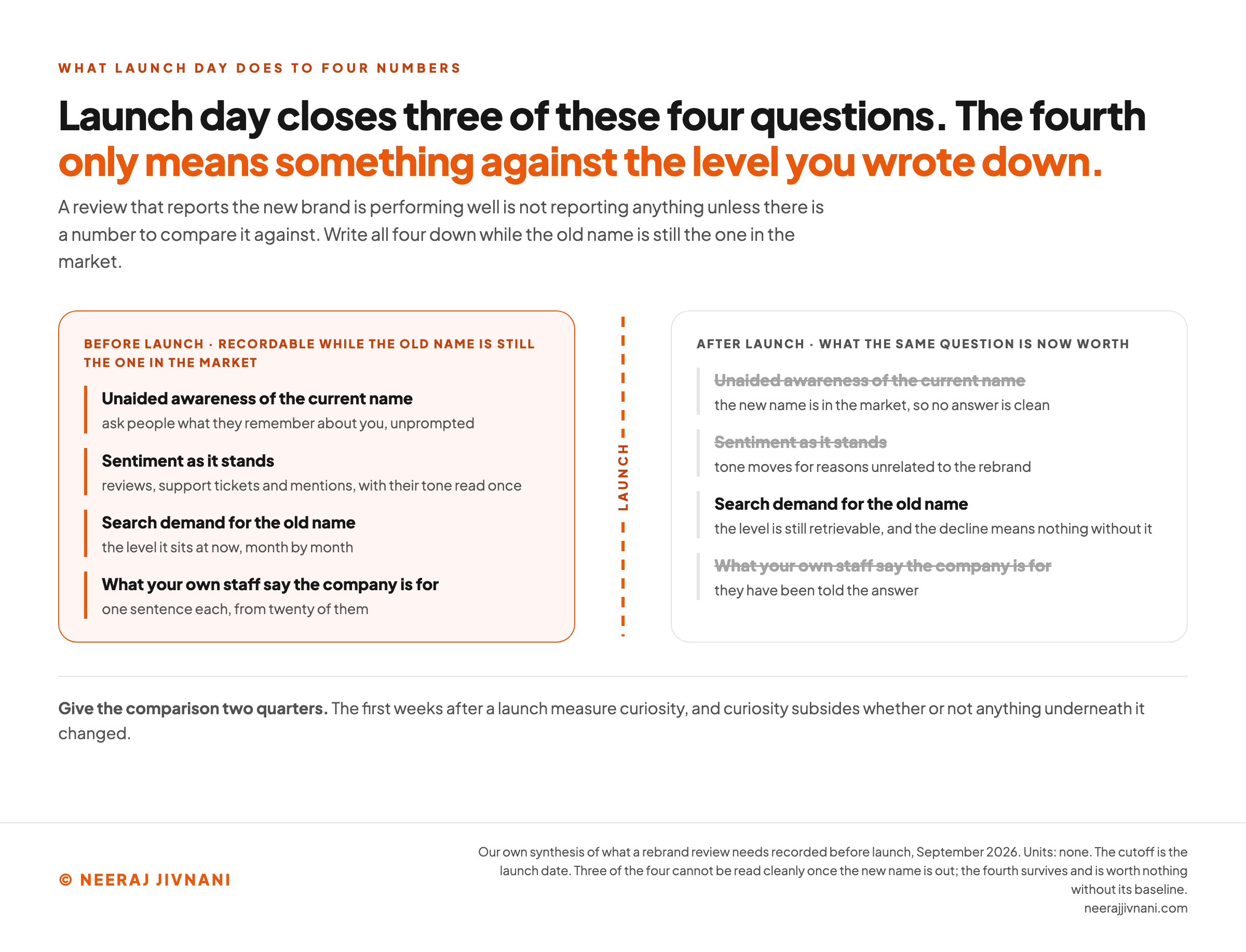
Four things are worth recording today. Three of them cannot be read cleanly once the new name is out, and search demand is only useful against the level you wrote down.
- Unaided awareness of the current name. The old name has to be the only one in the market when you ask, which puts a hard deadline on this reading: the day the new name goes out.
- Sentiment as it stands. Reviews, support tickets and social mentions carry a tone that will move for reasons unrelated to the rebrand, so the pre-launch reading is the only clean one you will ever have.
- Search demand for the old name. This is the clearest single indicator that a name change worked or did not, and it only means something against the level it was at before. That level is the one of the four you can still go and get afterwards, out of historical search volume data.
- What your own staff say the company is for. Both studies point at employees, and one sentence collected from twenty of them before the announcement is a baseline you cannot reconstruct afterwards.
What you will still be able to answer later
The same four measurements mean two different things depending on which side of the launch you are standing on. Say where you are, tick what has already been written down, and read back which questions are still open.
Where you are
What is already written down
What the review will be able to compare
Say where you are and the same four measurements read differently. Before the launch they are still recordable. After it, the ones nobody wrote down are questions you can no longer answer cleanly.
What the Review Is Actually Comparing
A review that reports the new brand is performing well is not reporting anything. The comparison has to be against a recorded number and over a period long enough for the launch noise to clear.
Give it two quarters at minimum. The first weeks after a launch measure curiosity, which is what Jaguar's three days of attention were, and curiosity subsides whether or not anything underneath it changed.
Use this chart — embed code and citation
<a href="https://neerajjivnani.com/blog/rebranding/"><img src="https://neerajjivnani.com/infographics/rebranding/baseline-cutoff.png" alt="Diagram of the launch as a cutoff line, showing unaided awareness of the old name, current sentiment, search demand for the old name and what staff say the company is for as measures that can still be recorded before launch, and on the far side awareness, sentiment and staff belief struck through as questions that can no longer be read cleanly, with search demand left standing because the level is still retrievable and means nothing without it." width="1200"></a>
<p>Chart: <a href="https://neerajjivnani.com/blog/rebranding/">Neeraj Jivnani</a></p>Neeraj Jivnani, "What Rebranding Is, What Usually Triggers One, and What the Logo Can and Cannot Fix", neerajjivnani.com, https://neerajjivnani.com/blog/rebranding/Free to republish with a link back to this page.
Change the Thing the Name Points At
A rebrand records a change. It does not create one.
That is what the 166-company study is saying when it finds the usual trigger is structural: the companies in it mostly changed their names because something underneath had already changed, and the new identity was how they told people.
Run in the other direction, with the identity leading and nothing structural behind it, the exercise still produces a launch, a spike of attention and a set of guidelines. What it does not produce is a different company, and customers are responding to the company.
So the question in front of you is not which of the four operations to run. It is what has changed about what you sell, who you sell it to, or who owns you.
If the answer is nothing, a refresh will cost a fraction of a rebrand and disappoint nobody.
If the answer is something structural, the new look is the smallest part of the work in front of you, and the people who will have to explain it are the largest.