Behavioral Segmentation: Which Behavior to Group People On, and Whether the Group Is Real
Group the customers you already have by what they did. Which behaviors are worth cutting on, what your data has to hold, and how to tell a real group.

/ On this page9 sections
Behavioral segmentation is grouping the customers you already have by what they did: what they bought, when, how often, and what they stopped doing.
The lists of types you will meet are lists of behaviors you could cut on, and picking one is the work.
Three decisions follow. Which behavior to cut on first, what your data has to hold before any of it functions, and how to tell a group that behaves differently from a line you happened to draw.
Behavioral Segmentation, in One Sentence
Behavioral segmentation divides a customer base into groups defined by observed actions rather than by attributes. A group is a rule over behavior: bought in the last 90 days, opened three of the last five emails, used the export feature, never returned after the trial.
Nothing works until two conditions are met.
You need a record per person that persists across visits, so today's action can be joined to last month's.
You also need the behavior to be observable in that record, which is a stricter test than it sounds. What somebody hoped to get from a product is a behavior nobody can see, and it has to be asked for.
Those two are the whole precondition.
Everything else is choosing.
Where It Sits Beside Demographic, Geographic and Psychographic
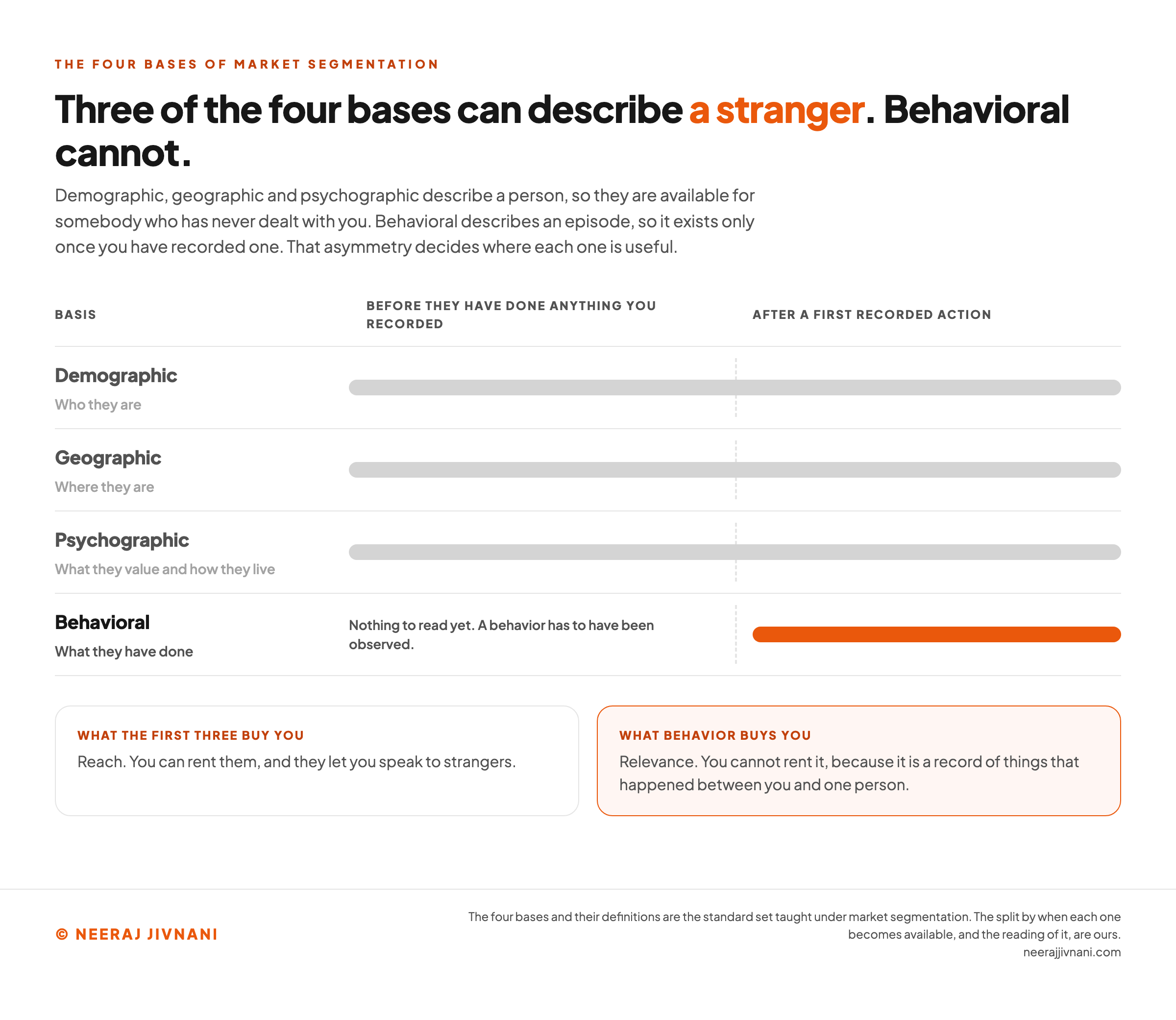
The four bases of market segmentation are demographic, geographic, psychographic and behavioral. Demographic groups people by who they are, geographic by where they are, psychographic by what they value and how they live, and behavioral by what they have done.
The first three describe a person and are available for people who have never dealt with you. Behavioral describes an episode, so it exists only once you have recorded one.
That asymmetry decides where each one is useful.
Demographics buy you reach. You can rent them, and they let you speak to strangers.
Behavior buys you relevance, and you cannot rent it, because it is a record of things that happened between you and one person.
If you are choosing who sees an ad, the first three are most of what a platform will sell you. If you are deciding what to send the people already on your email list, behavior is the one base of the four carrying information you did not already have.
Use this chart — embed code and citation
<a href="https://neerajjivnani.com/blog/behavioral-segmentation/"><img src="https://neerajjivnani.com/infographics/behavioral-segmentation/three-bases-work-on-strangers.png" alt="A four row chart setting the four bases of market segmentation against a timeline that is split into before they have done anything you recorded and after a first recorded action. Demographic, who they are, geographic, where they are, and psychographic, what they value and how they live, each run as a full width gray bar across both halves, so all three are available for somebody who has never dealt with you. Behavioral, what they have done, has nothing at all in the before half, marked with the note that there is nothing to read yet because a behavior has to have been observed, and a solid orange bar that begins only in the after half. Two cards underneath record what each side buys you: the first three buy reach, which you can rent and which lets you speak to strangers, and behavior buys relevance, which you cannot rent because it is a record of things that happened between you and one person." width="1200"></a>
<p>Chart: <a href="https://neerajjivnani.com/blog/behavioral-segmentation/">Neeraj Jivnani</a></p>Neeraj Jivnani, "Behavioral Segmentation: Which Behavior to Group People On, and Whether the Group Is Real", neerajjivnani.com, https://neerajjivnani.com/blog/behavioral-segmentation/Free to republish with a link back to this page.
The Behaviors You Can Group People On
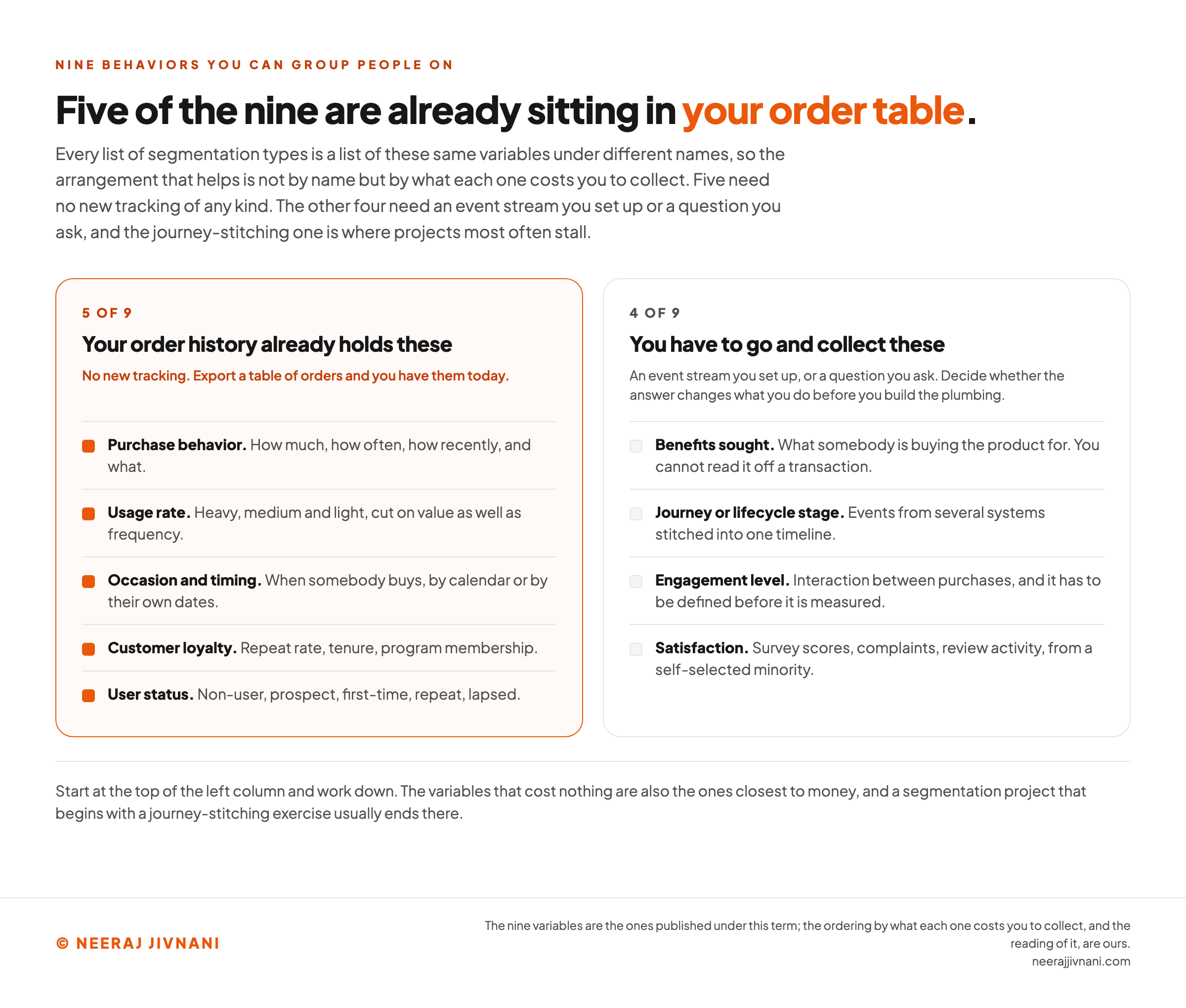
There are nine behaviors worth knowing about here, and five of them are already sitting in your database.
Every list of types you will meet is a list of these same variables under different names.
So the arrangement that helps is not by name but by what each one costs you to collect, which is the order below, and it doubles as the order to work through them in.
The Ones Your Order History Already Holds
Five of the nine need no new tracking at all. If you can export a table of orders, you hold every one of them today.
- Purchase behavior. How much, how often, how recently, and what. Recency, frequency and monetary value (RFM) is the durable version of this, because every field is already in your database and each one answers something the others cannot.
- Usage rate. Heavy, medium and light. Useful, with one warning that gets skipped: your most frequent buyer is not automatically your most valuable one, and a weekly small order can be worth less than a quarterly large one. Cut on value as well as frequency or you will build a group of enthusiastic low spenders.
- Occasion and timing. When somebody buys. Some of it is calendar, such as a holiday or a season, and some of it is personal, such as a birthday, a renewal date or a resupply interval. The calendar half is free; the personal half needs a date field somebody has to fill.
- Customer loyalty. Repeat rate, tenure, program membership. Worth saying plainly: repeat purchase is evidence of habit, convenience or lock-in as often as it is evidence of loyalty, so it measures something narrower than its name.
- User status. Non-user, prospect, first-time, repeat, lapsed, all of them scoped to people you already hold a record for. The least glamorous variable on this list and often the most useful, because the boundaries are unambiguous and the actions that follow from each one are obvious.
The Ones You Have to Go and Collect
The remaining four do not fall out of a transaction table. Each needs either an event stream you set up or a question you ask, so decide whether the answer will change what you do before you build the plumbing.
- Benefits sought. What somebody is buying the product for: speed, price, status, one specific problem solved. This has the strongest claim to causing behavior rather than describing it, and it is also the one you cannot read off a transaction. Two customers with identical order histories can want opposite things.
- Journey or lifecycle stage. Where somebody sits between first contact and renewal. It requires stitching events from several systems into one timeline, which is the most expensive item on either list and the one most often abandoned half-built.
- Engagement level. How much somebody interacts between purchases. Define it before you measure it, because engagement is the variable most often defined circularly: a group of engaged users, where engaged means the people in the group.
- Satisfaction. Survey scores, complaints, review activity. It has to be asked for, it arrives from a self-selected minority, and it is the only variable here that tells you how somebody feels rather than what they did.
Our position on the ordering: start at the top of the first list and work down. The variables that cost nothing are also the ones closest to money, and a segmentation project that begins with a journey-stitching exercise usually ends there.
Use this chart — embed code and citation
<a href="https://neerajjivnani.com/blog/behavioral-segmentation/"><img src="https://neerajjivnani.com/infographics/behavioral-segmentation/already-in-your-order-table.png" alt="A two column comparison of the nine behaviors you can group customers on, arranged by what each one costs you to collect rather than by name. The left column, marked five of nine and highlighted in orange, holds the variables your order history already carries with no new tracking: purchase behavior, usage rate, occasion and timing, customer loyalty, and user status. The right column, marked four of nine, holds the ones you have to go and collect through an event stream you set up or a question you ask: benefits sought, journey or lifecycle stage, engagement level, and satisfaction. A line beneath says to start at the top of the left column and work down, because the variables that cost nothing are also the ones closest to money." width="1200"></a>
<p>Chart: <a href="https://neerajjivnani.com/blog/behavioral-segmentation/">Neeraj Jivnani</a></p>Neeraj Jivnani, "Behavioral Segmentation: Which Behavior to Group People On, and Whether the Group Is Real", neerajjivnani.com, https://neerajjivnani.com/blog/behavioral-segmentation/Free to republish with a link back to this page.
Two Worked Examples
The first worked example needs no tracking of any kind. Say a bookshop with two years of orders wants a first cut, with no analytics and no survey.
It splits customers three ways on order history alone: bought once and never again, buys two or three times a year, bought nothing in eighteen months.
Three groups, three obviously different jobs. Get the first to a second purchase, give the second a reason to come more often, find out whether the third is gone.
The same email to all three would be written for none of them.
The second example uses one tracked event. Say a small software company that cuts on whether an account invited a second person in the first week.
That single fact gives you two groups you can compare on renewal, and if they renew at different rates you have found a behavior worth acting on. It also suggests one change worth trying, which is making the invitation the first thing a new account is asked to do.
Both cuts share a shape: one behavior, groups that need different treatment, and an action that follows from the split.
What Is Nike's Behavioral Segmentation?
Nike does not publish the segments it uses, so anything you read about them is somebody's reading from outside.
What is observable is enough. Its apps and its content are organized around activities somebody performs rather than around who they are, and a member who logs runs leaves a different record than a member who only buys shoes.
Copy the shape rather than the story. A running brand grouping people by whether they run is grouping on a behavior that predicts what they will need next, which is the test any group of yours has to pass.
What the Method Is Worth
What behavioral segmentation buys you is relevance you cannot rent. The bookshop's three groups need three different emails, and that much is available to anybody who can export an order table.
That part reliably works.
What gets sold is the step after it, which is that a message written for a group changes what that group does. That is the claim with money on it, and the one study below that tested it end to end came back mixed.
The Study That Ran a Control
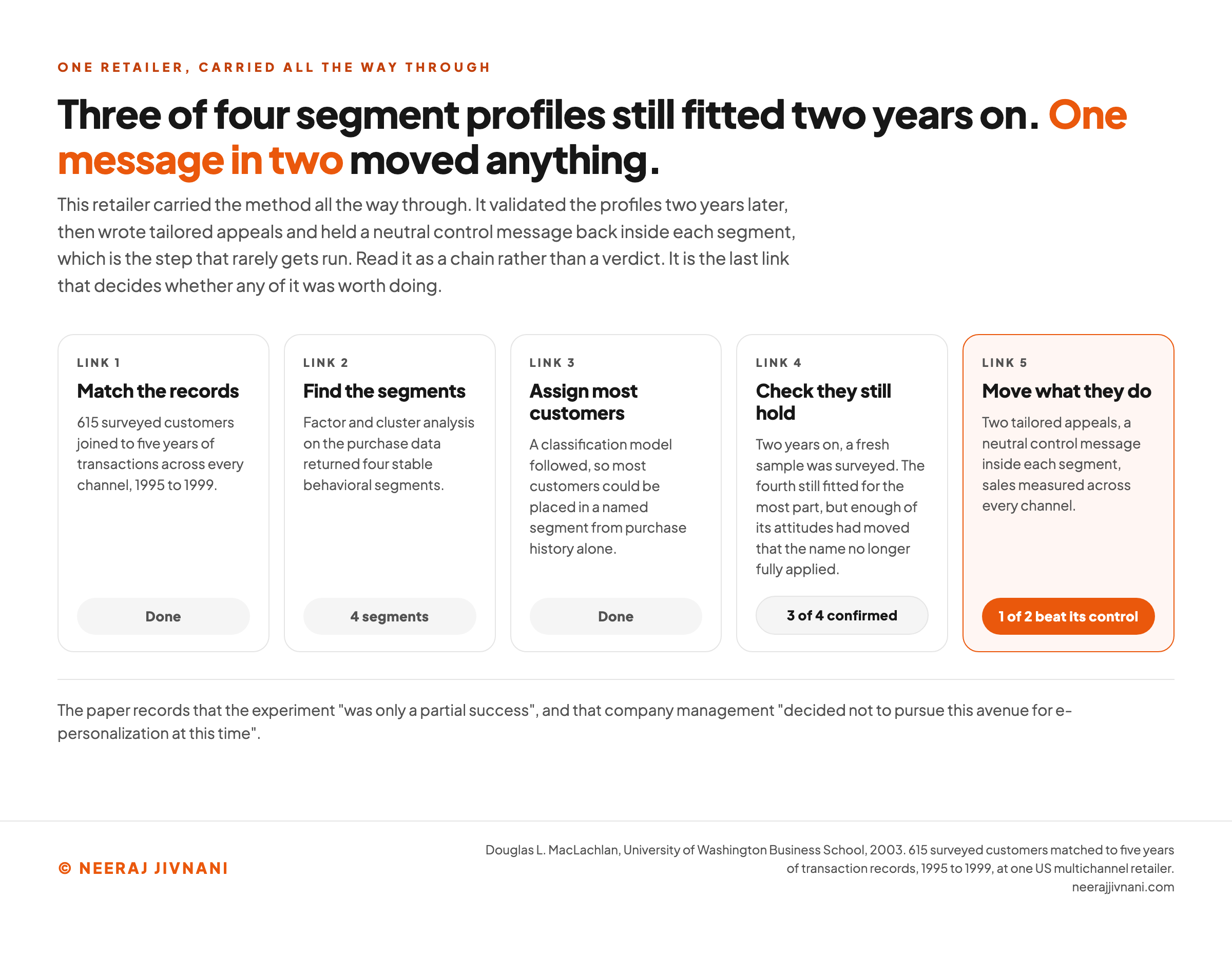
One US multichannel retailer carried the method all the way through, in a 2003 study by MacLachlan at the University of Washington.
It matched 615 surveyed customers to five years of transaction records from 1995 to 1999, then ran factor and cluster analysis on the purchase data.
Four stable behavioral segments came out of it, and a classification model followed so that most customers could be assigned to one from their purchase history alone.
Two years later the retailer re-surveyed a fresh sample and checked whether the segments held.
Three of the four profiles were confirmed. The fourth still fitted for the most part, but enough of its attitudes had moved that the name no longer fully applied.
Then came the step that rarely gets run. Two tailored appeals were written for the two most valuable segments, a neutral control message went to a subgroup inside each, and sales were measured across every channel over the week that followed.
One of the two targeted segments beat its control on sales per customer.
The other did not, and neither did any other segment.
The experiment "was only a partial success" and company management "decided not to pursue this avenue for e-personalization at this time", MacLachlan records.
What That Chain Shows
Read it as a chain rather than a verdict. Segments can be found, they can be stable across years, and most customers can be assigned to one.
Whether a message written for a segment moves what that segment does is the last link, and it came back yes once out of two, on a one-week read.
The academic framing has since caught up with that.
The field is moving away from "primarily descriptive analyses that focus on observing differences between customers" and toward approaches that model how customers respond to what a firm does, as Lemmens and co-authors described it in a 2025 working paper.
Our verdict: past behavior is the best cheap guess you have about who these people are, and it is still a guess about how they will answer you.
That second question is where the value is, and it is settled by trying, not by cutting the data more finely.
Use this chart — embed code and citation
<a href="https://neerajjivnani.com/blog/behavioral-segmentation/"><img src="https://neerajjivnani.com/infographics/behavioral-segmentation/the-chain-and-its-last-link.png" alt="Five cards in a row reading left to right as a chain, drawn from a 2003 University of Washington study of one US multichannel retailer. Link one, match the records, 615 surveyed customers joined to five years of transactions across every channel from 1995 to 1999, marked done. Link two, find the segments, factor and cluster analysis returning four stable behavioral segments. Link three, assign most customers, a classification model that could place most customers in a named segment from purchase history alone, marked done. Link four, check they still hold, a fresh sample surveyed two years later, marked three of four confirmed because the fourth still fitted for the most part but enough of its attitudes had moved that the name no longer fully applied. Link five, highlighted in orange, move what they do, two tailored appeals against a neutral control message inside each segment, marked one of two beat its control. A note underneath quotes the paper recording that the experiment was only a partial success." width="1200"></a>
<p>Chart: <a href="https://neerajjivnani.com/blog/behavioral-segmentation/">Neeraj Jivnani</a></p>Neeraj Jivnani, "Behavioral Segmentation: Which Behavior to Group People On, and Whether the Group Is Real", neerajjivnani.com, https://neerajjivnani.com/blog/behavioral-segmentation/Free to republish with a link back to this page.
Before You Act on a Group
Three questions, in this order. A group that fails any of them is a chart, not a segment.
Would the groups answer you differently? Not do they look different. A group earns its name when its members respond differently to the same thing being sent, and looking unlike each other in a report is no evidence that they will.
Name the thing each group would get. The offer, the timing, the channel, the page it lands on.
If those names come out identical, nothing hangs on the split and you are looking at one group with a label applied twice.
Is the difference in behavior, or in the cut? Take the top 20% of customers by spend. That group will always exist, will always outspend the rest, and tells you nothing, because you defined it by the thing you are about to measure.
A real group is one you could have named before you looked at the outcome.
Would it survive a rebuild? Recut the same data with a slightly different threshold, or on last quarter instead of this one. Groups that reshuffle completely under a small change in the rule are artifacts of the rule.
The Cheap Version of That Check
The practical test costs an hour. Define the group on data up to a date, then look at what it did after that date.
If the difference survives, it is behavior. If it evaporates, you drew a percentile and gave it a name.
Two things have to hold before a tailored message can beat a neutral one, and the hour above buys you a read on the second. People must respond differently, and you must be able to tell in advance which ones.
Lemmens and co-authors put both of those as matters of degree: the effectiveness of a personalized policy depends on "the degree of heterogeneity in individuals' responses to actions and the firm's ability to identify this heterogeneity".
The cuts beside yours
Write the cut you were going to make. The rules beside it come back built from your own number, because those are the ones your group has to survive before it has earned a name.
The shape of your rule
The rule you were going to write
People who bought in the last 90 days.
The rules beside it, and the runs you owe yourself
- People who bought in the last 60 days.
- People who bought in the last 120 days.
- People who bought in the last 90 days.The same rule, run on last quarter instead of this one.
Run them and compare who lands in the group each time. Groups that reshuffle completely under a small change in the rule are artifacts of the rule.
The threshold you have to defend out loud
Yours is 90 days, and the rules above are what you are defending it against.
A Predictive Score Is Not a Segment
Most customer platforms now sell a machine-learned propensity model: a per-person score for likelihood to buy, likelihood to churn, predicted value. These are useful, and they are a different object from a segment.
A score is continuous and personal. A segment is a group with a boundary.
Converting one into the other means choosing a cutoff, and the cutoff comes from you rather than from the model.
That matters more than it sounds. Say you score every account for churn risk and decide the top 10% gets a retention offer.
Two accounts either side of that line are near-identical and get opposite treatment, while two accounts at opposite ends of the top 10% get the same one.
The model did not ask for that.
The boundary did.
The retailer in the study above looks like the exception and is not one. Its classification tree reads as four named segments, but the paper records that the classification is probabilistic rather than definite, each node holding proportions of customers with the assignment made on the highest one.
The boundary was still a rule somebody chose. It was chosen once, inside the model, rather than every time a campaign ran.
What a Score Cannot Tell You to Say
The deeper difference is that a score carries no message inside it. You can write an email to people who bought once and never came back, because that sentence describes something they did.
Nobody can write an email to a decimal.
A score tells you who to spend on. A behavior tells you what to say, which is why the two belong at different points in the same campaign rather than in competition.
One last property, and it is the one that breaks a campaign quietly. Rescore the model next week and everybody's rank shifts a little, so the group sitting above your cutoff has different members every time it runs, and every send that assumed a stable membership list stops meaning what it meant.
Cutting Your First One
The first segment comes out of a decision you are already trying to make, not out of the data. "Who should get the winback email" produces a usable segment; "let us segment our customers" produces a workshop.
The order that works:
- Name the decision. One sentence, with the action attached. What will change for a group once you have it?
- Pick one behavior. One, from the order-history list, with a threshold you can defend out loud.
- Check the group can be reached. A segment nobody can address in a tool never leaves the spreadsheet. Confirm the identifier that defines the group is the identifier your sending tool uses.
- Write the different message. If you cannot, you have your answer before you have spent anything.
- Hold back a control. A portion of the group gets the ordinary message. Without it you find out what the group did, not what your message did, and those are the two things the retailer above kept apart.
- Read it after a full purchase cycle. For a weekly consumable that is a month. For an annual renewal it is a year, and no amount of impatience shortens it.
What Goes Wrong
The first of the four below goes wrong invisibly, which is what makes it the expensive one.
Segments decay quietly. A group defined on last year's behavior describes people who no longer behave that way, and nothing in a dashboard announces it. Put a review date on every segment at the moment you create it, because nobody goes looking for a rule that is still returning rows.
The data is thinner than the plan. Segmentation plans get designed against the record somebody wishes they had. Export the table first and count the rows with a usable value in the field you intend to cut on.
Consent decides what you may hold, not only what you may send. Behavioral segmentation runs on a stored history of what a person did, which sits inside the data-protection rules of every market you are likely to send into. The practical consequence is where the permission lives. Store it on the same record as the behavior, so one query can read both, because a permission held in a separate system is a permission nobody checks at send time.
Nobody can act on the output. A group with no owner, no channel and no message is a slide. It is a common ending for this work, and the first of the three questions above is what prevents it.
The Recency Cut, and What It Tells You
The cheapest useful segmentation available to you is a single cut on recency, and you can make it this week.
Open your order table. People who bought in the last 90 days, people who bought in the last year, people who have not bought in longer than that.
It takes an afternoon, needs no tracking plan and no platform, and it will teach you more than a taxonomy will.
Hold a control back and send it. A segment is a hypothesis about who responds differently, and the only thing that turns a hypothesis into knowledge is finding out.