What Direct Traffic Is, and How to Tell Which Cause Made Yours
Direct traffic is every visit your analytics could not place. See what fills the bucket, and how your own landing pages tell you what is inside it.

/ On this page8 sections
Direct traffic is what your analytics writes down when it could not work out where a visit came from. It is a leftover category, not a place people come from.
That matters because the size of it is a fact about your tracking before it is a fact about your brand. Two sites can report the same share for completely different reasons, and one of them has a problem.
So here is what fills the bucket, and how to tell which of those reasons is behind your own number.
What Direct Traffic Means in Your Report
Direct traffic is the set of sessions your analytics could not attribute to anything else.
It is the row that catches whatever the other rows rejected. Google Analytics Help describes it as traffic "that doesn't have a clear referral source", and the naming follows from that: the source is recorded as (direct) and the medium as (none).
Read those two labels closely. One says no source was identified. The other says no medium was identified, and neither says a visitor typed anything.
The Rule That Actually Fires
The plain-English description of the Direct channel in Google's documentation is a visit arriving "via a saved link or by entering your URL". That describes the common case. It is not the test.
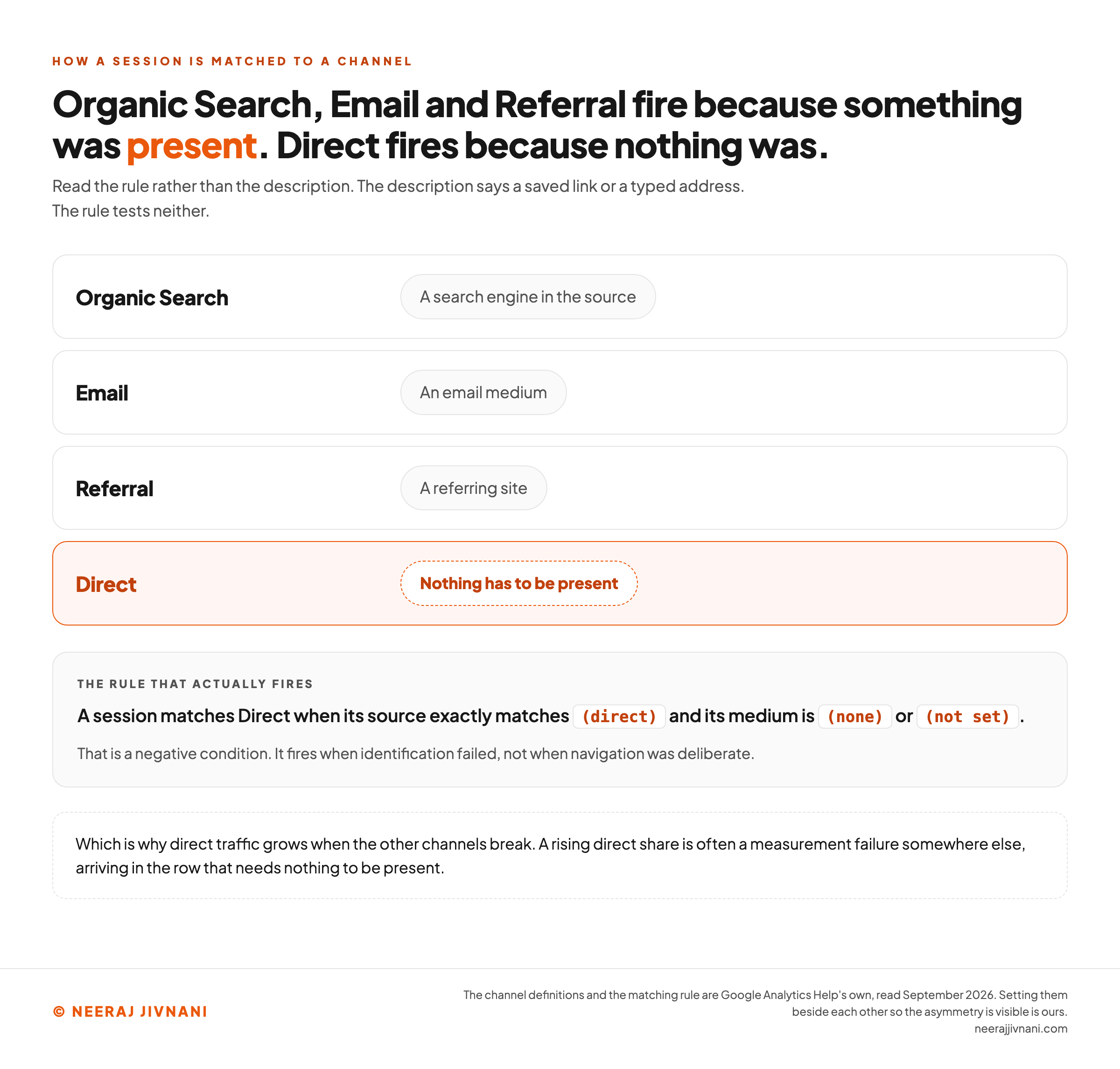
The test sits in the same documentation, in the default channel group definitions: a session matches Direct when its source exactly matches (direct) and its medium is (none) or (not set).
That is a negative condition. It fires when identification failed, not when navigation was deliberate.
Every other channel is the mirror image of that. Organic Search needs a search engine in the source. Email needs an email medium, and Referral needs a referring site.
Direct needs nothing to be present. Its rule matches the placeholder values Google writes when nothing was identified, which is why it fills up when something else breaks.
An Example of Each Kind
Somebody keys your address into the browser bar and presses enter. That is the textbook example, and it is real. No referring page exists, so nothing can be recorded.
Now a colleague pastes a link to your pricing page into a team chat and someone clicks it. There is no referring web page here either, because a chat app is not a page.
Both sessions land in the same row of the same report.
Only one of them was direct in any sense you would recognize.
Use this chart — embed code and citation
<a href="https://neerajjivnani.com/blog/direct-traffic/"><img src="https://neerajjivnani.com/infographics/direct-traffic/nothing-had-to-be-present.png" alt="Four channel rows showing what each one needs before a session can be matched to it. Organic Search needs a search engine in the source, Email needs an email medium, and Referral needs a referring site. The highlighted fourth row, Direct, has an empty dashed slot reading nothing has to be present. Beneath them the matching rule is printed in full, that a session matches Direct when its source exactly matches the literal value (direct) and its medium is (none) or (not set), with the note that this is a negative condition which fires when identification failed rather than when navigation was deliberate. A line at the foot says this is why direct traffic grows when the other channels break." width="1200"></a>
<p>Chart: <a href="https://neerajjivnani.com/blog/direct-traffic/">Neeraj Jivnani</a></p>Neeraj Jivnani, "What Direct Traffic Is, and How to Tell Which Cause Made Yours", neerajjivnani.com, https://neerajjivnani.com/blog/direct-traffic/Free to republish with a link back to this page.
What Puts a Visit in the Direct Bucket
Four different failures produce the same result, and telling them apart is the whole job.
Grouping them by what broke is what makes the rest of this usable, because the group a cause sits in decides what you can do about it. Two of the four are yours to fix outright, one is partly yours, and one needs nothing done to it at all.
Visits That Really Were Direct
Genuine direct visits are the ones the label was named for. Somebody typed the address, opened a bookmark, or let the browser autocomplete a site they visit often.
Mobile and desktop apps that open your site in an embedded browser often behave the same way.
Nothing is wrong here. This is the portion of the bucket that means what people assume the whole bucket means. On a well-known brand it can be most of it.
Visits That Lost Their Referrer on the Way In
A referrer is the address of the page somebody clicked from, and browsers send it automatically. When it goes missing, or when the tag on the link is stripped in transit, so does the attribution.
Google's own page names two ways this happens in ordinary use. Redirects can strip campaign parameters from the address, including a redirect from a secure page to a non-secure one. Link shorteners like bit.ly can strip the referral details as well.
Messaging and social apps are the largest version of the problem, and dark social is the name it usually goes by. A link sent through a private chat, a forwarded email or a direct message arrives with no referring page, because there was no page.
Privacy tooling does the same thing deliberately. A browser extension can suppress the referrer. A site can add noreferrer to its outbound links, which tells the browser not to send one at all.
AI assistants belong in this group too. When a reader copies an address out of a chat answer rather than clicking through, there is no click for a browser to describe.
None of these visitors did anything unusual: the signal was removed before it reached you.
Visits That Were Never Tagged
Untagged links are the group you control most directly, and they grow with how much marketing you do.
Campaign parameters are the tags you add to a link so analytics can credit the right campaign. Without them, a click from a newsletter looks identical to a click from nowhere.
The spellings matter more than people expect. utm_source, utm_medium and utm_campaign are the three that carry the attribution, and Google recommends adding utm_id alongside them. The parameters start after a question mark, and each one is separated by an ampersand.
A typo produces the same outcome as no tag at all.
Links in documents belong here too. A PDF, a slide deck or a printed page has no address of its own to act as a referrer. A tag is the only way that click will ever be identified.
Visits Your Own Site Broke
Self-inflicted direct traffic is the uncomfortable group, because it is invisible until you look for it.
If your analytics tag is missing from some pages, a visitor moving from a tagged page to an untagged one and back can start a fresh session with no source at all. The visit was never external.
Consent banners cause a subtler version. The source is only available on the landing page. So if a visitor accepts on the second or third pageview, the session that finally gets recorded has already lost it.
Sites split across domains do it too, when a checkout or booking system sits on a different address and cross-domain measurement has not been set up. So does a site reachable at both the www and the non-www address.
And your own team counts, because staff who have not been excluded from measurement generate direct sessions every working day.
Build the row yourself
Add visits to the report one at a time. Watch what the row records, and what it does not. Nothing is scored here and no verdict is offered about your site.
Add a visit
What your report records
Traffic acquisition, filtered to Direct.
Source (direct) and medium (none). One says no source was identified. The other says no medium was identified.
Direct needs nothing to be present. Its rule matches the placeholder values Google writes when nothing was identified, which is why it fills up when something else breaks.
What you put in it
It is the row that catches whatever the other rows rejected.
Nothing added yet. Add two or three from the list above, from different groups.
Knowing how many sessions are in the row tells you little. Knowing what is inside it tells you whether your measurement is working, which campaigns are going uncredited, and whether anything needs doing at all.
Where the Number Lives, and How to Split It
In Google Analytics 4 the figure sits in the Traffic acquisition report, under Reports and then Acquisition. Filter the session default channel group to Direct and you have the bucket on its own.
If you want it permanently, copy that report and save the filter into it, which needs editor access. An exploration does the same job with more freedom over the dimensions.
Getting to the number is the easy part.
Splitting it is where the answers are, and four breakdowns carry almost all of them.
- By landing page. The one that matters most, and the only breakdown that tells you which kind of failure you have.
- By device. Phones carry far more of the app and messaging traffic, so a lopsided split there points at referrers that were never sent rather than at anything you tagged wrong.
- By new against returning. Genuine direct traffic skews toward people who have been before. A bucket full of first-time visitors was not direct.
- Over time, against the other channels. A jump in direct that lines up with a drop somewhere else is a measurement event, not an audience event.
Compare like periods, and throw out any slice with too few sessions to mean anything.
Why Yours Is High, and How to Tell Which Cause It Is
Where the visits landed answers this faster than anything else available to you, and it costs one report.
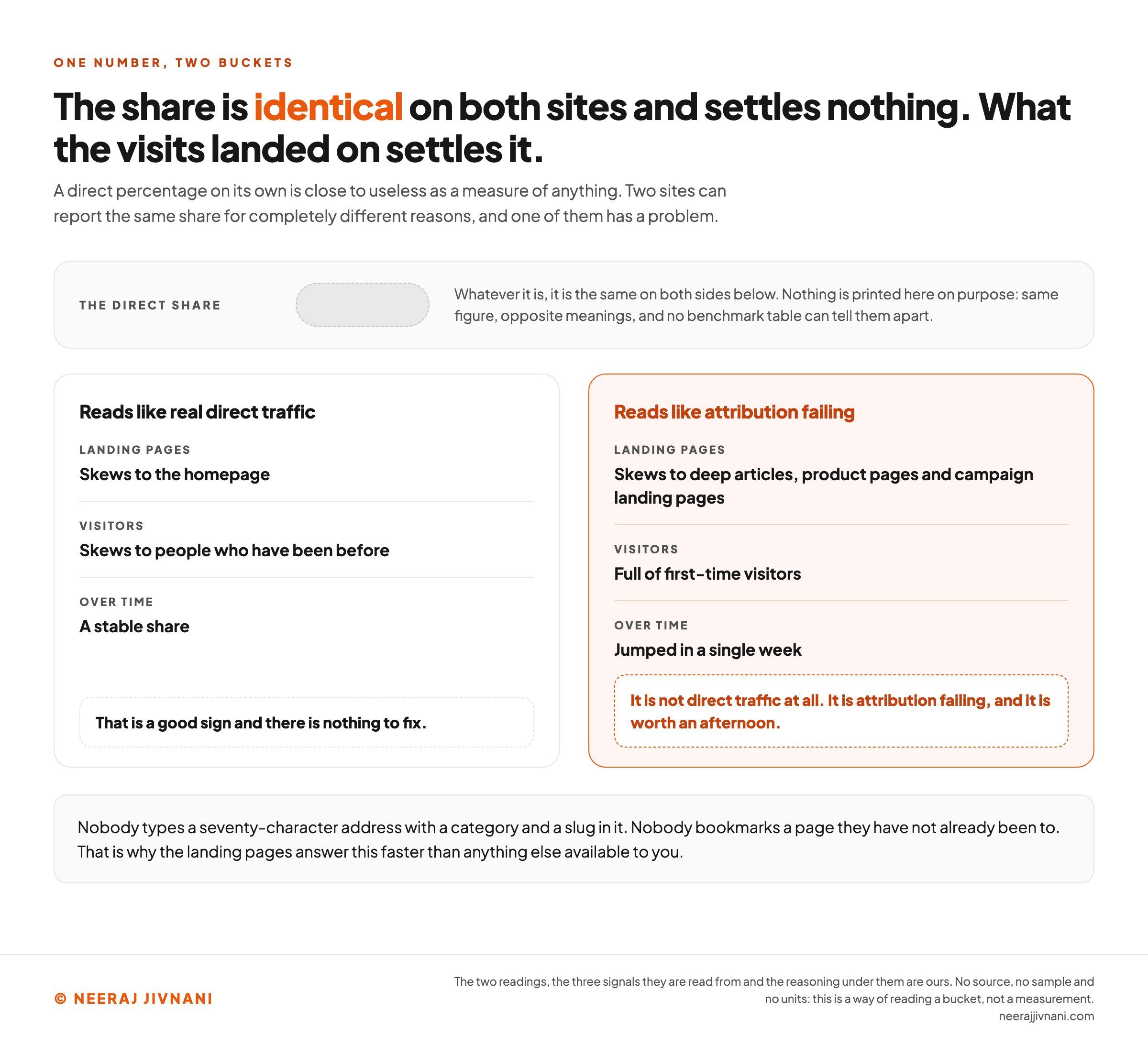
The reasoning is simple enough to check yourself. Nobody types a seventy-character address with a category and a slug in it. Nobody bookmarks a page they have not already been to.
So a direct session landing on your homepage is plausible. A direct session landing on a deep article, a product page or a campaign landing page is not, whatever the label says.
That is the same reasoning behind the best-known measurement of this problem. When Groupon de-indexed itself for six hours in 2014, it looked specifically at long URLs, because those are the ones you would not expect anyone to be typing.
Around 60 percent of the direct traffic to those pages disappeared along with the organic traffic, which meant it had been organic all along.
The number travels further than it should. Jason Packer reproduced almost exactly the same figure on a penalized site, a 59 percent loss of direct traffic, and published it in 2014. Then he worked out that he had confirmed nothing.
What he had matched was Groupon's ratio of organic to direct, not discovered a constant. His conclusion is worth taking at face value: you should not assume that 60 percent of your site's direct traffic is organic.
Use the method, and leave the number where it was measured.
The Order Worth Working In
The checks below run from the fastest to the slowest. Each one either explains your number or rules out a whole group, so you can stop as soon as one of them accounts for what you are seeing.
- Check the tag is on every page. A single untagged template can manufacture sessions all day. This is the fastest thing on the list to rule out and the most annoying to discover late.
- Look at the landing pages. Homepage-heavy is consistent with real direct traffic. Deep pages and campaign pages are not, and the pages that show up here tell you which campaign lost its tags.
- Look at your own links. Take the last month of email, social posts and paid placements and check the tags on each. Anything untagged here is direct traffic you created.
- Check the consent banner and the session boundary. Load your own site in a private window, accept on the first screen, and watch what gets recorded.
- Check the domains. If payment, booking or support sits elsewhere, confirm the handoff is measured as one visit rather than two.
That leaves you with a candidate or two you can test, instead of a cause list you have no way to sort.
Direct, Organic and Referral Are Not Three Of a Kind
The acquisition report reads like a list of equals, and it is not.
Organic Search, Referral, Email, Paid Search and the rest are all positive tests. Each one fires because something was present and matched a rule.
Direct is the one that fires because nothing did.
That asymmetry is why a rising direct share so often means another channel stopped being measured.
Referral is the closest comparison and the clearest contrast. It needs a referring website, and if that site strips the referrer or sits behind a redirect, the same click becomes direct instead.
Nothing about the visitor changed, only what survived the trip.
What You Can Fix, and What You Have to Live With
Two lists, and the second one matters as much as the first. A reader who does not have it spends months chasing attribution that was never available.
Worth fixing, in roughly this order:
- Tag every campaign link you control, with one convention, written down where the whole team can see it.
- Put the analytics tag on every page and template, then verify it rather than assume it.
- Serve the whole site securely, and update internal links that still point at the old insecure addresses.
- Make the consent choice available on the first screen, and do not redirect after it.
- Set up cross-domain measurement if any part of the journey sits on another address.
- Exclude your own team.
- Tag the links in your PDFs, slide decks and anything printed.
Not yours to fix, and worth accepting:
- A site that sends visitors to you with
noreferreron the link. - Messaging apps and private social channels, which send no referring page.
- Email clients and desktop software that open links without a referrer.
- Privacy extensions and browsers that strip parameters or suppress referrers.
- People who genuinely type your address or use a bookmark.
The second list never reaches zero. Every site carries some of it. The goal is to shrink the first list until what remains is mostly the second.
So Is a Big Direct Number Good or Bad?
Neither, and the share is the wrong thing to be looking at. A direct percentage on its own is close to useless as a measure of anything.
Published targets do not survive contact with a specific site. Say a retailer and a software company both report a third of their sessions as direct. One has customers who bookmark the shop; the other installed a consent banner last month that destroys the source on every session.
Same figure, opposite meanings, and no benchmark table can tell them apart.
What decides it is composition, which you now have a way to read.
A bucket that skews to the homepage, to returning visitors, and to a stable share over time is behaving like real direct traffic. That is a good sign and there is nothing to fix.
A bucket that skews to deep pages, to first-time visitors, and that jumped in a single week is not direct traffic at all. It is attribution failing, and it is worth an afternoon.
So do not ask whether your number is too high. Ask what is in it.
Use this chart — embed code and citation
<a href="https://neerajjivnani.com/blog/direct-traffic/"><img src="https://neerajjivnani.com/infographics/direct-traffic/same-share-two-buckets.png" alt="One direct share, drawn as a deliberately blank grey pill because no number is published, splitting into two readings of the same figure. On the left, a bucket that reads like real direct traffic: landing pages skewing to the homepage, visitors skewing to people who have been before, and a stable share over time, which is a good sign with nothing to fix. On the right, highlighted, a bucket that reads like attribution failing: landing pages skewing to deep articles, product pages and campaign landing pages, visitors who are mostly first-time, and a share that jumped in a single week, which is worth an afternoon. A line at the foot says nobody types a seventy-character address with a category and a slug in it and nobody bookmarks a page they have not already been to." width="1200"></a>
<p>Chart: <a href="https://neerajjivnani.com/blog/direct-traffic/">Neeraj Jivnani</a></p>Neeraj Jivnani, "What Direct Traffic Is, and How to Tell Which Cause Made Yours", neerajjivnani.com, https://neerajjivnani.com/blog/direct-traffic/Free to republish with a link back to this page.